Wastewater analysis suggests increasing recreational drug use among New Zealanders. (Although there are some problems with the data.) But this isn't an issue confined to our small islands.
This is of course when recreational drugs are illegal. So drug consumers are willing to pay more to gangs for a riskier product to get their chosen high.
The first is that legal drugs will make drug consumption more prevalent and more sordid. This goes against both evidence and theory: Milton Friedman for one arguing that the Iron Law of Prohibition actively encourages the escalation of more virulent pharmaceuticals, to make any drug problem worse.
But the other question is this:
Why do many people want to abuse drugs and alcohol? Why is this such a persistent problem in our culture — and would it still be a problem in a more rational culture?
Good question. And Stewart Margolis takes a good stab at answering it, beginning by drawing a distinction between drug use and drug abuse. Because clearly there are many well-functioning adults happily consuming recreational drugs including opium, alcohol and caffeine -- and if we trace the history, have been doing so since the first fermented berries were found several thousand years ago. Indeed,
Archaeologists have found evidence of opium use in Europe by 5,700 BC, and cannabis seeds have been found at archaeological digs in Asia from 8,100 BC.
So it seems at least some adults have discovered a rational way to use mind-altering substances. A decent martini before dinner for example being one of the best ways to shake off the cares of the day.
There may be some that are simply too dangerous to ever be used, but that would be a scientific question rather than a moral one.
But some adults won't, can't or don't want to be rational about it. If we discount the obvious (that some people are prone to addiction; that there might be genetic factors increasing susceptibility to substance abuse) we're left with the nagging idea that there might be more to it than that.
Margolis makes the case that the problem is fundamentally philosophical:
Of course, a worldwide problem like this undoubtedly has multi-factorial causes, but I think at root drug abuse is an attempt to escape reality.
Materially, the world has never been richer, so what are so many people eager to escape from? Despite our affluence, I think we are experiencing a philosophical crisis.
Ayn Rand pointed out that humans need a philosophy in order to live. In “Philosophy: Who Needs It,” she wrote,
“Your only choice is whether you define your philosophy by a conscious, rational, disciplined process of thought and scrupulously logical deliberation — or let your subconscious accumulate a junk heap of unwarranted conclusions, false generalisations, undefined contradictions, undigested slogans, unidentified wishes, doubts and fears, thrown together by chance, but integrated by your subconscious into a kind of mongrel philosophy and fused into a single, solid weight: self-doubt.”
I think Rand was spot on, and the increase we are seeing in drug abuse is the result of the self-doubt brought on by people who have assembled a “junk heap” of often contradictory ideas. This has always been a huge problem, and has always resulted in a tremendous amount of suffering. So why does it seem to be worse now?
I think it’s because the quality of the ideas in the “junk heap” has been steadily deteriorating.
When ... [common sense and] enlightenment ideas were widespread in the culture, average, unthinking people could randomly pick up a pretty workable set of ideas, which would allow them to prosper and attain a measure of happiness. They were not as happy and prosperous as they could have been, had they done the work of choosing and integrating the right ideas, but they could do all right.
But today, many of the ideas floating around in the cultural are anti-enlightenment. If you unthinkingly accept a collection of these ideas, you are unlikely to prosper or find happiness.
It's perhaps also the case that governments' increasing economic mismanagement has been making it increasingly difficult for younger folk to get ahead economically -- they can sense that even if they can't see that explicitly -- so that there's part of of them ready to give up on the "old" idea that hard work will pay off.
You [might] notice that you’re not doing as well as your parents did, either economically, romantically, or socially. As a result, you will be filled with doubt, with dread, with a sense that something is wrong with the world — but you don’t know what or how to fix it. I believe this is the feeling that people desperately want to escape — and so they turn to drugs that numb or relieve these feelings, at least temporarily.
While I’m sure there are benefits to be found in a variety of drug and alcohol treatment programmes, I don’t think we’re likely to make much progress on substance abuse until people deal with the underlying philosophical crisis driving the abuse.
In the meantime, though, making drugs legal would provide a huge benefit, both to those struggling with abuse issues, and more importantly, to those of us who don’t use drugs or who are able to use them responsibly.
"When President Nixon declared drug addiction Public Enemy Number One in 1971, it was with his 1969 declaration to Congress that the full forces of government must be marshalled “to cope with this growing menace to the general welfare of the United States.” Again, the nation was told, we would reduce crime and poverty, lower the scope and costs of incarceration, and stamp out a danger to the American family. "It is a vast understatement to say that these assurances were wrong ... "As of 2015, the rate of prisoners as a function of the population has grown from 100 per 100,000 in the period before Nixonian drug policy to over 500 per 100,000. As a result, the United States has become the world’s largest jailer, both in absolute terms and in rate. ... "Between 1973 and 2013, over $1 trillion was spent on drug enforcement in the U.S. alone. Yet, in 2016, Americans spent $150 billion on heroin, methamphetamines, cocaine, and marijuana, which doesn’t even factor in other classes of illicit drugs. Perhaps the most troubling aspect of these sunk opportunity costs is that despite a regime of increasing funding for supply-side enforcement, drug prices have continued to decline over the last four decades. This isn’t to say that they exist in cost parity with legal substances; their prices are still higher. What it does say is that current policy does little to abate demand. "Moreover, instead of reducing crime, prohibition simply creates more criminals. Everyone involved in the drug market, from supplier to distributor to consumer, is automatically a criminal. Absent the property rights protections and dispute resolution apparatus available via normal legal channels, interested parties must resolve their own conflicts, often leading to violent means. ... "Just as it was with alcohol during Prohibition, quality control is an issue with illegal drugs. As we discussed earlier, prohibitory laws create incentives to minimise the costs of production and transport while maximising profit, which in turn trends towards potency as the major concern. Because the product is manufactured by local entrepreneurs, however organised, there are no industry-wide safety standards. Hence, the current issue of heroin laced with fentanyl, for example. This leads to an increase in drug-related overdoses, and other related problems. "These are just a few of the more obvious social costs related to the War on Drugs™."
Lawmakers everywhere have failed to learn the Iron Law of Prohibition, that is, that prohibition encourages purveyors of prohibited substances to find more potent forms of the banned substance. As Jeffrey Singer explains in this Guest Post, policymakers are now discovering that tobacco and e‑cigarette bans are not exempt from the iron law. Whether these prohibitionists reverse course before causing more harm remains to be seen.
E‑Cigarettes Are Not Exempt from the Iron Law of Prohibition
The New York Timesreports today about a flood of illicit e‑cigarettes arriving from China “in Barbiecore colors and fruit, ice cream and slushy flavors,” accounting for a “major share of the estimated $5.5 billion e‑cigarette market in the United States.” This “never‐ending influx of vapes” comes despite the Food and Drug Administration authorising only a handful of e‑cigarettes for sale to persons over age 21.
The Times reports that many of these vapes contain 5,000 or more puffs per device and have nicotine levels that sometimes exceed those in tobacco cigarettes. Many are being sold in convenience stores even though the FDA has sent them warning letters threatening store owners with fines as high as $19,000 per violation.
The goal of policymakers and the FDA was to curtail the use of flavored vapes. Many states and some cities have enacted bans on in‐store and/or online sales of flavored vapes.
According to the CDC, these prohibitionist efforts have backfired, resulting in a surge in flavored vape sales, from 11 million per month in early 2020 to 18 million per month in June 2023.
The Times reports that seven years since Congress granted the FDA regulatory authority over e‑cigarettes in 2016, 40 percent of e‑cigarette users are 25 or younger. And while the FDA has authorized only a couple of dozen e‑cigarette products, vapers find access to more than 2,000 of them. The Times article states:
There are few places where the problem feels more pressing than in high school bathrooms, where students crowd the stalls between classes to get a nicotine fix.
Nevertheless, teen vaping rates have fallen from their peak of 28 percent in 2019 to roughly 14 percent in 2022.
The failure of e‑cigarette prohibition was predictable—as is the advent of more potent and puff‐packed forms of nicotine vapes now sold on the black market. Though prohibitionists never seem to learn, the “Iron Law of Prohibition” is inescapable. A variant of what economists call the “Alchian‐Allen Effect,” put simply, the iron law states, “the harder the law enforcement, the harder the drug.”
Prohibition encourages purveyors of prohibited substances to find more potent forms of the banned substance so it can be smuggled in smaller sizes and subdivided into more units to sell. During alcohol prohibition, for instance, bootleggers smuggled whiskey and other hard liquors, not beer or wine.
The iron law of prohibition is why cannabis THC concentration has grown over the years. It is what brought crack cocaine into the cocaine market. And it made fentanyl replace heroin as the primary cause of overdose deaths in the United States.
In the 21st century, law enforcement’s crackdown on diverted prescription opioids (the drug of choice for nonmedical users at the time) led to their replacement with heroin. By 2012, heroin dealers began adding the synthetic opioid fentanyl to heroin so they could smuggle it in smaller sizes and subdivide it into more units to sell. By 2016, fentanyl‐related deaths eclipsed deaths from heroin and diverted prescription pain pills. By 2017, fentanyl was found in more than 50 percent of opioid‐related overdose deaths. By 2022, it was involved in roughly 90 percent of deaths.
Policymakers are now discovering that tobacco and e‑cigarette bans are not exempt from the iron law. Whether these prohibitionists reverse course before causing more harm remains to be seen.
* * * *
Jeffrey A. Singer is is a senior fellow at the Cato Institute and works in the Department of Health Policy Studies. He is President Emeritus and founder of Valley Surgical Clinics Ltd., the largest and oldest group private surgical practice in Arizona, and has been in private practice as a general surgeon for more than 35 years. He is also a visiting fellow at the Goldwater Institute in Phoenix. Singer is a member of the Board of Scientific Advisors of the American Council on Science and Health. From 1994 to 2016, he was a regular contributor to 'Arizona Medicine,' the journal of the Arizona Medical Association. He served on the Advisory Board Council of the Center for Political Thought and Leadership at Arizona State University from 2014 to 2018. He writes and speaks extensively on regional and national public policy, with a specific focus on the areas of health care policy and the harmful effects of drug prohibition. He received his BA from Brooklyn College (City University of New York) and his MD from New York Medical College. He is a fellow of the American College of Surgeons.
If you want to know how to vote this weekend on legalisation, then ask yourself how the gangs would like you to vote.
Politicians regularly talk about going to war on gangs. But you can’t talk sensibly about a War on Gangs without also talking about the politicians' ongoing War on Drugs. Because, as the prohibition of alcohol proved so conclusively in America—coinciding with the birth of big criminal gangs there – where you have prohibition, you have a ready income stream for criminal organisations.
Drugs provide the gangs' primary income stream. If you want a real war on gangs, then rip away this secure income stream. (And if you'd rather not have gangs deciding what drugs your children are going to dabble with, because they will, then vote "legalise" to remove this secure monopoly.)
Challenged on this point a few years ago, Judith Collins accepted that gangs monopolised the drug trade, from which comes their primary income, yet bizarrely insisted that if marijuana were legalised they would instead get into legalised prostitution and harder drugs like methamphetamine.
But this is nonsense. First, a Justice Ministry study found that during the in-depth interviews of 656 sex workers “there was no mention of gang involvement or coercion.” Overseeing the research, the Ministry’s Prostitution Law Reform Committee considered “could not find any evidence of a specific link between crime and prostitution.” Legalisation has removed gangs from this trade, without offering any mechanism for their return.
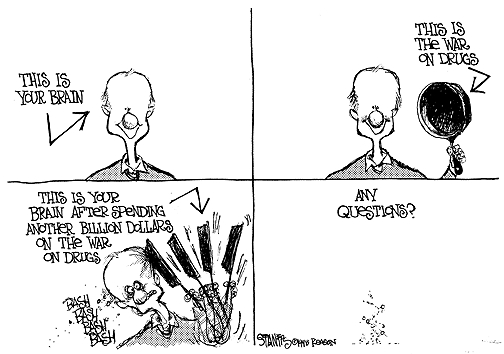
prohibition doesn't get drugs off the street. The government can't even get rid of drugs in the controlled environment of a prison, so they certainly can't get rid of them from the relative freedom of our streets. Which means….
outlawing drugs doesn't make them go away; it simply puts them in the hands of outlaws, and the in the hands of the soft targets on whom the outlaws focus. Which means…
the quality of drugs is set by the outlaws, at a price premium set by Prohibition; and because ...
prohibition limits demand a little, but it limits supply a lot, then as every economics student knows this pushes up prices a lot, and gives remaining dealers a profit on a plate.
So: prohibition means people don't stop consuming drugs they just change the drugs they're consuming. And the price they're paying to consume them.
Friedman proved, for example, that prohibition changes the way people use drugs, making many people consume stronger, more dangerous variants than they would in a legal market.
Consider this: During alcohol prohibition, moonshine eclipsed beer. For the same reason, during drug prohibition, crack will always eclipse coke. Friedman gave a name to this phenomenon, calling this curious historical fact “the Iron Law of Prohibition”: the harder the police crack down on a substance, the more concentrated the substance will become.
Why? If you run a bootleg bar in Prohibition-era Chicago and you are going to make a gallon of alcoholic drink, you could make a gallon of beer, which one person can drink and constitutes one sale – or you can make a gallon of poitin, which is so strong it takes thirty people to drink it and constitutes thirty sales. Prohibition of alcohol encourages you to produce and provide the stronger, more potent drink.
This is why, during Prohibition, gangs were not selling watered-down beer -- they were making their fortunes through sales of bathtub gin.
And just as bathtub gin eclipses beer, under Prohibition, so crack eclipses coke. If you are a drug dealer with a kilo of cocaine, say, you can sell it to casual coke users who will snort it and come back a month later – or you can microwave it into crack, which is far more lucrative, and you will have your customer crawling back to you for more in a few hours! Prohibition encourages you to produce and provide the more harmful drug.
For Friedman, the solution was stark: take drugs back from criminals and hand them instead to doctors, pharmacists, and off-licenses.
Legalise.
Chronic drug use will be a problem whatever we do, but adding a vast layer of criminality, making the drugs more toxic, and squandering millions on enforcing prohibition only exacerbates the problem, and helps raise the profits for gangs.
If politicians want to talk about a war on gangs, then start with a war on their income.
In honour of Helen Clark, I am reposting an old blog about Milton Friedman. Specifically, about what he called his Iron Law of Prohibition:
Johann Hari from London's Independent newspaper is surprised that ten days after Milton Friedman's death he's been eulogised for his monetarism, praised for his proselytising on small government, and buried with his errors ... but few have raised the "one issue [on which] Friedman applied the forensic brilliance of his brain to a deserving purpose. Over forty years," notes Hari, "he offered the most devastating slap-downs of the 'war on drugs' ever written":
He once told Bill Bennett, Bush Snr’s drugs tsar, “You are not mistaken in believing that drugs are a scourge that is devastating our society. Your mistake is failing to recognise that the very measures you favour are a major source of the evils you deplore.”
Friedman proved, for example, that prohibition changes the way people use drugs, making many people use stronger, more dangerous variants than they would in a legal market. During alcohol prohibition, moonshine eclipsed beer; during drug prohibition, crack is eclipsing coke. He called his rule explaining this curious historical fact “the Iron Law of Prohibition”: the harder the police crack down on a substance, the more concentrated the substance will become.
Why? If you run a bootleg bar in Prohibition-era Chicago and you are going to make a gallon of alcoholic drink, you could make a gallon of beer, which one person can drink and constitutes one sale – or you can make a gallon of pucheen, which is so strong it takes thirty people to drink it and constitutes thirty sales. Prohibition encourages you produce and provide the stronger, more harmful drink. If you are a drug dealer in Hackney, you can use the kilo of cocaine you own to sell to casual coke users who will snort it and come back a month later – or you can microwave it into crack, which is far more addictive, and you will have your customer coming back for more in a few hours. Prohibition encourages you to produce and provide the more harmful drug.
For Friedman, the solution was stark: take drugs back from criminals and hand them to doctors, pharmacists, and off-licenses. Legalize. Chronic drug use will be a problem whatever we do, but adding a vast layer of criminality, making the drugs more toxic, and squandering £20bn on enforcing prohibition that could be spent on prescription and rehab, only exacerbates the problem. “Drugs are a tragedy for addicts,” he said. “But criminalising their use converts that tragedy into a disaster for society, for users and non-users alike.”
It is also true that beer and wine are a gateway to whiskey and rum – although RTDs themselves are probably a gateway to the sort of idiotic childlike comments made by the minister.
It is true that the Dunedin life-study for example finds that heavy use of cannabis in teenagers correlates with mental health problems, but neither this study nor any other shows that heavy use of cannabis causes problems like schizophrenia any more than heavy drinking causes depression – indeed, it is more likely that those who are depressed feel like a drink, and so on.
Moreover, synthetic cannabis, which Adams and her ilk make legal from moment to moment, is arguably among the very worst of the recreational drugs found so easily around towns and cities; and just like the incentive towards more potent drugs, virtually all the many “harms” Adams and other cite as being due to cannabis – encouraging gangs, increasing toxicity, inconcistent products – are due instead entirely to its prohibition (as Portugal for example discovered so benevolently in overturning its prohibition policies and seeing crime and drug abuse both fall.)
Adams herself cites no studies at all in making her claim, relying instead only on her own studied ignorance and the fatuous stupidity of her interviewers.
Examples of studies concluding the gateway theory to be false however include a 2002 study based on recent survey data on nearly 4,000 children and young adults which finds: ● No significant impact of soft drug use on the risk of later involvement with crack and heroin. ● Very little impact of soft drug use on the risk of later involvement in crime. Add to this the peer-reviewed study published in the Journal of School Health which found that cannabis is not the gateway drug, but instead the most commonly used legalised drug in New Zealand, alcohol, is the precursor to use of much harder drugs like amphetamines. ‘While it may not settle the debate over how drug use begins, researchers found that alcohol, not marijuana, is the gateway drug that leads teens down the path of hard drug use, according to a new study that will be published in the August edition of the Journal of School Health. Researchers looked at data from over 14,500 students from 120 public and private schools in the United States to evaluate whether students had used any of 11 substances, including alcohol, tobacco, marijuana, cocaine, heroin, LSD, amphetamines, tranquilizers and other narcotics. They found that more often than not, alcohol was the first substance students tried before moving on to other drugs. “I am confident in our findings and the clear implications they have for school-based prevention programs. By delaying and/or preventing the use of alcohol, these programs can indirectly reduce the rate of use of other substances,” Barry said in a statement. Alcohol was also the most commonly used substance, according to the study. More than 70 percent of students reported using alcohol at some point during their lifetime, compared to only 45 percent who reported using tobacco and 43 percent who used marijuana. Researchers also found that students who used alcohol were up to 16 times more likely to use illicit drugs.’
Not that this represents any case either to prohibit responsible adults enjoying alcohol – all the evils of that most famous prohibition being obvious to all but the most abjectly ignorant.
Cannabis use in New Zealand registered 14.6% of adults in 2007 compared to methamphetamine use at 2% in 2009. With this in mind, wouldn’t we expect to see a much higher corresponding figure of people using meth if according to Amy Adams, cannabis users progress on to smoking meth? It is widely known that the large majority of people who smoke cannabis do not progress to using dangerous drugs such as amphetamines, just as the large majority of people who drink alcohol also do not then move on to hard illicit drugs. The current National government however won’t let facts get in the way of publicly spreading misinformation to keep the war on drugs consuming more victims in New Zealand.
Amy Adams is an idiot. In continuing to cause harm by continuing prohibition, she is a very harmful idiot – a gateway to all the harms that Richard Nixon’s War on Drugs has caused and will continue to under the ignorance of all the deluded drug warriors who maintain it.
Mind you, at least Dick Nixon’s advisors knew they were lying. I wonder what excuse Adams et al have.
Ever the populist, Police Minister Judith Collins has announced what she calls “a multi pronged attack on gangs” and a plan to “tackle drugs, illegal gains and firearms.”
But you can’t talk sensibly about a War on Gangs without also talking about the government’s War on Drugs. Not properly. As the prohibition of alcohol proved so conclusively in America—coinciding as that sorry period did with the birth of big criminal gangs there – where you have prohibition, you have a ready income stream for criminal organisations. (It was prohibition, if you like, that caused the Greatness of Gatsby.)
You might have thought then that ripping away their secure income stream would have been the obvious “prong” with which a police minister might begin attacking gangs. Even the most obvious.
Challenged on this point on Morning Report this morning however, Collins airily dismissed the notion. Accepting that gangs’ "primary income is from selling drugs," she was Asked by Espiner what would happen to gangs’ finances if marijuana were legalised, Collins rather bizarelly insisted that they would then get into legalised prostitution and harder drugs like methamphetamine.
But this is nonsensical. A Justice Ministry study that Collins could easily have read in her previous post found that during the in-depth interviews of 656 sex workers “there was no mention of gang involvement or coercion.” Overseeing the research, the Ministry’s Prostitution Law Reform Committee considered “that the links between crime and prostitution are tenuous. The Committee could not find any evidence of a specific link between crime and prostitution.”
Friedman proved, for example, that prohibition changes the way people use drugs, making many people use stronger, more dangerous variants than they would in a legal market. During alcohol prohibition, moonshine eclipsed beer; during drug prohibition, crack is eclipsing coke. He called his rule explaining this curious historical fact “the Iron Law of Prohibition”: the harder the police crack down on a substance, the more concentrated the substance will become. Why? If you run a bootleg bar in Prohibition-era Chicago and you are going to make a gallon of alcoholic drink, you could make a gallon of beer, which one person can drink and constitutes one sale – or you can make a gallon of pucheen, which is so strong it takes thirty people to drink it and constitutes thirty sales. Prohibition encourages you produce and provide the stronger, more harmful drink. If you are a drug dealer in Hackney, you can use the kilo of cocaine you own to sell to casual coke users who will snort it and come back a month later – or you can microwave it into crack, which is far more addictive, and you will have your customer coming back for more in a few hours. Prohibition encourages you to produce and provide the more harmful drug. For Friedman, the solution was stark: take drugs back from criminals and hand them to doctors, pharmacists, and off-licenses. Legalise. Chronic drug use will be a problem whatever we do, but adding a vast layer of criminality, making the drugs more toxic, and squandering £20bn on enforcing prohibition that could be spent on prescription and rehab, only exacerbates the problem [and helps raise the profits for gangs].
Collins talks about offering “a path out of gangs.” If she’s serious, then most obvious is to make them unprofitable.
* Note that they say legalisation, not merely decriminalisation. Decriminalisation can mean that it’s legal to enjoy drugs but still illegal to sell them. Portugal, for example decriminalised every imaginable drug, from marijuana, to cocaine, to heroin in 2001, to discover that to discover that drug use went down rather than up, that the drugs being consumed were far safer than they were before, and most importantly Portugal now enjoys the second-lowest death rate from recreational drugs in all of Europe (after experiencing one of the worst rates with prohibition) But because the selling of those drugs in Portugal is stil illegal, it is still largely in the hands of gangs – who are certainly being nicer than they were, but are still at heart just gangsters. “Decriminalisation’s flaw,” notes the Economist, “is that it does nothing to undermine the criminal monopoly on the multi-billion-dollar drugs industry. The decriminalised cocaine consumed without criminal consequences in Portugal is still supplied by the gangs who cut off heads in Colombia. Washington, DC’s version of legalisation is similarly flawed: although possession has been legalised, Congress has prevented the city from legalising the buying and selling of the drug. The capital’s pot business will therefore remain a criminal monopoly. The new law is good news for the people who harmlessly get high. But unless it is followed up eventually by legalisation of the supply-side of the business, it is [still] good news for the crooks who sell it.”
“Both xenophobic and stupid from a small man with small-man syndrome.” On Ron Mark – The Veteran, NO MINISTER
“Primarily people want a state house because they are cheaper than private rentals. Social agencies and budgeting organisations know this and work with the client to facilitate acquisition of state rentals. There is an old adage "beggars can't be choosers" which means people with no other options must be content with what is offered. “They are not content because they have other options.” State housing - it's about choice, not need – LINDSAY MITCHELL
“A 6 per cent unemployment rate should be treated as something much more serious – as a failure of some mix of stabilisation and structural policy – than it currently seems to be.” Unemployment – a pretty poor record – CROAKING CASSANDRA
“I’d stick [a real post] on Samizdata if I wasn’t so worn out from laughing at these Million Mask March ‘anarchist’ wankers who want, well, government to do more stuff.” ~ Perry de Havilland on Samizdata non-quote of the day
“London has a smaller proportion of residents born overseas (37%) than Auckland (39%). So does New York (37%). No real conclusion, just that it’s interesting.” Briefly – STATS CHAT
“Can cities fill up?” Is Auckland full? – Peter Nunns, TRANSPORT BLOG
“If Labor loves all this public spending, let them get elected on the promise of more taxes. In the meantime, Mr Eloquent and his Treasurer, Mr Fixanything, should be making the case for lower spending and why it is so important.” Why does the supposed right always try to fix the revenue problems created by the left? – Steve Kates, LAW OF MARKETS
“So behaviour is actually influenced by the incentives and the disincentives we confront? You bet it is. This is an iron law of the human condition. The failure to understand it or apply it consistently explains many of the dystopian malfunctions that surround us. The most ardent advocates of draconian taxes and regulations on smoking argue that such penalties will deter the smoker. Strange, isn’t it, that many of those same people think they can soak the entrepreneur, the investor, the saver, the employer, and the inventor with little or no negative consequence.” "If Incentives Matter, We Might Be in Trouble" – Larry Reed, FEE
“In two important respects, this bargaining process defeats the very goal of land-use deregulation necessary for a lasting solution to the housing affordability crisis.” Land Use: Regulations vs. Negotiations – CONVERSABLE ECONOMIST
“As the government spends more on [welfare], fewer dollars will be available for investment… ‘If savings are not being created, therefore investment is not occurring, therefore productivity is not growing, therefore the rate of growth in the economy is held back’.” Greenspan's Nightmare Chart Spoils US Labor Department Data Party – BLOOMBERG BUSINESS
More from the “what-has-capitalism-ever-done-for-us” file:
And from the what-have dictators-ever-done-for-us file …
And from the what-has-democracy-ever-done-for-us-file …
“Just as capitalism was propelling us forward into a technological future that would, among other advantages, double the average human lifespan, the intellectuals were looking backward to the Middle Ages and predicting that all of this new science and technology would bring disaster. (They're still doing it, except that now they conjure up the bogeyman of global warming in the place of Frankenstein's monster.)" The Historic Significance of Atlas Shrugged – Robert Tracinski, REAL CLEAR POLITICS
““As with any cult, once the mythology of the cult begins falling apart, instead of saying, oh, we were wrong, they get more and more fanatical.” MIT Climate Scientist: Global warming believers a "cult" – Howie Carr, BREITBART
“[The business-as-usual scenario] became the basis for scores of studies describing horrific futures that appear almost inevitable. But they seldom mention [the business-as-usual scenario’s] extreme assumptions.” Manufacturing nightmares: an example of misusing climate science – WATTS UP WITH THAT
“Environmentalists like to claim skeptics are making money off hampering global warming regulations, but those same activists are making a lot of money promoting global warming alarmism.” Global Warming Activists Don’t Like When Someone Follows The Money – Andrew Follett, DAILY CALLER
"The last thing the political left needs, or can even afford, are self-reliant individuals. If such people became the norm, that would destroy not only the agenda and the careers of those on the left, but even their flattering image of themselves as saviours of the less fortunate. . . ." ~Thomas Sowell, quoted in‘Thomas Sowell, Richie Parker, and the Left’s War Against Achievement’
The flip side of the Laffer Curve: “Here, no matter what level the topmost income tax rates in the United States have been set, the amount of money that the U.S. federal government actually collects in taxes as a percentage share of GDP is fairly constant.” Hauser's Law at Work Today – POLITICAL CALCULATIONS
“Henry Wadsworth Longfellow said it best: ‘We judge ourselves by what we feel capable of doing, while others judge us by what we have already done.’ And it works both ways! "Yes I Can - No I Can't" – Dr Michael Hurd, DR HURD.COM
“Once you grasp how an artist plays with shapes to convey another layer of meaning it can open up a universe of deeper insight and, sometimes, powerfully erotic subtexts. You may never see art again in the same way.” Erotic Symbolism in Visual Art – Michael Newberry, NEWBERRY ARCHIVE
“’I did not want this to be a mimsy-pimsy building… It is for soldiers. On horses. In armour,’ wrote Wellington’s Beehive architect Sir Basil Spence in 1971.” When concrete buildings drive people mad – BBC NEWS
“Moralists used to liken books to contagions, seeing censorship as quarantine. Today, students censor themselves.” Books are dangerous – Frank Furedi, AEON
“While technology has made amazing advances over the last twenty years or more, there is on area of technology that is going backwards at a rapid rate of knots.” Can’t Anyone Produce a Printer – That Works? – THE VANDAL
“The heroes of the repeal effort were the men and women who wrote and spoke against Prohibition, who formed organisations to educate for personal choice, and who refused to enforce the law even when judges never advised them they had that right.” HHonoring the Heroic Foes of Prohibitions Past and Present – Larry Reed, THE FREEMAN
A different kind of one-man band, Africa-style. George Evans Light: “Starts as if it will be a Hooky Joy Division cover and then just becomes utterly joyous.”
Prohibition doesn't get drugs off the street. The government can't even get rid of drugs in the controlled environment of a prison, so they certainly can't get rid of them from the relative freedom of our streets. Which means….
Outlawing drugs doesn't make them go away; it simply puts them in the hands of outlaws, and in the hands of the soft targets on whom the outlaws focus. Which means…
Prohibition limits demand a little, but it limits supply a lot -- as every economics student knows, this pushes up prices a lot, and gives remaining dealers a profit on a plate.
Prohibition means people don't stop consuming drugs they just change the drugs they're consuming.
Which means there is what Milton Friedman called an “Iron Law of Prohibition” (yes, ACT members, that Milton Friedman) which says that the more you actively prohibit drugs, then it is the more virulent drugs you actively encourage. Which means instead of the relatively benign drugs like cannabis, alcohol and tobacco being easily available and sold by friendly pharmacists, it’s the nasty stuff instead—and peddled by fearless gang members. Johann Hari summarises:
‘You are not mistaken in believing that drugs are a scourge that is devastating our society [said Friedman]. Your mistake is failing to recognize that the very measures you favour are a major source of the evils you deplore.’ Friedman proved, for example, that prohibition changes the way people use drugs, making many people use stronger, more dangerous variants than they would in a legal market. During alcohol prohibition, moonshine eclipsed beer; during drug prohibition, crack is eclipsing coke. He called his rule explaining this curious historical fact “the Iron Law of Prohibition”: the harder the police crack down on a substance, the more concentrated the substance will become. Why? If you run a bootleg bar in Prohibition-era Chicago and you are going to make a gallon of alcoholic drink, you could make a gallon of beer, which one person can drink and constitutes one sale – or you can make a gallon of pucheen, which is so strong it takes thirty people to drink it and constitutes thirty sales. Prohibition encourages you produce and provide the stronger, more harmful drink. If you are a drug dealer in Hackney, you can use the kilo of cocaine you own to sell to casual coke users who will snort it and come back a month later – or you can microwave it into crack, which is far more addictive, and you will have your customer coming back for more in a few hours. Prohibition encourages you to produce and provide the more harmful drug. For Friedman, the solution was stark: take drugs back from criminals and hand them to doctors, pharmacists, and off-licenses. Legalize. Chronic drug use will be a problem whatever we do, but adding a vast layer of criminality, making the drugs more toxic, and squandering £20bn on enforcing prohibition that could be spent on prescription and rehab, only exacerbates the problem. ‘Drugs are a tragedy for addicts,’ he said. “But criminalizing their use converts that tragedy into a disaster for society, for users and non-users alike.’
It’s not complicated. If you don’t want gangs deciding what drugs your children are going to dabble with, because they will, then end the War on Drugs now.
If you do want a legal, transparent, accountable market for drugs, rather than an illegal, secretive, unaccountable one, then end the War on Drugs now.
If you want police cracking down on real criminals instead of spending time frisking people harming only themselves, then end the War on Drugs now.
Because if you can’t even keep drugs out of prisons, then you sure as hell can’t keep them off the streets.
How could you end Prohibition easily? Well, here’s a simple proposal: just start by unbanning all the drugs less harmful than alcohol. (According to Britain’s widely respected Lancet journal of medicine, that means we could immediately legalise for recreational use (in decreasing order of harm): Buprenoprhine, Cannabis, Solvents, LSD, Methylphenidate, Anabolic steroids, GHB, Ecstacy, Alkyl Nitrites, Khat, and di-hydrogen monoxide.) On what rational basis could anybody object? Especially if they’re an alcohol “user” themselves?
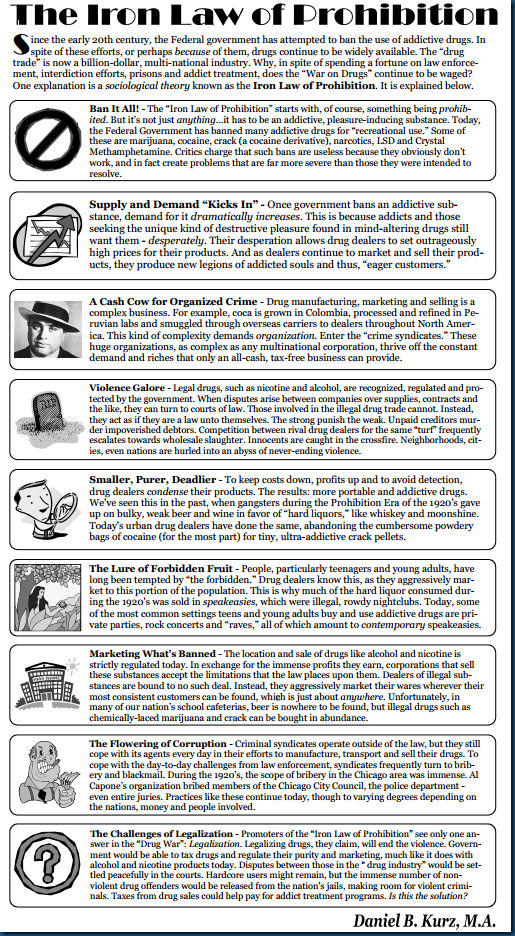
NB, for those not familiar with Uncle Milt’s Iron Law of Prohibition, here’s a handy summary:
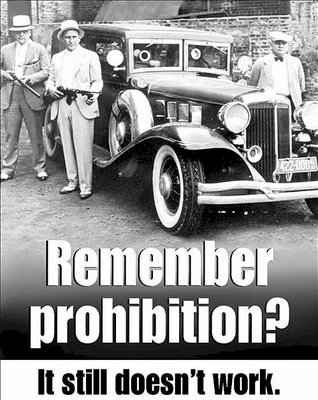
Mayoral hopeful Simon Prast is right. Prohibition doesn’t work. If no government, however officious, can even keep drugs out of its prisons, then it's clear enough that drugs aren't just going to disappear from the streets no matter how many laws are passed--any more than alcohol disappeared when laws were passed prohibiting that. All prohibition does is raise the crime rate, criminalise consumers, corrupt the cops, and put profits and quality control in the hands of gangs.
But don’t ask “What sane person would want to do that?” because prohibition is not about sanity. Says the UK Royal Society for the Encouragement of Arts, Manufactures and Commerce, "Drug laws are driven by ‘moral panic’… Whether we like it or not, drugs are and will remain a fact of life.”
Demonising drugs does more harm than good… The use of illegal drugs is by no means always harmful any more than alcohol use is always harmful," Professor Anthony King of Essex University, the commission chairman told Britain's Daily Telegraph. Professor King added: "The evidence suggests that a majority of people who use drugs are able to use them without harming themselves or others... The harmless use of illegal drugs is thus possible, indeed common."
It’s didn’t worked for alcohol—banning alcohol in the US was history’s biggest boon for organised crime.
It hasn’t worked for cannabis—banning cannabis in NZ has been the biggest shot in the arm for gangs you could imagine.
It hasn’t worked for party pills—prohibition putting the ‘P’ into BZP, and more profits in gang coffers.
It hasn’t worked any better for ‘P’ either.
Obtaining methamphetamine may be getting easier despite a Government crack down on the drug, a report says.
These are probably some of the reasons so many former law enforcement officers have joined the international advocacy group, Law Enforcement Against Prohibition (LEAP) (wouldn’t it be great to hear Leighton interviewing one them on air?), which argues that prohibition only exacerbates the harms it purports to diminish…
LEAP Statement of Principles LEAP does not promote the use of drugs and is deeply concerned about the extent of drug abuse worldwide. LEAP is also deeply concerned with the destructive impact of violent drug gangs and cartels everywhere in the world. Neither problem is remedied by the current policy of drug prohibition. Indeed, drug abuse and gang violence flourish in a drug prohibition environment, just as they did during alcohol prohibition. To view LEAP's Statement of Principles in its entirety, please click here.
But why on earth is Simon Prast talking only about legalising ‘P’? Yes, that’s a War that is already lost. But the best way to get rid of ‘P’ would be to get rid of prohibition across the board. Or even begin formulating a serious transitional plan to start the process. Why do I say that to get rid of ‘P’ we need to get rid of prohibition altogether? Because, as Milton Friedman pointed out with his Iron Law of Prohibition, it’s the particularly virulent drugs like ‘P’ that prohibition actually encourages. Johann Hari summarises:
‘You are not mistaken in believing that drugs are a scourge that is devastating our society [said Friedman]. Your mistake is failing to recognize that the very measures you favour are a major source of the evils you deplore.’ Friedman proved, for example, that prohibition changes the way people use drugs, making many people use stronger, more dangerous variants than they would in a legal market. During alcohol prohibition, moonshine eclipsed beer; during drug prohibition, crack is eclipsing coke. He called his rule explaining this curious historical fact “the Iron Law of Prohibition”: the harder the police crack down on a substance, the more concentrated the substance will become. Why? If you run a bootleg bar in Prohibition-era Chicago and you are going to make a gallon of alcoholic drink, you could make a gallon of beer, which one person can drink and constitutes one sale – or you can make a gallon of pucheen, which is so strong it takes thirty people to drink it and constitutes thirty sales. Prohibition encourages you produce and provide the stronger, more harmful drink. If you are a drug dealer in Hackney, you can use the kilo of cocaine you own to sell to casual coke users who will snort it and come back a month later – or you can microwave it into crack, which is far more addictive, and you will have your customer coming back for more in a few hours. “Prohibition encourages you to produce and provide the more harmful drug. “For Friedman, the solution was stark: take drugs back from criminals and hand them to doctors, pharmacists, and off-licenses. Legalize. Chronic drug use will be a problem whatever we do, but adding a vast layer of criminality, making the drugs more toxic, and squandering £20bn on enforcing prohibition that could be spent on prescription and rehab, only exacerbates the problem. ‘Drugs are a tragedy for addicts,’ he said. “But criminalizing their use converts that tragedy into a disaster for society, for users and non-users alike.’”
He’s still right. And so is Prast.
So forget the ‘moral panic,’ and think instead of the immorality of telling others what they’re allowed to do to themselves. And consider: If it is impossible to ban drugs and iniquitous to try, then the only relevant question becomes: should we have a legal, transparent, accountable market for drugs, or an illegal, secretive, unaccountable one?
Your call.
* * * *
*No, I never thought I’d be writing a sentence like “mayoral hopeful X is right.” But there you go. Well done Mr Prast.
PS: For those not familiar with Uncle Milt’s ‘Iron Law,’ here’s a handy summary:









![_Quote_thumb[2][5]](https://blogger.googleusercontent.com/img/b/R29vZ2xl/AVvXsEhu_cqAkZzLzfwkE3yltW_t9DghUfPOi0wJWTzSCw38wMNFYDGZwyC6BJd3DKjoCFVFrS1Xcprzw1muNEWHnbnK-cH4xK9xaWwj6ORIARbAuEkZWHYkSqCtiPfKStQ8dGLljndzwQ/?imgmax=800 "_Quote_thumb[2][5]")


