
“What can be asserted without evidence can also be dismissed without evidence.”~ Christopher Hitchens, from his 2007 book God is Not Great: How Religion Poisons Everything
“What can be asserted without evidence can also be dismissed without evidence.”~ Christopher Hitchens, from his 2007 book God is Not Great: How Religion Poisons Everything

"Be suspicious of all those who employ the term 'we' or 'us' without your permission. This is a form of surreptitious conscription [...] Always ask who this 'we' is; as often as not, it's an attempt to smuggle tribalism through customs."~ Christopher Hitchens, from his 2001 Letters to a Young Contrarian
"If an editorial assistant points out that a line in a draft article will probably detonate an explosion on social media, what is her supervisor going to do—risk the blowup, or kill the sentence? Probably the latter. The notion of keeping the sentence because of the risk, to defy the risk, to push the boundaries of free expression just a few millimeters further out—that notion now seems quaint. So the mob has the final edit."
~ George Packer from his acceptance speech for the 2019 Hitchens Prize, awarded to "an author or a journalist whose work, in the spirit of the late Christopher Hitchens, 'reflects a commitment to free expression and inquiry, a range and depth of intellect, and a willingness to pursue the truth without regard to personal or professional consequence'.” Read: 'The Enemies of Writing'[Hat tip Paul Litterick]
.
"To whom do you award the right to decide which speech is harmful or who is the harmful speaker? ... To whom would you delegate the task of deciding for you what you could read?"
~ Christopher Hitchens speaking 'On Free Speech'
.
"Mockery of religion is one of the most essential things. Because to demystify supposedly 'holy texts that are dictated by god' -- and show that they are man-made -- what you have to show are their internal inconsistencies and absurdities. One of the beginnings of human emancipation is the ability to laugh at authority, it's an indispensable thing. People can call it blasphemy if they like, but if they call it that they must assume there is something to be blasphemed, some divine work. Well, I don't accept that premise."
~ Christopher Hitchens, from his interview (above) with Jeremy Paxman
.
“Those who are determined to be ‘offended’ will discover a provocation somewhere. We cannot possibly adjust enough to please the fanatics, and it is degrading to make the attempt.”
~ Christopher Hitchens
“Human decency is not derived from religion.
It precedes it.”
~ Christopher Hitchens, from his book God is Not Great.
Yes folks, it’s time for that post again because …
It’s the Christmas season. Yuletide. The festive season. And we need to know the real reason for the season, which is …. probably not what you think it is.
We’ve had the cartoon, so like all good Christmas dinners, let’s have a Christmas joke:
Q: "What's the difference between God and Santa Claus?"
A: "There is no God."
Ha ha ha. The fact is, dear readers, at least Santa—well, Saint Nicholas at least—was a real figure, if not a real bloke, even if the many other inspirations for the Santa Claus character were not.
But God, or Christ, is suspiciously hard to find. (Which makes you sort of wonder what kind of message he’s allegedly trying to send by being so, well, non-omnipresent and all, and by only sending notes via obscure Bronze- and Roman-era texts.) And the harsh fact about him and Christmas, whatever else you may have heard, is that Christ himself was never even in Christmas --except in fiction and by order of the first few Popes.
Not even in the Roman-era texts:
[The New Testament itself gives two different and incompatible stories of the birth of Jesus, explains Christopher Hitchens.] None of the four gospels gives any notion of what time of year (let alone in what year) the supposed Nativity occurred. Only two gospels mention the virginity of Mary and only one has any mention of a "manger" [which is nothing more than a fancy name for trough – but try singing “Away in a trough” and see where that gets you!].
Nowhere is there any record of a "stable." Wise men and shepherds are likewise very unevenly distributed throughout the discrepant accounts. So that the placement of a crèche surrounded by a motley crew of humans and animals has no more Scriptural warrant than does The Life of Brian [and many fewer laughs].
Moreover, the erection of this exhibit near the turn of the year is actually a placation of the old Norse gods of the winter solstice - or "Yule" as the pre-Christians sometimes called it.
I myself [says Hitchens] repose no faith in any man-made text or made-man redeemer, so when it's Christmas I say "Merry Christmas" with a clear conscience, as I respect Ramadan and Passover, and also because "Happy Holidays" is so thin and insipid.
I don't mind if Christians honour the moment by displaying, and singing about, reindeer (a hard species to find in the greater Jerusalem/Bethlehem area). Same for the pine and fir trees that also don't grow in Palestine. I wish everybody joy of it.
And so do I. I just wish the Christians would leave off bashing us over the head with their myth—and their values.
So many facts that appear in your nativities don’t even come from those texts. We celebrate Christmas in December, yet the best we can tell from those Christmas stories is that the character of 
And God doesn’t even like Christmas trees, for Chrissake!
So the reason for the season, and how the season is celebrated, have very little originally to do with what you might have thought it did.
Historians themselves however do know the "reason for the season," and it's not because of anything that happened away in a stable at a time of a non-existent census. Even the Archbishop of Canterbury knows the truth, conceding a few Christmasses ago that the Christmas story and the Three Wise Men -- the whole Nativity thing itself -- is all just "a legend." Legends in fact that borrowed in whole cloth from other times and other places, and thereafter usurpedand occupied by the Christian church.
Speaking for myself, I really like myths and legends.
I’m even happier when we remember they’re stories, not historical accounts. (Q: What’s the definition of mythology? A: Somebody else’s religion.)

In the pre-modern northern hemisphere, (from whence these traditions started) this time of year was especially important; the time of year when days stopped getting darker and darker, and started once again to lengthen.
A halfway point in winter, that bleak season of hibernation before planting could begin again and you knew by now that the crops being stored to keep the wolves at bay would see you through. Or not. And if they would, you had something to celebrate: that another year on earth was maybe possible!
So this was a time of the year for great optimism. The end of the hardest part of the year was in sight (particularly important up in Lapland, the pagan home of the Norsemen where all-day darkness was the winter rule), and those all-important food stocks would soon be replenished.
All this was something worth celebrating with enthusiasm, with gusto and with plenty of food and drink and pleasures of the flesh -- and if those Norse sagas tell us anything, they tell us those pagans knew a thing or two about that sort of celebration! They celebrated a truly Salacious Saturnalia.
Thus was born the now-celebrated tradition of being blathered for most of what has become the Christmas month.

Observant readers will spot that the gift-giving and the red outfit lined with red fur (and even the name itself, almost) are still with us in the form of Santa. So Happy Satanmas, Santa!
SUCH WERE THE celebrations of the past. But the Dark Age Christian do-gooders didn’t like the pagan revels. Too little sackcloth and ashes for their liking. Instead of bacchanalia, these ghouls of the graveyard wanted instead to talk about suffering and their sores, and to spread the misery of their religion worldwide; instead of throwing themselves into such lewd and lusty revels, they thought everyone should be sitting at home mortifying their flesh – and very soon they hit upon a solution: first they stole the festivals, and then they sanitised them.
And instead of lusty revels with Satan and mistletoe, they gave us insipid nonsense around a trough along with Magi, stars, and shepherds – with only an angel or two to excite a bit of lust. (Just think, the first 'Grinch' who stole Christmas was really a Pope!)

BECAUSE THE VERY BEST OF Christmas is still very much pagan, for which you should really thank Odin, not the baby bloody Jesus.
The mistletoe, the trees, and the presents; the drinking and eating and all the red-blooded celebrations; the gift-giving, the trees and the decorations; the eating and the singing; the whole full-blooded, rip-roaring, free-wheeling, overwhelming, benevolent materialism of the holiday -- all of it all fun, and all of it fully, one-hundred percent pagan.
And commercial! (Spoiler alert, the modern Christmas was born that way: it was invented by capitalism.) Says Leonard Peikoff in 'Why Christmas Should Be More Commercial' (s), the festival is "an exuberant display of human ingenuity, capitalist productivity, and the enjoyment of life." I'll drink to all that, and then I'll come back right back up again for seconds.
Ayn Rand sums it up for mine, rather more benevolently than my brief introduction might have led you to expect:
“The secular meaning of the Christmas holiday is wider than the tenets of any particular religion: it is good will toward men—a frame of mind which is not the exclusive property (though it is supposed to be part, but is a largely unobserved part) of the Christian religion.
The charming aspect of Christmas is the fact that it expresses good will in a cheerful, happy, benevolent, non-sacrificial way. One says: ‘Merry Christmas’—not ‘Weep and Repent.’ And the good will is expressed in a material, earthly form—by giving presents to one’s friends, or by sending them cards in token of remembrance....
“The best aspect of Christmas is the aspect usually decried by the mystics: the fact that Christmas has been commercialized. The gift-buying is good for business and good for the country’s economy; but, more importantly in this context, it stimulates an enormous outpouring of ingenuity in the creation of products devoted to a single purpose: to give men pleasure. And the street decoration put up by department stores and other institutions—the Christmas trees, the winking lights, the glittering colors—provide the city with a spectacular display, which only ‘commercial greed’ could afford to give us. One would have to be terribly depressed to resist the wonderful gaiety of that spectacle.
And so say all of us. I wish you all, wherever you are a Cool Yule, a Salacious Saturnalia, and a very Happy Christmas.
PS: Here’s some related Hot Facts from the Hot Facts Girl. Concentrate as well as you can…
1. Yes, this is simply a rhetorical flourish. Jesus' birth may have happened in March. Or in September -- or not at all -- but it certainly did not happen in December. More on that here.
2. "A cancer. Like religion." Think that's harsh? You should try Landover Baptist's Bible Quizzes. Or Sam Harris's 'Atheist Manifesto.' Ouch! [Hat tip for both, good old Stephen Hicks] And, I confess, I pinched the quip from Australian comedy team The Doug Anthony All Stars.
.
Question for the Day is from the late Christopher Hitchens: “To terrify children with the image of hell, to consider women an inferior creation–is that good for the world?"

Paris Hilton makes sex tapes. Mother Teresa had just been made a saint.
Question for every reader: So who's the better person, Paris Hilton or Mother Teresa?
I ask because the Pope has just declared that Teresa deserves elevation to his church’s second-highest realm of worship; and because several years ago Paris was put forward to play the priestess in a putative film, and the subsequent furore made it clear that not everyone sees Teresa the same way the Bishop of Rome does. Yet her life and work and the church’s responses to it certainly do pull back the curtain on what lies beneath religious faith and its ethic of altruism.
At the time Paris was being promoted, for example, Penn & Teller's Penn Jillette was outraged at the vile suggestion ...
On his CBS radio show, Penn Jillette commented on the rumour that Paris Hilton may play Mother Teresa in a movie. He said Mother Teresa "had this weird kink that I think was sexual" about seeing people suffer and die. He also said that "Paris Hilton is so far above Mother Teresa on the moral scale, she should not lower herself" to playing the saintly nun. After comparing Mother Teresa to Charles Manson, Jillette again said she "got her [sexual] kicks watching people suffer and die."
He concluded by saying, "Paris Hilton. You're so much better than that. Don't take the gig. Keep making good wholesome porn films. Just do that. Do what you're cut out for. Don't lower yourself to playing Mother Teresa."
Naturally, the Pope’s emissaries in the US were outraged, demanding Penn and Teller be sacked from CBS for plumping for Paris and and dissing the imminent saint.
But I thought of the argument again when the Pope threw around the Holy Water yesterday.
Because I'm still with Penn. Whatever else she might do, Paris (I'm told) does make good sex tapes. Which is at least some sort of achievement. Whereas the woman who made a life celebrating suffering (which is what she made her life’s work) is nobody to worship. Christopher Hitchens pointed this out some years back in his all-warts bio of the woman he observed watching people suffer and die, arguing:
Mother Teresa was not a friend of the poor. She was a friend of poverty. She said that suffering was a gift from God. She spent her life opposing the only known cure for poverty, which is the empowerment of women and the emancipation of them from a livestock version of compulsory reproduction. And she was a friend to the worst of the rich, taking misappropriated money from the atrocious Duvalier family in Haiti (whose rule she praised in return) and from Charles Keating of the Lincoln Savings and Loan. Where did that money, and all the other donations, go? The primitive hospice in Calcutta was as run down when she died as it always had been—she preferred California clinics when she got sick herself—and her order always refused to publish any audit. But we have her own claim that she opened 500 convents in more than a hundred countries, all bearing the name of her own order. Excuse me, but this is modesty and humility?Surely not. But how could someone elevated to sainthood be such a vicious crone? Perhaps because the very ethic of altruism (i..e, otherism) that sainthood demands. This brief excerpt from 'The diabolical works of Mother Teresa,' by then Auckland University's Robert White helps explain:
You see, Mother Teresa believes that poverty and suffering are "gifts" from God. And the sisters in her order, The Missionaries of Charity, are taught that suffering makes God very happy. Mother Teresa once recounted, with a bright smile, how she had told a terminally ill cancer patient, who was suffering from unbearable pain, that, "You are suffering like Christ on the cross. So Jesus must be kissing you." Now, get that. According to Mother Teresa, Jesus, who, remember, is a moral ideal in her religion, expresses his "love" through tormenting the sick and the dying, while his father - God - gets his kicks from watching their suffering. This is pure sadism. And, unfortunately for the poor, Mother Teresa was ruthlessly intent on making God a very happy deity.'
One could go on, and of course Hitchens himself did exactly that with his book, and in subsequent interviews and articles.
I would describe mother Teresa as a fraud, a fanatic and a fundamentalist [concluded Hitchens]. Everything everybody thinks they know about her is false. Not just most of the things ... all the things.
So this, perhaps, is the irrevocably logical conclusion of altruism, an ethic seemingly demanding kindness to others but increasingly needing their suffering to demonstrate your own “goodness.” Not an ethic that can or should be practised for too long.
Even if you remove from the equation the intended suffering of others, if faithfully followed (as the church commands), it is impossible to achieve the ethic of other-ism without suffering.
Civilization would literally come to a stop if people stopped pursuing their own interests. Famine and poverty would immediately overtake not just the United States and the Western world, but all of humanity. Billions would die, and they’d die quickly. This is morality? Granted, there would be a lot of needy people desperately crying out for the efforts of a Mother Teresa. But even Mother Teresa, or her contemporary equivalents, would all be famished and diseased themselves, since all of civilization had stopped working. How would she and her Pope fly in their airplanes, and cure their own illnesses, so they could regain their strength to aid the needy? Where would they get the money to fund their projects? In a collapsed economy, there would be no donations.
Without the pursuit of the self-interest they damn, the church itself would not even have the riches it so fastidously hoards. So thank Galt we’re not all Mother Teresa, says Michael Hurd.
Funny how even today, 900 years after Maimonides demonstrated that the best way to help a poor man is to fund a business that will give him a productive job, and with it the self-respect and independence that come from productive work, Christians still think that the best way is to build him a hospital to die in - without even analgesics to ease his pain - when he gets ill from one of the many diseases caused by staying poor.
Michael Dell employs 8600 people in India. Larry Ellison (Oracle) somewhere between 10,000 and 20,000. IBM 39,000. Together, that's around 60,000 workers; with their families, about a quarter million, who in the unlikely case they get sick (people with good jobs do not get sick anywhere as often as the really poor) can afford real medical care, including analgesics - instead of the unmedicated pain dealt to the poor in 'Mother' Teresa's hospital down the road.
So, if you really want to throw some money at poverty in India [advises Adam Reed], invest in Dell Computer, in Oracle, in IBM. The people of India will grow richer, and you will too. Harmony of interests and all that.
Paris at least can be criticised for being no more than a hedonist, whose pursuit of short-term pleasures is at least some kind of pursuirt of happiness, and ultimately may at least hurt no-one but herself. Constrast that with the Catholic philosophy, which preaches that suffering is moral, that guilt is unearned and (in the words of Mother Teresa herself) "the world is being much helped by the suffering of the poor people."
But the church’s advocacy of suffering and the litle witch’s own sadism is much, much more damaging, and not just to the others that the ethic of other-ism ultimately demands. So perhaps this why, towards the end of her life this grizzled Albanian witch who now wears the robes of Christian sainthood began to question her calling, her faith, and even the very existence of the god the was supposed to be worshipping in her work (abundant evidence in her letters that the Vatican chose to ignore).
According to her own letters, Mother Teresa was "tormented" (her word) by "doubts concerning her faith."
... The silence and the emptiness is so great, that I look and do not see, — Listen and do not hear — the tongue moves but does not speak ...
As one wag said at the time, “That’s ‘cos there's no one there dear!”
Yet pathetically the Church used even this “doubt” (hardly a strong enough word to describe the self-hatred and emptiness at the heart of her black soul) to massage their own argument for faith.
Mother Teresa’s response to her own bewilderment and hypocrisy (her term) reveals just how like quicksand religious faith can be [observed Sam Harris]. Her doubts about God’s existence were interpreted by her confessor as a sign that she was now sharing Christ’s torment upon the cross; this exaltation of her wavering faith allowed her “to love the darkness” she experienced in God’s apparent absence. Such is the genius of the unfalsifiable. We can see the same principle at work among her fellow Catholics: Mother Teresa’s doubts have only enhanced her stature in the eyes of the Church, being interpreted as a further confirmation of God’s grace. Ask yourself, when even the doubts of experts are taken to confirm a doctrine, what could possibly disconfirm it? [Emphasis mine.]
Such is faith: when its loss is confirmation of its existence.
Such is altruism: when self-sacrifice is demanded then self-destruction and suffering can never be far behind.
How much less damaging than a saint then in every respect is a semi-celebrity porn actress famous for being famous.
And how heartening to see in Stuff’s posting of the story that the majority of commenters would seem to agree [scroll down for comments]..
The church may call her a saint, but it appears many New Zealanders at least see that news or the witch as nothing at all to worship.
PS: WATCH:
.
“Dictatorship nations are outlaws. Any free nation had the right to invade Nazi Germany and, today, has the right to invade Soviet Russia, Cuba or any other slave pen. Whether a free nation chooses to do so or not is a matter of its own self-interest, not of respect for the non-existent “rights” of gang rulers. It is not a free nation’s duty to liberate other nations at the price of self-sacrifice, but a free nation has the right to do it, when and if it so chooses."
~ Ayn Rand on ‘Self-Determination of Nations’
Any decision to take men and women into war must be made with the utmost seriousness and sincerity. Trying to peer beneath all the invective over the last decade about the decision taken to invade Iraq makes it almost impossible to see whether that was so in this case. “This rage over the Iraq war and inchoate desire for revenge has driven the collective political psyche in Britain and the West off the rails,” says Melanie Phillips in The Times.
I supported the war against Saddam and still do. I also think, though, that in many crucial respects it was misconceived from the start and subsequently managed with astounding incompetence, ignorance and cowardice.
The Bush and Blair administrations failed to understand they were entering a tribal minefield. They failed to acknowledge the need to stop Iran fomenting sectarian strife in Iraq. They also failed to commit themselves to the long haul in order to defeat Islamist terror.
It was a job half-done, its reasons poorly explained; the plan for the end-game, tragically, was dismal – barely conceived, if it ever was.
So … “Blair lied, people died.” “No blood for oil.” “Bush’s lapdog.” “Where was the WMD?” Too much commentary has been little more than bumper-sticker lite, not the thoughtful analysis the subject demands. Seven years in the making, the 12-volumes-worth of Chilcot report, issued overnight, should be that document.
Its executive summary certainly makes former Prime Minister Tony Blair, who led the British push for war, look terrible. According to the report, Blair made statements about Iraq’s nonexistent chemical, biological, and nuclear programs based on “what Mr. Blair believed” rather than the intelligence he had been given. The U.K. went to war despite the fact that “diplomatic options had not been exhausted.” Blair was warned by British intelligence that terrorism would “increase in the event of war, reflecting intensified anti-US/anti-Western sentiment in the Muslim world, including among Muslim communities in the West.”
On the other hand, the inquiry explicitly says that it is not “questioning Mr. Blair’s belief” in the case for war — i.e., it is not accusing him of conscious misrepresentations.
And after all those years being written, Julie Lenarz among others can still identify crucial omissions:
1) It's quite remarkable that Sir John failed to mention the attempt by the US and UK to resolve the conflict with Saddam peacefully by pushing new sanctions through the UNSCR, as the old sanctions regime was violated on a daily basis. That attempt was vetoed by Russia.
2) It's even more remarkable that Sir John made such bold statements about bad judgement on behalf of TB without acknowledging once the evidence he received from Hans Blix, the UN's chief weapons inspector and by no means a supporter of the war.
a) “It seemed plausible to me at the time, and I also felt — I, like most people at the time, felt that Iraq retains weapons of mass destruction. I did not say so publicly. I said it perhaps to Mr Blair in September 2002 privately… I talked to Prime Minister Blair on 20 February 2002 and then I said I still thought that there were prohibited items in Iraq.”
b) “I have never questioned the good faith of Mr Blair or Bush or anyone else. On some occasions when I talked to Blair on the telephone, 20 February, I certainly felt that he was absolutely sincere in his belief.”
It’s too easy now to forget that there was a case for war – a “legitimate case to be made for the removal of a genocidal regime.” Phillips reminds us of some of the selfish reasons for ending the regime, arguing that without the Iraq War Saddam would now be riding the tiger of .Islamist terror.
Saddam was a highly significant threat to the West. He was a godfather of international terrorism.
He was behind the plot to murder George HW Bush. Audiotapes of his conversations with key officials revealed that al-Qa’ida had been in contact with Iraqi intelligence for sanctuary, training and planning acts of terrorism against the US.
Saddam’s refusal to show that he had stopped developing chemical, biological and nuclear weapons, as he was required to do by the UN, reinforced the belief among western intelligence services that he was still engaged in these programs.
In 1998, the threat Saddam posed to the West had caused Bill Clinton to sign the Iraq Liberation Act, which called for Saddam’s removal and a forced end to his WMD programs. Clinton didn’t follow through.
The events of 9/11, however, changed the calibration of risk, overnight. It wasn’t that Saddam was generally thought to be responsible for those attacks. It was rather that, with the new realisation Islamic terrorism breached all previously understood constraints of warfare, Saddam’s regional ambitions, sponsorship of terrorism and pursuit of WMD made the threat he posed no longer tolerable.
These reasons were made at the time, poorly heard, and now only dimly remembered, but they were made and understood. “The case for overthrowing Saddam,” argued Christopher Hitchens in 2005, “was unimpeachable”—and Blair “the only statesman from the nineties to emerge from the decade with any credit on this front.”
The man he helped depose, unquestionably, was a monster:
All known and understood at the time. But then suddenly, once the Coalition went to war, as Phillips recognises: “Saddam was said never to have been a threat at all, and logic, reason and proportion went out of the window.”
The apparent over-egging of questionable intelligence about Saddam’s WMD programs was held to prove that they had long been junked altogether. The failure to find any stocks of WMD was held to prove that Saddam was no longer trying to produce the stuff. Absence of evidence was held to be evidence of absence.
The Iraq Survey Group’s interim report saying Saddam was pursuing biological weapons programs up to the start of the war was brushed aside. The Israelis who said WMD stocks may have been moved to Syria were brusquely dismissed. Former US general James Clapper, the present director of national intelligence, and ex-general Thomas McInerney, who said the same thing in 2003 and 2006, were ignored.
In 2004, an American defence official, John Shaw, claimed that Saddam’s WMD stockpiles had been moved to Syria by the Russians. In 2006, I interviewed Georges Sada, Saddam’s former air vice-marshal. He told me Saddam had transported chemical and biological stockpiles by air and road to Syria in late 2002.
The legacy of the Iraq war has been toxic. The British people now seem reluctant to believe warnings by politicians or intelligence officials about threats from the Islamic world and even less willing to countenance any military action to counter any such threat.
If Saddam were still around today, he would be riding the tiger of Islamist terror, as he always did, and the threat to us all would be even greater.
Chilcot is supposed to suggest lessons we must learn from the Iraq war. This is the main one: the core reason the war was botched was the West’s failure to acknowledge the nature, scale and complexity of the threat from the Arab and Islamic world.
The persecution of Tony Blair shows that this failure remains just as true today.
Perhaps that makes Chilcot’s Report the worst kind of whitewash.
The important, humane task of understanding the history and politics of that calamity in 2003 has been sacrificed at the altar of allowing a needy elite the space in which to say: ‘Blair is evil, and I am good.’
.
May we be cautiously optimistic that the right to voluntary euthanasia –to die at the time and manner of your choosing, if you wish --will finally be recognised in law in this country sometime soon?
It is quite literally a lottery, but ACT’s David Seymour is promoting a private member’s Bill which, if drawn in the regular ballot, could legalise assisted dying, and end the unendurable.
In my view [says Seymour] it is politically, morally, legally and, in terms of public policy, the right thing to do.
And so it is.
If drawn, it’s been confirmed today (as much as anything is ever really confirmed in politics) that the Prime Minister would give his own backing to the bill.
John Key said he would support a new member's bill lodged by Act leader David Seymour yesterday if it was drawn from the ballot… Mr Key's endorsement could play an important role in changing minds on the contentious issue.
Let’s hope so. One mind that very much needs to be changed is that of Mr Key’s Catholic deputy Bill English who, at the last vote on a similar member’s bill struck a blow for religious barbarism by saying that "Pain is part of life, and watching it is part of our humanity." It is Catholic commentary along these lines that prompted Christopher Hitchens many years ago to dub Mother Teresa, who also enjoyed watching people suffer, Hell’s Angel.
Frankly, the fewer opportunities there are for the inhumane to get between those who have chosen to end their unendurable suffering and the means by which to do it, the better. This bill, should it be drawn and passed, reduces those opportunities considerably.
So let’s hope, for the memory of Lecretia Seales and to end the suffering of many like her in the future, that it does appear, and soon.
Because if the Prime Minister keeps his promise, and Labour’s leader supports the law change, as he said he would, then change could come fairly rapidly.
Because it’s not like there’s much in the way of promised policies clogging up the order paper …
UPDATE:
The bill wasn’t drawn in this afternoon’s ballot, more’s the pity, and Mark Hubbard calls for those politicians who did find success in the ballot to put politics aside in the name of compassion, and allow Seymour’s bill to substitute for their own:
I think it’s crazy something so important is left to a lottery, but this is authoritarian democracy. So given we’ll never see such a basic right from the National Government, I’m calling for a grand gesture from the ballot winners.
For those who would say this isn’t how Parliament works, I say this is death and pain we’re dealing with - what is more important than the humanity existing in those two issues…
For David Stephens, for Helen Kelly, for all those who would avail themselves of a death with dignity in this century …
More related posts from Mark:
I’ve been too busy to catch up properly with the report on CIA torture that came out this week, but it looks like this is another report that’s been misreported.
From reports of it I’d heard on local media, I’d assumed the report recounted widespread and barbaric torture that was ultimately ineffective in extracting information, and was now very properly being condemned.
Turns out that out of 39 captured terrorists there were precisely three who were waterboarded. Waterboarding is not exactly comfortable, but depending how you classify being forced to listen Neil Diamond then that was really as far as the report says physical torture went.
Were some of the captured terrorists treated roughly? Absolutely. Their lives must have been miserable, and deservedly so. [This was war.]…
To me, what is striking is what was not done to the prisoners. While one was threatened with a power drill, it was not in fact used on him. That would have been torture. Similarly, while one detainee was told that his children might be killed, they were not harmed. (If it had been the Russians, they would have been killed.) Al Qaeda has produced a manual on how to torture prisoners; among many other things, it explains how to scoop the prisoner’s eyes out. Nothing like that was done to captured leaders of al Qaeda. The terrorists’ fingernails were not extracted, their testicles were not crushed, their thumbs were not screwed. They weren’t even beaten.
They were subjected to rough treatment, since a terrorist can’t be made to talk by feeding him tea and cakes. But none of this amounts to torture; not even waterboarding, in my opinion. Waterboarding is best seen as a humane alternative to torture. It lasts only a few minutes and, while unpleasant–that is the point–causes no lasting physical harm. Unlike real torture.
I don’t know what animus or desire for political gain drove Senate Democrats to produce a vindictive, one-sided report on the CIA’s interrogation techniques (almost all of which, for better or worse, are now history). But if you read between the lines, the picture that emerges is quite different: a civilised nation, determined to protect its people, did the dirty work necessary to learn the secrets of a ruthless, terrorist enemy, acting almost always within legal and moral norms.
To be sure, tt’s the “almost” that some of us still worry about. But if that account of the report is correct, it looks like the 39 captured terrorists were treated better by the CIA than some American citizens have been treated by their own police force.
Here’s Scott Walker, about genuine torture. (And, yes, it’s supposed to be disturbing.)
Last weekend, top Objectivist intellectual Andrew Bernstein debated Christian apologist Dinesh D’Souza on the topic ‘Christianity: Good or Bad for Mankind?’
“New Atheists,” such as Christopher Hitchens, Daniel Dennett, and Michael Shermer, have debated Mr. D’Souza in the past, but their critiques of Christianity have been based on skepticism, subjectivism and relativism. In short, they’ve argued on the basis od uncertainty, and have failed to properly critique religion’s history or offer any rational alternative to religious ethics.
Dr. Bernstein’s case against Christianity however (and against religion in general) is grounded in Ayn Rand’s philosophy of Objectivism. How did this play out? Watch and see:
"My own opinion is enough for me, and I claim the right to
have it defended against any consensus, any majority, anywhere,
any place, any time. And anyone who disagrees with this
can pick a number, get in line and kiss my ass.”
- Christopher Hitchens, Free Speech Debate at University of Toronto, 2006
Those cunning secularists, perverting the “reason for the season”! We hear the same complaints every year, from Fox News to the Vatican, that "Christ is being taken out of Christmas," about the "War against Christmas" (TM) -- about the "widespread revolt" against "Christian values” and “Christian symbols” –about the prevalence of "Happy Holidays" rather than "Merry Christmas" greetings…
Here's what I say to those complainers: Get a life. Learn some history. And try a Christmas joke:
Q: "What's the difference between God and Santa Claus?"
A: "There is no God."
Ha ha ha. The harsh fact is, customers, Christ was never even in Christmas --except in fiction and by order of the first Popes.
None of the four gospels gives any notion of what time of year (let alone in what year) the supposed Nativity occurred. Only two gospels mention the virginity of Mary and only one has any mention of a "manger" [i.e., a trough]. Nowhere is there any record of a "stable." Wise men and shepherds are likewise very unevenly distributed throughout the discrepant accounts. So that the placement of a creche surrounded by a motley crew of humans and animals has no more Scriptural warrant than does The Life of Brian. Moreover, the erection of this exhibit near the turn of the year is actually a placation of the old Norse gods of the winter solstice - or "Yule" as the pre-Christians sometimes called it.
I myself [says Christopher Hitchens] repose no faith in any man-made text or made-man redeemer, so when it's Christmas I say "Merry Christmas" with a clear conscience, as I respect Ramadan and Passover, and also because "Happy Holidays" is so thin and insipid. I don't mind if Christians honor the moment by displaying, and singing about, reindeer (a hard species to find in the greater Jerusalem/Bethlehem area). Same for the pine and fir trees that also don't grow in Palestine. I wish everybody joy of it.
And so do I. I just wish the Christians would leave off bashing us over the head with their myth—and their values.
Jesus wasn't even born in December, let alone at Christmas time: he was born in July* -- which makes him a cancer**. Just like religion.
And God doesn’t even like Christmas trees, for Chrissake!
Historians themselves know the "reason for the season," and it's not because of anything that happened away in a stable at a time of a non-existent census. Even the Archbishop of Canterbury knows the truth, conceding a couple of Christmasses ago that the Christmas story and the Three Wise Men - the whole Nativity thing itself -- is all just "a legend."
And I like myths and legends. I’m even happier when we remember they’re stories, not historical accounts.

All this was something worth celebrating with enthusiasm, with gusto and with plenty of food and drink and pleasures of the flesh -- and if those Norse sagas tell us anything, they tell us those pagans knew a thing or two about that sort of celebration! They celebrated a truly Salacious Saturnalia.
One popular celebration involved having a chap put on the horns and skin of the dead animal being roasted in the fire (worn with the fur side inside and the blood-red side outside ), and giving out gifts of food to revellers. This guy represented Satan, and the revellers celebrated beating him back for another year by making him a figure of fun (I swear, I'm not making this up). Observant readers will spot that the gift-giving and the fur-lined red outfit (and even the name, almost) are still with us in the form of Santa. So Happy Satanmas, Santa!
SUCH WERE THE celebrations of the past. But the Dark Age Christian do-gooders didn’t like the pagan revels. Instead of bacchanalia, these ghouls of the graveyard wanted instead to talk about suffering and their sores, and to spread the misery of their religion worldwide; instead of throwing themselves into such lewd and lusty revels, they thought everyone should be sitting at home mortifying their flesh – and very soon they hit upon a solution: first they stole the festivals, and then they sanitised them. Instead of lusty revels with Satan and mistletoe, we got insipid nonsense around a manger along with Magi, stars and shepherds dreamed up almost out of whole cloth. (Just think, the first 'Grinch' who stole Christmas was really a Pope!)
So given this actual history, it's somewhat churlish of today's sanitised saints of sobriety to be complaining now about history reasserting itself and folk claiming Christmas back for their revels.
BECAUSE THE VERY BEST OF Christmas is still very much pagan, thank Odin. The mistletoe, the trees, and the presents; the drinking and eating and all the red-blooded celebrations; the gift-giving, the trees and the decorations; the eating and the singing; the whole full-blooded, rip-roaring, free-wheeling, overwhelming, benevolent materialism of the holiday -- all of it all fun, and all of it fully, one-hundred percent pagan. Says Leonard Peikoff in 'Why Christmas Should Be More Commercial', the festival is "an exuberant display of human ingenuity, capitalist productivity, and the enjoyment of life." I'll drink to all that, and then I'll come back right back up again for seconds. Ayn Rand sums it up for mine, rather more benevolently than my brief introduction might have led you to expect:
“The secular meaning of the Christmas holiday is wider than the tenets of any particular religion: it is good will toward men—a frame of mind which is not the exclusive property (though it is supposed to be part, but is a largely unobserved part) of the Christian religion.
The charming aspect of Christmas is the fact that it expresses good will in a cheerful, happy, benevolent, non-sacrificial way. One says: ‘Merry Christmas’—not ‘Weep and Repent.’ And the good will is expressed in a material, earthly form—by giving presents to one’s friends, or by sending them cards in token of remembrance....
“The best aspect of Christmas is the aspect usually decried by the mystics: the fact that Christmas has been commercialized. The gift-buying is good for business and good for the country’s economy; but, more importantly in this context, it stimulates an enormous outpouring of ingenuity in the creation of products devoted to a single purpose: to give men pleasure. And the street decoration put up by department stores and other institutions—the Christmas trees, the winking lights, the glittering colors—provide the city with a spectacular display, which only ‘commercial greed’ could afford to give us. One would have to be terribly depressed to resist the wonderful gaiety of that spectacle.
And so say all of us. I wish you all, wherever you are a Cool Yule, a Salacious Saturnalia, and a very Happy Christmas.
And while I’ll be posting occasionally between now and next year, I’ll see you back here again to give it the full press in the New Year.
Be as good as you can be while I’m gone.***
PS: Here’s some related Hot Facts from the Hot Facts Girl. Concentrate as well as you can…
* Yes, this is simply a rhetorical flourish. Jesus' birth may have happened in March. Or in September -- or not at all -- but it certainly did not happen in December. More on that here.
** "A cancer. Like religion." Think that's harsh? You should try Landover Baptist's Bible Quizzes. Or Sam Harris's 'Atheist Manifesto.' Ouch! [Hat tip for both, good old Stephen Hicks] And, I confess, I pinched the quip from Australian comedy team The Doug Anthony All Stars.
*** Panic not, I won’t be away long. I’ll be posting occasionally over the summer break, and be back for good around the second week in January. Or so. Enjoy your holidays. I will be.
 Nearly one decade on from that day when an organised gang of barbarians hijacked civilian airliners and flew themselves and scores of innocents into two of the world’s most famous symbols of capitalism, one wonders what could be said about that outrage that hasn’t already?
 Simply evil. A decade after 9/11, it remains the best description and most essential fact about al-Qaida … a particularly odious group (a secretive and homicidal gang: part multinational corporation, part crime family) that was sworn to a medieval cult of death, a racist hatred of Jews, a religious frenzy against Hindus, Christians, Shia Muslims, and "unbelievers," and the restoration of a long-vanished and despotic empire.
To me, this remains the main point about al-Qaida and its surrogates. I do not believe, by stipulating it as the main point, that I try to oversimplify matters. I feel no need to show off or to think of something novel to say. Moreover, many of the attempts to introduce "complexity" into the picture strike me as half-baked obfuscations or distractions. These range from the irredeemably paranoid and contemptible efforts to pin responsibility for the attacks onto the Bush administration or the Jews, to the sometimes wearisome but not necessarily untrue insistence that Islamic peoples have suffered oppression. (Even when formally true, the latter must simply not be used as nonsequitur special pleading for the use of random violence by self-appointed Muslims.)
Underlying these and other attempts to change the subject there was, and still is, a perverse desire to say that the 9/11 atrocities were in some way deserved, or made historically more explicable, by the many crimes of past American foreign policy… That this was an assault upon our society, whatever its ostensible capitalist and militarist "targets," was again thought too obvious a point for a clever person to make. It became increasingly obvious, though, with every successive nihilistic attack on London, Madrid, Istanbul, Baghdad, and Bali. There was always some "intellectual," however, to argue in each case that the policy of Tony Blair, or George Bush, or the Spanish government, was the "root cause" of the broad-daylight slaughter of civilians. Responsibility, somehow, never lay squarely with the perpetrators.
… Al-Qaida demands the impossible—worldwide application of the most fanatical interpretation of sharia—and to forward the demand employs the most hysterically irrational means…
Contrary to the peddlers of shallow anti-Western self-hatred [however], the Muslim world did not adopt Bin-Ladenism as its shield against reality. Very much to the contrary, there turned out to be many millions of Arabs who have heretically and robustly preferred life over death. In many societies, al-Qaida defeated itself as well as underwent defeat…
Against the tendencies of euphemism and evasion, some stout simplicities deservedly remain. Among them: Holocaust denial is in fact a surreptitious form of Holocaust affirmation. The fatwa against Salman Rushdie was a direct and lethal challenge to free expression, not a clash between traditional faith and "free speech fundamentalism." The mass murder in Bosnia-Herzegovina was not the random product of "ancient hatreds" but a deliberate plan to erase the Muslim population. The regimes of Saddam Hussein and Kim Jong Il and Mahmoud Ahmadinejad fully deserve to be called "evil." And, 10 years ago in Manhattan and Washington and Shanksville, Pa., there was a direct confrontation with the totalitarian idea, expressed in its most vicious and unvarnished form. Let this and other struggles temper and strengthen us for future battles where it will be necessary to repudiate the big lie.
For many people, the Pope is an arresting figure. Now, two prominent atheists hope to change that slightly. They hope to make him an arrested figure, arguing that no-one deserves it more.
Richard Dawkins, author of The God Delusion, and Christopher Hitchens, author of God is Not Great: How Religion Poisons Everything, plan between them to have the Pope arrested during his state visit to Britain “for crimes against humanity.”
Says Dawkins: “This is a man whose first instinct when his priests are caught with their pants down is to cover up the scandal and damn the young victims to silence.”
Says Hitchens: “This man is not above or outside the law. The institutionalised concealment of child rape is a crime under any law and demands not private ceremonies of repentance or church-funded payoffs, but justice and punishment."
The priest & paedophile scandal should be the death knell for any notion that the Church is an organisation providing moral leadership. The arrest of its putative head would be a fitting postscript to the public realisation of its clear and institutionalised moral degeneracy.
Stories about what’s planned by Dawkins & Hitchens here and here, in The Times and The Telegraph respectively. [Hat tip Marcus Bachler]
Seeing the back of Ratzinger:

Seeing the backside of God:

Seeing the back of both together: Priceless.
| Share this post : |  |  |  |  |  |  |  |
It’s now eight years to the day since barbarians flew planes loaded with people into two soaring symbols of western freedom with around 5,000 souls inside. The resulting cataclysm still hangs over this century like a gaping wound. In the words of Christopher Hitchens,
“from Afghanistan the holy order was given to annex two famous achievements of modernism -- the high-rise building and the jet aircraft -- and use them for immolation and human sacrifice... Faith-based fanatics could not design anything as useful or as beautiful as a skyscraper or a passenger aircraft. But, continuing their long history of plagiarism, they could borrow and steal these things and use them as a negation.”
Eight years after the surprise Japanese attack on Pearl Harbor – the only comparable event in modern history – Japan had already been reduced to rubble and begun its rebuilding into the peaceful modern powerhouse into which it was transformed.
Yet eight years on after the brutal slaughter of thousands of innocent people the buildings the barbarians destroyed are still un-replaced, the chief planners and perpetrators of the outrage remain on the loose, and the pursuit of those leading barbarians is greeted with cries that the west itself is the aggressor.
How much has the world changed since 1941.
To be fair, the pursuit itself is so flawed as to be almost completely off-mission. Sure, there are problems in just finding the bastards who planned this – unlike the bastards who bombed Pearl Harbor, it’s not possible to find them on a map. But it’s not like there isn’t a rough idea.
War was declared on the west eight years ago. That it’s still going isn’t for lack of firepower on the west’s behalf, it’s an almost complete lack of moral fibre. A refusal to believe that it’s a war that we’re in, and a politically-correct misdirection of effort into a war on on a tactic instead of against the actual barbarians responsible for the outrage – a hand-wringing, faith-based unwillingness to identify the enemy.
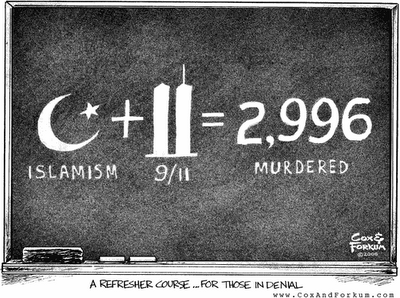 It should not bave been a “war on terror” in which the west was engaged these last eight years. In the same way that the Second World War was a war against Nazism and Shintoism, this was should have been a war on Islamic Totalitarianism – a war waged explicitly against this hydra, and with the full moral authority that this was a war of self-defence – a war of civilisation against the barbarians who attacked it.
It should have been a war in which it was recognised that there is “No Substitute for Victory.” It has never been that war, which is why it still dribbles on eight years after the outrage that finally brought the enemy to the world’s attention.
The errors made by George W in waging his “war against a tactic” (and in the wrong place) are now being repeated by his successor, President Zero. America’s Commander-in-Chief said recently,
“I’m always worried about using the word ‘victory’,” said Obama, “because, you know, it invokes this notion of Emperor Hirohito coming down and signing a surrender to MacArthur.”
But, you know, when Emperor Hirohito was made to come down and surrender to MacArthur that was the beginning of the end for the medieval warrior spirit of Shinto, and also the beginning of the beginning for the peaceful success of the modern-day Japanese who -- liberated from their medieval past -- gave the whole world a lesson in how ragingly successful the peaceful pursuit of prosperity can be.
It took another six years after World War II was concluded to subdue and modify Japan, and put it on a path to peace and prosperity : Six years and the destruction of Shintoism as an ethical code. It took seven years to reconstruct Germany and to destroy the bacillus of Nazism – two jobs selfishly important to every anyone who valued a peaceful world after decades of strife and war. Just as selfishly important now would be a haven of secular peace in the ravaged Middle East or Near East.
Mind you, these jobs were done by people and was done by people who knew what they were doing.
Now, eight years after the horrors of September 11, 2001, we discover that today’s leaders know nothing. We discover they were coasting on the knowledge of previous generations, without being able even to apply the lessons learned.
What should have been a day to commemorate the fallen is instead, therefore, a day to berate those who have betrayed them.
In their honour then I offer my thoughts above, such as they are, and this small memento of triumph: architect Minoru Yamasaki in front of his greatest achievement: New York’s World Trade Center. In every sense they were the symbol of the very best of modern civilisation. And that’s why they had to die.
UPDATE: Now the clocks have rolled around in the US, there’s more good commentary appearing online from my sort of people:
No dynamic culture can stand still, so we shouldn't be surprised that fewer and fewer people, from the president down, find it harder and harder to remember quite what "the day that changed the world" was all about. Nevertheless, there is unfinished business — starting with that hole in the ground in lower Manhattan.
Eight years ago today, our homeland was attacked by fanatical Muslims inspired by Saudi Arabian bigotry. Three thousand American citizens and residents died.
We resolved that we, the People, would never forget. Then we forgot.
We've learned nothing.
Instead of cracking down on Islamist extremism, we've excused it.
Instead of killing terrorists, we free them.
Instead of relentlessly hunting Islamist madmen, we seek to appease them.
Instead of acknowledging that radical Islam is the problem, we elected a president who blames America, whose idea of freedom is the right for women to suffer in silence behind a veil -- and who counts among his mentors and friends those who damn our country or believe that our own government staged the tragedy of September 11, 2001.
UPDATE 2: An email purporting to contain a short piece by one Emanuel Tanay is doing the rounds. In fact, the piece is by Paul E. Marek, a second-generation Canadian, whose grandparents fled Czechoslovakia just prior to the Nazi takeover. He wrote the following article in February of 2006 to explain why the peaceful majority is irrelevant. 
As he says about the deluded young girl on the right, “She misses the point: Her job is to prevent the fanatics from hijacking her faith.”
“All that is necessary for the triumph of evil is that good men do nothing.” – Edmund Burke
Why The Peaceful Majority Is Irrelevant
By Paul E. MarekI used to know a man whose family were German aristocracy prior to World War Two. They owned a number of large industries and estates. I asked him how many German people were true Nazis, and the answer he gave has stuck with me and guided my attitude toward fanaticism ever since.
“Very few people were true Nazis” he said, “but, many enjoyed the return of German pride, and many more were too busy to care. I was one of those who just thought the Nazis were a bunch of fools. So, the majority just sat back and let it all happen. Then, before we knew it, they owned us, and we had lost control, and the end of the world had come. My family lost everything. I ended up in a concentration camp and the Allies destroyed my factories.”
We are told again and again by “experts” and “talking heads” that Islam is the religion of peace, and that the vast majority of Muslims just want to live in peace. Although this unquantified assertion may be true, it is entirely irrelevant. It is meaningless fluff, meant to make us feel better, and meant to somehow diminish the specter of fanatics rampaging across the globe in the name of Islam. The fact is, that the fanatics rule Islam at this moment in history. It is the fanatics who march. It is the fanatics who wage any one of 50 shooting wars world wide. It is the fanatics who systematically slaughter Christian or tribal groups throughout Africa and are gradually taking over the entire continent in an Islamic wave. It is the fanatics who bomb, behead, murder, or honor kill. It is the fanatics who take over mosque after mosque. It is the fanatics who zealously spread the stoning and hanging of rape victims and homosexuals. The hard quantifiable fact is, that the “peaceful majority” is the “silent majority” and it is cowed and extraneous.
Communist Russia was comprised of Russians who just wanted to live in peace, yet the Russian Communists were responsible for the murder of about 20 million people. The peaceful majority were irrelevant. China’s huge population was peaceful as well, but Chinese Communists managed to kill a staggering 70 million people. The Average Japanese individual prior to World War 2 was not a war mongering sadist. Yet, Japan murdered and slaughtered its way across South East Asia in an orgy of Killing that included the systematic killing of 12 million Chinese civilians; most killed by sword, shovel, and bayonet. And, who can forget Rwanda, which collapsed into butchery. Could it not be said that the majority of Rwandans were “peace loving.”
History lessons are often incredibly simple and blunt, yet for all our powers of reason we often miss the most basic and uncomplicated of points. Peace-loving Muslims have been made irrelevant by the fanatics. Peace-loving Muslims have been made irrelevant by their silence. Peace-loving Muslims will become our enemy if they don’t speak up, because like my friend from Germany, they will awake one day and find that the fanatics own them, and the end of their world will have begun. Peace-loving Germans, Japanese, Chinese, Russians, Rwandans, Bosnians, Afghans, Iraqis, Palestinians, Somalis, Nigerians, Algerians, and many others, have died because the peaceful majority did not speak up until it was too late. As for us who watch it all unfold, we must pay attention to the only group that counts; the fanatics who threaten our way of life.


![2010-12-17[5]](https://blogger.googleusercontent.com/img/b/R29vZ2xl/AVvXsEj_gZ-GBCiVRdM2-TNAY5EBrEHGhliCr_r_MWXIO7EAxuTPsJ9sFwhjMTWI3ll4O2nkFWMy7eJ6P8niMy7SpT50fxCIgw5O3w4cDepmJw8AXgbm43Igk-94aUYI0FG_fk2u-tYecA/s1600-h/2010-12-17%5B5%5D%5B5%5D.png "2010-12-17[5]")
