Showing posts with label Food Prices. Show all posts

Thursday, 13 January 2022

How to help keep supermarket prices higher


The ill-named Commerce Commission (whose oxymoronic* job it is to hobble the market so as to somehow make it freer) has been considering how best to hobble supermarkets to (somehow) deliver lower prices. Everything they are considering will do the opposite.

Under present consideration from a commission consultant is a gold-plated proposal to force the two major supermarket owners to "divest" themselves of their stores in any region in which their market share exceeds 27%. 

What would be the effect of such a thing, aside form the loss of market freedom? Simple

banning them from going past some market share threshold tells them, when at the threshold, to stop competing. That doesn't seem like any kind of good idea. 

The Commerce Commission is full of such non-good ideas, as are the consultants they favour -- most of like men with a hammer looking for a nail on which to use it, while blind to the fact that nails are not even needed (and are anti-productive). Not that they care. They're mighty happy trying to work out how best to build bigger regulatory barriers so that the two major supermarket owners will be coerced into lowering their prices; they don't want to be told that the real solution would be to remove all the barriers to new entrants so that there are more than two major supermarket owners.

But that might do some of the hammer-throwers out of their make-believe jobs.

* The Commerce Commission clearly has zero problem with the concentration of power represented by  govt departments like itself, only that the productive might have it  instead of themselves. 

Wednesday, 4 June 2008

UN & Anderton learn good economics! (updated)

Crikey! Jim Anderton and the head of the United Nations -- the head of the godamned UN! -- are both on the correct side of the economic argument on food production! Liberty Scott has the stories on this amazing development:

They're both far better than the raving lunatics at last weekend's Greens conference like Jeanette Fitzsimons, who has built a career on "fear, irrationality and ignorance," and Sue Kedgley, who has gone to argue the opposite of good sense at the UN food conference.

UPDATE: Paul Walker sees me agreeing with Neanderton and the UN and asks, "Has Peter Cresswell gone completely mad?"

Tuesday, 29 April 2008

When producing becomes illegal, prices go through the roof

THE OTHER DAY I was discussing rising oil prices with some friends, who were suggesting to me that the it's the market that is to blame for rapidly rising commodity prices.  I was explaining about the power of price signals and how these get muddled when governments intervene and they interrupted me to tell me that when oil is over one-hundred dollars a barrel, it's too late to talk -- it's obvious we're already running out.

I pointed out that oil is not at one-hundred dollars a barrel because we're running out of oil -- oil is at one-hundred dollars a barrel because in many parts of the world in which oil is (or could be) produced, producing oil is now essentially illegal.

In the continental USA for instance, restrictions on drilling around the Gulf of Mexico, Alaska, Wyoming, Utah, Colorado and New Mexico and other states stymie efforts to tap into what amount to huge resources. (Opening up these areas would provide enough oil to power 60 million cars for 60 years, plus enough natural gas to heat 60 million homes for 160 years, but 85 percent of coastal waters have been declared off limits, along with similar restrictions on 75 percent of the onshore prospects. [Quoted from: Sound of Cannons. Emphasis mine.])

Meanwhile, environmental restrictions on building new refineries and expanding the productive capacity of existing refineries has made it all but impossible to expand production of the reserves that do exist.

==>ERGO 1: It's not that "we" are running out of oil, but that producing oil is rapidly becoming illegal.

==>ERGO 2: It's not a failure of markets, it's an obvious success of government: success in stifling production of the very stuff of industrial life, and in burying the ability of producers to respond to price signals in the way they need to.

THE SAME SORT OF story can be found with other commodities. The problem with price rises in most commodities is not that 'we're running out of room to grow stuff' or that 'we've got too much free trade.' What we have is another government success story.  As the story of rice shows, there is an almost compete lack of free trade in the staff of life for about half of the world's population - trade itself is slowly becoming illegal.

While the global price of rice has almost doubled, for example, adjustment to these prices has been all but impossible. Says Tyler Cowen in the New York Times in a piece called Freer Trade Could Fill the World's Rice Bowl (hat tip Paul Walker):

    Although rice is the major foodstuff for about half of the world, it is highly protected and regulated. Only about 5 to 7 percent of the world’s rice production is traded across borders; that’s unusually low for an agricultural commodity.
    So when the price goes up — indeed, many varieties of rice have roughly doubled in price since 2007 — this highly segmented market means that the trade in rice doesn’t flow to the places of highest demand.

Cowen goes on to say:

    The more telling figure is that over the next year, international trade in rice is expected to decline more than 3 percent, when it should be expanding. The decline is attributable mainly to recent restrictions on rice exports in rice-producing countries like India, Indonesia, Vietnam, China, Cambodia and Egypt.

As Walker concludes, "when trade is restricted and food exports are made illegal"there is little incentive to plant, harvest or store rice. High prices should give producers the incentive to expand production, which is just what is needed for rice. But if producers can not access those high prices on the world market because of export restrictions, then they don't have the incentive needed."  It's surely impossible to disagree with his conclusion:

There are few areas in which free trade could do more good, than in the production of food.

UPDATE: Matt B in my comments section brilliantly explains how understanding price signals leads to the proper response to rising prices:

    How different peoples' reactions would be if, instead of reading "high prices," they read "scarcity".
    It would transform the debate. The immediate question that follows would not be demands for price controls or export restraints ,etc., but instead, "how do we raise supply?"

Monday, 28 April 2008

Taxing food as food keeps getting dearer

As food prices go through the roof for all sorts of reasons -- most of them involving government meddling -- people are sensibly demanding that government here removes GST on food.  Quite right.  Government Slavery Tax on food is an abomination.  As I've said before, "Who else but a politician would see the poorest of the poor and still want to take the money out of their pockets they could have used to eat."

Turns out however that defenders of big government have no intention of taking their hand out of food-buyers' pockets.  Helen Clark, says nay.  So too does Michael Cullen.  And, of course, David Farrar -- never one to miss a chance to defend bigger government just as long as it his brand of bigger government -- who gives four reasons Grab Snatch and Take shouldn't be taken off food, and not one of them holds water:

  1. While poorer people struggle to pay their food bills, David says we can't take GST off food because "it would impose significant compliance costs on retailers" if GST were removed on one category of goods and not from others.  The answer, surely, is a simple one: remove it from all categories of goods. But a defender of bigger government like David Farrar wouldn't countenance this.
  2. While poorer people struggle to pay their food bills, David says we can't take GST off food because "it would start a trend of removing GST on more and more items, and the future political scene will be a series of debates about what GST should be one." And the problem with that is?  What better way could the "the future political scene" spend its time than discussing ways to remove the encumbrance of government from people's lives? But a defender of bigger government like David Farrar wouldn't countenance this.
  3. While poorer people struggle to pay their food bills, David says we can't take GST off food because "this is a one-off change that can never be repeated, and any benefits from it could well be swallowed up by further changes in international food prices."  This is insane.  A permanent removal of GST on food is not a one-off change -- it leaves poorer people permanently better placed to respond to price rises, and to better plan their lives with their money.  On the other hand, if GST isn't removed and there are further increases in food prices coming down the pike, then poorer people will be even less well placed to deal with them, and permanently less well off.  But a defender of bigger government like David Farrar wouldn't consider this.
  4. Finally While poorer people struggle to pay their food bills, David says we can't take GST off food because "it would mean direct taxes would be $2.4 billion higher than they need to be, to compensate for the GST loss."  Not if you put the bung back in the pork barrel ands cut spending by that same amount it wouldn't.  And don't tell me there are no means by which you couldn't kill of some of the bigger white elephants and put our own money back in our pockets.  But a defender of bigger government like David Farrar wouldn't countenance this.

The only argument for the government not taking its hand out of food buyers' pockets is government greed.  Instructive, isn't it, which bedfellows are in favour of government greed at the expense of greater penury from their countrymen.

Friday, 18 April 2008

Message to the world's poor: "Starve! Earth's worth it."

1482929738_8dc47f6734_m Another example here of how government controls lead to more government controls which lead to ... well, read on:

    In the last year, the price of wheat has tripled, corn doubled, and rice almost doubled. As prices soared, food riots have broken out in about 20 poor countries including Yemen, Haiti, Egypt, Pakistan, Indonesia, Ivory Coast, and Mexico. In response some countries, such as India, Pakistan Egypt and Vietnam, are banning the export of grains and imposing food price controls.
    Are rising food prices the result of the economic dynamism of China and India, in which newly prosperous consumers are demanding more food—especially more meat?

No, they aren't, as Reason's Ronald Bailey demonstrates .  They're proof that the effects of global warming are already upon us.  To be specific, the effect of government overreaction to warmist nonsense is already upon us.

    If surging demand is not the problem, what is? In three words: stupid energy policies [from which New Zealand isn't immune, and from which we'll be paying the price directly this winter] ... 
   
Even worse is the bioethanol craze. Politicians in both the United States and the European Union are mandating that vast quantities of food be turned into fuel as they chase the chimera of "energy independence"... The result of these mandates is that about 100 million tons of grain will be transformed this year into fuel, drawing down global grain stocks to their lowest levels in decades. Keep in mind that 100 million tons of grain is enough to feed nearly 450 million people for a year.

But it won't be feeding them, will it.  Instead, their demand to be fed-- and in the case of third world populations the demand for grain is demand for the very stuff of life itself -- is being turned into higher and ever higher prices.

    [Dennis Avery from the Hudson Institute is right to conclude:] "Biofuels are purely and simply the biggest Green mistake we've ever made and we're still making it."

Thursday, 17 April 2008

Reality check for Chicken Little warmist

James Hansen has been at the forefront of warmism since that day in 1988 that he told US Senators in the midst of a 1988 summer heatwave that the earth was burning up, and it was all our fault. More recently, he's been telling anyone who'll listen that we need to hold atmospheric CO2 levels at a level of 350 parts per million or else the sky will fall in. 

Currently however we're measuring 385 parts per million CO2, so achieving Hansen's target  presumably means going "carbon negative."  In fact, the atmosphere hasn't measured 350 parts per million CO2 since 1988, the year Hansen spoke to those sweating Senators.

So Indur Goklany asks the reasonable question, "Is the world better off today compared to 1988?"  Let’s check:

  • Life expectancy in developing countries was 4-5 years lower in 1988 than it is today (62 years rather than the current 67 years). Even in the US, it increased from 74.9 years in 1988 to 77.8 years in 2004!
  • Compared to today, at least 15 more infants out of every 1,000 in developing countries died in 1988 before reaching their first birthdays. In industrialized countries, the infant mortality rate dropped from 9 to 5.
  • India’s per capita income (in constant dollars adjusted for purchasing power) has more than doubled since 1988. China’s has more than quadrupled. As a result, hundreds of millions are no longer living in absolute poverty today. Even the US’s per capita income has increased by 40 percent.
  • Food production per capita in developing countries has increased 36 percent since 1988, despite a population increase of 40% (that is, 1.5 billion more people). [What fraction of this was due to the increase in carbon dioxide in the atmosphere, and petroleum-based and greenhouse gas-emitting fertilizers, all of which stimulates crop growth?].

The answer looks like a very firm "Yes!"  And crucially, as Goklany notes, these improvements are primarily due to the economic growth and agricultural activity that fuelled the rise of CO2 concentrations beyond 350 ppm "... had CO2 concentrations been capped at 350 ppm, we would have to forgo many of the above improvements in the quality of life, and not only in the developing world."  And what sane person would want that?

Looked at in this context, one might say that if the sky is going to fall in then it's more likely to be by following Hansen's prescription and stifling economic growth and agricultural activity than it is by increasing CO2.

UPDATE: For those of you who like graphs, here's the temperature record from 1979 until the day before yesterday (well, to March 2008, which in climatic terms is the same thing). Click the pic to enlarge. You can see how Hansen's heatwave has been in effect since his 1988 warning -- in fact aside from 1998's El Nino, temps have struggled to reach those experienced in that sweltering summer.

 rss_msu_mar2008_large

Wednesday, 16 April 2008

"Liberated" Zimbabwe (updated)

When tragedy strikes, it's not enough just to mourn, or to say things like  'that's the way the world goes' -- it's essential to make sense of the world and to guard against future tragedies that lessons are learned from tragedies, and applied in our own context, especially if the tragedies are man-made.

One contemporary disaster that is entirely man-made, and entirely avoidable, is the destruction of Zimbabwe and its people.  Ed Cline describes its demise:

    [O]nce the “breadbasket” of Africa when it was known as Rhodesia (and for a few years after its “liberation” from white rule)[, it] is now a destitute, starving nation whose citizens choose flight to neighboring states in search of food and employment. Nearly a third of the country’s 12 million population has fled.
    The life expectancy of males has dropped from 60 years to 37, and for women, to 34 years. Unemployment stands at over 80 percent...  Over more than a generation, since Zimbabwe’s independence in 1980, adult literacy has fallen from 90 percent to about 40 percent...  Inflation is currently measured at 150,000 percent and climbing; it takes a wheelbarrow of paper money to buy a small bag of flour, when it is available...
    Once second only to South Africa as the most prosperous economy in Africa, Mugabe has reduced Zimbabwe to a condition only a slightly better than the Darfur region of the Sudan...

The country has gone from breadbasket to basket case in less than a generation, and there are many, many lessons to be drawn from that.  Ed Cline draws them in a succinct and pointed essay at his Rule of Reason blog: “Liberation” Ideology in Practice.  (If you're impatient, you might like to scroll down to the word 'Obama.')

UPDATE:  From breadbasket to basket case, and stolen election to an election now being stolen -- "a violent crackdown on opposition supporters ... and a cowed judiciary seem to be helping one of Africa’s longest serving dictators to live another day" reports Kenya's Daily Nation -- but South African president Thabo Mbeki insists there is "no crisis" here, nothing to see, move along, move along.  Mbeki made his "no crisis" comment after meeting with Robert Mugabe en route to a UN Security Council meeting that he chaired, and at which he managed to keep the issue of Zimbabwe's troubles off the agenda. 

Mbeki it will be remembered, achieved fame a few years ago for telling global media that

he does not know of anyone who has died of HIV-Aids in his own country, where about 6 million people are living with and are dying of HIV-Aids-related complications.

Tuesday, 8 April 2008

Even free-ish trade is a good thing [update 1]

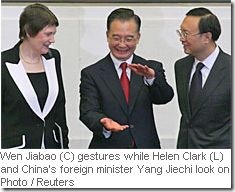
Clark_ChineseTrade Free trade?  Free trade doesn't come with tariffs, employment restrictions and other protectionist restraints on trade.  It doesn't come with pages and pages of agreements on duties, tariffs and quotas, and the continued entanglement of the state with economics.  Free trade is what it says it is: trade that's free of all government restrictions on sellers and buyers.

Genuinely free trade doesn't need pages and pages of lofty documents to protect them -- all that capitalist acts between consenting adults need to flourish is the disentanglement of the state from the loading docks and business houses of importers and exporters.  It's said that the US Declaration of Independence was written on one piece of parchment, and the ten commandments on two pieces of stone, but the European Union regulations on trade in bananas fill four hefty volumes that are less readable than a your average book of Chinese algebra. That's not how genuine free trade looks.

On that basis, the agreement the New Zealand government has just signed is not a free trade deal, but merely a freeish trade deal.

But that's still a good thing.   And it's damned exciting  to see two countries letting the breath of freeish air blow through their trade relations .. and damned refreshing to see politicians from all persuasions celebrating the opening up of trade and to announcing the slow abandonment of protectionism.  What we have today is better than we had yesterday -- even if it's not as good as we'll have in 2019 when the last of the tariffs is supposed to run out -- and more than you'd expect from two governments both on the reddish end of the political spectrum.

For those opposed, let's just remind ourselves of the chief benefits of trade:

  • There's the "double thank you moment." When you and I engage in trade -- let's say I pay you ten-thousand dollars for a container-load of iPods -- what we've both decided is that I value the iPods more than the ten-thousand dollars, whereas you value the money more than the noise-making equipment. We both win -- and the economy is the richer because both my money and your goods have moved to people who value them the most, and who can put them to the most productive ends -- and we all get to fill our homes and our counting houses with the stuff that we most want.

    This is a good thing, and it's proof again there's nothing "invisible" about Adam Smith's invisible hand. Trade benefits everyone.  "It is not from the benevolence of the butcher, the brewer or the baker that we expect our dinner, but from their regard to their own self-interest." The butcher, the brewer and the iPod-maker "direct [their] industry in such a manner as [their] produce may be of the greatest value," and we are the beneficiaries of their labours and their trade -- each intends only his own gain, but by the blessing of trade he is, said old Adam, "led by an invisible hand to promote an end which was no part of his intention."
  • International trade is a prime example of the virtue of comparative advantage, from which we all benefit.  Land-locked Switzerland for example produces watches and banking services in order to buy food and sailors, whereas we produce wool, beef, dairy products and sailors in order to buy the world's manufactured goods (and since most of these are now being manufactured in China, it's easy to see why trade with China is a good thing).  We all produce in order to trade, and the end result of all this industry is that the whole world is made better by the fact that we all specialise in doing what we do best: there are more watches, more food, more dairy products, more manufactured goods (and better and richer sailors) than there would be in the world if we all closed our borders and tried to do everything ourselves.

And let's remind ourselves that this is the reason we go to work every day: to be able to buy stuff that keeps us and our families alive and flourishing.  All that those remaining tariffs are going to do is make it more expensive for Ma and Pa Home-Owner to buy the stuff they need to make their homes better. Free trade makes everyone more prosperous (just look at that graph to the right for example to see what lowering tariffs, decreasing protectionism and increasing trade did for the US.)

Not everyone can see these benefits however, or if they do recognise them they raise other issues.

  • There are people who will argue that free trade kills local jobs. Just think for a moment about that. It certainly closes down jobs in industries and companies that don't perform well, and are doing things we don't do best -- but what it does by opening up trade is making goods cheaper for everybody who is working, leaving money in their pockets to buy from industries making use of that newly available labour to enter production in areas in which we're more productive.  In other words, trade allows us to move labour from less productive to more productive areas of industry, which will probably involve greater specialisation and increased comparative advantage.

    Everybody kicks a goal, and we're all made wealthier by it.  (And that's the case whatever China or anyone else does with regard to tariffs on our own exports.)
  • There are people who argue that trade with China encourages a government that persists in human rights abuses.  It's true: it does.  Recent events in Burma and Tibet and the ongoing human rights abuses and continuing existence of slave labour gulags suggest that with the Olympics just months away, Chinese politics now looks little different to Chinese politics at the time of the Tiananmen Square massacre

    But as we read news of Buddhist monks being shot on the streets of Lhasa, the chief question to consider is, "What can we do?"  The main thing to ask yourself whether free trade will 'open up' China more effectively than the Olympics, and the answer is "Of course.

    No one should ignore the liberating force that is free trade. Blockades and embargoes haven't made either Cuba or North Korea more free.  Imagine for example if trade with Cuba had been left as free as trade with Vietnam -- instead of fifty years of blockade and oppression and Old Busy Whiskers, Cubans would instead have been rewarded with the benefits of trade and the fruits of industry, and Old Busy Whiskers would be a long forgotten footnote in history.  Think about the example of trade and liberalisation provided by Hong Kong -- a beacon to all of us, let alone China -- and a prime example of how trade makes even the residents of a resource-free rock richer than Croesus could even dream about, and gives them all greater freedom.  Think about that when you oppose free trade on this basis.
  • There are people too who argue that trade with China will empower its military.  This is an argument that on the face of it has more legs, but on closer inspection is seen as just as illusory.  As Frederic Bastiat used to point out (and there's still no one better to read on the subject of free trade), "where goods don't cross borders, then armies will."  "Countries that trade," points out Bastiat commentator Lew Rockwell, "have a mutual stake in the preservation of open, friendly relations. This is one reason that free commercial activities promote peace, and why protectionism and trade sanctions generate war tensions...  Our lives – by which I mean the lives of regular people in [NZ] and in China – are made immeasurably better because of the freedom to trade. Our networks of exchange build private-sector prosperity in both countries."  This is a lesson learned by Japan and Japan's enemies in the death and destruction of the Second World War -- and if they'd read Bastiat instead of Clausewitz they would have learned it long before -- that when it comes to gaining a world full of resources, production and trade beats blockades and conquest every time.

    So we have to conclude again that as long as trade with China excludes trade in weapons (and Raykon aside, we hardly have any sort of comparative advantage in this area), then this is another argument that fails.

The fact is that this freeish trade deal is something to celebrate, just as it's something to celebrate that so many commentators are prepared to celebrate it.  That' real cause for a double celebration.  Cheers!

UPDATE: Not all commentators are prepared to celebrate. John Minto, as you may have guessed, isn't prepared to celebrate. He had an anti-trade piece in the Christchurch Press yesterday. Paul Walker makes a few comments on his article here, and good ones they are too. He concludes, not unreasonably, "Mr Minto should enrol in a first year economics course, he would learn much. But he would then have to buy the textbook ... and that is most likely to be imported."

Monday, 7 April 2008

'The Toxicity of Environmentalism'

I first read George Reisman's article 'The Toxicity of Environmentalism' back in the early nineties, and over the weekend I heard it for the first time, recorded at a its delivery at the University of Minnesota in 1991.

Galt it's good.

It could have been delivered yesterday.  Seventeen years after he told a stunned audience they were part of a "so-called intellectual mainstream of the Western world [that] has been fouled with a whole array of intellectual toxins resulting from the undermining of reason and the status of man" -- intellectual toxins that "can be seen bobbing up and down in the 'intellectual mainstream,' just as raw sewage can be seen floating in a dirty river" -- his analysis of why the scaremongering predictions of environmentalists would be proved wrong has proved correct; his dissection of the environmental movement's toxicity (toxic not just at the level of parts per million, but "at the level of parts per ten") is still accurate; and his analysis of the fundamental premise of environmentalism -- ie., the intrinsic value of nature -- as fundamentally anti-human is still right on the money.

Yes, this post describing his talk is long, and the article and talk are even longer, but the seventeen years that have passed since its inception have only proved its veracity.

That the scaremongering predictions of environmentalists have and are being proved wrong gives Reisman no claim to any power to predict the future.  As he says:

    The reason that one after another of the environmentalists' claims turn out to be proven wrong is that they are made without any regard for truth in the first place. In making their claims, the environmentalists reach for whatever is at hand that will serve to frighten people, make them lose confidence in science and technology, and, ultimately, lead them to deliver themselves up to the environmentalists' tender mercies. The claims rest on unsupported conjectures and wild leaps of imagination from scintillas of fact to arbitrary conclusions, by means of evasion and the drawing of invalid inferences. It is out and out evasion and invalid inference to leap from findings about the effects of feeding rats or mice dosages the equivalent of a hundred or more times what any human being would ever ingest, and then draw inferences about the effects on people of consuming normal quantities. Fears of parts per billion of this or that chemical causing single-digit deaths per million do not rest on science, but on imagination. Such claims have nothing to do either with actual experimentation or with the concept of causality.

Causality is the all-too frequently overlooked key to rejecting the majority of the scaremongering science in advance.

When, for example, genuine causes of death, such as arsenic, strychnine, or bullets, attack vital organs of the human body, death is absolutely certain to result in all but a handful of cases per million. When something is in fact the cause of some effect, it is so in each and every case in which specified conditions prevail, and fails to be so only in cases in which the specified conditions are not present, such as a person's having built up a tolerance to poison or wearing a bulletproof vest. Such claims as a thousand different things each causing cancer in a handful of cases are proof of nothing but that the actual causes are not yet known--and, beyond that, an indication of the breakdown of the epistemology of contemporary science. (This epistemological breakdown, I might add, radically accelerated starting practically on the very day in the 1960s when the government took over most of the scientific research ... and began the large scale financing of statistical studies as a substitute for the discovery of causes.)

Reisman is particularly scathing on the subject of global warming, and remind yourself when you read this that he was saying this in 1991:

    The environmental movement maintains that science and technology cannot be relied upon to build a safe atomic power plant, to produce a pesticide that is safe, or even to bake a loaf of bread that is safe, if that loaf of bread contains chemical preservatives. When it comes to global warming, however, it turns out that there is one area in which the environmental movement displays the most breathtaking confidence in the reliability of science and technology, an area in which, until recently, no one--not even the staunchest supporters of science and technology--had ever thought to assert very much confidence at all. The one thing, the environmental movement holds, that science and technology can do so well that we are entitled to have unlimited confidence in them is forecast the weather--for the next one hundred years!
   
It is, after all, supposedly on the basis of a weather forecast that we are being asked to abandon the Industrial Revolution...

This is not the act of "prudence and caution" so often cited as exemplifying the so called 'precautionary principle'; it would be neither prudent nor cautious to throw away the almost unlimited boon that past generations bestowed on us by virtue of the Industrial Revolution.  To abandon industrial civilization, and the enormous increase in wealth, health and life expectancy it brought, simply to avoid predictions of bad weather -- predictions that we now know were flawed from the outset -- would be quite simply insane.

   If we destroy the energy base needed to produce and operate the construction equipment required to build strong, well-made, comfortable houses for hundreds of millions of people, we shall be safer from the wind and rain, the environmental movement alleges, than if we retain and enlarge that energy base. If we destroy our capacity to produce and operate refrigerators and air conditioners, we shall be better protected from hot weather than if we retain and enlarge that capacity, the environmental movement claims. If we destroy our capacity to produce and operate tractors and harvesters, to can and freeze food, to build and operate hospitals and produce medicines, we shall secure our food supply and our health better than if we retain and enlarge that capacity, the environmental movement asserts.
   
There is actually a remarkable new principle implied here, concerning how man can cope with his environment. Instead of our taking action upon nature, as we have always believed we must do, we shall henceforth control the forces of nature more to our advantage by means of our inaction. Indeed, if we do not act, no significant threatening forces of nature will arise! The threatening forces of nature are not the product of nature, but of us! Thus speaks the environmental movement.
   
All of the insanities of the environmental movement become intelligible when one grasps the nature of the destructive motivation behind them. They are not uttered in the interest of man's life and well-being, but for the purpose of leading him to self-destruction.

That's the key to his argument.  Here's the kernel:

    Such statements [as these from David Graber & Steve McKibben et al hoping for "the extinction of the human species"] represent pure, unadulterated poison. They express ideas and wishes which, if acted upon, would mean terror and death for enormous numbers of human beings.
   These statements, and others like them, are made by prominent members of the environmental movement. The significance of such statements cannot be diminished by ascribing them only to a small fringe of the environmental movement. Indeed, even if such views were indicative of the thinking of only 5 or 10 percent of the members of the environmental movement - the "deep ecology," Earth First! wing - they would represent toxicity in the environmental movement as a whole not at the level of parts per billion or even parts per million, but at the level of parts per hundred, which, of course, is an enormously higher level of toxicity than is deemed to constitute a danger to human life in virtually every other case in which deadly poison is present.
    But the toxicity level of the environmental movement as a whole is substantially greater even than parts per hundred. It is certainly at least at the level of several parts per ten. This is obvious from the fact that the mainstream of the environmental movement makes no fundamental or significant criticisms of the likes of Messrs. Graber and McKibben.

The point is analogous to the one made frequently about the silence of so-called 'moderate Muslims' in the face of atrocities committed in Allah's name: if they truly opposed the extremists, then why the silence?  But this only explains Reisman's title - his talk goes much further. In order to survive, man either exploits the earth or dies.  In doing so, what we actually do is improve the environment, not destroy it:

    It is important to realize that when the environmentalists talk about destruction of the "environment" as the result of economic activity, their claims are permeated by the doctrine of intrinsic value. Thus, what they actually mean to a very great extent is merely the destruction of alleged intrinsic values in nature such as jungles, deserts, rock formations, and animal species which are either of no value to man or hostile to man. That is their concept of the "environment." If, in contrast to the environmentalists, one means by "environment" the surroundings of man--the external material conditions of human life--then it becomes clear that all of man's productive activities have the inherent tendency to improve his environment--indeed, that that is their essential purpose...
    Thus, all of economic activity has as its sole purpose the improvement of the environment--it aims exclusively at the improvement of the external, material conditions of human life. Production and economic activity are precisely the means by which man adapts his environment to himself and thereby improves it.
    So much for the environmentalists' claims about man's destruction of the environment. Only from the perspective of the alleged intrinsic value of nature and the nonvalue of man, can man's improvement of his environment be termed destruction of the environment.

Consider in this context the implications of environmental restrictions on producing energy and (here in NZ) the more-than-decade-long stranglehold on the construction of new power plants, which amount to a full-scale manifesto for anti-industrialism:

    The essential feature of the Industrial Revolution is the use of man-made power. To the relatively feeble muscles of draft animals and the still more feeble muscles of human beings, and to the relatively small amounts of useable power available from nature in the form of wind and falling water, the Industrial Revolution added man-made power....
    This man-made power is the essential basis of all of the economic improvements achieved over the last two hundred years. Its application is what enables us human beings to accomplish with our arms and hands the amazing productive results we do accomplish. To the feeble powers of our arms and hands is added the enormously greater power released by these sources of energy. Energy use, the productivity of labor, and the standard of living are inseparably connected, with the two last entirely dependent on the first...
    In total opposition to the Industrial Revolution and all the marvelous results it has accomplished, the essential goal of environmentalism is to block the increase in one source of man-made power after another and ultimately to roll back the production of man-made power to the point of virtual nonexistence, thereby undoing the Industrial Revolution and returning the world to the economic Dark Ages. There is to be no atomic power. According to the environmentalists, it represents the death ray. There is also to be no power based on fossil fuels. According to the environmentalists, it causes "pollution," and now global warming, and must therefore be given up. There is not even to be significant hydro-power. According to the environmentalists, the building of the necessary dams destroys intrinsically valuable wildlife habitat.
    Only three things are to be permitted as sources of energy, according to the environmentalists. Two of them, "solar power" and power from windmills, are, as far as can be seen, utterly impracticable as significant sources of energy. If somehow, they became practicable, the environmentalists would undoubtedly find grounds for attacking them. The third allowable source of energy, "conservation," is a contradiction in terms. "Conservation" is not a source of energy. Its actual meaning is simply using less. Conservation is a source of energy for one use only at the price of deprivation of energy use somewhere else.
    The environmentalists' campaign against energy calls to mind the image of a boa constrictor entwining itself about the body of its victim and slowly squeezing the life out of him. There can be no other result for the economic system of the industrialized world but enfeeblement and ultimately death if its supplies of energy are progressively choked off.

The reason for the anti-industrial thrust of environmentalism is the anti-human principle of so-called "intrinsic values" -- the idea that condemns a man for example for the crime of cutting a path through his farm down to the local beach, a home-builder for the crime of seeking to build in and enjoy a pristine landscape, and a power company for the crime of seeking to produce more power from an already existing power plant -- "something which provides an explanation in terms of basic principle of why the mainstream of the ecology movement does not attack what might be thought to be merely its fringe":

    [The idea of 'intrinsic value' of nature] is a fundamental philosophical premise which the mainstream of the movement shares with the alleged fringe and which logically implies hatred for man and his achievements. Namely, the premise that nature possesses intrinsic value--i.e., that nature is valuable in and of itself, apart from all contribution to human life and well-being...
    The premise of nature's intrinsic value extends to an alleged intrinsic value of forests, rivers, canyons, and hillsides--to everything and anything that is not man...
    The idea of nature's intrinsic value ... implies a perception of man as the systematic destroyer of the good, and thus as the systematic doer of evil. Just as man perceives coyotes, wolves, and rattlesnakes as evil because they regularly destroy the cattle and sheep he values as sources of food and clothing, so on the premise of nature's intrinsic value, the environmentalists view man as evil, because, in the pursuit of his well-being, man systematically destroys the wildlife, jungles, and rock formations that the environmentalists hold to be intrinsically valuable. Indeed, from the perspective of such alleged intrinsic values of nature, the degree of man's alleged destructiveness and evil is directly in proportion to his loyalty to his essential nature. Man is the rational being. It is his application of his reason in the form of science, technology, and an industrial civilization that enables him to act on nature on the enormous scale on which he now does. Thus, it is his possession and use of reason--manifested in his technology and industry--for which he is hated....
    When does the doctrine of intrinsic value serve as a guide to what man should do? Only when man comes to attach value to something. Then it is invoked to deny him the value he seeks. For example, the intrinsic value of the vegetation et al. is invoked as a guide to man's action only when there is something man wants, such as oil, and then, as in the case of Northern Alaska, its invocation serves to stop him from having it. In other words, the doctrine of intrinsic value is nothing but a doctrine of the negation of human values. It is pure nihilism.

That, dear reader, is the essential reason that anti-capitalism and anti-reason are linked; it is the chief reason the local Green Party's MPs appear far less concerned with "a wild and healthy planet" than they are with nannying, nationalism, nihilists and the nationalisation of NZ's children; and in point of fact it's the primary reason that yesterday's reds are now reincarnated as today's greens.  The link is clear enough, and was confirmed for me by a self-described communist who eagerly abandoned the Alliance to hop aboard the Greens when their new political vehicle looked ripe for takeover.  Says Reisman on this point:

    In my judgment, the "green" movement of the environmentalists is merely the old "red" movement of the communists and socialists shorn of its veneer of science. The only difference I see between the greens and the reds is the superficial one of the specific reasons for which they want to violate individual liberty and the pursuit of happiness. The reds claimed that the individual could not be left free because the result would be such things as "exploitation" and "monopoly." The greens claim that the individual cannot be left free because the result will be such things as destruction of the ozone layer and global warming. Both claim that centralized government control over economic activity is essential. The reds wanted it for the alleged sake of achieving human prosperity. The greens want it for the alleged sake of avoiding environmental damage. In my view, environmentalism and ecology are nothing but the intellectual death rattle of socialism in the West, the final convulsion of a movement that only a few decades ago eagerly looked forward to the results of paralyzing the actions of individuals by means of "social engineering" and now seeks to paralyze the actions of individuals by means of prohibiting engineering of any kind.

If you've never read Reisman's essay 'The Toxicity of Environmentalism' -- and even if you have -- then now's the time to download and print it out and read or re-read it.  Print out a copy and share it around [here's a PDF version to make it easy; and here's a pre-printed pamphlet]. It could have been written yesterday; understanding his main point will help determine tomorrow.

Friday, 28 March 2008

Biofuels boondoggle gaining attention

The biofuels boondoggle is gaining increasing attention, both here and overseas, and not before time.  Bread riots in the Twenty-First century?  That's something only governments and subsidy-seeking 'businessmen' could achieve.  Unconcerned that laws requiring so called 'sustainable' fuels will result in exorbitant fuel price rises of "just" fifteen percent or more?  That's something you'd think only a Green politician could be doing -- but no, they're all doing it -- all of them suggesting against the evidence that talking about alternative fuels and including the magic word "sustainability" in the biofuels bill will somehow, like magic, make everything alright.

It's dumb.

The boondoggle is getting attention, but its dangerous momentum seems almost inexorable.  Once again, the lesson of the law of unintended consequences will be demonstrated by the spectacle of politicians once again making the world worse, and voters blithely voting for more of the same.

Tuesday, 25 March 2008

Still no April Sun in Cuba

Some food for thought here for fans of communist dictators -- and for opponents and supporters of free trade:

   In 1958, Cuba was almost as rich as Japan, one and half times as wealthy as Singapore, richer than Hong Kong, and three times as prosperous as South Korea.
   Fifty years later, Cuba is one of the poorest countries in Latin America.
   Meanwhile, jurisdictions such as Hong Kong, Singapore, South Korea and Taiwan (the latter two also had dictators and problems similar to Cuba in the 1950s) have long eclipsed Cuba. They've done so not only in per capita wealth, but in measurements Castro's defenders point to when they assert the Marxist revolution "worked," such as in health care and education...

As Paul Walker comments, "GDP per person isn't a perfect measure of well being, but it is a rough guide to average living standards. And by that standard Castro has much to answer for."

Yes, he does.  But here's something else to think about, too:  given all we know about the liberating effects of free trade (see even the nominally communist Vietnam, for instance) -- and as we consider the merits of free trade with China -- and I invite readers to speculate on the state of Cuba and Castro and the country's communism today if the US had gone for free trade instead of blockade.  How liberating would fifty decades of free trade with Cuba have been, and what would have happened to Busy Whiskers and his communism if such a policy had been applied by the US?

Saturday, 15 March 2008

I got pointed to World Climate Report from Denis Dutton's Climate Debate Daily, where three recent articles caught my eye:

Monday, 3 March 2008

Freedom to starve?

More freedom, less government.  Yes, you hear me banging on about that very thing every day here at NOT PC, so it's occasionally worthwhile to pause and ask what freedom actually means.

Freedom means one thing and one thing only: being free from physical coercion.  It's that simple.  Freedom both from criminal coercion - which is why we have governments in the first place, to protect us against aggressors -- and freedom too from political coercion.  This last is harder to achieve, since while many governments fall down in their duty to protect their citizens from criminal coercion, most are assiduous in ensuring at least a minimum of political coercion.

So much, so simple to define. 

The forces of coercion never sleep, however.  They are forever alert to any new ways by which to inject their toxicity into the body politic.  One very successful form of poison is the gradual redefinition of the word 'Freedom' -- one whose currency rose at that same time as did that of the modern big government liberal.  No coincidence.  This view baldly declares that a starving man isn't free, that the only freedom that matter is freedom from want --  and that big government is the only means by which 'freedom from want' can be guaranteed.  Thus, by the stroke of a a redefinition, was classical liberalism transformed into big-government liberalism.

The cunning thing about this more recent illegitimate formulation that astute readers will already have recognised is that it altogether wipes out the earlier legitimate idea, as Ben O'Neill explains at the Mises blog,

This conception of liberty conflates two very different types of freedom: freedom from coercion by other men and freedom from the personal requirement of satisfying our own basic survival needs. While these are presented as two parallel requirements of liberty they are, in fact, mutually exclusive. So long as man exists he will have material needs, and the only way that he can escape personal responsibility to satisfy these needs is to impose this responsibility on others. If this imposition is undertaken by others voluntarily then both the libertarian and the modern liberal are in agreement — both condone voluntary charity. But this is not what modern liberals propose. Rather, they impose this duty to help the needy by force of law under the auspices of the welfare state. Under this system, all are forced to contribute to the cost of providing for the needs and alleged needs of others.

Despite any rhetoric to the contrary, this welfare state established by modern "liberals" does nothing to reconcile the contradiction between freedom from men and freedom from nature — it merely sacrifices the former in an attempt to obtain the latter.

As I've characterised it before, the difference between the two views is stark: one seeks to bar the initiation of physical force from human affairs, while the other declares that force is necessary in order to secure the means of survival of one person (the starving man), at the cost of enslaving another (the man whose food must be taken to help the starving).  One sense of freedom is to live free from aggression; the other is to seek to live free from the laws of nature, and at someone else's expense.

The latter bogus view of freedom wipes out the former legitimate and vitally important concept of what freedom is, and why it is necessary.

I recommend reading Mr O'Neill's piece in its entirety in order to defend yourself against the sophists of political argument who redefine the idea of freedom only in order to destroy it, and to reflect again on the point succinctly summarised by Ayn Rand:

Freedom, in a political context, has only one meaning: the absence of physical coercion.

Thursday, 11 October 2007

Biofuel boondoggle exposes Green snake oil

FOR YEARS, ENVIRONMENTALISTS HAVE been opposing new energy production and the use of fossil fuels. They've banged on instead about abstinence, about "renewable" energy systems, about biofuels, and for some reason they've been taken seriously. There's been an assumption they know what they're talking about, and that their solutions are viable and been thought through.

They haven't been.

As would-be power producers here in New Zealand have been refused permission under the RMA to construct power plant after power plant (or been granted permission with so many conditions attached as to make production imposssible), environmentalists like Jeanette Fitzsimplesimons have applauded the refusals, and hailed such decisions as the end of "old energy" and the beginning of "new energy." As each consent was opposed and each new power station was declined permission to produce, the cry has gone up from environmentalists: "Let's use renewables."

But "renewables" just aren't available. What distinguishes "new energy" from "old energy" it seems is that while "old energy" is reliable and actually produces energy, so called "new energy" is still experimental, and doesn't. It's the modern day equivalent of snake oil. While "old energy" fuels world industry, "new energy" still requires your money to prop it up, and barely scratches the surface of the sort of capacity required for a modern industrial nation. Said Australian PM John Howard recently, (and accurately):
Let's be realistic. You can only run power stations in a modern Western economy on fossil fuel, or, in time, nuclear power."
Alan Jenkins from NZ's Electricity Networks Association issued a similar warning two years ago which has still been widely undigested, saying
It's very hard to invest in coal [because of Kyoto], nuclear's a sort of four letter word... hydro is suddenly becoming too hard... what's left? ...we can't do everything on windpower.
BUT WE DON'T LEARN, do we. The anti-industrialists are still taken seriously.

Take the example of biofuels, for which environmentalists like Jeanette Fitzsimplesimons have also been clamouring for years, and here we are just one year away from having them imposed upon us in the name of "lowering carbon emissions," and it turns out that biofuels are not only going to send food prices through the roof (and are already causing food fights in Europe and elsewhere), are not only going to cause increased forest clearance and decreased biodiversity, but as Der Speigel magazine summarises Biofuels 'Emit More Greenhouse Gases than Fossil Fuels':
A team of researchers led by Nobel-prize winning chemist Paul Crutzen has found that growing and using biofuels emits up to 70 percent more greenhouse gases than fossil fuels. They are warning that the cure could end up being worse than the disease.

Biofuels, once championed as the great hope for fighting climate change, could end up being more damaging to the environment than oil or gasoline. A new study has found that the growth and use of crops to make biofuels produces more damaging greenhouse gases than previously thought.
This is a classic example of "unintended consequences" from idiotic top-down technical-economic policies.

Does this bother the likes of Fitzsimplesimons? Do we hear themNot a whit! As my colleague Greg Balle says, the Greens and their fellow travellers should be taken severely to task for these atrocious policies and bad ideas that they wish to have imposed on transport, food and economic systems without even the virtue of decent research to back them up.

Instead, they get a free run in the media -- and now Fitzsimplesimons says it has become the fault of "gas-guzzling rich westerners" ahead of "the stomachs of the very poor."

The woman is mad. These Green idiot ideologues have been calling for biofuels for decades without having even the first clue as to the actual implications of such policies and at the first sign of a reality check they won't even take the blame for their crazy policies. This is Soviet era policy making on the hoof writ large once again, with fuzzy Lysenko-like Green "solutions" enforced by central governments globally.

WHY ARE THEY TAKEN seriously? Do they really know what they're talking about? Have they any clue at all about the full implications of wind, solar and other uneconomic technologies being made mandatory while reliable power production is slowly strangled? Why are they so ignorant about the powerful and positive effect of property rights on the environment? Why do they remain ignorant of the role of price signals in reducing scarcity? When will they stop meddling with the free market and let genuine solutions find their way through, as they have since time immemorial?

The easy certainties that many of them want enshrined in law would do less for the planet than just letting price signals, property rights and human ingenuity do the job they're supposed to: send information on resources and markets and avoid the destruction of environments, while leaving the productive free to invent new ways of doing thing.

And when will media commentators begin asking them serious questions to see if they have the first clue about the serious implications of their immature 'sky-is-falling' play-acting.

UPDATE 1: Bloggger 'Classically Liberal' asks Which National Leader really Hates the Poor? [hat tip Lindsay M]
What would you call a government that intentionally promoted a policy that increased world hunger and gave subsidies to the better off at the expense of the poorer members of their own society?
UPDATE 2: So the Government's Energy Strategy is released again today, just as it was in December. As I said of the December release, this is not a hard-headed energy strategy to produce more of the energy we desperately need -- instead, "Ministers would tell state owned generators there was no need for new baseload fossil fuel generation for the next ten years" -- but a feelgood fumbling to fight a fiction with more top-down foolishness: Hugs, cuddles, electric cars, warmer houses and a renewed focus on "renewables" -- and more statements making it plain that the production of real industrial-level energy will become more difficult.

Why are they allowed to get away with this?

Monday, 17 September 2007

The effects of global warming are already upon us

Looks like the effects of global warming are already upon us, and will soon hit the pockets of consumers and home-owners.

That is, despite there being at best only threadbare evidence of human effect on climate, and there being little evidence (if any) for the worldwide climate forecast to be catastrophic, we're already seen the all too real effect of global warming in legislation and regulation designed to limit human activity, and human industry -- and now something else is about to hit us both here in NZ, and worldwide.

The latest effect of the threadbare global warming bandwagon will be increased power and fuel prices (courtesy of the Clark Government's 'cap and trade' emissions scheme to be announced Thursday, probably to the applause of John Boy Key), and rapidly increasing worldwide food prices due in part to increasing demand from Asia and India, but also crucially because acreages normally used to produce food are being used instead to produce biofuels. Protests over rapidly rising pasta, baguette and tortilla prices have already been seen in Italy, France and Mexico respectively. As more than one British commentator has suggested, "The era of cheap food is over." If true, then we we have human-induced global warming hysteria to thank for it.

So, big and probably permanent price rises coming up then for power, for fuel and for food -- and, once the world's central bankers catch up, higher interest and mortgage prices to dampen down what they will no doubt be calling "inflation."

The effects of global warming are already upon us -- specifically, the effect of irrational behaviour in pursuit of a pathetic charade.

UPDATE 1: "Global warming is an entirely natural phenomenon and its effects can even be beneficial, according to two leading researchers." They "have looked at the work of more than 500 scientists and concluded that it is very doubtful that man-made global warming exists" and that GW itself is beneficial. Story here. [Hat tip Marcus.]

UPDATE 2: Meanwhile, while we can be assured that whatever Clark can do Key will do even wetter, The Observer has found a list of environmental and safety policies that Key's UK idol Wavy Davy Cameron is contemplating. These include:
  • Household recycling to become easier by making it mandatory for all new houses to be built on land-fill sites, thus cutting out the middle man. Rubbish simply to be tipped out of the back door or first-floor windows.
  • Anyone taking a long-haul flight must pay for two seats. The seat next to the passenger to be occupied by a tree, to be planted at the destination.
  • All cars to be edible and consumed at end of journey.
  • Carrot-and-stick approach to car pollution. Research into whether it's possible to come up with a car engine that runs on carrots and sticks.
  • Everyone to wear a permanent seatbelt, which they then attach to whatever motor vehicle they get into.
  • A height tax to encourage couples to have shorter children.
Expect to hear the more idiotic of these announced here soon.

UPDATE 3: Cameron's actual policies are even more absurd than the satire, if that's possible. [Hat tip No Minister].