"A spectre haunts debates about governance: the idea of benevolent and efficient dictatorship. Where democratic leaders haggle, delay, and pander, the authoritarian ruler simply acts. Where elected governments bend to lobbyists and electoral cycles, a dictator [it's alleged] is in for the long haul. ...
"Beijing officials invoke it to explain the rise of China; climate activists to argue that the planetary emergency demands that we put democracy on pause; populists to suggest that current institutions are broken and that a fresh start and setting the popular will free requires a firm and unchecked hand. ...
"However, a large body of studies of how democracies and autocracies actually perform across regions, over centuries, and in domains ranging from economic growth to military effectiveness to environmental protection have questioned this story. They do not show autocracies to be superior—on the contrary, the autocratic temptation is, in most domains, a mirage, or even a trap. Not only are democracies morally preferable because they recognise the political equity and dignity of citizens; they also tend to work better. ...
"Countries that successfully consolidate free and fair elections face substantially lower risks of civil war ... Citizens who can kick out the opposition at elections are less inclined to take to the streets with weapons.
"[D]emocracies have been accused of weakness in warfare. ... Yet the long-term record is unambiguous: since 1815, democracies have won more than 80 percent of the wars they have fought. ...
"Democratic institutions protect property rights in a way that encourages the private investment that drives productivity. And the open circulation of ideas across universities, a free press, and competitive markets is not a distraction from growth but one of its primary engines. Studies show that, on average, democracies enjoy a modest but robust long-run growth advantage over autocracies, and that this advantage strengthens with the quality and longevity of democratic institutions.
"More telling than average growth rates, however, is the frequency with which disasters strike. Unchecked political authority not merely fails to deliver growth; rather, it periodically produces catastrophes. Mao’s Great Leap Forward between 1958 and 1962 killed tens of millions through an entirely man-made famine, a consequence of ideological fantasy insulated from the real world. The Soviet collectivisation campaign produced similar horrors two decades earlier. Comparable disasters in democratic states are virtually unknown—not necessarily because democratic leaders are wiser or more virtuous, but because they face institutional constraints and public scrutiny that make disastrous policies impossible to sustain.
"The most advanced economies in the world are democracies. The handful of countries that have joined the ranks of wealthy, high-technology societies over the past century, including South Korea, Taiwan, Israel, and Ireland, made at least the final leap under democratic governance. Singapore is the sole exception to this rule. Autocratic regimes can mobilise resources to achieve middle-income status, as China has done. But the transition to a knowledge-based economy requires the rule of law, the protection of intellectual property, and the freedom to challenge received wisdom—all of which are systematically undermined under dictatorship. ...
"At a time when open societies face serious pressure from within and without, the temptation to admire their alternatives is understandable. But admiration is not a sound foundation for political judgment, especially not when it is based on a selective reading of the evidence. The autocratic temptation promises fortitude and efficiency—but too often, it only produces chaos and mismanagement; and, occasionally, it delivers disaster."
"While the share of people in extreme poverty has been falling since the 19th century, the total number didn’t begin to decline [at scale] until the late 20th century, when [communism collapsed and] rapid economic growth spread worldwide.
"Since then, poverty has fallen to the lowest level ever recorded."
"The end is nigh – not for the world, but for the climate industrial complex. It has been a decline brought about mainly by the sheer reality of energy economics in the developing world.
"Published by the International Energy Agency (IEA), the “World Energy Outlook 2025” reads like an obituary for the fantasy of global decarbonisation, acknowledging the undeniable truth that nations prioritising prosperity must unapologetically embrace coal, oil and natural gas.
"For years, the IEA and Western think tanks insisted that hydrocarbons were in structural decline, predicting a fatal drop in demand after 2030. Yet in the very document meant to track progress toward realising an absurd net-zero objective, the IEA concedes that demand for oil and natural gas will continue to grow well beyond 2035 and may not peak until 2050.
"The key insight of the IEA report is that emerging markets, excluding China, are becoming the primary drivers of growth in global energy consumption. This is a massive, structural shift. No longer will the trajectory of energy markets be dictated by the policies of Paris, Berlin or Washington but rather by the sovereign choices of nations whose citizens are desperate for better lives."
"Comparing the world today with that of 24 years ago, I am tempted to say that bin Laden lost the war on terror but is winning the clash of civilisations. ...
"It is not just that the West has been successfully penetrated by an antagonistic civilisation that fundamentally rejects the fundamental division between religion and politics - church and state - that lies at the heart of both Christianity and Judaism. The West is also being geopolitically outmanoeuvred by 'the rest' in just the way Huntington foresaw*.
"Contrast the global order after 9/11 with the global order today. We have come a long way since NATO secretary-general George Robertson’s statement on September 11, 2001 - 'Our message to the people of the United States is . . . "We are with you." '
"In the past three years, Zbig Brzezinski’s worst-case scenario has come about. 'Potentially, the most dangerous scenario,' he wrote in 'The Grand Chessboard' (1997), would be a grand coalition of China, Russia, and perhaps Iran, an ‘antihegemonic’ coalition united not by ideology but by 'complementary grievances' Since the Russian invasion of Ukraine, that grand coalition has come into being, with North Korea as a fourth member. The 'Axis of Upheaval' (China, Russia, Iran, and North Korea) are now cooperating in military, economic and diplomatic ways. Moreover, the Trump administration’s combative treatment of American allies (the European Union, Japan, South Korea) and neutrals (Brazil, India, and Switzerland), not least with respect to trade policy, is alienating not only the traditionally nonaligned but also key partners.
'The upshot is that Israel is now virtually alone in fighting against the Islamists, so that even the United States wants plausible deniability when, as this week, the Israeli Air Force strikes the leadership of Hamas in the Qatari capital, Doha.
'The point is that the clash of civilisation continues. Now ask yourself: Who’s winning?
... "[C]omparing the world today with that of 24 years ago, I am tempted to say that bin Laden lost the war on terror but is winning the clash of civilisations. That’s not to say his particular brand of Salafist jihadism is winning; it can even be argued that it’s in decline. Bin Laden’s creed was always too uncompromising to form alliances of convenience. By contrast, the pro-Palestinian 'global intifada' is much more omnivorous, and can easily absorb the old left (Marxism and pan-Arabism) and the new (anti-globalism and wokeism). ...
"At the same time, Western civilisation today is so much more divided than it was 24 years ago. The public response to 10/7 illuminated the divisions. Whereas older voters generally remain more pro-Israel than pro-Palestinian, younger cohorts have swung the other way. Perhaps that’s because to Gen-Z, 9/11 is a faint memory - as distant as the Cuban Missile Crisis and Kennedy’s assassination were to my generation. But it’s also because the Islamists have done such a good job of co-opting the campus radicals, somehow overriding the cognitive dissonance in slogans such as “Queers for Palestine,” while at the same time tapping the antisemitism that still lurks on the far right. ...
"Walking the streets of New York this week, I felt old. To my children, my students, and my employees, 9/11 is not a memory. It is not even an historical fact. It is something people argue about on social media. ...
"It has taken me all these years to understand that 9/11 really was a clash of civilisations. And it has taken me until this week finally to face the reality that ours is losing."
* Harvard political scientist Samuel Huntiongton, whose seminal essay on “The Clash of Civilizations” was published in 1993, aligning with the Princeton scholar Bernard Lewis, who had long argued that Islam was chronically unable to modernise.
It's hard to overstate how politically and historically tone-deaf Helen Clark & John Key are for showing up at a Chinese Communist Party "victory" party, complete with the world's biggest dictators, celebrating the end of the Second World War.
Politically tone-deaf for all the many reasons rolled out by mainstream commentators: being responsible for cementing New Zealand's free-trade deal with China (for which much credit to both) doesn't require attending the biggest Asian military parade since the Japanese army rolled into Manchuria.
Far from any credit going to Mao Zedong's Communist Party for resisting that invasion, it was instead the CCP's salvation. It gave them their best chance of survival, which they grabbed with both hands.
Far from fighting a patriotic war, Mao's rabble instead withdrew into Yenan, coming back from near-extinction far from the war zone while lighting joss sticks and praying to Marx for the destruction of Chiang Kai-Shek's Republican army at the hands of the Japanese.
So it wasn't "China" that fought off the Japanese. Because by and large the only "China" fighting there was Chiang Kai-Shek's Republican army, forced to fight the Japanese invasion while Mao's forces largely sat on their hands hoping for the best—keeping their powder dry ready for the civil war they started after the Japanese surrender and the exhaustion of Chiang Kai-Shek's army.
After resting up for several years while building its materiel and men, on the very day following Japanese surrender in China Mao's party headquarters issued orders to advance — taking over the country from north to south, finally seizing full control in 1949. (You can read all about the sorry tale in Anthony Kubek's brilliant How the Far East Was Lost.)
That neither Helen Clark nor John Key appeared to know anything about that history says very little for either, but their attendance at the revisionist parade would bring a quiet chuckle to Chinese organisers delivering the Big Lie to an international audience.
It would be even worse if Clark or Key did know the real history. That would be worse than a disgrace. It would be damning.
1937-45: Kuomintang (KMT) exhausts itself fighting Imperial Japan. CCP "hides its strength bides its time."
1945: Imperial Japan surrenders.
1947: US cuts back on aid to KMT.
1949: CCP, supported by Stalin, defeats an exhausted KMT. Captures China by Oct 1. KMT flees to Taiwan.
UPDATE: Historically tone-deaf to the CCP's stolen valour (the point of the cartoon above), and politically inept: just consider how the Financial Times, for example, summarises the event that Key and Clark endorsed. In short, it wasn't about free trade :
Chinese President Xi Jinping was selling his vision for a new world order this week. Hosting a regional security summit on Monday, Xi called on attendees including India’s Narendra Modi — Trump’s latest tariff target — and Russia’s Vladimir Putin to join China in leveraging their economic influence to challenge the west.
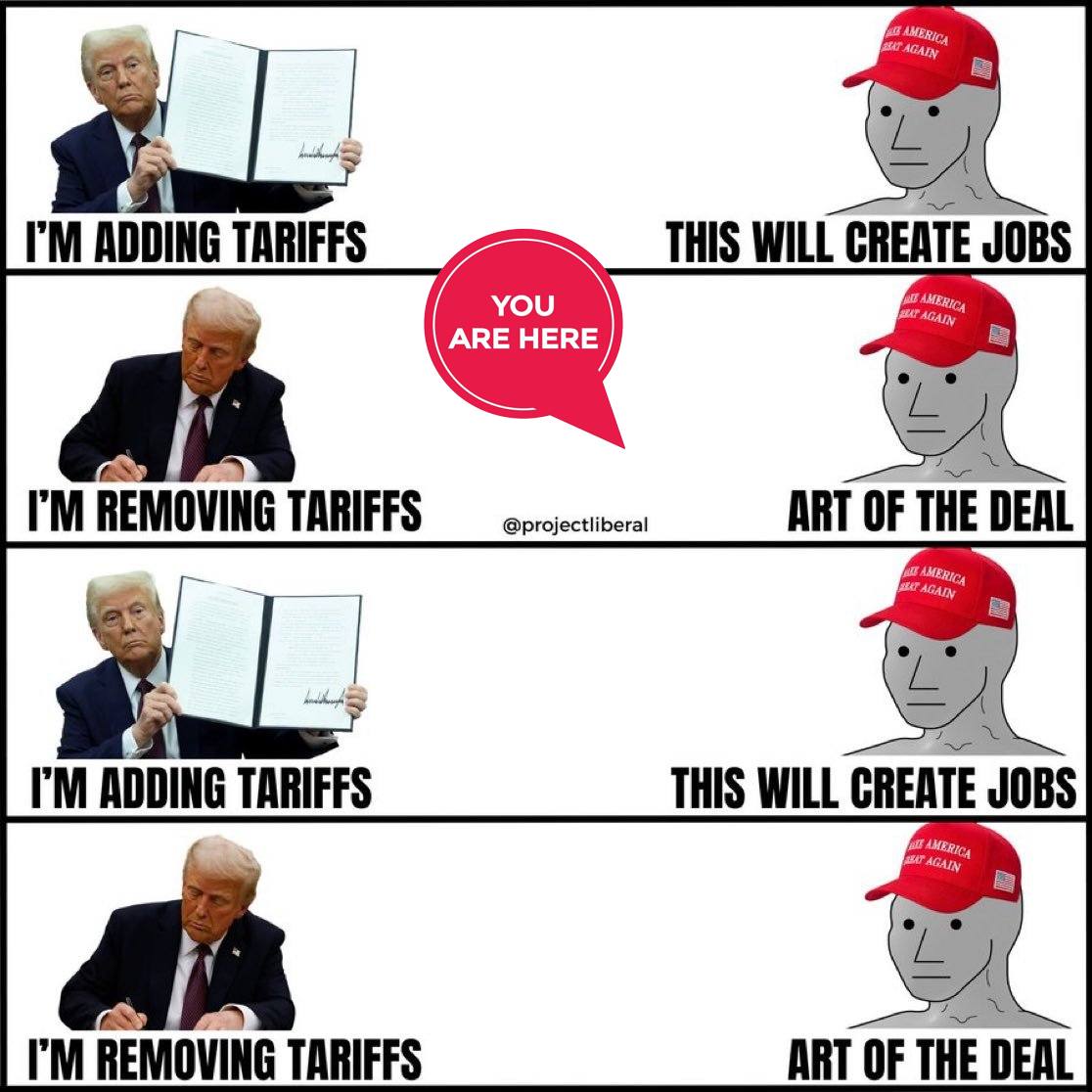
"MAGA—genuinely, explain the 'win' to me. The claim is this deal 'brought China to the negotiating table.' But… they were already there. We’re not further ahead than we were 90 days ago. No resolution. No structural wins. Just a 145% tariff that tanked the markets—now walked back to 30% so we can 'keep talking.' ...
"I’m asking a specific question: what was actually accomplished here? We’re in the exact same place we were 90 days ago. No structural reforms. No resolution. Just tariffs that were hiked, tanked markets, and then were walked back during joint talks both sides agreed to in Geneva. ...
"Nobody wanted the tariffs. They hurt consumers and businesses. Reducing them helps—but that’s not a victory. That’s just undoing damage we caused ourselves.
"And wasn’t the whole point of this to force companies to stop buying from China and make everything in America? So how exactly is that going to happen now? Seriously—I’m asking. Help me understand what was accomplished.
"I understand this wasn’t a unilateral move. The U.S. and China both sent delegations to Geneva and mutually agreed to lower tariffs for 90 days to de-escalate the trade war.
"There’s no evidence China begged us for relief—this was a joint decision to pause and keep talking. To me, it just looks like a temper tantrum that backfired. No strategy. No plan. Just retreat, then spin it as a win.
"Dialogue and negotiation were already happening before Trump’s 145% tariff stunt wrecked the markets. There’s no 'position of strength' here, he lit the fire, panicked when it backfired, then called the act of putting it out a victory. He doesn’t have more strength now…
"And no one’s demanding a full framework in 2 days, we are just calling out the fact that nothing was achieved except reversing his own mess. That’s not strategy. That’s spin. ...
"A 'Win'? China didn’t “drop” export controls—they paused them for 90 days as part of a mutual de-escalation agreement. That’s not a concession, it’s a temporary reset so both sides can keep negotiating. Nothing structural changed.
"A 'Win'? Our tariffs on China were 12% Trump jacked them up to 145%, tanked the markets, then walked them back to 30%. That’s not a win—it’s called cleaning up your own mess and calling it progress.
"A 'Win'? China’s tariffs dropped to 10%? Sure—after we started a trade war that forced them to hike them in the first place. Most of their original tariffs ranged from 5–15% and averaged 7.2% on key sectors. You’re bragging about partially undoing damage Trump caused. This wasn’t strategy. It was a tantrum, a retreat, and now you’re dressing it up like 3D chess, dipshit."
You don't need to wait to see what will happen. Trump's tariffs have already had a chance, and they've failed, explains Timothy Taylor.
President Trump set off a wave of protectionist trade policies about seven years ago, back in 2018, and those policies were mostly extended and followed during President Biden’s term of office as well.
So we can already measure the results from Trump 1.0. And, who would have thought ...
[U]nsurprisingly to most economists, trade restrictions have done a poor job of producing the desired results. ..
Those "desired results" being those desired (or claimed to be desired) by Trump 1.0 and his protectionist advisors and cronies.
Apart from making tariff threats for geopolitical ends ("Give us Greenland or feel our trade wrath") America First's protectionists claimed there to be three specific economic benefits from their economic protectionism:
more US jobs in manufacturing;
reducing US economic ties with China; and
reducing the trade deficit.
Studying the results since Trump 1.0, it's clear that all three are dead on arrival.
Taking them one at a time.
1. American manufacturing employment has been declining ever since WWII. If anything however, it accelerated under Trump's tariffs. Why?
As [one economist] points out, there are several effects of trade barriers on US manufacturing jobs: a certain domestic industry is protected against competition, but higher prices in that industry can lead to problems for other domestic industries, and foreign countries may retaliate by shutting out US-produced exports. Put these together, and [this] suggests that the Trump tariffs of 2018 may even have led to a reduction in US manufacturing jobs.
2. Even while Americans were taxed to trade with China (which is what a tariff does) US trade with China has remained steady for more than a decade. "[S]even years of protectionism has not led to any meaningful drop in China’s value-added share." But it has led to Americans paying more for their goods.
3. The 'current account deficit' is the broadest measure of the trade deficit, explains Taylor. And was thus reduced by Trump's tariffs? Answer:
This measure also doesn’t change much in the years after the Great Recession, and then gets much worse [sic] during the pandemic. In short, seven years of protectionism hasn’t “fixed” the trade deficit, either.
Oops!
[T]he main point is simply that judged in terms of its own main justifications, the surge of protectionism since 2018 has not been achieving its goals. One can of course offer reasons for this failure. A common pattern in politics–and not just in trade issues–is that the failure of past policies to achieve their stated goals then becomes a new justification for more of the same. In this case, the failures of past protectionism become a reason for additional protectionism. As one example. after Trump renegotiated the North American Free Trade Agreement (NAFTA) back in 2018, transforming it into US-Mexico-Canada Agreement (USMCA), he said in his press conference: “Once approved by Congress, this new deal will be the most modern, up-to-date, and balanced trade agreement in the history of our country, with the most advanced protections for workers ever developed.” Seven years later, Trump now apparently views the agreement that he renegotiated and lauded as a failure, and promises to dial up tariffs against Mexico and Canada–along with the rest of the world–to new heights.
Who would have thought it. Trump's not playing 4-d chess. He's playing 2-d Go-Fish. And losing.
"All of this helps to explain why a forcible annexation of Greenland would ultimately also harm U.S. interests. To trade in the most stable and powerful military alliance in modern history for control over a frigid and sparsely populated island—plus a place for Trump in the history books—is a bad deal for the American people. But that doesn’t mean that the Trump White House will see things the same way."
“'China believes it has a mandate to rule the world,' and that it is using trade balances to accomplish this. ... But, ultimately, Chinese trade surpluses [don’t] help ... '[Right up to] 1839 ... trade favoured the Chinese.' Little good it did them: China [eventually] experienced military humiliation, political and social disintegration, and an eventual descent into communism. ... "China’s 'strategy of generating massive trade surpluses [would] not have worked [when money was] backed by bullion ... the trade surpluses incurred by exporting more than its imports [would] have caused China’s currency to appreciate ... [making] Chinese manufactures more expensive and less attractive for outsourcing…' "'That never happened' ... because [without a gold standard] China [could devalue] its currency, harming its own people...' .... China’s currency manipulations have imposed costs on its citizens in terms of reduced real incomes.
"That isn’t all. The currency creation necessary to keep the yuan’s exchange rate with the dollar somewhat stable when new dollars are being produced at an impressive rate has helped fuel one of the biggest property bubbles in history [in both China and the US] .... [A] US deficit on the trade account must be offset with a surplus on the capital account ... [so] to maintain its export advantage was devious: it invested in the United States, 'buying US assets with US dollars ...The CCP today sits atop a $3 trillion hoard of assets, many of them American.'
"And, again, little good it did them. Holding significant stocks of depreciating US government debt isn’t, in fact, a source of strength. China cannot dump them to drive Federal borrowing costs up without tanking their value, which the Federal government is doing itself. As for those US assets, like farmland, it isn’t going anywhere, just like the buildings bought to much distress by the Japanese in the 1980s. "China’s government might well be running a trade surplus as a matter of policy. It may even be doing so with the aim of strengthening itself relative to geopolitical rivals like the United States. But ... it has tried this before [and] that same history indicates that the prospects for the government in Beijing are not good. Little good it did the Qing dynasty and little good will it do the Communist Party....
"As Adam Smith observed in 'The Wealth of Nations,' mercantilism can enrich a few individuals but not entire countries – it detracts from, rather than adding to, the general welfare."
“President, Mr. Prime Minister, Ladies and Gentlemen Ministers, My dear colleagues,
"Europe is at a critical turning point in its history. The American shield is crumbling, Ukraine risks being abandoned, Russia strengthened. Washington has become the court of Nero ...
"This is a tragedy for the free world, but it is first and foremost a tragedy for the United States. Trump’s message is that there is no point in being his ally since he will not defend you, he will impose more customs duties on you than on his enemies and will threaten to seize your territories while supporting the dictatorships that invade you.
"The king of the deal is showing what the art of the deal is all about. He thinks he will intimidate China by lying down before Putin—but Xi Jinping, faced with such a shipwreck, is probably accelerating preparations for the invasion of Taiwan.
"Never in history has a President of the United States capitulated to the enemy. Never has anyone supported an aggressor against an ally. Never has anyone trampled on the American Constitution, issued so many illegal decrees, dismissed judges who could have prevented him from doing so, dismissed the military general staff in one fell swoop, weakened all checks and balances, and taken control of social media.
"This is not an illiberal drift, it is the beginning of the confiscation of democracy. Let us remember that it took only one month, three weeks and two days to bring down the Weimar Republic and its Constitution.
"I have faith in the strength of American democracy, and the country is already protesting. But in one month, Trump has done more harm to America than in four years of his last presidency. We were at war with a dictator, now we are fighting a dictator backed by a traitor.
"Eight days ago, at the very moment that Trump was rubbing Macron’s back in the White House, the United States voted at the UN with Russia and North Korea against the Europeans demanding the withdrawal of Russian troops.
"Two days later, in the Oval Office, the military-service shirker was giving war hero Zelensky lessons in morality and strategy before dismissing him like a groom, ordering him to submit or resign.
"Tonight, he took another step into infamy by stopping the delivery of weapons that had been promised. What to do in the face of this betrayal? The answer is simple: face it.
"And first of all, let’s not be mistaken. The defeat of Ukraine would be the defeat of Europe. The Baltic States, Georgia, Moldova are already on the list. Putin’s goal is to return to Yalta, where half the continent was ceded to Stalin.
"The countries of the South are waiting for the outcome of the conflict to decide whether they should continue to respect Europe or whether they are now free to trample on it.
"What Putin wants is the end of the order put in place by the United States and its allies 80 years ago, with its first principle being the prohibition of acquiring territory by force.
"This idea is at the very source of the UN, where today Americans vote in favour of the aggressor and against the attacked, because the Trumpian vision coincides with that of Putin: a return to spheres of influence, the great powers dictating the fate of small countries.
Mine is Greenland, Panama and Canada; yours are Ukraine, the Baltics and Eastern Europe; his is Taiwan and the China Sea.
"At the parties of the oligarchs of the Gulf of Mar-a-Lago, this is called 'diplomatic realism.'
"So we are alone. But the talk that Putin cannot be resisted is false. Contrary to the Kremlin’s propaganda, Russia is in bad shape. In three years, the so-called second-largest army in the world has managed to grab only crumbs from a country three times less populated.
"Interest rates at 25%, the collapse of foreign exchange and gold reserves, the demographic collapse show that it is on the brink of the abyss. The American helping hand to Putin is the biggest strategic mistake ever made in a war.
"The shock is violent, but it has a virtue. Europeans are coming out of denial. They understood in one day in Munich that the survival of Ukraine and the future of Europe are in their hands ...
"It is a Herculean task, but it is on its success or failure that the leaders of today’s democratic Europe will be judged in the history books. ...
"Europe will only become a military power again by becoming an industrial power again. ... But the real rearmament of Europe is its moral rearmament.
"We must convince public opinion in the face of war weariness and fear, and especially in the face of Putin’s cronies, the extreme right and the extreme left.
"They argued again yesterday in the National Assembly ... They say they want peace. What neither they nor Trump say is that their peace is capitulation, the peace of defeat, the replacement of de Gaulle Zelensky by a Ukrainian Pétain at the beck and call of Putin. ...
"Is this the end of the Atlantic Alliance? The risk is great. But in the last few days, the public humiliation of Zelensky and all the crazy decisions taken in the last month have finally made the Americans react.
"Polls are falling. Republican lawmakers are being greeted by hostile crowds in their constituencies. Even Fox News is becoming critical.
"The Trumpists are no longer in their majesty. They control the executive, the Parliament, the Supreme Court and social networks.
"But in American history, the freedom fighters have always prevailed. They are beginning to raise their heads.
"The fate of Ukraine is being played out in the trenches, but it also depends on those in the United States who want to defend democracy, and here on our ability to unite Europeans, to find the means for their common defense, and to make Europe the power that it once was in history and that it hesitates to become again.
"Our parents defeated fascism and communism at great cost.
"The task of our generation is to defeat the totalitarianisms of the 21st century.
"Long live free Ukraine, long live democratic Europe.”
-Claude Malhuret speaking to the French Senate Tuesday March 4 2025.
"In August 1941, about four months before the Japanese attack on Pearl Harbor, Franklin Roosevelt met with Winston Churchill aboard warships in Newfoundland’s Placentia Bay and agreed to the Atlantic Charter, a joint declaration by the world’s leading democratic powers on 'common principles' for a postwar world. ... "The Charter, and the alliance that came of it [including the supply of military equipment to Britain by Lend-Lease] is a high point of American statesmanship. On Friday in the Oval Office, the world witnessed the opposite. Volodymyr Zelensky, Ukraine’s embattled democratic leader, came to Washington prepared to sign away anything he could offer President Trump except his nation’s freedom, security and common sense. For that, he was rewarded with a lecture on manners from the most mendacious vulgarian and ungracious host ever to inhabit the White House. "If Roosevelt had told Churchill to sue for peace on any terms with Adolf Hitler and to fork over Britain’s coal reserves to the United States in exchange for no American security guarantees, it might have approximated what Trump did to Zelensky. Whatever one might say about how Zelensky played his cards poorly — either by failing to behave with the degree of all-fours sycophancy that Trump demands or to maintain his composure in the face of JD Vance’s disingenuous provocations — this was a day of American infamy. "Where do we go from here?"
PICS: Bottom, war leader Winston Churchill at the White House 3 January 1942, wearing his air-raid suit (Imperial War Museum); top, a war leader at the White House with two thugs (Getty Images)
UPDATE 1:
"What does seem clear is that Trump is putting an end to the foreign policy the United States has pursued since the end of World War II. Indeed, his worldview seems to rest on two assumptions that run directly counter to the way in which, for all the serious differences between them, every president since 1945 has thought about America’s role in the world.
"The first is that Trump has a fundamentally zero-sum view of the world. America’s relationship with allies like Japan or the United Kingdom has been based on the assumption that both sides would benefit from the partnership. In particular, America would provide its allies with a security guarantee; in return, it would enjoy international stability, reap the benefits of free trade, and have huge sway over the rules governing the world order. Even if the United States might be a net contributor in the short run, expending more for its military budget than its partners, these alliances would over the long run serve the country’s 'enlightened self-interest.'
"Trump, by contrast, seems to believe that every deal has a winner and a loser; since American allies in Europe or East Asia are not unhappy about the current arrangements, this must mean that it is his nation that’s the sucker. ...
"The second assumption shaping Trump’s foreign policy is his belief that spheres of influence are the natural, and perhaps even the morally appropriate, way to organise international relations. ... [and] that maintaining an alliance structure that ignores spheres of influence is naive, needlessly costly, and fundamentally sentimental. ...
"Panama and Greenland are in America’s sphere of influence, and so Trump believes that he is entitled to make outrageous demands on them. Conversely, he seems to regard Ukraine as falling into Russia’s natural sphere of influence ...
"If Trump gets his way, the world will become much more transactional. America’s erstwhile allies in the western hemisphere will either need to learn to stand on their own feet or to pay financial tribute to their protector. Those which happen to be located in the vicinity of the world’s most powerful authoritarian countries will need to accommodate themselves to the diktat of Beijing or Moscow ..."
"In light of the events of the past week [which includes the US siding with Russia and North Korea on a UN resolution condemning Russia's invasion of Ukraine, and a three-ship Chinese naval circumnavigation of Australia], the Washington faction of NZ's Ministry of Foreign Affairs & Trade faces a new and major problem. ...
"President Donald Trump’s affection for dictatorial regimes; the brutality of his transactional approach to international affairs; and his apparent repudiation of the 'rules-based international order' in favour of cold-eyed realpolitik; makes it difficult for America (and its increasingly apprehensive allies) to retain their footing on the moral high-ground. "It is difficult [therefore] to criticise the transactional elements of the relationships forged between China and the micro-states of the Pacific – the Cook Islands being only the latest in a succession of Chinese-initiated bilateral agreements negotiated in New Zealand’s 'back yard' – when the United States is demanding half of Ukraine’s rare earths in part-payment for the American munitions supplied to counter Russian aggression. "What those three Chinese warships have produced, however, is a much more compelling argument for aligning New Zealand’s defensive posture in general and its military procurement in particular with Australia’s. In the much colder and more brutal world that is fast emerging from the collapse of the 80-year-old Pax Americana, only the Australians can be relied upon to protect us – and only then if they are satisfied that the Kiwis are pulling their weight."
"To listen to protectionists, one would think tariffs are something of a miracle drug. Anything and everything can be solved by tariffs. Prices too low? Tariffs will raise ‘em. Prices too high? Tariffs will lower ‘em. Sprained knee? Just take two tariffs and call me in the morning. ...
"Take, for example, the argument that tariffs can be used as negotiation tools. The argument goes that you can threaten another nation with tariffs, impose the costs of the tariffs on them, and force them to bend to your will (whatever that will may be). ...
"[Yet] politicians face a different set of incentives. The major issue with many tariff supporters’ models is that they improperly model these incentives. This is a side effect of collectivist thinking; we must always remember that a 'nation' is a useful abstraction, but ultimately is made up of individuals who choose. A 'nation' never, ever chooses. And a government is not synonymous with the nation or the people located therein. ...
"Consequently, there is no incentive for the politicians to change their behaviour. It is for this reason we see tariffs consistently fail as a negotiation tool.
"Indeed, so-called trade sanctions and tariffs end up having the opposite effect. The American embargo of Cuba entrenched the Castro regime. Tariffs and embargoes on Iran failed to halt their nuclear program or weaken the regime. Putin still wages war in Ukraine despite (or because of?) trade sanctions. Perhaps most damningly, the Chinese government developed DeepSeek as a direct response to Trump’s original 'economic statecraft' against the Communist Party (continued by Biden).
"Adam Smith recognised this problem. In the 'Wealth of Nations' ... he notes that tariffs could be a potential tool to negotiate lower barriers in other nations. ... Such negotiations could work, he states, but could also lead to war ...."
"President Trump made it clear during his presidential campaign that tariffs will be a part of his policy-making. He has followed through on that. But tariffs are very risky business. Yes, you can get lucky with them being a political tool at times.
"But tariffs can also turn very bad, especially when egos get revved up. American history is littered with the use of tariffs going very badly.
"President Trump, and the American people, should always keep that in mind.
"Economic wars often turn into military wars.
"Given the bankrupt state of our nation, any type of war should be the furthest thing from our minds. It could end up being the last nail in the coffin.
"Best to focus intensely on cleaning our own house."
You don't need to wait to see what will happen. Trump's tariffs have already had a chance, and they've failed, explains Timothy Taylor.
President Trump set off a wave of protectionist trade policies about seven years ago, back in 2018, and those policies were mostly extended and followed during President Biden’s term of office as well.
So we can already measure the results from Trump 1.0. And, who would have thought ...
[U]nsurprisingly to most economists, trade restrictions have done a poor job of producing the desired results. ..
"The desired results" being those desired by Trump 1.0 and his protectionist advisors.
Apart from making tariff threats for geopolitical ends ("Give us Greenland or feel our trade wrath") America First's protectionists claimed there to be three specific economic benefits from their economic protectionism:
more US jobs in manufacturing;
reducing US economic ties with China; and
reducing the trade deficit.
Studying the results since Trump 1.0, it's clear that all three are dead on arrival.
Taking them one at a time.
1. American manufacturing employment has been declining ever since WWII. If anything however, it accelerated under Trump's tariffs. Why?
As [one economist] points out, there are several effects of trade barriers on US manufacturing jobs: a certain domestic industry is protected against competition, but higher prices in that industry can lead to problems for other domestic industries, and foreign countries may retaliate by shutting out US-produced exports. Put these together, and [this] suggests that the Trump tariffs of 2018 may even have led to a reduction in US manufacturing jobs.
2. Even while Americans were taxed to trade with China (which is what a tariff does) US trade with China has remained steady for more than a decade. "[S]even years of protectionism has not led to any meaningful drop in China’s value-added share." But it has led to Americans paying more for their goods.
3. The 'current account deficit' is the broadest measure of the trade deficit, explains Taylor. And was thus reduced by Trump's tariffs? Answer:
This measure also doesn’t change much in the years after the Great Recession, and then gets much worse during the pandemic. In short, seven years of protectionism hasn’t “fixed” the trade deficit, either.
Oops!
[T]he main point is simply that judged in terms of its own main justifications, the surge of protectionism since 2018 has not been achieving its goals. One can of course offer reasons for this failure. A common pattern in politics–and not just in trade issues–is that the failure of past policies to achieve their stated goals then becomes a new justification for more of the same. In this case, the failures of past protectionism become a reason for additional protectionism. As one example. after Trump renegotiated the North American Free Trade Agreement (NAFTA) back in 2018, transforming it into US-Mexico-Canada Agreement (USMCA), he said in his press conference: “Once approved by Congress, this new deal will be the most modern, up-to-date, and balanced trade agreement in the history of our country, with the most advanced protections for workers ever developed.” Seven years later, Trump now apparently views the agreement that he renegotiated and lauded as a failure, and promises to dial up tariffs against Mexico and Canada–along with the rest of the world–to new heights.
Who would have thought it. Trump's not playing 4-d chess. He's playing 2-d Go-Fish. And losing.
Accidental Prime Minister Chris Hipkins apparently never read history.
"There have been times when China has been more active in its history," said the child leader at the Labour rump's party conference. "But bear in mind," said the historically-challenged infant, "that China has never invaded any other country."
At this point I hand you over to Bob Edlin, who has a little list ...
Tibet attests to that being bollocks, although maybe it did not come into the curriculum at Waterloo Primary School, Hutt Intermediate and Hutt Valley Memorial College (later known as Petone College), where Hipkins was educated before he completed a Bachelor of Arts majoring in Politics and Criminology at Victoria University, In 1950, the newly established Chinese Communist Party launched an invasion of Tibet to incorporate it into the People’s Republic of China. ... 'By seizing Tibet, China gained access to a multitude of rich natural resources and easier access to the strategically significant Indian border.' .... 'In February 1979, Chinese forces launched a surprise invasion of northern Vietnam ...' '... Diplomatic relations between the two countries were not fully restored until 1991. Then there’s tiny Bhutan .... [where] China Is Quietly Expanding Its Land Grabs in the Himalayas.... just its latest move to ... challenge its regional rival India in the Himalayas. ... Constant skirmishing on the border dates back to the Sino-Indian Border War in 1962. Then there’s Taiwan, [never ever a part of historical China and] the subject of constant threats from Beijing that it will one day take control of the country ... by force if necessary. ... China’s refusal to condemn Russia’s invasion of Ukraine has only added to those fears.
One could also mention Korea, in modern times (1950), which China invaded to maintain the hermit kingdom in its tyrannical solitude. And in olden times (1636), when it invaded to maintain a vassal state.
And Mongolia, invaded in 1919 to crush dissent.
At this point we can see that China has torched, turned over and touched up nearly every single nation on its border. Yet according to Hipkins Junior, "China has never invaded any other country."
Waterloo Primary School, Hutt Intermediate and Hutt Valley Memorial College would all like a refund on their history teachers.
"The [destructive aftermaths of the] Soviet Union, Maoist China, Kim's North Korea, Pol Pot's Cambodia, Castro's Cuba, Mugabe's Zimbabwe, Chavez and Maduro's Venezuela, and countless other deadly authoritarian regimes and revolutions— all carried out in Marx's name, and celebrated by Marxists at their inception — are casually dismissed and dissociated from Marx's theories ... They are not 'true socialism' or 'true Marxism,' we are told, and it falls to the next socialist regime to implement Marx 'the right way.' "A succinct and representative example of this tendency among modern intellectuals may be seen in political theorist Matthew McManus's account of Marx's reputation over time
'But of course the most substantial objection came from Karl Marx, whose epochal critique of political economy remains in some respects the climax of the modernist project...Marxism became the chief theoretical outlook for most of the major socialist movements and parties by the end of the 19th century, with many achieving important reforms. But its reputation was seriously tarnished by the totalitarian movements in the Soviet Union, China, Cambodia, and elsewhere, which appealed to Marx's legacy to advance tyranny while taking serious liberties with his thought. With the collapse of the Soviet Empire in 1989, many thought socialisms' days were numbered, though it has since enjoyed a resurgence in popularity as the inequalities and vulgarities of neoliberalism [sic] became increasingly scrutinised.'
"Note that McManus errs in assigning high status to Marx's intellectual following in the late nineteenth century, which, as we have seen, he did not possess at any point in his life or for many decades thereafter. Neither does McManus substantiate his efforts to differentiate the humanitarian abuses of Marx's twentieth century followers from Marx's own revolutionary theorising.
"One is reminded of the quip of French philosopher Michel Foucault, who stated in a rare moment of clarity: 'Rather than searching in [Marx's] texts for a condemnation in advance of the Gulag, it is a matter of asking what in those texts could have made the Gulag possible, what might even now continue to justify it, and what makes it intolerable truth still accepted today.' 'The Gulag question,' Foucault continued, 'must be posed not in terms of error (reduction of the problem to one of theory) but in terms of reality'."
"Economists think that the more interconnected countries are by trade and investment, the less likely warfare will occur between them. [See for instance the NOT PC posts 'Free Trade Is the Path to Peace & Prosperity' and 'The Horsemen of non-apocalypse'] "On many occasions countries have consciously intensified those interconnections as an alternative to war. "Examples include the federation of the American states into the USA following a confederation after customs conflict between Maryland and Virginia; the European Coal and Steel Community (which evolved into the EU) tying up the French and Germany industries after three painful wars; ASEAN which was started after the Indonesian confrontation of Malaya ended; recently India has improved its physical and trade links with its neighbouring China and Pakistan. "Alas, economic relations between China and the US have deteriorated. That this occurred under both President Trump and President Biden suggests a structural tension arising from jostling over their places in the world. ... "One can explain the First World War and the follow-up Second World War as a consequence of Germany catching up in economic size to Britain and trying to find a comparable place in the world. (Neither noticed that the US was already bigger.) We may be grateful that moving from one global hegemon, Britain, to a second, the US, did not involve conflict between the two (although the two world wars accelerated the transfer from a weakened Britain). "It is unlikely that China is going to be the next global hegemon. Rather, we are moving to a multipolar world where there is none. There is a plausible economic model which predicts that world economic output, and hence power, is moving to where the populations are – the situation before British industrialisation. It occurs because of the ease with which technology and capital can transfer between countries. "That does not mean that Chinese productivity will catch up to the American level – not in this century anyway. Factors like the resource base and social organisation mute the economics. ... "So behind today’s incipient economic warfare and military machinations we face a multipolar world whose shape is uncertain. ... The challenge for the world, then, is how to get from the current world order, in which the US acts the hegemon, to a multipolar world in which the US is but one of four or so big economies. Full multipolarity may be less than a quarter of a century away. "The US does not seem to see the issue this way. It is largely preoccupied with the short-term task of trying to maintain its current hegemony in a world whose order it sees as not too different from the immediate post-war one. .... "New Zealand may have little influence over the evolving world order. In so far as we have, we should be putting our effort in assisting it to move towards the reality of multipolarity. Ultimately New Zealand is having to balance its short-term interests against its long-term ones. I am not sure our friends always understand this."
"Donald Trump has had a lifelong adherence to the most primitive form of trade protectionism imaginable. That is, the utterly mistaken presumption that trade deficits are mainly a result of cheating by nefarious foreigners and/or stupid trade deals foisted on the economy by Washington Swamp creatures. "Thus, according to the Donald America will not start winning economically again until a tough businessman/negotiator like himself brings the hammer down on cheaters and slams the gates on imports by tariffs and any other means necessary ... "What is worse ... [his crackpot advisers] see trade is way too important to be left to the whims of the free market. ... Thus, if you are an exporter [adviser Peter] Navarro insists that you get state approval for what you may or may not sell to the Chinese. And if you are an importer, you might as well get ready to pay a stiff tariff upcharge for the audacity of sourcing the lowest cost of global supply rather than buying from red-blooded, albeit higher cost, American vendors. .... "To be sure, there is a giant problem with the $20 trillion of cumulative current account deficits (2024 $) the US has racked up continuously since the mid-1970s. But those massive, chronic trade shortfalls and the devastating off-shoring of domestic industry which had accompanied them are the result of bad money — not bad trade deals, bad actors abroad, or the free market at work. ... "Stated differently, when you look for the culprit behind the collapse of America’s trade account and industrial base ... its wasn’t the Chicoms over there or incompetent trade policy officials over here. It was the money printers domiciled ten blocks from the White House. ...
"[N]o more insidious notion is at loose in the beltway [in this context] than the Trade Nanny predicate which underlies the Donald’s revived attacks on China’s alleged technology theft and 'economic aggression.' ... [W]hat actually unfolded [under the Trump presidency] was the very opposite of a traditional trade skirmish. Instead, it was an unprecedented act of Washington-led economic aggression against another sovereign state that happens to have unfortunately saddled itself with a statist economic model that we call the Red Ponzi. ... [T]he attack of Navarro and the Donald on China was an attack on the entire warp and woof of its jerry-built $15 trillion red capitalist economy. ...
"[T]he prospective return of [Trump's deplorable gang of trade advisers] to the top trade policy positions in Washington ought to scare the living bejesus out of everyone. ... Navarro is the most dangerous economic ignoramus and fanatical nationalist ever to hold high office in the White House; and Lighthizer is a career swamp creature and the walking embodiment of Washington’s crony capitalist system. ... "[A] return to the Trumpian Trade Wars is [not] a secondary matter.
"What is actually brewing is an epic upheaval of international commerce that will bury Washington even deeper in the Swamp and batter the living standards of Flyover America in trade-based inflation that will make the recent fly-up on Joe Biden’s watch look like a walk in the park."
"A comedian asked today if his audience was getting bored from all these slow-news days. Let’s consider the tumult: "Over the weekend, President Joe Biden did what he said he would not do and quit his race for a second term as US president. He also endorsed Kamala Harris for the bid. Overnight millions and millions of mega-donor and celebrity donations poured in for Kamala and the Democrats now that their favorite fossil was out of the race. .. "Suddenly, former President Trump has a real campaign to run against veritable competition, and reports started emerging that his campaign people are now doubting hopeful VP Vance is up to the new job because he was supposedly picked to electrify the MAGA faithful, but with the new fight for independent voters, the race becomes a different beast. ... Democrats have swung from all-out despair to surging hope over the course of a weekend. ... "That graze by a bullet and deaths caused by the assassination attempt have finally united a divided congress to the task of dividing the Secret Service from its leader. ...
"This isn’t just the most tumultuous year of political chaos in the US, geopolitics has ramped up in the last couple of months to suddenly outweigh inflation as a concern for markets ... [with] the prospect of an increasingly fractious Europe, isolationist America and a slowdown in the pulse of world trade. ... after a roaring rally, money is rushing out of potential flashpoints - such as Taiwan's stock market - and into havens such as gold, which hit an all-time high last week…. "'All of Trump's policies are likely to be inflationary - be it tax cuts, immigration, or re-shoring, and hence dollar bearish...so the [US] dollar is likely to depreciate against gold,' ... "China’s growth is slowing even more, resulting in rescue packages from the Chinese government. So is growth under Bidenomics. ... "At the same time more than $100 billion has been wiped from the market value of Taiwan Semiconductor Manufacturing Co in less than a week after Trump sounded equivocal about his commitment to Taiwan's protection and chip industry. ... "Things are also only getting hotter in the Middle East ... Israel bombing Yemen with F-15s in reprisal to a drone attack in Israel by the Houthis ... Russia [moving] ships out of Crimean ports due to decimation of its Black Sea navy by the Ukraine ... Meanwhile, in the West, the Paris Olympics look like a police state, while Europe is gearing up for more war with the introduction of military conscription … In fact, Paris now hosts the largest military camp inside of Paris since WWII so that soldiers (not police) can reach any part of the Paris Olympics, which are scattered around the city, in thirty minutes. ... "And, of course, on Friday we had the biggest global internet crash in history. ... part of the mad mix of events that have happened all around the world in less than one week’s time. ..."