Showing posts with label Umberto Eco. Show all posts

Saturday, 28 February 2026

Your library is like a wine cellar ...

It is foolish to think that you have to read all the books you buy, as it is foolish to criticize those who buy more books than they will ever be able to read. It would be like saying that you should use all the cutlery or glasses or screwdrivers or drill bits you bought before buying new ones. “There are things in life that we need to always have plenty of supplies, even if we will only use a small portion. 
“If, for example, we consider books as medicine, we understand that it is good to have many at home rather than a few: when you want to feel better, then you go to the ‘medicine closet’ and choose a book. Not a random one, but the right book for that moment. That’s why you should always have a nutrition choice! 
"Those who buy only one book, read only that one and then get rid of it. They simply apply the consumer mentality to books, that is, they consider them a consumer product, a good. Those who love books know that a book is anything but a commodity.”
~ attrib. Umberto Eco from discussion in Nassim Nicholas Taleb's 2007 book The Black Swan

Wednesday, 24 February 2016

Eco. Dead.

I’ve been trying to write a tribute to one of my favourite novelists, who died this week.

Can’t do it.

Instead, I can only point you to my own pathetically few posts, here, here, here and here to explain why his books gave me such enormous pleasure …

Eco writes with what Jose Louis Borges calls both "algebra and fire" -- in love with learning and with language, Eco constructs his many-layered stories with the ingenuity of a crossword puzzle. Professor of semiotics by day and novelist by night, Eco does sometimes make me wonder if academics simply have too much time on their hands, but if all post-modernists were as witty and sharp as Eco, I could easily be seduced.

… and post this video, excerpted from a longer documentary, of Eco in his home, which is to say: in his library. Titled, appropriately in all respects: When a House is a Library:

What a loss.

What a great loss.

Tuesday, 7 July 2015

Greece, Keynes & intellectual decay: What made it possible?

Greece is in many ways the dead end of Keynesian economics; of the idea that aggregate demand alone, regardless of its source, is what fires prosperity. Like many modern top-heavy welfare states, Greece has abundant demand; but thanks to unaffordable government promises it has few willing to produce enough to pay for it, and –even now!—an infrastructure of credit creation ready, willing and able to underpin it.

The result, of course, has been prosperity’s opposite.

So how does something as intellectually lame as Keynesian apparatus get traction? Why were Keynes’s nonsensical nostrums accepted so readily in the mid-twentieth century by neoclassical economists when they’d been thoroughly exploded decades before by British classical economists?

The answer given by Austroclassical economist George Reisman is: “intellectual decay.” Not just in those (like Hayek and the ineffectual Pigou) who attempted to answer Keynes in the 1930s, or later on post-war when the Keynesian technocrats took control of the academies and their centres of economic “planning” -- because the decay had started several generations earlier.

So, you want to know what made Keynesianism possible, and with it disasters like Greece? Answer: intellectual decay.1

image
image1

Doesn’t it make you want to know more about the wages-fund doctrine “and other such essential doctrines of classical ‘economics” like Say’s Law that Keynes was supposed to have assailed? And about that intellectual decay? Because it wasn’t just exhibited in economics – and it didn’t of course originate there. Because, to paraphrase Keynes himself,

So-called practical men who believe themselves to be quite exempt from any intellectual influence, are usually the slaves of some defunct philosopher. Madmen in authority, who hear voices in the air, are distilling their frenzy from some academic scribbler of a few years back.

Dewey-Character-and-EventsWe can identify the scribbler most at fault as German philosopher Immanuel Kant3, that “catastrophic spider” as Nietzsche called him who had declared “a few years back” that it was senseless to seek causes or try to integrate knowledge of phenomena since all these mere appearances – the notion for example that saving was somehow causally related to wage levels and future production, for example – or that production of commodities itself creates a market for the commodities produced -- were only surface manifestations of the unknowable.

Trying to explain these slippery manifestations by means of causality and integrated argument would be, argues Kant, a long, slow path to bedlam. American pragmatist John Dewey essentially holds that the ultimate source of the decay recounted above was  German idealism, noting Kant as “the thinker who for the past seventy-five years supplied the bible of German thought” that would foment a “revolt” against British support and enthusiasm for laissez-faire liberalism in economics and politics.4 The Kantian “bible’s” core themes, says Dewey, were skeptical, idealist, and duty-based:

Kant to himself and to many in his own day was a revolutionary. There is no valid intellectual access, he taught, to the things of ultimate importance to man. …

Dewey notes

    the immense interest taken in professional German philosophy in the generation after 1870 — the generation of revolt against the empiricism that reigned in Great Britain from Locke onwards. …
    German philosophy was seized upon [by this generation] as a weapon with which to attack the former official philosophy of England. It is more than a coincidence that the reign of German idealism in Great Britain5 coincided with the revolt against laissez-faire liberalism in economics and politics, and with the growth of collectivism … .

… and of intellectual decay.


1. Reisman’s phrase echoes Mises’s on the rise in those earlier generations of “the anti-capitalist mentality”: [T]he supremacy of those modern doctrines is a proof of intellectual decay … . It demonstrates … the decay of the intellectuals and of the bourgeoisie.” (Mises, Omnipotent Government, pp. 118–19)
2. From George Reisman’s book Capitalism: A Treatise on Economics, p. 865. (You can download a free PDF copy at Reisman’s site, www.capitalism.net)
3. Of Kant, the “all-pulveriser,” H.L. Mencken once observed, “Kant was probably the worst writer ever heard of on earth before Karl Marx. Some of his ideas were really quite simple, but he always managed to make them seem unintelligible. I hope he is in Hell." Mencken was being generous.
4. Quotes from Dewey’s 1929 collected essays, Characters and Events: Popular Essays in Social and Political Philosophy, which also suggests: “It is possible that the Great War [no less] was in some true sense a day of reckoning for Kantian thought” (68).
5. Hard to believe, but one of the prime popularisers of Kant’s “idealism” in England was a book written and intended as an entertainment. Little-known now, for a generation of British and American romantics Carlyle's Sartor Resartus was the populariser of Kant’s philosophy.
The book Sartor Resartus (literally, 'The Tailor Re-Tailored') purports to describe dialectically a 'Book of Clothes' produced by a 'professor of clothing' Doctor Diogenes Teufeldrockh (Dr Heaven-Sent Devil's-Dung), which book, we are told, argues that clothes are simply appearances or metaphors for the true 'inner state' of a thing -"the material world is symbolic of the spiritual world of ultimate reality. Man's creeds, beliefs, and institutions, which are all in tatters because of the enormous advances of modern thought and science, have to be tailored anew as his reason perceives the essential mystery behind the natural world."
Itself written metaphorically (of course), the book is in may ways an ancestor to the books of Umberto Eco.

Friday, 19 December 2014

Ten Books That Changed Your Life

A while back a friend on Facebook1 challenged me to list for her the Ten Books That Changed Your Life. So I thought long and I thought hard, and then I wrote this instead2. Not necessarily my ten favourite books as we speak. In fact not even just ten. Because I cheated…

Ten books that changed my life:

1= Atlas Shrugged – Ayn Rand
1= Frank Lloyd Wright on Architecture – Selected writings 1894-1940, ed. By Frederick Gutheim
1 = Economic Sophisms – Frederic Bastiat

2 = Ninety-Three – Victor Hugo
2 = Time Enough For Love – Robert Heinlein
2 = Introduction to Objectivist Epistemology – Ayn Rand

3 = The Four Million – O. Henry

4 = Austrian Economics: A Reader – Richard Ebeling, editor
4 = Foucault's Pendulum – Umberto Eco
4 = The Romantic Manifesto: A Philosophy of Literature – Ayn Rand

5 = Capitalism: A Treatise on Economics – George Reisman
5 = Aristotle – John Herman Randall

6 = The Long Goodbye – Raymond Chandler
6 = No Highway – Nevil Shute
6 = Clockwork Orange – Anthony Burgess
6 = We – Yevgeny Zamyatin

7 = Martini: A Memoir – Frank Moorhouse
7 = The Complete Saki – Saki
7 = The Old Man and The Sea – Ernest Hemingway

8 = All the Trouble in the World: The Lighter Side of Overpopulation, Famine, Ecological Disaster, Ethnic Hatred, Plague, and Poverty – PJ O’Rourke
8 = How to Lie With Statistics – Darrell Huff
8 = Up the Organisation: How to Stop the Corporation from Stifling People & Strangling Profits – Robert Townsend

9 = The Book of Tofu – William Shurtleff & Akiko Aoyagi
9 = Willard & His Bowling Trophies – Richard Brautigan
9 = Architecture as Nature: The Transcendentalist Idea of Louis Sullivan – Narciso Menocal

10 =The Landscape of Man: Shaping the Environment from Prehistory to the Present Day – Geoffrey & Susan Jellicoe
10 = The Noblest Triumph: Property Rights Through the Ages – Tom Bethell
10 = The Roosevelt Myth – John Flynn
10 = Putting Humans First: Why We Are Nature’s Favourite – Tibor Machan

So which ten or so books changed your life?


1. No, not a Facebook friend, but an actual friend who communicated with me on Facebook. It happens.
2. And promptly forgot about until just now when I found a copy down behind the printer.

Monday, 21 November 2011

Shelf Life for Dummies

I’m pinching this idea from Craig Ranapia, who pinched it from the “Shelf Life” feature from The Spectator’s Book Blog.

1) What are you reading at the moment?

Umberto Eco’s new one The Prague Cemetery, and Detlev Schlicter’s Paper Money Collapse: The Folly of Elastic Money and the Coming Monetary Meltdown.  (Come on, everyone reads at least two books at once, don’t they?)
I’m not finding Eco’s as enjoyable as his other novels—so far it seems like a rehash of his much better Foucault’s Pendulum but without the drama, humour or sympathetic characters, which leaves me disappointed. Detlev’s book is fantastic in explaining the dangers of central banking and the modern system of paper money creation—why it is both iniquitous and leads inevitably to collapse. Well written, it fills a number of holes in the money creation story.

2) As a child, what did you read under the covers?

I did some of my best childhood reading under the covers. I recall reading the likes of E.W. Hildick’s Jim Starling series, Bertrand Brinley’s The Mad Scientists’ Club and even C.S. Lewis’s Narnia series under the bed clothes, and have turned out none the worse for it. (Quiet at the back!) Thank Galt for good torch batteries. But curious that parents want you to read, then complain enough when you do that you have to hide under the covers to do it.

3) Has a book ever made you cry, and if so which one?

No (although several scenes from Les Miserables always comes close), but a few carefully placed books did on a couple of occasions save me from crying by being placed down my pants when the cane was being applied. See, you should always have books with you.

4) You are about to be put into solitary confinement for a year and allowed to take three books. What would you choose?

Hmm, you’d want something that could be read and re-read and studies and thought about wouldn’t you.  So how about Gibbon’s Decline & Fall of the Roman Empire, Victor Hugo’s Les Miserables, and Blackstone’s Commentaries on the Laws of England. Between them that should offer plenty of food for thought. (Mind you, if I were only given one choice it would have to be Arthur Koestler’s Darkness At Noon. Because if I was given only one choice, I would undoubtedly be in a position to learn much from the fate of Koestler’s protagonist.)

5) Which literary character would you most like to sleep with?

Now there’s a question. How many strong, intelligent, sexy women are there in literature? Not many.
But I confess I wouldn’t push Robert Heinlein’s girl Friday out of bed for leaving crumbs. Or Dagny. (And if The Avengers could be reclassified as literature…)

6) If you could write a self-help book, what would you call it?

How to Write a Self-Help Book Without Sounding Like an Arsehole. And if I could pull that off, then maybe I’d start on Things Your Teachers Never Taught You (But Should Have), and Did Teach You (But Shouldn’t Have). Because that’s an important one.
But it would be very, very long.

7) Which book, which play, and which poem would you make compulsory reading in high school English classes?

Not being a fan of compulsion, I’d prefer to make them “highly recommended.” But these would be my choices:

  • The Fountainhead, by Ayn Rand. Offers the crucial lesson to teenagers that if living second-hand (by peer pressure) doesn’t kill you outright immediately, it will certainly kill your soul eventually. (Edward Cline’s Sparrowhawk series would be a close second—an inspiring series of stories about history’s most momentous, inspired and beneficent revolution ever, giving the sort of inspiration that can fire a whole life, and the demonstration that it is ideas that move the world.)
  • The Winslow Boy, by Terence Rattigan. Demonstrates the craft of good theatre, and the importance of standing on principle—how when you fight for a better world, you live in that world today.  (Ibsen’s An Enemy of the People would be a close second. It’s all about principle.)
  • If, by Rudyard Kipling. Because if youngsters discover they can keep their heads while all around them are losing theirs, why then they will create everything there is on earth that’s worth having. (Robert Frost’s Two Tramps in Mud Time would be a close second, with good wisdom on uniting vocation and avocation.)

8) Which party from literature would you most like to have attended?

Well if it’s a fictional party, then one of Hunter S. Thompson’s bashes might be worth the notional damage. If you could remember it.

9) What would you title your memoirs?

Mind Your Own Business.

They’d be very short.

10) If you were an actor, which literary character do you dream of playing?

Francisco d’Anconia. And I’d do a far better job than the slob in the current film version of Atlas Shrugged. But then, who couldn’t?

11) What book would you give to a lover?

Atlas Shrugged. And I’d tell them they’d be examined on it in four weeks time. (Yes, I’m kidding. I’d give them a full six weeks. Smile )
I do confess that being given Shakespeare’s Love Sonnets by a lover was quite a buzz, however, so perhaps I would return the favour.

12) Spying Mein Kampf or Dan Brown on someone’s bookshelf can spell havoc for a friendship. What’s your literary deal breaker?

What wouldn’t be good would be Someone with no bookshelves at all in the house, but shelves full of movies instead: which usually means a house full of crap and a head full of mush. But you can usually spot that long before visiting their home.
But if they did have shelves and they were full of crystal healing, homeopathy and “the facts” about how the Jews and the Masons brought down the Twin Towers, that would see me heading for the door quick smart.

Thursday, 21 January 2010

A Complete Hiftory of Man According to Hif Divers Delightf — PART TWO: 'Making the Geniuf Quicker'

by Peter Cresswell

Strong is a king who destroys all, stronger still is a woman who obtains all, but strongest is wine, which drowns reason. Stronger still, however, is Truth and I who speak it.

                                                     Umberto Eco, The Island of the Day Before

    So, to summarise (from Part One yesterday, 'You Smell of Goat'): in the beginning all that existed was savagery and raw steak.  And then, with bread and beer, civilisation was ushered in. (Bread and circuses were to come later.)
    Since beer and civilisation was something to celebrate, everybody did. For the next several thousands of years human beings would celebrate the arrival of beer by being variously bladdered, blotto, blathered and blagged (to use just four of the over one-thousand English words for being bevvied).
    Talk about overdoing a good thing.
    Fact is, the world was awash in ‘wastage.’ For some centuries the main source of nutrition for most families was beer. Lunch, dinner, supper—as a ‘warm beer soup it was drunk by men and women and children at every meal including breakfast – indeed, in most cases it was the meal’ -- and the world looked like you’d expect it to look after several thousand years of a serious session.

[New scene: A medieval city under siege[1]. Plague stalks the land. Camera pans to a small shit-laden hovel with a filthy leprous woman in the foreground. Suddenly, with a loud crash, a dead horse crawling with maggots and flung by a siege catapult crashes through the roof.]
Women (turns to camera): I can’t wait for the Renaissance!

    Two things happened to bring on the Renaissance: after a millennia-and-a-half of drinking, a few scholars sobered up long enough to begin reading what all those wine-sodden Classical Greeks had been banging on about. “Hey, this is good stuff!” they instantly hallelujahed.
    Artists and popes agreed, and celebrated by producing and commissioning some of the finest erotica the world has ever seen (and in the case of the popes themselves enacting it upstairs at the Vatican). But the world didn’t see any of it (especially what was gong on upstairs): it still took several centuries and Gutenberg’s invention of the printing press for the art and thought of the Renaissance to become widely available.
    And it took one more thing too -– it needed the rest of the population to sober up for a moment to read and savour what Gutenberg‘s copier produced. And what that took, in a word, was the invention of coffee.
    From out of Islam came this great redeemer, and his name was Suleiman the Magnificent.  His rescue was quite inadvertent. When the Turks in 1529 left behind a few bags of their coffee at Suleiman’s failed siege of Vienna, we suddenly knew what to do when in the grip of a hangover, and our fuzzy brains began working again. Naturally, men began writing eulogies to the arrival of this exotic new intoxicant:

When the sweet poison of the Treacherous Grape[2]
Had acted on the world a general rape; …
Coffee arrives, that grave and wholesome Liquor
That heals the stomach and makes the genius quicker.
Coffee was the Great Redeemer:
It is a panacea…It dries the cold humours, dispels wind, strengthens the liver, it is the sovereign cure for hydropsy and scabies, it restores the heart, relives bellyache. Its steam in fact is recommended for fluxions of the eyes, buzzing in the ears, catarrh, rheum or heaviness of the nose, as you will.[3]
Coffee was great; coffee was it; coffee was the new new thing.  And what coffee produced was a new kind of man, Homo coffea, and with it a new society that frowned on the excesses of the past. One in which reason was no longer drowned in a beer tun:
The massive, heavy body types of seventeenth-century paintings had their physiological explanation in high beer and beer-soup consumption… The insertion of coffee achieved chemically what the Protestants sought to fulfil spiritually [by] ‘drying’ up the beer-soaked bums and replacing them with ‘rationalistic, forward-looking bodies’ typical of the lean cynics of the nineteenth-century.[4]

     The whole of Europe changed. People suddenly became sober and serious; thought and wit and rationality became valued; and business picked up as people stopped shooting each other and being knifed in pub brawls.
    The popular pastime of besieging each other’s cities stopped -- the Thirty Years War came to an end -- and the population began instead desperately seeking overseas supplies of this wonder drug.
    With coffee addiction came the immediate necessity of large scale foreign trade to keep the addiction fed: such was the beginning of the noble tradition of globalisation that Starbucks celebrates to this day. Coffee at once energised the brains of entrepreneur’s and gave them a goal: more coffee!
    And with it too came innovation! As Ayn Rand observed, animals survive by adapting themselves to their environment while humans flourish by adapting their environment to themselves. For too long people had concluded that all foods aside from beer quickly ‘go off’ so best just sup up and stay stoated. Although coffee itself didn’t replace the nutritional value that beer then provided, what it did do was sober people up enough to begin inventing ways of preserving foods, producing packaging and so making of food (and life) the man-made delight it had never been before. We today are the hearty beneficiaries of those sober and serious producers.

    Western civilisation rightly fell in love with coffee and the enlightenment it ushered in. Historians were so excited they capitalised the era: coffee ushered in The Age of Enlightenment. Western civilisation was again transformed for the better, industry and enterprise picked up, and in the coffee-houses of Europe two new revolutions were being planned, and executed.

To be continued ...

[1] Don’t interrupt. But if you can remember from which film this scene originates I’d be obliged.
[2] Our anonymous author clearly couldn’t find a word to rhyme with ‘hops’ so chose wine as his target. The point remains the same. And stop interrupting.
[3] The Island of the Day Before, Umberto Eco
[4] Tastes of Paradise : A Social History of Spices, Stimulants, and Intoxicants, Wolfgang Schivelbusch [I swear I did not make that name up!]

NB: A special note for my American readers: You’ve probably never had a good coffee.  Friends from NZ who live in the States tell me they’ve yet to meet an American barista who can make good coffee, or who have good beans to make it with. (One is tempted to say at cafes, “could I please have a medium latte with 3 shots and do you mind if I come back there and make it myself.”)
    There is hope however.  ‘Albina Press’ in North Portland is reported to have good coffee. And ‘Mud’ in Manhattan.  Any others?

Saturday, 11 August 2007

Books

My regular weekend ramble has been stymied by Firefox losing my session with all the tabs ready to go. Bugger.

So instead, let's do books. I'll say this first: I love 'em. Our apartment here is overrun with them, they pile up on shelves, on table, beside the bed; across, under and around my desk; around the kitchen, the bathroom and in every room but the switch cupboard. I like books, and but there's not one in any of those piles I could do without.

A while back I listed what (and whom) looms largest in my musical collection here at home, which has formed itself into similar piles, so perhaps it might be fun to do the same for the books that are stacked up around? Here goes then, ranked in descending order based on whom they're on or by (plays tend to overstate themselves a little--I've excluded Shakespeare since he'd tend to skew the results), which gives a reasonably fair summary of my enthusiasms:

Ayn Rand, 33; Frank Lloyd Wright, 31; Robert Heinlein, 31; Anthony Burgess, 31; Robert B. Parker, 27; Graham Greene, 22; Maria Montessori, 21; Wagner, 21; Dick Francis, 19; Aristotle, 14; Terence Rattigan, 14; FD Roosevelt, 14; Chekhov, 12; Len Deighton, 12; PJ O'Rourke, 10; Lee Child, 10; PG Wodehouse, 9; David Lodge, 9; Herman Wouk, 9; Leonard Read, 9; Ludwig von Mises, 8; Victor Hugo, 8; Umberto Eco, 8; Raymond Chandler, 8; Paul Johnson, 7; Phillip Roth, 7; Ibsen, 7; Lou Reed, 7; Gerald Seymour, 7; Oscar Wilde, 7; Mark Twain, 7; Rothbard, 7; Tibor Machan, 6; Hemingway, 6; Jefferson, 6; Martin Cruz Smith, 6; Mickey Spillane, 6; Bernard Levin, 5; Duke Ellington, 5; Dickens 5; Tom Wolfe, 5; GB Shaw, 5; Euripides, 5; Churchill, 5; Michelangelo, 5; Daniel Silva, 5; Dickens 5; Winnie the Pooh, 5; Sven Hassell, 5; Rodin, 4; Edward Cline, 4; Dostoyevsky, 4; Douglas Adams, 4; Thomas Sowell, 4; Frank G. Slaughter, 4; Richard Brautigan, 4; Aristophanes, 4; Aldous Huxley, 4; Rembrandt, 4; Vermeer, 4; Ken Follett, 4; Stephen Fry, 4; Brian Aldiss, 4 . . .

So how about you and your enthusiasms? What figures highly in the piles around your house?

Saturday, 5 August 2006

The world's shortest novel

According to Umberto Eco, who's the sort of chap who knows this sort of thing, this, by Augusto Monterroso, is the world's shortest novel: El Dinosaurio ('The Dinosaur'). Here it is, the whole thing:
Cuando despertó, el dinosaurio todavía estaba allí.
("When he awoke, the dinosaur was still there.")
Think about it. Comments on the plot and theme will be entertained below.

TAGS: Books

Thursday, 2 March 2006

'Da Vinci Code' becomes a thriller

There is more thrill in the Dan Brown copyright infringement case than there is in his book, but at least it has finally become a thriller.

No matter how many copies of The Da Vinci Code have been bought, it's a very tiresome read. As some others have noted (with whom I agree), it reads just like "a dumbed downed version of Umberto Eco's Foucault's Pendulum... Same story, more or less, and yet Eco's book (written in 1990) is more thought provoking and detailed while reading Brown's book is like reading Dr. Seuss."

Samizdata agrees about the banality, and suggests it applies to the whole genre:
As someone who loves books and has worked in publishing, I have long been perplexed by the massive sales of leaden conspiracy 'thrillers' ... and of pseudo-histories. These are strange alien artefacts in the literary world. They appear to be books, having the same physical manifestation. Yet the words in them have no rhythm, and make no sense, the world they portray is all surface, all banality: all invented, but paradoxically without imagination...

These... I need another wordname... reads are bought in vast numbers by people who do not otherwise read. You see them swarming on the tube, at bus-stops, in advertisements as book-club special offers, everywhere. And then they are gone. Where?
Sometimes these things turn up in court. And what a curious claim from the authors of the "'non-fiction 'work of non-history," Holy Blood and the Holy Grail: that a fiction author 'stole' the 'historical conjecture' from their 'sort-of non-fiction' work. "The question the court is facing," The Bangkok Post points out, "is whether you can copyright an idea, a conjecture."

Asks Samizdata: "What could make "historical conjecture" original work capable of copyright protection? Only that it bears no relation to history, it seems to me." So does that mean the HBHG authors will only be successful if the court finds their work to be a total fantasy? Or that fiction authors will be debarred in future from using original historical works?

It's taken a court case, but just as Samizdata suggests, The Da Vinci Code has finally become a thriller.

LINK: The case of the recycled tripe - Guy Herbert (Samizdata)
'The Da Vinci Code'
- Six Different Ways
'Da Vinci Code' author begins copyright battle - Guardian

TAGS: Books

Tuesday, 14 February 2006

A library of classics

Have you ever wanted to track down all those books that appear in other books? You know, books like Panther Without Eyelashes by Adeodato Lampustri, which appears in Umberto Eco's Foucault's Pendulum; or Clinton York's classic A History of Nebraska from the Richard Brautigan novel Abortion: An Historical Romance; or how about the seminal reference work On the Polyphonic Motets of Lassus which appears in one of the later Sherlock Holmes adventure stories?

Well, you can't track them down of course, as they're all imaginary books: they exist only in the works of fiction in which they appear. But you can do the next best thing -- you can browse the catalogue of the Imaginary Library.
The Invisible Library is a collection of books that only appear in other books. Within the library's catalog you will find imaginary books, pseudobiblia, artifictions, fabled tomes, libris phantastica, and all manner of books unwritten, unread, unpublished, and unfound.
Enter the portals here. [Hat tip Berlin Bear]

LINK: The Invisible Library

Saturday, 26 November 2005

Books on the bedside table, 2

Some current or recent reading material, all of which I can recommend:

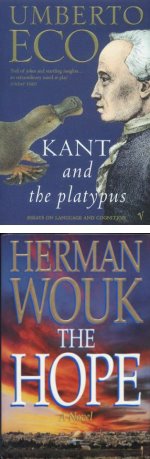
The Hope, by Herman Wouk. Called "magnificent" by Anthony Burgess, that was enough to lure me into its pages. An epic novel describing the birth of modern Israel, told through the lives and fortunes of its leading characters. (You may remember Wouk's Winds of War which told a story of WWII in a similar fashion, and which was turned into a TV mini-series?) The Hope is well crafted and enjoyable.

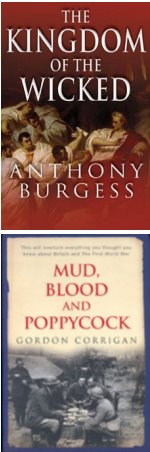
The Kingdom of the Wicked, by Burgess himself, is set in the same geographical area as Wouk's novel but two thousand or so years earlier. Another historical novel, this follows on from Burgess's Man of Nazareth (from which another mini-series came) and purports to recount the story of Paul and the Apostles in setting out to take over the world with their stories of Messiahs, miracles and other madness. Not Burgess's best, but it still shits all over lesser accounts of the same events, such as those by the Apostles themselves . . .

Moving on now to something completely different: Gordon Corrigan's Mud, Blood and Poppycock is an extended argument that all you know about the horrors of First World War trench warfare -- the stories of "lions led by donkies" -- the senseless slaughter, all so that as Blackadder observed, "General Haig can move his drinks cabinet a hundred yards closer to Berlin -- the talk of a 'lost generation' -- all this Corrigan argues is the stuff of myth and nonsense. At least, that is, for trench warfare on the Western Front, for the British, for most of the war. In that severely delimited fashion I think he does succeed, pointing out for example that the Generals and the military tactics adopted were highly successful -- for example, troops advancing under the cover of rolling artillery barrages would often succeed where later even tanks could not; pointing out too that the slaughter on first day of the Somme offensive, with 20,000 British dead, was both necessary, given the available materiel and the events at Verdun, and tragic -- but comparable in loss of life to, for example, the first day of the D-Day offensive in the Second World War, when 9,500 Allied soldiers died in the battle to begin the liberation of Europe from the Nazis.

A book worth reflecting upon if you think you know WWI.

Last but not least, Umberto Eco's Kant and the Platypus, an entertaining meditation as Eco desribes it on "the reasons we can tell an elephant from an armadillo (as well as why we don't normally mistake our wife for a hat) . . [a problem] even Kant (as we shall see) not only failed to solve but didn't even manage to express in satisfactory terms." For his part, Eco himself offers much indecision, gleefully taking as his motto "a quotation from Boscoe Pertwee, an eighteenth century author (unknown to me) which I found in Gregory (1981:558): 'I used to be indecisive, but now I'm not so sure.'"

Both the motto and his manner of describing it give a clue to the book: it's playful, learned and offering more questions than answers but with much insight and a friendly wink at his own footnoting. Less enjoyable than Eco's fiction, but still delightful for all that. [And if you really care what I think about Kant, you might be interested in several articles on the 'catastrophic spider' written in response to a Kantian philosopher, Kant Can't, Kant Couldn't, Kant Didn't, and Kant Really Wasn't -- the first by Lindsay Perigo, and the last three by yours truly.]

Tuesday, 15 November 2005

Eco's mysterious flame

Umberto Eco's latest novel 'The Mysterious Flame of Queen Loana' is another delightful and encyclopaedic cornucopia of references, quotes and tempting diversions; this one, like all Eco's novels, almost demanding to be hyperlinked just so you can work out where he's going, and why. It's worth the effort.

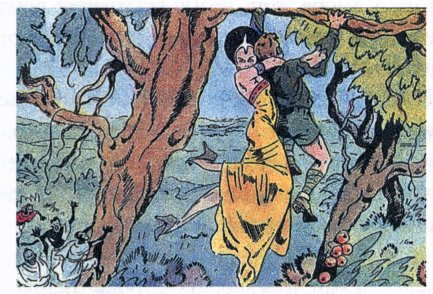
Eco's protagonist in 'The Mysterious Flame,' an antiquarian bookseller called Yambo, has lost his personal 'episodal' memory but would still score highly in Mastermind with 'Literature' and 'Mid-Century Italian Comics & Popular Culture' as his two possible specialist subjects; Yambo seeks to rediscover himself through an attic's worth of boxes containing books, cigarette packages, magazines, comics, stamps and other miscellany -- the book includes many of the beautiful and politically incorrect illustrations mentioned in the text.

I say the book almost demands to be hyperlinked, about which Eco is delightfully aware -- in an interview with Village Voice "Eco says he structured Mysterious Flame to mimic the free-associative behavior of electronic navigation" -- and he sets the book in pre-Google 1991, requiring Yambo to rummage through his past instead of Googling it -- but a new Wiki project has taken up the challenge "to create a thorough and accurate set of annotations to Umberto Eco's latest novel," and as always with a Wiki, "anyone is free to add or modify entries."

You can just imagine his eyes twinking at the thought. "Books," he said once, "belong to those kinds of instruments that, once invented, have not been further improved because they are already alright, such as the hammer, the knife, spoon or scissors." But as a professional semiologist, he's not unaware of what his readers might be using Google to do with the signs he's made available in his book, and that's no doubt part of his plan, as the Village Voive interview suggests.

In the Eco-ian universe, books aren't merely stand-alone islands to be traversed in linear fashion; they are nodes in an exponentially expanding extranet. To read one book, you sometimes have to pass through several others, accumulating countless references and subtexts along the way. "We've been reading books in a hypertextual way ever since Homer," Eco says. "We read a page and then we jump, especially when we're rereading it. Think of the Bible. When people read it, they're always jumping here and there, constantly connecting various quotations."
It took sixteen years to produce a published Key to 'The Name of the Rose,'Eco's first novel -- and very welcome it was too. Now we've got the beginnings of a similar project in just six months, and with the wide participation that a Wiki invites. Excellent. Says Eco of his books, "I construct Aristotelian Machines, that allow anyone to see with Words." It doesn't hurt to ask for help in order to see what he's asking you to see.

You can find the Queen Loana Wiki here. And you can find the definitive Eco site here.

UPDATE: Eco's comments from a 1995 interview with 'Vogue' are priceless, and worth repeating:
People always ask me, 'How is it that your novel, which are so difficult, have a certain success?' I am offended by the question. It's as if they asked a woman, 'How can it be that men are interested in you?' Because I am beautiful, of course!" he roars. "To ask such a question insinuates that you are very ugly.

"I myself like easy books that put me to sleep immediately. But the normal reader who does not spend his day fighting with Kant or Hegel feels respected if there is a jujitsu with a novel, a resistance, a seduction. If the book says yes immediately, it is a whore. There is no challenge in seducing a whore." Only as energetic a bibliophile as Eco, it occurs to me, would regard it as the reader's job to seduce the book.

Corrierino

A striking illustration from the Italian 'Corrieriono' from 1936, taken from Umberto Eco's 'Mysterious Flame of Queen Loana'

Monday, 10 October 2005

The future of textbook publishing

Google have done it again. Google Blog Search is one recent boon. Google Scholar allows us, as the slogan says, to "stand on the shoulders of giants." And Google Earth gives us all free access to aerial views of almost anywhere on earth. Bloggers have used it for example to see whether or not Mayor Ray Nagin had buses to use to evacuate the New Orleans Superdome (he did).
Google Earth Hacks allow you to see:
And I've used it to check out:
AND NOW: Google have produced the face of the future of textbook publishing, Google Print. [Hat tip Stephen Hicks]. Whole books; online; searchable!! Some treats that I've found already (well I think they're treats anyway):
Wow! This is a whole searchable library at your fingertips, and without the overdue fines. :-)

Tuesday, 16 August 2005

Eco's latest

I'm as eager to get my teeth into Umberto Eco's latest as so many others were to get into the latest Harry Potter.

Eco writes with what Jose Louis Borges calls both "algebra and fire" -- in love with learning and with language, Eco constructs his many-layered stories with the ingenuity of a crossword puzzle. A professor of semiotics in his day job, Eco does sometimes make me wonder if academics simply have too much time on their hands, but if all post-modernists were as witty and sharp as Eco, I could easily be seduced.

What a ride he takes the reader on. What a labyrinth. I can't wait to try and decode this one.