"Why does no one understand that the people primarily responsible for the [opioid] 'epidemic' are the addicts themselves? Narcotics are not some irresistible force that takes over the human brain. Each addict made a conscious decision each and every time he or she 'tried,' 'tried again,' and “continued” rather than 'abstained.' ...
"This then is the real issue—some people, including youths, find their own lives unbearable. Why? What is it about our culture that leads to such desperation? ...
"The only effective long-term strategy for eliminating drug abuse from a culture—whether the drug of choice be oxycodone, heroin, fentanyl, cocaine, morphine, marijuana, or alcohol—is to create a culture that will support authentic self-esteem, not the pseudo-self-esteem created by the cult of vicious victimhood."
~ Donna Paris, from her post 'The Opioid Epidemic Becomes the New Rope Used for Big Business Lynching'
.
Showing posts with label Victimless Crimes. Show all posts
Showing posts with label Victimless Crimes. Show all posts
Monday, 23 September 2019
"Why does no one understand that the people primarily responsible for the opioid 'epidemic' are the addicts themselves? This is the real issue—some people, including youths, find their own lives unbearable. Why? What is it about our culture that leads to such desperation?" #QotD


Thursday, 5 September 2019
In honour of Helen Clark ...
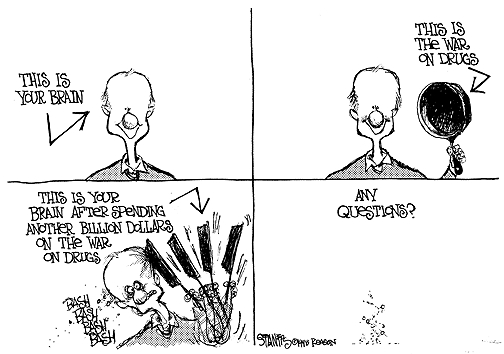
In honour of Helen Clark, I am reposting an old blog about Milton Friedman. Specifically, about what he called his Iron Law of Prohibition:
Johann Hari from London's Independent newspaper is surprised that ten days after Milton Friedman's death he's been eulogised for his monetarism, praised for his proselytising on small government, and buried with his errors ... but few have raised the "one issue [on which] Friedman applied the forensic brilliance of his brain to a deserving purpose. Over forty years," notes Hari, "he offered the most devastating slap-downs of the 'war on drugs' ever written":Read on here for more. Challenge yourself. Or just watch Friedman interviewed:
He once told Bill Bennett, Bush Snr’s drugs tsar, “You are not mistaken in believing that drugs are a scourge that is devastating our society. Your mistake is failing to recognise that the very measures you favour are a major source of the evils you deplore.”
Friedman proved, for example, that prohibition changes the way people use drugs, making many people use stronger, more dangerous variants than they would in a legal market. During alcohol prohibition, moonshine eclipsed beer; during drug prohibition, crack is eclipsing coke. He called his rule explaining this curious historical fact “the Iron Law of Prohibition”: the harder the police crack down on a substance, the more concentrated the substance will become.
Why? If you run a bootleg bar in Prohibition-era Chicago and you are going to make a gallon of alcoholic drink, you could make a gallon of beer, which one person can drink and constitutes one sale – or you can make a gallon of pucheen, which is so strong it takes thirty people to drink it and constitutes thirty sales. Prohibition encourages you produce and provide the stronger, more harmful drink. If you are a drug dealer in Hackney, you can use the kilo of cocaine you own to sell to casual coke users who will snort it and come back a month later – or you can microwave it into crack, which is far more addictive, and you will have your customer coming back for more in a few hours. Prohibition encourages you to produce and provide the more harmful drug.For Friedman, the solution was stark: take drugs back from criminals and hand them to doctors, pharmacists, and off-licenses. Legalize. Chronic drug use will be a problem whatever we do, but adding a vast layer of criminality, making the drugs more toxic, and squandering £20bn on enforcing prohibition that could be spent on prescription and rehab, only exacerbates the problem. “Drugs are a tragedy for addicts,” he said. “But criminalising their use converts that tragedy into a disaster for society, for users and non-users alike.”
- Another iron law of prohibition - Not PC
- Don't like gangs? Then legalise cannabis. - NOT PC
- Legal US Weed Is Killing Drug Cartels – Jonah Bennett, DAILY CALLER
- The Only Thing Drug Gangs and Cartels Fear Is Legalisation – Johann Hari, THE WORLD POST
- Prohibition Caused the Greatness of Gatsby – NOT PC
- Friedman's "Iron Law of Prohibition" – Clark & Watkins, SUN LIVE
- Portugal’s Experiment in Drug Decriminalisation Has Been a Success – Mark Thornton, MISES INSTITUTE
- The Economist explains: The difference between legalisation and decriminalisation- THE ECONOMIST
- More drugs, less crime - Not PC
- "Skunk killed my beloved son" - or did it? - NOT PC
.
Thursday, 13 December 2018
Quote of the Day: On Neo-Puritanism and "Meddlesome Preferences"
"[There may be] an implicit recognition by all parties ... that, although each may have preferences over the others' behaviour, any attempt to impose one person's preferences on the behaviour of another must be predicted to set off reciprocal attempt to have one's own behaviour constrained in a like fashion. An attitude of 'live and let live, ' or mutual tolerance and mutual respect, may be better for all of us, despite the occasional deviance from ordinary standards of common decency.
“Such an attitude would seem to be that of anyone who claimed to hold to democratic and individualistic values, in which each person's preferences are held to account equally with those of others. By contrast, the genuine elitist, who somehow thinks that his or her own preferences are ‘superior to,’ ‘better than, ‘ or ‘more correct’ than those of others, will, of course, try to control the behaviour of everyone else, while holding fast to his or her own liberty to do as he or she pleases.”
~ James Buchanan, from his essay on 'Politics & Meddlesome Preferences'
[Hat tip Jim Rose]
.
Saturday, 27 October 2018
QotD: On 'addiction'
.
"Religious and medical propaganda to the contrary notwithstanding, I hold some simple truths to be self-evident. One of these truths is that just as the dead do not rise from the grave, so drugs do not commit crimes. The dead remain dead. Drugs are inert chemicals that have no effect on human beings who choose not to use them. No one has to smoke cigarettes, and no one has to shoot heroin. People smoke cigarettes because they want to, and they shoot heroin because they want to."
~ Thomas Szasz, from his article "The Protocols of the Learned Experts on Heroin" in The Libertarian Review
Thursday, 1 February 2018
Bonus Quote of the Day: On prohibition
"We have to ask ourselves as lawmakers, has the prohibition on cannabis been effective? ... We know from the number of people who are doing it -- from police, including former police officers in this chamber -- that it is a highly ineffective prohibition because so many people are doing it. The objective is to stop people smoking cannabis; the effectiveness is almost zero. The people that want to do it are doing it..
...."The unintended consequences are that people put themselves in danger dealing with criminal elements whose criminal sphere they fund by acquiring elicit cannabis, and they receive a product that is made all the more dangerous by being underground ...
...."What you want to be doing is asking the simple question: is the policy of prohibition a successful policy; if not, would New Zealand be a better country if we ended that policy for people with chronic illnesses, and would it be a better policy if people could acquire what they are acquiring already through much safer, much more legitimate means that did not lead to children in this country growing up in households funded by the proceeds of [a] crime that only exists because of prohibition?"
~ Act Party MP David Seymour speaking last night in favour of Chloe Swarbrick's Members Bill to legalise medical marijuana
Wednesday, 14 September 2016
NZ police officer calls for and end to “unsustainable” War on Drugs
A New Zealand cop states the obvious: NZ's war on cannabis must end.
The frontline officer shared his opinion in a September 'I Am Keen' column for Police Association magazine ‘Police News,’ in which officers have the opportunity to anonymously voice their views on police operations…
He says his perspective on the crime has changed over his time as an officer.
"I have dealt with drugs on an almost daily basis in the course of the job, whether it's seizing them or dealing with the after-effects on users.
"But I often question why we prosecute people who have small quantities of cannabis on them… does punishing a user of a drug, any drug, actually impact on their decision to use that drug? I don't think so.
"People use drugs for various reasons. The thought of being prosecuted for such behaviour is obviously something they have considered briefly and then decided not to worry about it.
"Punitive measures often have very little impact on the fight against drug use."
He argues treatment and education are the answers to drug problems, not criminal sentences.
"Slapping someone with a criminal conviction for possessing one gram of anything is a disproportionate punishment." …
"This war on drugs is not sustainable and cannabis reform needs to be at the heart of a wider debate about how we deal with drugs. Making criminals out of users benefits nobody."
He’s right you know.
[Hat tip NZ Law Enforcement Against Prohibition]
.
Wednesday, 17 August 2016
Q: What’s the difference between decriminalisation & legalisation? A: Gangs. One funds them, one doesn’t. [Updated]
The Herald’s sensational poll on Monday has put ending the War on Drugs in Enzed right back on the agenda. The shackles of prohibition have been coming off around the world, and the poll says most New Zealanders (whether they imbibe or not) would like to see that new dawn here too.

It shows almost 65 per cent of NZers want personal possession of cannabis either decriminalised or made legal. While a similar proportion think selling cannabis should still be illegal.
Here’s a quick question for everyone: if you can legally possess but not legally buy, will this encourage or discourage those who supply illegally?
Yes, right answer: it will hand certain profits over to every outlaw who suppies outside the law.
So bad news then.
A similar confusion exists between those who favour decriminalisation instead of simple legalisation.
They see it as a peaceful halfway house instead of the recipe for gang funding it really is.
So what’s the difference between decriminalisation and legalisation?
Legalisation means it’s legal to enjoy, sell and (perish the thought but pass the peaceful joint) even tax the blessed weed. Whereas decriminalisation means it’s legal to enjoy drugs but still illegal to sell them. Spot the contradiction a gang truck can drive through.
Portugal, for example decriminalised every imaginable drug, from marijuana, to cocaine, to heroin in 2001, to discover that to discover that drug use went down rather than up, that the drugs being consumed were far safer than they were before, and most importantly Portugal now enjoys the second-lowest death rate from recreational drugs in all of Europe (after experiencing one of the worst rates with prohibition)
Almost all good news then.
But because the selling of those drugs in Portugal is still illegal (drugs were only decriminalised, not legalised), it is still largely in the hands of gangs – who are certainly being nicer than they were, but are still at heart just gangsters. “Decriminalisation’s flaw,” notes the Economist (which even our Prime Minister is known to read),
is that it does nothing to undermine the criminal monopoly on the multi-billion-dollar drugs industry. The decriminalised cocaine consumed without criminal consequences in Portugal is still supplied by the gangs who cut off heads in Colombia. Washington, DC’s version of legalisation is similarly flawed: although possession has been legalised, Congress has prevented the city from legalising the buying and selling of the drug. The capital’s pot business will therefore remain a criminal monopoly. [Decriminalisation] is good news for the people who harmlessly get high. But unless it is followed up eventually by legalisation of the supply-side of the business, it is [still] good news for the crooks who sell it.
So remember Richard Branson’s observation that drug legalisation is pretty much the worst thing that could happen to organised crime. Still true. But only legalisation, not merely decriminalisation.
Remind your MP. And don’t forget to suggest they pass a copy of that Economist to the PM.
UPDATE: The support and the facts supporting legalisation being so clear, the Prime Minister has resorted to fear-mongering in response. “Obviously, this wild scaremongering is intended to attempt to defuse popular momentum and support for a law change. And the manifestly fact-free nature of Key’s rhetorical stabs are revealed by the logical contradictions between them.”
In other words, says Curwen Rolinson, Key is Being Disingenuous on Dope Decriminalisation.
..
Tuesday, 16 August 2016

 Posted with Blogsy
Saturday, 13 August 2016
Quote of the Day: How to really mess up your head
“If you think that weed, cocaine, and heroin mess up people's heads, you should see what statism does to them. The latter's harm exceeds the former's harm by many orders of magnitude.”
~ Robert Higgs
.
Monday, 20 June 2016
Amy Adams is an idiot
Amy Adams argues that cannabis is a gateway drug for meth. Amy Adams is an idiot. It is not …
What is true however, and what the minister in charge of prohbition needs to realise, urgently, is that prohibition of cannabis is a gateway policy in encouraging production and dristribution of meth – Milton Friedman pointing out many years ago when the War on Drugs was born that prohibiting all drugs encourages drug suppliers to supply and produce the most potent and toxic drugs per kilo. (You know, if you’re going to carry risky illegal substances around as a supplier, then you’re better to carry around less in quantity but the most potent substances for that weight. He calls this an Iron Law of Prohibition.)
It is also true that beer and wine are a gateway to whiskey and rum – although RTDs themselves are probably a gateway to the sort of idiotic childlike comments made by the minister.
It is true that the Dunedin life-study for example finds that heavy use of cannabis in teenagers correlates with mental health problems, but neither this study nor any other shows that heavy use of cannabis causes problems like schizophrenia any more than heavy drinking causes depression – indeed, it is more likely that those who are depressed feel like a drink, and so on.
Moreover, synthetic cannabis, which Adams and her ilk make legal from moment to moment, is arguably among the very worst of the recreational drugs found so easily around towns and cities; and just like the incentive towards more potent drugs, virtually all the many “harms” Adams and other cite as being due to cannabis – encouraging gangs, increasing toxicity, inconcistent products – are due instead entirely to its prohibition (as Portugal for example discovered so benevolently in overturning its prohibition policies and seeing crime and drug abuse both fall.)
Adams herself cites no studies at all in making her claim, relying instead only on her own studied ignorance and the fatuous stupidity of her interviewers.
Examples of studies concluding the gateway theory to be false however include a 2002 study based on recent survey data on nearly 4,000 children and young adults which finds:
● No significant impact of soft drug use on the risk of later involvement with crack and heroin.
● Very little impact of soft drug use on the risk of later involvement in crime.
Add to this the peer-reviewed study published in the Journal of School Health which found that cannabis is not the gateway drug, but instead the most commonly used legalised drug in New Zealand, alcohol, is the precursor to use of much harder drugs like amphetamines.
‘While it may not settle the debate over how drug use begins, researchers found that alcohol, not marijuana, is the gateway drug that leads teens down the path of hard drug use, according to a new study that will be published in the August edition of the Journal of School Health.
Researchers looked at data from over 14,500 students from 120 public and private schools in the United States to evaluate whether students had used any of 11 substances, including alcohol, tobacco, marijuana, cocaine, heroin, LSD, amphetamines, tranquilizers and other narcotics. They found that more often than not, alcohol was the first substance students tried before moving on to other drugs.
“I am confident in our findings and the clear implications they have for school-based prevention programs. By delaying and/or preventing the use of alcohol, these programs can indirectly reduce the rate of use of other substances,” Barry said in a statement.
Alcohol was also the most commonly used substance, according to the study. More than 70 percent of students reported using alcohol at some point during their lifetime, compared to only 45 percent who reported using tobacco and 43 percent who used marijuana.
Researchers also found that students who used alcohol were up to 16 times more likely to use illicit drugs.’

Meanwhile, Wake Up NZ point out that
Cannabis use in New Zealand registered 14.6% of adults in 2007 compared to methamphetamine use at 2% in 2009. With this in mind, wouldn’t we expect to see a much higher corresponding figure of people using meth if according to Amy Adams, cannabis users progress on to smoking meth?
It is widely known that the large majority of people who smoke cannabis do not progress to using dangerous drugs such as amphetamines, just as the large majority of people who drink alcohol also do not then move on to hard illicit drugs. The current National government however won’t let facts get in the way of publicly spreading misinformation to keep the war on drugs consuming more victims in New Zealand.
Amy Adams is an idiot. In continuing to cause harm by continuing prohibition, she is a very harmful idiot – a gateway to all the harms that Richard Nixon’s War on Drugs has caused and will continue to under the ignorance of all the deluded drug warriors who maintain it.
Mind you, at least Dick Nixon’s advisors knew they were lying. I wonder what excuse Adams et al have.
.

.
Thursday, 10 March 2016
“But when was the last time that the police needed to do raids, armed or otherwise, on a brewery or a distillery?”
The armed standoff in Kawerau began with a police raid on someone growing marijuana. A peaceful drug attracting violence only because it has been made illegal.
An armed standoff only begun because this harmless drug has been made illegal.
Meanwhile, while the police ride helicopters to pluck harmless leaves from the countryside, they manage to resolve only 10% of the burglaries inflicted upon New Zealanders – 164 unresolved burglaries a day -- not because they can’t, but because they don’t want to. Why don’t they want to? Eric Crampton offers one reason: Priorities.
If it puzzles you that the New Zealand Police can find resources to run raids on marijuana growers, which sometimes turn into armed standoffs, but cannot find resources to solve burglaries, remember this:
The Criminal Proceeds (Recovery) Act enables police to seize assets believed to be the proceeds of crime, with or without a conviction.
Since it came into effect, $382 million worth of assets has been restrained (which means the police hold on to it during an investigation), while $85 million has been forfeited altogether. The funds recovered are used to fund law enforcement initiatives.
Police Minister Judith Collins says police have been “extremely successful” in investigating and seizing the “dirty money” of criminals and gangs since the legislation was introduced.
About 96% of forfeitures and 86% of restraints are linked to drugs and organised crime.What profit is there in solving a home break-in? Anything you seize has to go back to the property's owners. But if you go after the folks who only commit victimless crimes, well, there's nobody who has to be compensated out of the seizures.
I hate saying I told you so, but I did tell you so.
The cops will tell us that the standoff's lesson is that police should be better armed. But when was the last time that the police needed to do raids, armed or otherwise, on a brewery or a distillery? Or on the Petone cigarette plant?
The better lesson is that legalised markets are less violent and have less need for armed cops.Update: Commenter Ben rightly notes that the funds don't go directly to the police. Here's the NZ Drug Foundation on that:
The lion’s share (70 percent) has gone to Police, Customs, Justice and Corrections. Health gets the rest.
Wednesday, 2 March 2016
Don’t like gangs? Then legalise cannabis.
Ever the populist, Police Minister Judith Collins has announced what she calls “a multi pronged attack on gangs” and a plan to “tackle drugs, illegal gains and firearms.”
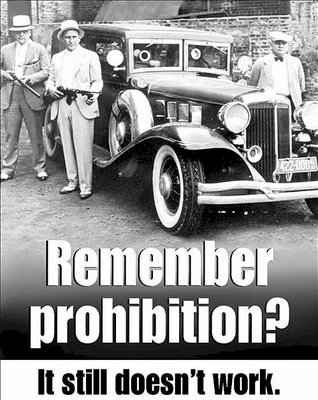
But you can’t talk sensibly about a War on Gangs without also talking about the government’s War on Drugs. Not properly. As the prohibition of alcohol proved so conclusively in America—coinciding as that sorry period did with the birth of big criminal gangs there – where you have prohibition, you have a ready income stream for criminal organisations. (It was prohibition, if you like, that caused the Greatness of Gatsby.)
You might have thought then that ripping away their secure income stream would have been the obvious “prong” with which a police minister might begin attacking gangs. Even the most obvious.
Challenged on this point on Morning Report this morning however, Collins airily dismissed the notion. Accepting that gangs’ "primary income is from selling drugs," she was Asked by Espiner what would happen to gangs’ finances if marijuana were legalised, Collins rather bizarelly insisted that they would then get into legalised prostitution and harder drugs like methamphetamine.
But this is nonsensical. A Justice Ministry study that Collins could easily have read in her previous post found that during the in-depth interviews of 656 sex workers “there was no mention of gang involvement or coercion.” Overseeing the research, the Ministry’s Prostitution Law Reform Committee considered “that the links between crime and prostitution are tenuous. The Committee could not find any evidence of a specific link between crime and prostitution.”
The notion is as bizarre as her claim that legalising marijuana, for example, would see an explosion of methamphetamine being sold on the street. As thousands of current and former members of law enforcement who support drug regulation rather than prohibition argue—including Scotland Yard’s former head of drug policing—prohibition doesn’t mean people stop consuming drugs, they just change the drugs they're consuming.
Here, Collins could benefit from getting to grips with what Milton Friedman called The Iron Law of Prohibition: which says that the more you actively prohibit drugs, then it is the more virulent drugs you actively encourage.
Friedman proved, for example, that prohibition changes the way people use drugs, making many people use stronger, more dangerous variants than they would in a legal market.
During alcohol prohibition, moonshine eclipsed beer; during drug prohibition, crack is eclipsing coke. He called his rule explaining this curious historical fact “the Iron Law of Prohibition”: the harder the police crack down on a substance, the more concentrated the substance will become.
Why? If you run a bootleg bar in Prohibition-era Chicago and you are going to make a gallon of alcoholic drink, you could make a gallon of beer, which one person can drink and constitutes one sale – or you can make a gallon of pucheen, which is so strong it takes thirty people to drink it and constitutes thirty sales. Prohibition encourages you produce and provide the stronger, more harmful drink.
If you are a drug dealer in Hackney, you can use the kilo of cocaine you own to sell to casual coke users who will snort it and come back a month later – or you can microwave it into crack, which is far more addictive, and you will have your customer coming back for more in a few hours. Prohibition encourages you to produce and provide the more harmful drug.
For Friedman, the solution was stark: take drugs back from criminals and hand them to doctors, pharmacists, and off-licenses. Legalise. Chronic drug use will be a problem whatever we do, but adding a vast layer of criminality, making the drugs more toxic, and squandering £20bn on enforcing prohibition that could be spent on prescription and rehab, only exacerbates the problem [and helps raise the profits for gangs].
Collins talks about offering “a path out of gangs.” If she’s serious, then most obvious is to make them unprofitable.
After all, it’s working exactly that way in Mexico, where legalising American weed has been off killing drug cartels.
In fact, as both Ethan Nadelmann of the N.Y.C.-based Drug Policy Alliance and Richard Branson, the chairman of Virgin Group point out: drug legalisation is pretty much the worst thing that could happen to organized crime.*
Are you listening, Judith?
RELATED POSTS:
- Don’t like drugs? Then legalise cannabis. – NOT PC
- "Stop arresting people for drugs and start offering help" – NEWSHUB
- Legal US Weed Is Killing Drug Cartels – Jonah Bennett, DAILY CALLER
- The Only Thing Drug Gangs and Cartels Fear Is Legalisation – Johann Hari, THE WORLD POST
- Prohibition Caused the Greatness of Gatsby – NOT PC
- Friedman's "Iron Law of Prohibition" – Clark & Watkins, SUN LIVE
- Portugal’s Experiment in Drug Decriminalisation Has Been a Success – Mark Thornton, MISES INSTITUTE
- The Economist explains: The difference between legalisation and decriminalisation- THE ECONOMIST
* Note that they say legalisation, not merely decriminalisation. Decriminalisation can mean that it’s legal to enjoy drugs but still illegal to sell them. Portugal, for example decriminalised every imaginable drug, from marijuana, to cocaine, to heroin in 2001, to discover that to discover that drug use went down rather than up, that the drugs being consumed were far safer than they were before, and most importantly Portugal now enjoys the second-lowest death rate from recreational drugs in all of Europe (after experiencing one of the worst rates with prohibition)
But because the selling of those drugs in Portugal is stil illegal, it is still largely in the hands of gangs – who are certainly being nicer than they were, but are still at heart just gangsters. “Decriminalisation’s flaw,” notes the Economist, “is that it does nothing to undermine the criminal monopoly on the multi-billion-dollar drugs industry. The decriminalised cocaine consumed without criminal consequences in Portugal is still supplied by the gangs who cut off heads in Colombia. Washington, DC’s version of legalisation is similarly flawed: although possession has been legalised, Congress has prevented the city from legalising the buying and selling of the drug. The capital’s pot business will therefore remain a criminal monopoly. The new law is good news for the people who harmlessly get high. But unless it is followed up eventually by legalisation of the supply-side of the business, it is [still] good news for the crooks who sell it.”


Tuesday, 20 October 2015
UN saying end the War on Drugs
An “as-yet unreleased statement” leaked to the world by Richard Branson “may be about to call on the governments of all countries to end the ‘war on drugs’ and decriminalise the use and possession of all illegal substances.”
In an extraordinary post on his Virgin website, Richard Branson said he had been showed a report by the UN Office on Drugs and Crime (UNODC) which dramatically changed the organisation's stance on drug control.
He said the "as-yet unreleased statement" had been sent to some of the world's media under embargo - but that he has gone public with it early for fear the UN will "bow to pressure by not going ahead with this important move."
Good for Richard. Good for the UN too. (A sentence I never thought I would write.)
The UN was preparing to declare "unequivocally that criminalisation is harmful unnecessary and disproportionate", Branson wrote.
Which is all true. Recreational drug use is a victimless crime; as with all prohibition, the alleged cure proves worse than the disease—the war against drugs creating many more real victims than even the worst of the drug warriors would claim for the drugs themselves.
"Let us hope the UNODC, a global organisation that is part of the UN and supposed to do what is right for the people of the world, does not do a remarkable volte-face at the last possible moment and bow to pressure by not going ahead with this important move. The war on drugs has done too much damage to too many people already."
(Hat tip AB)
Monday, 13 July 2015
Mark Thornton Joins Tom Woods to Discuss Drug Decriminalisation in Portugal
Followers of Curwen Ares Rolinson – whose numbers appear to be legion! – might appreciate this interview with Mark Thornton, expanding on today's Mises Daily article reviewing the cases of Portugal and Washington state, and askin: have the fears of the prohibitionists been realised?
Mark provides some additional details on how the decriminalisation program has worked in Portugal, contrasting decriminalisation with the legalisation that has been implemented in Colorado and Washington State.
Good listening. [Conversation starts at 2:30]
Wednesday, 8 July 2015
What Happened When Portugal Decriminalised Drugs [updated]
Guest post by Anything Peaceful
On July 1, 2001, Portugal did something extraordinary: it quit the war on drugs — or, at least, the war on drug users — by decriminalising all controlled substances.
Portugal still tries to stop the supply of drugs, but, in the last fourteen years, it has not sent people to prison for possessing or using drugs.
The decision was all the more remarkable because the country really did seem to have a problem with drugs: Portugal was in the middle of an “addiction epidemic,” with 1 in 100 Portuguese addicted to heroin.
But since the shift in policy, rates of STDs and drug overdoses have fallen dramatically. Since decriminalization, the Economist reports, drug-induced deaths have fallen by 80 percent, from 80 deaths in 2001 to just 16 in 2012. Meanwhile, the number of heroin addicts fell by half, in absolute terms, over the same period.
Because drug abuse is treated like a public health question instead of a criminal offense, the state focuses on treatment and harm-reduction.
Instead of increasingly militarized cops kicking down doors and "frisking" random people on the street, Portugal pays psychologists and treatment specialists to walk beats and offer help to addicts. Resources now go to clean needles and medical advice, instead of handcuffs and jail cells.
We can quibble about whether the government or charity could best address the health care needs of the poor. We can certainly disagree with the incoherent decision to keep the supply side illegal while legalizing consumption.
But all lovers of liberty must applaud the move away from a more coercive, more violent state, and toward a greater respect for the individual, for freedom of choice, and for anything that’s peaceful.
Anything Peaceful is FEE's new online ideas marketplace, hosting original and aggregate content from across the Web.
UPDATE: See, sense is breaking out everywhere. Today, it’s Chile:

Pot, petards and Curwen Ares Rolinson [updated]
A politician should (as I have read)
Be furnish’d in the first place with a head…
- short poem, after a painting by Hogarth

Portrait of a young man who was in a hurry
When a young man wants to go into politics he may take two paths. One will choose the path of principle, choosing a party that matches his values and fighting across the length of his career to put them into practice. Another will identify the rotting carcass of a party with a regular turnover of tailor’s dummies sitting MPs for whom lack of ability is no barrier to parliamentary honours, and seek to ingratiate himself therein.
Curwen Ares Rolinson was the second kind of young man.
Described variously as “a “one-man nationalist revolution”,” “the biggest statist douche I have met,” and a “statist neo-Nazi asshole” – and this is by young people who know him -- Rolinson was a huge believer in big government, in the wit and wisdom of Winston Peters, and for many years was a board member of NZ First and the leading member of their “youth wing.” Truth be told, he was its only member.
Rolinson would regularly assail passersby and other aspiring young politicians about the virtues of big government, about the need for greater law and regulation, about the dangers of human freedom that could only be curtailed if hedged around by rules. Politicians in his view ruled people’s lives, and he wanted to be a politician. Passionately.
He was also, it seems, a cannabis dealer, for which he has just been charged.
This is really neither ironic nor surprising.
Bruce Yandle has written copiously on the kindred relationship of Bootleggers and Baptists, two big and distinctly different groups who yet both support big regulation – especially on things that give people pleasure.
The metaphorical “Baptists” point to the moral high ground and give vital and vocal endorsement of laudable public benefits promised by a desired regulation. Baptists flourish when their moral message forms a visible foundation for political action. “Bootleggers” are much less visible but no less vital. Bootleggers, who expect to profit from the very regulatory restrictions desired by Baptists, grease the political machinery with some of their expected proceeds. They are simply in it for the money.
It turns out Rolinson was both a Baptist and Bootlegger – maybe using the money from the latter to help climb up the greasy pole to do more of the former.
Like I say, for that second kind of chancer, neither ironic nor surprising.
But in the end, Rolinson has been hoisted on a petard not yet of his own making, but the size and violence of which he has spent his short youth applauding.
As a passionate supporter myself of human freedom, it’s clear that if Rolinson is guilty of anything on the crime front however it is assuredly a victimless crime – a crime with “neither criminal nor victim,” whose own young political adversaries are already coming out in his support.
As must I. However odious the recipient of my support. Because to paraphrase Ayn Rand, while
it is not very inspiring to fight for the freedom of would-be statists. … the disgusting nature of the offender makes it a good test of one's loyalty to a principle.
PS: Leader of the NZ First carcass Winston Peters has leapt into print to declare Winston First does not have a youth wing, has never had a youth wing … and is now and has always been at war with Eurasia.
So here’s Winston below, with some random folk he just met on the way to a conference:

RELATED POSTS:
- If you must, you can read Curwen’s collected wit and wisdom at the Daily Blog: Posts by Curwen Ares Rolinson.
- Uncivil Curwen thrown in jail for being civil – ANARKIWI
- Bootleggers and Baptists – LEARN LIBERTY
UPDATE: In the interests of fairness, the young man discussed in the article above would
respectfully contend that to ALL THOSE who truly know me, the very opening paragraph of this article [here at NOT PC] stands out as testament to the malign and malicious cavalcade of carnivorous falsehoods which feather out the full length of this perfidious and perfunctory piece.
So there.
Monday, 8 June 2015
ACT acting on voluntary euthanasia.
 Since we gave David Seymour a hard time not so long ago about refusing to back a bill supporting voluntary euthanasia – the ultimate expression that your life is your own – it’s only appropriate now to praise him now.
Lecretia Seales’s very sad case has certainly concentrated a few minds. It has thrust the issue back on the public agenda with a very concrete case.
The judge in Lecretia Seales’s petition for the right to have a doctor assist her death decided it was ultimately a matter for parliament, not the courts. And, right on cue,
ACT leader David Seymour has confirmed he is drafting a member's bill calling for a debate on [voluntary] euthanasia and will urge the Government to adopt the bill.
Seymour said the public view had changed over recent years and polls suggested most Kiwis were in favour of choice.
"Since 1995 and 2003 the world has changed quite dramatically and I believe that it's time for Parliament to actually debate this issues."
"This is something that has to be done right - certainly the public opinion is overwhelmingly in favour according to all the polling."
Opportunistic it might be, but there’s nothing wrong with acting on principle when the opportunity finally strikes. Even if it takes a wee nudge.
Thursday, 26 February 2015
Mercy to the guilty is injustice to Jeremy Frew
“Pity for the guilty is treason to the innocent.”
- Ayn Rand
“’Mercy’ means an unearned forgiveness.”
- Leonard Peikoff
So a dickhead who helped kill someone apparently appears on a TV show, and the producers don’t even bother to give the audience the full context of the crime for which he was jailed – a "rampage of violence" said the judge who convicted him; a “commotion” says the YV show -- nor warn the parents of the young man he killed that a thug who helped kill their son will soon be singing on their TV screen.
But it’s all okay, says the producer, because the thug has “paid his debt to society” and everyone should move on.
Bullshit.
You see, this is just one more problem with having so many victimless crimes: when so many crimes are victimless, it’s so easy to forget that real crimes do have real victims. Your “debt,” as a criminal, is not to a collective; it is to those people whom you’ve harmed – those very real victims of your actions.
And dead victims can’t move on.
Mercy to the guilty is an injustice to the innocent. The producers of X Factor have committed an enduring injustice to Jeremy Frew and his family.
Wednesday, 18 February 2015
Legal Weed Is Killing Drug Cartels
Here’s a lesson from the United Not-So Police States of America we might take on board here…

Nick Sorrentino writes that Legal US Weed Is Killing Drug Cartels:
It makes sense. We have argued for a long time that ending pot prohibition would do much to reduce crime.
Marijuana is by far the illicit drug of choice in the USA. Even though weed is relatively bulky, smells like a skunk crossing and so is easily detected, it remains number 1.
Legalise the market, legitimise the market, and the prohibition-inflated profits (and incentive) go away.
It should be noted however that profits are not only reduced for illegal drug dealers, but also to some extent for the LEGAL drug dealers, the booze and pharma firms.
(From The Daily Caller)
“Two or three years ago, a kilogram [2.2 pounds] of marijuana was worth $60 to $90,” Nabor, a 24-year-old pot grower in the northwestern Mexican state of Sinaloa, told NPR. “But now they’re paying us $30 to $40 a kilo. It’s a big difference. If the U.S. continues to legalize pot, they’ll run us into the ground.”
Click here for the article.
Thursday, 25 September 2014
Debating Drug Prohibition at the Oxford Union
Guest post here from the Mises Institute, interviewing Mark Thornton, Mises Institute Senior Fellow, who recently took part in Oxford University’s Oxford Union Debates.
Mises Institute: Why were you invited to debate at Oxford?
Mark Thornton: The Oxford Union can pretty much get whoever they want to debate, including presidents, prime ministers, Mother Theresa, the Dalai Lama, and even Julian Assange, so I was honoured that they invited me. I met several students in the Oxford Union and at Oxford University who were familiar with my work on the drug war and at the Mises Institute.
Each side of the debate generally consists of a student presenter and three experts. The debate is similar in structure to the House of Commons and has been that way since 1823.
MI: What was your basic line of argumentation and how was it received? How did the other side justify the drug war?
Subscribe to:
Posts (Atom)