Showing posts with label Nicola Willis. Show all posts

Tuesday, 21 July 2026

This is what a Luxon-led Government means by being "pro-business"

This Luxon-led Government is pro-business.

That is to say, it's pro particular businesses. Particularly one that begins with an 'F' and ends in 'letcher.' Have a city to rebuild, or a convention centre to build (and burn down), and that particular business will assuredly get the nod -- along with a large cheque paid for by you and I.

Ronald Reagan famously observed the principle of pro-business governments like this one: “If it moves, tax it. If it keeps moving, regulate it. If it stops moving, subsidise it.” All three are in operation in the decision to shell out $60 million of your money (along with a new tariff) to subsidise Fletcher's to keep open a cement business

Why do Fletcher's need the subsidy? Because National's Emissions Tax Scam was going to stop the business moving. And a business that doesn't move, along with any associated businesses needing Fletcher's cement, don't pay any tax.

Does the Emissions Tax Scam make any sense? Nope, not unless you think shackling producers makes sense -- shackling and then subsidising to avoid the scam's implications. To quote a friend back in 2009, the scheme is "criminally absurd," and a decent government would by now already scrapped it (in favour, perhaps, of a subtle and sensible carbon tax).

“An ETS is the best tool to reduce emissions," says the Taxpayers 'Union' in response to the subsidy's announcement, before going on to pontificate that "it should not sacrifice industry at the altar of net zero, only for taxpayers to fund the rescue. ... It is a false economy," they say, "to make businesses unviable through carbon charges, then bail out those with the best lobbying teams in Wellington. The Government must review its industrial allocation settings [sic] across all trade-exposed sectors.”

In two sentences this illustrates everything wrong with this government, with the Taxpayers 'Union,' and with the so-called policy 'settings' about which they argue.

Yes, it's false economy. But it's worse than that. The whole Emissions Tax Scam is a gun pointed straight at producers' feet. To impose the tax, and then subsidise its payment, makes no sense on any level. It's simply insane. The argument isn't about tinkering with 'policy settings,' it should be about removing the insanity, and danger of the slippery slope back to the Muldoonist 'picking losers' policies we once escaped with so much pain. 

In reality, as RD points out below, it's a strong example of Luxon and Willis’ net-zero scheme being unworkable (not to mention immoral), then socialising the cost of the failure by picking favourites at taxpayers' expense.

Expect to see more of it in the very near future as its unworkability (and immorality) become more obvious even to those who espouse it.

Wednesday, 3 June 2026

"There is no plan about how the cuts in bureaucrat numbers will work"

"As far as can be judged, there is no plan about how the cuts [in bureaucrat numbers] will work. ... The government mumbled about ‘artificial intelligence,’ ... but I have seen no study which would suggest that it is possible to get a 14 percent increase in productivity across such a diverse range of activities in three years. ...

"To add to the confusion, the government is going to merge a wide number of public agencies and centralise some backroom activities. With the possible exception of politicians, everyone knows that such re-disorganisations reduce productivity for a period of three and more years. ...

"Typically, these bigger organisations have more layers of management – I bet there will not be a proportional reduction in generic managers – and the top is even more isolated from the front line. ... In any case they will have increasingly to deal with the job reductions plus the re-disorganisation. There will be an increase in badly supervised consultancies.

"I regret to say that to this independent observer, the proposed reduction seems to be a panic measure. I shall not be surprised if it all turns to custard when the new government arrives after the election. (It may still be a Luxon-Willis Government.) Another source of custard is if the Treasury assumption of the strait of Hormuz opening up soon and smoothly proves optimistic. ...

"Expect some brutal measures after the election."
~ Brian Easton fro his post 'Is New Zealand’s Economy in Dire Straits?'

Friday, 29 May 2026

"Responsible"? They lie to you and assume you're too stupid to notice. [UPDATED]

UPDATE: Professor Robert MacCulloch: "It's a rigged budget ... so she can get a soundbite. ... Media got suckered." The promised return to surplus is a “phony” and “reverse-engineered” political exercise designed for election headlines rather than economic reality.


It's one of those rare occasions, this budget, when commentators have mostly taken the finance minister's own spin as a given and burrowed instead into the details. The result however is to ignore context, and to focus on the irrelevant to the exclusion of the important. That's why the finance minister is looking so goshdarned pleased: because her lies are going mostly unchallenged.

The finance minister tells you that this election-year budget contains "no sugar hits." That New Zealanders won't be bribed on election year with their own money.

That's a lie.

The small matter of a $450 million "emergency contingency fund" has been set aside "in a time-limited contingency" if the cork remains in the Straits of Hormuz -- betting, of course, as she does in her heroic forecasts, that the cork will at least be loosened, allowing a wee flutter when polls show it's needed. 

Yes folks, the true "emergency" being provisioned for is an election debacle. That's what the slush fund is for.

The finance minister also tells us repeatedly that she's being responsible.

That's why she's set aside "just over $1 billion" for unspecified "improvements" to KiwiRail. Which is of course a big win for Shane Jones and his friend Winston. This is their billion-dollar slush fund for the election, which is just over double the fund she's allowed for her own party.

Responsible?

It's also handing councils $400 million in “growth incentives” now while only walking slowly to bring council's rates under control. And this is only because the finance minister can't bring her own govt's costs sufficiently under control to allow the GST component of new housing to go to councils (the real growth incentive she was encouraged to enact).
Responsible?

As Michael Reddell observes (one of the few commentators to put his head under the bonnet with the proper focus, New Zealand remains among the advanced countries with the largest structural fiscal deficit -- which have got "materially worse" under this Government.


As the Taxpayers Union notes, "Despite branding this a 'responsible Budget,' Nicola Willis has today confirmed the Government will have borrowed more by 2029/30 than Treasury forecast just five months ago." Over a billion dollars more.

So have things got any better under this National finance minister rather than the last Labour liar? Has it hell.  Reddell again:

In the last full year Labour was responsible for core Crown operating expenses were 31.7% of GDP 
In 24/25 32.6% 
In 25/26 32.6% 
In 26/27 32.6%

Responsible, hell!

And of course, this Government went to the country promising "no new taxes." That's another long-term lie. 

The budget has announced three new taxes on banks and shareholders -- sorry, two "levies" and one "charge" -- that will of course immediately be passed on to customers -- "the Beehive can try to frame it as a levy on the big banks, but this new tax will be paid by savers and mortgage holders. It’s a sleight of hand."

So that's just yet more charges and "levies" to add to the other new taxes already whacking New Zealanders since the last election's promise of "no new taxes (Levy (n.) an officially imposed fee, tax, or penalty demanded by a government or organisation). The full list:

Road User Charges on Electric Vehicles (April 2024)
GST on Digital Platforms -- the "App" Tax (April 2024)
Trustee Tax Rate Increase to 39% (April 2024)
Prudential Regulation Levy on Banks and Insurers (announced Budget 2026)
Company Shareholder Loan Integrity Rules (Budget 2026)
Thin-Capitalisation Changes for Foreign-Owned Banks (Budget 2026)
And finally, the promise of "returning to surplus" by 2029?

To use Michael Reddell's term, that's just vapourware:
Not only has the projected date for getting back to budget surplus (on the standard OBEGAL measure) kept being pushed back but the projected surpluses for 26/27 (the yearr today's Budget directly relates to) have worsened by more than 4% of GDP in 3 years (under both governments).
Responsible? They lie to you and assume you're too stupid to notice.

Wednesday, 20 May 2026

Reducing the coercive sector of the economy

While too many pundits still labour under the misapprehension that the primary job of government is to continue subsidising Wellington's economy with make-work jobs, one insightful twitterer offers several good reasons why reducing the size of the public service is a good idea:

  • Reduces complexity 
  • Reduces waste 
  • Reduces cost 
  • Reduces an out-of-control deficit 
  • Stops unnecessary government programmes 
  • Reduces power and influence of the state 
  • Frees up people who work in the coercive sector of the economy to work in the productive sector of the economy

Ideally, it reduces that coercion. As Walter Williams noted: 

Powerful government tends to draw into it people with bloated egos, people who think they know more than everyone else and have little hesitance in coercing their fellow man.

Fewer know-alls given power --> less coercion.

Ideally.

However ... Michael Reddell is exactly right: National's announcement looks more like last-minute electioneering that a genuine plan for improvement.

63657 core public service Full-Time Equivalent employees (FTEs) as at 31/12/25. Of those 24834 are in Corrections, MSD, & Ministry of Children. Seems unlikely there would be material cuts in any of those ... To cut 8000 FTEs off the rest by 2029 would mean a 21% cut.

No doubt it could be done, but over its first 2.5 yrs the govt has done very little to cut public service numbers, so people would reasonably be quite sceptical that the same senior ministers will suddenly sharply change their approach. ...

One might sympathise with the spirit of [Nicola Willis's announcement] (I do) but can't help noticing that there are no specifics (at all) beyond the baseline cuts for 26/27 for some agencies in the Budget. Beyond that is little more than handwaving

Talking up 20% real cuts (2+5+5 + 2% pa inflation) means almost nothing at this point (6 months from an election, with her party averaging say 28% or so in recent polls) without specifics. It has the feel of budget-accounting gimmickry: just enough to get Treasury to count the savings in the forward fiscal projections (& thus avoiding any more slippage in the date for getting back to surplus on the measure the govt likes (but Treasury doesn't). 

Had the speech been given in Dec 2023 it would have been one thing, but they've had 2.5 yrs to work out what they want to cut & still the answer seems to be "not much at all, but perhaps this latest rhetoric might get us beyond the election."

As for track record, recall that in the 2025 Budget, core Crown expenses for 25/26 were to be 32.0% of GDP, UP slightly on the 31.8% for the last full year under Lab.

And simply saying "Cut!" without specifying on which portion of the bureaucratic anatomy the knives should be sharpened leaves the Government, as before in this term, hostage to the decisions of the capital's Sir Humphreys.

[So] simply telling us that you'll cut some spending quite a lot in future (really I will...) brings to mind both the old economist's joke (let's assume a can opener) and St Augustine on continence and chastity ...  but not yet.

Tuesday, 5 May 2026

"Much of the social history of the Western world over the past three decades has involved replacing what worked with what sounded good."

"Much of the social history of the Western world over the past three decades has involved replacing what worked with what sounded good. In area after area – crime, education, housing, race relations – the situation has gotten worse after the bright new theories were put into operation. The amazing thing is that this history of failure and disaster has neither discouraged the social engineers nor discredited them."
~ Thomas Sowell from his 1993 book Is Reality Optional?
"Emotion has its place. You might argue that it was appropriate in crisis situations like the pandemic, the Christchurch shooting, and the White Island eruption. ...
    "But emotion can only go so far, because wanting something to be true, because it's kind, is not the same as it actually being true."

~ OJB from their post 'I Blame Women!'
"It is not kind to keep borrowing against future generations’ futures. It isn’t kind to promise the world and deliver sweet F all. Remember Ardern was going to house all of NZ’s homeless within 4 weeks of becoming PM, end child poverty, and build 100,000 houses? How wonderful! And what happened? ..."

Monday, 4 May 2026

Nicola Orwell [updated]

Over the weekend, we were watching the recent George Orwell doco Orwell 2+2=5 on DocPlay. Worth it, except to the extent it (deliberately?) confuses economic power with political power -- the very important distinction, as Harry Binswanger explains, between, the Dollar & the Gun. (And the film's own language does get somewhat Orwellian itself towards the end.)

Anyway, two quotes from the great man came to mind as I read Finance Minister Nicola Willis attempting to explain why her government spending more is nonetheless a 'saving.'


"What [her] Government has largely done,"explains Luke Malpass, "is to cut in some areas to fund increases in others." In her words:
It is not a saving in the sense that we are spending less as a government; it is a saving in the sense that, in the absence of making those savings, we would not have been able to fund increases to health and education and essential services without borrowing more.
As Orwell writes:
Political language is designed to make lies sound truthful and murder respectable, and to give an appearance of solidity to pure wind.
And:
When one hears a politician using a word like 'socialist,' 'communism,' 'freedom,' 'patriotic,' 'realistic,' 'justice,' and the like, one is not sure what he is saying, but it is clear that he is not saying anything meaningful.
Add to that last one the word 'saving.'

1984 was not supposed to be an instruction book; it was supposed to be a warning.

Look! Look! Come see how much 'saving' Nicola has been doing year on year! 
[Source: NZ Treasury's official Financial Statements]

UPDATE: To put some more context into what Willis's 'savings' look like, here's Matthew Horncastle, who's been reading the NZ Govt's Financial Statements, which say that last year, Willis's government took in $169.8 billion in revenue.

The majority of that is taxes. Forced. Compulsory. Taken from working people, business owners, and families under threat of legal consequence. There is no opt out. 
    They spent $183.5 billion. That is $13.7 billion more than they collected. 
    Net government debt is now $182.2 billion. That is $140,000 for every household in New Zealand. The interest bill alone is $8.9 billion a year. Every single year. That is more than the entire budget for law and order. More than defence. More than housing. Just interest. Just the cost of the debt that already exists. 
    And debt is still growing. In 2019 net Crown debt was $58 billion. It is now $182 billion. In six years the government tripled the national debt and handed every New Zealand household a $140,000 bill they never agreed to. 
    That is not governance. That is generational theft. 
    Free people should not be working to service the borrowing habits of politicians who will never personally bear the consequences of what they have spent. 
    Get the books back to surplus. Cut spending. Stop borrowing. Let productive people keep more of what they earn.
    This is not complicated. It just requires the courage to do it.

Tuesday, 17 March 2026

More than a covid's-worth of fiscal incontinence

"[W]hen the pandemic hit Ardern and Robertson had a decision to make. Respond in a fiscally prudent manner or borrow seventy billion, at least thirty of this was spent on non-pandemic frippery, and wrap themselves in a cloak of virtue while leaving an economic calamity to a future set of politicians. ...

"Ardern and Robertson used the pandemic to advance their own agenda ... [John] Key saw a crisis and, lacking an economic agenda or political philosophy, ran to the international money men to maintain the status quo rather than attempt meaningful reform.

"Given the content of the Covid Report the current government is right to highlight Robertson’s fiscal incontinence; pointing to the 70.4 billion total spend as a contrast with their own rectitude.

"Except. Well. ... [Nicola] Willis, who has managed to add over twenty billion new debt in her first two years in office, is projected to increase sovereign debt by more than Robertson achieved over the next five years.

"And this is without a pandemic, major earthquake or outbreak of foot and mouth. ...

"Imagine a company director who has seen revenue fall but maintains payroll by borrowing. Eventually the line of credit ends, staff lose their employment and the director is forced to sell the family home.

"That is our economic policy in one paragraph."

Monday, 14 July 2025

Rocketing rates rises rightly reviled

"Look at me, I'm on a bus!" Second-prize winner in the "my council spends too much awards,"
Greater Wellington's spender-in-chief Daran Ponter unfortunately ignores the exits.

BY HOW MUCH HAVE YOUR rates gone up by this year?

If you're "lucky," they've only risen by under 3 percent — that's if you're under the regime of either the Whanganui or Waitomo District Councils, or the Bay of Plenty Regional Council. You, dear people, are the "lucky" ones. Only a 3-percent rates rise

Not so lucky however if you live under the arm of the Clutha District Council, Upper Hutt City Council, Waipa District Council, Hamilton City Council, or Hastings District Council. If you're unlucky enough to have those folk on the letterhead of your. rates bill, then you're forced to pay more than 15 percent more this year than last year.

And pity those poor folk in Hastings.  Over the last three years, under Mayor/Chair Sandra Hazlehurst, their rates demands have gone up by just under 50 percent. Fifty percent in three years! And there are four councils demanding even more over these last three years — West Coast Regional Council demanding 66 percent more than they did in 2022, and Greater Wellington 55 percent more.

Well, I guess Wellington does need to fix its pipes, right?

But here's the problem. Those rocketing rates rises haven't been going to fix the pipes, have they. Like every other council ni the country, the Greater Wellington Regional Council has found what its politicians and planners think are far more important things on which to spend your money.

Monuments. Landscaping.

Bread. Circuses. Consultants.


All paid for from your rates, which also pay (almost) for their hefty borrowing. 

You can find all these frightening figures at the Taxpayer Union's Rates Dashboard 2025, released today.


THE FIGURES ARE FRIGHTENING. BUT they still don't reveal the whole truth.  'Cos even with rates rocketing, these profligate bastards still can't pay their way. They're not just over-spending, they're over-borrowing.
At least 11 councils have net debt-to-revenue ratios of more than 200 percent.

Hamilton is on 281 percent, just four points away from the limit on councils’ debt covenants. Queenstown Lakes is on 265 percent. Tauranga is on 248 percent now, but forecasting to blow the 285 percent lid from 2030 onwards.

“Some are reaching their debt ceilings, which will have the auditors in a twist,” says [Greater Wellington's Spender-in-Chief Daran] Ponter. “That’s a real issue. If you look to the UK, Birmingham has effectively gone into liquidation in the last few weeks. There’s a city of two to three million people that basically can’t pay its way anymore.”

Hamilton’s mayor Paula Southgate 
[42% rates rises over three years]and Local Government NZ vice president Campbell Barry, who is the Hutt City mayor [45% over three years], today published research showing the wide gap between council revenues and capital spending obligations, over the 10 years of the new longterm plans.
The research, by Infometrics, shows councils had already committed to $23.3 billion capital investment from 2021 to 2024. Infometrics principal economist Brad Olsen says once construction inflation is added in, that’s nearly $3 billion more.
It's all very well for Nicola Willis to say she wants councils to "stick to the basics" and "not waste ratepayers money" — "focusing on the things people expect them to do, which is the rubbish, the roads, the pipes, the basics - and not all the fanciful projects" — but she is doing damn all about it.

It's just more politico-blather.

Sandra Lee, 2002: Let's get councils
spending more, and doing less core
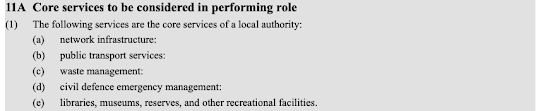
Nicola Willis is Finance Minister. She should have a good talk to her hopeless Local Government Minister Simon Watts about repealing the one Act that gave explicit permission for councils to begin focussing on all the fanciful projects, and to ignore the things people expect them to do, such as the rubbish, the roads, the pipes, the basics ...

That Act was the Local Government Act, which receives far less opprobrium than it should.

JUST OVER TWO DECADES AGO, in 2002, the then-Local Government Minister was the hard-left Alliance Party's Sandra Lee. And it was then that local government debt began to rise dramatically — not because councils around the country were over-investing in infrastructure; not because they were going hard on their core business; not at all because they were building, maintaining and upgrading roads, bye-roads, drains, pipes and parks as they were damned well supposed to. For the most part, instead, with some significant exceptions, they weren't. What they began building instead was a lot of expensive fucking monuments

Monuments mostly to themselves.

The culprit here was Sandra Lee's Local Government Amendment Act 2002, which granted to city councils, district councils and regional councils a "power of general competence" (I know, right?) which would enable them to enter into any activity they wished, with the only limit being their imagination and the pockets of their ratepayers.

Prior to Sandra Lee's Local Government Act, councils could only do what they were legally permitted to to, i.e., to carry out their core business. After Sandra Lee's Local Government Act, however, the leash was off. And council credit cards started straight away racking up debt for vanity projects everywhere. 

I'd like to say I told you so. I'd like to, so I will. Because I was as outraged then as I am now:

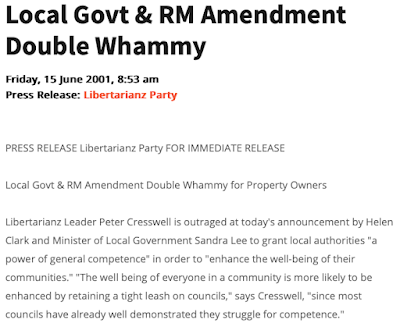
Libertarianz Leader Peter Cresswell is outraged at today's announcement by Helen Clark and Minister of Local Government Sandra Lee to grant local authorities "a power of general competence" in order to "enhance the well-being of their communities." "The well being of everyone in a community is more likely to be enhanced by retaining a tight leash on councils," says Cresswell, "since most councils have already well demonstrated they struggle for competence."
    "Local government throughout New Zealand's history has demonstrated its utter incompetence in handling the loot they confiscate from ratepayers by wasting it on such idiocies as the New Plymouth Wind Wand, the Auckland Britomart edifice, and the Palmerston North empty civic building." he said. ...
    "More substantially," says Cresswell, "there is a crucial constitutional principle at stake -the constitutional principle that citizens may do whatever they wish, apart from what is specifically outlawed, whereas governments and councils may only do what is specifically legislated for. The main purpose of this constitutional principle is to keep a leash on government, both central and local. It is this leash that is beginning to gnaw at local governments, and it is this leash that Clark and Lee propose to untie."
    "It is a dangerous step to take," warns Cresswell, who points out that councils are being given more 'freedom' at he same time as the Resource Management Amendments Bill threatens to take away even more freedom from New Zealand property owners. "The constitutional principle is being reversed," he says. "Even as they propose giving local government wider powers to act, they are taking away the power of individuals to act for themselves," says Cresswell. "Every property owner should rise up in protest," he says.
    "Libertarianz will be making a strong submission on the consultation document," says Cresswell. 

Which we did. For all the bloody use that it did: The Clark Government passed it, a succession of Local Government ministers since since has kept it, and every bloody local councillor ever since Sandra's "permissive" Act has spent like a drunken sailor on shore leave with a start-up founder's credit card.

The New Zealand Local Government Funding Agency (LGFA) supplies around two-thirds of that council debt, and last time I looked their tab was just over $18 billion. That's about $20,000 for every ratepayer. Add to that an existing $5 billion of Auckland and Christchurch council debt. And those numbers are every year by around a billion a year as ballooning rates rises fail to keep up with even-more ballooning council spending.

And as you can now see, it's not like they've been spending much of it underground.

In Christchurch they've been turning the city into "an innovative and modern community with major facilities from Akaroa Wharf to Te Kaha Canterbury Multi-Use Arena." In Wellington they've been watching the city's infrastructure crumble while they vote to spend hundreds of millions on earthquake-prone inner-city monuments of questionable value. And here in Auckland, council have allocated yet another billion dollars (plus fuck-ups) to pour down the ever-expanding black hole of the train set with the ever-disappearing-opening date, plus several hundreds of millions more to continue transforming the place into "one of the world's most liveable cities."

A shame there are still very few plans to make it an affordable one.

What on earth is to be done?

You know, here's an idea.

Instead of keeping Sandra Lee's Local Government Act and binning Three Waters, which is where this new Coalition Government went, how's about — and hear me out, now that you've all heard the story —how's about we bin Sandra Lee's act and tell fucking councils to stop over-spending, to close down their PR departments, and to get back to their core fucking business.

Maybe you could suggest something like that to Simon Watts, who's the current Local Government minister. 

But you'll have to explain to him first who Sandra Lee is, and what she did back then to stuff things up. Because the gormless twit does appear a bit simple.

UPDATE: It's been pointed out to me that Simon Watts is trying to overturn some of Sandra Lee's Act, and argued that I've been unnecessarily harsh about him in my conclusion.

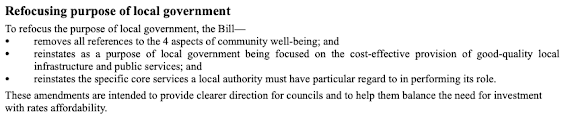
Nearly two years into his job, he is introducing an Act he says will "refocus" councils to their core jobs.

. . . .
 . . . .
. . . .
Unfortunately, however, while this is good as far as it goes, it's the Act from way back in 2002 that still needs a bullet.

Friday, 23 May 2025

A coward's budget [updated]

The New Zealand Government's gross debt — the amount taxpayers must service — will now increase by another $73b by 2029, reaching a massive $283b.  That's $94,000 for every New Zealand family (with nearly $6000 of that just to pay the government's interest!).

Things are desperate. It's the middle year of an election cycle. Time for something bold.

No?

No.

Its not about doing more with less, or vainly trying to to. It's about doing less with less. Less with our money.

Ms Willis has failed us on both counts.

Let me give you two examples. (Three Four if you count my polite suggestion yesterday to gradually raise superannuation age, and include Lindsay Mitchell's today to time-limit welfare assistance.")

Several years ago when Helen Clark's Labour Party was about to lose an election , then Finance Minister Michael Cullen placed a fair proportion of New Zealanders onto welfare. His Welfare for Working Families programme made sure that, until ended, more than half of the country will now be beneficiaries. On the mooch. More than half of the country pulling down more from other taxpayers than they can ever give back.

This National Party Finance Minister could have done nothing with the programme — allowing inflation to make the maximum threshold for the programme dissolve.

She could have ended it altogether — signalled in good time, of course, to let folk plan ahead — but ending it could have saved $2.5-3billion. 

Instead, she raised that threshold below which working families get welfare. Around 142,000 New Zealand families. Which means even more working New Zealanders will continue to be moochers off (further normalising the behaviour perpetuating the Welfare State).

Many years ago a National Party Finance Minister introduced an Accommodation Supplement to, supposedly, help out poorer renters. Of course, it did nothing of the sort: instead if helped out their landlords, who could simply raise their rents to meet this new "supplemental" monetary demand for their supply. The Supplement — a grant to landlords — currently costs around $5 billion.

This National Party Finance Minister could have announced a lowering of the Supplement, saving some of those billions.

She could have announced it would end altogether, saving them all (while lowering rents). Instead, another expensive, destructive market-distorting subsidy continues.

I highlight these two measures because, for all Nicola Willis's hand-wringing about being prudent, about being responsible, about needing to achieve a surplus — and with the economic system flatlining while government debt vaults up decade by decade, bold measures to get there are not just a nice-to-have but a have-to-have — this budget is neither prudent, nor careful nor responsible.

Not being bold is to be irresponsible.

It's to be a coward.

Opposition parties are trying to paint this as an austerity budget. National Party pollster David Farrar boasts that it isn't.

It bloody should have been.

More here from others:

The Taxpayers’ Union is slamming Budget 2025 as a waste of time and hype, asking ‘is that it?’
"Nicola Willis has failed,” says Taxpayers’ Union Spokesman Jordan Williams. “This Budget could easily have been delivered by Grant Robertson."

“Willis promised to tackle the last Government’s ‘addiction to spending’. Spending is going up as a proportion of the economy in this year’s Budget compared to the current year. Core Crown Expenses are forecast to be 32.9 percent in 2025/26 compared to 31.8 percent under Robertson in 2022/23.

“She promised to balance the books. The OBEGAL never gets into surplus according to Treasury forecasts. Willis has had to make up a new measure to exclude the ACC deficit to create an illusion of a laughably small surplus in 2029.”

“And she promised growth. But the headline measure – an accelerated depreciation regime – is basically no better than what the last Labour Government tried immediately after COVID.”

“According to the Budget documents, the Government's headline ‘growth’ policy adds just 1 percent to GDP over 20 years. It is laughable in its small size.”

“More spending, more debt, and nothing to materially shift the dial and grow the economy. It’s not a Growth Budget, it’s a fudge-it."
Further:
"Spending as a share of GDP is materially higher than in the last fiscal year Grant Robertson was responsible for."  
It's very much a centrist budget to not please those wanted a balanced budget and shrinking of the state, and of course isn't a budget of new grand larceny and profligate handing out to preferred causes, it basically just holds the line of NZ's Jacinda-era bloated state. ... a[nother] kick-the-can-down-the road budget.

Eric Crampton mentions some political sleight-of-hand:

"At some point, we have to wonder about the fiscal responsibility provisions in the Public Finance Act matter, because those effectively say you should not be running structural deficits for a decade, and we will have been running structural deficits for a decade. The ones during Covid were excusable - now, not so much. ....

"If you want to see the state of the government's books on the more traditional OBEGAL measure, rather than the one that excludes substantial ongoing ACC deficits, you have to go to the "Additional materials" in the online appendix. 

"Here 'tis. No return to surplus."

"The Growth Budget" has just one growth-oriented policy [i.e., accelerated depreciation for business investment], estimated by Treasury to raise GDP by a mere 1% over 20 years (0.5% in total in the next five). 

"We were, of course, promised 'bold steps.' 

"Simply unserious."

UPDATE: More from Michael:

"[T]he government chose to title its effort [yesterday] 'The Growth Budget.' The Minister spoke today against a backdrop emblazoned repeatedly with that label.... the Prime Minister made a big thing of the need to accelerate growth ... The Minister of Finance in announcing the Budget date ... [boasted] 'the Budget will contain bold steps to support economic growth' ...

"They did not deliver.

"There was a single growth-oriented initiative in the Budget ... [T]he best Treasury estimate is that it will lift GDP by 1 per cent, but take 20 years to do so

"This year’s Budget represents another lost opportunity, and probably the last one before next year’s election when there might have been a chance for some serious fiscal consolidation. The government should have been focused on securing progress back towards a balanced budget. Instead, the focus seems to have been on doing just as much spending as they could get away with without markedly further worsening our decade of government deficits. ...

"We used to have some of the best fiscal numbers anywhere in the advanced world, but as things have been going – under both governments – in the last few years we are on the sort of path that will, before long, turn us into a fairly highly indebted advanced economy, one unusually vulnerable to things like expensive natural disasters. ...

"The government seems to have become quite adept at rearranging the deckchairs (cutting spending that they consider low priority and increasing other spending) but they are choosing to make no progress at all in reducing the structural deficit. ...

"Which brings us to the most recent IMF Fiscal Monitor released a few weeks ago [showing how our] primary deficit now compares ... Depending on your measure we were (based on HYEFU/BPS numbers) worst or close to worst in the advanced world. Today’s Budget will have done nothing to improve that ranking."

Friday, 28 March 2025

Four years of housing uncertainty. Thanks National.

Important to remember that on top of Chris Bishop's announcement this week of recommended changes to the Resource Management Act, unlikely you'd think to be passed before the next election (with all the uncertainty that that will generate), is his and his boss's other injection of uncertainty into housing — i.e., what the planners will and won't allow on a building site — with an admission, buried in a speech yesterday, that this uncertainty will persist until at least 2027!

Dan Brunskill spotted the admission tucked into the speech, calculating that "National's U-turn on the bipartisan accord caused a three-year delay to housing reform"! He explains:

In a speech to the Property Council summit in Auckland on Thursday, Bishop said "Going for Growth” and other reforms would only be bedded in “from 2027 or so onwards.” 

This delay follows the National Party’s decision to abandon a bipartisan housing agreement, called the MDRS (medium density residential standards), negotiated from the National side by Judith Collins and Nicola Willis in 2021.

At the time, Willis said Labour and National had come together “to say an emphatic ‘yes’ to housing in our backyards.” [And this gave every developer certainty.

But new party leader Christopher Luxon sided with his NIMBY caucus colleagues in the run-up to the 2023 election and forced [sic] Bishop to rush out an alternative policy after letting his opposition to the arrangement slip during a public meeting.

National’s new policy allowed councils to opt out of the denser housing rules, provided they zoned their cities for 30 years of growth "immediately" — but, almost two years later, not a single council has formally adopted the policy.

Bishop said on Thursday the finer details of the policy’s first phase were still being worked through by officials and local councils should be ready to implement them in 2027.

This is partly due to a “sequencing problem” as the Government is also planning to introduce an entirely new resource management regime towards the end of next year. ... 

Housing reform and the new resource management rules will be implemented as part of the 2027 Long Term Plan cycle [they hope], or roughly four years after Bishop backtracked on the MDRS.
Four fucking years! George Gregan would be proud.


Wednesday, 19 February 2025

"In the Minister’s words, 'Going For Growth outlines the approach the Government is taking to turbo-charge our economy.' Yeah right.


"The Minister [of Finance] also used her speech to announce the launch of a Going for Growth website complete with a 44 page document (15 of which are photos and covers, and another 9 are lists of things (being) done) titled 'Going for Growth: Unlocking New Zealand’s Potential' – in the Minister’s words, 'Going For Growth outlines the approach the Government is taking to turbo-charge our economy.'
    
"Yeah right.

"Now, to be clear, there are some (mostly small) useful things the government has done in the area of economic policy. There are also some (fewer in number) overtly backward steps ... and some important areas where the government has so far failed to act at all .... There is [however] just nothing in what the Minister said, or in what the government has done (or has concretely indicated it will shortly do), that comes even close to being likely to 'turbo charge' the economy.

"It isn’t even clear that either the Minister or her Treasury advisers has anything close to a compelling model and narrative about how we got into the longer-term productivity mess, let alone how we might successfully get out of it (if any politicians really cared enough to want to do so).

"We are told ... that 'Leaders around the world are being compelled to act more boldly than they have for several decades.' But there isn’t much sign of it ..."

"We are told that 'New Zealand’s low capital intensity is a key driver ... of our poor productivity performance.' No one disputes that business investment as a share of GDP has been low in New Zealand for a long time ... So the capital stock per worker is, in some mechanical sense, quite low. ...

"But ... the mentality is all wrong. Low levels of capital intensity are at best seen as symptom not as any sort of cause or 'driver' of productivity growth failures economywide. New Zealand has never had a particularly problem attracting finance ... And we should assume that, on average, firms and potential investors are responding rationally, and even optimally on average, to the opportunities they face.

"So the issue is not that firms are failing to use enough capital in their production processes – they are most likely doing what is best for them – but that, having regard to all the other constraints (taxes, FDI rules, RMA regimes, other bits of regulation, real exchange rates) there just aren’t that many attractive projects here in New Zealand. A highly successful New Zealand economy would be likely to be more capital intensive (and generate higher wages), but focusing on the capital intensity or otherwise is the wrong lens with which to look at the problem.

"Firms and investors respond to opportunities, and sometimes (often) governments get in the road and make investment ... unattractive."


~ Michael Reddell from his post 'Willis and Rennie speaking'

Friday, 24 January 2025

... the *state* of this nation! [updated]

"Brief thoughts on [the PMs'] 'State of the Nation' [speech]: Focus on economy is good. Saying 'economic growth' a lot & renaming the Economic Development portfolio doesn't do much.  [I'm] confused as to what the role of Invest NZ is compared with NZ Trade & Enterprise (NZTE). 
    "The idea of less saying 'no' is great but it is not a policy or a roadmap. 
    "There was a whole lot of nothing in that speech. Aspiration, ideas, hopes. We need some steel spines & brass balls when it comes to the economy. Nicola & Luxon need to stand up & unapologetically declare that they are going to be brave, bold, ruthless. Spending has to come down. Growth doesn't matter if spending outstrips it. 
    "I am underwhelmed and anxious. I'm a swing voter; past two elections I've voted centre-right. That State of the Nation speech has given me anxiety. With scores of advisors, comms people, ministers etc that was what they came up with? I WANT THE GOVT TO SUCCEED!! Because I want to live in NZ. 
    "That was depressing."
          ~ Ani O'Brien

"Luxon’s ‘going for growth’ just grows the government bureaucracy. ...
    "Christopher Luxon’s State of the Nation speech on the economy strikes, but misses the mark, with no announcements that will increase New Zealand’s productivity, or unshackle the private sector that drives growth. 
    "[T]he speech was more about 'feels' and repeating old announcements than concrete policy changes to improve New Zealand’s prosperity.
    "The only exception is, bizarrely, another government agency, apparently to attract foreign investors.”   
    “The speech represents shifting deck chairs, not the sort of economic reform the times call for.” 
    “People don’t invest in a country because a government agency tells them to. Claims that this model is seen in Ireland or Singapore are fantasy. Investors in those countries don’t have among the highest corporate tax rates in the developed world. Today’s speech would have meant something had it tackled our tax settings or securities law which make investing here so unattractive.”
    “New Zealand’s lack of foreign investment isn’t because of a lack of bureaucrats. It’s because we don’t offer competitive investments. Today’s speech lacks the seriousness or urgency in ‘going for growth’.”
          ~ Jordan Williams

[Hat tip cartoon Dr Stephen Clarke]

UPDATE:

Eric Crampton tries for more optimism. Like Denis De Nuto, it's all about "the vibe," he reckons

A shift in vibe has to be backed by more than speeches. The culture in our bureaus and agencies needs to change, along with the regulatory regimes. That will take real work.
    But the shift in vibe is welcome. It’s time to build.

Wednesday, 18 December 2024

Tweedledum, and Tweedledumber


"My reading of NZ Treasury's Half Year Economics & Fiscal Update 2024 is that little has changed since the government changed. ...
    "The average of [the fiscal deficit (excess of government spending over taxes)], which comprise the Coalition's first term in office, is -3.4%. ... How does it compare to when former PM Jacinda Ardern & Finance Minister Grant Robertson governed? ... The[ir] average is -1.6%. So National, ACT & NZ First are on course to more than double the size of fiscal deficits that were run during the Ardern-Robertson years.
    "What's more, the year when the deficit really blew out, being 2020, was due entirely to the wage subsidy scheme expansion [for which] National lobbied hard ... to make it of unlimited size ... Before the wage subsidy cap was lifted, the maximum any one firm could take was $250,000. After the cap came off, firms like Fletcher Building scooped over $50 million each.
    'What's the moral of the story? That National and Labour are essentially the same party, just run by different actors, sales folks and marketing directors who are pretending their two products are different, because they use different branding & colors. They're like Coke and Pepsi Cola. ... Same old. Same old."

~ Robert MacCulloch from his post 'Its Official: Behind all the Hot Air from the PM & Finance Minister, National is Running a Bigger Borrow-and-Spend Government than 6 years of Ardern & Robertson.

Wednesday, 27 November 2024

"Finance Minister Willis: my first recommendation is to replace your advisers with ones who do not represent the interests of the biggest monopolies and duopolies in NZ."


"[Bill] English had an Academic Advisory Group when he was Finance Minister, which included me. Willis dumped it. Her adviser outside the Beehive is the NZ Initiative ... a lobbying group for our biggest corporate monopolies.
    "Its board includes Scott Perkins ... a Non-Executive Director of Woolworths. Another Board member is Chris Quinn, who is Chief Executive of Foodstuffs ... Barbara Chapman, another Board member, is former Chair of one of the Big Banks.
    "Can you believe it? This is the Board of the outfit who our Finance Minister takes advice from about how to break-up monopolies? Fletcher Building is a member of the Initiative. I was there around 8 years ago when Key was PM, and the CEO of that company ... lectured me how NZ's infrastructure was 'amazing' and not in need of any significant repair. Air NZ is a member. ANZ is a member. ...
    "So Finance Minister Willis, my first recommendation is to replace your advisers with ones who do not represent the interests of the biggest monopolies and duopolies in NZ."

Wednesday, 20 November 2024

Little Nicola's report card after one year: 'Not Achieved'


"National was elected on the promise of fixing the economy. Not talking about it; but to deliver the goods. ... How is Finance Minister Willis doing? [Answer:] She has not yet proved herself. ...
    "[T]he Kiwi economy is stagnant ... experiencing one of the lowest GDP growth rates in the world. [I]nflation is lower, [but] it has been coming down in most nations. ... [W]e held out hope there would be a drastic reduction in red tape and regulation. However the new Department of Regulation has done next to nothing yet, other than hire managers. ... Willis has sent no clear message to the markets that hers is a government of low taxes. Quite the opposite, she has kept top tax rates the same, as well as corporate taxes. ... [yet] the fiscal deficit will [still] worsen under Willis, unless the economy starts to rapidly pick up. The trimming of civil servants, whilst necessary, is not on a scale that will greatly shift the dial. ...
    "[O]n healthcare, Willis pretends that hiring Lester Levy is a reform. Parachuting in a cost cutting manager does not constitute a health-care policy. ... [O]n housing, once the propaganda is stripped away, National's reforms offer less of an increase in supply than was going to happen under the bi-partisan accord that the Party signed up to with Labour years ago. ... National's trumpeted Fast-Track Approvals is nothing more than a rejig of the Fast-Track Approvals process Labour enacted when in office, although with a lessening of environmental checks. ...
    "Willis ... represents ... a Sir Bill English-type, a steady-as- she-goes, status-quo, old-style, conservative Nat. Maybe it worked for him. It won’t for her. It won’t for the nation. ... New thinking is required."

Wednesday, 14 August 2024

"Don't ignore the reputational harm Willis is inflicting on our financial system by proposing untested, populist policy measures driven by short-term political motives."


"The Minister of Finance [Nicola Willis] has, over the last couple of weeks, been trailing various possible changes in the financial system. ... trying to beef up Kiwibank ... overriding various bits of policy that are now squarely the legal responsibility of the Reserve Bank ... chang[ing] the law to force the Reserve Bank to lower bank capital requirements, and provide carveouts for some or other favoured groups. ...
    "But if you really want to make a change like that you do it after wide and serious consultation, or perhaps even as part of a well-trailed campaign promise, not simply (as it seems) to play distraction because another government agency might be about to release a briefly awkward report. ... if you want to be taken seriously as a Minister of Finance, you don’t just drop such a view into an interview – with, it appears, nothing in support – you outline carefully your case, or commission some reviewers to look into the matter carefully. ...
    "I don’t suppose it is very likely that Willis and the government will end up doing any of the things she trailed in last week’s 'Herald' interview. ... [But don't ignore] the reputational harm Willis is inflicting on our financial system by proposing untested, populist policy measures — arguably driven by short-term political motives. ... it hardly enhances any reputation Willis aspires to to be (and be seen as) a more serious Minister of Finance (focused on things that might make a real difference) than her predecessor. ...
    "Willis could readily have changed the chair of the Reserve Bank board when his term expired ... She could have filled the vacancies on the board with people better qualified than those Robertson appointed. But [she] hasn’t done anything about that either. ... suggest[ing] she isn’t really serious about any of this.
    "In the same vein, each year the Minister of Finance writes a Letter of Expectation to the Board... [Her] 2024 letter ... has not a hint of any of the sorts of issues/concerns Willis was raising in the 'Herald' interview. She also hasn’t revised the Financial Policy Remit(a new tool) issued by Robertson a couple of years ago. ... [S]he has shown no sign of doing any of the things she could (e.g. Board chair and vacancies, unwinding new indemnities the Bank has been given) or of using any moral suasion (e.g. through the letter of expectation) around financial policy issues or the Bank’s budgetary excesses.
    "So it all just looks a lot like a search for a good headline ... rather than a Minister with any sort of serious interest in ... a much better central bank ... Perhaps in that sense she and the Governor ... deserve each other. It is just that New Zealanders deserve much better from both ..."
~ Michael Reddell, from his post 'Still a bad idea'

Monday, 1 July 2024

"On present form, Luxon is looking like a watered down version of John Key, and Willis a watered down version of Bill English."


"The Prime Minister was elected on the basis that his previous career as CEO meant he had a much greater business acumen than Labour's leaders. ... However, yesterday it was revealed .... that the builder of the now cancelled new ferries ... has put in a claim stemming from the terminated $551 million contract ... [and] KiwRail don't know what will be the size of the claim that the NZ taxpayer will ultimately end up paying. ... [I]t's not up to Kiwi Rail's lawyers to decide what is "fair" - it depends on what HMD's lawyers also believe what is fair - and should the two not agree, it ultimately must be decided in court. Furthermore, the government cannot tell anyone what will be the cost of smaller, scaled-down ferries.
    "The crux of the matter is ... the question ... how could PM Luxon & Finance Minister Willis pull out of a billion dollar deal with no idea of the legal consequences?
    "With no idea of the costs of the claims that will arise?
    "With no idea of the price of a replacement deal?
    "PM Luxon talks a big game but has he ever done a three-billion dollar deal before? No. Has he ever pulled out of a billion dollar deal before? No. Elon Musk tried pulling out of a multi-billion dollar deal to buy Twitter. It was a nightmare - so costly that he ended up going ahead with it.
    "If Luxon and Willis don't smarten up and prove they know how to do deals ... show they know [for example] how to do a quality-enhancing health-care reform (rather than pretending abolishing the Māori Health Authority is a reform plan) then we will know in quick order that both are not the real deal.
    "On present form, Luxon is looking like a watered down version of John Key, and Willis a watered down version of Bill English. Labour were so bad that anything is an improvement. But these two are so far looking like not much of one."


~ Robert MacCulloch from his post 'Who, with an ounce of business sense, pulls out of a deal with no idea of what legal claims will arise, and with no idea of the price of a replacement deal? PM Luxon and Finance Minister Willis.'


Monday, 13 May 2024

"Debt is tax."


"There is no point reducing taxation if spending remains unchanged. It is government spending that takes goods and services out of the community, not the means by which Wellington pays for it.
    "Debt is tax."

~ Damien Grant from his column 'Nicola Willis isn’t going to balance the books by culling a few tea ladies'

Monday, 29 May 2023

National promises more housing uncertainty [updated]


DESPITE RISING INTEREST RATES and falling housing demand, New Zealand remains in the grip of its decades-long housing affordability crisis. 

“New Zealand is not short of land," said National's Chris Bishop yesterday, "but restrictive planning rules and a broken funding system have driven up the price of land and housing, creating a social and economic disaster."

He said this while announcing National would backtrack on its own bi-partisan policy to free up restrictive planning rules just a little bit in New Zealand's most unaffordable cities -- a policy that has already been successfully introduced, in association with the Labour govt, and operating for nearly a year. Those new "3-storey" density standards (called MRDS) are a blunt instrument, sure, but they allow city property owners to build taller housing in greater densities in larger numbers than ever before. They have been the only relaxation of restrictive planning rules since ... anyone can remember. And Bishop wants to overturn that.

What a fuckwit.

The MRDS standards were finally introduced only last year -- and more houses and apartments are already being planned and built and lived in under those new standards -- building up instead of out -- buyers seeing large falls in prices for entry-level dwellings, consistent with increased supply enabled by the MDRS and related changes. 

In the way of these things however, with the uncertainty this policy announcement will now make, almost all that planning will now stop while everyone waits to see what happens now -- with all the further implications for housing unaffordability.

What a complete fuckwit.

Christopher Bishop is backed up in this fuckwittery by both his leader, Christopher Luxon, who signalled the backtrack last week ("I think we've got the MRDS wrong," said the fuckwit), and by the leader of the opposition David Seymour, who on this issue abandons his pseudo-liberalism and becomes instead the "Minister for More Rules and Restrictions" -- and by Seymour's thoroughly confused deputy Brooke van Velden who says "The right answer is to leave planning to councils."

What a pack of total fuckwits. NIMBYs to a man and woman.

No news yet on how National's deputy thinks about all this, who's just been thoroughly undermined, i..e., Nicola Willis, who co-sponsored these relaxed density standards with Labour's Megan Woods -- a rare dose of bipartisanship and possibly the only good move on housing any politician has made in at least half a century. So good that all politicians bar those from ACT's illiberal wing could support it.


Oh yes, Bishop couched his announcement of backtracking on relaxing restrictions within cities with a policy to have planners "release" some land on green fields outside them*. Building more out instead of up. Eventually. (And probably easily averted by the planners' art.) But he's hanging his hat on the headline writer's spin that something is being done.**

National has form on this. Before he was elected as Prime Minister, National's John Key announced he would "improve housing affordability by ... changing the building regulatory regime ... and [fix] the Resource Management Act." And voters believed him. Of course, once appointed, that fuckwit did no such thing, watching instead as house prices soared, and planning and building restrictions mounted -- and he was heard to declare that the house price inflation he had helped create would "fix" the leaky homes crisis by inflating it all away.

Who cared what that did for first-home buyers. Certainly not the Prime Minister.

SO WITH HOUSING ONCE again a political football, we await an election to sort out which fuckwits where get to tell us where and how we're allowed to build, planning rules in and around our city are once again completely up in the air -- as they were while we awaited certainty around the MRDS. And without that certainty, it's impossible for developers and builders to make real plans, uncertain as they are as to how council's planners might be allowed to curtail them.

Sure, freeing up any land or planning restrictions anywhere will help housing affordability eventually. But it's not clear that the Christophers' city-edge botch-up is the solution, even if it were to free up anything at all.

Up or out? Why not both.

And why give those planners any bloody power at all?

* * * * 

* Bishop's policy is to require planners "to zone land for 30 years’ worth of housing demand." Those measuring whether this is achieved will be the same planners who wrote the rezoning rules - making it easy for planners to avoid. And he ignores that simply "releasing" land on its own does not necessarily make land cheaper.

The RMA's requirement for planners to undertake a cost-benefit analysis before writing new rules, easily fudged, and Auckland Council's continued fudging over the MRDS requirements demonstrates on their own how easy it is for planners to wriggle around these kind of requirements, and how willing councils will be to back them up.

UPDATE

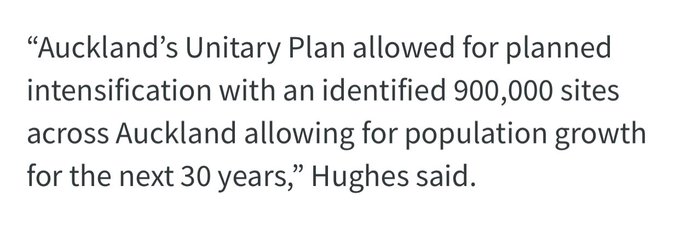
** And Auckland Councillors are already "confirming" that no new land will be rezoned as a result of this -- the Auckland Unitary Plan, they say, already has all that Bishop asks for.