Showing posts with label Quantitative Easing. Show all posts

Tuesday, 14 March 2023

How the Central Bank's Easy Money Killed Silicon Valley Bank [updated]


The second-largest collapse of a bank in recent history would not have existed if not for ultra-loose monetary policy, as Daniel Lacalle explains in this Guest Post. SVB made one big mistake: follow exactly the incentives created by the central bank's loose monetary policy and banking regulations: its lending and asset base read like the clearest example of the old mantra “Don’t fight the Fed.”
[Since this piece was written, of course, we've had the disgraceful announcement by the dumbarse in the White House and from the former Fed chair who helped blow up the tech bubble, of what is effectively a bailout-to-infinity for depositors. UPDATE: David Stockman, Reagan's former Budget Director, calls it A Bailout Most Crooked"They have done it again [he comments], and in a way that makes a flaming mockery of both honest market economics and the so-called rule of law. In effect, the triumvirate of fools at the Fed, Treasury and FDIC have essentially guaranteed $9 trillion of uninsured bank deposits with no legislative mandate and no capital."]

How the Central Bank's Easy Money Killed Silicon Valley Bank

by Daniel Lacalle

THE SECOND-LARGEST COLLAPSE of a bank in recent history (after Lehman Brothers in 2008)  could have been prevented. Now the impact is too large, and the contagion risk is difficult to measure.

The demise of the Silicon Valley Bank (SVB) is a classic bank run driven by a liquidity event, but the important lesson for everyone is that the enormity of the unrealised losses and the financial hole in the bank’s accounts would not have existed if not for ultra-loose monetary policy. Let me explain why.

According to their public accounts, as of December 31, 2022, Silicon Valley Bank had approximately $209.0 billion in total assets and about $175.4 billion in total deposits. Their top shareholders are Vanguard Group (11.3 percent), BlackRock (8.1 percent), StateStreet (5.2 percent) and the Swedish pension fund Alecta (4.5 percent).

The incredible growth and success of SVB could not have happened without negative rates, ultra-loose monetary policy, and the tech bubble that burst in 2022. Furthermore, the bank’s liquidity event could not have happened without the regulatory and monetary policy incentives to accumulate sovereign debt and mortgage-backed securities (MBS).

Silicon Valley Bank’s asset base read like the clearest example of the old mantra “Don’t fight the Fed.” Silicon Valley Bank made one big mistake: follow exactly the incentives created by loose monetary policy and regulation.

WHAT HAPPENED IN 2021? Massive success that, unfortunately, was also the first step to demise. The bank’s deposits nearly doubled with the tech boom. Everyone wanted a piece of the unstoppable new tech paradigm. Silicon Valley Bank’s assets also rose and almost doubled.

The bank’s assets rose in value. More than 40 percent were long-dated Treasuries and Mortage-Backed Securities. The rest were seemingly world-conquering new tech and venture capital investments.

Most of those “low risk” bonds and securities were held to maturity. Silicon Valley Bank was following the mainstream rulebook: low-risk assets to balance the risk in venture capital investments. When the Federal Reserve raised interest rates, Silicon Valley Bank must have been shocked.

Its entire asset base was a single bet: low rates and quantitative easing for longer. Tech valuations soared in the period of loose monetary policy, and the best way to “hedge” that risk was with Treasuries and Mortage-Backed Securities. Why bet on anything else? This is what the Fed was buying in billions every month. These were the lowest-risk assets according to all regulations, and, according to the Fed and all mainstream economists, inflation was purely “transitory,” a base-effect anecdote. What could go wrong?

Inflation was not transitory, and easy money was not endless.

Rate hikes happened. And they caught the bank suffering massive losses everywhere. Goodbye, bonds' and Mortage-Backed Securities' prices. Goodbye, “new paradigm” tech valuations. And hello, panic. A good old bank run, despite the strong recovery of Silicon Valley Bank shares in January. Mark-to-market unrealised losses of $15 billion were almost 100 percent of the bank’s market capitalisation. Wipeout.

As the bank manager said in the famous South Park episode: “Aaaaand it’s gone.” Silicon Valley Bank showed how quickly the capital of a bank can dissolve in front of our eyes.

The Federal Deposit Insurance Corporation (FDIC) will step in [and has - Ed.], but that is not enough because only 3 percent of Silicon Valley Bank deposits were under $250,000. ['So what,' said Janet Yellen, the former Fed Chair ho helped blow up this bubble- Ed.]  According to Time magazine, more than 85 percent of Silicon Valley Bank’s deposits were not insured. [But this has not bothered Yellen, who has now ignored her rules, rewarded this failure, and further ignited the financial industry's glaring moral hazard - Ed.]

It gets worse. One-third of US deposits are in small banks, and around half are uninsured, according to Bloomberg. Depositors at Silicon Valley Bank will likely lose most of their money [or should have - Ed.], and this will also create significant uncertainty in other entities [or should have - Ed.].

SILICON VALLEY BANK WAS the poster boy of banking management by the book. They followed a conservative policy of acquiring the safest assets—long-dated Treasury bills—as deposits soared.

Silicon Valley Bank did exactly what those that blamed the 2008 crisis on “deregulation” recommended. Silicon Valley Bank was a boring, conservative bank that invested its rising deposits in sovereign bonds and mortgage-backed securities, believing that inflation was transitory, as everyone except us, the crazy minority, repeated.

Silicon Valley Bank did nothing but follow regulation, monetary policy incentives, and Keynesian economists’ recommendations point by point. It was the epitome of mainstream economic thinking. And mainstream killed the tech star.

Many will now blame greed, capitalism, and lack of regulation, but guess what? More regulation would have done nothing because regulation and policy incentivise buying these “low risk” assets. Furthermore, regulation and monetary policy are directly responsible for the tech bubble. The increasingly elevated valuations of unprofitable tech and the allegedly unstoppable flow of capital to fund innovation and green investments would never have happened without negative real rates and massive liquidity injections. In the case of Silicon Valley Bank, its phenomenal growth in 2021 was a direct consequence of the insane monetary policy implemented in 2020, when the major central banks increased their balance sheet to $20 trillion as if nothing would happen.

Silicon Valley Bank is a casualty of the narrative that money printing does not cause inflation and can continue forever. They embraced it wholeheartedly, and now they are gone. [Or should be.]

Silicon Valley Bank invested in the entire bubble of everything: Sovereign bonds, Mortage-Backed Securities, and tech. Did they do it because they were stupid or reckless? No. They did it because they perceived that there was very little to no risk in those assets. No bank accumulates risk in an asset it believes is high risk. The only way in which banks accumulate risk is if they perceive that there is none. Why do they perceive no risk? Because the government, regulators, central banks, and the experts tell them there is none. Who will be next?

Many will blame everything except the perverse incentives and bubbles created by monetary policy and regulation, and they will demand rate cuts and quantitative easing to solve the problem. It will only worsen. You do not solve the consequences of a bubble with more bubbles.

The demise of Silicon Valley Bank highlights the enormity of the problem of risk accumulation by political design. Silicon Valley Bank did not collapse due to reckless management, but because they did exactly what Keynesians and monetary interventionists wanted them to do. Congratulations.


Author:
Daniel Lacalle, PhD, economist and fund manager, is the author of the bestselling books Freedom or Equality (2020), Escape from the Central Bank Trap (2017), The Energy World Is Flat (2015), and Life in the Financial Markets (2014).
He is a professor of global economy at IE Business School in Madrid.
His post first appeared at the Mises Economics Blog.

Thursday, 20 October 2022

"Frankly, if British Conservatives are not prepared to countenance tax cuts, spending cuts or other pro-growth measures, they might as well give up and let Starmer try his hand." [updated]


"For years now, the world economy has resembled a ludicrously high-stakes game of Jenga. Politicians and central bankers kept taking it in turns to remove blocks from the tower, adding them back to the top of the stack and congratulating themselves on their brilliance, wilfully blind to the fact that the structure was becoming ever more unstable....
    "Liz Truss and Kwasi Kwarteng [were] doubly unlucky. While almost everybody else in Britain remained in denial, they correctly identified this absurd game for the con-trick that it truly was, warned that it was about to implode, and pledged to replace it with a more honest system....
    "What happened next is dispiriting in the extreme... In an understandable rush, Truss and her Chancellor moved too quickly and, paradoxically, given their warnings about the rottenness of the system, ended up pulling out the last block from the Jenga tower, sending all of the pieces tumbling down. Contrary to the Left’s propaganda, they didn’t crash the economy – it was about to come tumbling down anyway – but they had the misfortune of precipitating and accelerating the day of reckoning....
    "The idea, now accepted so widely, that the price of money must be kept extremely low and quantitative easing deployed at every opportunity has undermined every aspect of the economy and society. It has been a catastrophe, as Truss and Kwarteng have long understood, but the scale of the zombification of the economy that it has spawned caught even them by surprise.
    "There are now too many zombies, with too much to lose..."

~ Allister Heath, from his op-ed 'Britain's zombie economy is crumbling and the real culprits are getting off scot-free'

"Serious spending cuts are impossible. That is the melancholy conclusion we must draw from the événements of the past [weeks]. If a PM chosen specifically to cut taxes can’t do it, no one can. Britain will carry on becoming more expensive, less competitive and poorer, while we [Britons] guzzle more of the medicine that sickened the patient....
    "Several broadcasters have been lazily asserting that the markets didn’t like Kwasi Kwarteng’s tax cuts – which would be very odd if it were true. What the markets actually disliked, of course, was not the tax cuts, but the consequent rise in borrowing. That rise owed more to the energy price cap than to all the tax cuts put together ...
    "So why close the gap by raising taxes rather than by cutting spending? ... Liz Truss might have restored fiscal discipline in several ways.... Instead, she chose what the IFS calls 'probably the least growth-friendly option'....
    "Frankly, if the [UK's] Conservatives are not prepared to countenance tax cuts, spending cuts or other pro-growth measures, they might as well give up and let Starmer try his hand."

~ Daniel Hannan, from his op-ed 'If Conservative MPs can’t even cut taxes, they might as well hand over power to Keir Starmer'
UPDATE:

This seems relevant again this morning. James Carville, advisor to then President Clinton, musing in 1993: 
“I used to think that if there was reincarnation, I wanted to come back as the president or the pope or a .400 baseball hitter. But now I want to come back as the bond market. You can intimidate everybody.”

Thursday, 13 October 2022

Ben Bernanke's Nobel Prize: The Committee Rewards an Arsonist for Claiming to Fight the Fire He Started


The central bankers on the Nobel Prize committee gave their award this year to the central bankers who, as Mark Thornton outlines in this guest post, "rescued" the world from a disaster of their own making.

Ben Bernanke's Nobel Prize: The Committee Rewards an Arsonist for Claiming to Fight the Fire He Started

Guest post by Mark Thornton

Former Federal Reserve Chairman and 'saviour of the world' Ben Bernanke was awarded the Nobel Prize in Economics this week, along with Douglas Diamond and Philip Dybvig. The three have written extensively on the need to bail out banks in times when the economy is in corrective mode, generally after a long period of monetary injections. Bernanke was Chairman of the Federal Reserve when he pushed for the latest round of bank bailouts in 2007-2009.

Bernanke’s research concentrated on the Great Depression, and argued that the banks needed to be bailed out in the 1930s in response to the collapse of the stock market and the severe correction in the US economy. Diamond and Dybvig have also written on the implications of bank failures on the US economy. All three have latched onto the idea that banks take in deposits which are redeemable short term, but they make loans that are longer term and are thus susceptible to bank runs.

Their work is highly suspect from the view of economic theory and is derived from the point of view of history and the social sciences. They neglect the overall situation they are trying to explain, the role of institutions, and the basics of government intervention. For example, Bernanke’s work does not explain why the “situation” occurred in the first place, what the government did from the outset, or how it could be prevented in the future, except for ever-increasing government and Fed intervention.

Their research amounts to little more than an excuse to bail out the banks. Therefore, if you are a member of the privileged financial elites, the Housing Bubble and the ensuing Financial Crisis was an unmixed blessing. You made big money all throughout the housing and stock market bubbles and then your banks received several bailouts and special privileges during the bust, including borrowing at zero interest rates on loans, capital infusions, Quantitative Easing 1 & 2, and interest payments on “excess reserves.”

Of course, most importantly, you had your man in charge of the Federal Reserve, the man who literally “wrote the book” and dissertation on how the Fed must bailout the banks in times of economic trouble. No matter how badly everyone else fared, you could depend on Bernanke to bailout the banks, whatever the costs to others.

The Great Depression is a pivotal event in American history, and it is also crucial in terms of economic theory and policy. Bernanke’s writings are pivotal in terms of redirecting government bailout policy from monetary policy to bank bailouts.

Milton Friedman’s monumental work (on which Bernanke's bailouts were based) argued that the depression became "great" because the Fed allowed the money supply to collapse in the early 1930s. Instead, Joseph Salerno has /shown/ that the Fed was aggressive in trying to keep the money supply growing, but they failed. Bernanke’s own work shows that banks failed in large numbers in the early 1930s -- due to the negative expectations of banks (and the demise of many of them) they were simply not an effective conduit of the Fed’s desire to pump up the money supply. Banks thereby became “systemically important.”

Each major school of economic thought has its own story of the Great Depression, with Friedman and Bernanke representing the Monetarists, and Bernanke providing the “shock” that provided the “pluck” to Friedman’s Fed-piloted model, as explained by Professor Garrison.

The Keynesians of course have Keynes’s (1936) General Theory. He felt that the depression was caused by a failure of aggregate demand: people were unwilling to spend and invest causing the economy to contract via a psychological pathway, without any fundamental cause, thus necessitating government intervention to prop up the economy. This is the same naive “explanation” you would hear from your grocer, barber, or gas station clerk. Peter Temin filled out this historical narrative in his 1976 book Did Monetary Forces Cause the Great Depression? where he suggests that the cause was a decrease in the demand for money.

The debate between Monetarists and Keynesians devolved into bickering over aggregate supply and demand, model specifications, empirical results, and, at base, cause and effect.

The Austrian school has its own macroeconomic approach, and this can be seen vividly in the case of Great Depression. Ludwig von Mises wrote about the coming of the depression before it happened, and he pointed out what was causing it. In his day, Irving Fisher was the leading economist in the US; Mises showed that it was Fisher’s notion of a stable dollar, managed by the Fed, that was the cause of the coming depression. I explain this episode as evidence of the superiority of the Austrian Business Cycle Theory. Lionel Robbins wrote a contemporaneous account of the Great Depression based on the Austrian Business Cycle Theory.

Murray Rothbard’s America’s Great Depression provides a comprehensive view of the economics, politics, and policy implications of the event from the Austrian view. 

First, Rothbard shows that the Fed’s policies in the 1920s, based on Fisher’s views, were the fundamental economic cause of the crash. It was the Fed that was inflating the money supply during the 1920s, and it was the Fed that had recently taken on the newly created function of "lender of last resort" -- thereby encouraging bankers to take on more risk, and making our fractional reserve banking system more unstable in the first place.

Second, it was the political action by Hoover, Roosevelt and others -- regulations; tariffs; attempting to keep prices and wages high; propping up malinvested resources through the Reconstruction Finance Corporation; moral suasion to raise prices -- that caused the resulting depression to be "great." 

Third, the policy action in the 1930s to keep spending high and to restructure the American economy with New Deal policies lengthened the time of recovery, largely due to the regime uncertainty created by all the political activism. (And just by the way: Robert Higgs demonstrated conclusively that WWII did not get us out of the Great Depression.)

While Bernanke et al are dependable in terms of recommending and endorsing bailout policies and promoting the activities of the central bank -- the Nobel Prize being awarded by and for central bankers -- were happy to  the Austrian school seeks a better, fuller understanding and questions the fundamental effectiveness of such bailouts. The cause of the Great Depression was the Federal Reserve Banks’s inflationary monetary policy of the 1920s. Rather than preventing or even reducing the impact of the depression, it was the New Deal policies of Hoover and Roosevelt expanding the role of government in the 1930s that made it great!

To address the fundamental problem that Bernanke, Diamond and Dybvig have fixated on, and which any non-central banker can explain, requires not an extensive quilt of government regulation, controls, and bailouts, but merely a sound-money regime of money, and banking without a central bank.

AUTHOR
Mark Thornton is the Peterson-Luddy Chair in Austrian Economics and a Senior Fellow at the Mises Institute. He is the book review editor of the Quarterly Journal of Austrian Economics, and has authored seven books and is a frequent guest on national radio shows.
His post first appeared at the Mises Wire.

Thursday, 12 May 2022

Exorbitant Money Creation + Unhampered Government Spending = Stagflation


Too much government spending and too-loose monetary policy lead to rising prices, and falling economic growth rates. The Keynesian theories on which continuing monetary expansion is based lead not to continuing prosperity but to stagflation. Keynesian garbage in, garbage polices and economics destruction out. The 
The problem is not just local, it is worldwide. Again and again, the belief has been proven wrong that central bankers could guarantee so-called price stability, and that fiscal policy could prevent economic downturns. The looming inflationary crisis is one more piece of evidence that interventionist monetary and fiscal policies are disruptive. Instead of a permanent boom, explains Antony Mueller in this guest post, the result is stagflation....

Stagflation—a Keynesian Curse

Guest post by Antony Mueller

“Stagflation” characterises economies that are plagued by inflation, combined with economic stagnation. This is where most of the world is right now, because of the failed (and failing) economic policies they have all followed. In this case, the conventional Keynesian macroeconomic toolkit of monetary and fiscal policy, that offers no help in fixing the crisis it has caused.

Rising price inflation rates and tanking economies are the results of the policy mix that has dominated past decades. It has become common to believe that decades of expansive monetary and fiscal policies would not cause price inflation; that the expansion was 'all under control'; that policies of so-called price stability had somehow 'tamed' the inflation caused by the state's usual money printers. 

As recently as 2020, economic policy worldwide followed the false consensus that combatting the fallout from the lockdowns with additional money creation and higher government spending would lead to an economic recovery without higher price inflation. It was blithely assumed that what appeared to work in 2008 -- flooding economies with newly-minted cash -- would also function in 2020. However, policymakers ignored the difference between the two episodes.

In the aftermath of the financial crisis of 2008, the stimulus policies did not immediately turn into price inflation, as it's commonly measured, because the newly-created money remained largely in the financial sector and it only spilled over into the real economy in a big way in rocketing house prices (exacerbated in NZ by sclerotic land and housing policies). Outside of this generational calamity, the main effect of the policy of low interest rates was to support the stock market and to provide a windfall to financial investors. While Wall Street flourished, Main Street was left on the sidelines -- and while profits surged, wages remained stagnant.

But this time it's different. In 2008, the production side of economies were 'mismatched' due to the earlier credit expansion, but still intact; but this time, they are severely damaged by a major pandemic.  The crisis of 2008 left the capital structure of the real economy intact. Due to the lockdowns, however, this is no longer the case. Consequently, severe interruptions of the global supply chains have happened. In such a constellation, new stimulus measures further weaken already fragile economies. 

The present situation is less like 2008, which most of of us still remember, and more like the oil price shock in 1973 -- which too many current economic practitioners and advisers have forgotten. At that time, like now, the external shock hit an economy rampant with liquidity. Stimulating the economy by fiscal and monetary expansion produced not prosperity but long-lasting stagflation. Back then, along with “stagflation,” the term “slumpflation” was coined to characterise an economy that is mired in a deep slump that then gets devastated by price inflation.

When stagnation and recession show up together with price inflation, the conventional macroeconomic policy becomes impotent. Applying the Keynesian recipe to an economy whose capital structure is still intact inflates bubbles; but applying it to one who capital structure has already been ravaged invites disaster.

Intentionally or by ignorance, policymakers neglected the long-term effects of their doing. Going this wrong way led to such aberrations that policymakers and their intellectual bodyguards even tended to believe that some truth could be found in the alchemy of the so-called modern monetary theory and market monetarism.

The consequences of these policy errors have now come to light. They are particularly grave because they were committed by all major central banks and the governments of all leading industrialised countries. They all follow the concept of “inflation targeting.” Other than timing, there has been not much difference among the policies of major Western economies. Japan is a special case only insofar as its policymakers have applied the Keynesian recipe for over three decades by now.

Let us have a look at Japan first and then at the United States -- who both offer lessons for New Zealand.

Japan


Japan began applying vulgar Keynesianism as early as in 1990. Faced with a slight downturn after the boom of the 1980s, instead of allowing things to cool down, the Japanese leadership instead insisted on going on with the show.

Yet, the more the government began to accelerate public spending and increases the fiscal stimuli, the less its spending policy produced economic recovery. Even when monetary policy fully supported the government’s expansive fiscal policy, the hoped-for recovery did not materialise.

John Maynard Keynes, on whose theories this "rescue" was based, once advised that policy-makers should ignore advice that such loose spending would lead to destruction in the long run -- "in the long run," he quipped, "we're all dead." But Japan's short run is now the long run: its policy mix of fiscal and monetary expansion has been going on now for three decades. In recent times, the Bank of Japan even doubled down, setting extremely low-interest rates and finally resorting to negative interest rates (NIRP). In the meantime, public debt as a percentage of the gross domestic product (GDP) rose to a whopping 266 percent (see figure 1).

Figure 1: Japan: Policy interest rate and public debt as a percent of GDP

Despite its magnitude, this stimuli did not lift the Japanese economy out of its quagmire. Instead, economic growth remained anemic for a quarter of a century (figure 2).

Figure 2: Japan: Annual economic growth rates of real GDP

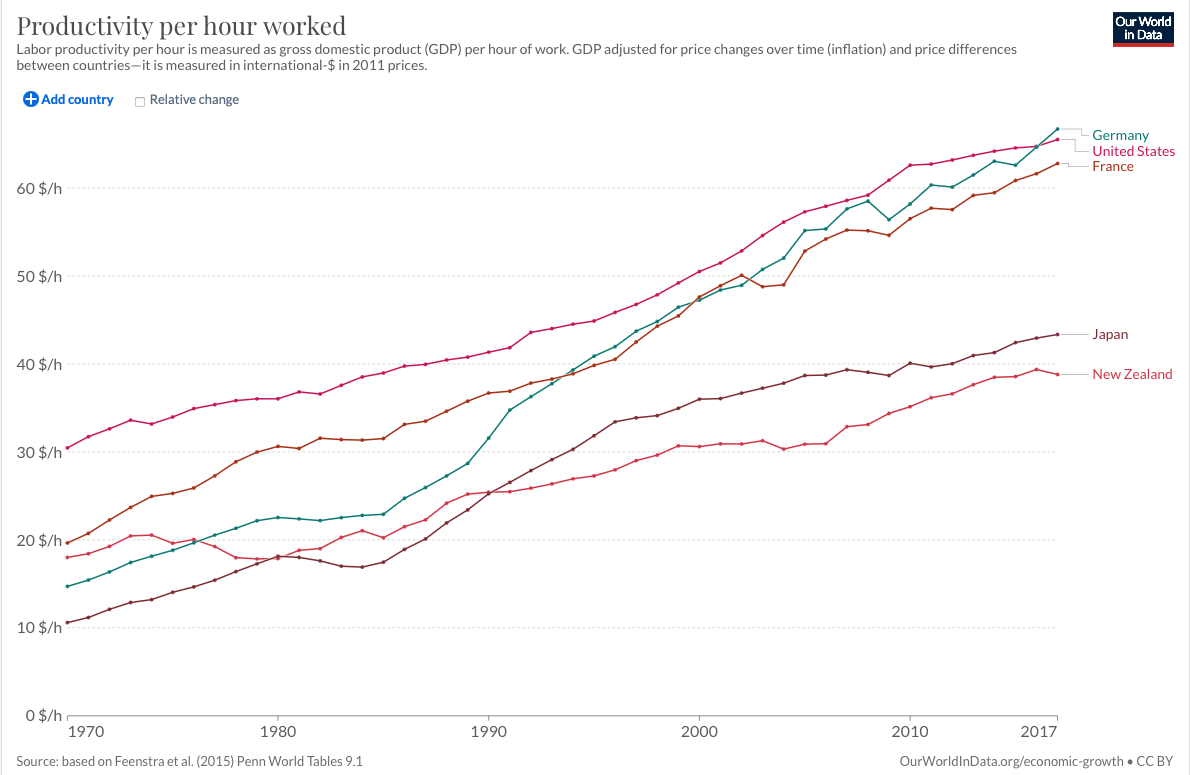
As an “early starter” in applying vulgar Keynesianism to its 'macroeconomy,' the Japanese economy was also early to suffer from productivity stagnation. Unlike economies like the United States, France, Germany, and many other industrialised countries, which have continued with productivity gains over the past decades, after it had begun with its extreme Keynesianism in the 1990s Japan's has moved sideways (and New Zealand, for slightly different and equally tragic reasons, has followed a similar path -- figure 3).

Figure 3: Productivity per hour worked: Germany, United States, France, Japan, New Zealand

It is important to note that one of the most devastating effects of the Keynesian policy mix is its effect on productivity. A country’s long-run economic progress (or growth, as it's often called) is mostly the result of productivity gains. Labour productivity is the main determinant of wages. A slowdown in productivity precedes the economic decline. When the output per unit of input tends to fall, even lower interest rates will not stimulate business investment. The marginal productivity of debt, already low, diminishes even faster -- and further. 

And when government then jumps in to compensate for this “lack of aggregate demand,” things get even worse because governmental enterprises are fundamentally less productive than the private sector.

The United States


Confronted with the financial crisis of 2008, the US government abandoned any sense of economic responsibility and decided instead to launch a series of stimulus packages. The American central bank provided full support, drastically reducing its interest rate.

As a result, the ratio of public debt to GDP rose from 62.6 percent (in 2007) to over 91.2 percent just three years later (in 2010), reaching a full 100.0 percent in 2012. The next two boosts came in the wake of the policies to counter the effects of the economic lockdowns, when the ratio of public debt to GDP rose to 128.1 percent in 2020 and to 137.2 in 2021 (see figure 4). It took less than fifteen years to more than double an already barely-sustainable debt -- and, unfortunately, New Zealand governments chose a similar destructive trajectory.

Figure 4: The United States: Policy interest rate and federal debt as a percentage of GDP


Figure 4a: New Zealand: Policy interest rate and government debt as a percentage of GDP

In the face of the crisis in 2008, the American central bank brought down its interest rate quickly from over 5 percent in 2007 to under 1 percent in 2008 (NZ's meanwhile dropped its rate from 8% to 2.4% over the same period). After a short-lived period when the American central bank tried to raise the interest rates, the consequent market reaction of falling prices of bonds and stocks induced the Fed to resume its policy of “quantitative easing” that combined low interest rates with the massive expansion of the monetary base. 

Then, in early 2020, still trying to escape from the bear-trap of quantitative easy, it also began trying to "ease" the economic effects of the lockdowns with its patent brand of monetary salve, deciding to continue with its expansive monetary policy. And not just to continue, but to accelerate! In due course, the central bank’s balance sheet rose to $7.17 trillion in June 2020, reaching $8.96 trillion by April 2022. Once again, New Zealand's Reserve Bankers followed the lead.

Figure 5: Balance sheet of the US Federal Reserve System & NZ Reserve Bank


As figure 5 shows, the Fed had tried to trim its balance sheet somewhat from 2015 to 2019 when it had brought down the sum of its assets to $3.8 trillion in August 2019. Yet beginning already in September 2019, many months before the lockdown was implemented, the balance sheet of the American central bank began to expand again and reached over four trillion before the additional big increase happened due to the fallout from the lockdowns. (And, once again, NZ's central wbankers followed their 'expansive' lead.)

Since the time before the financial crisis of 2008, the assets of the Federal Reserve System rose from $870 billion in August 2007 to a whopping $4.5 trillion in early 2015 and to around nine trillion US dollars in early 2022.

Even when inflation rates began to rise towards the end of 2020, the US central bank had kept its policy of tapering small and refrained from tightening. The monetary authorities had simply abandoned the objective of reining in the money supply, becoming instead almost Wall Street's banker. Each time they tried to tighten monetary policy, the financial markets began to tank and tended to crash. As soon as the central bank began to raise its policy rate of interest, the bond market began to tank and took the stocks down with it. In 2022, it was not different. Yet in early 2022, the policymakers could not shrink back. Different from the episodes before, the price inflation had begun to skyrocket (see figure 6, and NZ following in almost lockstep, figure 6a).

In the first months of 2022, stagflation became fully visible. While price inflation rose, the rate of real economic growth began to fall. In the first quarter of 2022, the US inflation rate moved up to a rate of 8.5 percent, while the real annual growth rate fell by 1.4 percent. Similar things were happening in the South Pacific.

Figure 6: United States: Policy interest rate and official consumer price inflation rate

Figure 6a: New Zealand: Policy interest rate and official consumer price inflation rate


Of course, none of this should come as any surprise. With global supply chains in disarray, and national protectionism on the rise, the assistance that came from the expansion of international commerce after the crisis of 2008 is no longer with us. The lockdown of economies has severely hurt the global system of supply chains -- and now, a huge monetary overhang meets a shrinking production. The war in Ukraine, which started in February 2022, is not to blame for the distortions, albeit it will make them more severe.

Conclusion


The levee broke. Price inflation is on the rise. This is the result of the accumulation of liquidity that has been going over decades. There is the risk that things will get worse because the world economy has been severely wounded by the lockdown. More so than only mild stagflation, a “slumpflation” looms on the horizon as the world economy gets mired in the morass of a deep slump combined with steeply rising price inflation.
But the problem was not inevitable -- it is a result of specific policies followed out on the basis of flawed economic theory. Local politicians are right in one way to blame the problem on global issues -- the problem is that this destructive Keynesianism is everywhere, and as long has it is, so will the problems.

* * * * 

Author: Dr. Antony P. Mueller is a German professor of economics currently teaching in Brazil. See his website and blog. A version of this post previously appeared at the Mises Wire.


Friday, 29 April 2022

"The NZ Reserve Bank is now in panic mode...."


"After keeping the cash rate so low for so long, and embarking on a $53 billion quantitative easing programme, the [NZ Reserve] Bank is now in panic mode. Those having trouble paying back their mortgages in the next few years can blame our RBNZ Governor [Adrian Orr] and Finance Minister [Grant Robertson]. They encouraged a borrowing binge to buy [and borrow against] houses at wildly inflated prices, financed by dirt-cheap credit, turning a blind eye to the breach of the target to which they mutually agreed, and not learning the lessons of the global financial crisis in 2008.
    "The RBNZ was once lauded around the world for making NZ exceptional. It pioneered inflation targeting. We became the gold standard [sic] of monetary credibility.
    "Now, our hard-fought success and huge reputation built up over thirty years lie in ruins.... our RBNZ Governor and Finance Minister have driven a truck through the single most important agreement underpinning our economic security since 1989."
~ Auckland Uni economics professor Robert MacCulloch, from his op-ed 'The case against the Reserve Bank & Finance Minister'


Wednesday, 26 February 2020

Quantitative Easing Explained


Ten years later, and still topical. And still hilarious. And now viewed more than 6 million times!

But maybe just a bit too topical.


"The only thing that is deflating that I can see is the Fed's credibility."
PS: And don't forget the late John Clarke's masterful explanation of QE ...
. 

Tuesday, 11 February 2020

"Our so-called economic recovery is actually a 'bubblecovery' based on the growth of dangerous new bubbles and another debt binge." #QotD


"I have been warning that we are experiencing another massive bubble for eight years now (starting in June 2011) and I am proud of it...  My belief is that our so-called economic recovery (both U.S. and global) is actually a 'bubblecovery' based on the growth of dangerous new bubbles and another debt binge. These bubbles are ballooning across the globe in numerous assets, industries, and countries such as U.S. equities and bonds, U.S. higher education, U.S. corporate debt, tech startups, shale energy, China and emerging markets, New Zealand, Australian and Canadian property, and more. The actual driver of these bubbles is the extremely aggressive central bank policies since the global financial crisis (i.e., record-low interest rates and quantitative easing).
    "While most of my trolls and critics assume that I’ve been calling to short the market for nearly a decade because of my bubble warnings (and have, therefore, been wrong all along), they couldn’t be further from the truth..."

~ Jesse Colombo, from his post 'Why Warning About A Bubble For A Decade Is Completely Rational'
.

Saturday, 10 August 2019

In 1789 Marie Antoinette said 'let them eat cake.' In 2019, the Reserve Bank tells us to eat 'cheap money.’


A piece of excrement called Adrian Orr
[pic of Herald hard copy]

Many savers live off their savings. In order to maintain their capital, many -- older, retired folk, especially -- live off the interest on their savings.

Mr. Adrian Orr has just told all those people, every single one of them, to get stuffed.

Mr. Adrian Orr is the governor of the New Zealand Reserve Bank.

This makes him, by virtue of the Official Cash Rate, which he dictates, the person who sets the level of New Zealand's interest rates.

Without any special inflationary pressure on him (controlling which purports to be the purpose of his job), Mr. Adrian Orr announced this week that he intends to savage savers. Not in those words, naturally. What he did was announce a savage and unprecedented cut to the make the OCR the lowest it has ever been in history, while telling savers to suck it up: Savers, he said, "might have to think about investing in other assets if you want to get higher than what you consider the lowest-risk nominal returns."

In other words, savers who wish to stay afloat need to seek out all those forms of risky too-good-to-be-true investments that collapsed so spectacularly just over a decade ago.

Mr Orr is considered a prudent manager of the country's interest rates.

Clearly however, by his subsequent (and frankly stupid) comments about the "need" at this dangerous time for govt spending, for greater borrowing and spending, and to flush out cash from under pillows, he is a student of John Maynard Keynes -- who famously called for interest rates to be driven to zero in order to bring about "the euthanasia of the rentier." That is, to euthanase all those folk, like all those retirees, all those rentiers, as he labelled them, who live off the interest on their savings.

In what world would you call that "prudence"?

Every student of Keynes is aware of Keynes's ambition here. Because this was not just one of My Keynes's many idle remarks. This was
a linchpin of his basic political programme, the “euthanasia of the rentier” class: that is, the state’s expanding the quantity of money enough so as to drive down the rate of interest to zero, thereby at last wiping out the hated creditors. It should be noted that Keynes did not want to wipe out investment: on the contrary, he maintained that savings and investment were separate phenomena. Thus, he could advocate driving down the rate of the interest to zero as a means of maximising investment while minimising (if not eradicating) savings.
The basic message to savers being, as from Mr Orr, to get stuffed. This cheap money policy is here to stay, Keynes wished for and Orr now seems to say, and the "class of savers" seeking should simply suck it up and get used to it. As with others, like the FT's Martin Wolf, who have similarly invoked Keynes's methodology
What makes [this] conclusion so tainted is that he understands the consequences of this policy... the ruination of people who earn interest on their savings.
    He sees the problem as insufficient aggregate demand...
    This is classic Keynesian logic: solve the problems of debt and monetary expansion by engaging in more debt and monetary expansion. With governments reluctant to expand spending further he concludes that we are stuck with the second-best solution of a cheap money policy consisting of ultra-low interest rates and quantitative easing.
Besides, as we have observed, Mr. Orr believes the cautious "rentier" no longer serves a useful purpose.

Mr. Orr's comments are of a piece with other we might declare as an "unabashed mouthpiece for the ruling power elite." Because as Mark Thornton points out about the FT's Martin Wolf when he openly advocated (in a piece titled “Wipe out Rentiers with Cheap Money,”) what Mr Orr now clearly implies:
He clearly and correctly [observes] what this policy actually accomplishes — cheap monetary policy hurts most people in the economy, particularly workers and savers and redistributes wealth to the ruling elites. The losers from easy credit policy include the broad categories of insurance, pensions, and households. This long known result was confirmed in a [2014] study ... by the McKinsey Global Institute.
    Insurance is far more important than most people think. Insurance protects us against the loss of life (life insurance), our health (medical insurance), our homes (home, flood, and fire insurance), and our vehicles (car insurance). There is also general liability insurance and various types of business insurance. Insurance companies even offer incentives to be better drivers, to maintain safer homes, and to live healthier lifestyles, and they strive to eliminate moral hazard. Insurance companies are hurt by cheap money policies because their interest return on investments are now lower than required to meet their payout obligations. This hurts the companies and their policyholders because it requires higher premiums and raises the possibility of bankrupting insurance companies.
    Pensions and retirement savings accounts are also hurt by easy credit policies. These institutions arose to address the problems associated with increased longevity brought about by increased prosperity. By saving during your working career you provide income for your retirement. Cheap money policy and low interest rates discourage saving and also makes it more difficult for pensions to earn returns on their investments necessary to make future payouts to retirees. The same is true for individuals who have retirement savings accounts.
    In order to achieve higher returns, pension funds and people saving for retirement have been forced into more risky investments. Savings accounts, money market mutual funds, certificates of deposit, and short-term government bonds earn less than 1 percent, and after taxes and inflation they are losing purchasing power. Hence, central banks have been forcing these people to invest in the stock markets and junk bonds and the possibility of large losses in the future.
This is precisely and specifically what Mr Orr demands of householders, to "stop suffering money illusion and if that's still too low a return then push your bank or investment advisers for alternatives." The unspoken adjective here being "riskier" alternatives.
    The class labeled 'households' [who are the losers here] is basically everyone except the small number of people who benefit from cheap money policy. Households are harmed in a variety of ways, including the weak job market, declining real wages, and the negative impact on savings. It has also harmed them by encouraging households to take on extremely high amounts of debt, much of which comes with much higher interest rates.
    The winners from cheap money policy are the government, large corporations, and large banks in the US. Low interest rates clearly benefit borrowers with lower interest rates and governments, banks, and corporations are the biggest borrowers. In general, artificially low interest rates benefit capital and hurt labor. Cheap money policy by central banks helps banks, like subsidized flour policies would help bakeries. Banks are also helped by most forms of government bailouts.
    The easy money policy makes it easy for large corporations to borrow large amounts of credit at very low interest rates. It also forces stock prices up as alternative forms of savings, such as certificates of deposits, yield a real negative return. It has also made it very cheap for corporations to buy back their stock and to leverage their balance sheets. The stock market bubble is the direct effect of the cheap money policy of the central bank.
    Mr. Wolf and central bankers around the world [like Mr. Orr still] have the idea that cheap money policies can increase stock prices and that this will lead to sustainable increases in investment, consumer spending, and increased aggregate demand. In reality, cheap money policies cause economic bubbles that are inherently unstable and subject to crash. It should be obvious that harming the workers and savers of society to benefit the wealthy ruling class is no way to get the economy back on track. Therefore, cheap money policy is a scam of gigantic global proportions.
    Achieving economic recovery and growth requires first knowing what caused the problem in the first place. A lack of aggregate demand is the effect, not the cause. A lack of aggregate demand is the crisis, not the cause of it. The cause of the crisis is easy money policy and runaway government spending and debt. Continued easy money policy and government spending will only make the negative consequences of the crisis even worse.
    The solution consists of: 
1. Central banks should have no monetary policy and they should not interfere with interest rates.
2. Government budgets should be balanced and reduced over time.
3. Government regulations, subsidies, and taxes should be eliminated.
4. Land, labour, and capital should be transferred from the public sector to the private sector. And,
5. Programmes that burden future generations should be ended.
The horrible irony here is that when Keynes wrote approvingly of the euthanasia of the rentier class, he was speaking of a powerful class of monopoly capitalists and aristocrats. When [Mr. Orr implies] the euthanasia of the rentier he is actually targeting insurance, pensions, and households, with a policy that has enormous financial benefits to the class of people that Keynes was targeting for extinction!
    In 1789 Marie Antoinette said 'let them eat cake.' In [2019, Mr. Orr] tells us to eat 'cheap money.'

[Note: The text quoted above comes from a 2014 post by Mark Thornton critiquing the Financial Times's Martin Wolf. That it could have been written yesterday, and directed at Adrian Orr, is reason enough to quote it in full, with permission, here.]

RELATED READING:
  • "When the Fed [i.e., the US Federal Reserve Bank] goes back to rate cuts, after months of stopping rate cuts, it means only that their recovery failed, the economy is moving back toward recession, and the Fed sees a need to go back to stimulus measures because the economic recovery was not sustainable on its own.
        "It means the patient is in need of perpetual life support to stay alive, and that is horrible news. Truly abysmally horrible, as it is the end of hope for the US [and world] economy if the Fed, by going to the zero bound for years and creating the largest heap of new money ever created for years, could not create a recovery that can sustain itself but has to go right back on to emergency life support.
        "It also demonstrates how utterly dependent on the Fed this market has become, which is miserably unhealthy."
    When will we win? Chinese trade victory is a mirage - THE GREAT RECESSION BLOG
  • "If the market interest rate is artificially suppressed, people save less and consume more out of their incomes – compared to a situation in which the market interest rate had not been artificially lowered. In addition, firms invest in projects that had not been undertaken had the market interest rate not been manipulated downward. In other words: The artificially lowered market interest rate leads an unsustainable production and employment structure."
    The Fed Has No Choice But to Return to Ultra-Low Interest Rates - Thorstein Polleit, Mises Wire
  • "According to the Austrian School of economics, however, the latest crisis has been brought about by a monetary policy of artificially suppressing the interest rate; and pushing interest rates down even further will only make matters worse."
    The Cure (Low Interest Rates) Is the Disease - Thorstein Polleit, Mises Wire
.

Monday, 20 March 2017

The state can't protect the environment – markets can


environment

Unfortunately, mainstream ­­economists of the progressive era became enamoured of making economics a quantitative “science” and forgot the role of institutions, argues Fred Smith in this guest post. Thus environmental issues were relegated to the category of “market failure,” and the role of economists to that of commissars of rules and regulations designed to correct these failures. With lawyers and regulatory law invoked instead, the institutions necessary to allow environmental market transactions to solve the problems were simply not allowed to evolve. And today, instead, we are faced with political stoushes over water aquifers and mongrelised “legal fictions” manufactured giving “personhood” to rivers

As Joseph Schumpeter noted, free markets had a good first century. That century was the 1750s to 1850s: A market economy produced massive improvements in the quality of life, and that gained it general legitimacy. But, as he also warned, as wealth increased and this wealth generation became increasingly taken for granted, markets and the prerequisite institutions for markets to exist (specifically property rights) came more and more under attack.

Environment1Markets were good at producing wealth but, if tweaked by political intervention (it was thought), would achieve even more benefits. Progressives in the United States and socialists in Europe both championed political control of markets and, perhaps more strategically, both blocked efforts to allow markets to expand into new areas of concern, leaving these new areas exposed instead to intervention.

Those policies are now being reconsidered, but the one area where many, perhaps most, still believe only government can operate is that of environmental protection. This essay argues that classical liberals should challenge this view and seek to evolve a free market environmental programme based on the expansion of property rights and associated legal protections. There are indeed environmental concerns, but these reflect failures to allow markets and their prerequisite institutions to evolve, rather than “market failures”.

Market Institutions

Economic liberals have long understood that free markets evolve and are dynamic, and the appropriate price/demand terms for today will continually vary as consumer tastes and producer technologies evolve. But classical liberals also understand (although they devote less attention to) the fact that markets don’t operate in a vacuum, but rather are embedded within a necessary institutional framework. That framework entails a system of extensive private property, a rule of law outlining how contracts and liability issues are to be resolved and, finally, a culture that recognizes that voluntary exchange can increase wealth. Environmental issues arise in a situation where one or more of these requisite institutions don’t exist, where voluntary arrangements for resolving them have been denied.

Ludwig Von Mises summarised this position:

It is true that where a considerable part of the costs incurred are external costs from the point of view of the acting individuals or firms, the economic calculation established by them is manifestly defective and their results deceptive. But this is not the outcome of alleged deficiencies inherent in the system of private ownership of the means of production. It is on the contrary a consequence of loopholes left in the system. It could be removed by a reform of the laws concerning liability for damages inflicted and by rescinding the institutional barriers preventing the full operation of private ownership.

Environment2Policy makers have failed to recognise the relevance of such institutions and that time may be required for them to evolve. This neglect stems in part from the fact that these requisite institutions had evolved, in many areas, long before the Industrial Revolution. Those established institutions were stressed by the different challenges arising from the Industrial Revolution.

As the Nobel Laureate Ronald Coase notes, as the Industrial Revolution developed and environmental concerns (sparks from early rail locomotives, river damage from early industrial processes, the need to locate and develop oil resources), institutions did develop. Nuisance law was applied to pollution, and subsurface property rights were established. But then that process was stopped in its tracks.

Legislatures eager to promote economic growth granted railroads and many industrial plants pollution privileges. Subsurface property rights in oil pools and reserves did evolve, but they were not extended to aquifers, groundwater, and other liquid underground resources. And most mainstream environmental resources, such as wildlife, springs and brooks, airsheds and bays, remained as unprotected commons. Normal market processes were blocked from addressing these emerging areas of social concern. Thus, overuse and pollution – not addressed at the margin – were neglected until they grew to critical levels. A similar problem occurred in the failure to recognise the efforts of radio pioneers to homestead the electromagnetic spectrum.

Institutional evolutionary history has received too little attention because for much of history it had happened incrementally, slowly and largely out of view. Some newly discovered resource or some emerging value raised interest in providing or obtaining that resource, but interested parties found the transaction costs of achieving such exchanges excessive. But, viewing the potential of reaching a mutually beneficial wealth-enhancing agreement, the potential buyers and sellers as well as those brokering such transactions, would seek ways to lower these costs – via institutional and/or technological innovations.

The more successful of these innovations would be integrated into the established institutional framework. In effect, over time this would civilise these novel frontier exchanges, extending the market so that it could make “sweet” commerce available there also. The growth of the institutions of liberty would permit the expansion of the market.

Environment3Why didn’t this process occur as environmental values moved into prominence? Why were markets blocked from playing a creative role in nurturing and advancing economic values as they had long done in more traditional economic areas? Why are environmental resources rarely available as ownable private property?

Although the history of early environmental concerns has received little attention, Coase among others has examined how environmental concerns were addressed at the dawn of the Industrial Revolution. Early forms of pollution – primitive charcoal production that produced noxious smoke, say, or sewerage that dirtied water – would likely irritate downwind or downstream parties. Communal norms would discipline to some degree such “pollution activities” as they threatened the communities’ “proper enjoyment of their property”. But such low levels of pollution, especially in small cultural enclaves, could readily be handled: community pressures could encourage charcoal operations to relocate to more remote woodlands. Homeowners could be shamed into building clay-lined privies.

"Excuse Our Dust, But Grow We Must"

But with the dawn of the Industrial Revolution, the quantity and nature of materials processed and the quantity of residuals increased. The power of communities to address external and large enterprises weakened; moreover such enterprises brought benefits as well as nuisances.

Yet weak property rights and a liability system dealing with water and air did exist, building blocks for a more robust market in these areas. And efforts were made to adapt them to these new challenges. Coase notes that farmers filed suits against railroads when the sparks from these first-generation locomotives set fire to their crops. Fishing clubs moved to enjoin corporate disposal practices that harmed the fishing in areas where they held rights. And these early “free market environmental actions” had impact – firms did respond and, it appeared, that the Industrial Revolution would consider all values (addressing the challenge posed by Mises).

But, while there were some concerned about environmental values (initially mostly those enjoying those resources or harmed by a firm’s negligence) many, especially socialists in Europe and progressives in America, championed “Progress” – a policy of “Excuse our Dust but Grow We Must!”

Politicians in Britain responded by granting licences to pollute to industries and firms seen as especially important to such growth. Rather than integrating environmental resources into the market economy, they were locked out.
Environment4And, perhaps more importantly, the concept of private property as a valuable institution to disperse power, encourage a variety of experiments, allow diversity in use, Progressives viewed resources as better protected by politics – vast tracts of Australia, North America and New Zealand have been transferred to governments over the last century. Moreover, the process by which newly valued resources slowly gained the status of private property, allowing them to become managed by the market, stopped totally in the late 19th Century. No resource that was not in private hands in 1890 is today.

The shift was sometimes abrupt. The electromagnetic spectrum which became a valuable resource at the turn of that century was initially being homesteaded with rules to separate one bandwidth user from another. Then Congress created the precursor of the Federal Communication Commission to own and manage this valuable resource. Subsurface resources such as minerals, oil and water all gained protection in America in the 19th Century by the innovation and legitimisation of the concept of subsurface mineral rights. Yet aquifers (the most abundant source of potable water) remain common property resources, lacking the institutional benefits of ownership.

Environmental Politics

To reiterate: free market environmentalism argues that current environmental policy took an unfortunate path. Rather than realising that the more worrisome forms of external impacts happened incrementally, that we should encourage a vast array of experiments about how best to reconcile (indeed integrate) environmental concerns with economic ones, the “market failure” model presumes that all environmental issues are inherently political.

Such environmental events happen somewhere and at some time before they happen everywhere and persistently. Thus, some individuals will be affected initially and will seek redress while the impacts are still small. Coase finds that the common law was often receptive to such requests, leading firms to reduce the nuisance: relocation, changing time of operations, acquiring buffer zones or even negotiating with the harmed party to permit future emissions. Firms and impacted parties might well innovate – impacted parties “fencing” themselves off from the nuisance, firms adding settling and treatment ponds, and so forth.

In brief, classical liberals would expect a period of confusion and adaptation as the parties encountering such-extra market costs and benefits evolved means of integrating those costs and benefits into the market structure. These would include extending property rights to the new resource (clarifying the right of owners to prevent this new form of trespass), legitimising new contract instruments that would permit the parties to agree to a risk-sharing arrangement (the plant agrees to hold its effluents below some harmful level and agrees to compensate the property owner if those protections fail), cultural change (recognising that air and water transgressions – transferring one’s residuals on to the properties of others without their permission – is a trespass, a “pollution”).

Environment5Since environmental issues will happen in many areas over time, classical liberals would expect the discovery process to provide a number of competing environmental response strategies and for those which proved most effective to gain dominance in the courts and in practice. Moreover, given the dispersed nature of these initial events, we would expect the initial respondents to be those most adversely affect or those most sensitive to nuisances, or those who value aesthetic more (modern environmentalists). If the culture viewed polluting activities as “necessary”, such individuals might well use their own resources within the restricted institutional framework to protect those environmental resources they valued.

Moreover, since those early events would affect relatively few people there would be less urgency to solve such problems immediately, politically. Over time, as the legal rules and property rights evolved, the nuisance would integrate into the standard market framework.

Endangered Animals

There is much to say about this process but an illustrative example can be drawn by concern over endangered species (and more broadly biodiversity). Efforts to protect such species politically – making such species a ward of the state – have not fared well. Too often the reaction of property owners faced with laws banning them from encroaching (on their own land) on the habitat of such species is: “Shoot, shovel, and shut up.”

That’s a description of how many American landowners have reacted to the burdens of the Endangered Species Act. Those burdens are substantial – finding that an endangered species is using your land as its habitat will preclude any further development or use of the land. The result has been that landowners have an incentive to kill any endangered species they find on their land, remove all traces of it, and keep quiet about it. Can there be a better way?

Classical liberal economics suggests that the answer is yes. The reason why the landowner disposes of the endangered species is not simply because the species imposes a cost, but also because the species has no economic value to him. If we can find a way of providing value to the landowner in having the species on his land, then the incentives towards destructive behaviour will be removed (or at least lessened).

One way to do this would be through ownership of the animal(s). Having a property right in the members of the species inhabiting his land would give the landowner an incentive to protect his property and its habitat. Moreover, the landowner could realise that value by selling his property right to someone else, thereby allowing the landowner to “cash in” his ownership stake.

Environment6The new owner might then pay the landowner to maintain the habitat, thereby providing an income stream associated with the species. Moreover, ownership in wildlife – like ownership in commercial and pet species – encourages the developing of a wide array of supporting institutions: pet stores, veterinary science, licenses, and pet adoption agencies.

To initiate this process one might leave in place the current government ownership of wildlife but create a process that would allow individuals or groups (those having a special interest in that species) to petition to acquire ownership of a suitable population of that species. As in the case of human adoption, the petitioners might have to demonstrate their ability to manage the species and be monitored until that was proven. Different petitioners might experiment with different approaches and, over time, one would expect a wide array of management practices. All this would open the market to Green experiments and innovation just as has long happened in conventional areas.

Every party would benefit from such a market arrangement. The landowner would get a continuing income from land that would otherwise have been worthless, the new owner would get a property right in something he regards as valuable, and the endangered animal gets a chance to live in a maintained habitat. Such a market arrangement of winners is clearly preferable to the current regulatory arrangement, which produces losers.

Even a market arrangement short of outright ownership would be better. For instance, crowdfunding could be used to compensate the landowner for his foregone income from his land. People who value the endangered species could pool their resources to provide this benefit. Again, this would be a market transaction.

‘Externalities’ and the Market Process

The problem is that market solutions like these are currently made very difficult by the nature of environmental regulation. Environmental regulation generally depends on bans, caps, and mandates that restrict the possibility of market transactions. Why should people who value the spotted owl send money to a landowner to protect it when the landowner is theoretically banned from doing anything to harm it or its habitat? They get far more “bang per buck” from funding environmental groups that lobby for more bans, caps, and mandates.

Environment7Regulation evolved this way because the economists of the progressive era viewed environmental degradation as a social cost. Landowners, factory owners, utilities, and so on were viewed as imposing costs on the rest of society and had to be prevented from doing so by legislation.

This imposition of regulatory law derailed the process by which market institutions could have evolved to solve the problem. As Coase revealed in his essay The Problem of Social Cost, such “externalities” are actually the manifestation of differing priorities between people that, if the transaction costs are low enough, could be painlessly resolved by market transactions .

Coase therefore did not support government intervention (at least, not initially or permanently) but rather argued that the potential wealth-creating opportunity would engage entrepreneurs to devise ways of reducing such transaction costs, to realise that wealth. The possibility of transactions creating value for both parties would create the “inventive-incentive” necessary for creating a framework for these transactions to happen.

In particular, proper institutions can lower transaction costs. For example, the rule of law makes transactions more likely, as parties to the transaction can be certain that disputes will be resolved fairly. The institution of property rights provides a vehicle for a whole swathe of transactions. These institutions are essential and evolving prerequisites to markets. This is a central insight of classical liberal economics.

Unfortunately, mainstream ­­economists of the progressive era became enamoured of making economics a quantitative “science” and forgot the role of institutions. Thus environmental issues were relegated to the category of “market failure,” and the role of economists to that of commissars of rules and regulations designed to correct these failures. The institutions necessary to allow environmental market transactions to solve the problems were simply not allowed to evolve.

A Path Forward

In many ways, environmental regulation is the last bastion of central planning. It is remarkable that even as Europe has realised the folly of central planning in so many other economic areas, it has actually doubled down on it in environmental regulation, and has indeed sought to export it to other nations. In this, it has found a willing ally in recent years in the United States, whose environmental policy is also largely a product of progressive era thought.

Environment7In that framework, the role of government should be to stand ready to facilitate proposals to expand and refine property rights and contracts, to ensure that liability laws encourage rational exchanges.

Perhaps the simplest example of this thinking would be to encourage experimentation with subsurface ownership of suitably isolated aquifers. The history of mineral and oil and gas policy suggests the value of linking ownership and natural resources. Does anyone really think that water availability would be a problem if such a policy were in place?

The term “the environment” has become a synonym for “everything” – but central management of everything is foolish. Allowing private parties to pioneer extending the institutions of liberty to environmental areas would begin the exploration and discovery process that has been suppressed for the last century. It is overdue.

A property rights approach would allow those closest to a polluter the right to enjoin that nuisance. The polluter could bargain and compensate to gain operating rights, with penalty fees for accidental discharges. That would create incentives for an array of ameliorative innovations: settling ponds, treatment diversion to other media (via incineration or land disposal).

Moreover, as such policies became widespread, firms would locate in areas where non-industrial uses were rare or where dilution potentials were high. In effect, externalities would be internalized while they were minor, and readily addressed, rather than waiting till there was a crisis.


Fred L. Smith, Jr. is the founder of the Competitive Enterprise Institute. He served as president from 1984 to 2013 and is currently the Director of CEI’s Center for Advancing Capitalism.
His post first appeared at CEI and FEE.

.