Showing posts with label Federal Reserve Bank. Show all posts

Wednesday, 24 June 2026

Alan Greenspan, 1926-2026: 'The Undertaker' passes away

Alan Greenspan, dubbed by Ayn Rand as "The Undertaker."  
Ultimately, he took the job that John Galt refused: economic dictator

"Alan Greenspan died [earlier this week], and the man who spent two decades inflating bubbles will be eulogised as a maestro. Fitting, because he understood exactly what he was doing. 

"In 1966 a younger Greenspan wrote an essay called 'Gold and Economic Freedom.' [In it, he states that the gold standard is essential for economic freedom.] He laid out the case with precision. The gold standard protected savers from confiscation by inflation. Welfare statists hated gold because it stood in the way of their deficits. He wrote that the abandonment of gold made deficit spending a "scheme for the hidden confiscation of wealth." He was right. He knew it. Then he took the job running the printing press.

"From August 1987 to January 2006 Greenspan sat atop the Federal Reserve and did the opposite of everything that essay defended. After the 1987 crash he flooded the banks with liquidity and taught a generation of traders that the central bank would catch them every time they fell. They named the reflex after him: the 'Greenspan put.' He cut the federal funds rate to 1 percent by June 2003 and held it there, and you watched housing prices detach from any sane relationship to income. Mortgage credit gushed. He went on television in February 2004 and suggested Americans consider adjustable-rate mortgages, roughly eighteen months before he started hiking rates into those very borrowers. The man who warned in 1966 about the hidden confiscation of wealth engineered the largest credit distortion in postwar history. 

"Then came the apology that wasn't one. In October 2008, sitting before Congress as the wreckage smoked, Greenspan confessed he had found 'a flaw' in his model of how the world worked. He was 'shocked' that lenders [licensed to print money] had not policed themselves. You don't get to spend twenty years pricing risk at zero and then act surprised when men respond to the incentives you built. Any committee of economists cannot set the price of money better than a market can. 

"Greenspan knew the answer at 40 and spent the next half century pretending he'd forgotten it. The savers he warned about in 1966 paid for that performance. ..."

"Every Fed chair since Greenspan has discovered this truth the hard way. Bernanke cranked rates to zero after 2008, then Yellen kept them pinned there, then Powell printed $4 trillion more during COVID. Each crisis demanded bigger interventions than the last."
~ Handre

"Greenspan was the Dr. Robert Stadler of our age: the brilliant man who knew the right principles and betrayed them, certain his own genius could control the evil he agreed to serve. 

"He was a member of Rand's inner circle. His essay "Gold and Economic Freedom" appeared in Capitalism: The Unknown Ideal. He argued, correctly, that the gold standard protected savers from confiscation, that statists hated gold because it blocked their deficits, and that abandoning it turned deficit spending into a scheme for the hidden confiscation of wealth. 

"He even understood that Social Security was a Ponzi fraud that would help bankrupt the nation. He knew all of it. Then he took command of the Federal Reserve and did the opposite of everything he had written. 

"The 'Greenspan put,' rates held at one percent, the housing bubble, the very confiscation he had warned of, engineered by his own hand. 

"Here is the irony. Greenspan knew 'Atlas Shrugged' intimately. He watched Rand create Stadler, the genius who lent his mind to the looters' Institute believing he could outwit them, and who lived to see his knowledge weaponised as Project X. Greenspan studied that warning at the source, from the author herself. He understood the character completely. Then he walked the identical road and became the man the novel was written to expose. 

"When the wreckage came in 2008, he told Congress he had found 'a flaw' in his model. There was no flaw in the model. The flaw was in the choice to abandon what he knew. Some men meet the virus and are consumed by it. Greenspan had the answer at forty and spent the next fifty years pretending he had forgotten."
~ The Rational Animal

"Q: Alan Greenspan passed away [this week]. Alan Greenspan was a close associate of Ayn Rand for a while, and the Chairman of the Federal Reserve … these things did not overlap, as people familiar with Ayn Rand’s ideas wouldn’t be surprised to hear. So, Keith, I’m sure you’ve read [Greenspan’s essay] ‘Gold & Economic Freedom’ many times; so let’s get your thoughts on Greenspan’s passing…

"A: For anyone who’s read that essay, which was published in 1966 as part of [Ayn Rand’s] book 'Capitalism: The Unknown Ideal,' and therefore endorsed by Ayn Rand, he had to evade everything he knew in 1966 in order to take the job at the Fed. And ultimately, he took the job that John Galt refused, which was economic dictator.

"Now … everybody is confused about capitalism … but … there is no greater area of confusion than the concepts around money. Both the critics of capitalism and of gold, and the FANS of capitalism and gold will tell you that he was 'a Maestro' — and if you ask “a master of what?’ you’ll be told he was a master of central planning of our economy, and of managing our little lives for us. …

"They’ll say ... ‘he managed a sound money regime’— and the problem with the concept of sound money they use is an anti-concept, that is, [it’s a notion] that destroys and obliterates a legitimate concept in order to smuggle something else in. And what they mean by ’sound money’ is an irredeemable fiat currency jammed down our throats by the government forcing us to use it as if it WERE money, but ‘sound’ because it’s somehow managed to avoid consumer prices going up [by no too much].

"So I’d like people to think about a simple fact, that in every industry seeking greater efficiency, that is, they want to produce more with less — with less cost, with fewer inputs, with less labour, land, physical commodities etc. — and of course that’s happening relentlessly across the entire economy in every sector (unless regulation prevents it…).

"So suppose the average across the entire [economy] is a 2 percent gain in efficiency every year, all else being equal, you’d expect consumer prices therefore to be falling comparatively across industries, as costs are falling. SO your expect consumer prices tl be falling roughly 2 percent per year.

"So imagine it it were possible as the manager of the currency to debase the currency at a matching rate. Now, this is pure fantasy [hoho!]; this is only interesting as a thought experiment … but suppose it were possible to debase the currency at a matching rate so that every company from Intel to US Steel to Rolls Royce making aircraft engines is cutting costs at 2 percent, [while] you are debasing the currency at a matching 2 percent, and the nett result is CPI = zero. Would anybody call that SOUND?

"I wrote an article called ‘Sound Money is Not What You Think It Is,’ and I had a picture that I took from Norman Rockwell [above, with customer and butcher both cheating] … and I asked if that would be considered a sound measurement of the weight of the chicken, and therefore a sound price to pay … And at best, that’s what Greenspan did."
~ Keith Weiner from Monetary Metals, interviewed on the 'Daily Objective'


"Of course you can 'speak ill of the dead' ...  After all, wrote Shakespeare, 'The evil that men do lives after them; / The good is oft interred with their bones.'

"Alan Greenspan, former chairman of the Federal Reserve System, just died at age 100. The general public wants to blame the United States president for the health of the U.S. economy, but the Fed chairman has much more influence over economic conditions. 

"Greenspan spent some time early in his career as an Ayn Rand acolyte, and in fact three chapters of Rand's book Capitalism: The Unknown Ideal, were written by the future Fed chairman.... Greenspan's opponents on the left therefore interpreted his whole career through a Randian lens, which serves to remind us how stubbornly they refuse to understand the world. 

"Had Greenspan wanted to run the Federal Reserve in such a way as to approximate a gold standard as much as possible, he could certainly have done so. Instead, he used it as an instrument for central planning, with disastrous results.

"Initially, Greenspan could do no wrong. He became known as 'The Maestro' ....  Meanwhile, Greenspan's contempt for the public was legendary: he confessed to Lesley Stahl of CBS that before congressional committees he would speak gibberish -- a tactic he called 'syntax destruction.' The next day the headlines would report two different things about what he had said, and for Greenspan that meant he had succeeded. Greenspan's policy moves (like arranging for a bailout of Long Term Capital Management in 1998) gave rise to the belief in a 'Greenspan put,' according to which investors could be assured that the Fed chairman was prepared to use the tools at his disposal to backstop the market if it should ever fall below a certain level. 

"And of course his monetary stimulus after the dot-com bust in 2000-2001, which looked to some observers at the time as a brilliant move, only delayed the reckoning, and transformed that bust into a real estate bubble (and eventual bust). When the lights of the economy should have turned red, Greenspan made them all green. That was the only recession on record in which housing starts rose rather than fell. 
"The Federal Reserve, like the government itself, has no real goods at its disposal, so while its various tricks can redistribute resources and simulate prosperity, it cannot generate real wealth. It simply arranges the economy into an unsustainable configuration that has to come apart. 

"Because of Greenspan's earlier association with Ayn Rand, and because the general public knows so little about the Fed, when the 2008 crash occurred, people generally went along with blaming 'capitalism' -- even though the Federal Reserve is a non-market institution created by act of Congress and enjoying a government-granted monopoly, and even though Greenspan's manipulations overrode what the market was trying to say. 

"Greenspan's legacy is 2008, and the undeserved reputational damage that the market economy suffered as a result."

Monday, 22 June 2026

JIM GRANT: 'AI Is “One of the Greatest Bubbles of All Time”'


"Q:We heard a stat recently that if you combine SpaceX, OpenAI, Anthropic potential IPOs, inflation adjusted, these are so large, they're as big as all the IPOs in the nineties combined. What do you think about that?

"A: I think that the excitement surrounding the potentialities of artificial intelligence dwarf the excitement generated by the worldwide web and by the internet and by fibre-optic cables. And I think the dollars, of course, even when adjusted for inflation are larger today. And I think that the role of the Fed[eral Reserve Bank] is more intrusive, more problematical than it was then. And I think that a great deal is riding on the efficacy of the technology on which the world's hopes are hanging. And a great deal is also contingent on whether we collectively have correctly calculated (or miscalculated) the demand for tokens, for data centres, and for the rest of the capital that goes into artificial intelligence.

"So you know, you'd think that any technology with 'intelligence' in the very word would be up to date [on the] supply and demand [for it]. But I think there's reason to doubt that. I think there's a great deal of overbuilding, double ordering, just like there was in the late 1990s [with the Dot.Com bubble]. People thought, well, such is the high degree of organisation of all the information relevant to the marketplace that there will be nothing like the macro miscalculations of yesteryear. But it turns out that the human speculative spirit is a pretty wild thing and is not necessarily grounded by better technology.

"On the contrary, sometimes that can only incite it. So I think that [this] today is one of the greatest bubbles of all time. ...

"A guy from Uber, a COO of Uber, a CFO, was quoted the other day as saying, well, it's it's certainly a wondrous technology. We don't see it in our profit and loss. We can't really rationalise the expense just now. This is all kind of the jury's still out on this. It's wonderful -- it's not wonderful; it is hallucinating -- it is smarter than you ever dreamt ...

"What we do know is that the capital draw on AI is as great as it was on the [nineteenth-century] railroad [boom]. And the value proposition of railroads is very simple ...Now it is what? AI, augmenting human intelligence, planning it?

"We don't know. But the capital draw is immense, and there are dollars that are riding on the success of this and on the correct calculation of supply and demand for semiconductors, for data centres and the like. All this is terrifically important and also unknowable at the moment. So this makes it a time well worth living in."
~ Jim Grant interviewed on the Meb Faber Podcast on 'AI Is “One of the Greatest Bubbles of All Time”'

RELATED: 


What Defines an Asset Bubble? What Got Us Out of the Depression? - ROBERT MURPHY SHOW

"... some notion of irrationality or mania intrinsic to it is ... a required ingredient [of an asset bubble]. Because if you don't have that, it's not a bubble. And and that's how I use the term. 

"So, for example, as opposed to a boom. ...  like if they got rid of the IRS ... and we're sure it's not coming back. I think that would lead to an economic boom, but that wouldn't be a bubble. Okay, there might be a bubble involved if it overshoots ... I wouldn't call that a bubble because a bubble's going to pop. Like that's the whole point. That's why they call it that ...

"I would say for it to be a bubble where it unmoored from the fundamentals, and people kind of know it is. ...[that] at some point, this is going to crash hard, but as long as you think you can get out, it can keep going. And so, to me that's clearly a bubble. And again, I think a necessary ingredient of that is there some element that people know this is unmoored from reality.  ... 

" I'm going to say I don't think loose money or government interference or whatever is a part of the definition. ... [T]here could be a bubble even in An-Capistan if there could just be a mania. That could happen, but I think it would be relatively modest, other things being equal, for the same amount of irrationality and willingness to take a gamble or whatever ...

[H]aving a Federal Reserve Bank thrown into the mix is only going to allow that irrationality to get multiplied... So, the biggest bubbles are necessarily going to go along with a central bank."

Friday, 5 June 2026

"Welcome to the most insidious form of inflation: when newly printed dollars bypass consumer prices and flow directly into financial assets."

"The [US] Federal Reserve created $4 trillion in new money [in the GFC, and another $4 trillion over Covid] yet your grocery bill barely budges while Nvidia stock doubles in six months. [Over Covid, from March 2020 to mid-2021] the NZ Reserve Bank created NZD $50 billion in new money, and here again groceries barely budged over that period compared to bonds, shares and housing.]

"Welcome to the most insidious form of inflation: when newly printed dollars bypass consumer prices and flow directly into financial assets.

"You won't see this wealth transfer reflected in the Consumer Price Index. The CPI measures bread and gasoline, not Bitcoin and Berkshire Hathaway. Meanwhile, the [central banks'] money printing operation sends fresh liquidity straight to primary dealers, who park those dollars in stocks, bonds, and real estate. Asset owners get richer. Wage earners watch their purchasing power erode in real terms, even as official inflation statistics claim everything is fine.

"This creates a vicious feedback loop that sound-money advocates have warned about for decades. Cheap credit inflates asset bubbles, which [govts and central banks] then feels compelled to support with even more money printing. Each cycle makes the wealth gap wider. The Tesla shareholder benefits from artificially suppressed interest rates. The school teacher saving in a current account gets destroyed by financial repression. ... 

"Expanding the money supply faster than real economic growth means that new money has to go somewhere. Since 2008, it has systematically flowed into assets that wealthy people own rather than goods that working people buy. 

"Your [portfolio] might look healthy, but you're watching monetary debasement in real time. The stock market is booming because dollars are dramatically less scarce, not because companies are dramatically more productive. 

"If you can, buy stocks, bitcoin, property, or gold. This makes you a beneficiary of this phenomenon, not a victim."
~ Handre

Tuesday, 16 December 2025

'The Blithering Economic Crackpottery Of Donald J. Trump'

"Just when you thought that the Donald had already won the derby for economic crackpottery, he comes up with another even more fakakta entry. This one spilled forth when asked whether the President should have a say in monetary policy:
".... It should be done,” Trump said....”I don’t think he should do exactly what we say. But certainly we’re — I’m a smart voice and should be listened to.”

Asked how low he would like to see interest rates go, Trump made it clear he wants the new Fed chief to be aggressive. Rates should be “1% and maybe lower than that,” Trump said. “We should have the lowest rate in the world.”
"Well, actually, it was only a matter of time until we got a domineering dufus in the Oval Office who has no compunction about loudly displaying his barking economic ignorance. To our knowledge there has never been an economist—-left, right, or centre—–and possessing intellectual faculties—brilliant, feeble or in-between—- who has claimed that the 'lowest rate in the world' has anything to do with anything when it comes to monetary policy.

"The Donald’s quip here is just sui generis humbug—a word salad, if you will, on a very crucial matter that makes Kamala Harris sound like a deep thinker. After all, who in their right mind would think that having a lower rate then the likes of Zimbabwe, Venezuela (or the Wiemar Republic for that matter) or dozens of other inflaters that dot the world economy even today provides any kind of monetary standard? 
...
"Interest rates are the price of money and debt and provide the benchmark for the valuation of all financial assets and real estate. They are, accordingly, the most important price in the entire capitalist economy and they should therefore be set by the free market, not the FOMC, the POTUS or any other arm or agency of the state.

"However, once the government apparatchiks who comprise the FOMC (Federal Open Market Committee) seized the power to set interest rates decades ago it was foreordained that some unhinged know-it-all would end up in the Oval Office claiming a piece of the action. ...

"[W]here in the hell does the Donald think inflation comes from—-failure of the Peruvian anchovies schools ... ? The Hunt brothers cornering the silver market ...? OPEC meetings ...? The beef processors cartel ...? 

"The fact is, the guy is 79 years old and has been pontificating on how to fuel prosperity and remedy inflation and other economic ills for decades, and most especially since he came down the escalator in June 2015. Yet has it ever once occurred to him that the easy money and ever lower interest rates at the central bank that he has ceaselessly advocated is actually the one and only cause of 'inflation,' and that’s the case with respect to both goods and services and financial asset prices, too?

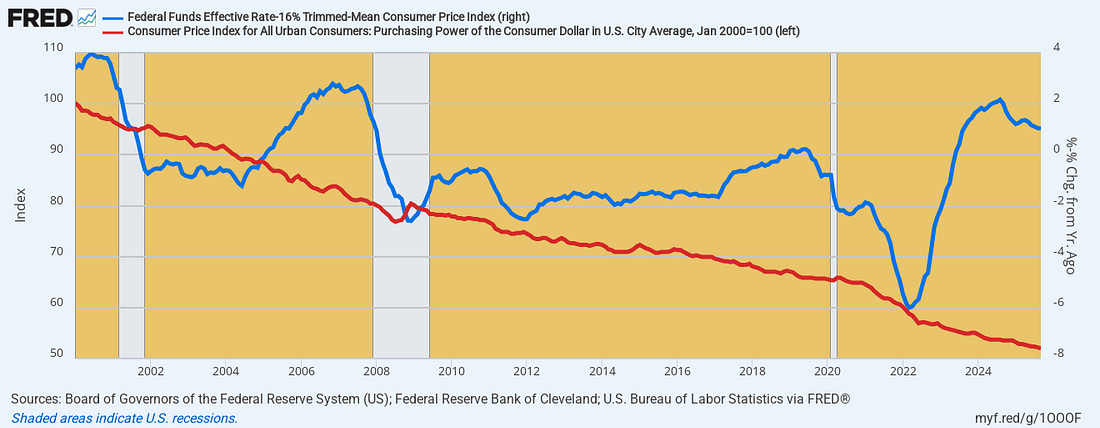
"As it has happened, since the turn of the century the real Fed funds rate on overnight money 
(blue line, below) has been below the zero bound 75% of the time ... [meaning that s]hort-term money for gambling and speculation on Wall Street and main street alike has been free after inflation for the entirety of this century to date.

"So is there any mystery as to why the purchasing power of the consumer’s dollar earned or saved in the year 2000 has already lost 50% of it value? ... [Yet] the Donald has endlessly denounced [those responsible] for not running the printing presses even faster and hotter....
"Once upon a time, the GOP knew that inflation comes everywhere and always from the printing presses of the central bank. But as of December 2025 it has turned into such a sheepish herd of partisan hacks that it has the audacity to claim that it’s all Sleepy Joe’s fault.

"And yet and yet. The Donald is now demanding the very same 1% interest rates and another central bank printing spree that caused the last inflationary flare-up. And he is doing so while falsely claiming that he has single-handedly ended the inflation that he actually fostered during his first go round in the Oval Office. ...

"At the end of the day, the Donald has made no impact on [lowering] the inflation rate to date, but is fixing to push it materially higher owing to his out-of-this-world TariffPalooza and his utterly insensible demand that the Fed undertake another plunge into 1.0% money.

Then again, easy money, big spending and high tariff-taxes amount to the blithering crackpottery that is the essence of Trump-O-Nomics. And that surely ain’t no recipe for a new Golden Age of Prosperity."

Real Fed Funds Rate Versus Purchasing Power Of The Consumer Dollar, 2000-2025


Wednesday, 26 November 2025

To remain independent from politics, a central bank must be less political

"Independence isn’t an absolute virtue. Our constitutional order doesn’t include completely independent officials who can print money and regulate banks as they wish. ...

"The [central bank] has vastly expanded its scope of operations, propping up asset prices, monetising debt, channeling credit, directing banks how to invest, straying into climate and inequality, and denying whole business models such as narrow banks and segregated accounts. These actions are political and cross over into fiscal policy and credit allocation. It has had no reckoning with its great institutional failures, including [high] inflation and repeated bailouts.

"It is reasonable to discuss reform. Either the [central bank] must be more 'democratically accountable,' which is the same thing as 'politically influenced' when the other party is in power, or it must be reformed to a narrow, enforced and accountable mandate so it can remain independent."
~ John Cochrane from his WSJ op-ed 'Trump and monetary policy'

Wednesday, 22 October 2025

Pay no attention to the (mad) men behind the curtain [updated]


Readers here might remember I got some stick for calling John Key a fucking moron a while back. A fucking moron, specifically, for repeated calls for the Reserve Bank to juice up house prices again, just so home-owning voters will feel better again. Feel better again, and then vote National.

"The guts of what’s wrong," explained the moron, "is that the housing market is going down, not up" — and "then you have a negative wealth effect," and voters feel bad. And when they feel bad, they vote for the other team.

Classic short-termism.  Stuff rocket fuel into the economy, and then all things will be jake for the governing political parties. This, by the way, was Key's "one simple trick" while Prime Minister: ensure massive house-price inflation, no matter the economic and social dislocation, and then sit back and watch home-owners fooled into feeling better off, and borrowing and consuming more, regardless of the economic consequences. (Consequences for which we're all still paying, by the way.)

In the US, the discredited "wealth effect" — "a gussied-up version of Keynesian stimulus, only targeted at the prosperous classes rather than the government’s client classes" — is generally felt in the stock market. Pundits there are starting to get nervous about a soaring stock market with anaemic growth in the economic system itself, with "important implications for the path of America’s stockmarket boom and its economy."
The good times could continue, at least for a bit longer [says 'The Economist']. ... [But] might a wealthier society also take a harder fall? Bears would point to the bursting of the dotcom bubble in 2000, when a brutal stockmarket slump pushed America into recession. ... The stockmarket might be more of the economy. It still is not all of it.
It's not. And nor is the housing market. We can't get rich just by selling each other houses. (And kudos to one National minister at least who understands that.)

Yet David Stockman is concerned that nothing has been learned from the last major crash. 
Roughly 15 years ago it was reasonably well understood that the Great Financial Crisis of 2008-2009 had been case of speculation run amuck on both Wall Street and main street alike. These credit and housing bubbles, in turn, had been fuelled by the massive money-printing sprees of the Greenspan and Bernanke Fed.

It might have been presumed, therefore, that the mad money-printers [at the US central bank] would have had second thoughts about the underlying cause of these great economic disasters—that is, the dubious Greenspan policy known as the “wealth effects” doctrine. In simple terms the latter held that if people felt richer owing to soaring home prices and their stock market winnings, they would spend more freely and fulsomely, thereby goosing the Keynesian cycle of ever more spending-sales-production-income-and spending, which was to be rinsed and repeated in an endless round of rising prosperity.

At the end of the day, of course, Greenspan and his heirs and assigns at the Fed turned out to be unreconstructed Keynesians and the wealth effects doctrine a monumental economic con job. The latter did not make society richer; it just made the rich richer. Or stated more directly, main street got inflation at the grocery store, gas pump and doctor’s office—even as the asset-holding class experienced unspeakable windfalls in their brokerage accounts.
Let's not repeat the same mistake again here — especially when local interest rates are already below our trading partners, with no noticeable effect on genuine economic progress. Please: pay no attention to the mad men behind the curtain.

UPDATE:
"The advocates of annual increases in the quantity of money never mention the fact that for all those who do not get a share of the newly created additional quantity of money, the government's action means a drop in their purchasing power which forces them to restrict their consumption. It is ignorance of this fundamental fact that induces various authors of economic books and articles to suggest a yearly increase of money without realising that such a measure necessarily brings about an undesirable impoverishment of a great part, even the majority, of the population."
~ Ludwig von Mises from an interview 'On Current Monetary Problems'

Wednesday, 27 August 2025

Doug Casey: "The goal is to remake the world’s monetary regime"


"Stephen Miran’s appointment to the Federal Reserve isn’t just another personnel move—it’s the placement of Trump’s Reset architect inside the very institution that will help carry out America’s most ambitious economic overhaul in generations.

"If you’re still unfamiliar with what Trump’s Reset entails, I strongly recommend checking out Matt Smith’s comprehensive analysis. He’s done the heavy lifting of connecting dots that were only hinted at in Miran’s original white paper. ...

"The goal is to remake the world’s monetary regime….

"But there are consequences to Trump’s plan - one of which is a guaranteed period of painful adjustment. ...

"Trump doesn’t just want a weaker dollar - he wants a dollar that is radically devalued against every other currency on earth. ... a dollar devaluation of 90%.

"That may sound horrific - but it’s only slightly less than the devaluation of the 1970s, when the dollar lost 75% of its purchasing power.

"Anyone not holding 'real stuff' - like gold, silver, natural resources, commodities, etc. - is going to see a dramatic drop in their standard of living.

"Team Trump will deal with US debt the way governments always deal with debt…

"By inflating it away - and with it, the purchasing power of your US dollar savings....

"But he wants more than just a weak currency.

"He wants to change the nature of the US economy by copying China['s] model of state-backed investment.. ... [and] industrial policy ... [demanding] large profitable corporations reinvest in China. ...

"Trump’s plan will [demand] the same of US companies. And the Trump plan is already in motion. Apple announced a $500 Billion investment in America in late February ... [Intel were forced to give a ten percent cut to the US Government.] ... Expect to see many announcements like these ....

"[Trump's advisor Stephen] Miran makes it clear that nothing good can happen until the burden [sic] of having the reserve currency is shared by our trading partners.

"Does that mean the dollar will lose its status? Probably."
"Let me get this straight: the Republican Party now favours concentrating power in one individual to impose protectionist tariffs, centrally plan the economy, nationalise stakes in private businesses, and use the Fed to create massive inflation to monetise soaring budget deficits."

~ Peter Schiff 

Friday, 26 July 2024

"The prospective return of Trump's deplorable gang of trade advisers to the top trade policy positions in Washington ought to scare the living bejesus out of everyone."


"Donald Trump has had a lifelong adherence to the most primitive form of trade protectionism imaginable. That is, the utterly mistaken presumption that trade deficits are mainly a result of cheating by nefarious foreigners and/or stupid trade deals foisted on the economy by Washington Swamp creatures.
    "Thus, according to the Donald America will not start winning economically again until a tough businessman/negotiator like himself brings the hammer down on cheaters and slams the gates on imports by tariffs and any other means necessary ...
    "What is worse ... [his crackpot advisers] see trade is way too important to be left to the whims of the free market. ... Thus, if you are an exporter [adviser Peter] Navarro insists that you get state approval for what you may or may not sell to the Chinese. And if you are an importer, you might as well get ready to pay a stiff tariff upcharge for the audacity of sourcing the lowest cost of global supply rather than buying from red-blooded, albeit higher cost, American vendors. ....
    "To be sure, there is a giant problem with the $20 trillion of cumulative current account deficits (2024 $) the US has racked up continuously since the mid-1970s. But those massive, chronic trade shortfalls and the devastating off-shoring of domestic industry which had accompanied them are the result of bad money — not bad trade deals, bad actors abroad, or the free market at work. ...
    "Stated differently, when you look for the culprit behind the collapse of America’s trade account and industrial base ... its wasn’t the Chicoms over there or incompetent trade policy officials over here. It was the money printers domiciled ten blocks from the White House. ...
   
"[N]o more insidious notion is at loose in the beltway [in this context] than the Trade Nanny predicate which underlies the Donald’s revived attacks on China’s alleged technology theft and 'economic aggression.' ... [W]hat actually unfolded [under the Trump presidency] was the very opposite of a traditional trade skirmish. Instead, it was an unprecedented act of Washington-led economic aggression against another sovereign state that happens to have unfortunately saddled itself with a statist economic model that we call the Red Ponzi. ... [T]he attack of Navarro and the Donald on China was an attack on the entire warp and woof of its jerry-built $15 trillion red capitalist economy. ...

"[T]he prospective return of [Trump's deplorable gang of trade advisers] to the top trade policy positions in Washington ought to scare the living bejesus out of everyone. ... Navarro is the most dangerous economic ignoramus and fanatical nationalist ever to hold high office in the White House; and Lighthizer is a career swamp creature and the walking embodiment of Washington’s crony capitalist system. ...
    "[A] return to the Trumpian Trade Wars is [not] a secondary matter.
    "What is actually brewing is an epic upheaval of international commerce that will bury Washington even deeper in the Swamp and batter the living standards of Flyover America in trade-based inflation that will make the recent fly-up on Joe Biden’s watch look like a walk in the park."
~ David Stockman from his post 'The Folly Of The Trumpian Trade Wars'


Wednesday, 10 July 2024

So maybe, just maybe, we shouldn't give central bankers the keys to the whole monetary system.


"To repeat one of my consistent lines, human beings are fallible, they make mistakes. Central banks – here and abroad – are made up of humans, so they make mistakes. Really serious ones, of the sort seen in the last few years, shouldn’t happen but they do. One might even offer perspectives in mitigation: the pandemic was something quite extraordinary, and many people (here and abroad) misread the macroeconomics of it for too long. But those responsible need to take responsibility for the mistakes that were made."
~ Michael Reddell from his post 'Still avoiding responsibility'

Don't worry, the central banks will control inflation.


[Hat tip Rudy Havenstein]

Saturday, 8 June 2024

"To repeat, inflation is a purely monetary phenomenon."


"Unfortunately, the entire edifice of the government’s theories [on the causes of inflation] — the assumption of discretionary power, the administered-price theory, the wage-price spiral, the exogenous shocks, the self-sustaining expectations, the idea of 'cost-push' — all of it is the rankest nonsense as an explanation of inflation....

"Inflation occurs, by definition, when the economy’s aggregate volume of money expenditure grows faster than its aggregate real output. The excessive growth of money expenditures can have, again by definition, only two sources: either the velocity of monetary circulation grows excessively or the money stock itself grows excessively (or both). Our current inflation is attributable almost entirely to excessive growth of the money stock.
    "Because the excessive growth of the money stock and the inflation it causes do not happen simultaneously, some people always fail to perceive the relationship. Increases in the money stock take some time before their effect on the volume of expenditure becomes significant. But once the actual lag is recognised, the relationship is seen to be very close....
    "In short, inflation is not caused by cost-pushes, wage-price spirals, depreciation of the dollar on foreign exchange markets, regulatory constraints, minimum wage laws, or lagging productivity growth. Inflation is a purely monetary phenomenon: when the purchasing power of the dollar falls steadily and persistently over many years, it is because dollars have steadily and persistently become more abundant in relation to the total quantity of real goods and services for which they exchange. Inflation, in sum, is caused by excessive growth of the money stock. Period.

"As the [central bank] authorities can control the rate of growth of the money stock, they clearly are to blame for its excessive expansion....
    "[Government] deficits, in the absence of excessive monetary expansion, can not cause inflation. Clearly, the deficits, working through the political process as it influences the [central bank], encourage a loose monetary policy. But it is essential to recognise that it is the excessive growth of the money supply, whether to finance deficits or for some other reason, that causes inflation. Conversely, with a sufficiently slow growth of the money stock, there can be no inflation, no matter what is happening to the [government] budget, labour costs, regulatory standards, minimum wages, and so forth. To repeat, inflation is a purely monetary phenomenon.

"It hardly needs to be added that once excessive monetary expansion has been halted, inflation cannot be kept alive merely by expectations of inflation. People will find that, in the absence of continuing monetary stimulation of aggregate expenditures, the inflation they expected just doesn’t happen. If they are obstinate and continue to act as if inflation is not abating, they will simply price themselves out of their markets in the same manner as the conspiring firm in the example above. It is far more likely, however, that they will adjust their expectations as the rate of inflation falls.
"Expectations cannot sustain an inflationary process unless they are validated by the actual course of inflation; and that validation can occur only so long as the growth of the money stock remains excessive."

~ Robert Higgs, from his article 'Blaming the Victims: The Government’s Theory of Inflation'

Wednesday, 1 May 2024

Central Banks Are Wrong about Rate Cuts

Few people truly understand the destructive present relationship between interest rates and central banks. Daniel Lacalle points out the toxicity in this guest post, and suggests a way out ...

Central Banks Are Wrong about Rate Cuts

by Daniel Lacalle

When we talk about monetary policy, people do not understand the importance of interest rates reflecting the reality of inflation and risk. Interest rates are the price of risk and manipulating them down leads to bubbles that end in financial crises, while imposing too high rates can penalize the economy. Ideally, interest rates would flow freely and there would be no central bank to fix them.

A price signal as important as interest rates reflecting the true amount of money would prevent the creation of bubbles and, above all, the disproportionate accumulation of risk. The risk of fixing rates too high does not exist when central banks impose "reference rates," as they will always make it easier for state borrowing—artificial currency creation—in the most convenient—what they call “no distortions”—and cheap way.

Many analysts say that central banks do not impose interest rates; they only reflect what the market demands. Surprisingly, if that were the case, we wouldn’t have financial traders stuck to screens [before every central bank announcement] waiting to decipher what the rate decision is going to be. Moreover, if the central bank only responds to market demand, it is a good reason to let interest rates float freely.

Citizens perceive that raising interest rates with high inflation is harmful; however, they do not seem to understand that what was really destructive was having negative real and nominal interest rates in the business cycle's earlier phase. That’s what encourages economic agents to take far more risks than we can take, and to disguise excess debt with a false sense of security. At the same time, it is surprising that citizens praise low rates but then complain that home prices and risky assets rise too fast!

Shifting the Blame


Inflation is a huge advantage for the currency issuer. It blames everyone and everybody for the rise in prices, except for the only thing that makes aggregate prices go up, consolidate that increase, and continue to rise, even at a more moderate rate: printing much more currency than the private economy demands and setting rates well below the real risk levels.

The benefit of statism is that it puts the blame for high interest rates on banks, just as it blames supermarkets for high and rising consumer prices.

Who prints currency and disguises risk? Of course, we look at the European Central Bank (ECB) and the Fed and the local Reserve Bank, who all dictate the increase in money supply through repurchases and fixed interest rates. However, central banks do not buy back state assets, print money, or impose negative real interest rates because they are evil alchemists. They do so because the state’s deficit—which is artificial monetary creation—remains unsustainable, public debt is atrophied, and state solvency is worsened by imbalanced public accounts. The central bank is not responsible for implementing fiscal policy. Thus, the state is the one that prints money out of nowhere and passes the imbalance to the citizens through inflation and taxes.

No wonder politicians are always so eager to shift the blame.

In a genuinely open unhampered economy, banks do not create money out of nowhere; they lend to real projects that are expected to be repaid with interest, and those loans have collateral. If commercial banks created money out of nowhere, none of them would go bankrupt. They only create money out of nowhere when regulation imposes risk-disconnected rates and eliminates the need for capital to sustain the government by accumulating its bonds and loans under the false construction that they are “no-risk assets.” Thus, the castle of cards built under the disguise of public-sector risk always creates inflation, financial crises, secular stagnation, and liquidity traps. The amount of money created goes to unproductive expenditure, destroys the purchasing power of the currency, impoverishes citizens, and at the same time decapitalises the most fragile companies, SMEs (small and medium enterprises). 

That’s what they call the social use of money. Seriously.

Hikes or cuts?


The ECB has announced a possible interest rate cut in June that is in danger of being premature and wrong. First, because money supply, credit demand, and supply are rebounding, and inflation remains persistent and above the 2% target. Furthermore, the underlying trend is a much higher inflation level than the ECB’s target, even after two changes in the CPI calculation. After a 20% accumulated consumer price level since 2019, calling victory on inflation after two changes in the calculation of CPI and still elevated core inflation is insane. If we see the rise in non-replaceable goods prices, we can understand why citizens are angry. Real non-replaceable goods’ CPI is probably closer to 4-5% per year.

The ECB rate hikes are signalled by many market participants as the cause of the euro zone’s stagnation, but curiously, no one mentions that the euro area was already experiencing massive stagnation due to negative interest rates earlier in the phase. Besides, if you need to have real negative rates to “grow,” you’re not growing but accumulating toxic risk. 

The ECB knows that the base effect, which played in favour of year-on-year inflation in 2023, will not be supportive in 2024. They also know that monetary aggregates were down a few months ago but are rebounding, and that the supply of credit has not collapsed. The ECB, like every other non-deluded central bank in the known world, knows that inflation is a monetary phenomenon and that there is no such thing as so-called cost-push inflation, “greedflation,” or similar statist excuses. None of those factors can cause aggregate prices to soar, consolidate, or continue to rise; it is only the destruction of the currency’s purchasing power that causes inflation.

Of course, no central bank will acknowledge that inflation is its fault, among other things, because no central bank increases the money supply at will but to finance an unsustainable public deficit. However, no central bank will challenge a financial structure that is based on the myth that public debt is risk-free. Central banks know that inflation is a monetary phenomenon, which is why they attack rising consumer prices with rate hikes and money supply reductions. They just do it mildly because governments benefit from inflation.

Eurozone cuts?


The problem of lowering interest rates now, when there is no evidence of having controlled inflation and achieved a target that already erodes the purchasing power of the currency by 2% annually, is to fall into the narrative that the eurozone is in a poor economic situation because of monetary policy when it is due to the wrong fiscal policy, the disaster of the Next Generation EU Funds, whose failure is already only comparable to the forgotten "think big" Juncker Plan, a shortsighted and destructive energy, agricultural, and industrial policy, and a taxation system that shifts innovation and technology to other countries.

The ECB is aware that interest rates are not high and that the system’s money supply has not decreased as expected. In fact, it continues to repurchase outstanding bonds and will not carry out a significant reduction in its balance sheet in real terms until the end of the year. Lowering interest rates now includes the risk of depreciating the euro against the dollar and thus increasing the euro area’s import bill in real terms, reducing the inflow of reserves into the eurozone, and further encouraging public spending and government debt that has not been contained in countries like Italy and Spain, which boast of “growing” by massively increasing debt and where inflation, moreover, is not under control. 

All this reminds us of the mistakes of the past when Greece boasted to be the EU’s growth engine, and many said that Germany was Europe’s “sick member.” The ECB cannot pretend to be the Bank of Japan for two reasons: the eurozone lacks the luxury of Japanese society’s dollar savings structure or its iron citizen discipline, and, above all, because the failure of Japan’s ultra-Keynesianism has brought the yen to a 35-year low against the dollar.

(To those who say that the euro and the ECB are Europe's main problem however, I recommend that you exercise your imagination of what Spain, Portugal, or Italy would be with their own currency and populist governments printing as if Argentina were Switzerland. You don’t have to imagine it; remember when these countries had an inflation rate of 14–15% and they destroyed savings and real wages with the falsehood of “competitive” devaluations? It wasn't that long ago.)

* * * * 

Daniel Lacalle, PhD, economist and fund manager, is the author of the bestselling books Freedom or Equality (2020), Escape from the Central Bank Trap (2017), The Energy World Is Flat​ (2015), and Life in the Financial Markets (2014). He is a professor of global economy at IE Business School in Madrid.
Ranked as one of the top twenty most influential economists in the world in 2016 and 2017 by Richtopia, he holds the CIIA financial analyst title, with a postgraduate degree in higher business studies and a master’s degree in economic investigation. He is a member of the advisory board of the Rafael del Pino Foundation and Commissioner of the Community of Madrid in London.
Lacalle is a regular collaborator with CNBC, Bloomberg TV, BBC, Hedgeye, Seeking Alpha, Business Insider, Mises Institute, and the Epoch Times as well as an occasional consultant for the World Economic Forum, Focus Economics, the Financial Times, the Wall Street Journal, and other major news publications around the world.
His article first appeared at the Mises Wire.

Wednesday, 4 October 2023

News of new jobs is supposed to be great, right? So, what kind of weird world do we live in when it is considered horrible? Welcome to Fedworld, where market decisions are nothing but bets on what central bank will be doing next.


"News of new jobs is supposed to be great, right? So, what kind of weird world do we live in when it is considered horrible? Welcome to Fedworld where most market decisions are nothing but bets on what [the US Federal Reserve Bank, i.e., ] The Fed will be doing next with its free money for millionaires.
    "Today we saw that in action as good job news kicked some reality into the FedMed-addled heads of investors about Fed tightening, which they have been denying all year. Suddenly, they realised they had a lot of catching down to do to align with a tightening target that readers here know the Fed has been heading to all along ... even before the Fed knew it. (Obviously, the Fed didn’t know it, given that the Fed has revised its tightening targets all along the way as these articles [here] said would happen.)
    "While workers report in today’s survey that they don’t feel the [U.S.] job market is strong, the number of new jobs was high enough that it caused Treasuries to take a rocket ride up past 4.8% yields on the 10-YR bond. The 30-YR joined the move, also rising to its highest point in 16 years. All because those jobs means the Fed will going 'higher for longer.' ...
    "'MarketWatch' reports that banks are now bracing for a recession. Two weeks ago, it seemed like everyone in the mainstream media, as I reported, believed there would be no recession and that a soft landing was practically certain. I stuck to my guns. Just like my endless refrain of “no pivot” to all the pivot heads last year, I’ve stayed with inflation is likely going to rise again, forcing the Fed to tighten harder into a deep recession, which means a lot more serious trouble ..."

~ David Haggith, from his post 'It's All Coming Down!'

Friday, 1 September 2023

ESG as an Artifact of ZIRP


What's ESG? What's ZIRP? -- and why should you care?

ZIRP (zero-interest rate policies) characterises the cheap credit that has flooded out of central banks in the last decade or more. 

ESG (environmental, social, and governance) is the dripping wet "stakeholder" theory that demands that so-called "ethical investors" should direct companies to undertake more politically-correct projects. It is the stakeholder theory route to collectivism.

Fortunately, as Peter Earle explains in this guest post, shareholders and consumers are starting to flex their muscles, and the credit contraction is making a lot of what was formerly cheap very expensive.


ESG as an Artifact of ZIRP

Guest post by Peter C. Earle

Founding myths tend to be mired in obscurity, and like many other investment trends, the roots of environmental, social, and governance (ESG) philosophies are unclear.

The founding of the World Economic Forum is one origin. Stakeholder theory is another of ESG’s clear antecedents, especially as formalised in R. Edward Freeman’s 1984 book Strategic Management: A Stakeholder Approach. The 2004 World Bank report “Who Cares Wins: Connecting Financial Markets to a Changing World” is another contender, providing as it did guidelines for firms to integrate ESG practices into their daily operations. And the publication of the reporting framework United Nations Principles for Responsible Investing in April 2006 (the most recent version of which can be found here) was another.

Its origins however are less important than the destruction it has caused.

Wherever it began, ESG clearly hit its stride within the last five to ten years. Those were heady times for bankers and financiers, first characterised by zero interest rate policies (ZIRP) and then, during the pandemic, by massively expansionary monetary and fiscal programs. Yet in the last two years or so, the prevailing economic circumstances have changed considerably. Inflation at four-decade highs is battering firms by raising the cost of doing business. It is also negatively impacting corporate revenues, as consumers retrench by cutting back on expenditures.

Nowhere are these effects more evident than in shareholder land, where the fourth-quarter 2022 S&P 500 earnings season is just about over. “Earnings quality” is an evaluation of the soundness of current corporate earnings and, consequently, how well they are likely to predict future earnings. For the past year, and certainly for the last quarter, the quality of earnings has been abysmal. One particular element – “accruals,” or cashless earnings – are their highest reported level ever, according to UBS. In that same report, we find the somewhat shocking revelation that nearly one in three Russell 3000 index constituents is unprofitable.

For those and other reasons, a theme in many of the fourth-quarter corporate earnings reports has been cost-cutting: Disney, Newscorp, eBay, Boeing, Alphabet, Dell, General Motors, and a handful of investment banks are all eliminating jobs and slashing unnecessary expenses. And although firms regularly write off the value of certain assets and goodwill, that process accelerates during recessions. 

Firms are additionally contending with the highest interest rates they’ve faced since 2007, and in some cases back to 2001. A substantial amount of corporate debt assumed at lower interest rates is now more costly to service, as a generation of managers grapple with a world of interest rates (and its effects) that they've never seen before.

Dividend payments for example, typically considered sacrosanct during all but the most severe financial straits, are being targeted for savings. February 24th in Fortune:
Intel, the world’s largest maker of computer processors, this week slashed its dividend payment to the lowest level in 16 years in an effort to preserve cash and help turn around its business. Hanesbrands Inc., a century-old apparel maker, earlier this month eliminated the quarterly dividend it started paying nearly a decade ago. VF Corp., which owns Vans, The North Face, and other brands, also cut its dividend in recent weeks as it works to reduce its debt burden … Retailers in particular face declining profits, as persistent inflation also erodes consumers’ willingness to spend. So far this year, as many as 17 companies in the Dow Jones US Total Stock Index cut their dividends, according to data compiled by Bloomberg.
All of this suggests two things.

First, if large firms are doing everything they can to reduce unnecessary overhead, then feel-good initiatives and other corporate baubles are likely to face the chopping block – even if quietly. ESG observance is one of those very costly trinkets, bringing as it does compliance costs, legal costs, measurement costs, and opportunity costs. The reporting requirements alone associated with upholding ESG standards are high, and rising. In 2022, two studies attempted to estimate those costs:
Corporate Issuers are currently spending an average of more than $675,000 per year on climate-related disclosures, and institutional investors are spending nearly $1.4 million on average to collect, analyze and report climate data, according to a new survey released by the SustainAbility Institute by ERM … The survey gathered data from 39 corporate issuers from across multiple U.S. sectors, with a market cap range of under $1 billion to over $200 billion, and 35 institutional investors representing a total of $7.2 trillion of AUM … The SEC has released its own estimates for complying with its proposed rules, predicting first year costs at $640,000, and annual ongoing costs for issuers at $530,000. The study explored the specific elements covered by the SEC requirements, and found that issuers on average spend $533,000 on these, in line with the SEC estimates. Elements not included in the SEC requirements included costs related to proxy responses to climate-related shareholder proposals, and costs for activities including developing and reporting on low-carbon transition plans, and for stakeholder engagement and government relations.
Difficulty measuring costs means difficulty budgeting for them. Another recent report commented:
Although it is inherently difficult to assess the costs [of ESG], it is fair to anticipate significant costs for ambitious ESG goals. In an article in The Economist, a specific cost estimate was made in relation to offset a company’s entire carbon footprint. This was estimated to cost about 0.4 percent of annual revenues. This could already be a huge component for many companies, but it is only one aspect of merely one ESG factor.
Yet that comment concludes with the kind of assurance that flows effortlessly from consultants well-positioned to, frankly, make a lot of money off of ESG compliance: “However, there is no real choice. The climate certainly cannot wait.” Given the recent backlash against ESG, whether driven by ideology or accounting, it’s clear that there is a real choice, and that choice is being invoked with increasing frequency throughout the commercial world.

Second, the recent explosion of ESG adoption may have been in the spirit, if not embodying a strictly theoretical manifestation, of malinvestment as predicted by Austrian Business Cycle Theory (ABCT). 

Without engaging in a lengthy discussion of ABCT, artificially-low interest rates (interest rates set by policymakers instead of markets) undercut the natural rate of interest, misleading entrepreneurs and business managers. Many years of negligible interest rates, indeed negative real rates, have given rise to bubble-like firms, projects, and I would argue, by extension, business concepts. The latter, which include but are not limited to ESG, seem feasible and arguably essential when the money spigots are open. When interest rates normalise and sobriety re-obtains, cost structures reassert themselves. It’s back to the business of business. 

Interest rates are now beginning to normalise. And, perhaps, business practices with them.

Gone are the salad days of easy money, and with it the schmaltzy wishlists of niceties which a decade of monetary expansion permitted activists to blithely force upon corporate executives. In the face of rising interest rates, an uncertain path for inflation, budget-constrained consumers, and rapidly deteriorating corporate earnings, shareholders are likely to take a closer look at how and where their money is being spent than they have in some time. 

Although it is unlikely to disappear completely, the ESG fad is probably past the crest of its popularity. It’s time again for firms to focus, singularly and completely, on the inestimable task of making money.

* * * * 

Peter C. Earle is an economist who joined the American Institute for Economic Research (AIER) in 2018. Prior to that he spent over 20 years as a trader and analyst at a number of securities firms and hedge funds in the New York metropolitan area. His research focuses on financial markets, monetary policy, and problems in economic measurement. He has been quoted by the Wall Street Journal, Bloomberg, Reuters, CNBC, Grant’s Interest Rate Observer, NPR, and in numerous other media outlets and publications. Pete holds an MA in Applied Economics from American University, an MBA (Finance), and a BS in Engineering from the United States Military Academy at West Point.
His post first appeared at the AIER blog.


Wednesday, 23 August 2023

This is not normal


Source: Liabilities data for 1916–2023 from the Board of Governors of the Federal Reserve System, statistical release H.4.1, Factors Affecting Reserve Balances of Depository Institutions and Condition Statement of Federal Reserve Banks, via FRED; and M2 money supply data for 1959–2023 from the Board of Governors of the Federal Reserve System, statistical release H.6, Money Stock Measures, via FRED. Note: The solid trend line (1) is a curve fit to the data between 1965 and 2003. The solid trend line (2) is a double exponential curve fit to the data after 2003. The two world wars are indicated by arrows pointing to the pink regions. Recessions are indicated by sepia-colored strips.

"The world since 1900 has experienced two major world-encompassing wars. Wars cost a lot of money, and countries—even if they were once on a gold standard—usually start printing massive amounts of money to finance their wars....
    "[Yet i]f we take the real value of the expansion of U.S. Federal Reserve liabilities between 1934 and 1963 due to World War II, and compare this to the total liabilities from 2008 to 2023, we find [this most recent period] to be 2.3 times larger at its peak than it was in World War II!"
~ John Hartnett. from his post 'Has World War II Already Begun?' [emphasis mine]

Tuesday, 2 May 2023

'The Most Important Factor in The Economy Is Flashing A Huge Warning Sign'

Source: TheChartStore.Com, and the post: 
"The wavelike movement effecting the economic system, the recurrence of periods of boom which are followed by periods of depression is the unavoidable outcome of the attempts, repeated again and again, to lower the gross market rate of interest by means of credit expansion.”
~ Ludwig von Mises, from his chapter titled 'The Monetary or Circulation Credit Theory of the Trade Cycle,' quoted in the post 'The Most Important Factor in The Economy Is Flashing A Huge Warning Sign'

Source: Board of Governors St Louis Fed, and the post: 

Monday, 17 April 2023

"This year’s banking crisis was never going to be 2008 redux — more like 2008, the sequel...."


"This year’s banking crisis was never going to be 2008 redux — more like 2008, the sequel....
    "In one respect, the collapse of both Silicon Valley Bank and Credit Suisse were isolated, one-off events that have now been contained.... Nevertheless, the runs on these banks are better seen as symptoms of an underlying disease that continues to fester.... the edge of a coming economic storm whipped up by a decade of geopolitical fragmentation and cheap money. Now, the overdue attempt to reverse this course has slowed the global economy, possibly to the point of recession.
    "Unlike the 2008 crash, this does not follow an era of prosperity, but rather 15 years of monetary chaos....
    "Central banks now find themselves trapped in a stop-start course of withdrawing money with interest-rate rises, and putting it back at each sign of stress ... And this hair-of-the-dog treatment may soften the hangover but only prolong the addiction of the financial system to cheap money."

~ John Rapley, from his post 'The Next Financial Crisis Will Get Ugly'


Friday, 24 March 2023

Is it an LOLR? No, It’s a Trap. And you should be mad.


Pic from AIER

Banking regulators set a trap for bankers, depositors and taxpayers back in 2008 into which they're all falling, explains
Michael Munger in this guest post. And now the trap is sprung, we're up to our pocket-books in moral hazard and "too big to fail." What those regulators failed to fully understand is the proper role for the Lender of Last Resort (LOLR) ...

Is it an LOLR? No, It’s a Trap

by Michael Munger

In the 1983 film Return of the Jedi, Admiral Ackbar turns to the officers on the bridge and says what everyone already knew: “It’s a trap!” It had seemed a little too easy to be able to destroy the main threat, permanently and with no risk. Of course that turned out badly for the Alliance; they shouldn’t have been fooled.

Dodd-Frank and other post-2008 banking regulations were supposed to have fixed the banking system, permanently and without risk. But once again that was too good to be true. Turns out that all that new regulation did was to set another trap, Not intentionally (although the benefits to large firms are at least partly intentional). The solution to effective banking regulation however is to understand the role of the “Lender of Last Resort,” and to commit to doing nothing more, no matter what. As Richard Salsman and I argued more than a decade ago, the alternative, “Too Big to Fail,” has proven disastrous.

The Way to Regulate Banks: The Lender of Last Resort


Banks, and many other financial institutions, are brokers, mediating transactions between people who have money — depositors — and people who want to secure loans to do things with the money — borrowers. Brokers generally don’t hold on to the money that is deposited with them; the value of brokerage is connecting that money with an investment. In fact, the banking business was long described as a sleepy-but-safe activity, one that followed the “3-6-3 rule”:
  • 3 percent — the interest you pay on deposits
  • 6 percent — the rate you charge on loans
  • 3 pm — your daily tee time on the golf course, because this business runs itself
Banks package and sell a product called “liquidity.” Liquidity is a measure of how quickly and cheaply an asset can be used to buy something else. Importantly, liquidity is not money, but a measure of the demand to hold cash balances, rather than holding wealth in some other form. Still, cash is liquid. It is easy to agree on a price, and transferring ownership is cheap. Loans are (usually) illiquid. Loans (such as mortgages) are contracts that bind one party to another, requiring payments that are secured by an asset. In the case of a mortgage, for example, the loan is secured by the value of a home, meaning that it is possible to negotiate a much-lower interest rate than on an unsecured personal loan, because the risk to the lender is smaller.

It is possible to buy and sell loans, or stocks, or other equities, but it is much more expensive than paying cash. (This illiquidity was part of the reason that mortgage-backed securities seemed like such a good idea back pre-2008, because in theory at least those were liquid; in fact, it appears that mortgage-backed securities were pretty liquid, and held their value better than is sometimes described). Another form of loan is called a “bond,” which is a promise to make periodic payments for a term of time, and then repay the full amount of the loan, the principal, at the end of that term. Ten-year US Treasury bonds, for example, have a face value and an implied interest rate paid to the buyer of the bond.

As I said earlier, banks are brokers. They take in deposits, and then use those deposits to “buy” loans. The bank might be the originator of a loan, as in the case of many mortgages. Or the bank might literally buy bonds or other securities, financial instruments that generate a higher rate of return than just holding money.

The problem is obvious. There can be a mismatch in liquidity between the bank’s liabilities (depositors put in cash, and they want to be able to take cash out) and assets (loans, bonds, other securities of various kinds). It is easy to imagine situations where a bank will be technically solvent — i.e., the total value of all its assets exceeds the value of all its liabilities — but the bank can’t convert enough of those valuable assets into cash fast enough to let everyone pull out their money right now. And when everyone does want their cash, right now, that’s called a bank run.

A bank run is dramatic, and has been used in movies from It’s a Wonderful Life to Mary Poppins. (It can be fun to use these movies in class, as illustrations!) The reason folks hurry to get their money is that there isn’t enough, and if you snooze you lose. The policy problem is that there is enough value, there just isn’t enough cash, today. That’s why the Lender of Last Resort (LOLR) function is so crucial. All that is required is a short-term loan so that there is enough cash today.

The cool thing about the Lender-of-Last-Resort solution (and note that the Lender of Last Resort could be either a private central clearinghouse, or a store of cash that maintains value in liquid form for immediate disbursal) is that if people believe the Lender of Last Resort will act immediately and effectively, then the Lender of Last Resort entity never has to act at all. If I know that I can get my money out, today, or for that matter tomorrow or the next day because the bank won’t run out of money — it cannot run out of money — then I don’t try to get my money out in the first place.

Walter Bagehot (Lombard Street, 1873) made the very sensible argument that many financial crises are not problems of insolvency, but only of illiquidity. And illiquidity is only a problem if literally everyone wants to take their money out of the bank at the same time. That problem is that “everyone wants to pull their money out at the same time” is literally the definition of a bank run, where depositors rush to get their cash while there is still some cash left.

Bagehot (pronounced “BADGE-uht”) claimed that the Lender of Last Resort must be fully committed to do three things, and never to do more than these three things:
  1. Lend as much money as necessary directly to troubled (temporarily illiquid) banks; 
  2. At a penalty rate (far above the market interest rate) 
  3. But only against good collateral, as offered by a technically solvent bank.

Since there is immediate, unlimited cash available, there will be no bank runs. 

Since the interest rate is high, loans that are made will be very short-term. 

And since the bank has sufficient assets to cover its liabilities, there is no problem securing longer-term loans if that is necessary. Loaning to provide liquidity is cheap and effective, but it is not a bailout, because the bank has equity, it just lacks liquidity.

The Way NOT to Regulate Banks: Become the Insurer of Last Resort


The drawback with relying solely on Bagehot’s Lender-of-Last-Resort solution is that it does nothing to address “financial contagion,” when problem banks suffer not just from a liquidity shortage but from full-on insolvency. I learned about “contagion” as part of my professor Hyman P. Minsky’s theory of “fragility” in a financial system, so I tend toward his definition of contagion as a cascade of failures, animated by one or more financial institutions failing to make good on its commitments. When these assets become worthless, other banks immediately become technically insolvent also, though they were solvent an hour ago. The failures propagate like falling dominoes, quickly causing massive financial failures.

The reader will likely notice that the US has abandoned the Bagehot rules in favour of trying to limit contagion. Our present-day Lender of Last Resort, a composite of the Federal Reserve and the Treasury Department, routinely and wilfully misuses the discretion afforded central bankers. In their defence, though, the Bagehot criteria are not politically viable, because failing banks that lack good collateral are just as contagious, and maybe more contagious, than banks that have good collateral.

If the job of the Lender of Last Resort is to prevent contagion — and that is how the regulatory authorities describe their job — then it is logically impossible to hold to Bagehot’s third rule, lending only to banks that are solvent but need liquidity. But that changes everything. Without the constraint of requiring good collateral, the Lender of Last Resort becomes instead an insurer of last resort — a backstop for depositors who have no reason to consider risk when deciding where to place their funds. This problem has been massively exacerbated by the “deposit insurance” guarantees, which have now been extended far beyond the statutory $250,000 limit for despite protection, to have become essentially unlimited.

And that’s what happened for the depositors of Silicon Valley Bank, and Signature Bank (and, by the time this appears, possibly more banks). All of the deposits were guaranteed by taxpayers, even though the banks were insolvent, not illiquid. The usual story has been that the deposits were guaranteed by “the government,” but that’s nonsense. Money is being taken from taxpayers and used to support depositors who made a bad bet about where to put their money.

Since our regulatory practice has gone beyond making loans to illiquid-but-solvent banks, to paying back all the deposits of insolvent banks, the result is that there is no reason for depositors to care about whether their bank is taking excessive risks. This is called “moral hazard,” because it encourages the very risk-taking that regulators are later asking taxpayers to pay for.

The problem of moral hazard sounds arcane, but it’s a trap. In the case of Silicon Valley Bank, the risks in the bank weren’t even intentional, but revealed an astonishing lack of knowledge of basic financial principles regarding the capital value of bonds in times of inflation. To be fair, the stockholders of the bank itself have been punished by market forces (maybe, unless the Treasury loses its nerve, and succumbs to political pressure from union and state pension funds. Stay tuned!), because their equity is worthless. But the depositors should have been more careful. And they would have been more careful, except that deposits are insured by taxpayers who have no say in rewarding foolish risks. Worse, the fact that deposits of greater than the $250,000 statutory limit are now being covered by taxpayers means that the signal to all other depositors is that they need not look at their own banks, because taxpayers will cover those deposits, too.

The reason this is infuriating is that we are being told that taxpayers should be willing to double down, to reimburse even-more-careless depositors for their negligent inattention to risk. And I suppose you can see why, given that this dangerous assumption is now baked into expectations about how regulators will behave.

As Obi-Wan said to Luke, also in Return of the Jedi: “What I told you was true, from a certain point of view.” But Luke was mad that he had been lied to, and you should be mad, too.

 
Michael Munger is a Professor of Political Science, Economics, and Public Policy at Duke University and Senior Fellow of the American Institute for Economic Research.
His degrees are from Davidson College, Washingon University in St. Louis, and Washington University.
His research interests include regulation, political institutions, and political economy. he is the author of the 2021 book Is Capitalism Sustainable?
His post first appeared at the blog for the American Institute for Economic Research.