Showing posts with label Egypt. Show all posts

Wednesday, 22 February 2023

"Managed Retreat"?


Folk resting beside Ancient Egypt's Nile. (Annual flooding not shown.)

SO IMAGINE YOU'RE AN ancient Egyptian. You know: pharaohs, camels, mummies, pyramids, the Nile flooding every year....

Every. Damn. Year!

Or ... you're an ancient resident of the banks of the Tigris, or the Euphrates -- these places where civilisation began. And these rivers that feed your crops and bring down life-giving nutrients from the mountain streams also occasionally, you discover, bring you floods.

Yes, you'd get a bit sick of it after a time. So after a time you could do one of two things.

1, you could adapt to nature and organise a "managed retreat." Nature knows best, you might say.

Or, 2, you could invent hydraulic engineering, tame the rivers (adapting nature to yourselves, you might say) and so put us on the path to human progress that got us to where we all are today. Relatively prosperous.

Man v Dragon

There was a time when it was widely accepted that it was a good thing to adapt nature for our own ends. Indeed, that's the only way we humans can survive. Nature has dragons; left unprotected from them, and they will devour us. 

And on our own, compared to nature's power, we human beings are weak. Left exposed and naked and without the food, shelter and technology produced by our adaptation of nature, if we merely settled for adapting ourselves to nature's dragons then ever single one of us would struggle for survival. But adapt nature to ourselves -- make it more humane and set nature's processes and nature's bounty working for us rather than agin us-- and then as a species we're off to the races.

This path -- adapting nature to ourselves -- was the path of centuries of human civilisation and flourishing, starting all the way back in settlements around the Euphrates, the Tigris and the Nile where floods were tamed and used to produce abundant wealth from the enormously fertile soil.

This is not the view nowadays however. Not so much.

THE PREDOMINANT VIEW NOWADAYS is that protecting ourselves from nature is wrong. That "the environment" trumps human beings. That nature must take its course. That natural processes have rights, but human beings don't. 

If sand dunes move and the sea threatens, in a more rational time men built protection from dunes and from sea. Nowadays however the call is for people to just move away from the coast. 

If rivers or drainage systems silt up or threaten, in a more rational time men built stop banks and better drainage systems -- and they cleared up the silt. Nowadays instead the call is to let nature take its course, and we hear folk from the Prime Minister on down call for "a debate" about whether townships and horticultural producers should simply move away from the hazard. Or be forced to.

This is not a climate problem or an engineering problem. It's an attitude problem. It's an attitude borne of bad philosophy: of the ethics that says that Gaia comes first, and humans a far distant second.

We didn't always think this way, or we would never have come so far as a species.

However it's now a notion that's philosophically entrenched in present generations, and in most government departments (central and local). It's also legally entrenched in the RMA (which gives rights to the "intrinsic value of ecosystems," but not to humans wishing to protect themselves from the often dangerous natural processes inflicted upon us by ecosystems). And don't think David Parker's various replacement bills for the RMA will improve things either -- to read those legislative tributes to Gaia is to understand they will only make things harder all round.

Just imagine if this attitude was predominant around the Nile in the times of the pharoahs; if instead of taming the Nile and its regular floods to produce abundant crops, invent hydraulic engineering and to build a civilisation the Egyptians ran away instead. As a culture they'd now be deservedly lost to history. As would all the cultures and civilisations (i.e., ours) that built upon those first beginnings in Egypt and Mesopotamia.

And that goes for any culture that opts out of the ongoing battle against the dragons of nature -- and it goes for us too.

Folk dig out after the 1938 Esk Valley flood

CIVILISATIONS HAVE BUILT OTHER solutions too since pharaohs controlled things and simply ordered people around. We've built and understood things like common law and property rights too, and inventions for managing risk like insurance. And when they're allowed to work (which things like he RMA make more difficult) they developed organic processes of their own that create a kind of spontaneous order. So, for example, instead of having a nationwide debate about whether "we" as modern-day pharaohs should "allow" folk to build on flood- or slip-prone land, why not allow these organic processes to work?

Economist Eric Crampton suggests we can, and has a starter proposal for how. It looks like this:

1. People should be able to build where they want.

2. Insurers should be able to set premiums to reflect risk. EQC could make that safer for private insurers by leading the way. They have decades of claims history.

3. Councils should reserve the right to discontinue services in places that are too expensive or difficult to maintain. In such cases they could offer existing residents a choice:
a. Special ratings district that imposes a differential higher levy reflecting higher costs of providing council services in those areas, and a promise that there will be no cross-subsidies from safer places, reminding that that means that if their road washes out and they want it reinstated, the levy will have to go up;

b. Setting of a special purpose local board that becomes the owner of local infrastructure, governed by its residents, and able to set its own levy on properties for service. Councils would need to sharply reduce rates for those properties to reflect that council is no longer providing those services.
4. Ability to set those special purpose local boards should be extended more broadly, such that a group of farmers could set one to take on the debt that funds flood protection works and finances that debt through a levy on protected properties, on approval of those properties’ owners.

5. EQC to recognise mitigation works when setting premiums. Private insurers would do similarly so long as that market is sufficiently competitive.

6. Make damned sure that there aren’t regulatory barriers unduly hindering insurance entry, including provision of parametric insurance products.

7. Land values in high-risk places no longer cross-subsidised by low-risk places would drop. If government worries about the equity implications of that, it could provide a one-off payment in compensation. Ideally it would set a cap on such compensation because it will disproportionately go to rich people living in unsafe places who have been cross-subsidised by poorer people living in safer places for ages. (On this point, remember the 2018 Motu work that said that cross-subsidies in current insurance through EQC mainly run to the benefit of richer neighbourhoods.) ...

Seems simple enough. No need for government or council to decide who's allowed to live where. If you want to live in a risky place at your own expense, that should be up to you.

As it should be.

Monday, 13 October 2014

The Capitalist Cure for Terrorism

If that sounds like an unusual headline, then consider that the ideas of Hernando De Soto have been credited not just with helping turn around Peruvian poverty, but also to putting an end to the Marxist guerrilla movements like Shining Path that plagued the place.

As he explains in one book, two TV documentaries, and countless speeches, lectures and articles, the two are not unconnected.

His weapons in this struggle: capitalism, and property rights – and he says the recipe can work just as well for the Middle East. Indeed, he says, it is how the Arab Spring began:

Deploy capitalism, he argues, and you can stop recruitment to Islamic State’s “network of death.”

Sunday, 18 August 2013

“Hey History Guy, What the Heck is Up with Egypt?!”

My favourite online historian, Scott Powell, reckons history is desperately needed to understand how Egypt’s crisis has unfolded, and where it is headed …

Thursday, 15 August 2013

What could possibly save Egypt?

News overnight that Egyptians are being killed en-masse by their government is hardly inspiring--especially since the reasons for the bloodletting this time are not going away.

Sixty years of state brutality has suppressed violent Islamism, but not killed it—and brutalised all of Egypt in the process. And democracy has failed—delivering at first the radical Islamism the majority seem to want, and now a return to the brutal suppression that has characterised too much of “modern Egypt.”

So how to save Egypt—and the few liberals there that are the only genuine source of hope?

A suggestion comes from an unusual source, a former foreign policy adviser to Jimmy Carter, who says instead of heading for democracy they should become a secular republic with one important constitutional criterion:

What Egypt should focus on instead is the formulation of a new constitution, employing it as an opportunity to seek a basic understanding about the future of the regime to which both side can subscribe. This is unlikely to be simply a procedure like free elections. Rather, it could be a principle: separation of state and religion…
   This approach would allow Islamic groups to feel free to promote their way of life without limiting the secular liberals’ freedom to pursue theirs, inasmuch religion would not be promoted as a matter of law but through social means. Such a separation of state and religion may seem at first a very American idea. However, it is not alien or even novel for Egypt…liberals would find such a separation far from unfamiliar because they lived for decades under Mubarak in a nonreligious regime… [And] Over the last forty years, the Muslim Brotherhood was first oppressed and then tolerated, but it was never was able to draw on the state to promote its religious agenda. Despite this limitation, it spread its ethos by providing social services. Skeptics who might ask why they would settle for something they always had should take into account that in the past the regime tried to curb and hinder the religious groups; under the new deal they would be sure to flourish.

Too much to hope they might eventually become (classical) liberals themselves, but they might, perhaps, hopefully, maybe, eventually, realise that brutal state imposition of Sharia on those who don’t want it is neither desirable nor necessary.

So why would either side agree to this?

    In pondering what might prompt the pro-Morsi and anti-Morsi camps to reach a compromise, I thought of a line I heard from the reformers in Iran during a meeting in Isfahan. The leader of the reformist group stressed that he and his comrades were anticlerical but not against religion. He put it this way: “we do not want to force people to pray; we want people to want to pray.” When applied to Egypt, this dictum would be best satisfied by a constitution that renders the state largely neutral on religious matters. Thus it would not ban the consumption of alcohol, not penalize women who refuse to wear a headscarf, and so on. At the same time religious groups and organizations (such as the Muslim Brotherhood and even the Salafis) would be free—and even financially supported by the state in their running of private schools and their provision of social and medical services…

…well, he is a former adviser to Jimmy Carter…

[Hat tip Robert Tracinski]

Monday, 8 July 2013

12-year-old Egyptian boy condemns Islamism, excoriates Muslim Brotherhood

This 12-year-old Egyptian boy knows what’s going on.

Huffington Post has some background to the interview:

In a video interview with Egyptian news outlet El Wady, first grader Ali Ahmed delivers an incredibly precocious condemnation of the Muslim Brotherhood that will leave you speechless.
    Touching on topics like Egypt's wealth inequality, lack of rights for women, and oversize influence of religion on politics, Ahmed's articulate censure of the Egyptian government -- although filmed back in October -- is more apt now than ever, as the military
removed Egyptian president Mohammed Morsi from power on Wednesday, just one year after he was elected to office.
    While some Reddit commenters have questioned whether the interview was improperly translated or may have been staged,
Arabic-speaking commenters say the translation is accurate, and the boy's evident passion in speaking suggests his tirade was not scripted.

Friday, 5 July 2013

Middle Eastern democracy, in pictures

It’s not true just for Egypt. It’s true for every Islamic nation … 

(Click the pic to enlarge)

which is why it’s best never to confuse democracy with freedom.

[Hat tip Julian P. and Russell W.]

Tuesday, 2 July 2013

Don’t Egyptian protestors know what they want? [updated]

Last year after protests against Hosni Mubarak’s military rule, President Morsi of the Muslim Brotherhood was installed as leader.  And everyone went home. Now, a year later, anti-Morsi protestors  have stormed and ransacked the Cairo headquarters of Morsi's Muslim Brotherhood group (while police and army stood around and watched), they have collected over 22 million signatures asking for his departure, and they are asking the Egyptian head of state to resign by 5 p.m. tomorrow.

And the military are ready to take over again.

What’s going on? Don’t Egyptian protestors know what they want?

They do. The anti-Morsi coalition seems to be an unstable mixture of those who abhor the authoritarianism of military rule but who want a secular Egypt (the military being the most powerful institution standing for secular rule), and those who want the increasing Islamicisation of the country, and even the full imposition of Sharia, but who don’t think Morsi was going fast enough.

So, somewhat like Syria, really.

And nothing like anything than can end well.

UPDATE: Robert Tracinski is more optimistic:

When Egypt had its first revolution to overthrow Hosni Mubarak, some people saw Egypt's young, educated, secular liberals marching side-by-side with the Muslim Brotherhood and thought that this was normal and natural and heartening and showed how a pious Muslim religious party could embrace democracy.
   
The rest of thought this couldn't possibly last.
    Since Tahrir Square, it has become pretty clear what the Muslim Brotherhood thought: thanks, liberals, for making this revolution for us—but now we're taking over.
    Brotherhood leader Mohammed Morsi's rule has become increasingly authoritarian, and at the same time he has done nothing no revive the nation's collapsing economy, to establish public order and the rule of law, or to rein in rampant corruption. Egyptians have begun to fear they're getting the same old regime, but in an even more restrictive, Islamist version.
    Resistance to the Brotherhood's rule has been building up and exploded over the weekend with the "Tamarod" or "rebel" protests that brought
millions into the streets.

        "The scale of the demonstrations, coming just one year after crowds in Tahrir Square cheered Mr.
    Morsi's inauguration, appeared to exceed even the massive street protests in the heady final days of
    the uprising that overthrew President Hosni Mubarak in 2011....
        "Demonstrators said they were angry about the near total absence of public security, the desperate
    state of the Egyptian economy and an increase in sectarian tensions. But the common denominator
    across the country was the conviction that Mr. Morsi had failed to transcend his roots in the Brotherhood,
     an insular Islamist group officially outlawed under Mr. Mubarak that is now considered Egypt's most
     formidable political force. The scale of the protests across the country delivered a sharp rebuke to
    the group's claim that its victories in Egypt's newly open parliamentary and presidential elections gave
    it a mandate to speak for most Egyptians."

In effect, Egyptians are asking for a do-over on their revolution: this time, can we do it without the Brotherhood? And the answer is clearly: yes, they can.
    Tom Friedman
puzzles over the purpose of street protests in a democracy, where the people presumably have recourse to the ballot box. Part of the answer is that folks in Egypt (and Turkey) aren't so sure they are going to have recourse to the ballot box. They are demonstrating because they think the Islamists are going to take away their political freedom. But there is another purpose massive protests serve even in societies where the right to vote isn't in doubt: they are an opportunity for the people to make their numbers known in an unmistakable way, as a kind of shot across the bow between elections.
    The massive street protests brought out such a significant portion of Egypt's population—some have calculated that it is the equivalent of 30 or 40 million people in the US—that they have undermined any claim Morsi and the Brotherhood have to claim the consent of the governed.
    As a result, the Egyptian military has stepped in—with it own ulterior motives, no doubt—to issue an
ultimatum for Morsi and the protesters to come to an agreement within 48 hours…. That sounds to me like the military intervening to basically push Morsi into resigning, or at least into calling a new election.
    At any rate—and I am happy to say that I managed to be a little
ahead of the curve on this—the Tamarod movement, along with the recent protests against Recep Tayyip Erdogan in Turkey, constitute a new phase in the Arab Spring, a new revolution against religious authoritarians rather than secular ones.

Tuesday, 15 February 2011

People power? [update 2]

I’m struggling to understand why everyone’s so happy about the outcome in Egypt.

For nearly sixty years—ever since Lieutenant-Colonel Nasser’s nationalist “Association of Free Officers” overthrew the monarchy promising to establish a parliamentary democracy—Egypt has been ruled by military strongmen in Nasser’s nationalist anti-Islamist image.

DeFreedom For three weeks Egyptians protested in Tahrir Square, demanding a change in that succession. They called for the dictator of the last twenty years to step down. And after three weeks of getting his money out of the country, he complied.

To be replaced by another military strongmen aping the long line already preceding him: to whit, Field Marshal Mohammed Hussein Tantawi, the former Minister of Defense, Military Production, Deputy Prime Minister, Commander of the Presidential Guard, and chief of the Operations Authority of the Armed Forces. A man who is “aged and change resistant,” and “committed to the status quo.”

Is this really the “new-found freedom” people died for?

Now they’ve begin to disperse, courageous protestors still mopping up after their victory might still insist they

_Quote will not give up on Egypt as a civilian state, not a military state. If things move away from our demands, we will go into the street again, even if we have to die as martyrs.

But they have just cheered the coming to power of a military ruler who will have quite specific ideas about how to use that desire for martyrdom.

And I’ll wager good money it won’t be to set up a constitutional republic and then resign—any more than his predecessor some dictators ago did.

So this is not a victory for individual freedom—more’s the pity.

And neither is it a victory for democracy.  And thank goodness for that. Because by contrast to a constitutional republic, a democracy (i.e., majority rule; i.e., a counting of head regardless of content) would not have delivered freedom and individual rights to Egyptians, but instead a government responding to the the one-out-of-every-five Egyptians who thinks suicide bombing can be justified; and the four-out-of-every-five Egyptians who would stone people who commit adultery, cut limbs off people who steal, and put to death those who leave the Muslim religion. [See Pew survey here.]

Muslim Egypt is not secular Turkey—where they understand the dangers of Islam playing a large part in politics, and have at least begun to put some rights beyond the vote. It’s a place where nineteen-out-of-every-twenty people think it would be a good thing for Islam to play a much larger role in politics, with everything that implies for individual freedom—or lack thereof.

No wonder the Muslim Brotherhood are coming round to the idea of democracy. For one election, anyway.

And the Brotherhood’s own statement about the “historic victory” gives a clue to where exactly they would like an Egyptian democracy to go, were such a thing ever to be allowed:

_Quote_Idiot The victory scored by this revolution is in the first place directed against the United States, which so far sponsored the toppled regime, and wanted it as a strong ally and defender of the Zionist entity, and an enemy of the Arab jihad and resistance movements.

So should they ever get near the seats of power (something both Egyptian monarchists and nationalists have been trying for over eighty years to avoid) that would mean big ticks by the Brotherhood to Egypt being a strong enemy both of Israel and the U.S. (and presumably pretty much everywhere else in the west who trades, supports or visits these places), and a strong ally and defender of jihad.

So much then for the cry for freedom.

UPDATE 1: Quoting Olivier Roy, Matthew Iglesias argues that people in Tahrir Square were marching for real freedom,

_Quote“This new generation isn’t interested in ideology, their slogans are all pragmatic and
concrete; they don’t speak of Islam the way their predecessors did in Algeria in the late
    1980s. Above all they reject corrupt dictators and demand democracy. That’s not to say
    that the demonstrators are secular, but simply that they don’t see Islam as a political
    ideology to be used to create a better order, they’re well inside a secular political space.”
    This [says Yglesias] is a continuation of Roy’s work over the past several years on “the failure of political Islam.”
    The basic idea here is that in part thanks to the example of Iran, you just don’t have a mass constituency that’s prepared to believe that Islam or Islamic rule offers answers to the concrete problems of poverty, corruption, and slow economic growth.
    People may be religiously observant or culturally conservative in ways that western liberals (or even western cultural conservatives) would find alarming, but the Egyptian people are asking “where are the jobs?” and don’t think the answer is going to be found in the Koran.

Hat tip Dim Post, who points out that “revolutions do have a tendency to get derailed…”

UPDATE 2: Historian Niall Ferguson explains some uncomfortable truths about the outcome of the Egyptian revolution—and of the Obama Administration’s handling of it. [Hat tip reader Michael]

Tuesday, 8 February 2011

Democracy is not freedom: An Egyptian case study [updated]

I keep being told by people “in the know” that the coming of “real democracy” to Egypt will bring real freedom.

Rubbish.

The whole idea is premised on the idea that what “pro-democracy” protestors want is what you and I want. That democracy is a synonym for freedom.

It’s not.

Democracy is simply a synonym for mob rule.

It’s a counting of heads regardless of content.

It is the worship of jackals by jackasses.

It’s three wolves and a sheep voting for dinner.

It was what George Bush and his neo-cons wanted to export to the Middle East. Their “Forward Strategy for Freedom” called for the exportation by force of democracy to the Middle East.

They succeeded.

And the people of the Middle East turned out in droves to vote for the wolves.

Democracy, said the neo-cons, would bring freedom and security to the Middle East. Instead, it unleashed a whirlwind.

Democracy in Iraq gave the people an Islamic constitution and a regime that favours Tehran.

Democracy in Palestine delivered a landslide victory to the Iranian-backed Hamas—who began establishing a totalitarian Islamist regime and unleashing a wave of suicide bombings, before collapsing into a civil war with Fatah.

Democracy in Lebanon handed control of Lebanon to the Iranian-backed Hezbollah--who almost immediately started launching rockets into Israel, beginning a month-long war.

And what will democracy in Egypt bring    Well, guess . . .

gettycrowd595 Iran's supreme leader Ayatollah Khamenei has already called for Egyptians to rise up and install an Islamic state.

Would a regime mandating shariah law and genital mutilation represent “freedom” for Egyptian men and women?  Would its installation bring “security” to the Middle East?

Egypt is a country where the “all-encompassing and explicit system” of totalitarian Islam is widely supported across the spectrum—where stone-age barbarism is still the prevailing attitude, and more than 50% support the militant Muslim Brotherhood, the progenitors of Al Qaeda, and the only organised political opposition in the country.

Would their installation—or the installation of a “beard” for the Brotherhood like ElBaradei—would that represent freedom?

Egypt is a country with (thanks to the US who supplied them) the world’s tenth-largest military, and a population in which even the so-called “moderates” are violently anti-Semitic. Would a government giving expression to that violence increase security in the Middle East?

Democracy is not a synonym for freedom.

And the “Forward Strategy for Freedom” was a Forward Strategy for Failure.

Mob rule in Egypt will be one more sign of evidence of that failure.

What are the options for Egypt?

The plight of Egypt — like that of much of the region — is intellectual. The protestors who genuinely do want a better future face no good options.”

Tuesday, 1 February 2011

Ayatollah ElBaradei

Although some are still fooled by the talk of “freedom” around Cairo, the onset of an Islamic dictator in 2011 is looking all but inevitable in Egypt, with consequences as profound for the Middle East (and the world) as when an Islamic dictator first took over Iran in 1979—the most important turning point in Middle Eastern geo-politics since Napoleon took the pyramids.

(Check out yesterday’s post for some background on today’s fire in Cairo, and this video below for a short summation of the views of the folk in and around “Liberation” Square, Cairo, who want nothing more than to be free to destroy, and have nothing to offer the world but blood, tears and genocidal hatred .)

It will only have added irony if the vehicle by which that dictatorship comes is the man whom the UN had inspecting Iran’s nuclear facilities—”nothing to see here” was his message when he came back from Tehran—the same man who now says of the Muslim Brotherhood, the progenitors of Al Qaeda and Hamas, that “We should stop demonizing them.”

The heroic Ayaan Hirsi Ali gave her take on Egypt this morning, one to which most of us would like to give a resounding “Yeah!”:

"We should help the secular democrats with a campaign of 'Yes to freedom. No to shariah.'

Well, yes we should. But the fact has to be faced that hoisting that sentiment in the face of the Islamist whirlwind is little more than wishful thinking. In the battle of Mid-Eastern ideas, freedom lost out to shariah centuries ago, and everything since has been the consequence of that.

I suggested yesterday what’s been obvious for some time, Egypt is going Islamist, as has Lebanon last month, as did Iran in 1979, and there’s very little you or I or Ayaan can do about it.

The mystic blood-letters are taking over from their secular cousins.

To commiserate with those few folk of reason in Egypt, who will soon be shot by both sides, here’s a sing-along from 1979 that is almost as topical today: Ayatollah, by Phil Judd and the Swingers.

Monday, 31 January 2011

The inevitable conflagration in Cairo [updated]

There will be no attractive outcome from the incipient revolution in Cairo’s streets.  On one side, fighting for survival, a  nationalistic sense of “nationhood” going back several millennia that has been represented in recent decades by the brutal military dictatorships of Nasser, Sadat and Mubarak; on the other, fighting for its biggest conquest since the Iranian Revolution, a brand of toxic, militant Islam from which sprang the ideology of hate that powers Al Qaeda and related Islamic murderers.

Whoever wins in the street battles, the results will not be pretty.

All that can be said in favour of the dictators is that they were and are opposed to the militant mystics—helping make Egypt one of the more secular, “westernized” Islamic nations in the Middle East. But the price at which this was bought was a militant dictatorship maintaining control by political oppression—an environment of overarching brutality in which the odious mystic hate-mongers flourished underground. Like a bacillus.

That bacillus is now out of the cellars and into the streets, and whichever particular individual takes over after the violence subsides (and note that the leading opposition candidate Mohammed ElBaradei is backed by the same Muslim Brotherhood from which Al Qaeda mentor Sayyid Qutb emerged) the eventual victor will assuredly be the bacillus.

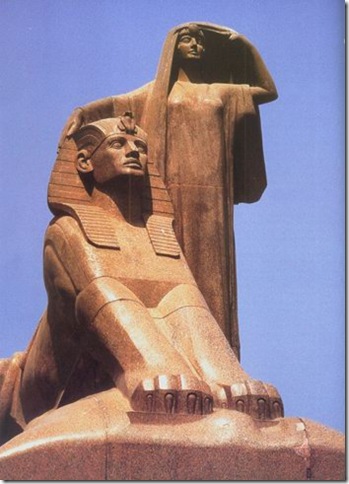
It was always inevitable. If Egypt ever had a renaissance, it was only in 1919 to 1928 in the wake of World War I when Egypt's rising tide of nationalism re-emerged in the modern form of secular socialism, building a “modern Egypt” in the likeness of a worker’s Soviet and such lifeless monuments to its dead past as this one shown here by Mahmoud Mokhtar.  Egypt’s sense of nationhood certainly goes back centuries, (as historian Scott Powell explains “an implicit premise embedded in Egyptian thinking that extends back to its “glorious” pharaonic past, of which the ever present pyramids and temples [and mortuaries and funerary palaces] provide a constant reminder”), but without the philosophical base responsible for these past glories, its modern “renaissance” could never rekindle the full power of its past (as Mokhtar’s soulless sculpture adumbrates). The strident militant nationalism of Nasser/Sadat/Mubarak could never be a real substitute for the full-on pharaonic metaphysics.

Hence, since the death of Nasser, Egyptian nationalism's most vigorous standard bearer, Egypt's nationalism has withered in the face of the more explicit and integrated metaphysics and values of Islam, both of which are widely accepted by the Egyptian population.  As I blogged a couple of years ago,

_Quote the values of these two ideological forces have been in open warfare ever since the formation of the Muslim Brotherhood in 1928 -- the suppression of the Brotherhood and the murder of Nasser's successor Anwar Sadat by Muslim Brotherhood killers being two ready symbols of the conflict played out between the secular but disintegrating nationalism and the vigorous, violent and persistent Islamism that the brotherhood embodies.
    This can be a conflict with only one victor.
  Scott Powell argues at his 'Powell History Recommends' blog that because nationalism is merely a set of disintegrated implicit notions whereas Islamism  is an "all-encompassing and explicit system of ideas," it is therefore "only a matter of time before it takes over."

Only a matter of time . . .

_QuoteEgypt is thus a nation in flux, and on its way to somewhere worse. "Despite the constant use of force by the Mubarak regime to suppress the Muslim Brotherhood," notes Powell, "that Islamist organization remains the only organized political opposition in Egypt [as a 2008 day of angry protest was intended to demonstrate]. This matters because the country may be on the verge of economic collapse and widespread violence."

An Egyptian Islamist theocracy? Don’t bet against it.

Why does this matter to us?

_QuoteThis matters to us because Egypt is not only the source of one of the most virulent of Islamism's anti-western toxins, but because it has the potential to be the next Poland -- ie., "the next flashpoint that ignites an unexpected larger war, such as occurred in 1939."

Let us profoundly hope not.

Here’s The Cure:

UPDATE: Egypt and the world face a crossroads, says Liberty Scott.

_QuoteLet's be clear, an Islamist run Egypt would pose a threat not only to Israel, but could be a base for terrorist activities in Europe and beyond.  It would have a stranglehold over shipping through the Suez Canal, and be leading the largest Arab state by population.   The Iranian military religious dictatorship is already claiming a new Middle East, Islamic dominated, is coming to the fore, let's hope not.
    For if it were to happen, do not be deluded that it will cost in lives, and could create a new age of conflict that makes Iraq and Afghanistan seem like they were easy. . .
    For if it is a bad dream for Egyptians to be suppressed by the Mubarak regime, it would be one of our worst nightmares to have an Ayatollah of Cairo.

Not that Obama would know. Looks like while Cairo burns, Obama parties.

Friday, 17 December 2010

The greatest story (hardly) ever told [updated]

‎"The events of any given period of history are the result of the thinking of the
preceding period. The nineteenth century [for example]—with its political freedom,
science, industry, business, trade, all the necessary conditions of material
progress—was the result and the last achievement of the intellectual power
released by the Renaissance."
- Ayn Rand

HERE’S A STORY FROM history that’s hardly ever told, but yet it’s the greatest story history could tell.

It’s a story that covers two continents and 2,000 years, and is the fundamental reason for all our health,wealth and happiness —and freedom—but most people don’t know anything about it, and couldn’t tell you why it matters.

Here’s a small part of that story, which starts for us in an unlikely place. . .

alhambra THE SEAT OF SCIENCE and civilisation a thousand years ago was in the Muslim world.

While Western Europe endured its Dark Ages—that wasteland of crosses and graves that lasted nearly a millennia, and buried more than a million souls in misery and squalor—the Arab and Persian world was making advances in medicine, mathematics, cartography, astronomy, philosophy, poetry, scientific method and more.

If you were a scientist, an artist, or any sort of human being hoping to breathe free then, from the eighth to twelfth century, the places in which you wanted to breathe had names like Toledo, Cordoba and Baghdad.

And then, it all came to a crashing halt. And within two centuries, the situation in the two places was almost entirely reversed.

What happened? What changed? And what made the  successes happen in the first place?

A fascinating 28 minute interview on Radio New Zealand with scientist Jim al-Khalili, author of Pathfinders - The Golden Age of Arabic Science, tells part of the tale—one of history’s most-interesting yet least told. And he tells a fascinating story. I recommend a listen.

al-Khalili explains how Muslim scientists flourished in a culture that then valued the “this-world” knowledge they were pursuing. But he finds it damnably hard to put his finger on the precise reason for the growth and development of this culture—talking about things like the invention of paper and “the ideas of the Greeks,” without really saying much about what those ideas were.

Equally, he finds it difficult to explain the rapid fall of Islamic science and the slow awakening of western Europe from its intellectual slumber, beyond talking about a “conservative backlash” in Islam, “the discovery of the New World” by the West (which actually happened around three centuries after Islamic decline began) and the transmission of “the ideas of the Greeks” from the Muslim world to the West.

In fact, the reason for both fall and rise is the relationship that both these cultures had with Greek ideas. Specifically, with their relationship to reason, and especially to the man they called The Philosopher of Reason, Aristotle.

Pathfinders: The Golden Age of Arabic Science
(9781846141614): Jim Al-Khalili

A History of Knowledge: Past, Present, and Future
(9780345373168): Charles Van Doren

61BXWMUJZHL._SL500_AA300_ 
Aristotle
(9780231085298): John Herman Randall

“Ancient Greece tore away the heavy shroud of mysticism woven for centuries in
murky temples, and achieved, in three centuries, what Egypt had not dreamed of in
thirty: a civilization that was essentially pro-man and pro-life. The achievements of
the Greeks rested on their confidence in the power of man’s mind—the power of reason.”
- Mary Ann Sures

ARISTOTLE WAS PLATO’S STUDENT, yet the mature philosophies of these two giants could not have been more different.

Raphael’s famous painting shows Plato pointing to the heavens, and Aristotle to this earth. It is an accurate summation of their positions. Plato looked to the heavens for the “true reality,” and found there rules for living on this “imperfect,” non-ideal plane. Aristotle saw instead that happiness on this earth was man’s highest estate, and that knowledge of the things of this earth—observing nature and drawing conclusions from it—is the means by which to begin obtaining it.

aristotle-platoIt’s said that the history of philosophy is described by the duel between Plato and Aristotle. In virtually every important sense, this is true. In both the Muslim and Christian worlds, it’s played out in the duel between mysticism, with Plato and neo-Platonism brought in on the side (literally) of the angels and of other-worldly maunderings; and Aristotle (when he’s been rediscovered) on the side of reason and a focus on success in this world.

It’s the rediscoveries of the ideas of Aristotle that have been crucial in our story.

Aristotle left behind at his death a veritable manual of scientific discovery and how to live on this earth—especially the Organon, six treatises on logic that were a virtual toolkit of logic. These were “the ideas of the Greeks” that mattered most to Muslim scientists when they rediscovered them eleven centuries later, and to western philosophers and scientists when (thanks to Muslim scholars) they rediscovered them for the west fifteen centuries after they had first been buried.

Because these ideas, while powerful enough to turn civilisations around, barely had time to be given even a full road test after their first brief time in the sun, around 300BC. Because this was very quickly becoming very much not a safe time in which to be a philosopher, and just a few short decades after Aristotle’s death his school was closed, his students were scattered, and his works on papyrus rolls were buried for safety in a trench in Asia Minor, not to be uncovered for centuries.

And while they lay buried, the light of reason which had flickered so briefly and so well was going out around the world, in Athens and Alexandria and eventually, finally, even Rome. 

hieronymus_bosch_-_the_garden_of_earthly_delights_-_hell1It was buried by pagan mysticism (which had never fully gone away) and neo-Platonism (which had been around long enough to take hold), but most forcefully and more thoroughly still by those Roman emperors who from the fourth century had already set themselves up as both definers and enforcers of religious “orthodoxy,” and the head of a monotheistic state.  (The Christian insistence on the absurdity of the Trinity, for example, dates from Theodosius’s 381AD decree dictating that all his subjects subscribe to a belief in the Trinity of the Father, Son and Holy Spirit, or else.)

As if to demonstrate that without reason to deal with one another there is only force, the emperors from Theodosius on now began the systematic suppression by the sword of all non-orthodox Christianity, and of all still-surviving pagan philosophies that couldn’t be made hand-maidens of theology as easily as neo-Platonism (which could easily be bent to fill up the gaps in the emerging Christian theology).

With Justinian edicts in the 530s enforcing religious conformity on pain of death, the assault on reason and freedom was complete.

Thus began the inevitable waves of barbarism, looting and darkness that necessarily accompanies the widespread rejection of reason and a culture-wide focus on the next world rather than on this one.

“If there is a philosophical Atlas who carries the whole of Western civilization on
his shoulders, it is Aristotle…. Aristotle may be regarded as the cultural
barometer of Western history. Whenever his influence dominated the scene, it
paved the way for one of history’s brilliant eras; whenever it fell, so did mankind.”
- Ayn Rand

the-alhambraWHILE THE WEST WAS  committing intellectual suicide, the Islamist world was just beginning to wake up. It was the rediscovery of Aristotle in Muslim Spain and the Middle East that was the next light of hope in the world, and that built and underpinned the Islamic Golden Age—which at its three-hundred year peak spread wealth, riches, learning, art and happiness from Baghdad to Spain.

Just as it was built by ideas, so too however  was it killed by them—by what scientist al-Khalili calls the “conservative backlash,” a reaction against science and reason best summed up by eleventh-century theologian Al-Ghazali, who called for the Greek ideas to be thrown out, saying essentially, “If it’s in the Quran we don’t need it; if it’s not in the Quran we don’t want it.” And so out it all went. For good—or at least for ten centuries.

One of the most illustrative examples of Al-Ghazali’s “thinking” was his direct assault on causality. Things don’t act according to their nature, he said, God makes things act any way he pleases:

_Quote_Idiot

The connection [said Ghazali] between what is habitually believed to be a cause and what is habitually believed to be an effect is not necessary…
    For example, there is no causal connection between the quenching of thirst and drinking, satiety and eating, burning and contact with fire, light and the appearance of the sun, death and decapitation, healing and the drinking of medicine, the purging of the bowels and the using of a purgative…
    On the contrary, it is within [divine] power to create satiety without eating, to create death without decapitation, to continue life after decapitation, and so on to all connected things…   

You might think this is insane, and it is; the stuff of madness, and you’d be right; utterly illogical--which is it’s point. al-Ghazali is here simply doing God’s work:

_Quote_Idiot

Our opponents claim [for example] that the agent of the burning is the fire exclusively; this is not a natural, not a voluntary agent, and cannot abstain from what is in its nature when it is brought into contact with a receptive substratum. This we deny, saying: The agent of burning is God, through His creating the black in the cotton and the disconnection of its parts, and it is God who made the cotton burn and  made it ashes either through the intermediation of angels or without…

This is a God for every teenage arsonist seeking an excuse: “Well, yes, I lit the match. But it was God wot burned the school down.”

This is nothing like the “God of the Gaps” that leave God just to fill in what science has yet to discover. This is a God who holds every test tube, sparks every flame, guides every bullet, and detonates every bomb—either  with the intermediation of angels, or without.

According to al-Ghazali—whose “thinking” swept the Muslim world (and swept away reason, logic and science with it)—there is no other causal agent in the universe but God, and therefore “no unity in the world, moral, physical or metaphysical; all hangs from the individual will of Allah.”

Nothing could be more destructive to reason, to science, and to civilisation. Yet al-Ghazali’s fateful rejection of reason swept the Islamic world, which (still proudly waving his flag and that of the Quran) sank into the intellectual mire from which it has yet to emerge.

“Aristotle’s philosophy was the intellect’s Declaration of Independence. Aristotle, the
father of logic, should be given the title of the world’s first
intellectual, in the purest
and noblest sense of that word. No matter what remnants of Platonism did exist
in Aristotle’s system, his incomparable achievement lay in the fact that he defined
the basic principles of a rational view of existence and of man’s consciousness…
    If we consider the fact that to this day everything that makes us civilized beings,
every rational value that we possess—including the birth of science, the industrial
revolution, the creation of the United States, even the structure of our language—is
the result of Aristotle’s influence, of the degree to which, explicitly or implicitly, men
accepted his epistemological principles, we would have to say: never have so
many owed so much to one man.”
- Ayn Rand

STTING HERE IN 2010, it’s easy to laugh at al-Ghazali.  That’s because we, here and now, mostly take reason for granted—so thoroughly that we find it hard to understand those who don’t. That we do take it so much for granted is testament to how thoroughly western culture has supped from Aristotle’s well. But it took a while.

Because in the first ten centuries after Christian theology first gained its toehold, the west was also labouring under similar nonsense to al-Ghazali’s, and with the same existential results as the Islamist apostle of unreason would deliver to his culture. Early Christian theologians were in virtually all respects peddlers of the very same nonsense, just delivered wearing a different brand.

Paul, for example, who took violently against the “upstart” Greek philosophers whose logic he had trouble countering, took instead to attacking the very core of Greek intellectual achievement.

_Quote_Idiot

The more they [Greeks] call themselves philosophers, the more stupid they grew … they made nonsense out of logic and their empty minds were darkened. [Romans 1:21-22]
The wisdom of the world is foolishness to God. [Corinthians 1:25]

(He made more sense when he declared, “I know of nothing good living in me.” [Romans 7:20] On that, I can concur.)

And while Augustine, the second-most influential Christian theologian, was willing to allow reason, he also declared it may only be used to explore “truths” already revealed by his God—and even these revelations were only to be accepted on the authority of the monotheistic state. (“I would not have believed the Gospels except on the authority of the Catholic Church.”)

And Tertullian, “I believe because it is absurd.”

And John Chrysostom: “Restrain our own reasoning and empty our mind of secular learning in order  to provide a mind swept clear for the reception of divine words.”

And Lactantius: “What purpose does knowledge serve—for as to knowledge of natural causes, what blessing is there for me if I know where the Nile rises, or whatever else under the heavens the ‘scientists’ rave about?”

And Philastrius of Brescia, who was ready to declare causality itself implicitly a heresy in a fashion that Cantabrians might appreciate:

_Quote_Idiot

There is a certain heresy concerning earthquakes that they come not from God’s command but, it is thought, from the very nature of the elements… Paying no attention to God’s power  they [the heretics] presume to attribute the motions of force to the elements of nature … like certain philosophers who, ascribing this to nature, know not the power of God.

(T paraphrase al-Ghazali’s similar “arguments” aired above,  it would seem that Philastrius’s God has extended to him the power to think without having possession of a brain.)

Finally, to show that they knew who their enemy was, we have Anastasius of Sinai, who  was ready to declare  that the ten sections of Aristotle’s Categories were ten “heresies” representing the ten horns of the dragon in the Book of Revelation (12:4)

No wonder, under the sway of “thinkers” like these, that western Europe spent so many centuries in darkness.

Fortunately however, in the brief window before the fruits of Islamic thinking disappeared forever, western translators eager to learn the “heresies” that had been buried for so long discovered and began translating Islamic works on medicine, astronomy, mathematics, engineering … and philosophy. They discovered the Arab commentators on Aristotle, and they discovered the great works of Aristotle himself. In short, they re-discovered his manual of reason, and with it the key to begin civilisation anew.

If the industrial revolution of the nineteenth century owes its genesis to the tremendous intellectual power released by the Renaissance, as the quote at the top of the page suggests, then it’s important to realise that the intellectual power released in the fourteenth and fifteenth centuries was generated by the intellectual “atomic power station” of Aristotelian reason that was rediscovered in the twelfth.

The new Latin translations of Aristotle’s Organon (translated in Spain and Sicily from Arabic, which themselves were translations from lost Greek originals) were the transmission belts for the ideas that powered the new thinking of Albertus Magnus, Aquinas, and Francis Bacon; the new art of Giotto, Michelangelo and Da Vinci; the new architecture of Brunelleschi, Bramante and Palladio; the new science of Copernicus, Galileo and Newton; the new conception of human freedom embodied in the ideas of Grotius, and Locke and (eventually) Jefferson—who all of them, as reason requires, began their work by turning their eyes to observing the facts before them before seeking the causal integration that explained the facts observed: a re-use and rediscovery of reason’s method all but lost in the west since the original days of the Greeks.

To that almost fortuitous rediscovery we owe virtually all human progress of the past five centuries. That’s how important this story, and that rediscovery, is.

“The events of any given period of history are the result of the thinking of the preceding period.” That’s what this story makes so plain—that ideas do have tremendous consequences, for good and for ill.

It’s astonishing that the story is so rarely told---and so little understood when it is—told when it is told with, for example, the sort of mechanistic detail that explains the rise of Islam by the discovery of paper or the west by the discovery of the New World; or the fall of Rome by the onset of hyperinflation, or the fall of Islamic science to some undefined “conservative backlash”; without ever seeking to look beyond these outward details to the fundamental facts that caused them.

“There is no future for the world except through a rebirth of the Aristotelian
approach to philosophy. This would require an Aristotelian affirmation of the reality
of existence, of the sovereignty of reason, of life on earth—and of the splendor of man.”

- Leonard Peikoff

YOU’LL HAVE NOTICED by now that I’ve strewn a few books across your path, each of which tells a part of the story. And below I’ve added three more that between them integrate and give the culmination of the story—the first as a guide to the loss and rediscovery; the second, in which the title essay tells the tale told here in far more colourful and sweeping terms than I could; and the third, to demonstrate that the primordial struggle for reason and individual liberty are the same story, whose culmination we find in the discovery of individual rights and their implementation.

Taken together, they tell a remarkable tale. But the astonishing thing to note is how few books there are telling the story itself. When Burgess Laughlin, for example, began work on another project, he looked for a book telling the tale and found none. So he wrote his own, The Aristotle Adventure. To my knowledge it’s still the only book-length survey giving the whole context.

If you want to bury yourself in books on the greatest story (hardly) ever told, then these listed here are a good place to start.

And there’s no time like a long summer holiday to begin.

Enjoy!

The Aristotle Adventure: A Guide to the Greek, Arabic, & Latin Scholars
Who Transmitted Aristotle's Logic to the Renaissance

(9780964471498): Burgess Laughlin

For the New Intellectual
- Ayn Rand
(Signet) (9780451163080): Ayn Rand

Capitalism Unbound: The Incontestable
Moral Case for Individual Rights

(9780761849698): Andrew Bernstein

NB: Note that not all books listed here are entirely without fault or error. I should note that those to be most careful of are Rubinstein’’s Aristotle’s Children and Reilly’s The Closing of the Muslim Mind, which are both sadly infected by the authors’ own religiosity, making them sadly unable to see the full drama of the story they’re trying to tell.

Naturally, I’d be very happy to have other books recommended that might fill in some of the gaps.

And to see the whole story in one graphic, here’s one of the charts from Burgess Laughlin’s Aristotle Adventure that makes it so valuable:

AristotleAdventure 

UPDATEAndy Clarkson points out

It was Arabs qua Aristotelians and not Arabs qua Islamists who are responsible for the accomplishments of Arab Muslims.

Monday, 15 March 2010

Simple Simon: Stay Away

Philip Duck from SOLO wants to know why New Zealand is required to prostrate itself before the world’s torturers?

    New Zealand's Justice Minister Simon Power and a small army of bureaucrats from various government ministries and departments have been ordered to New York to front up to the United Nations Human Rights Committee.
    The Minister will, over a two-day session, be asked by the representatives of countries such as Egypt, Algeria, Tunisia and Morocco, to 'provide detailed information on cases in which electro-muscular disruption devices, Tasers, have been used by the police.’ And Power is also going to be asked to provide information on ‘Operation Eight’ and explain whether ‘Maori individuals and their families were victims of violations of their rights and subjected to discriminatory treatment.’
    So, the Algerian government, which is highly corrupt, controls the judiciary and routinely uses its secret police to beat journalists, is going to interrogate Power on New Zealand’s unarmed police force's use of the Taser?
    And the government of Egypt, which refuses to make spousal rape illegal, allows the searching of people and places without a warrant, detains without charge for 'security-related' offenses more than 12,000 people every year and, in 2008, shot and killed at least 32 migrants attempting to get into Israel, is going to challenge Power on ‘Operation Eight?’
    The reason for the Minister’s trip is sick; it is not just a waste of time and money. It is far worse than that. By appearing before the committee, Power will not only deflect attention away from the worst of the world’s human rights abusers and the governments of countries such as Iran, Zimbabwe, China, Egypt, North Korea and Sudan, he will also allow them to continue to engage in the sickest of moral equivalency and say, “Look! Don’t pick on us, human rights problems are everywhere!”
    If Simon Power were truly concerned about the worst of human rights abuses he would pull down his trousers and give the U.N his very own performance of a Whakapohane while telling the committee to sod off.