"One of my most memorable lessons about incentives came during college. My university, Berry College, purchased dozens of bikes to distribute throughout campus. The red-painted 'Berry Bikes' were free to use, intended for students to ride easily between buildings to and from class.
"The programme famously flopped. Shortly after it launched, the student newspaper reported that 'chains have been broken, tires punctured, handlebars bent, and seats torn.' Appeals to 'treat the bikes as if they were your own property' were ignored. Two months in, the project was abandoned.
"Dozens of universities launched similar bike-sharing projects around that time, all with the same result. Two-thirds of Northern Arizona University’s free 'yellow bikes' were stolen or vandalised during the project’s first semester. Purdue’s 'Gold Bike' programme lasted less than a month. At Florida’s Eckerd College, $25,000 worth of bikes disappeared. Students devised a clever way to use the few that remained—by taking the seats with them to class to ensure the bike would still be there later.
"Several cities tried free bike programmes, too.In Portland, Oregon, community activists released 1,000 yellow bikes on city streets. Almost all were stolen or vandalised within a few months. Tampa’s 'Orangecycles' programme ended just weeks after it began. Another programme in Princeton, New Jersey, failed so badly that the local paper reported finding a free bike was 'kind of like seeing Elvis.'
"The lesson is one that applies as much to free bikes as does to the conservation issues on which the Property and Environment Research Center (PERC) works: Ownership provides clear incentives for people to care for their resources. But when assets are freely available for anyone to use—or abuse—without consequence, those incentives disappear."~ Shawn Regan from his introduction to a special issue of PERC Reports demonstrating the importance of incentives across a wide range of issues from rangeland health to water conservation.
Thursday, 1 August 2024
"Ownership provides clear incentives for people to care for their resources. "
Tuesday, 21 March 2017
Whinlayson’s retreat into animism is a river too far
Attorney General Christopher Whinlayson has declared the Whanganui River to be a legal person, and last week your MPs agreed with him, unanimously passing a law declaring that the Whanganui River has all "the rights, duties and liabilities of a legal person,"
But a river is not a legal person, despite what Christopher Whinlayson publicly professes to think. “Legal persons are of two kinds,” points out Jamie Whyte:
we humans, known in law as "natural persons", and persons that are legal fictions, such as companies and countries. These fictional people solve legal problems that can arise when natural people act in groups.
Two kinds, but with one constituent: human beings possessing agency. Natural persons are actuals persons or their guardians acting on their behalf; legal persons are properly “changing collections of natural people or positions filled by successive individuals” – such as companies, trusts or corporations.
Whinlayson acknowledges that "some people will say it's pretty strange to give a natural resource a legal personality, but it's no stranger than family trusts, or companies, or incorporated societies." Yet as Whyte points out, it is surely even stranger that an alleged legal mind thinks this is strange.
And even stranger that he thinks granting legal personality to a river is "no stranger."
Rivers are not changing collections of natural people or positions filled by successive individuals. Nor can rivers be legal persons, whatever Parliament says. What duties might the Whanganui River have? Does it have a duty of care to ensure no one drowns in it? Can the river be sued?
The underlying rationale can be seen in Finlayson's claim that Whanganui iwi will "have a representative speaking for the river [and] the Crown has a representative speaking for the river, and they are focused on addressing many of the problems the river has had over the last 140 years."
So, asks Whyte, “What can justify this foray into legislative lunacy?” Whyte identifies it as a retreat to animism:
Mr Finlayson appeals to traditional Maori thinking. ‘In their worldview, “I am the river and the river is me”,’ he has said. ‘Their geographic region is part and parcel of who they are.’
“If this worldview were literally true, then the Whanganui River would be a natural person – or, rather, many natural people: namely, all those Maori with whom it is identical. But it isn't literally true. It is simply a way of expressing a feeling towards the river.
“A river is not a natural person: our legislators have embarrassed themselves.”
And so they have. This is indeed a “river too far.” But the failure is not just Whinlayson’s et al in parliament. As our guest poster Fred Smith pointed out yesterday, there was once a school of law that recognised a rational method whereby, over 140 years ago, a representative may have legal standing to speak for a body of water, so “addressing many of the problems [it may have] had over the last 140 years." That is: a legal system once embodied in the common law, that once recognised (around 140 years ago) that environmental resources be readily available as ownable private property, giving standing thereby to an actual person to protect his or her property.
The failure of Whinlayson et al to recognise this solution is at least twofold. First of all, in refusing to recognise the practical possibility of owning water, this government has committed itself instead to collective ownership, mysticism and a spiral down into increasing and utter absurdity. That the left is demanding a market solution to water allocation while this our centre-right govt says no is only one tine to this absurdist fork. Whinlayson’s retreat into animism is another.
And second of all, they are part of a now 140-year-old tradition that, in denying property rights in what are instead erroneously considered “environmental resources,” they have destroyed the possibility of rational legal and market solutions to what is actually a very simple problem. (Property rights in streams and rivers for example coupled with common law systems of protection would at a stroke solve the ‘dirty dairying’ problem about which so much is said, but so little achieved. Property rights in flora and fauna and land is the best means of ensuring a genuinely sustainable nation.)
The answer is better thinking about the institutions that protect environmental resources; not the creation of legal absurdities like this.
RELATED POSTS:
- “With lawyers and regulatory law invoked instead, the institutions necessary to allow environmental market transactions to solve the problems were simply not allowed to evolve. And today, instead, we are faced with political stoushes over water aquifers and mongrelised “legal fictions” manufactured giving “personhood” to rivers …”
The state can't protect the environment – markets can – Fred Smith, NOT PC - “Prime Minister John Key says it’s not possible to own water.
“The Prime Minister is wrong…
“Neither the Prime Minister nor his advisers may have ever read a book of common law—and the loss is very much ours.”
The Prime Minister is wrong – NOT PC, 2012 - “John Key announced ‘o one owns water.’But what he really means is ‘he government owns the water.’So he is being duplicitous.”
Water, water everywhere… – NOT PC, 2012 - The answer to most water problems is clearer property rights, and greater common law protection of those rights.
Dirty dairying and dodgy drafting – NOT PC, 2008 - Recognising water rights is the easiest thing in the world.
Access to Irrigation Water: Private Property Rights Applied to Water – Craig Milmine, UNIVERSITY OF OTAGO - “Property rights in streams and rivers for example coupled with common law systems of protection would at a stroke solve the ‘dirty dairying’ problem about which so much is said, but so little achieved. Property rights in flora and fauna and land is the best means of ensuring a genuinely sustainable nation.”
What would Party X do about the environment? Part 2: A Nuisance and a BOR – 2011
.
Monday, 20 March 2017
The state can't protect the environment – markets can
Unfortunately, mainstream economists of the progressive era became enamoured of making economics a quantitative “science” and forgot the role of institutions, argues Fred Smith in this guest post. Thus environmental issues were relegated to the category of “market failure,” and the role of economists to that of commissars of rules and regulations designed to correct these failures. With lawyers and regulatory law invoked instead, the institutions necessary to allow environmental market transactions to solve the problems were simply not allowed to evolve. And today, instead, we are faced with political stoushes over water aquifers and mongrelised “legal fictions” manufactured giving “personhood” to rivers …
As Joseph Schumpeter noted, free markets had a good first century. That century was the 1750s to 1850s: A market economy produced massive improvements in the quality of life, and that gained it general legitimacy. But, as he also warned, as wealth increased and this wealth generation became increasingly taken for granted, markets and the prerequisite institutions for markets to exist (specifically property rights) came more and more under attack.
Markets were good at producing wealth but, if tweaked by political intervention (it was thought), would achieve even more benefits. Progressives in the United States and socialists in Europe both championed political control of markets and, perhaps more strategically, both blocked efforts to allow markets to expand into new areas of concern, leaving these new areas exposed instead to intervention.
Those policies are now being reconsidered, but the one area where many, perhaps most, still believe only government can operate is that of environmental protection. This essay argues that classical liberals should challenge this view and seek to evolve a free market environmental programme based on the expansion of property rights and associated legal protections. There are indeed environmental concerns, but these reflect failures to allow markets and their prerequisite institutions to evolve, rather than “market failures”.
Market Institutions
Economic liberals have long understood that free markets evolve and are dynamic, and the appropriate price/demand terms for today will continually vary as consumer tastes and producer technologies evolve. But classical liberals also understand (although they devote less attention to) the fact that markets don’t operate in a vacuum, but rather are embedded within a necessary institutional framework. That framework entails a system of extensive private property, a rule of law outlining how contracts and liability issues are to be resolved and, finally, a culture that recognizes that voluntary exchange can increase wealth. Environmental issues arise in a situation where one or more of these requisite institutions don’t exist, where voluntary arrangements for resolving them have been denied.
Ludwig Von Mises summarised this position:
It is true that where a considerable part of the costs incurred are external costs from the point of view of the acting individuals or firms, the economic calculation established by them is manifestly defective and their results deceptive. But this is not the outcome of alleged deficiencies inherent in the system of private ownership of the means of production. It is on the contrary a consequence of loopholes left in the system. It could be removed by a reform of the laws concerning liability for damages inflicted and by rescinding the institutional barriers preventing the full operation of private ownership.
Policy makers have failed to recognise the relevance of such institutions and that time may be required for them to evolve. This neglect stems in part from the fact that these requisite institutions had evolved, in many areas, long before the Industrial Revolution. Those established institutions were stressed by the different challenges arising from the Industrial Revolution.
As the Nobel Laureate Ronald Coase notes, as the Industrial Revolution developed and environmental concerns (sparks from early rail locomotives, river damage from early industrial processes, the need to locate and develop oil resources), institutions did develop. Nuisance law was applied to pollution, and subsurface property rights were established. But then that process was stopped in its tracks.
Legislatures eager to promote economic growth granted railroads and many industrial plants pollution privileges. Subsurface property rights in oil pools and reserves did evolve, but they were not extended to aquifers, groundwater, and other liquid underground resources. And most mainstream environmental resources, such as wildlife, springs and brooks, airsheds and bays, remained as unprotected commons. Normal market processes were blocked from addressing these emerging areas of social concern. Thus, overuse and pollution – not addressed at the margin – were neglected until they grew to critical levels. A similar problem occurred in the failure to recognise the efforts of radio pioneers to homestead the electromagnetic spectrum.
Institutional evolutionary history has received too little attention because for much of history it had happened incrementally, slowly and largely out of view. Some newly discovered resource or some emerging value raised interest in providing or obtaining that resource, but interested parties found the transaction costs of achieving such exchanges excessive. But, viewing the potential of reaching a mutually beneficial wealth-enhancing agreement, the potential buyers and sellers as well as those brokering such transactions, would seek ways to lower these costs – via institutional and/or technological innovations.
The more successful of these innovations would be integrated into the established institutional framework. In effect, over time this would civilise these novel frontier exchanges, extending the market so that it could make “sweet” commerce available there also. The growth of the institutions of liberty would permit the expansion of the market.
Why didn’t this process occur as environmental values moved into prominence? Why were markets blocked from playing a creative role in nurturing and advancing economic values as they had long done in more traditional economic areas? Why are environmental resources rarely available as ownable private property?
Although the history of early environmental concerns has received little attention, Coase among others has examined how environmental concerns were addressed at the dawn of the Industrial Revolution. Early forms of pollution – primitive charcoal production that produced noxious smoke, say, or sewerage that dirtied water – would likely irritate downwind or downstream parties. Communal norms would discipline to some degree such “pollution activities” as they threatened the communities’ “proper enjoyment of their property”. But such low levels of pollution, especially in small cultural enclaves, could readily be handled: community pressures could encourage charcoal operations to relocate to more remote woodlands. Homeowners could be shamed into building clay-lined privies.
"Excuse Our Dust, But Grow We Must"
But with the dawn of the Industrial Revolution, the quantity and nature of materials processed and the quantity of residuals increased. The power of communities to address external and large enterprises weakened; moreover such enterprises brought benefits as well as nuisances.
Yet weak property rights and a liability system dealing with water and air did exist, building blocks for a more robust market in these areas. And efforts were made to adapt them to these new challenges. Coase notes that farmers filed suits against railroads when the sparks from these first-generation locomotives set fire to their crops. Fishing clubs moved to enjoin corporate disposal practices that harmed the fishing in areas where they held rights. And these early “free market environmental actions” had impact – firms did respond and, it appeared, that the Industrial Revolution would consider all values (addressing the challenge posed by Mises).
But, while there were some concerned about environmental values (initially mostly those enjoying those resources or harmed by a firm’s negligence) many, especially socialists in Europe and progressives in America, championed “Progress” – a policy of “Excuse our Dust but Grow We Must!”
Politicians in Britain responded by granting licences to pollute to industries and firms seen as especially important to such growth. Rather than integrating environmental resources into the market economy, they were locked out.
And, perhaps more importantly, the concept of private property as a valuable institution to disperse power, encourage a variety of experiments, allow diversity in use, Progressives viewed resources as better protected by politics – vast tracts of Australia, North America and New Zealand have been transferred to governments over the last century. Moreover, the process by which newly valued resources slowly gained the status of private property, allowing them to become managed by the market, stopped totally in the late 19th Century. No resource that was not in private hands in 1890 is today.
The shift was sometimes abrupt. The electromagnetic spectrum which became a valuable resource at the turn of that century was initially being homesteaded with rules to separate one bandwidth user from another. Then Congress created the precursor of the Federal Communication Commission to own and manage this valuable resource. Subsurface resources such as minerals, oil and water all gained protection in America in the 19th Century by the innovation and legitimisation of the concept of subsurface mineral rights. Yet aquifers (the most abundant source of potable water) remain common property resources, lacking the institutional benefits of ownership.
Environmental Politics
To reiterate: free market environmentalism argues that current environmental policy took an unfortunate path. Rather than realising that the more worrisome forms of external impacts happened incrementally, that we should encourage a vast array of experiments about how best to reconcile (indeed integrate) environmental concerns with economic ones, the “market failure” model presumes that all environmental issues are inherently political.
Such environmental events happen somewhere and at some time before they happen everywhere and persistently. Thus, some individuals will be affected initially and will seek redress while the impacts are still small. Coase finds that the common law was often receptive to such requests, leading firms to reduce the nuisance: relocation, changing time of operations, acquiring buffer zones or even negotiating with the harmed party to permit future emissions. Firms and impacted parties might well innovate – impacted parties “fencing” themselves off from the nuisance, firms adding settling and treatment ponds, and so forth.
In brief, classical liberals would expect a period of confusion and adaptation as the parties encountering such-extra market costs and benefits evolved means of integrating those costs and benefits into the market structure. These would include extending property rights to the new resource (clarifying the right of owners to prevent this new form of trespass), legitimising new contract instruments that would permit the parties to agree to a risk-sharing arrangement (the plant agrees to hold its effluents below some harmful level and agrees to compensate the property owner if those protections fail), cultural change (recognising that air and water transgressions – transferring one’s residuals on to the properties of others without their permission – is a trespass, a “pollution”).
Since environmental issues will happen in many areas over time, classical liberals would expect the discovery process to provide a number of competing environmental response strategies and for those which proved most effective to gain dominance in the courts and in practice. Moreover, given the dispersed nature of these initial events, we would expect the initial respondents to be those most adversely affect or those most sensitive to nuisances, or those who value aesthetic more (modern environmentalists). If the culture viewed polluting activities as “necessary”, such individuals might well use their own resources within the restricted institutional framework to protect those environmental resources they valued.
Moreover, since those early events would affect relatively few people there would be less urgency to solve such problems immediately, politically. Over time, as the legal rules and property rights evolved, the nuisance would integrate into the standard market framework.
Endangered Animals
There is much to say about this process but an illustrative example can be drawn by concern over endangered species (and more broadly biodiversity). Efforts to protect such species politically – making such species a ward of the state – have not fared well. Too often the reaction of property owners faced with laws banning them from encroaching (on their own land) on the habitat of such species is: “Shoot, shovel, and shut up.”
That’s a description of how many American landowners have reacted to the burdens of the Endangered Species Act. Those burdens are substantial – finding that an endangered species is using your land as its habitat will preclude any further development or use of the land. The result has been that landowners have an incentive to kill any endangered species they find on their land, remove all traces of it, and keep quiet about it. Can there be a better way?
Classical liberal economics suggests that the answer is yes. The reason why the landowner disposes of the endangered species is not simply because the species imposes a cost, but also because the species has no economic value to him. If we can find a way of providing value to the landowner in having the species on his land, then the incentives towards destructive behaviour will be removed (or at least lessened).
One way to do this would be through ownership of the animal(s). Having a property right in the members of the species inhabiting his land would give the landowner an incentive to protect his property and its habitat. Moreover, the landowner could realise that value by selling his property right to someone else, thereby allowing the landowner to “cash in” his ownership stake.
The new owner might then pay the landowner to maintain the habitat, thereby providing an income stream associated with the species. Moreover, ownership in wildlife – like ownership in commercial and pet species – encourages the developing of a wide array of supporting institutions: pet stores, veterinary science, licenses, and pet adoption agencies.
To initiate this process one might leave in place the current government ownership of wildlife but create a process that would allow individuals or groups (those having a special interest in that species) to petition to acquire ownership of a suitable population of that species. As in the case of human adoption, the petitioners might have to demonstrate their ability to manage the species and be monitored until that was proven. Different petitioners might experiment with different approaches and, over time, one would expect a wide array of management practices. All this would open the market to Green experiments and innovation just as has long happened in conventional areas.
Every party would benefit from such a market arrangement. The landowner would get a continuing income from land that would otherwise have been worthless, the new owner would get a property right in something he regards as valuable, and the endangered animal gets a chance to live in a maintained habitat. Such a market arrangement of winners is clearly preferable to the current regulatory arrangement, which produces losers.
Even a market arrangement short of outright ownership would be better. For instance, crowdfunding could be used to compensate the landowner for his foregone income from his land. People who value the endangered species could pool their resources to provide this benefit. Again, this would be a market transaction.
‘Externalities’ and the Market Process
The problem is that market solutions like these are currently made very difficult by the nature of environmental regulation. Environmental regulation generally depends on bans, caps, and mandates that restrict the possibility of market transactions. Why should people who value the spotted owl send money to a landowner to protect it when the landowner is theoretically banned from doing anything to harm it or its habitat? They get far more “bang per buck” from funding environmental groups that lobby for more bans, caps, and mandates.
Regulation evolved this way because the economists of the progressive era viewed environmental degradation as a social cost. Landowners, factory owners, utilities, and so on were viewed as imposing costs on the rest of society and had to be prevented from doing so by legislation.
This imposition of regulatory law derailed the process by which market institutions could have evolved to solve the problem. As Coase revealed in his essay The Problem of Social Cost, such “externalities” are actually the manifestation of differing priorities between people that, if the transaction costs are low enough, could be painlessly resolved by market transactions .
Coase therefore did not support government intervention (at least, not initially or permanently) but rather argued that the potential wealth-creating opportunity would engage entrepreneurs to devise ways of reducing such transaction costs, to realise that wealth. The possibility of transactions creating value for both parties would create the “inventive-incentive” necessary for creating a framework for these transactions to happen.
In particular, proper institutions can lower transaction costs. For example, the rule of law makes transactions more likely, as parties to the transaction can be certain that disputes will be resolved fairly. The institution of property rights provides a vehicle for a whole swathe of transactions. These institutions are essential and evolving prerequisites to markets. This is a central insight of classical liberal economics.
Unfortunately, mainstream economists of the progressive era became enamoured of making economics a quantitative “science” and forgot the role of institutions. Thus environmental issues were relegated to the category of “market failure,” and the role of economists to that of commissars of rules and regulations designed to correct these failures. The institutions necessary to allow environmental market transactions to solve the problems were simply not allowed to evolve.
A Path Forward
In many ways, environmental regulation is the last bastion of central planning. It is remarkable that even as Europe has realised the folly of central planning in so many other economic areas, it has actually doubled down on it in environmental regulation, and has indeed sought to export it to other nations. In this, it has found a willing ally in recent years in the United States, whose environmental policy is also largely a product of progressive era thought.
In that framework, the role of government should be to stand ready to facilitate proposals to expand and refine property rights and contracts, to ensure that liability laws encourage rational exchanges.
Perhaps the simplest example of this thinking would be to encourage experimentation with subsurface ownership of suitably isolated aquifers. The history of mineral and oil and gas policy suggests the value of linking ownership and natural resources. Does anyone really think that water availability would be a problem if such a policy were in place?
The term “the environment” has become a synonym for “everything” – but central management of everything is foolish. Allowing private parties to pioneer extending the institutions of liberty to environmental areas would begin the exploration and discovery process that has been suppressed for the last century. It is overdue.
A property rights approach would allow those closest to a polluter the right to enjoin that nuisance. The polluter could bargain and compensate to gain operating rights, with penalty fees for accidental discharges. That would create incentives for an array of ameliorative innovations: settling ponds, treatment diversion to other media (via incineration or land disposal).
Moreover, as such policies became widespread, firms would locate in areas where non-industrial uses were rare or where dilution potentials were high. In effect, externalities would be internalized while they were minor, and readily addressed, rather than waiting till there was a crisis.
Fred L. Smith, Jr. is the founder of the Competitive Enterprise Institute. He served as president from 1984 to 2013 and is currently the Director of CEI’s Center for Advancing Capitalism.
His post first appeared at CEI and FEE.
.
Thursday, 28 February 2013
Who comes first? Shark or man?[updated]
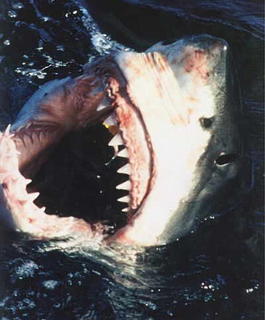
Poor Adam Strange was killed yesterday at Auckland’s Muriwai Beach by a White Pointer shark.
Despite police firing shots at the shark after it had killed Mr Strange, the man-eating White Pointer is a protected species in New Zealand, and has been since 2006.
As I said when Chris Carter so cavalierly added the Great White to the Department of Conservation’s list of protected species, this policy conserves everything except human life. But in that, it is part of a much wider context that
directly pits the anti-concept of 'intrinsic values'-- which environmentalists employ to say things should be protected 'as is, where is'—against real human values, such as the value of human life: from which all real value is actually derived.
This isn't just a semantic argument, as you’ll soon discover if one of these protected Great Whites starts chewing through your surfboard. Or your arm. Or your loved one.
A similarly stupid three-decade Australian ban on hunting crocodiles has seen numbers jump from 5,000 to 70,000, and an increase in savage croc attacks.
David Graber, research biologist with the US National Park Service, once declared on behalf of mainstream environmentalism that “We are not interested in the utility of a particular species or free-flowing river, or ecosystem, to mankind. They have intrinsic value, more value—to me—than another human body, or a billion of them... Until such time as Homo Sapiens should decide to rejoin nature, some of us can only hope for the right virus to come along.” City University of New York philosophy professor Paul Taylor adds: "[T]he ending of the human epoch on Earth would most likely be greeted with a hearty 'Good Riddance.'"
Graber gives the game away by declaring the notion of 'intrinsic values' itself to be valuable to him: as trees, rocks and mud puddles can’t speak for themselves, environmentalists like Graber must be paid to do it for them. (Idiscussed this phenomenon the other day.) Responding on behalf of human beings, Glenn Woiceshyn argues:While extreme, these anti-human sentiments are logically consistent with environmentalism's "intrinsic value" philosophy: Since man survives only by conquering nature, man is an inherent threat to the "intrinsic value" of nature and must therefore be eliminated. Environmentalism makes man the endangered species. The only antidote to these haters of mankind and their anti-human philosophy is to uphold man's right to pursue his own life by means of his productive activities.The real endangered species, says Michael Berliner, is us:There is a grave danger facing mankind. The danger is not from acid rain, global warming, smog, or the logging of rain forests, as environmentalists would have us believe. The danger to mankind is from environmentalism.
The fundamental goal of environmentalists is not clean air and clean water; rather it is the demolition of technological/industrial civilization. Their goal is not the advancement of human health, human happiness, and human life; rather it is a subhuman world where "nature" is worshipped like the totem of some primitive religion.The history of how a love of nature has turned into a preservationist religion is traced briefly here by Robert Bidinotto. Chris Carter's announcement is just one more example of that policy: Protecting a killer as some sort of 'totem' is a clear threat to the rest of us.
Fortunately, one person at least came out against Carter's stupidity. Me.
Of course, few listened. The shark was protected as an intrinsic value, and human beings were placed second.
But there are good folk about arguing that a love of nature can be put in its place—which has to begin by abandoning the phony notion that pristine nature is sacred, that is has intrinsic value, i.e., value in and of itself regardless of who is around (or not) to value it. Which means (as I also argued back in 2005) repudiating the “deep ecology” insanity that puts humans at the bottom of the totem pole, and embracing instead an environmentalism that accepts humans as first in the hierarchy of nature.
That’s not easy, not when
fully a fourth of all Americans "see nature as sacred, want to stop corporate polluters, are suspicious of big business, are interested in voluntary simplicity, and are willing to pay to clean up the environment and stop global warming." That's one quarter of Americans who see nature as sacred, just as the deep ecologists do.
It's true that there is now a growing tension between those who sympathise with the view of the deep ecologists--what you might call the 'romantic' or 'religionist' environmentalists-- and a growing minority who have reversed their views on issues of population growth, urbanization, genetically engineered organisms, and nuclear power (as I discuss in a previous blog called 'Religionists for Nuclear.'), but this latter group is not yet in the environmental mainstream, although they do deserve to be.
On this question of who comes first, consider the case of Florida boy Jessie Arbogast, whose arm was bitten off by a shark. It's easy to agree (or to maintain a discreet silence as animal rights activists did) with the shark being shot so the arm could be retrieved and successfully reattached (but do note that such an action might now be illegal if the shark was one of Chris Carter's protected Great Whites) . That's an easy case with which to agree, and the justice of shooting the shark and retrieving the boy's arm should be obvious, as Tibor Machan quite properly points out:Few among us would have hesitated at this choice: boy's arm versus life of shark. Of course the boy's arm is more important, and so the shark had to go. Yet, there are millions of animal-rights advocates around the world, many of them Hollywood celebrities with easy access to talk shows and news reporters, who have remained completely silent about their professed view—namely, that human beings are not more important than non-human animals.But consider Tibor's further point. An environmentalism that honestly puts humans first would go further and apply the same principle applied correctly to secure the boy's survival and well-being to all the day-to-day activities human must undertake to secure their livelihood: Rather than seek to shackle human production and fecundity, they must recognise that the unique nature of human beings requires that they use, alter and sometimes despoil nature in order to maintain their lives and to produce wealth: no other means of livelihood is possible to the human animal.
Supporting human life means opposing the 'religious' environmentalism that is often economically devastating to farmers, fishers, miners, loggers, and others who necessarily 'despoil' untrammeled nature in the necessary pursuit of their, and our, livelihood.
So that's the challenge I put to you: do you agree that humans should be put first in the hierarchy of nature? And if so, do you agree with my conclusion here; that is, in an "environmentalism ... that...eschews any idea of 'intrinsic values' or deep ecology, and embraces instead the idea of seeking and advancing those environmental values that support and enhance human life."
This is not a “pave the world” argument, it is moving from the extremism saying (to borrow from Monty Python) that:
Every tree is sacred,
Every bird is great,
If a dune is built on,
Greens get quite irate.
Every bush is wanted,
Every swamp is good,
every shark is needed,
in your neighbourhood.
Are there really and truly environmentalists that don't put humans first, I hear you ask? that put bugs, rocks and mud puddles ahead of human beings? Well, yes there are. I quote two above. I quoted many more here.
As I say here, I'm sure we can all embrace an "environmentalism ... that...eschews any idea of 'intrinsic values' or deep ecology, and embraces instead the idea of seeking and advancing those environmental values that support and enhance human life."
A property-rights based environmentalism putting humans first is such a beast.
Good reading on this important subject here:
- George Reisman's classic 1990 heads-up: 'The Toxicity of Environmentalism.'
- Tibor Machan's excellent ethical challenge: Putting Humans First: Why We Are Nature's Favorite.
- Elizabeth Brubaker's masterful online book, Property Rights in the Defence of Nature.
Politically, the so-called environmentalist movement has put forward the myth that a better environment means authoritarian control by environmental bureaucrats who prioritize sloths over human beings. CIP shows that a better environment means clear, scientific laws that protect both the right to develop and the right to preserve clean air and water.
Alex Epstein, founder and president, Center for Industrial Progress, Laguna Hills, Calif. – BUSINESS SUPERSTAR
Friday, 15 October 2010
When the possum hits the island
The Hauraki Gulf paradise of Great Barrier Island is mercifully free of possums.
That is to say, it was mercifully free of the pests … until now—until the arrival this week of an Auckland City Council roading gang, who showed up to play around on the roads armed with a truck, a crane and a barge. And a possum.
The possum came in hidden somewhere around the crane, locals surmise, and once the barge nosed up to the island the possum swiftly identified its chance and made its bid for freedom. Successfully, as it happens.
Naturally, the local (fully-staffed) Dept of Conservation (DoC) office sprang immediately into action. They looked at each other for a few moments, brewed up several cups of tea, wrote thesmelves a report, then sent a memo to Head Office calling for reinforcements.
This is how things are done in the local (fully-staffed) DoC office.
So now the small island has several extra trappers, many extra DoC staff, many new cars zooming about the roads with sirens wailing … and one small possum happily making itself at home in its new habitat. And there’s at least one eagle-eyed local who’s prepared to swear it’s a pregnant female…
Which reminds me of an old joke told around DoC office water coolers:
Q: How do you wipe out possums?
A: You give DoC the job of protecting them.
Wednesday, 9 June 2010
Libz leader offers fake libertarian a job
PRESS RELEASE
For immediate release
Commercial WhalingPaul Henry Flustered By Whale Farming Proposal
Libertarianz leader Richard McGrath said comedian Guy Williams did such a good job promoting a free market in whale meat on Paul Henry’s breakfast TV show (above) that he should be offered a spokesman job for the party.
“While Paul Henry is still smarting from being harpooned, Mr Williams did offer good arguments in support of the private farming of whales.”
Dr McGrath, who prefers to think of whales as ‘sea cattle’, said the farming of livestock in rural areas of New Zealand had ensured the viability of species such as cows, bulls, sheep, alpacas and goats.
“A while back, our party suggested eating roast kiwi or kereru for Sunday dinner, which would be possible if the farming of these animals was open up to commercialisation.”
Dr McGrath disputed Paul Henry’s claim that he couldn’t have a decent argument with Mr Williams as sour grapes, because the comedian had made a trophy of him.
“Paul didn’t offer one single skerrick of rebuttal against the cogent and reasoned points in favour of whale farming made by Mr Williams, which the Libertarianz Party endorses.”
“Whales are endangered because no-one owns them or the seas in which they swim,” added Dr McGrath. “As Mr Williams implied, the current situation is a mess because of the absence of property rights--and the Japanese are having a field day as a result, slaughtering at will.”
“The Libertarianz Party believe a free market would encourage and ensure the survival and sustainability of whale species,” he said. “Whale fritters should definitely be a menu item at fish and chip shops around the country. Any other system where humans lack a vested interest in looking after whales dooms these sea cattle to extinction.”
It’s enough to make you vote Libertarianz!ENDS
- TVNZ apologises for hoax interview - STUFF
- Key denies prankster's whaling claims – NEWSTALK ZB
- Read more posts from NOT PC about saving whales with property rights.
Thursday, 3 June 2010
Save the whales?
Pete Bethune is prepared to go to jail to save whales, but I don’t recall him or anyone else throwing acid at cattle trucks, or trying to occupy abattoirs so cows can’t be killed.
He’d look a bit stupid, wouldn’t he. Hard to get any sort of traction for a “save the cows” campaign.
But what’s the essential difference between marine cattle and land cattle? Well, one essential difference is that unlike land cattle, the marine cattle aren’t owned by anyone. Just one simple reason cows aren’t an endangered species. Fact is, says Christopher Costello, a professor of natural resource economics at UC Santa Barbara, as long as you treat the ocean and everything in it like a commons, “then people will treat the ocean like a public bathroom.”
How to save a dying ocean? Easy. Recognise ownership rights in oceans.
- Read more posts about saving whales with property rights.
Tuesday, 9 March 2010
Saving endangered **what**, exactly?
Here’s a question for you: Is it a waste of resources to try and save the not-endangered whales from whaling when there are plenty of endangered species on which they could concentrate instead?
Conservationist Brendan Moyle says yes.
“Nearly a third of all amphibian and reptile species are estimated to be in serious risk of extinction. We are at a point where thousands of species are at much greater risk than minke whales. Yet the choice is to take those resources we have and put them into "stopping whaling". Trying to save a small set of species not actually threatened by whaling, and giving up on so many more species that are in more urgent need, isn’t the optimal approach. And the fact that this strategy to stop whaling has not succeeded in 30 years feels like a colossal waste of money.”
But there’s an assumption built into that, notes Eric Crampton: It “assumes that activist attention tends to improve outcomes for the target species.
“I'd been of the impression that it often did more harm than good, ensuring that property and market based solutions were politically impossible.”
For example:
“Do the odds of weka meat farming being legalized go up or down if Greenpeace suddenly stops caring about whales and starts caring about weka?”
Thursday, 9 October 2008
Govt spends while economy burns
While the world's economies collapse, and the NZ dollar heads for life support, "your" Government just spent $40 million of your money to buy a high country South Island sheep station you can only get to by helicopter.
Do you think "your" Government has their priorities right?
Forest & Bird and the Department of Conservation -- in whose lap Helen Clark has just thrown this pre-Xmas spend-up -- are both over the moon. "Forest and Bird's vision to create a coast-to-coast protected corridor is now a reality," said Forest and Bird. Have the very considered backing up their "visions" with their money -- or, like us, do they have more important things to do with it.
UPDATE: Owen McShane comments:
Helen actually said out loud that they had to buy the farm to make sure a foreigner didn't get it!
Is she moving into Winston's territory.
And as always we have a few environment court decisions which turn down a few subdivisions on the grounds they use up a few hectares of "productive farm land."
But thousands of hectares is OK.?
Monday, 8 September 2008
National environmental nonsense
A POPULAR PIECE OF schoolboy doggerel when I was a youngster went as follows: "If you notice this notice, you will notice there is no notice to notice."
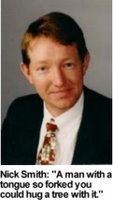
That was pretty much everyone's reaction when Trevor Mallard revealed National's Environment Policy had turned up on his cafe table between the baked beans and the toast last week, and then again when the Policy itself was confirmed over the weekend by National's senior liability, Nick Smith.
Fact is, there's pretty much nothing noticeable to notice. The environmental ‘vision’ outlined within is nothing of the sort. It essentially amounts to the same old state interference via continued disrespect, if not complete ignorance, of private property rights -- in other words, the same old "me too" environmentalism Smith has been peddling now for a decade-and-a-half.
- Neither abolition nor change nor even mention of National's Resource Management Act.
- No commitment to reinstating the protection of New Zealanders' property rights that the Resource Management expunged.
- No recognition that it is property rights and common law that provide the most secure environmental protection possible, and did so for most of seven-hundred years.
- A new Environmental Protection Agency to continue the job of doing over New Zealanders' property rights that the Resource Management began.
- The already announced promise to strangle the economy by 50% to half-meet the Kyoto Protocol targets National signed up to on Smith's previous watch.
- National's own Emissions Tax Scam.
Nothing new at all then, just the same authoritarian approach to "the environment" from the dripping wet Nick Smith now as he exhibited when he was a minister administering the Resource Management Act back in the nineties -- the same wet green wet dream as every other politician -- unless of course you count yet another bureaucracy that National would like to join the horde huddled around Wellington's downtown in search of ever more expensive office space: an "Environmental Protection Agency" that will no doubt emulate the expensive disaster that its American progenitor is widely recognised as being, while hoovering up over-earnest young graduates from the inexorably increasing number of environmental psuedo-science courses that are slowly taking over the educational sector, for an agency that will be inexorably doing the same to the economy.
Quite how another bureaucracy to add to Wellington's already replete list is going to lead to fewer bureaucrats rather than more (and a note to National's billboard incompetents: if you're going to lie for your living, then at least try to be grammatically correct), only either a politician or a liar would know. But I fear, dear reader, you've already spotted the repetition there. And quite how another agency with all-encompassing powers second-guessing every single productive person in the country is going to help either prosperity or freedom, only a politician would try to explain.
And they do try. Prosperity? Growth? "Environmentalism and a commitment to economic growth must go hand in hand," said Key's speech writers. "We should be wary of anyone who claims that one can or should come without the other," he read. "Let me be clear that I don't think environmental and economic objectives need always be traded off one against the other," he clarified. "Increasingly, New Zealand's environmental credentials will underpin our prosperity," he insisted. One wonders who he was trying to convince since, as this blog has made a fetish of arguing since its birth, when environmentalism by diktat is the chosen route, freedom and prosperity are the first things to disappear.
Freedom? Prosperity? Environmental values? If those three together are to mean anything, then firm clear property rights under a regime of common law were and are and always have been the only possible way to harmonise the three, and in face the only way they ever have been. Private property rights in a common law system provide the strongest possible protection for the environment and for property owners -- clear property reflect back to owners the consequences of their own actions; common law gives standing to those whose ownership rights are violated by environmental degradation.
If you really wish to improve the environment, with the additional bonus of achieving massive economic growth within a relatively short space of time, just have the guts to abolish the Resource Management Act outright. Don’t tinker; just trash it. That appalling piece of fascism allows others to control the use of one’s property. Further, it is the single biggest impediment to progress within New Zealand. When somebody owns something, they look after it to maintain its value. When the law upholds them in that protection, we all get to kick an environmental goal. In other words, if you wish to maintain the quality of the environment while giving wings to prosperity, which surely even Nick Smith must agree is urgently necessary, you can start by implementing full private property rights -- instead of promising to do them over further.
DESPITE KEY"S LIMP ATTEMPTS to link environment and economics simply by raw insistence, the link between the two fields is clear enough.
After all, economics has been defined as the science that studies infinite wants in a world of scarce resources. That must surely have something to say about things? And effective property rights under a system of common law is demonstrably the most effective method yet devised of 'internalising externalities' -- of reflecting back to owners the real environmental consequences of their activities. (See for example: "The Invisible Hand of the Market Doesn't Deliver a Sustainable Nation": True or False?)
Between them, strong property rights and real price signals are far more efficient at telling us all the real consequences of our own activities and of our own choices-- and they offer the added benefit that they're not just real rather than made-up; they're not just efficient; they're not just moral, but they're good for freedom as well.
That's not something one can say for any the silly statist schemes Smith takes to be 'green.' The biggest long-term cost of all of them is not just for the environment, it's in their cost to the human environment -- the cost to us all of shackling industry and productivity; of the time wasted in fruitless feel-good stupidity; of the larger state needed to administer all these programmes (with the various threats that implies) and in the loss of freedom to live our own lives in our own way.
As Fred L. Smith says, "The threat posed by humans to the natural environment is nothing compared to the threat to humans posed by global environmental policy."
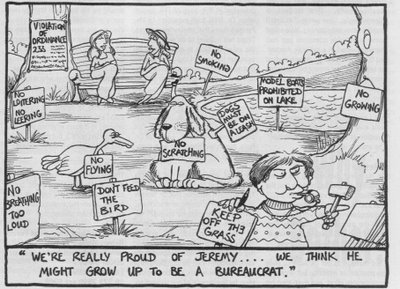
As I've said before, when they come for you they'll be carrying a clipboard, not a gun -- and the person carrying it will probably be called Jeremy.
FURTHER READING:
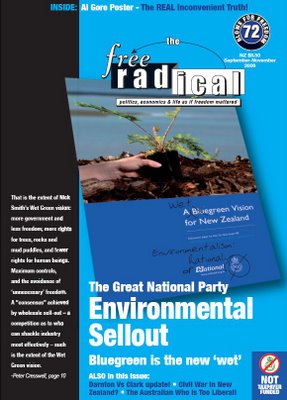
If you've got this far, you probably want to know more. Since The Free Radical devoted part of an issue to Nick Smith's authoritarian greenwash two years ago, readers may download a PDF copy of that issue here, or by clicking on the cover above. And for more on the inimitable connection between environmental values and property rights, feel free to investigate some of NOT PC's writing on the subject:
- Cue Card Libertarianism: Environmentalism
- Cue Card Libertarianism: Common Law
- Cue Card Libertarianism: Property
- Cue Card Libertarianism: Rights
- Cue Card Libertarianism: Pollution
- Dirty Dairying
- "The invisible hand of the market doesn't deliver a sustainable nation." True or false?
- Market forces in the Amazon?
- There's lots to celebrate on World 'Environment' Day
And here's a more sane, sober and serious set of environmental policies that could be adopted by any party committed to rolling back statism, instead of advancing it:
Wednesday, 3 September 2008
Why oil is like pistachio nuts
Over at Anti Dismal, Don Boudreaux demonstrates (using pistachio nuts) why we'll never actually run out of oil. What happens, you see, is that unless technological improvement saves the day, what's left (whether it's oil or gold or pistachio nuts) simply becomes increasingly difficult to extract.
And no, this isn't a 'wriggle.' It's actually an important lesson in resource economics.
Friday, 22 August 2008
A new, more rational Greens?
I was interested to see the Greens' Frog Blog's reaction to Genesis Energy's proposed new gas power station in Kaukaupaupa.
Naturally, the Greens are gearing up for a fight -- as environmentalists' protests against wind, hydro and even solar schemes indicate, not to mention their protests against even the means by which power is reticulated, they will be gearing up for a fight whatever the means by which a power station is to be powered, whether it's thermal or 'renewable' or whatever -- their opposition is all too obviously to human power as such -- but what I'd like to note is one of the arguments against the scheme used by Frog Blog contributor 'Frog.'
Now bear in mind that Genesis is government-owned, and the Greens to day have been, one might say, somewhat in favour of wall-to-wall government ownership of the means of production, and opposed to the 'irresponsibility' of corporations.
But in the last few paragraphs of the post they argue that it is the choice to build a gas-powered plant that they specifically oppose, and they oppose it because it will be a) economic without a government handout,and b) because "the Energy Data File from the MED says we’ll be running seriously short of gas (at least as far as electricity generation is concerned) around 2015. That’s just when Genesis’ mega plant would want to start operating." So, says the Frog,
Whose hair-brained, think-big idea was this? Could it even stack up economically to the scrutiny of a real board of directors? Or has our SOE and its shareholding Minister lost the plot?
Interesting, don't you think, that question "could it even stack up economically to the scrutiny of a real board of directors?" Is this the foreshadowing of a realisation among some Greens that the scrutiny of a real board of directors is orders of magnitude greater than the scrutiny of a political elite (just look for example at the 'scrutiny' currently applied to one Winston Raymond Peters by said elite, for example, or of the management and appointment of the Hawkes Bay District Health Boards and the failure so far to even lay a glove upon either entity for obviously shonky behaviour). Could it be the first sign of an understanding among some Greens that being able to stack up economically is the very best means we have by which to ensure that valuable resources are not wasted, but instead put to their highest value use?
Or am I just talking bollocks?
Wednesday, 20 August 2008
Greens' Fitzsimons favours toxic poison drop
WHILE THAMES RESIDENTS PROTEST against the Department of Conservation's 1080 aerial drop in the Coromandel Ranges, dropping the toxic poison over 13,000 hectares from Jeanette Fitzsimons bit of “green heaven" in the Kauaeranga Valley all the way up to Te Puru, the clean, Green Party Leader pleads in today's Hauraki Herald for “tolerance.” “She did not know anyone who was comfortable with poison being dropped from the air," the local paper reports, "However, 1080 was necessary to ‘hold the line’ until a more effective pest control method was developed."
If recent polls can be trusted, Fitzsimon's party will experience a rather effective pest control method come November. But it does seem strange to see the Green leader plead for tolerance for toxins, when opposition to toxins and the like was once the Greens' raison d'être.
Perhaps when the toxins are delivered by Nanny it's okay?
But why should hunters and land-owners have to be tolerant of a poor decision made by government without any reference to those directly affected?
Fact is, DoC's use of 1080 has been intensely destructive to everything but possums, on which it has only just held the line. After many years and over a billion of tax payers dollars spent on possum control we still have the same 70 million possums we had at the start. Not successful and of very little, if any, benefit.
No wonder DoC staff joke that the best way to protect the kiwi is to give it them to exterminate.
The so called possum problem is largely a manufactured one by the Government agencies who stand to gain from perpetrating it. DoC claims that the 70 million possums in New Zealand eat about 300 grams each of foliage each day, resulting in a whopping 21,000 tonnes of vegetation being consumed daily.
What they do not tell us though is the forests of this country produce about 300,000 tonnes of new vegetation daily.
The economics do not make any sense either. The New Zealand Conservancy Authority states that the economic costs attributable to possums is estimated to be between $40 million and $60 million per year. Yet over $130 million is spent each year by State, private individuals and businesses on control. Not much benefit in something that uneconomic, or in the costs to game hunters and food gatherers who face a stand-down time of 6 months or more, and the considerable risk of contaminated meat, and the considerable costs to farmers directly and indirectly of aerial spreading of such a toxic poison on and near their properties --including in some cases whole farms -- with no compensation for their loss.
There are three main limits to possum populations in any given area; in decreasing order these are dry nest sites, food supply and (to a much lesser extent) play areas. Possum populations cannot go beyond these natural barriers, so despite DoC claims to the contrary, they simply cannot explode without control. In fact, many areas of New Zealand do not have any possum control, without any of the adverse effects that DoC claims they should experience.
Further, concern about damage done to endangered species by possums is more than offset by the damage done by 1080 itself.
THE ARGUMENT OVER THE use of 1080 shows once again the problem of a lack of private ownership. To control a pest on government land, the government tramples on the rights of everyone - no matter how ineffective the control, or how toxic the chosen pesticide. But governments always favour blunt instruments, in complete disregard of the damage they cause.
The use of 1080 itself should not be banned. What should be stopped is the widespread use of 1080 whether a landowner consents to it or not.
1080 use should be controlled because of the downstream effects on almost everything, including invertebrates, birds and fish -- and all those good things that hunters like to shoot. There's no need for a ban, however, because widespread private ownership and rigorous common law would effectively do this anyway, as a responsible property owner would have trouble guaranteeing no harmful effects to other property owners.
What needs to be emphasised is that in free countries free people own the land, not the Government. It's the government's ownership of land that causes the conflict, not the possums.
Tuesday, 3 June 2008
Meet the enfeebled, Part 2 (updated)
“It's very hard to invest in coal [because of Kyoto], nuclear's a sort of four letter word... hydro is suddenly becoming too hard... what's left? ...we can't do everything on windpower.”
– Alan Jenkins, Electricity Networks Association, 2006
ELECTRICITY IS THE LIFEBLOOD of every industrial country. Electrical power allows human beings to multiply their relatively feeble muscular strength many times, putting that enormous productive power to use in transforming our world to make it a better place in which to live. Says George Reisman:
It is vital to recognize the enormous contribution that the essential vehicle of economic progress, namely industrial civilization, has made to human life and well-being since its birth over two centuries ago in the Industrial Revolution.
Industrial civilization has radically increased human life expectancy: from about thirty years in the mid-eighteenth century to about seventy-five years today. The enormous contribution of industrial civilization to human life is [dramatically] illustrated by the fact that the average newborn American child has a greater chance of living to age sixty-five than the average newborn child of a nonindustrial society has of living to age five. These marvelous results have come about because of an ever improving supply of food, clothing, shelter, medical care, and all the conveniences of life . . .
In the last two centuries, loyalty to the values of science, technology, and capitalism has enabled man in the industrialized countries of the Western world to put an end to famines and plagues, and to eliminate the once dread diseases of cholera, diphtheria, smallpox, tuberculosis, and typhoid fever, among others. . .
As the result of industrial civilization, not only do billions more people survive, but in the advanced countries they do so on a level far exceeding that of kings and emperors in all previous ages . . .
Trade and the fruits of industrial civilization beat all the conquests made by all the kings and emperors throughout all history into a cocked hat. At the most concrete level, the root of the success of industrial civilisation has been making it possible to multiply and direct our own muscular strength exponentially to produce what's needed to make our lives better. For an industrial country, electrical power is not a luxury, it is a necessity.
Technology is man's means of staying alive. Human existence without technology is characterised by squalor, disease, plagues, starvation, drudgery, and helplessness in the face of natural disasters. This is the state to which the eco-freaks would return us.
When you look at the change in average life expectancy since James Watt invented his steam engine and Richard Arkwright installed them in his cotton mills -- from thirty-five years of age then to well over seventy now -- you might realise that everyone over the age of thirty-five now owes their lives to technology, and to the Industrial Revolution that made it possible.
TECHNOLOGY THESE DAYS NEEDS ELECTRICAL power (and most reliable electrical power is still generated by steam). Nationally, the demand for power is growing by 150MW per year. The graph below charts that rise.
Note that the primary growth is not in residential demand, but in industrial demand -- in supplying power to produce new wealth -- which puts into context the claims from sandal wearers that if we all turn off a few lights and have a cuddle our power problems will all go away.
They won't.
As it happens, over the years from from 1980 to 1998, the growth in New Zealand's generating capacity matched the growth in demand, growing at an averaged rate of about 150MW per year. Despite this, regular power shortages such as the famous outages of 1992 showed that even at this time capacity was near its limits -- partly because of the lack of backup generation for the occasionally fickle hydro generators.
What has changed since then is the National Party's introduction of the Resource Management Act (which was introduced in 1993) and the signing of the Kyoto Protocol by National in 1998, which was ratified by Labour in 2002. The former made the construction of new generating infrastructure all but impossible; the latter (which under David Parker comes with an Emissions Limiting Scheme and a ten-year moratorium on the construction of new thermal power stations) makes the construction of any serious generating capacity immoral. Together they make an anti-industrial dream team that has made every anti-industrialist in the country red-eyed with excitement.
As I said here last week, energy demand in New Zealand has increased at an annual rate of roughly 150MW, but, since the onset of the anti-industrial dream team, energy generation hasn't. Energy generators have wanted to produce more power, but for the most part they haven't been allowed to. We've enfeebled ourselves by a lack of industry's lifeblood. The table below shows the slowing of capacity growth:
Have a look at what's been built since the Resource Management Act was launched by National's Simon Upton in 1993, (arranged from north to south):
Now, looked at baldly that looks pretty impressive, doesn't it.
TOTAL NEW CAPACITY 1993 - 2008 = 1850.5 MW .
That's almost 125MW per year for the last fifteen years. You can see how that capacity was used over the last year in this graph showing the contributions of each of those thermal power producers over the last few years [e3p and HLY p40 are the new Huntly additions):
So, 125MW per year, mostly from new thermal stations like Taranaki's Combined Cycle Station, Huntly's new gas and co-generation plants, and the Otahuhu B station (Pete Hodgson's new Whirinaki station is just too expensive to run). Not quite the 150MW demanded (nor quite the figure claimed by an 'Insider' here last week.)
We could even go back to 1990 if we like and add the Clyde dam, finally commissioned in 1992, contributing 432 MW to the grid (giving us a total of 2282.5 MW, or 127 MW/year new capacity from 1990 to now). But all this new power production must be balanced against those plants that were decommissioned, either because they were too old, too inefficient, or just too damned expensive to run.
POWER STATIONS DECOMISSIONED 1990-2008:
New Plymouth, 2007 (580 MW)
Stratford, 1999 (200 MW)
Marsden A, 1992 (114 MW)
Otahuhu A, 2002 (90 MW)
Whirinaki ‘a’, 2002 (216 MW)
Meremere, 1990 (133)
TOTAL DECOMISSIONED 1990-2008: (1333 MW)
TOTAL NETT NEW CAPACITY SINCE 1990: 949.5 MW
That's pathetic. Looked at like this, we can see just how sick we are. If we'd kept up with demand we'd have produced over 2700 MW of new capacity. Instead, we have just one third of that.
Here's what we relied on last month (Waikato, Tongariro, Waitaki, and Clutha are the four main hydro contributors to add to the thermal production shown in the previous graph):
And just look at what we could have built. In recent weeks we've heard about the ban on new thermal power stations, and in recent years we've heard the Environment Court and the High Court knocking back and delaying Resource Consents for several high profile projects, and killing stone-dead the planning of many more we'll never know about:
Projects Abandoned/Delayed/Restricted due to Resource Management Act :
· Project Aqua, hydro (520 MW) - abandoned 2000-2004
· Marsden B, coal (320 MW) - abandoned 2007
· Wairau Valley, Marlborough, hydro (75 MW) - abandoned 2007
· Whanganui/Tongariro, hydro – Environment Court effectively reduced the Tongariro capacity by one-third due to the “mauri” of the Whanganui river …
· North Bank Tunnel, hydro (260MW) - delayed until at least 2016
· Makara, wind - reduced from 210 to 140MW in 2007
· Project Hayes, wind (150MW) - still in delay
· Te Uku Wind (72MW) - awaiting consents
· Te Waka Wind (111MW) - consent overturned by Environment Court in April, 2007
Leaving aside the effect on the Tongariro catchment of restricting water flow from the Whanganui, which is difficult to quantify, this looks like 1580 MW of power generation that we could have producing power now ... if it weren't for the Resource Management Act.
This is just some of the 'surplus capacity' that energy analysts in the late nineties were beginning to talk about coming on stream, and it hasn't. This is surplus capacity that hasn't come on stream, and in most of these cases never will come on stream. (Instead of this, we have one line of the dirty, asbestos-ridden hulk of New Plymouth's burner cranked up one more time to try and avoid the election-year ignominy of a shortage of electrical power bringing down those with political power).
The result of this undercapacity was only noticed by government last week when the power went off in the Beehive, but that rest of us have already seen it in news last week that factories from Bluff to Auckland aren't just switching off heaters and changing a few lightbulbs, they're already running fewer shifts and producing less wealth, all because of the parlous state of the present system, and with no new real generation capacity in sight beyond a few windmills.
This is what it means when we say that the effects of global warming are already upon us: the effects, that is, of government throttling industry to keep our Kyoto commitments.
Fact is, we either meet that increasing annual demand of 150MW per year, or we make ourselves poorer. If we're going to have any show of meeting that continually increasing demand -- which means, to remain as an industrial economy -- we need to build new power now.
Which means putting paid now to the Resource Management Act, and abandoning urgently the commitments we've made under Kyoto to throttle ourselves and our energy production.
UPDATE: Some arithmetic errors amended, Thursday 6 June, 9:10am.

This isn't just a semantic argument, as you’ll soon discover if one of these protected Great Whites starts chewing through your surfboard. Or your arm. Or your loved one.