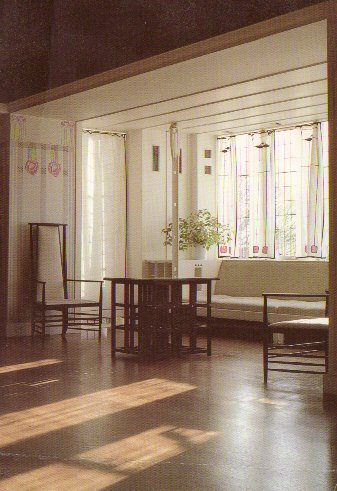
Since I haven’t posted anything by Charles Rennie Mackintosh for a while, here’s a beautiful rendering by his wife Margaret of his proposal for a Glasgow music room:

Head to ArchDaily's post for the original.
Since I haven’t posted anything by Charles Rennie Mackintosh for a while, here’s a beautiful rendering by his wife Margaret of his proposal for a Glasgow music room:
Head to ArchDaily's post for the original.
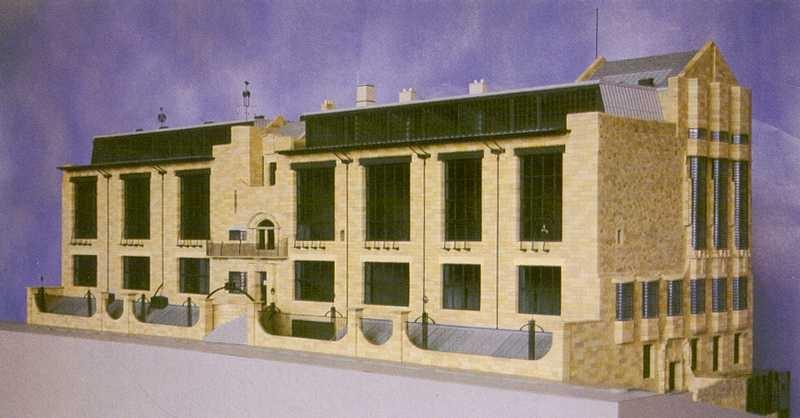
Charles Rennie Mackintosh's Glasgow School of Art of (designed 1906-7; completed 1909) was one of the twentieth Century's first true architectural masterpieces. Mackintosh designed it at the age of just twenty-eight.
That's a model (above) of the completed building, and a glimpse of the West facade (below).

I was devastated to discover over the weekend that the masterpiece by architect Charles Rennie Mackintosh, his Glasgow School of Art, was destroyed by fire last week.
The shell remains, but rooms are ravaged – and the architectural heart of the school, the library, is no more.
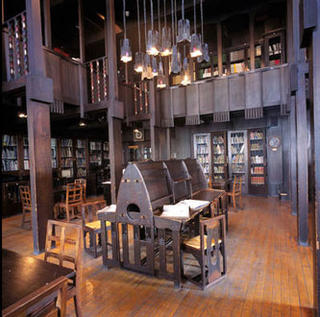
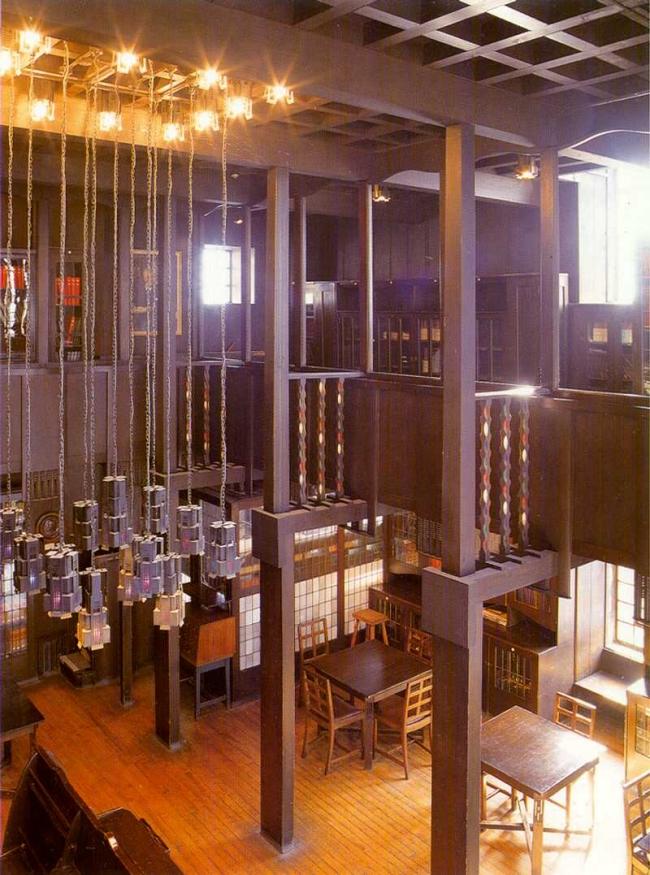
There is talk of restoration, but it’s hard to see what there is left to restore.
Devastating.


 Glasgow has never looked so sunlit, or so alive.


 Brilliant Scottish architect Charles Rennie Mackintosh was designing and building tall, stunning modern buildings -- to use Louis Sullivan's phrase, buildings that were "comely in the nude" --long before the idea really occurred to too many others outside Chicago, and few of those rare geniuses were able to express their ideas as deftly as Mackintosh.
 The famous Mackintosh 'ladder' chair by architect Charles Rennie Mackintosh, left, and there's one in the location for which they were designed, at Hill House, Glasgow, right. (1903)
 They're both very nice -- exceptional, in my estimation -- but is there enough in them on their own to be that "shortcut to our most deeply-held premises" which is the defining characteristic of art, particularly good art? Is their sufficient scope in a chair or an example of ornament to perform that role? Or are these things somewhat like a good and well-crafted phrase in a poem, or a peculiarly apt metaphor in a short story, or a telling chapter in a novel: things we can sometimes enjoy in their own right as well -- particularly if we know they came from and are part of the same theme as a major work -- but which we nonetheless know are part of an art work?