Showing posts with label Sandra Lee. Show all posts

Monday, 25 May 2026

More mismanagement, please, ministers demand

"More mismanagement please," insists Minister

In 2002 Sandra Lee's Local Government Act took the shackles off local government, and gave them written permission to build monuments and to blow out budgets. Her Act reversed the legal principle that governments may only do what they are legally empowered to do, and instead said they could do what the hell they like unless there was a law to stop them. And so budgets were blown out, monuments were built, and everyone forgot what councils had been originally constituted to do: i.e, that boring stuff like looking after pipes in the ground.

Then in 2010 Rodney Hide super-sized Auckland's Council, and debt ballooned from around $1 billion in total for the 8 councils smashed together (mainly from Manukau and Auckland) to a figure of nearly $15 billion now. And the mandarins heading the new super-sized council immediately added a whole new layer of super-sized egos to run it, or try to, literally hundreds of new six-figure staff there to attend bigger meetings and build bigger monuments. 

So what lesson do you think the Ministers for Resource Management Reform and Local Government, Chris Bishop and Simon Watts, draw from this? 

Are they to insist, in their last few months of government, that Sandra Lee's Local Government Act be reversed, and councils required to go back to their knitting? Back to a better focus, to those pipes in the ground and on the rubbish on the streets?

Not a bit of it. Instead these idiots are insisting that all councils take lessons from Auckland's monumental disaster. In what appears to be a last-minute lurch to a headline, they have given councils three months (just this side of the election) to come up with proposals to merge themselves out of existence, and those that do not will have mergers chosen for them by Messrs Watt and Bishop.

And all this while Bishop is making a bollocks of his RMA replacement.

We are led by donkeys. In politics, anyway.

UPDATE: And to reinforce the issue, here's the most recent headline on Auckland's local governance: 
'Nerves on edge as Auckland Council finalises record rate rise in cost of living crisis.' 

What sane person would look at that and say: "Let's have more of that around the country?"

It takes a minister ...

Monday, 14 July 2025

Rocketing rates rises rightly reviled

"Look at me, I'm on a bus!" Second-prize winner in the "my council spends too much awards,"
Greater Wellington's spender-in-chief Daran Ponter unfortunately ignores the exits.

BY HOW MUCH HAVE YOUR rates gone up by this year?

If you're "lucky," they've only risen by under 3 percent — that's if you're under the regime of either the Whanganui or Waitomo District Councils, or the Bay of Plenty Regional Council. You, dear people, are the "lucky" ones. Only a 3-percent rates rise

Not so lucky however if you live under the arm of the Clutha District Council, Upper Hutt City Council, Waipa District Council, Hamilton City Council, or Hastings District Council. If you're unlucky enough to have those folk on the letterhead of your. rates bill, then you're forced to pay more than 15 percent more this year than last year.

And pity those poor folk in Hastings.  Over the last three years, under Mayor/Chair Sandra Hazlehurst, their rates demands have gone up by just under 50 percent. Fifty percent in three years! And there are four councils demanding even more over these last three years — West Coast Regional Council demanding 66 percent more than they did in 2022, and Greater Wellington 55 percent more.

Well, I guess Wellington does need to fix its pipes, right?

But here's the problem. Those rocketing rates rises haven't been going to fix the pipes, have they. Like every other council ni the country, the Greater Wellington Regional Council has found what its politicians and planners think are far more important things on which to spend your money.

Monuments. Landscaping.

Bread. Circuses. Consultants.


All paid for from your rates, which also pay (almost) for their hefty borrowing. 

You can find all these frightening figures at the Taxpayer Union's Rates Dashboard 2025, released today.


THE FIGURES ARE FRIGHTENING. BUT they still don't reveal the whole truth.  'Cos even with rates rocketing, these profligate bastards still can't pay their way. They're not just over-spending, they're over-borrowing.
At least 11 councils have net debt-to-revenue ratios of more than 200 percent.

Hamilton is on 281 percent, just four points away from the limit on councils’ debt covenants. Queenstown Lakes is on 265 percent. Tauranga is on 248 percent now, but forecasting to blow the 285 percent lid from 2030 onwards.

“Some are reaching their debt ceilings, which will have the auditors in a twist,” says [Greater Wellington's Spender-in-Chief Daran] Ponter. “That’s a real issue. If you look to the UK, Birmingham has effectively gone into liquidation in the last few weeks. There’s a city of two to three million people that basically can’t pay its way anymore.”

Hamilton’s mayor Paula Southgate 
[42% rates rises over three years]and Local Government NZ vice president Campbell Barry, who is the Hutt City mayor [45% over three years], today published research showing the wide gap between council revenues and capital spending obligations, over the 10 years of the new longterm plans.
The research, by Infometrics, shows councils had already committed to $23.3 billion capital investment from 2021 to 2024. Infometrics principal economist Brad Olsen says once construction inflation is added in, that’s nearly $3 billion more.
It's all very well for Nicola Willis to say she wants councils to "stick to the basics" and "not waste ratepayers money" — "focusing on the things people expect them to do, which is the rubbish, the roads, the pipes, the basics - and not all the fanciful projects" — but she is doing damn all about it.

It's just more politico-blather.

Sandra Lee, 2002: Let's get councils
spending more, and doing less core
Nicola Willis is Finance Minister. She should have a good talk to her hopeless Local Government Minister Simon Watts about repealing the one Act that gave explicit permission for councils to begin focussing on all the fanciful projects, and to ignore the things people expect them to do, such as the rubbish, the roads, the pipes, the basics ...

That Act was the Local Government Act, which receives far less opprobrium than it should.

JUST OVER TWO DECADES AGO, in 2002, the then-Local Government Minister was the hard-left Alliance Party's Sandra Lee. And it was then that local government debt began to rise dramatically — not because councils around the country were over-investing in infrastructure; not because they were going hard on their core business; not at all because they were building, maintaining and upgrading roads, bye-roads, drains, pipes and parks as they were damned well supposed to. For the most part, instead, with some significant exceptions, they weren't. What they began building instead was a lot of expensive fucking monuments

Monuments mostly to themselves.

The culprit here was Sandra Lee's Local Government Amendment Act 2002, which granted to city councils, district councils and regional councils a "power of general competence" (I know, right?) which would enable them to enter into any activity they wished, with the only limit being their imagination and the pockets of their ratepayers.

Prior to Sandra Lee's Local Government Act, councils could only do what they were legally permitted to to, i.e., to carry out their core business. After Sandra Lee's Local Government Act, however, the leash was off. And council credit cards started straight away racking up debt for vanity projects everywhere. 

I'd like to say I told you so. I'd like to, so I will. Because I was as outraged then as I am now:

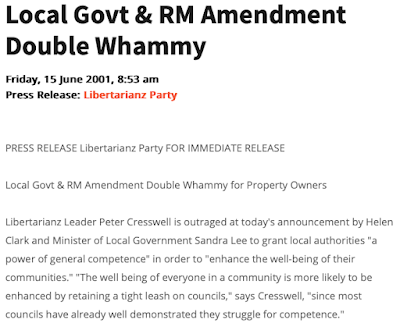
Libertarianz Leader Peter Cresswell is outraged at today's announcement by Helen Clark and Minister of Local Government Sandra Lee to grant local authorities "a power of general competence" in order to "enhance the well-being of their communities." "The well being of everyone in a community is more likely to be enhanced by retaining a tight leash on councils," says Cresswell, "since most councils have already well demonstrated they struggle for competence."
    "Local government throughout New Zealand's history has demonstrated its utter incompetence in handling the loot they confiscate from ratepayers by wasting it on such idiocies as the New Plymouth Wind Wand, the Auckland Britomart edifice, and the Palmerston North empty civic building." he said. ...
    "More substantially," says Cresswell, "there is a crucial constitutional principle at stake -the constitutional principle that citizens may do whatever they wish, apart from what is specifically outlawed, whereas governments and councils may only do what is specifically legislated for. The main purpose of this constitutional principle is to keep a leash on government, both central and local. It is this leash that is beginning to gnaw at local governments, and it is this leash that Clark and Lee propose to untie."
    "It is a dangerous step to take," warns Cresswell, who points out that councils are being given more 'freedom' at he same time as the Resource Management Amendments Bill threatens to take away even more freedom from New Zealand property owners. "The constitutional principle is being reversed," he says. "Even as they propose giving local government wider powers to act, they are taking away the power of individuals to act for themselves," says Cresswell. "Every property owner should rise up in protest," he says.
    "Libertarianz will be making a strong submission on the consultation document," says Cresswell. 

Which we did. For all the bloody use that it did: The Clark Government passed it, a succession of Local Government ministers since since has kept it, and every bloody local councillor ever since Sandra's "permissive" Act has spent like a drunken sailor on shore leave with a start-up founder's credit card.

The New Zealand Local Government Funding Agency (LGFA) supplies around two-thirds of that council debt, and last time I looked their tab was just over $18 billion. That's about $20,000 for every ratepayer. Add to that an existing $5 billion of Auckland and Christchurch council debt. And those numbers are every year by around a billion a year as ballooning rates rises fail to keep up with even-more ballooning council spending.

And as you can now see, it's not like they've been spending much of it underground.

In Christchurch they've been turning the city into "an innovative and modern community with major facilities from Akaroa Wharf to Te Kaha Canterbury Multi-Use Arena." In Wellington they've been watching the city's infrastructure crumble while they vote to spend hundreds of millions on earthquake-prone inner-city monuments of questionable value. And here in Auckland, council have allocated yet another billion dollars (plus fuck-ups) to pour down the ever-expanding black hole of the train set with the ever-disappearing-opening date, plus several hundreds of millions more to continue transforming the place into "one of the world's most liveable cities."

A shame there are still very few plans to make it an affordable one.

What on earth is to be done?

You know, here's an idea.

Instead of keeping Sandra Lee's Local Government Act and binning Three Waters, which is where this new Coalition Government went, how's about — and hear me out, now that you've all heard the story —how's about we bin Sandra Lee's act and tell fucking councils to stop over-spending, to close down their PR departments, and to get back to their core fucking business.

Maybe you could suggest something like that to Simon Watts, who's the current Local Government minister. 

But you'll have to explain to him first who Sandra Lee is, and what she did back then to stuff things up. Because the gormless twit does appear a bit simple.

UPDATE: It's been pointed out to me that Simon Watts is trying to overturn some of Sandra Lee's Act, and argued that I've been unnecessarily harsh about him in my conclusion.

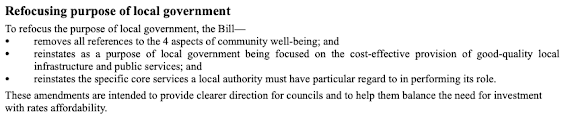
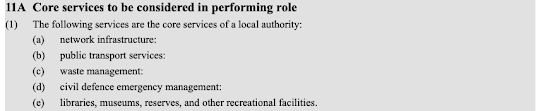
Nearly two years into his job, he is introducing an Act he says will "refocus" councils to their core jobs.

. . . .
 . . . .
. . . .
Unfortunately, however, while this is good as far as it goes, it's the Act from way back in 2002 that still needs a bullet.

Thursday, 25 January 2024

Whatever happened to the idea that building and maintaining infrastructure is council's core business?


YESTERDAY MORNING, THE RESIDENTS OF Waipukurau were awoken to loudspeakers in the street "spreading the message of immediate and vital water restrictions" after a "major leak."

South Wairarapa residents endured water restrictions two weeks ago due to leaks in their water infrastructure.

All summer, water and sewage has continued to pour downs Wellington streets, while water restrictions are imposed in Wellingtonian's homes and the council starts planning for a state of emergency. (An announcement this morning says Wellingtonians should prepare for "Level 3" restrictions, and the declaration of a "drinking water emergency.")

And on Boxing Day in Auckland, thirty-six of Auckland's beaches were off limits because they were contaminated with poo.

It's all a bit shit at the moment, isn't it. All too literally.

Billions of dollars are supposed to be needed to fix New Zealand's threadbare infrastructure after what's said to be decades of underground under-investment.  Local Government New Zealand (a lobby group for the very people who under-invested) reckons we are "heading toward a tragedy if more is not invested in council infrastructure, and that people need to get used to double-digit rates increases." Infrastructure New Zealand (a lobby group who chases government dollars for its members) reckons the number of billions needed is somewhere near 200 billion.

The solution from both lobby groups is supposed to be lots of central government cash.

Meanwhile (to pick one council just at random, since it's where I live) Auckland council's rate this year are going up another 7.5 percent this year. And that's with a mayor supposedly reluctant to raise them. And to pick another (let's use Wellington since it presently has the highest-profile mayor) they've just voted to "invest" $330 millions dollars in a tumble-down town hall —on the back of a 12.3 percent rate rise which still doesn't cover what could be a billion-dollar hole in their accounts.

Um.

May I ask a polite question?

Just what the fuck is the primary purpose of local fucking goivernment? 

Whatever happened to the idea that building and maintaining infrastructure is council's core fucking business?

If I refer to my handy copy of G.W.A Bush's history of Auckland Council (if you just give me a moment to find it) we find that the clamour for setting up the damned thing back in the 1840s was because sewage was flowing in the streets. Specifically Queen Street. "Auckland," wrote the 1847 editor of The New Zealander, while it is "erected in the healthiest country in the world, has enough filthy lanes and dirty drains to keep up a virtual plague, had it been situated in a less airy country." Set up finally in 1851, its core business (reflected in its six committees) was Bye-Laws, Roads, Public Works, Public Health, and Charitable Trusts. This reflected Lord John Russell's instructions to Governor Hobson back in December 1840 that "district governments" should be set up "for the conduct of all local affairs such as drainage, bye-roads, police, the erecting and repair of local prisons, court-houses, and the like."

Much responsibility has been taken away from councils since (bye-roads, police, the erecting and repair of local prisons, court-houses, and the like) so from the Lord's list we're left, as core business, just drainage.

Fucking drainage.

You know, the stuff that's supposed to contain that stuff that's running down our streets.

This is what Labour's Three Five Six Waters was supposed to solve, taking away this the core business of council. National has binned that, but continues to dangle to councils a somewhat similar carrot. Because some councils were, and still are, keen to off-load the job of drainage to someone else. 

But if I may again ask another polite question: Why the fuck aren't councils doing the fucking job they were specifically set up to do?

Huh?!

It's not like they've been keeping rates down while they've under-fucking-invested.

New water infrastructure is desperately needed around the country because, for the most part, for at least two decades, council's haven't been doing their core work.

Why do I say two decades?

Guess why: just over two decades ago, in 2002, the then-Local Government Minister was the hard-left Alliance Party's Sandra Lee. And it was then that local government debt began to rise dramatically — not because councils around the country were over-investing in infrastructure; not because they were going hard on their core business; not at all because they were building, maintaining and upgrading roads, bye-roads, drains, pipes and parks as they were damned well supposed to. For the most part, instead, with some significant exceptions, they weren't. What they began building instead was a lot of expensive fucking monuments

Monuments mostly to themselves.

The culprit here was Sandra Lee's Local Government Amendment Act 2002, which granted to city councils, district councils and regional councils a "power of general competence" (I know, right?) which would enable them to enter into any activity they wished, with the only limit being their imagination and the pockets of their ratepayers.

Prior to Sandra Lee's Local Government Act, councils could only do what they were legally permitted to to, i.e., to carry out their core business. After Sandra Lee's Local Government Act, however, the leash was off. And council credit cards started straight away racking up debt for vanity projects everywhere. 

I'd like to say I told you so. I'd like to, so I will. Because I was as outraged then as I am now:

Libertarianz Leader Peter Cresswell is outraged at today's announcement by Helen Clark and Minister of Local Government Sandra Lee to grant local authorities "a power of general competence" in order to "enhance the well-being of their communities." "The well being of everyone in a community is more likely to be enhanced by retaining a tight leash on councils," says Cresswell, "since most councils have already well demonstrated they struggle for competence."
    "Local government throughout New Zealand's history has demonstrated its utter incompetence in handling the loot they confiscate from ratepayers by wasting it on such idiocies as the New Plymouth Wind Wand, the Auckland Britomart edifice, and the Palmerston North empty civic building." he said. ...
    "More substantially," says Cresswell, "there is a crucial constitutional principle at stake -the constitutional principle that citizens may do whatever they wish, apart from what is specifically outlawed, whereas governments and councils may only do what is specifically legislated for. The main purpose of this constitutional principle is to keep a leash on government, both central and local. It is this leash that is beginning to gnaw at local governments, and it is this leash that Clark and Lee propose to untie."
    "It is a dangerous step to take," warns Cresswell, who points out that councils are being given more 'freedom' at he same time as the Resource Management Amendments Bill threatens to take away even more freedom from New Zealand property owners. "The constitutional principle is being reversed," he says. "Even as they propose giving local government wider powers to act, they are taking away the power of individuals to act for themselves," says Cresswell. "Every property owner should rise up in protest," he says.
    "Libertarianz will be making a strong submission on the consultation document," says Cresswell. 

Which we did. For all the bloody use that it did: The Clark Government passed it, a succession of Local Government ministers since since has kept it, and every bloody local councillor ever since Sandra's "permissive" Act has spent like a drunken sailor on shore leave with a start-up founder's credit card.

The New Zealand Local Government Funding Agency (LGFA) supplies around two-thirds of that council debt, and last time I looked their tab was just over $18 billion. That's about $20,000 for every ratepayer. Add to that an existing $5 billion of Auckland and Christchurch council debt. And those numbers are every year by around a billion a year as ballooning rates rises fail to keep up with even-more ballooning council spending.

And as you can now see, it's not like they've been spending much of it underground.

In Christchurch they've been turning the city into "an innovative and modern community with major facilities from Akaroa Wharf to Te Kaha Canterbury Multi-Use Arena." In Wellington they've been watching the city's infrastructure crumble while they vote to spend hundreds of millions on earthquake-prone inner-city monuments of questionable value. And here in Auckland, council have allocated yet another billion dollars (plus fuck-ups) to pour down the ever-expanding black hole of Len Brown's train set, plus several hundreds of millions more to continue transforming the place into "one of the world's most liveable cities."

A shame there are very few plans to make it an affordable one.

What on earth is to be done?

You know, here's an idea.

Instead of keeping Sandra Lee's Local Government Act and binning Three Waters, which is where this new Coalition Government is at the moment, how's about — and hear me out, now that you've all heard the story —how's about we bin Sandra Lee's act and tell fucking councils to stop over-spending, to close down their PR departments, and to get back to their core fucking business.

Maybe you could suggest something like that to Simeon Brown, who's the current Local Government minister. 

But you'll have to explain to him first who Sandra Lee is, and what she did back then to stuff things up. Because I don't think he was born then.

Tuesday, 27 October 2015

Productivity Commission dumps on land-owners

Governments pass laws to fix the unintended consequences of their previous laws. Today’s new law is tomorrow’s set of unintended consequences.

NZ’s severely hampered housing market has been so skewed, so hampered by decades of previous laws that have stripped property rights from land-owners, made building slower and more expensive, and given gobs of counterfeit capital to borrowers with which to buy existing houses that the median price of a house in Auckland is now rapidly heading towards ten times Aucklanders’ median income.

So along comes the Productivity Commission last week suggesting ways the whole clusterfuck can be fixed. Their recommendations however form a whole new clusterfuck of their own—recommending “changing everything” (everything? really?) from “the way rates are calculated to which buildings are protected.”

So, not “everything” at all then.

“Everything” for example does not include making property rights stronger. It does not include reducing Reserve Bank expansion of credit—or taking planners hands off land-owners’ throats. Instead, to “fix” the problems caused by the previous intrusions of government and its planners, the recommendations are for greater intrusions by even bigger government.

To a man, woman and small sausage dog however, the commentariat has ignored the big government bulldozer in the wings and talked instead about the only ‘more-market’ thing they noticed. What got the headline last week for example was the Commission’s recommendation that planners use price signals to rezone land. Nowhere however was there any recommendation from the Commission that the planners stop fricking zoning people’s landone important key to avoiding boom and bust, and a very important key to recognising land-owners’ property rights.  

What should have made headlines but didn’t was the recommendation for the greatest intrusion possible by big-and-growing government, for an Urban Development Authority given virtually carte-blanche power to do anything they like, including steal your land. In America, where they’ve had these things before, they call these Authorities the Federal Bulldozer. And with good reason. Imagine a Federal Bulldozer driven by Gerry Brownlee and you might get some idea of the problem.

The Commission’s specific recommendation to create Brownlee’s Bulldozer is that

    • The Government should legislate to create a regime similar to Special Housing Areas whereby certain developments undertaken by local urban development authorities are designated by Order in Council as having the potential to deliver significant numbers of dwellings, and within which the urban development authority will operate with different powers and land use rules.

“Order in Council” means without parliamentary oversight (not that that means much anyway with the currently hopeless opposition). “Different powers and land-use rules” means that the Bulldozer can do whatever the hell it wants, and ignore whatever rules it wants to--much like the Government did when it decided to extend Mt Eden prison to block the view of the mountain itself, something no-one else would have been allowed to do.

More frighteningly, they recommend that

    • The Government should legislate to grant compulsory acquisition powers to local urban development authorities for ‘designated developments,’ subject to the normal processes, compensation and protections of the Public Works Act 1981.

“Compulsory acquisition powers.”

Got that?

As Daryl Kerrigan might explain, that means the power to acquire your land compulsorily.

In a word: Confiscation.

In the year that Magna Carta was commemorated – the legal foundation of the idea that a man’s home is his castle* – these meddling bastards propose confiscating people’s land to “coordinate residential development.”

Compulsory acquisition of your property if your face doesn’t fit the planners’ plans.

The taking of private land by the state, to be given (no doubt) to cronies who suck up to nanny.

You know, all those things that the Waitangi claims are supposed to be about, but proposed now, today, here in the Twenty-First Century.

And nothing at all about hammering a stake through the heart of the thing that has constrained for two decades what people can actually do with their own land: the RMA.

Nothing about fixing the disastrous planning rules that underpin the motivation of property owners to leave land undeveloped.

Instead: Legal theft.

Taking a hammer to the hampered housing market, with property owners being made to be the nut.

Another demonstration of the dictum that controls necessarily lead to further controls, and on ad infinitum.

Not even the Chinese have compulsory acquisition of private land.

But it’s in “the public interest” you say!

Bollocks. As Michael Reddel summarised the Commission’s draft doggerel: “there seems to be a too-ready sense that government is the source of on-going solutions, rather than the source of the underlying problems.”

At one level, the claim that “compulsory acquisition of property by the state can be justified if it is in the public interest” is circular.  What is “the public interest”?  The public interest might, for example, involve the protection of private property rights, including the right to hold property undisturbed. 
    This is another example of the Commission’s apparent reluctance to grapple with pervasive government failure and abuse of regulatory powers. 
    The
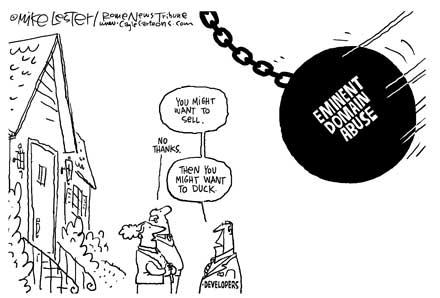
abuses of eminent domain powers in the United States should be a salutary warning here….

And so they should be. 

In the States, “compulsory acquisition” is known as “eminent domain.” Among the worst abusers of eminent domain is the odious Donald Trump, who once “persuaded” Atlantic City bureaucrats to confiscate the home of elderly widow Vera Coking so he could construct a limousine parking lot for the customers of his Trump Plaza Casino and Hotel. (Google "Susette Kelo" for another horrible story, or get hold of Ilya Somin’s new book on the problems with eminent domain, The Grasping Hand: 'Kelo v. City of New London' and the Limits of Eminent Domain.)

As PJ O’Rourke observes, when legislation is introduced about what’s bought and sold, the first thing to be bought is the legislators—those not politically connected are the first ones to suffer by it; those (like Trump) who are the first to gain.

The Commission simply washes its hands of such thoughts.

   As if to water down the rather shocking nature of this proposal, the report suggests that powers don’t need to be exercised much, as they can provide leverage (in the same way a mugger with a baseball bat won’t need to hit me to get my money) and the chair is also quoted as suggesting the powers might only be to deal with “holdouts”.    
    But it just is not clear why such powers should be given to public agencies.  In [an unhampered market], housing is readily provided by the private sector.  Public agencies and political leaders got us into this mess, and why would we expect that new powers would not be abused?  
    Have powers of compulsion worked well in central Christchurch?  It hadn’t been my impression.

Has it been anyone’s?

But, I hear you cry, don’t worry: Bill English and John Key would put a stop to this!

"It would be a bit of a stretch to get to compulsorily acquisition, but the idea of better co-ordination of building houses, of getting water and roads in place is an attractive idea," English said [yesterday], adding he wouldn't rule out compulsory acquisition because the Commission had only issued a draft report that was open to submissions.

Oops, maybe not.

But surely John Key … oops, maybe not: point 2a of his first "four-point plan" to fix housing envisioned forcing land-owners to build on their undeveloped land or face confiscation.

Fact is: This is an idea the politicians and planners just keep coming back to.

They can’t help themselves.

So it might presage the worst violation of property rights ever in this country. It might show what happens once respect for property rights is dead. It might be against the stated principles of the party presently in power.

So for all those reasons and more, don’t bet against the recommendations becoming law.

* * * *

Oh, there are other recommendations too. Like toll roads, “targeted rates,” and lifting councils’ debt ceilings (have you noticed them being reluctant top borrow?!). All recipes for growing control and growing governments so, quite naturally, all applauded by enthusiasts for both.

“There seems to be a too-ready sense that government is the source of on-going solutions, rather than the source of the underlying problems.” Daryl Kerrigan should have hung that up in his house.

Mind you, at least he could still afford to buy one.


* Famously commemorated in a superb film, the name of the Castle Coalition, and Lord Denning’s pithy observation in Southam v Smout[1964]:

The poorest man may in his cottage bid defiance to all the forces of the Crown.
It may be frail—its roof may shake—the wind may blow through it—the storm may enter—the rain may enter—but the King of England cannot enter—all his force dares not cross the threshold of the ruined tenement.” So be it—unless he has justification by law.

Monday, 13 July 2015

Hugh Pavletich blames the incompetent council. But who’s really to blame?

Exorbitant rates rises are only part of the severe imposition on Auckland home-owners. Housing commentator Hugh Pavletich blames the incompetent council:

If Auckland was a normal housing market, like most in North America, house prices would be at or below $300,000 for those on $100,000-a-year household incomes.
    Thanks to the incompetent Auckland Council, an Auckland family with a household income of $100,000 is forced to pay $820,000 for a house.
    The council is forcing them to pay an extra $520,000 for the house and this new study calling for more apartments in the suburbs is no solution to the crisis.
    That money for an Auckland house must come from a grossly excessive mortgage, crippling the city's residents for the remainder of their working life.
    Add the interest over the life of this inflated mortgage and this $100,000-a-year household is forced to pay over $1 million in excessive mortgage costs, and all because the Auckland Council is incompetent.
    The council is being deliberately misleading because it has lost control of its costs and has lost the capacity to meet its infrastructure responsibilities to its community.
    Land supply, infrastructure financing and processing for new housing are issues councils must tackle - and no council more than Auckland needs to deal with this.

But council aren’t the only ones to blame, are they.

Q: What gives Auckland Council power to blow out its costs, ignore infrastructure responsibilities, and lock up housing like this?
A: The Local Government reforms of 2002, that removed restrictions on how councils could waste ratepayers money, and the Resource Management Act, that grants council’s “planners” complete authority over your land.

Q: So who passed and introduced these?
A: The Alliance’s Sandra Lee under Helen Clark’s Labour Government passed the Local Government Act reforms, and National have adamantly refused to reverse them. Labour’s Geoffrey Palmer wrote the Resource Management Act, National’s Simon Upton introduced it, and fro many years Nick Smith administered it.

Q: So how come they got away with it?
A: Because NZ has no constitutional and little institutional protection for property rights. Because over many years folk have forgotten why property rights are important. And because all of you bastards keep voting for it all to happen.

So, in the end, you’ve only got yourselves to blame.

Suck it up.

PS: Auckland has been “wedded to a 1950s vision of uncontrolled sprawl,” say politicians.

“Auckland's mayor is standing firm against urban sprawl,” say commentators.

“Auckland’s sprawl is unsustainable and must stop,” says virtually every planner everywhere.

And yet … what uncontrolled sprawl?

Here’s Auckland just over thirty years ago, in 1984:

image

And here’s Auckland in 2012:

image

Can you spot all that “uncontrollable sprawl” after thirty years?

Fact is, New Zealanders’ fear of urban sprawl is wholly misplaced.

[NB:  The pictures above come from a really neat Time Lapse visualisation of the world here.  Use any of the pre-programmed settings—click on Las Vegas or Shanghai if you really want to see sprawl!—or just click on “Explore the World” and play.]

Monday, 2 February 2015

Councils continue to reject ‘stop-spending-so-goddamn-much plan’ [updated]

UPDATE: “Expecting governments to fight the deficit is like expecting the mafia to fight crime.”

Council parasites have their hands out again.

Until Sandra Lee’s 2002 “reform” of local government, which granted council’s a legal all-clear to do whatever the hell they like unless prohibited by law, most councils did their best to keep their spending under control. Since then, the shackles have been off.

Today, Local Government head Lawrence Yule released a “discussion paper” recognising “a significant shortfall between revenue and spending by councils.” In times of yore, this was called overspending. Now, it means councils considering more ‘”funding mechanisms.”

Yule argues “therefore” that councils should have “broader taxing powers” (including “local income tax, local expenditure tax, selective taxes, regional fuel taxes and transaction taxes), “co-funding” from central government, “user charges,” and – naturally – even more debt piled upon existing debt.

In other words, every means possible should be used by over-spending councils to put their hands further into your pockets.

Not included in Lawrence Yule’s report is the obvious response to the shortfall between revenue and spending: that councils should stop spending so goddamned much.

Sandra Lee, and every local government minister since who has refused to slap the shackles back on over-spending councils, have a hell of a lot to answer for.

POSTSCRIPTTaxpayers Union are quick out of the blocks with a response:

New Zealand’s average rates bill has doubled in the last 20 years, tracking at twice the rate of inflation. Instead of focusing on the quality of councils' spending decisions, this campaign is using ratepayer money on propaganda promoting new taxes.
    LGNZ is a taxpayer funded lobby group representing the interests of councils. Nowhere in the discussion paper do we see a disciplined analysis of why local government spending is out of control.
    This campaign is so blatant that LGNZ spin doctors are sending Mayors draft opinion pieces so local politicians can 'leverage local media' and promote these new taxes. The Taxpayers' Union has been forwarded some of the emails by elected officials who are concerned LGNZ is overstepping the mark.
    Responding to LGNZ President, Laurence Yule’s comments that The goal is not to increase the overall tax burden for New Zealand, but rather to determine whether a different mix of funding options for local government might deliver better outcomes for the country,” Mr Williams says:

          “Mr Yule is telling the public that the goal isn’t to increase the overall tax burden, but today he released
            a report, not on ways to save money, but on ways to tax more."

RELATED POSTS:

Tuesday, 20 January 2015

So they’re “reforming” the RMA again?

In the middle of last year John Key told a roomful of council numpties that if he was returned to government after the election,

one of our top priorities will be to progress the Resource Management Act amendments that we’ve had to park for the time being.
    Our changes to the RMA will tackle housing affordability by freeing-up land supply and making it easier to build, extend, and renovate houses.
   Consenting will be sped up and simplified.

Since these same promises have been made every single time the Resource Management Act has been amended – right back to Nick Smith’s first tinkering with it back in the late 90s – and right up to the Key Government’s last chocolate-coated turd -- I won’t be holding my breath for Nick Smith’s promised announcement tomorrow any more than I have been for the last twenty years of promises.

The problems have been known about long enough – the inability to build new houses in NZ cities at a price new home-owners can afford and at which spec builders can make a profit –nearly  all of them stemming from the Local Government Act’s encouragement for council’s to grow like cancer, and the Resource Management Act’s virtual removal of property rights in land.

Yet I can guarantee that neither will be addressed tomorrow.

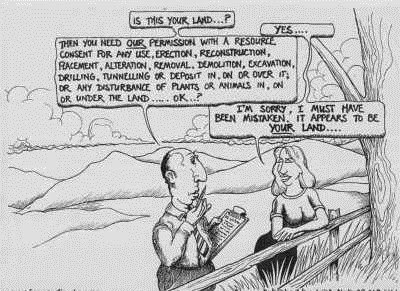
Whose_Bloody_Land_is_it_Anyway

Instead, if we are to take Amy Adam’s tepid 7-point plan from last year as the template , all we can expect is more flaccid bullshit like “a national planning template” which will allegedly create “a simplified planning framework” (yeah right); “streamlined” costs and processes (d’you believe that at all?); district plans now available online (on Skynet yet?); “better consideration of natural hazards in planning” (expect more building in more places to be banned); and finally, district plans that are more “proactive” (Galt save us!).

Monday, 20 October 2014

Send in your horror stories

I fear it’s simply a ruse to absorb dissatisfaction rather than the blunt instrument it should be to hit councils around the head, but new Local Government minister Paula Bennett has now

formally launched her Rules Reduction Taskforce aimed at finding 'loopy' property rules and regulations, naming the heads of the new body and setting up a website to solicit examples.
    "People can now head to this
rules reduction website, to start telling us what bugs them when it comes to loopy rules and regulations," Bennett said.

The “Taskforce” is headed by  National MP Jacqui Dean, with no particular qualifications for the task, and Auckland Chamber of Commerce CEO Michael Barnett.

"I'm asking property owners, builders, tradespeople and businesses who have experienced the issues caused by irrelevant or unnecessary regulations, to help draw these to our attention," Bennett said…
    "We need to hear from New Zealanders about examples that have got in the way of their building, renovation, landscaping, and home improvement plans, so that we can cut the red tape where it needs to be cut, to help them get on with the job."

I expect little – and still say the single best thing Bennett could do in her portfolio is to reverse the “powers of general competence” that former minister Sandra Lee granted councils -- but I’d still recommend you fill Bennett’s rules reduction website with all your genuine horror stories, of which I know you will have several dozen each.

At least it will give you somewhere to get them off your chest.

Lindsay Mitchell has already made a start.

Thursday, 11 September 2014

“The left has already won this election”

She’s right, you know. 

Josie Pagani, that is, saying National is coasting on its rival's policy:

The left has already won this election.
    John Key's National Party is still high in the polls, not because the values of the right are popular, but because National's pitch is essentially, "Trust us to implement Labour policy. We'll spend a bit less than them doing it, and if you're lucky we'll give you a tax cut from the savings -- maybe."
    The left won the contest of ideas a long time ago, and National has completely capitulated… promising only to administer the policy wins of the left.

On that, she’s absolutely right. On the battle of ideas, the left has already won this election. It’s so patently obvious it need hardly be debated.

Where she’s wrong is assuming that’s a good thing.

She says it’s a good thing for example that

_Quote_IdiotNational has rolled over and accepted the left's analysis that … the market can't fix everything. [That] National held its nose and intervened to rebuild Christchurch and fix the failing housing market.

Yet, when was the market given an opportunity to rebuild Christchurch? It worked very well until 4 hours after the earthquake when the government took over and closed the city down.

And, when has the market been given a chance to fix the failing housing market? It had been working moderately well for umpty-tum years until increasing council costs (brought on by Sandra Lee’s 2001 Local Government Act intervention) and the increasing planning stranglehold on land (brought on largely by National’s 1993 Resource Management Act) began sending housing costs through the roof – and even while supply went through the floor demand has been kept high by newly issued debt courtesy of the Reserve Bank.

Being at the intersection of the three of the most heavily regulated and interventionist “markets” in the land – building, planning and money creation – all areas that have been reformed from the “leftist” menu -- it’s no surprise that what the housing “market” has managed to deliver has been large gains for some at the expense of misery for many.

Such is the pattern of heavily regulated and interventionist “markets” everywhere.

And it’s no surprise to discover that the leftist-inspired top-down solutions in Christchurch have failed to set anything alight apart from anger and resentment and very little rebuilding that really deserves the name.

Such is the general pattern when governments attempt to direct markets in direction people don’t wish to go.

Such would be the tragedy repeated in every other area should the Nats’ ideological capitulation be given voice in the other areas Josie would have them further gum up: in “actively managing the economy in favour of exporters and producers” (and so lowering the dollar that it would reduce real wages for everyone); in further raising minimum wages (and so locking out teenagers and the  low-waged from ever rising up the employment ladder); in regulating the prices of energy companies (guaranteeing both shortages and falling energy investment); and in tying up “the supermarket duopoly” (all but guaranteeing either shortages or rising prices).

Josie’s right that for years the Nats have capitulated in every ideological battle they have encountered – bringing always and in every policy debate just a pop gun to the left’s ideological nuclear weapons.  As Lindsay Perigo and myself and undoubtedly many others have and will have pointed out, this is the real reason, if there is one, for what the left have called “dirty politics.” 

But where Josie is very wrong is in assuming the Nats’ “management” of their capitulation has made anyone outside the immediate political arena better off.

Monday, 14 April 2014

LGNZ’s Alternative Funding Mechanisms Can Get Stuffed

I note councils around the country are at it again to get someone,anyone, to pay through the nose for their borrowing and over-spending.  They call this “looking for alternative funding mechanisms.”

Basing rates on property values alone may soon no longer be sustainable as the sole taxation form for many councils, says Local Government New Zealand (LGNZ).

Why will basing rates on property values alone no longer be sustainable as the sole taxation form for many councils? The answer is as simple as its corollary conclusion is obvious: because they’re spending too damned much and don’t wish to be stopped.

Instead [of reining in council spending, LGNZ] would investigate other forms of taxation such as local consumption and local income taxes as "complementary alternatives."

Ever since Sandra Lee changed the Local Government Act to give councils the ironically named “powers of general competence” their spending has gone up and up and up – and no Local Government minister with balls has emerged since to reverse this gift, let alone emasculate altogether the congenitally incompetent.  (Someone stick a toe up Nick Smith’s arse and ask him why he won’t stir in this direction.)

So as their powers of general incompetence continue to morph wildly, so too do the many  “alternative funding mechanisms”they contemplate to keep up with them –“complementary alternatives" in addition to the rates, service charges, levies, development contributions and general overcharging done whenever ratepayers and property owners are coerced into their company. They give them many labels…

“Local consumption taxes.”

“Local income taxes.”

“Funding tools.”

“Congestion charges.”

“Visitor charges.”

“Payroll taxes.”

“Capitation payments from central government.”

Many euphemisms to describe putting-our-hand-in-someone’s-pocket-and-rummaging-around-until-we-come-up-with-some-large-notes.

I say: Watch out. There are thieves about – they take many forms, and use many euphemisms their wonders of thievery to perform.

Thursday, 15 August 2013

When will they withdraw council’s “powers of general competence”?

2002 was a red letter year for ratepayers.

Before 2002, councils were constrained to only do what they were empowered by law to do. After 2002 however, councils could do whatever the hell they liked, and send you and I the bill.  It was Sandra Lee’s 2002 Local Government Amendment Act that was the key. This was the Act that gave them what is called, with a straight face, the power of general competence.

Overspending councils were given carte blanche by Sandra Lee’s 2002 Local Government Amendment Act to become rabidly indebted over-spenders. And, oh boy, they sure have

One way these desperately overspending councils have tried to claw back some readies is by levying hundreds of thousands on builders and developers—who are considered by most good council men and women to be ripe sucks whose wallets are ripe for the plucking, with the contents filched therefrom spent on whatever makes their hearts content.  Like monuments. And skate ambassadors.

The result, for housing, is this: fewer houses are built because the exorbitant levies make them cost more. And those that are built cost buyers more.

This is just one of the many reasons our cities have severely unaffordable housing.  Indeed, in the run up to New Zealand’s house price  inflation, this component—having trebled over the last decade--is second only to the rocketing price of land as being responsible for the exploding cost of house-building.

Enter, stage right, the National-led Government, who say today—finally- they are “taking aim at section charges levied by local councils.”

“We are going to narrow the charges councils can put on new sections, provide an independent objections process and encourage direct provision of necessary infrastructure to get costs down,” Housing Minister Dr Nick Smith and Local Government Minister Chris Tremain said.
    Development contributions had trebled nationally over the past decade and had gone up more than any other component cost of a new house, the two said.
    "This huge increase can be attributed to the local government law change in 2002 that gave councils carte blanche to charge whatever they liked and removed any check or appeal on these charges. These charges now average $14,000 per section but can be as high as $64,000 per section,” Smith said…
    "There will always be pressure on councils over rates and we need a check on development contributions to ensure the new home owner is not over-charged," Tremain said… 
    The changes mean that councils will only be able to charge for new infrastructure and not recreational facilities or reserves for developments that do not involve residential housing."
    Tremain said councils would still be able to charge for infrastructure and resources directly associated with a new subdivision.

A change—and a necessary and much overdue one.

But when is this National-led Government going to reverse Sandra Lee’s gift to overspending councils of this absurdly oxymoronic “power of general competence.”

It’s reversal is long overdue.

Thursday, 25 July 2013

Monumental council debts

This is some interesting spin from the head of Local Government NZ:

Councils spent $700 million more than they earned in the past financial year, leading to the worst operating deficit on record, but officials say this was one of the symptoms of keeping rates low in tough economic times… Local Government NZ head [and mayor of underperforming Hastings Council] Lawrence Yule said councils had tried to keep rates as low as possible since the economic downturn and so had incurred some operating deficits.

What the hell is Yule talking about? “Keep rates as low as possible,” says the dickhead! They’ve risen every year since Sandra Lee’s Local Government Act reform took the handbrake off their spending, with rates nationally rates having risen an average of 7 per cent a year for the past decade. And that’s not slowing down any time soon.

_YuleBasically, since at least 2002 councils have been spending like drunken sailors on non-core council business. Their problem—and their ratepayers’ problem—is that when the economic downturn began not one of them bothered to exercise prudence and cut their overspending. Instead, they all borrowed. They borrowed billions.

Their debt positions are purposely made as opaque as Yule’s spin, but council watchdog Larry Mitchell says

Sector-wide total debt, (including the Regional Councils) has quadrupled from around $2 billion seven years ago to $8 Billion by 2011-2012.
   
Of greater concern, according to Council long terms plans forecast sector debt is scheduled in the period to reach around $25 Billion, with Auckland Council taking a disproportionate share of this at $16 or more billion … or over two thirds of the total.

And that is before Len Brown’s plan to have us pay for all his monuments.

Councils (and government) need to urgently rein in their spending, or today’s children will be working most of their adult lives to pay off the debts of irresponsible politicians. The head of Local Government NZ should be in the forefront of making councils live within their means. Instead, he is an apologist for their failure.

He deserves a good kicking.

Tuesday, 20 March 2012

We come to praise Nick Smith. For now. [updated]

imageI never thought I’d write to praise Nick Smith rather than bury him. Neither did Liberty Scott.

But here you go.

It’s a first.

Because Nick Smith intends to muzzle councils.

Not just chronically over-spending councils haemorrhaging debt; not just over-stretched councils over-excited about meddling in other peoples’ business; not just councils flush with over-aggrandisement on truckloads of other people’s money; but all councils in the country who, he says, he intends to confine to doing only what councils should be doing.

Now if you were to list the differences between what Nick and I think councils should be doing you would have a very long list indeed.

So I hang my enthusiasm for his pronouncement not on words like “castrate,” “emasculate” and “tie up”–i.e., the sort of words I would be using as minister to describe my intentions for councils’ powers—but on the more temperate words being used like “confine,” restrict” and “roll back” (still far more energetic than anything else said by this government in its four year reign) and his stated intention to end the failed decade-long experiment of granting councils the legal “power of general competence.”

The reforms, dubbed “Better Local Government” effectively remove what has been widely known as the “power of general competence” granted to local councils in [Sandra Lee’s] 2002 reform of the Local Government Act, which made them responsible for “social, economic, environmental and cultural well-being.”
    Instead, councils will be given legal responsibility to provide “good quality local infrastructure, public services and regulatory functions at the least possible cost to households and business.”

This ill-named “power of general competence” (clearly an oxymoron when it comes to councils in any case) was always going to end badly because, as many of us said at the time, it overturned the centuries-long principle of  that citizens may do anything they like except what is explicitly prohibited by law, whereas agents of government may do only what is explicitly allowed by law.  This is what it means to have the rule of laws, not men—a principle overturned by Sandra Lee’s 2002 reforms with the resulting encroachment by cockroaches on things they should never have contemplated.

So bravo then to Nick Smith (words I never thought I’d write) for doing what urgently needed to be done, and should have been done years ago. (One still wonders why, rather than reining in every bureaucracy in the country by doing what Nick promises to do, as local government minister Rodney Hide instead committed all his energy and every part of his party’s dwindling political capital into super-sizing Auckland’s bureaucracy.  There’s a story there still to be told.)

But it’s not all good news.  The minister still talks about “super” mayors and “super” bureaucracies, twin illusions you would think the reality of Len Brown and his dysfunctional merry-makers should surely have punctured by now.

And he maintains his enthusiasm for the disaster that is the Resource Management Act, which has single-handedly reduced property rights while raising housing prices.

So something to celebrate. But it’s still early days.

PS: Feel free to let us know what Nick Smith is trying to demonstrate in the picture above. Answers on a postcard please.

UPDATE:  Yes, this is still the same old Nick Smith, of course.  A person with a fully-equipped battery of political antennae who as minister of ACC was happy to write a “reference” for a friend who just happened to be involved in a messy ACC claim—fully aware of the effect of such a letter from such a minister on those considering the claim, even though he now suggests otherwise.

Monday, 5 March 2012

Council debt tsunami now unstoppable

When the Great Recession first began hitting the country, everyone had two choices: either hunker down and beginning cut your cut according to your shrunken cloth, or keep spending like a drunken tailor and borrow to cover your rapidly increasing debts.

You can guess the approach every council in the country took. 

When Sandra Lee’s Local Government Act 2002 gave councils the power to do whatever the hell they wanted to (laughably called “the power of general competence”), to a man and woman virtually every councillor in the country began voting for grandomania.  Then as the Recession hit and revenues shrunk (even with their hugely inflated rates bills and development levies) they borrowed to keep their overspending going—sailing blithely along to disaster.

The result now is predictable as the Greek decision to do much the same. Total council debt has quadrupled from $2 billion in the Year of Sandra Lee to over $8 billion today.

And the rate of still growing: $500 million more in 2007, $800 million more in 2008, $1,100 million more in 2009, and $1,800 million more in 2010.

Most councils in the country now have an uncontrollable debt, no debt repayment programme, and no plans to rein in their spending.

Dunedin and Kaipara are merely the most high-profile froth on this torrent of irresponsibility.

Listen to whistle-blower

One of the few to pay this any notice, Larry Mitchell, who has spent the last 15 years analysing council’s books, reckons

the financial tsunami currently hitting the beach of some New Zealand territorial local authorities is unprecedented. You don’t have to be a rocket scientist to go through the figures and see that it has come time to activate the warning systems.

Listen to him talking this morning on Radio NZ [audio], after which Sir Humphrey steps up.

Monday, 7 September 2009

No Maori seats for Auckland

It was good to see from last week’s announcement that even in the process of setting up a decidedly un-super local government for Auckland  last last week, there were at least no racist seats on the menu.

Thank goodness for small blessings.  Seats based on skin colour would enshrine separatism, tribalism and race-based favouritism and would be, as David Round points out, a precursor to the inevitable Balkanisation of New Zealand.

You can still hear the bleating of the Apartheid Party and their more unthinking supporters however, who are still bleating that to fail to provide racist seats is itself racist.  Irony itself is too ironic for these people. 

The Apartheid Party makes three points in its rearguard protest in favour of racial favouritism:

  1. Race-based seats were “a specific recommendation of the Royal Commission on Auckland Governance.”
  2. Race-based seats would be “consistent with current provisions in the Local Government Act 2002.”
  3. Race-based seats would “uphold the partnership relationship established between Maori and the Crown through the Treaty of Waitangi, including the partnership established with the mana whenua of the Auckland region.”

As Muriel Newman points out, none of the three points lasts a minute under scrutiny. First, The Royal Commission on Auckland Governance was set up by Labour, long-time friends of race-based law,  to effect the Auckland super state along with the race-based seats it so favoured.  Just because Rodney Hide and John Key are delivering the amalgamated uber-council that Labour wanted, that places no onus on them to make that uber-council a racist one.

Second, if race-based seats would indeed be “consistent with current provisions in [Sandra Lee’s] Local Government Act 2002,” then this just gives one more reason why Sandra Lee’s law should be struck down. Sandra Lee gave councils the “power of general competence” – a power they’ve used to dabble in things they can’t do, and their ratepayers can’t afford. A power Auckland’s new council megalith will wield.  If she also gave the power to deliver race-based seats, then this only makes the repeal of her Local Government Act more urgent, and more necessary.

And third, where exactly is this “partnership” established in the Treaty of Waitangi – except in the imaginations of those who support it?  As Michael Basset says,

“Constant repetition of assertions that Maori have a Treaty of Waitangi right to dedicated seats on the new Auckland Council doesn’t make them correct. It is clear that neither Tuku Morgan nor Len Brown, nor most of the other advocates of separate representation, has read the Treaty.”

Neither the word nor the concept appears in the Treaty’s three spare clauses -- under Article One, the chiefs of New Zealand ceded their sovereignty to Queen Victoria; Article Two created private property rights; and Article Three conferred on Maori the rights and privileges of British subjects, making all New Zealanders equal under the law.  There was nothing in there about “partnership” between state and tribes, and as Muriel Newman notes,

If such a special relationship just applied to Maori, then the Courts would have been responsible for elevating Maori to the status of a ruling class superior to all other citizens. By definition, all other non-Maori New Zealanders would therefore have been relegated to an inferior status as second class citizens. Since that is clearly not the case, any talk of Maori having special partnership status with the Crown is just wishful thinking by Maori separatists.

I have to agree.  Talk about the difficulties of Maori councillors being elected onto council is both irrelevant and (according to historian Michael Bassett) questionable.  I hesitate to use the word “merit” about the sort of self-serving scum who usually end up sitting on council and kicking us around, but if you can’t persuade a truckload of people to vote for you based on your character rather than just the colour of your skin, then I’d suggest it’s not a megaphone you should be using when you call others racist, but a mirror.