Showing posts with label Alan Greenspan. Show all posts

Wednesday, 24 June 2026

Alan Greenspan, 1926-2026: 'The Undertaker' passes away

Alan Greenspan, dubbed by Ayn Rand as "The Undertaker."  
Ultimately, he took the job that John Galt refused: economic dictator

"Alan Greenspan died [earlier this week], and the man who spent two decades inflating bubbles will be eulogised as a maestro. Fitting, because he understood exactly what he was doing. 

"In 1966 a younger Greenspan wrote an essay called 'Gold and Economic Freedom.' [In it, he states that the gold standard is essential for economic freedom.] He laid out the case with precision. The gold standard protected savers from confiscation by inflation. Welfare statists hated gold because it stood in the way of their deficits. He wrote that the abandonment of gold made deficit spending a "scheme for the hidden confiscation of wealth." He was right. He knew it. Then he took the job running the printing press.

"From August 1987 to January 2006 Greenspan sat atop the Federal Reserve and did the opposite of everything that essay defended. After the 1987 crash he flooded the banks with liquidity and taught a generation of traders that the central bank would catch them every time they fell. They named the reflex after him: the 'Greenspan put.' He cut the federal funds rate to 1 percent by June 2003 and held it there, and you watched housing prices detach from any sane relationship to income. Mortgage credit gushed. He went on television in February 2004 and suggested Americans consider adjustable-rate mortgages, roughly eighteen months before he started hiking rates into those very borrowers. The man who warned in 1966 about the hidden confiscation of wealth engineered the largest credit distortion in postwar history. 

"Then came the apology that wasn't one. In October 2008, sitting before Congress as the wreckage smoked, Greenspan confessed he had found 'a flaw' in his model of how the world worked. He was 'shocked' that lenders [licensed to print money] had not policed themselves. You don't get to spend twenty years pricing risk at zero and then act surprised when men respond to the incentives you built. Any committee of economists cannot set the price of money better than a market can. 

"Greenspan knew the answer at 40 and spent the next half century pretending he'd forgotten it. The savers he warned about in 1966 paid for that performance. ..."

"Every Fed chair since Greenspan has discovered this truth the hard way. Bernanke cranked rates to zero after 2008, then Yellen kept them pinned there, then Powell printed $4 trillion more during COVID. Each crisis demanded bigger interventions than the last."
~ Handre

"Greenspan was the Dr. Robert Stadler of our age: the brilliant man who knew the right principles and betrayed them, certain his own genius could control the evil he agreed to serve. 

"He was a member of Rand's inner circle. His essay "Gold and Economic Freedom" appeared in Capitalism: The Unknown Ideal. He argued, correctly, that the gold standard protected savers from confiscation, that statists hated gold because it blocked their deficits, and that abandoning it turned deficit spending into a scheme for the hidden confiscation of wealth. 

"He even understood that Social Security was a Ponzi fraud that would help bankrupt the nation. He knew all of it. Then he took command of the Federal Reserve and did the opposite of everything he had written. 

"The 'Greenspan put,' rates held at one percent, the housing bubble, the very confiscation he had warned of, engineered by his own hand. 

"Here is the irony. Greenspan knew 'Atlas Shrugged' intimately. He watched Rand create Stadler, the genius who lent his mind to the looters' Institute believing he could outwit them, and who lived to see his knowledge weaponised as Project X. Greenspan studied that warning at the source, from the author herself. He understood the character completely. Then he walked the identical road and became the man the novel was written to expose. 

"When the wreckage came in 2008, he told Congress he had found 'a flaw' in his model. There was no flaw in the model. The flaw was in the choice to abandon what he knew. Some men meet the virus and are consumed by it. Greenspan had the answer at forty and spent the next fifty years pretending he had forgotten."
~ The Rational Animal

"Q: Alan Greenspan passed away [this week]. Alan Greenspan was a close associate of Ayn Rand for a while, and the Chairman of the Federal Reserve … these things did not overlap, as people familiar with Ayn Rand’s ideas wouldn’t be surprised to hear. So, Keith, I’m sure you’ve read [Greenspan’s essay] ‘Gold & Economic Freedom’ many times; so let’s get your thoughts on Greenspan’s passing…

"A: For anyone who’s read that essay, which was published in 1966 as part of [Ayn Rand’s] book 'Capitalism: The Unknown Ideal,' and therefore endorsed by Ayn Rand, he had to evade everything he knew in 1966 in order to take the job at the Fed. And ultimately, he took the job that John Galt refused, which was economic dictator.

"Now … everybody is confused about capitalism … but … there is no greater area of confusion than the concepts around money. Both the critics of capitalism and of gold, and the FANS of capitalism and gold will tell you that he was 'a Maestro' — and if you ask “a master of what?’ you’ll be told he was a master of central planning of our economy, and of managing our little lives for us. …

"They’ll say ... ‘he managed a sound money regime’— and the problem with the concept of sound money they use is an anti-concept, that is, [it’s a notion] that destroys and obliterates a legitimate concept in order to smuggle something else in. And what they mean by ’sound money’ is an irredeemable fiat currency jammed down our throats by the government forcing us to use it as if it WERE money, but ‘sound’ because it’s somehow managed to avoid consumer prices going up [by no too much].

"So I’d like people to think about a simple fact, that in every industry seeking greater efficiency, that is, they want to produce more with less — with less cost, with fewer inputs, with less labour, land, physical commodities etc. — and of course that’s happening relentlessly across the entire economy in every sector (unless regulation prevents it…).

"So suppose the average across the entire [economy] is a 2 percent gain in efficiency every year, all else being equal, you’d expect consumer prices therefore to be falling comparatively across industries, as costs are falling. SO your expect consumer prices tl be falling roughly 2 percent per year.

"So imagine it it were possible as the manager of the currency to debase the currency at a matching rate. Now, this is pure fantasy [hoho!]; this is only interesting as a thought experiment … but suppose it were possible to debase the currency at a matching rate so that every company from Intel to US Steel to Rolls Royce making aircraft engines is cutting costs at 2 percent, [while] you are debasing the currency at a matching 2 percent, and the nett result is CPI = zero. Would anybody call that SOUND?

"I wrote an article called ‘Sound Money is Not What You Think It Is,’ and I had a picture that I took from Norman Rockwell [above, with customer and butcher both cheating] … and I asked if that would be considered a sound measurement of the weight of the chicken, and therefore a sound price to pay … And at best, that’s what Greenspan did."
~ Keith Weiner from Monetary Metals, interviewed on the 'Daily Objective'


"Of course you can 'speak ill of the dead' ...  After all, wrote Shakespeare, 'The evil that men do lives after them; / The good is oft interred with their bones.'

"Alan Greenspan, former chairman of the Federal Reserve System, just died at age 100. The general public wants to blame the United States president for the health of the U.S. economy, but the Fed chairman has much more influence over economic conditions. 

"Greenspan spent some time early in his career as an Ayn Rand acolyte, and in fact three chapters of Rand's book Capitalism: The Unknown Ideal, were written by the future Fed chairman.... Greenspan's opponents on the left therefore interpreted his whole career through a Randian lens, which serves to remind us how stubbornly they refuse to understand the world. 

"Had Greenspan wanted to run the Federal Reserve in such a way as to approximate a gold standard as much as possible, he could certainly have done so. Instead, he used it as an instrument for central planning, with disastrous results.

"Initially, Greenspan could do no wrong. He became known as 'The Maestro' ....  Meanwhile, Greenspan's contempt for the public was legendary: he confessed to Lesley Stahl of CBS that before congressional committees he would speak gibberish -- a tactic he called 'syntax destruction.' The next day the headlines would report two different things about what he had said, and for Greenspan that meant he had succeeded. Greenspan's policy moves (like arranging for a bailout of Long Term Capital Management in 1998) gave rise to the belief in a 'Greenspan put,' according to which investors could be assured that the Fed chairman was prepared to use the tools at his disposal to backstop the market if it should ever fall below a certain level. 

"And of course his monetary stimulus after the dot-com bust in 2000-2001, which looked to some observers at the time as a brilliant move, only delayed the reckoning, and transformed that bust into a real estate bubble (and eventual bust). When the lights of the economy should have turned red, Greenspan made them all green. That was the only recession on record in which housing starts rose rather than fell. 
"The Federal Reserve, like the government itself, has no real goods at its disposal, so while its various tricks can redistribute resources and simulate prosperity, it cannot generate real wealth. It simply arranges the economy into an unsustainable configuration that has to come apart. 

"Because of Greenspan's earlier association with Ayn Rand, and because the general public knows so little about the Fed, when the 2008 crash occurred, people generally went along with blaming 'capitalism' -- even though the Federal Reserve is a non-market institution created by act of Congress and enjoying a government-granted monopoly, and even though Greenspan's manipulations overrode what the market was trying to say. 

"Greenspan's legacy is 2008, and the undeserved reputational damage that the market economy suffered as a result."

Wednesday, 22 October 2025

Pay no attention to the (mad) men behind the curtain [updated]


Readers here might remember I got some stick for calling John Key a fucking moron a while back. A fucking moron, specifically, for repeated calls for the Reserve Bank to juice up house prices again, just so home-owning voters will feel better again. Feel better again, and then vote National.

"The guts of what’s wrong," explained the moron, "is that the housing market is going down, not up" — and "then you have a negative wealth effect," and voters feel bad. And when they feel bad, they vote for the other team.

Classic short-termism.  Stuff rocket fuel into the economy, and then all things will be jake for the governing political parties. This, by the way, was Key's "one simple trick" while Prime Minister: ensure massive house-price inflation, no matter the economic and social dislocation, and then sit back and watch home-owners fooled into feeling better off, and borrowing and consuming more, regardless of the economic consequences. (Consequences for which we're all still paying, by the way.)

In the US, the discredited "wealth effect" — "a gussied-up version of Keynesian stimulus, only targeted at the prosperous classes rather than the government’s client classes" — is generally felt in the stock market. Pundits there are starting to get nervous about a soaring stock market with anaemic growth in the economic system itself, with "important implications for the path of America’s stockmarket boom and its economy."
The good times could continue, at least for a bit longer [says 'The Economist']. ... [But] might a wealthier society also take a harder fall? Bears would point to the bursting of the dotcom bubble in 2000, when a brutal stockmarket slump pushed America into recession. ... The stockmarket might be more of the economy. It still is not all of it.
It's not. And nor is the housing market. We can't get rich just by selling each other houses. (And kudos to one National minister at least who understands that.)

Yet David Stockman is concerned that nothing has been learned from the last major crash
Roughly 15 years ago it was reasonably well understood that the Great Financial Crisis of 2008-2009 had been case of speculation run amuck on both Wall Street and main street alike. These credit and housing bubbles, in turn, had been fuelled by the massive money-printing sprees of the Greenspan and Bernanke Fed.

It might have been presumed, therefore, that the mad money-printers [at the US central bank] would have had second thoughts about the underlying cause of these great economic disasters—that is, the dubious Greenspan policy known as the “wealth effects” doctrine. In simple terms the latter held that if people felt richer owing to soaring home prices and their stock market winnings, they would spend more freely and fulsomely, thereby goosing the Keynesian cycle of ever more spending-sales-production-income-and spending, which was to be rinsed and repeated in an endless round of rising prosperity.

At the end of the day, of course, Greenspan and his heirs and assigns at the Fed turned out to be unreconstructed Keynesians and the wealth effects doctrine a monumental economic con job. The latter did not make society richer; it just made the rich richer. Or stated more directly, main street got inflation at the grocery store, gas pump and doctor’s office—even as the asset-holding class experienced unspeakable windfalls in their brokerage accounts.
Let's not repeat the same mistake again here — especially when local interest rates are already below our trading partners, with no noticeable effect on genuine economic progress. Please: pay no attention to the mad men behind the curtain.

UPDATE:
"The advocates of annual increases in the quantity of money never mention the fact that for all those who do not get a share of the newly created additional quantity of money, the government's action means a drop in their purchasing power which forces them to restrict their consumption. It is ignorance of this fundamental fact that induces various authors of economic books and articles to suggest a yearly increase of money without realising that such a measure necessarily brings about an undesirable impoverishment of a great part, even the majority, of the population."
~ Ludwig von Mises from an interview 'On Current Monetary Problems'

Thursday, 7 November 2013

Living in a Chinese bubble

No, you can’t see bubbles when you’re in them, said Bubble Master Alan Greenspan.

No, there’s no way to tell if you’re a in bubble, said his apprentice Ben Bernanke.

No, no one can see a bubble at the time, says Ben’s successor Janet Yellen, echoed by every central banker in the world busy inflating their bubbles.

Which means there’s nothing at all to see in China.

[Hat tip Hugh Pavletich]

Wednesday, 9 October 2013

It’s Janet

So, as expected, Obama has finally formally appointed Janet Yellen to chair of the US Federal Reserve, taking over from PrintMaster-in-Chief  Bernanke, who took over from BubbleMaker-in-Chief Greenspan.

That’s Janet Yellen, the woman who sincerely believes that Japan’s biggest problem was they didn’t print enough money. Of whom, when she was appointed as Vice PrintMaster, Gerard Jackson observed,

Janet Yellen is an inflationist first and foremost. She has made it abundantly clear that all of her policy suggestions will be geared to promoting an inflationary policy. Like all Keynesians she seems congenitally incapable of grasping the dangerous microeconomic consequences of inflation for investment, jobs and the standard of living. She is in fact a very dangerous woman.

Do you think this will end well?

Monday, 30 July 2012

Is it any wonder investment is leaving Christchurch? [updated]

A new "plan" for the rebuilding of central Christchurch is to be announced at 6pm today.

This will be (hold on, let me count) the sixth different plan for rebuilding the central city to be announced by govt or local govt since the first earthquake.

No wonder property owners haven't got on and started rebuilding themselves.

First, they were barred from their own property. Then, with the release of each plan, they've been told their property will be confiscated if the planners deem it necessary.

The radio story announcing the new plan was accompanied by the hand wringing of Mayor Parker, bewailing the flight of investment capital out of Christchurch. Is it any wonder?

It’s still not too late to turn Christchurch into an Enterprise Zone. It could be done overnight.

No, we won’t know how Christchurch would look if that were to happen. There’d be no grand plan about which to trumpet—no great monuments for politicians to unveil; but there’d be rebuilding, you can be sure of that; the rebuilding would start, carried out by people using their own property, their own money, and expecting to turn a profit on it.

In other words: rebuilding the way this city and every great city* was built in the first place.

A simple fact forgotten by those who harbour a fetish for grand plans and a wish to keep Christchurch on welfare.

UPDATE: The citizens of Christchurch deserve more respect than to have  inflicted on them more infantile boosterism, says Hugh Pavletich, Coordinator of Cantabrians Unite.

Later today an announcement will be made on the proposed central public projects. All these proposed projects will likely be loss makers, requiring on going ratepayer / taxpayer subsidies.
National and international research also illustrates the wider economic and social benefits are minimal ...- at best. Indeed - comprehensive and robust research often illustrates there are wide economic and social costs.
The focus should be on how best to provide these loss making services in whole or in part, at the lowest possible ongoing cost to ratepayers and taxpayers.
It is to be hoped the media makes a point of communicating with people both nationally and internationally, with credibility and expertise in these public projects.
In very general terms, if at the outset the development cost estimates are in the order of $800 million and because these projects appear to be rushed, it will be likely there will be substantial costs blowouts. The promoters need to be asked ( based on reputable international evidence and research ) what provision at this stage have they made for likely cost blowouts.
By rushing in to these projects, the promoters will be forced to pay excessive land costs. Going forward, central area land values are expected to fall dramatically. The public deserves to be fully informed of the additional land costs involved with these proposed rushed projects.
Even based on the initial costs estimates of around $800 million, when the ongoing costs of capital and operating losses (including insurances, maintenance, depreciation, staffing etc. etc.) are factored in, it seems likely these could be in the order of at least some 10% or $80 million a year of ongoing losses.
With a little over 150,000 households, this is in the order of $533 per household - more if there are cost blowouts.
While of course the commercial / industrial sector pay a substantial proportion of the Local Authority rates - the losses are still a cost to us all as citizens. The commercial / industrial sector will simply pass on these increased rates costs in the prices they charge for the goods and services they provide. Business is simply an intermediary.
And in the broader sense - have we got our priorities right - with people first - housing second - and business third.
Quality decisions can only be made if the citizens of Christchurch are provided with honest and credible information.
The citizens of Christchurch most certainly deserve to be treated with respect. They deserve much better than to be inflicted with infantile boosterism.

Tuesday, 17 February 2009

Wrong rhyming slang [updated]

A few weeks ago Deborah Hill-Cone mused over “whom leftists would throw their shoes at now Dubya has yahooed back to Texas.” Now she knows: it’s bankers.

Although I bet [Gordon Brown, Barack Obama], Polly Toynbee and all the rest were quite happy to take advantage of the boomtimes when their houses were increasing in value, one can't help but wonder if they are feeling some self-loathing now. When the party stops it is much easier to blame the bankers for getting us drunk than admit we are lushes.

And much easier for big-government worshippers like Polly, Brown and Barack to blame those private bankers who were simply doling out the punch, when the primary cause of the problem was the punch bowl being spiked by big-governments’ central bankers .

UPDATE: To get some idea of the role of central banks in the boom -- which has turned to bust in a big way -- and just how seriously they spiked the punch bowl, consider these three quotes from William Fleckenstein's book Greenspan's Bubbles,

Central bankers like Greenspan [and Bollard] aren't like bankers at all... Central bankers are actually central planners [with all the failures of that breed]. Like bureaucratic leaders of central-planned or command economies, they pick an interest rate to wthin two decimal places that they guess will be the correct one, and then they proceed to cram it down the throat of the banking system.

And there are people who call the failure of The Fed a failure of free markets!

So with what was the punchbowl spiked? What were the central bankers cramming down our throats?

Greenspan erred by continually picking an interest rate that was too low, then he solved the turmoil that resulted from that decision with another period of interest rates that were again too low.

Repeat process until finished, which is what Greenspan did -- and what we're now paying for. The last tranche of easy money that left the Fed was to 'fix' the bursting of the bubble in 2001, and we know where it all ended up ...

We will quote once more an amazing nugget of research from Asha Bangalore, economist at Northern Trust Co.: No less than 40 percent of new jobs since 2001 owe their existence, directly or indirectly, to the real-estate levitation.

Friday, 12 December 2008

Culture wars over the economic crisis

You’ve no doubt heard the whole litany: Alan Greenspan stuffed up.  Alan Greenspan admitted “a flaw” in his hands-off ideology.  Alan learned his chops from his friend Ayn Rand. So that means Rand’s Objectivism has failed.

I don’t know about you, but I keep hearing this all the time. “What makes it especially revolting,” says Harry Binswanger, longtime friend of Rand (who died in 1982), “is that the real destroyer of the economy is Greenspan, through his inflation-generating last years at the Fed.”

Commentators from Gareth Morgan to Harry Binswanger to Roger Kerr to George Reisman to the contributors at the Mises Institute have pointed this out, but for the most part haven’t been heard.  They’ve cogently, responsibly and thoroughly destroyed the myth of free-market failure, pointing out the role and responsibility of Greenspan and his central bankers for the present crash (whose seeds were set in Greenspan’s massive credit expansion from 2001 to 2004), and for all the earlier crashes over which they presided.  The priority of Alan Greenspan’s Fed in particular, notes Morgan, has become to keep economic growth going by the continual expansion of credit. “So much so that the periodic creative destruction that markets naturally undertake to prevent excesses, was no longer considered necessary. Oh dear.”

But for the most part, the mainstream media isn’t really listening.  The real story doesn't fit their pro-big-government playbook.

Now, however, Newsweek magazine has put the question to the Ayn Rand Institute’s Yaron Brook.  His response? 

    This is not a failure of free markets, this is not a failure of capitalism, but this is a failure of the exact opposite. It's a failure of the regulatory state. It's a failure of all the government policies of the last eight years. Actually, the last 95 years.

    Why do you say the last 95 years?
    I believe that the No. 1 cause of the current crisis is Federal Reserve policy. [The Federal Reserve was created in 1913.] The Federal Reserve, by necessity, creates economic problems; no matter how good a Federal Reserve chairman is, he's going to create cycles of booms and busts.

It’s a great (if short) interview.  You should read it.

And Britain’s Telegraph carries this blog from Ayn Rand Institute’s Alex Epstein: “What capitalists need to understand,” penned in response to Iain Martin's observation in the Telegraph that "A culture war has been launched against free markets and so far the hostilities have been astonishingly one-sided." This “unfortunately applies just as much to America as to Britain,” says Epstein (as it does here).

Our capitalists, from think-tank intellectuals to businessmen, are unforgivably timid in the face of an anti-capitalist onslaught of bailouts, handouts, deficit spending, and central planning. Why?

Good question – and he has the answer.  Find out what capitalists need to understand to make them more vocal in defence of their values.  What they need to know above all is this:

Today's crisis illustrates the evils of government intervention in the economy and vindicates supporters of laissez-faire capitalism… Today's events are not unexpected consequences of laissez-faire that Rand, Ludwig von Mises, and others failed to anticipate--they are expected consequences of the mixed economy that they explained decades ago.

The ‘other’ side isn’t silent, and they’re wrong.  So why should we be so silent when, unlike them, we have reality on our side.

Wednesday, 5 November 2008

"Tight" my arse

Greenspan ran a "tight" monetary policy, says Cato Intitute moron David Henderson.

Horseshit! says the Mises Institute's Jeffrey Tucker, who responds with the evidence.

But evidence, no matter how sound, is not going to stop the morons bagging the "free market," apparently oblivious to the presence of an economic dictator with the power to inflate the money supply at will.

Friday, 31 October 2008

Best of NOT PC this week, to 31 October

Another good week here at NOT PC, but sadly another week in which scandal outdid substance on the campaign trail, even as out in the real world the chickens of political economy were vividly coming home to roost. Here are the posts from this blog that rated best over the last seven days:

  1. REISMAN: It's Not Laissez Faire, Stupid!
    By far the most popular post was not mine, but my link to George Reisman's outstanding article on the economic crisis:
    The Myth that Laissez Faire Is Responsible for Our Financial Crisis.
    People said, "that's the definitive article on the US economic woes for me, thus far." "Superb." "The greatest economist since Mises strikes again." "WOW! Reisman hits it out of the park!" and "The sad thing is that those who need it most won't read it..." All of these things are true, so don't let that stop you putting it in front of those who need to read it most.
  2. Stossel's Politically Incorrect Guide to Politics
    This is making me look lazy. Another post, another set of links, this time to a superb John Stossell television special. Start here: The Politically Incorrect Guide to Politics, Part one.
  3. The best garden shed in Hamilton
    Some say that architecture is just for cathedrals and public buildings. Bollocks. Good architecture is for every building, no matter how apparently humble.
  4. Greens: Vote for [.........]?
    Why not make up your own Green billboards? I did. They're a lot more honest than the ones asking your vote to impoverish someone else's kids.
  5. "So, are you going to vote for yourself this year?"
    Helensville Libertarianz candidate Peter Osborne asks punters the question at the Titirangi markets.
    So, are you? Or are you going to vote to make someone else's kids poorer instead?
  6. F*** fireworks fun
    Nanny's war against fun on fireworks night continues apace.
    For years now we've been banned from buying anything that goes BANG!
    And this year we're being all but banned from being able to buy them at all.
  7. John Maynard Keynes: The destroyer of monies
    Deborah Hill Cone confesses in this morning's Herald to "swotting up on John Maynard Keynes."
    For Galt's sake woman, why!? You'd be better off using his writing to light this year's bonfire.
  8. WSABHD?
    What Should Alan Bollard Have Done? Sure as hell not what he did do. When it's time to stop spending and replenish the pool of real savings, what effect do you think dropping interest rates will have? Answers on a postcard, please.

Lots of good reading there -- and let let me leave you with a question: Whom should we string up on our bonfire tomorrow night? Any bright ideas for our guy? Suggestions so far include Helen Clark, John McCain, John Key, John Maynard Keynes (in the future, all arseholes will be called John), Barack Obama (got to be careful about the proximity of burning crosses though), Winston Peters and Alan Greenspan. And depending on how the Wallabies do, there might even be a late call for Dingo Deans. Post your ideas in the comments.

Cheers, and enjoy your weekend,
Peter Cresswell

Fed up with central bankers

Former leader of the National Party Don Brash talks exclusively to political editor of the Sunday Star Times  Ruth Laugesen about life after politics and the direction he plans to take now that his marriage has broken up and he lives alone in a bachelor apartment in the Viaduct, Auckland.
Pic:Lawrence Smith/Sunday News 200508 Bill Ralston interviewed Don Brash a couple of nights ago on the back of news that the US Federal Reserve has essentially given NZ's Reserve bank a 'letter of credit' for up to US$15 billion, apparently to help America's "liquidity trap" by distributing credit more widely to so called "emerging countries" like ours to assuage our potential inability to draw down foreign currency reserves given our rapidly falling dollar.

Ralston asked one acute question of Brash: "Where do they get these billions to spray around," to which Brash essentially replied that both the Reserve Bank and the Fed can print as much of their own currency as they wish -- "without limit" --  in other words, it's credit produced out of thin air -- but that's alright, Brash hastened to add, since "no one's worried about inflation at the moment."

He'd be wrong about that -- just as he's wrong, still, about inflation.  Just as all central bankers have been for decades.

If this is nothing to worry about, then I'm a Muslim.  As I've tried to explain before, the central problem the central bankers create is not price inflation, but monetary inflation -- ie., not inflation of prices so much as inflation of the money supply, which is generally the cause of price inflation, and much more else besides.  The US now has negative real interest rates (don't mention the moral hazard: with government guarantees, that means you can't afford not to borrow) but the Fed chairman still continues to inflate the money supply in the blind hope that debasing the currency, diluting the pool of real savings and reducing the purchasing power of your money will, somehow, fix the problems caused by decades of the self-same approach. 

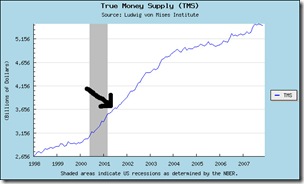
tms-9-11 From 2001 to 2004 now-disgraced Fed chairman Alan Greenspan inflated the money supply to "ease" the US economy through 9/11 and the collapse of the Dot.Com boom (see right).  He added $1 trillion plus to the money supply in that period, "slashing the federal funds target from 6.5% in January 2001 down to a ridiculous 1% by June 2003." [See 'Did the Fed Cause the Housing Bubble?'] At that time, no one was worried about inflation either, but that didn't stop Greenspan's monetary pumping setting off the housing bubble, the boom and now the dramatic collapse.

And the Dot.Com boom itself was caused by the double digit growth rates of the MZM and M3 measures of money supply during the late 1990s to get them through an earlier crisis -- a crisis that was caused by a relaxation of the money supply from 1994 to get out of that crisis -- which was caused by the monetary pumping to rescue the economy from an early crisis ...

Crisis after crisis after crisis, the seeds of each of them planted in the "rescue" from the preceding crisis. 

And people wonder where the so called "business cycle" comes from?!  Better to call it a "Federal Reserve" cycle. [See 'Yet Another Boom?' for similar thoughts.]

So "no one's worried" about inflation, says Brash the former central banker, except several years later when the malinvestments propped up by decades of monetary pumping finally start falling over -- and even then central bankers are too blind to see it for themselves.

No wonder central bankers still read Keynes.  About the long run, they're all braindead.

Thursday, 30 October 2008

Quote of the day: On Greenspan

    "No sympathy should be wasted on Alan Greenspan. He did what John Galt in Ayn Rand's Atlas Shrugged refused to do even at the point of a gun and under physical torture: he agreed to become an economic dictator of the country...
    "Of all the economists who have advised various administrations over the last century, Greenspan had the least excuse for advocating statist economics.
    "When he accepted the appointment by President Ronald Reagan in 1987 to become Chairman of the Federal Reserve, Greenspan "legitimatized" or sanctioned the idea that the government should "manage" the economy with "rational" interventions. Now he may see the true "flaw" in his "good intentions" and what those intentions have inexorably wrought: a greater destruction of freedom and wealth than he admits he could have imagined. "
    - Edward Cline: Alan Greenspan vs. Capitalism

Sunday, 26 October 2008

Quote for the day - Alan Greenspan [update]

As if he was speaking yesterday, instead of when he just retired:

" Relying on policymakers to perceive when speculative asset bubbles have developed and then to implement timely policies to address successfully these misalignments in asset prices is simply not realistic."

The success of Greenspan himself in producing several speculative asset bubbles -- not to mention the present disaster that is now bursting in our faces -- is all the more evidence for his observation.

The man has sold out everything he ever said he stood for, for a career only a second-hander could want -- and is revealed now as a fraud, a phony and the living example that one man in charge of a printing press cannot do anything to improve markets, but he sure as hell can destroy them.

UPDATE: Willie's comment nails it:

    I just can't believe this man and the media.
    The evasion is phenomenal.
    Here is the man who sets the price of credit, centrally, proclaiming that his "free market ways have failed."
    WTF!!!??? WHAT free market ways?
    Damn it he sets the price of credit!
    If Alan Greenspan poured water into the petrol tank of a car, and the car failed to start, he would proclaim that petrol has failed the automotive industry.
    The media would nod, the politicians would agree.

I'll have more to say tomorrow, but that summary will be hard to beat.

Wednesday, 15 October 2008

No indeed, Minister [updated]

You have to laugh.  Earlier in the week No Minister was rightly lambasting Michael Cullen for meddling with the New Zealand Superannuation Fund -- insisting that the Super Fund, which is supposed to relieve the need for taxpayers to fund NZers' retirement years, must "invest" instead in "long-term infrastructure bonds," bonds whose returns will be paid for by the taxpayer.

It's not just insane, but once you start the meddling any hint of it being an "independent fund" is gone -- and before you know it Minister for Tasteless Crap Sue Kedgley will be insisting it must "invest" in mung bean manufacturers and ethical bone carving. 

Said National-supporting No Minister about Cullen's signalled intervention this leaves Cullen "looking more like Muldoon by the minute." 

But now John Key is doing the same.  See: National to legislate for at least 40% of NZ Super Fund to be invested in NZ.

This is bad.  Crikey, even National man David Farrar thinks it's bad: "We don’t want MPs in charge of a $100 billion fund," he says.  No, we sure as hell don't.

But Key does.  Key is signaling here that he's a tinkerer.  A meddler.  An interventionist. In his facile way he thinks his laudable success in the world's finance markets qualifies him as a politician to be tinkerer in our local markets. It didn't work for Muldoon -- hell, it didn't even work for Greenspan -- and it sure as hell won't work for Key, or for us.

You have to laugh.  if you didn't laugh at what they're all doing with our money, you'd cry.

UPDATE  1: Looks like No Minister aren't the only ones from the Blue Team who will need to give their Team Leader an uppercut.  The stodgy fraud who calls himself Adam Smith wrote earlier in the week that "directing the so called ‘Cullen Fund’ to invest more in NZ for political reasons is worse than National reducing Kiwisaver contributions," and their assault on the independence of the Super Fund shows "Clark and Cullen seem determined to gain short term political advantage for themselves and the Labour Party at the expense of New Zealand and the New Zealand citizenry."

I look forward to his response now his hero has plumped for the same mess of short-term political advantage.  [UPDATE: Good to see 'Adam' rightly upset, if a little muted: "No this is not a good idea."  It's worse than that, mate.]

UPDATE 2:  "This is a defining election issue," said No Minister's Adolf about Cullen's intervention. "Nothing is sacred for these greasy pricks. Remember the Kirk superannuation fund the demise ... has been widely vilified by people of all political stripes."

What do you think Adolf will say once he realises that "greasy prick" John Key is just as much an interventionist as the other "greasy prick" Adolf so despises?

UPDATE 3: Crampton comments:

    I'm intensely disappointed in the commentariat over at Kiwiblog. The same folks who would be (and were) foaming at the mouth about the policy when proposed by Labour find all kinds of reasons to love it when proposed by National.
    More evidence that Caplan's hypothesis in The Myth of the Rational Voter is right. For most folks, politics is just cheering for the home team, without any thought given to the content of policy.

He's right, you know.

UPDATE 4: Paul Walker has a summary of blog commentary on Key's capitulation to collectivism.

Weimar Republic here we come

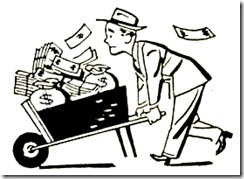
MoneyWheelbarrowLeft People here and elsewhere have been asking where all the money comes from to pay for all the world's governments' rescue plans.

Apparently they haven't read Ben Bernanke's comment in 2002 (back when his then boss Alan Greenspan was inflating his way out of the collapse of the Dot.Com bubble and sowing the seeds for this latest collapse):

The US government has a technology, called a printing press (or, today, its electronic equivalent), that allows it to produce as many U.S. dollars as it wishes at essentially no cost...

Author Peter Schiff points out in this CNN interview that Americans blew through their savings in the Dot.Com crash, too few people want to lend to Americans now, so to pay for all those rescue plans Americans at least "are reaching for the printing press." 

And in Europe?  Essentially just the same.  The "responsibility" of paying for the "rescue plans" rests on the central bank's printing press and the wilting shoulders of taxpayers. But unlike the facile reasoning of Bernanke, the printing press does not come "at essentially no cost." As Honorary Professor at the Frankfurt School of Finance & Management Thorstein Pollett explains,

    Under today's fiat-money regime, banks, under governments' auspices, increase the money stock "out of thin air" whenever they extend loans. The money supply is built on credit, which, in turn, hinges on peoples' confidence in banks and banks' confidence in their borrowers' ability and willingness to service their debt.
    As confidence leaves the system, banks refrain from extending loans and demand repayment of outstanding loans, and the money stock contracts. Economies that have for decades been fuelled by ever-higher doses of credit and money fall into depression — that is, declining production, employment, and prices...

The "punch bowl" of never-ending credit expansion has been taken away, and while the hangover is now in full swing the response from all the "rescue plans" so far is to keep the punch bowl topped up and spiked with an increasingly toxic mix:

  • More credit, by increasing the base money supply in the interbank market,
  • Guarantees for financial institutions' liabilities, and
  • Nationalising the world's banks. 

How is it all paid for? 

  • By government sponsored credit, and
  • Money-supply expansion.

In other words, by more of the same.  And the expected result?  Thorstein Pollett again:

... it is hard to see how fighting the symptoms of the unfolding monetary fiasco could solve its underlying cause.

True.  And ...

Starting the printing presses wouldn't solve the debt crisis either. Hyperinflation would cause economic and political damage to the greatest possible extent.

So...

    To qualify as a remedy to present ills, government action needs to be constrained to a far-reaching reform of the monetary systems, which, if implemented properly, would neither cause deflation nor inflation.[1] Markets need to be liberalized to the greatest extent to allow prices to adjust back to equilibrium.
    A return to sound money is needed.

You think that's going to happen?  You think the house of cards can be repaired from the ground up?

Or is it Weimar Republic here we (all) come?

UPDATEBusinessweek magazine explodes the idea that New Zealand can ride out the world financial crisis.  Reports NBR:

    Businessweek has named New Zealand as one of the 13 countries likely to be hit hardest by the global credit crunch.
    New Zealand, which scrapes in at 13th place, is joined on the list by countries like Pakistan, Argentina, Serbia and Kazakhstan.
   Businessweek compares New Zealand to Iceland, saying both countries were favourites of investors playing the yen carry trade...
    But it’s not all bad: “Unlike Iceland, though, New Zealand's banks have strong support because most of them are controlled by bigger banks across the Tasman Sea in Australia.
    “The New Zealand government also is in a stronger position than Iceland's, having run budget surpluses of around 4% of GDP until recently. Even with the country in recession, the government is likely to continue running a budget surplus..."

Maybe Businessweek hasn't read the "economic plans" of either Cullen or Key, since both plan to plunge the government firmly into deficit...

Monday, 13 October 2008

Bubble, bubble, housing and trouble

ATM-Housing How do you tell the difference between an investment and a hole in the ground?  It's not always as as easy as you might think. 

When prices of widgets or wodgets are going up and up and up, it's easy to think that widgets or wodgets -- or tulip bulbs, or llamas, or ostriches -- or houses -- represent a real investment, and not just something whose returns are based solely on the number of 'investors' stampeding into the market desperate to make 'capital gains.' 

The 'capital gains' for these 'bubble commodities' are real enough, at least at first, but the cause of rising prices is frequently nothing other than the same thing that drives your friendly, neighbourhood pyramid scheme: new people with new money coming on board all the time. So too is the cause of the eventual collapse the same: no new people, no new money, and a slow realisation that the market has been inflated beyond all reason -- that the reason for the gains was illusory.

TulipPriceIndex1636 The chart for the seventeenth century Tulip Bulb Mania (right) stands for all such bubbles -- a brief inflationary bubble that literally feeds upon itself, followed by rapid collapse as early 'investors' leave the scheme, only to see the pyramid/bubble collapse and prices go back to a level based on fundamentals rather than flatulence.

The same thing happened with the South Seas Bubble in the eighteenth century, the Railway Mania in the nineteenth, the Florida Land Bubble in the 1920s, the Japanese Asset Bubble in the 80s, the Dot.Com Bubble in the 90s ... and now the Housing Bubble of the 2000s, the one that we're all now paying for.

You see, real resource are used up in these false 'booms' -- real resources that are bid away from genuinely productive  businesses into sectors that are considered (at the time) to be sexier, and more profitable.   Sometimes there's a real reason underlying price gains -- increased profits from railway companies; restrictions on land supply imposed by governments - but the bubble builds on the back of these initial gains and leverages them into something insane, whose returns are measured only by the new money coming into the market.

You might have noticed that bubble behaviour in the last century has been more frequent and more virulent:  US Fed chairman Ben Bernanke's favourite technology, the printing press.   Said Bernanke in 2002, when his then boss Alal Greenspan was inflating his way out of the collapse of the Dot.Com bubble and sowing the seeds for the collapse of the housing bubble:

The US government has a technology, called a printing press (or, today, its electronic equivalent), that allows it to produce as many U.S. dollars as it wishes at essentially no cost... under a paper-money system, a determined government can always generate higher spending and hence positive inflation.

"Positive inflation."  Central banks and their printing presses, and the "positive inflation" of their bubbles, are in all important respects a twentieth-century inventionEvery time the central banks inflate the money supply, we see a boom.  An inflationary boom, followed by a bust.  This time it happened in housing, and everyone thought they were making a million dollars.  Alan Greenspan's inflation of the money supply from 2001 to 2004 (right) underpinned the housing bubble that is only just starting to burst here and elsewhere.

When you look at charts of the US housing market (right) you can easily see the bubble and its correlation with Greenspan's inflationary injection.

Notice [says the bubble watcher from whom I pinched that graph] that in the 25-year period from 1975 through 1999, real house prices stayed roughly within the range of $132,000 to $171,000. Only since the year 2000 have real house prices risen above the top of this range. The United States median price was at approximately $206,500 as of the second quarter of 2008. This is 21% higher than the previous housing boom peak of an inflation-adjusted $170,900 in 1989.

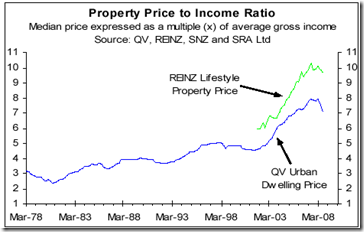
imageThe NZ housing market performed the same way, based on our own Reserve Bank's inflationary credit creation, as this chart (right) from Rodney Dickens latest 'Raving' demonstrates.

In both markets, relative stability over recent decades erupted into a credit-fuelled bubble that can only collapse once the air is taken out.

Gareth Morgan reckons the drop in prices will be something like thirty percent.  Study those graphs and you'll see why. 

And if you want to know where all the money has gone, to understand what happens when central banks use Ben Bernanke's favourite technology to "generate higher spending and hence positive inflation," study your credit card statements to see how you've been using the "investment" in your home to consume your capital.  Take a look at the empty subdivisions and unsold or uncompleted developments around the likes of Orewa, Omokoroa, Tutukaka, Mangahawai, Raglan, and other 'boom' areas in recent years.  Inflationary credit creation has bid resources away from genuinely profitable work, and into malinvestments such as these whose replacement cost (over-inflated by regulation) is now higher than their price that buyers are willing to pay.

Such is the inevitable result of resorting to the printing press to fake economic reality.

FURTHER READING:

  • Confidence Is Leaving the Fiat Money System, by Thorsten Polleit, October 10, 2008
  • What's Behind the Financial Market Crisis? by Antony Mueller, September 18, 2008
  • Our Financial House of Cards, by George Reisman, March 25, 2008
  • The Housing Bubble in Four Easy Steps, by Mark Thornton, September 27, 2008
  • The Economics of Housing Bubbles, by Mark Thornton, June 6, 2006
  • Did the Fed Cause the Housing Bubble? By Robert Murphy, April 14, 2008
  • Housing Bubble: Myth or Reality? By Frank Shostak, March 4, 2003
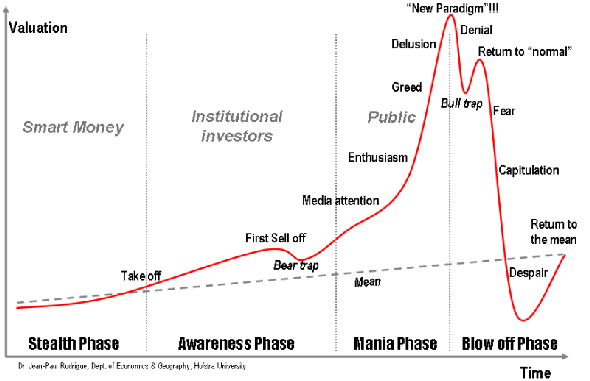
  • UPDATE: Jean-Paul Rodrigue at NY's Hofstra Uni has a chart that describes all bubbles over time:

    bubblesandmanias

    Wednesday, 24 September 2008

    Borrowed time - the anatomy of recession

    stabilization (1) When the stock market crashed in 1929, it brought on the world's worst disaster since the First World War. In the US, it was the worst calamity to face the nation since the Civil War. 
    By the end of 1930, one in four wage earners was out of work. In one day in Mississippi, one quarter of the entire state was auctioned off. Prices of wheat and corn were so low, crops were left to rot in the fields. "Somebody had blundered," wrote F. Scott Fitzgerald, "and the most expensive orgy in history was over."
        It was borrowed time anyhow -- the whole upper tenth of a nation living with the insouciance of grand ducs and the casualness of chorus girls.  Even when you were broke you didn't worry about money, because it was in such profusion around you.  Toward the end one had to struggle to pay one's share...
        Now once more the belt is tight and we summon the proper expression of horror as we look back at out wasted youth ... when we drank wood alcohol and every day in every way we grew better and better and people you didn't want to know said "Yes, we have no bananas" -- and it all seems so rosy and romantic to us who were young then, because we will never feel quite so intensely about our surroundings any more.
    Wars and depressions.  Recessions, booms and busts.  They're written about afterwards as if they're natural events over which man has no more control than we do over hurricanes and earthquakes, when they are in every way as man-made as a Monday morning hangover -- which is perhaps the very best metaphor for economic depression. 
    Somebody has blundered, and we're paying for it again.
    With every depression, with every hangover, if we have any insight we must look back and ask ourselves, "wha' happened?" and make sure we don't do it again.  What happens instead however is we wake up saying something like "Ooh, never again!" -- and within the week we're back on the turps and gibbering again about bananas, whether we have them or not.
    History repeats itself, but only if we're too dumb to learn. The pattern of the twenties was replicated over the last decade; the collapse is almost a repeat of the consequent disaster; and the bailouts intended to prolong our own orgy of the last few years replicates the bailouts of Herbert Hoover's abysmal administration. 
    They didn't work either.
    But what caused the collapse of 1929?  Like every monumental hangover, the collapse was inherent in the orgy. And like that one, those responsible for the monumental blunder are shucking off the blame, and seeking even more power to do it all over again.
    Financially speaking, the twenties in the US were characterised by three things: the rise of the central bank to prominence and the idea that there was a "new era of prosperity" in the air; an era of easy credit, which helped to foster the idea that a "new era of prosperity" was in the air; and the single-minded pursuit of "price stability," which led to the pumping of the money supply and all that easy credit.
    Sound familiar?
    For almost the entire decade of the twenties, the Federal Reserve vigorously pursued a policy of "price stability." The grandaddy of all Fed Governors, Benjamin Strong -- the predecessor to Greenspan and Bernanke -- wrote in 1925,
    that it was my belief, and I thought it was shared by all others in the Federal Reserve System, that our whole policy in the future, as in the past, would be directed toward the stability of prices so far as it was possible for us to influence prices.
    And again in 1927, when asked in that years "Stabilization Hearings," whether the Fed could "stabilize the price level" through open-market operations and other control devices:
    I personally think that the administration of the Federal Reserve System since the reaction of 1921 has been just as nearly directed as reasonable human wisdom could direct it toward that very object.
    Sound familiar?
    They aimed for "price stability," and they succeeded: Consumer prices and wholesale prices were stable for most of the decade.  But they shouldn't have been.  They should have fallen.  Increased mechanisation, increases in scale and increasing productivity should have made prices fall.  To keep prices up -- to keep them 'stable' -- The Fed had to inflate, and inflate and inflate again.  In 1921, before their inflation of the currency began, the total American money supply was $45.3 billion.  By July 1929, when the stock market first started to crack after a year-on-year expansion of the money supply (which in 1924 was as high as 11.6% !), it had exploded to $73.29 billion.
    As economists CA Philips, TF McManus and RW Nelson said in 1937, "the end-result of what was probably the greatest price-level stabilization experiment in history proved to be, simply, the greatest depression."
    That $28 billion, created out of thin air, had to go somewhere.  Where it went, for the most destructive part, was into capital goods.  Consumer prices and wholesale prices were stable, but the General Price Level (which included housing, commercial property, foods and farm products) rose considerably.
    Sound familiar?
    Just as in the twenties, so too over the last decade, where in order to keep consumer prices "stable," the money supply had to be inflated year-on-year to conceal by inflation the productivity effects of the internet age and and of the flood of cheaper consumer goods from Asia -- and the monetary inflation blew out first in the housing market. Just as in the twenties, so too in the 'Noughties,' the expansion of the money supply squandered real wealth and led to economic destruction.  And so it has been every time the expansion of the money supply has been substituted for genuine prosperity, in the US and NZ just as surely as in Zimbabwe -- as this graph so clearly demonstrates:
     
    We might write it as a general rule: Monetary expansion always cometh before a fall.
    The flood of easy credit always has to blow out somewhere.  Where it first blew out this time was the housing and mortage sector, and Jeff Perren starts a series today tracing the course of that particular sector of the disaster.  (The first two parts are here and here.)  But if you think, as George Bush and Ben Bernanke and Henry Paulson seem to think, that the blow-out will be contained to the housing and mortage sector, then you are even more deluded than we already have good reason to think they are.
    As Frank Shostak pointed out yesterday,
        The Bush administration is asking Congress to let the government buy $700 billion in bad mortgages as part of the largest financial bailout since the Great Depression. The plan would give the government broad power to buy the bad debt of any US financial institutions for the next two years. It would also raise the statutory limit on the national debt from $10.6 trillion to $11.3 trillion.
    tms-9-11 (1)     At the root of the problem are not mortgage-backed assets as such but the Fed's boom-bust policies. It is the extremely loose monetary policy between January 2001 and June 2004 that set in motion the massive housing bubble (the federal-funds-rate target was lowered from 6% to 1%). It is the tighter stance between June 2004 and September 2007 that burst the housing bubble (the federal-funds-rate target was lifted from 1% to 5.25%).
        Can the "rescue plan" fix the US economy, or will it plunge us into the mother of all recessions?
        On account of the time lag, we suggest that the tighter interest stance of the Fed between June 2004 and September 2007 has so far only hit the real-estate market and financial institutions.
        Various bubble activities that sprang up on the back of loose monetary policy between January 2001 and June 2004 are not only in the real-estate and financial sectors; they are also in the other parts of the economy.
        Consequently, there is a growing likelihood that these activities will come under pressure in the month ahead regardless of the rescue package. Since these activities are the product of loose monetary policy, obviously the banks that supported them are going to incur more bad assets, which will put more pressure on banks' net worth.
        Contrary to popular belief, the rescue package cannot help the economy; it will only severely weaken wealth generators. (The larger the package, the more misery it will inflict.) Hence, once the massive rescue plan is implemented, it will not prevent an economic slump but, rather, runs the risk of plunging the economy into the mother of all recessions.
    Shostak is not alone in his analysis.  The whole capital structure is contaminated, not just the housing and mortage sector. The easy credit has worked its way all through the capital structure like termites through your new home -- adding more weight to that structure when what producers need is to be left alone to restructure stick by stick will only extend the misery, and delay the necessary recovery.
    And as for calls to regulate the "deregulated" capital markets, only a myopic drone could even take such calls seriously.  As Michael Hurd points out in today's Washington Times:
        I don't understand why the lesson of the recent financial meltdown is that we must return to regulation. The regulatory infrastructure we have today has been in place since the 1930s New Deal - and before.
        This infrastructure was supposed to prevent such a meltdown from happening. The federal government guarantees everything. This transformed capitalism from a system in which all financial institutions are privately run - and financially responsible for their mistakes.
         Deep down, business executives always knew they could appeal to the government if they made foolish decisions that cost untold billions - and that's exactly what happened.
        Our mixed economy - neither capitalism nor all-out socialism since the 1930s - performed exactly as it's supposed to perform in the context of a heavily regulated market.
        We could basically respond in one of two ways. One way would be to acknowledge the experiment in the mixed economy as a failure, refuse to bail out those who counted on the government to rescue them from their mistakes and evasions, and start clean with a private marketplace.
        It would be painful, but there's no escaping pain after a mistake of this kind. The other alternative is what's happening now: to bail out most if not all of the failing institutions; to require American taxpayers to foot the bill; to nationalize and even further regulate what's left of the industry, where possible; and to remove still more - maybe even most, at this point - of the capital out of capitalism.
        Sens. John McCain and Barack Obama don't fight over which direction in which to move. Fundamentally, they agree: We need more regulation, more government and less capitalism.
        Fine. Will one of them please explain, then, how more of the system that brought us to this point is to rescue us suddenly?
    Even if either was economically literate, it would be impossible.  And neither of them are.
    UPDATE 1: Via Anti Dismal, Don Boudreaux wonders why, since the government's money supply policy is obviously so crash hot, we don't we have the same policy for steel supply.  Good reading.
    UPDATE 2: I am in receipt of an excellent letter to the editor of the NZ Herald, in response to their appalling editorial yesterday:
    Dear Sir,
    In your editorial of 23 September you refer to the US government’s bailout of the financial system as “rewarding the guilty” and then note that “… when markets fail, government is the only solution.” The only truly guilty party is the party to which you are now turning to for “solutions”.
    Since the creation of the Federal Reserve in 1913, there has been a significant debasement in the value of the US dollar due to the unrestrained increase in the money supply by the Federal Reserve, i.e they have been printing money. Since 2001, this has manifested itself in a housing bubble, the recent bursting of which is a healthy recognition by the market that the real value of these assets is much lower.
        The seeds of the current crisis were therefore laid many decades earlier with government intervention in the market. It is they who are guilty and they should not be rewarded with additional powers to intervene, actions that will lead to the further destruction of economic wealth.
    J. Darby
    Auckland