Showing posts with label Kim DotCom. Show all posts

Tuesday, 21 February 2017

In New Zealand it is not illegal to steal the fruit of other people's labour


Yesterday we discovered that in New Zealand it is not illegal to steal the fruit of other people's labour.

I learned that from reading the Herald this morning, who on page three quoted the High Court judgement against Kim DotCom, which said, and I quote: “online communication of copyright protected works to the public is not a criminal offence in New Zealand under s131 of the Copyright Act."

This is passing strange for many reasons, not least because this was the very section of the law that led to the fat German’s arrest. But also because s131 of New Zealand’s 1994 Copyright Act (written a few years before the internet was really a thing) says quite clearly that

Every person commits an offence against this section who, other than pursuant to a copyright licence … in the course of a business or otherwise, sells or lets for hire; or distributes otherwise than in the course of a business … an object that is, and that the person knows is, an infringing copy of a copyright work.

It is without question that the internet pirate and his business cronies did knowingly and with aforethought organise, arrange and seek out the job of distributing (but not selling, letting or hiring out) a great many “objects” that they know were infringing copies of copyright work. That was this fat slug’s very business model, aiding and abetting outright theft, as demonstrated in emails sent by his other slugs saying: "We're not pirates, we're just providing shipping services to pirates." The loophole that by all accounts brought these counterfeit businessmen to New Zealand and which the High Court confirmed yesterday is unplugged is those few words “otherwise than in the course of a business.”

Those few words, it seems, mean that online communication of copyright protected works to the public is not a criminal offence in New Zealand just as long as you have those people paying these people to help them steal other people’s work. Which means that in New Zealand it is not illegal to steal the fruit of other people's labour.

We have this fat slug to thank for showing us that.

.

Wednesday, 20 May 2015

John Banks: justice delayed

So John Banks is innocent of filing phony electoral returns. But he is still guilty of being John Banks. And being John Banks now appears to be the reason for him being charged in the first place, and for evidence in his favour being withheld by the prosecutor.

But whatever you think about the former Minister of Rhyming Slang, and my own estimation is subterranean, his case highlights a serious problem with NZ justice. And I don’t just mean the problems of evidence.

I mean the extreme fricking delay in getting justice.

As they say, justice delayed is justice denied. Banks filed his electoral return in 2010. Five years ago. This first went to court in 2012. It’s only yesterday, when it was confirmed he wouldn’t face a retrial, that his name was finally cleared.

Three years.

He was put through the mill.  Utterly unable to get on with his life. His political career was terminated– for which some, me included, are very grateful. But a man, even this one, is entitled to something in the way of justice much swifter than this.

Justice delayed is justice denied. Even if it’s denied to John Banks.

Wednesday, 17 September 2014

That’s democracy, David

I have to laugh at David Farrar getting angry because DotCon turns out to be a bigger blowhard than Winston Peters.

For months and even years we have given Kim Dotcom a slight benefit of the doubt. He claimed back in 2012 that he had evidence John Key knew about him before 19 January 2012. He said he would produce this evidence in court.
    He never ever did.
    But he kept insisting he had the evidence…Most of us thought the evidence would be ambiguous at best, or inconsequential – but thought he would at least have something.
    But it seems he had nothing at all. The claimed e-mail is so obviously a fake (
see Danyl McLauchlan), that he didn’t even present it at the meeting…
   I’m angry about this, and you should be also…

David’s angry.

Why is David angry?

Because election. [Emphasis that follows is all David’s.]

   Kim Dotcom has tried to hijack our democracy and we should be angry about this… New Zealanders should have been having a final week debating . But Dotcom’s media manipulation has tried to make it all about him…
   
Yes some of the stuff alleged by Snowden is of public interest …

Butt me no buts, David. The stuff alleged by Snowden and Greenwald is of public interest [emphasis mine] and no matter how flaky their host is, (which is substantial0 it is perfectly appropriate to spend a week or more debating their allegations.

It’s not like there’s really a major item of difference about which to debate what any of the major parties propose in the economy, the health system, the education system, jobs, incomes, welfare, housing or the like. All (both?) propose various degrees of state intervention, often along remarkably similar lines.

It’s true that there’s not really a scintilla of difference either in what they might do about what Snowden and Greenwald allege, but that doesn’t make it wrong to debate it in the last week of the election campaign. [Emphasis mine, that time.]

Because, you know David, in an election campaign there’s no “we should” about what we discuss.

You and the major party campaign managers might like to talk about the economy, the health system, the education system, jobs, incomes, welfare, housing or the like – and I talk about these myself, because I too think they are important. But some people want to talk about property rights and individual liberty; some want to talk about why they should be arrested for smoking a joint; some just want to talk about the lies that politicians tell (which are many) and the promises they tend to keep (which are few); but whatever they want to talk about in the last week of the election campaign is entirely up to them. [Emphasis, once again, all mine.]

That’s the whole point about democracy, I’ve heard.

In a democracy, you don't get to dictate what everyone gets to talk about. You don’t get to dictate what issues they want to vote about. What everyone talks about is, well, up to everyone. That I guess is one of the key  points about a democracy. Like it or not, it's not a bug, it's one of its features.

That’s the lesson for today.

If democracy is the counting of heads regardless of their content, and it is, then you don't get to complain about what those heads want to talk about, if what they want to talk about is not always of your own choosing.

Tuesday, 16 September 2014

“The Moment of Truth”: Too many agendas

“A proper government is the agent of its citizens, not the master. In its role
as the agent, the default should be openness, not secrecy;  in very few
contexts is it appropriate for the government to operate in secrecy. Only
when the government can convince its citizens that secrecy is necessary
for protecting their rights is it acceptable. With respect to the NSA [and
GCSB
and SIS] surveillance programs, that burden has not been met.”
- Yaron Brook, YARON BROOK'S POV — NSA MONITORING: SHOULD WE BE WORRIED?

IT HAD BEEN BILLED by Kim DotCon as “The Moment of Truth” – "a political bomb" – THE moment when he would prove beyond a shadow of a doubt that John Key knew about DotCon before the raid on his house, and by implication that Key had conspired to get him into the country so as to get him into American hands.

It wasn’t that moment. The shred of evidence DotCon floated earlier yesterday had already been shot down as fraudulent, and nothing more on that score made any appearance at all.

It was billed by Laila Harre as being “framed” by Hager’s #DirtyPolitics, hyped by DotCon’s lawyer as being “Watergate on emails.”

It wasn’t that either (and really never was).

And it was promoted by the likes of Martin/Martyn Bradbury as something that would make your head blow off.

It may well have done that for him (but how would the rest of us ever know the difference.)

There was a wrestle of agendas going on among an ill-sorted collection of folk: a copyright thief keen to make it about him; a political party leader and activists running an election rally; a public launch of the fat German’s “communications suite”; the fat German’s lawyer launching anti-corporate barbs and trying to turn it into an anti-TPPA rally…

Take away the puffery of these poseurs, and the rambling irrelevance of Julian Assange, and in the end what you had was a story presented by Glenn Greenwald and Edward Snowden that needs sober consideration -- but will hardly get them given the context in which they were put, and the company in which these two global figures allowed themselves to appear.

And there was still a glaring absence of smoking guns.

Snowden claimed NZ’s GCSB as part of Five Eyes has been ramping up towards a system of mass state surveillance which, if true, is worrying. But what was his evidence?

He said the American National Security Agency (NSA) has a base in Auckland “and in the north of the country.” Sounds ominous, but Paul Buchanan suggested this morning the Auckland connection is probably no more than an NSA agent at the American Consulate in Auckland, who may have the services of a satellite dish. The facility up north one assumes is the Warkworth satellite station, which he suggests by implication is subject to monitoring. This deserves further investigation.

Snowden claimed that when working for the NSA in Hawaii he routinely handled metadata from NZ’s GCSB, and could easily drill down into the metadata to investigate content. But he had no specifics, no documentary evidence, just a discussion (on which he had expanded in his Intercept article earlier yesterday) about a checkbox on the XKEYSCORE system used to compile and analyse data.

That solitary checkbox, the Five Eyes Defeat … is what separates our most sacred rights from the graveyard of lost liberty.

Snowden has always appeared genuine, and unlike others at this event appears to understand the importance and basis of “our most sacred rights” – not a gift from government, he said last night, but part of our nature as human beings.

When these things are collected, by any arm of government, without an individualised, particularised suspicion of wrongdoing, on the individual level, that is a violation ... of human rights -- that are not given to us by government,but are inherent to our nature.

He’s right, you know. But unless I missed it somewhere, he’s offered no direct evidence for his claims about mass surveillance in NZ than his testimony last night, his earlier documents about XKEYSCORE, and the reluctance of PMs, leaders of opposition, and former and present heads of GCSB to discuss XKEYSCORE.

He took a swing at the Prime Minister for his public claim that “there is not and there never has been any mass surveillance.” This is false, says Snowden, and only defended now by a Prime Minister “throwing classified documents in the air like Julian Assange.”

Clearly, Snowden sees himself as more careful with classified documents than Julian Assange, and the PM, but he still brought nothing more to back his claims but his cogent discussion and believable demeanour.

If there was a smoking gun last night, it was brought by Glenn Greenwald. While John Key was throwing classified documents in the air defending the non-commissioning of something called CORTEX, Greenwald was documenting a programme called SPEARGUN.

According to Greenwald, [and I’m relying for this summary on Keith Ng’s report] this project involved the "covert installation of 'cable access' equipment" on the Southern Cross cable (i.e. Tapping into New Zealand's traffic with the rest of the world). The existence of this capability cannot be denied.
    In response to the Southern Cross cable's operators saying that such a thing was impossible, Snowden (who videoconferenced into the event) asked (I'm paraphrasing): What makes the Southern Cross cable so special that it cannot be accessed undetected by the NSA, when everyone else around the world can be?
    The new documents show that the GCSB had a cable access project underway, followed by another document that Phase 1 was "achieved". More crucially, he has a message showing:

        (TS//SI//NF) New Zealand: GCSB's cable access program SPEARGUN Phase 1; awaiting new GCSB
    Act expected July 2013; first metadata probe mid 2013.

This shows that they had to wait for the GCSB Act to be passed before SPEARGUN could be used. i.e. The new GCSB Act - the one that supposedly wouldn't expand GCSB powers - expanded GCSB powers to allow them operate a metadata probe on the this cable which they'd tapped.

If there was a case to answer that was presented last night, then that was it.

THE BIGGER PICTURE TO all this is realising that the time-honoured protections against state intrusion into our lives has been breaking down philosophically, legally and politically, just at a  time when new technology makes the possibilities of this intrusion so much more widespread.

“We want to bring down Five Eyes,” said the fat German trying to get a chant going. Well, no “we” don’t. In a world with many threats, intelligence gathering is essential.

The reason we have state security is to protect our most sacred liberties – to protect them against the slings and arrows of war and outrageous criminality. That’s government’s job. But to protect our liberties against those agencies themselves, especially as the power of surveillance and analysis increases, we need more than just checkboxes. 

It is not a matter of left or right. Yes, the centre-right here are defending the GCSB’s alleged excesses and the left are running the argument against the abuse of power, but reverse political power and the positions would be reversed. The left are always against the abuse of power until they have it themselves. And remember too that this process started here under Helen Clark’s Labour, and has been carried out in US under the Democrats’s Obama.

The issue is not party political. It is protection against the state.

In “the old days” the need to obtain a search warrant was your protection against every state agency except the IRD. But we are now in a new age.

In this new age when searches of your data so much more easy than rummaging through your rubbish bins (as easy as tapping a cable, it seems), and analysis of data is as easy as writing a good data mining algorithm (still not that easy, to be fair) what separates our most sacred rights from the graveyard of lost liberty seems to be only the scruples of security agents themselves – and in New Zealand, so the claim goes, those scruples are being sacrificed for the excitement of being part of a world intelligence network in which New Zealand can be a player just as long as it supplies the (meta)data that keeps it in the big tent.

It is really a time for a new consideration of the checks and balances that tie up the agencies who act purportedly in our defence – and those who think it’s all okay now because a nice man is overseeing date collection might like to contemplate how they might feel if it were all overseen by the former PM, or her successor.

But that sober and serious job needs better “framing” than it did with all the agendas on display last night.

PS: I’ll be updating this post over the day as new info and analysis comes to light.

RELATED POSTS (TODAY):

RELATED POSTS (PAST):

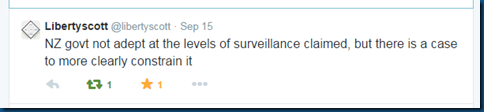
TWITTER, AS IT HAPPENED (oldest to newest)…
image

image

image

image

image

image

image

image

image

image

image

image

image

image

image

image

Tuesday, 9 September 2014

The weed drives people mad.

Marijuana has an almost unique ability to get people unhinged.

Well, not people. Politicians.

Latest to fall foul of their sanity when it comes to the cannabis?  The Internet Mana menage led by Hone and Laila.

Laila’s DotCon front wants to legalise cannabis, for reasons both fair and foul, but good on them nonetheless for being willing to free smokers who like a wee toke.  Hone’s mana however doesn’t allow him to concede on a subject for which he’s previously called for execution – yes, live execution on television, for peaceful pot dealers.

I did use the word “unhinged.”

This is not the first time politicians had a public spat about what should be a straightforward issue of freedom. You’ll recall that Don Brash’s 2011 election campaign was derailed by his ill-chosen colleague John Banks, when the Minister of Rhyming Slang threw a tantrum over Brash’s perfectly principled proposal to legalise a victimless crime.

We might wish that history would repeat for Laila and Hone.

But that hardly advances the principle, does it.

Friday, 15 August 2014

DotCon Drivel

Guest post from our accidental Invercargill correspondent, Jim Cuttance, who inadvertently stumbled into an InternetMana revival meeting….

The principle message from the savvy new internet party that's going to change everything is: don't change anything.

That's what Auckland school teacher and list no. 3 Miriam Pierard insisted at the InternetMana party's Invercargill show this week.

She assured everybody that education in New Zealand was bureaucratic perfection and new-fangled charter schools would ruin things for young people.

Because, you know, overseas evidence and stuff.

Everybody should know by now that the education department always gets everything right and if they know it don't you should send them to remedial education camps and we've got the tax drones right where we want them, thank you.

Furthermore, only a vote for the savvy new Dotcon party that's going to change everything can make sure education won't change.

Pierard and teacher-cum-lawyer Angela Greensill are driven by the desperate need for more teachers, lawyers and unionists on New Zealand's political left. Because they're just aren’t enough already.

They set the platform for megalog-on jillionaire Kim Dotcom to decry New Zealand's slow internet.

He said it was caused by Telecom's undersea cable monopoly but A-lister and unionist Laila Harre wasn't there to explain why monopolies are bad.

And party no.1 Hone Harawira wasn't there to tell us whether he is still a global warming sceptic.

However, Pierard assured us changing climate is a key youth issue, and the savvy new Dotcom party that's going to change everything is going to stop the climate from changing too.

Huzzah!

Plus, I think she's going to feed the kids.

All of them.

Because she's sick of kids dropping dead of starvation in the middle of her climate classes.

I forget why parents have some other priority rather than feeding their kids, but they do, and that’s fair, and it’s not right to ask. And anyway, it's the government's fault and stuff.

OK, I admit I was switching off quite a bit, but if you take anything away from this you know there is a savvy new Dotcom party that's going to change everything.

Or not.

Wednesday, 28 May 2014

Sykes to Co-Lead the Menage of Convenience? [update 2]

UPDATE 1:

NBR is apparently reporting the leader is Laila Harre (right), formerly of New Labour, the Alliance, the CTU and the Greens – and one of the architects of Rodney Hide’s super-shitty Auckland mega-bureaucracy.

If this is true, it might suggest I’m just talking complete bollocks and the only thing DotCon wants out of this is getting Laila Harre and John Minto into parliament.

I guess we’ll have to wait and see …

Pigs Do Fly

Here is a picture of the world’s first flying pig, in 1909.

Tags: first-flying-pig John-Theodore-Cuthbert-Moore-Brabazon pig baskett plane
Pic of John Moore-Brabazon, from the Gloucester Transport History site.

Here’s the most recent.


Pic by www.sunlive.co.nz

Wednesday, 21 May 2014

John Key & the GCSB [update 2]

Two politicians are having lunch together. All of a sudden
one stands up and shouts: “You’re lying.”
“I know,” replies the other. “But just hear me out.”

Circumstance and coincidence, as Russell Brown observes, but there’s a hell of a lot of both about.

Last night's Campbell Live report on the complex story of the GCSB, the Prime Minister, Kim Dotcom, Ian Fletcher and the Americans may have left a few viewers scratching their heads last night. What, exactly, was Campbell saying and what was its import?
    … Certainly, the report was principally a re-stating of previously-aired facts. But its new claims were not immaterial.
    The most interesting of them was that in December 2011, incoming GCSB director Ian Fletcher took leave from his job in Queensland and flew to Wellington for meetings with John Key, acting GCSB boss Simon Murdoch and
Hugh Wolfenson … in the same week that the surveillance of Dotcom began, but we continue to be told that neither Key or Fletcher had any advance knowledge of the surveillance operation or the raid. Key has said he did not know who Dotcom was until the day before the raid and up till now we've thought that Fletcher only came into the picture when he officially started at the GCSB 10 days after the raid.
    The programme also went back over the series of misleading statements [and memory losses] Key has made over his relationship with Fletcher and the circumstances of Fletcher's recruitment…

For a Prime Minister who Fran O’Sullivan reckons is “world class” -- speaking without notes, “completely fluent,” “very much in the mode of a former top-flight international businessman,” “the guy who served on the board of the New York branch of the Federal Reserve” – he continues to have a heck of a lot of very convenient memory loss.

“But he’s such a *nice* man…”  He wouldn’t lie, would he. (Well, only about his achievements and about tax cuts and raising GST and smacking and his share ownership and complementary medicines and manifesto promises and Maori seats and whether or not his GCSB bill will enable them to spy wholesale on all NZers and where he was when the Springbok tour was on (or was that just another memory loss?).

And what of the meeting on

March 16, 2011, a week after it was announced that [former GCSB head General Jerry] Mataparae would be moving on from the job of New Zealand's top spy, [when] US director of National Intelligence James Clapper flew into Wellington for meetings with Key and others. … [And] another meeting, over dinner at the home of British High Commissioner Vicki Treadell on October 11, 2011, where the guests were Key, his head of the Department of Prime Minister and Cabinet Martin Wevers, SIS chief Warren Tucker, Ministry of Foreign Affairs CEO John Allen, Defence Force chief Lt Gen Richard Rhys Jones -- and Ian Fletcher, four months before taking up his role at the GCSB. All of them have declined to comment on the purpose of the meeting.
    The meeting at Treadell's home may simply have been a get-to-know-you for Fletcher. That wouldn't be unusual. But it does seem unusual that Fletcher, having been brought into the loop so far in advance of starting his new job, and then having flown over yet again for a meeting in the same week that surveillance of Dotcom actually began, remained innocent of what was a notable and legally perilous operation on behalf of the US government.

As Russell says, “Campbell Live may turn out to have grossly over-reached, as critics insist. But there seems every reason to keep digging.”

And to keep asking why foreign officers of the law like the FBI were given complete carte blanche to operate within our borders, with our GCSB acting apparently as handmaiden.

UPDATE 1:  Russell Brown updates subsequent events at Question Time this avo:

Key has just been pressed on the issues at Question Time.
        - He has admitted that *both* meetings with Fletcher were organised by his office.
        - But he insists he didn’t discuss the GCSB role at all with Fletcher at the breakfast meeting.
        - Asked about his false statement that Rennie came to him with the proposal to hire Fletcher: "that was
          my recollection at the time".
        - He “can’t be sure” whether DPMC briefed him about Kim Dotcom on December 14.
The last one is absurd. He’s been repeatedly pressed on his foreknowledge of Dotcom and insisted he’d never even heard of the guy until January 19. Now he says he hasn’t even checked to see whether he got a briefing on Dotcom from his own department?
   
How on earth does he get away with this stuff?

UPDATE 2:  Dim Post:

But Kim Dotcom is only one of 88 instances of illegal spying that we know about, and the GCSB were, presumably, also conducting some surveillance that wasn’t against the law. Kim Dotcom is their only operation we’re aware of so I think there’s a temptation to build narratives around him. If we didn’t know about Dotcom and instead knew, say, that the GCSB had illegally spied on New Zealand based friends and relatives of Daryl Jones, the dual New Zealand/Australian citizen assassinated in a drone strike in Yemen in November 2013 (there’s no evidence this happened but it’s not unlikely) then we’d be looking at it all very differently and try to find meaning in Fletcher’s appointment there.
    Because Fletcher’s appointment is weird. Why did Key shoulder-tap this guy with no background in intelligence to be head of our signals intelligence agency and then repeatedly lie about it? Even if you don’t buy into the Campbell Live narrative and – like DPF – think its all an absurd conspiracy theory, that’s still a pretty relevant question.

Monday, 14 April 2014

MMP = More Marriages of Convenience?

I can’t think of a fancy-arsed acronym to describe it, but MMP obviously stands for More Marriages of Convenience. The InterMana Party sort-of agreement, should one ever be made and either party (or agreement) stay around long enough to make a difference, is exactly the sort of marriage of convenience the MMP laws, rules and environment not only makes possible, but positively encourages.

Why that should surprise media commentators says more about media commentators than it does about either Mr and Mrs Harawira or Mr DotCon.

Regardless of what the media commentators think, the rules as written do favour deals between small parties with either big policy differences,1 or going for different votes2.

A ManaNet Alliance fits both bills. The groups are different enough that they’re not competing over the same policy ground. And they have sufficiently similar aims (getting rid of National; promoting leaders’ egos) that they have something around which to coalesce.

The rule being exploited is that allowing a victory in a constituency to trigger MPs on the basis of party votes. While the arrangement being discussed by DotConAndHarawira may not have been contemplated by the rule’s writers, again, says more about the writers than it does the negotiators. 

That it would suit both Harawira and DotCon and  is obvious. For the former, he can trade his potential for electoral success in return for gobs of DotCon’s money (if by then the FBI haven’t got it) and maybe even an extra MP; for the latter, it allows him to parlay his ill-gotten money into MPs – and, thereafter, he hopes, negotiating power in a new Government that might deliver him immunity from extradition.

Both get what they want, they hope, courtesy of MMP.

It may not be what anyone ever contemplated when MMP was begun, but maybe when this jerry-built electoral system was set up, it should have been.

* * * *

1. Parties with very similar policies will obviously be fighting for the same voters, and might therefore find little  on which to agree organisationally, normally...
2. Whereas parties going for different votes, with one going for party votes and the other for electoral, may be able to accommodate each other to mutual benefit whatever their perceived differences, or similarities.

Monday, 31 March 2014

The Internet Party: Mostly Clowns

image

The magic of German megalomania continues to transform journalists into either sourpusses, sycophants or clowns.

Mostly clowns.

Last week was another political and journalistic circus, with both DotCom and the commentariat turning themselves into clowns.

The circus started with Dotcom’s “confession” he owned a book, and continued with his party “launch.” A “soft” launch, you’d have to say, since virtually the only thing we heard about it was that DotCom owned both a book and an MP.

About the book, a signed copy of Hitler’s Mein Kampf, a breathless herd chased down the “story” as if by their endeavour alone they could apply Godwin’s Law and spike an election campaign.

Possibly the worst two were Colin Espiner and the self-satisfied TV3 muckraker with a face that looks like an arse. Espiner’s drivel on how owning a book makes you a Nazi was reinforced by staunch analysis like this:

Some detailed policy may help protect the party from accusations it is nothing more than a vanity project for an ego maniac concerned only about his reputation and avoiding spending time in a US jail cell.
    So far there's been nothing but meaningless platitudes such as "a party for people who care about a digital future" and the hoary old "breath of fresh air … dose of common sense". The Internet Party promises more jobs, cheaper broadband, more modern schools, and, quite possibly, free apple pie.

Funny as a fight. A shame the alleged journalist overlooked a fairly substantial policy that other parties would do well to pick up: ending the surveillance state.

I find it curious too that Espiner isn’t alone in making up the party’s policy position on this: most other media  also  ignored that fairly substantial policy plank, just as they continue to ignore the rise and rise of the surveillance state itself.

Much easier just to go through a fat man’s rubbish bags.

Fortunately, former Fair Go presenter Brian Edwards did for journalism what he once tried to do for honest commerce, castigating Espiner’s “mindless shit,” and pointing out the irony of journalists “exhibiting the mentality of book-burners”:

They are people who believe that a man’s character may be judged not merely by the contents of his library but, in this particular case, by his ownership of a single book. Their logic, as I argued in my previous post, is that if the contents of a book are evil then the ownership of such a book is itself evidence of evil:
    
   ‘Kim Dotcom owns and has read a copy of Hitler’s Mein Kampf. Hitler was the founder of National
     Socialism and one of history’s most evil men. Ergo: Kim Dotcom must be an evil Nazi.’

    The Dotcom/Mein Kampf story was first given national prominence by TV3 journalists Brook Sabin and Patrick Gower who confidently predicted the end of Dotcom’s political aspirations and, one might assume, of his hopes of remaining in this country, as a result of his owning a priceless historical document, signed by Hitler himself and dedicated to his cellmate Hermann Esser.
    So the first irony lies in journalists, traditional advocates of free speech, if not actually promoting book-burning, at least fanning the embers.
    But then, in the current climate of New Zealand commercial television, sensation mongering is precisely the journalist’s job.

You could even call it “braindead.”

* * * * *

Full disclosure: I once owned a 1941 Wermacht belt buckle, a copy of a Leni Reifenstahl movie, a World War 2 era  British helmet and campaign medals, and a scale model of a T34 Russian Tank. But I am neither a Nazi, an imperialist, or a sympathiser of Stalin. Just so you know.

[UPDATE: This is not to denigrate the entire profession of journalists, some of whom still do excellent work . Like Rebecca MacFie’s thorough summary of the series of events leading to the collapse of the CTV building.
[Hat tip Eric Crampton]

Thursday, 16 January 2014

Kim DotCon takes another scalp

It seems Kim DotCon is political kryptonite to anyone he touches: starting court cases, ending careers, embarrassing them in front of their friends.  He may not be accident prone himself, but he is certainly prone to causing them to his erstwhile friends.

Alistair Thompson, until yesterday the lynchpin of Scoop, was the latest to fall under his sway and have the inevitable happen  -- resigning yesterday from the baby he began because Cameron Slater was able to reveal that, far from being an independent press gallery journalist reporting for an independent site, he had already assumed the role of Kim DotCon’s Internet Party Secretary, and had registered the Party’s website domain in his own name.

Even his erstwhile brother-in-arms Gordon Campbell finds it indefensible that an independent journalist would stain himself this way.

The manner of his parting makes it particularly sad, for me personally as well.

This is for two reasons.

First, because back in the bright and breezy days of early online activity, back when Scoop has just launched and I was giving assistance to a fellow in a David and Goliath court battle with the Auckland Council for having done him over, Alistair Thompson at Scoop was the only fellow willing to risk his neck publishing my twice-daily accounts of the court battle we dubbed Sludgegate. Every other news outlet from NBR to TVNZ  had been happy to talk up the case before it went to the High Court, but the instant it got there they all went silent.

Enter Citizen journalism, with your own correspondent sitting (alone) in the High Court’s press box for two weeks writing these twice-daily reports that Scoop published and shared around. They’re still there now, as close to the bone now as they were then.

“I hope you’re not going to get us all sued,” Alistair said to me one day while cutting the code to upload the latest report. Fortunately, we didn’t.

What I did get into trouble for however was for the same thing Alistair did.  When the ‘David’ I was supporting was without funds and needed a website for supporters to get behind, without thinking I registered and paid for it. And promptly forget about it.

But sitting in the High Court pressbox a few days later, I discovered both High Court judge and council lawyer mistook me for someone neutral. So when the “barrister representing council vermin” raised the fact my name appeared to have registered the website on which a link to a particular document had appeared, along with some distinctly unflattering prose about said vermin, I was given a stern dressing down by the High Court judge – who told me his “ideal model” of a court reporter to which I should aspire was Owen Poland.

(In googling his name, I’ve only just now discovered who he is. He runs “corporate training.”)So you can see, I do have some sympathy for Alistair.  It’s easy to do what he did so unthinkingly.

All that said, what I don’t share is his sympathy for Kim DotCon – a convicted fraudster, internet pirate and copyright thief.

But if DotCon’s new party were to stand solely on the platform of opposing the Surveillance State, as we’re hearing suggestions this morning, then for that that I would have a great deal of sympathy indeed.

I would even wish them well.

Disclosure: I have neither been approached to shill for the Internet Party or Kim Dotcon, nor have I been offered bagfuls of easy money to offer advice, expertise or white papers full of cliches. But if I do, you’ll be the first to know.

Wednesday, 15 January 2014

Internet Party

Well, if in launching a political party your aim is to get everyone to talk about you, then the launch of Kim DotCon’s Internet Party has worked a treat.

Although I imagine the publicity wasn’t supposed to be generated because Fartin’ Martyn Bradbury was stupid enough to leavea draft paper about the party’s plans and programme lying around for Cameron Slater to publish, or for it to be revealed therein that Martyn Bradbury was being paid to “consult” for Hone Harawira’s Mana Party while being paid $8000 to spruik  DotCon’s Party Party to his friends and associates while also being paid an undisclosed sum to talk trades union at the trade-union funded Daily Blog – and that the Scoop website is not as politically independent as it once was.

Which means no-one is talking much about DotCon’s putative policy platform, whatever it might be beyond standing up against the surveillance state (hopefully) and for legalised theft of intellectual property (hopefully not) beyond speculation that Bradbury would only be involved if he found the policies congenial – which means every member of the human race is likely to find the opposite – and that he is on record as finding “Kim Dotcom’s economic vision a genuine way forward.”

Which, based on Bolshie Bradbury leaping out of Hone’s boudoir to get into bed with DotCon, could only be a Great Leap Backwards.

Wednesday, 10 April 2013

QUOTE OF THE DAY: Giving a bugger

“Key’s announcement that he plans to respond to the GCSB’s habit of
illegally spying on New Zealanders by
making it legal for them to spy on
New Zealanders
is the same as National’s previous response when the
police were caught illegally spying on New Zealanders. No one gets held
accountable, and the law is changed to enable the previously illegal activity.
    “The message to government agencies – that they can break the law and
violate people’s rights with impunity because the government will never
prosecute them and will rewrite the law to whatever they want if they get
caught – doesn’t seem very compatible with National’s nominal values of  
freedom, responsibility and limiting the power of the state over individuals.”
                  - Danyl, DIM POST

Tuesday, 4 December 2012

Can’t remember

When a Prime Minister’s memory and grasp of affairs disappears, isn’t it time to turn him in?

Sure, like a befuddled oldster he has a long history of losing his memory. Unlike every other adult in the country at the time, he couldn’t remember where he was during the Springbok tour.  When he was promising “significant” tax cuts during the 2008 election, forgetting there’d just been a global financial crash, he couldn’t remember that his former employer Merrill Lynch—where he’d earned his fortune—had been swept away in the destructive tide.

He couldn’t remember when he first heard about Kim Dotcom; couldn’t remember a briefing about raiding his house, a cafeteria visit, or cracking a joke about it at the time; who he talked to, or not, about Sky City’s casino application; who he talked to, or not, about Mediaworks’ taxpayer bailout; who he talked to, or not, about how he voted on  the drinking age.

And this week, at the moment, he’s saying  he “can’t remember” the name of the senior American official who flew into Wellington last week in a liveried US government plane, or even if  he’d seen a piece of paper with the name on it.

Can’t remember.

It’s like a little child lying about things he’d rather his mother not know, and hoping she doesn’t notice. But it’s still lying—and if it’s not lying, then it’s incompetence.

Monday, 1 October 2012

“Can Libertarianz step up?”

The media has been talking up Libertarianz in recent days.  Mostly as a means by which to bash John Banks, but amidst Banks-bashing there are both truth and lies—and good points and bad.

No one could be unaware that ACT’s meltdown has left a yawning gap where a National coalition partner used to be. TV3, NBR and the Sunday Star Slime have all had pieces arguing once the corpse of ACT is finally taken out the back and buried then Libz, or a new vehicle including Libz, should be the next big thing. I’ve been arguing that the coming GFC2.0 and the failure of this National government to do anything to roll back the state makes it urgent.

As it happens, many liberty lovers agree—hence the forthcoming Liberty Conference calling for all freedom lovers to work towards a new “true liberal” bloc in parliament.  [Only four days away, book your tickets now punters!)

TV3’s piece appearing on The Nation, and featuring yours truly along several current Libz and former ACT members, argues “the ACT Party has stood by John Banks through the Kim Dotcom donations scandal, but it hasn't impressed core supporters.” Frankly, their disgust with Banks pre-dates that particular scandal—as a feral conservative holding the reins of a purportedly liberal party should disgust its supporters.

image

Naturally, to talk down John Banks the media needs to talk up our chances of a new freedom alliance. We’re happy to help them. But there is some confusion about what a new freedom alliance actually means.  Writing in the Sunday Star Slime, Simon Day for example, reckons “The Libertarianz party is ready to tone down its image in order to take advantage of the political hole left by Act.”

Peter Cresswell… believes the party is in need of a facelift [says Day], which could be revealed as soon as Saturday at their party conference in Auckland.
    “Project Act and Project Libertarianz have been failures," McGrath [sic] said. "The upcoming conference is a call for everyone involved to look at a new vehicle.”
    The party must join the middle ground while pointing to their goals if they hope to achieve any success, he said.

Actually, I didn’t say that, but I can understand why a media obsessed with image and “middle ground” would think I did. And I can understand why former Libz and ACT stalwarts like Deborah Coddington would be appalled to think we would.  I’d be appalled too.

But it’s not our image we’re looking to change. We’re not going to “soften out stance.” And I never use words like “facelift.” As I said to Simon, it’s the whole approach of all related parties that needs to change. For opposite reasons, Project Act and Project Libertarianz have both been failures--and Project ALCP continues to go up in smoke. Economic and social liberals from all parties—classical liberals, if you like—can learn from our failures.

Project ACT abandoned principle in favour of populism, and ended up losing both. Project Libz embraced principle over populism, and we’ve succeeded only in putting those principles on the public stage. That’s a big “only,” but not as big as we’d have liked when we started Project Libz seventeen years ago. For similar reasons, ALCP supporters have faced similar disappointment.

What I’ve been saying in recent months is that there is an opportunity from ACT’s collapse, and from National’s desperation for new “partners,” for the appearance of a new vehicle: for a Party of All the Talents attracting like-minded adherents from all parts of the political spectrum.  A party firmly based on sound principles,* promoting a small suite of popular policies that get us there one principled step at a time. **

As I see it, that’s what this coming weekend’s conference is about. To take the first step with new friends and old to make that happen.

Can Libertarianz step up?” asks Matthew Hooton in the National Business Review. That’s a fair question.

But we need to.

image

* * * * *

PS: Like Lindsay Mitchell I laughed like a drain at Bryce Edwards' complaint about Libertarianz:

“Part of the problem is that Libertarianz are just too damn principled, and all about promoting their core ideology," said political commentator and lecturer Bryce Edwards.

At least  they have some principles and ideology to adhere to, responds Lindsay.

Or would it be better if they had some political wannabe minor celebrities using the party as a personal vehicle. Or a leader who appealed to old ladies and racists. Or embodied any of the new religions like global warming, freedom from genetic engineering, or putting trees before humans. Or provided a hitching post for old religionists who cling to biblical ideas of sin. Or played to separatists and first-people privilege sentiments. Or were such a broad church as to be indistinguishable from the next broadest church.
Are these political entities Libz should be looking to emulate?

Put that like, you realise the opposition is really only paper thin.

* * * * *

* ACT’s stated principles were always fine, and should have been since they were written by Libertarianz founder Ian Fraser. The problem was not their principles, which could easily be the founding principles of a new party, caused problems was their inability to follow them up in any way that meant anything.

**Policies like my Environmental Judo policies. Or Peter Osborne’s Canterbury Enterprise Zone.

Thursday, 27 September 2012

The DotCom

Q: What’s the similarity between Kim DotCom and Tame Iti?
A: The NZ police and security services did their level best to
make them both look good.

I wonder if incompetence can be measured. Perhaps, if it could, the unit could be called “The DotCom.” The Dot Com could be defined as the ability of one govt agency to blow one case sky high by one piece of rank incompetence.*

Every now and then we get a clear peek into the inside of the government machine—a look behind the scenes into that ever-growing armed bureaucracy that asserts its power to run our lives, and to attempt to run this country.

The revelations of blunders, mistakes and cockups made by virtually every police and govt security organisation in the investigations of both the Urewera 18 and Kim DotCom and his band of pirates is such an occasion. Organisations set up to enforce the law can’t even follow their own laws they are employed to enforce.

It seems there is virtually nothing the police and its fellow agencies could not cock up, does there.

But they’re not alone. This is really the record of every govt agency everywhere, from ACC to the Auckland City Council—though not all their cockups make headlines…

We know the Soviet Union did not collapse because of the competence of its govt departments. In the same way, we can be confident that the incompetence revealed in the botched investigations of Iti and Dotcom are simply the very public tip of an iceberg of endemic incompetence.

I suggest that next time and every time you are confronted by a man with a plan to be carried out by government, you just think back to occasions such as these and remember: these people really do not have a fricking clue.

* * * * *

* But this might be confused with the other obvious use of “The Dotcom”: which could be defined as the ability of one person in one visit to parliament to put a Prime Minister on the back foot for one week.

Tuesday, 3 July 2012

Ewen McDonald. Guilty? [updated]

All of the evidence supporting the charges against Ewen McDonald for the murder of Scott Guy has now been presented.

And I fully concede the press reports from the trial were sensational rather than factual. But I don’t recall any clear evidence being presented (or at least reported as being presented) that demonstrates beyond reasonable doubt that it was Ewen McDonald who killed Mr Guy.  Hell, forget reasonable doubt—I can’t recall any evidence presented at all even suggesting it was he who murdered him.

Sure, he didn’t like him. But evidence of dislike is not evidence of murder. Yes, he burned down a house being trucked in. But evidence of arson is not evidence of murder.  And I saw no credible evidence presented in court supporting the charge against him of murder.

Did you?

UPDATE:  Apparently the jury didn’t either.

Verdict is not guilty after yet another disgraceful prosecution by Crown Law—a prosecution so lacklustre it leaves McDonald neither convicted nor cleared.  With continuing incompetence like this, no wonder Crown Law has given up the ghost on the Kim DotCom case.

Tuesday, 31 January 2012

Justice?

No, apparently it’s not just me who’s wondering.

While I’ve been recuperating over the last week, a man has been thrown in jail, his property seized, his bank accounts frozen, and his business shut down—yet no evidence has been filed in a New Zealand court to assert, let alone prove, his guilt.

It seems too that up to 76  NZ police officers were involved in the raids on Mr DotCom’s home and business, “working with four FBI officers and backed by the Armed Offender’s Squad.”

What on earth is going on?

What New Zealand law(s) allows foreign officers of the law (e.g FBI) to operate within our borders like this?

What New Zealand law(s) and/or international treaties allows for an arrest warrant to be issued without any evidence against the accused even being presented to a New Zealand judge?

I’m no fan of copyright theft, of which Mr Kim DotCom and his MegaUpload site is accused, but there was a time when justice demanded that evidence be adduced before incarceration, and guilt be proved before property is seized, businesses are shut down and livelihoods destroyed.

What on earth has happened to our justice system?

I think we should be told.

[Hat tip Willy S.]