The Blue Team is crowing again about a budget surplus. In three years time. They seem to have forgotten their promise three years ago was that we'd be in operating surplus by now.
It's a bit like the old Soviet Five-Year Plans, isn't it. At the Plan's announcement, in those old Soviet days, forecasts were delivered and cast-iron promises made; and then, after five years, the same failures appeared, along with excuses for the failure -- saboteurs/wreckers/bad harvests -- at which point a new Five-Year Plan was announced promising that this time it will be different.
Nicola Willis is in the "this time it will be different" phase.
Because Treasury's crystal-ball waving three years ago forecast that net debt would peak at 22.8% of GDP in 2024/25, then fall. It didn't. It was make-believe, a fantasy: what economist Michael Reddell calls "vapourware."
Because today, net core Crown debt is forecast to peak at 46.1% of GDP in 2027/28. "So the important context is that NZ is now carrying roughly twice as much net debt relative to the size of the economy as the peak Treasury forecast in the 2023 PREFU [i.e., Treasury’s Pre-election Economic and Fiscal Update]."
at the 2023 election National promised that the govt would be in budget surplus (& not on a make-believe measure) and that debt would have been falling by now. (Both Labour and National numbers rested on make-believe assumptions. Likely to be true this time too).
The promises, like the forecasts, are worth nothing. Why? Because Treasury is required to report on the basis that the Ministry of Finance told them that a re-elected govt would suddenly 'get religion'" -- would suddenly become fiscally responsible; would suddenly lose the spending bug.
Yeah right. Like that's ever going to happen.
Willis is still spending more than Grant Robertson’s 2019 pre-COVID "Wellbeing Budget," and she has no plans to unwind the post-COVID government bloat.
There is no likelihood of Willis getting the responsibility religion any time soon.
"Nice supermarket chain you have here. Shame if something were to happen to it ... "
When the Greens suggested a policy calling for a government supermarket, National called it "communist." "Soviet." Now, Nicola Willis wants to forcibly "break up" private supermarkets in a bid to lift its flagging electoral fortunes.
It's of a piece with David Cunliffe's 2006 dismemberment of Telecom, a private company, and the First Labour Government's nationalisation of the BNZ.
I was (initially) impressed with Business NZ's response, which came out swinging. "BusinessNZ is alarmed at National's proposal to pursue the separation of supermarket chain Foodstuffs," said BusinessNZ's Catherine Beard.
New Zealand has long benefited from a reputation for regulatory stability, respect for property rights and predictable policy settings. Measures of this nature risk undermining that reputation at a time when New Zealand needs investment, productivity growth and economic confidence ...
This is a very concerning move by the National Party and sends a chilling signal to businesses across New Zealand ... We consider this to be in the same league as Labour's ban on oil and gas exploration and New Zealand First's promise to split up the gentailers.
Exactly right.
If National really gave a damn about regulatory stability, respect for property rights and predictable policy settings, it would be ashamed of itself. But this of course is the same party which had a Prime Minister who used to make up "mini-budget" on the hoof (so much for predictable policy settings), and went on to introduce the RMA (so much for private property rights).
And of course the hypocrisy is baked in: when Labour's Michael Cullen introduced his Welfare for Working Families, in order to get over the line in another narrow election, National leader John Key described it then as "communism by stealth" -- only to embrace it three years later. (As it happens, Willis was then a senior advisor to Key during this capitulation.)
So National has form.
But if only Business NZ's Catherine Beard had left it at that. Instead. she heads swiftly from the broad uplands of principled opposition to Willis's pledge to strong-arm a private business, and straight into the undergrowth of compromise.
Ms Beard said any proposal to structurally separate Foodstuffs would require rigorous scrutiny of its unintended consequences.
"Scrutiny."
Increasing competition in New Zealand's grocery sector is a worthwhile goal, but structural intervention of this scale raises significant questions about whether it would actually deliver lower prices for consumers.
A "worthwhile goal." Raises "significant questions."
Guess which responses will be read by Willis and her scumbag team.
At least Jordan Williams and Michael Reddell were more forthright.
National, a party founded to protect private enterprise from the predations of state intervention, will campaign on "pursuing" the breakup of Foodstuffs into two competing
National came into government promising a resource management regime based on property rights. It's going into the next election promising a property rights regime based on a hopeful Cost-Benefit Analysis and vibes.
That is to say, it's pro particular businesses. Particularly one that begins with an 'F' and ends in 'letcher.' Have a city to rebuild, or a convention centre to build (and burn down), and that particular business will assuredly get the nod -- along with a large cheque paid for by you and I.
Ronald Reagan famously observed the principle of pro-business governments like this one: “If it moves, tax it. If it keeps moving, regulate it. If it stops moving, subsidise it.” All three are in operation in the decision to shell out $60 million of your money (along with a new tariff) to subsidise Fletcher's to keep open a cement business.
Why do Fletcher's need the subsidy? Because National's Emissions Tax Scam was going to stop the business moving. And a business that doesn't move, along with any associated businesses needing Fletcher's cement, don't pay any tax.
Does the Emissions Tax Scam make any sense? Nope, not unless you think shackling producers makes sense -- shackling and then subsidising to avoid the scam's implications. To quote a friend back in 2009, the scheme is "criminally absurd," and a decent government would by now already scrapped it (in favour, perhaps, of a subtle and sensible carbon tax).
“An ETS is the best tool to reduce emissions," says the Taxpayers 'Union' in response to the subsidy's announcement, before going on to pontificate that "it should not sacrifice industry at the altar of net zero, only for taxpayers to fund the rescue. ... It is a false economy," they say, "to make businesses unviable through carbon charges, then bail out those with the best lobbying teams in Wellington. The Government must review its industrial allocation settings [sic] across all trade-exposed sectors.”
In two sentences this illustrates everything wrong with this government, with the Taxpayers 'Union,' and with the so-called policy 'settings' about which they argue.
Yes, it's false economy. But it's worse than that. The whole Emissions Tax Scam is a gun pointed straight at producers' feet. To impose the tax, and then subsidise its payment, makes no sense on any level. It's simply insane. The argument isn't about tinkering with 'policy settings,' it should be about removing the insanity, and danger of the slippery slope back to the Muldoonist 'picking losers' policies we once escaped with so much pain.
In reality, as RD points out below, it's a strong example of Luxon and Willis’ net-zero scheme being unworkable (not to mention immoral), then socialising the cost of the failure by picking favourites at taxpayers' expense.
Expect to see more of it in the very near future as its unworkability (and immorality) become more obvious even to those who espouse it.
National leader Christopher Luxon now wants to compel you to save in his chosen politically-connected savings vehicle. You're taxed by coercion, and you'll save by Luxon's compulsion.
And it starts with a Baby Bonus. For which you will be taxed to pay for other people's babies.
Even Muldoon turned up his nose at that one. In fact, bad as National leader Robert Muldoon was, you can trace the ideological degeneration of the National Party by its reaction to variants on this one policy.
WHEN THE THIRD LABOUR Government went to the 1975 election promising cash payments to families to have children -- the payments supposedly compensating mothers for reduced contributions to Labour's compulsory superannuation scheme due to time out of the workforce -- Muldoon correctly called it a "baby bonus" offered up by the Labour Government as an election bribe.
Not many people, he said, would be fooled into allowing a baby bonus to be put into an account in [Labour's] New Zealand Superannuation Scheme. It was the biggest "con game anyone had seen." It was "just an election bribe." Mr Muldoon said.
That was then.
The National Party today should be explaining without fudging or vapourware how they propose to get the government's accounts into surplus. "But instead," to paraphrase what their former leader said then about Labour's election bribe, "all they can offer is 'Have a baby and we'll give you a couple of thousand dollars'."
Pathetic.
And who is the "we" whose cash will be doled out for this election bribe? Yes, of course, it's you and I, Joe and Josephine Taxpayer.
And as anyone still alive from 1975 might remember, the National Party created an election-winning ad pointing out that to the extent the compulsory savings grew, they would drown out voluntary savings, and their politically-driven investment eventually come to strangle the whole country. It became known as the Dancing Cossacks ad. It became infamous. But it was accurate.
IN 2007, NATIONAL LEADER John Key called Cullen's voluntary Kiwisaver scheme "socialism by stealth."
And so it was, and is. And Key could have killed it off back then in one sentence, simply by announcing it would be cancelled under his watch. Instead, he oversaw its expansion.
He really didn't care. Muldoon didn't care who disliked him. But Key just liked to be liked.
So now, with the stage set, we see this National Party who want leader wants to introduce compulsion. For which his party give him a standing ovation, and he was granted a few brief moments of warm commentary from the left-leaning commentariat.
The intellectual and ideological rot is complete.
=>Oh, but it will "boost" household savings.
Bullshit.
People's wont to save is already measured, and measurable. Whether voluntary or by compulsion, their preference to save and/or spend is a measure of their time preference, which is relatively constant over the medium term. Any "boost" by compulsion would undoubtedly see a proportionate decline in voluntary savings, a decline in people making their own choices about their financial future, leaving more capital in politically-driven investment vehicles instead.
=>Oh, but it's "good for the economy." say National Party cheerleaders. It will create a "surge" in investment capital, say investmentbankers eager to take your compulsory-acquired savings.
Bullshit.
As Roger Kerr patiently explained way back in 2007, New Zealand already has access to a whole "vast international pool of capital for investment at a price that is set in world markets."
KiwiSaver cannot stimulate investment by reducing the world cost of capital. If it increased domestic savings, firms would simply use less foreign savings.
Moreover, much of any additional saving would not be invested in New Zealand. In the interests of prudent diversification, fund managers are likely to place more than 50 percent of the inflows offshore, as the New Zealand Superannuation Fund does. Domestically, they will have to put most of their equity funds into listed companies. The diversion of savings from other vehicles into KiwiSaver might reduce local funding for sectors like small business and farming. These are amongst the most innovative and productive in the economy....
Even if the funds going into KiwiSaver translated fully into additional investment and were manna from heaven, the impact on GDP would be small... The contribution of KiwiSaver to GDP is thus looking very small at best, and could easily be negative, having regard to deadweight losses and distortionary effects on savings and investment decisions. Its contribution is clearly negative compared with equivalent tax reductions.
Again, and not for the first time, it's necessary to make the point that all the government programmes in the world can't boost productivity -- the only thing they can do help is to get the hell out of the way.
We've already seen the NZ Superannuation Fund (aka the Cullen Fund) invest in every variety of politically-driven alleged investment, from "green" energy" to an Iwi/Māori investment fund -- and as the fund grows by coercion, those calls to divert investment into political vehicles will only increase.
And on the issue of encouraging savings, the basic point to make is this: if you truly want NZers to save, then just stop taking so much of their hard-earned money.
"As far as can be judged, there is no plan about how the cuts [in bureaucrat numbers] will work. ... The government mumbled about ‘artificial intelligence,’ ... but I have seen no study which would suggest that it is possible to get a 14 percent increase in productivity across such a diverse range of activities in three years. ...
"To add to the confusion, the government is going to merge a wide number of public agencies and centralise some backroom activities. With the possible exception of politicians, everyone knows that such re-disorganisations reduce productivity for a period of three and more years. ...
"Typically, these bigger organisations have more layers of management – I bet there will not be a proportional reduction in generic managers – and the top is even more isolated from the front line. ... In any case they will have increasingly to deal with the job reductions plus the re-disorganisation. There will be an increase in badly supervised consultancies.
"I regret to say that to this independent observer, the proposed reduction seems to be a panic measure. I shall not be surprised if it all turns to custard when the new government arrives after the election. (It may still be a Luxon-Willis Government.) Another source of custard is if the Treasury assumption of the strait of Hormuz opening up soon and smoothly proves optimistic. ...
UPDATE:Professor Robert MacCulloch: "It's a rigged budget ... so she can get a soundbite. ... Media got suckered." The promised return to surplus is a “phony” and “reverse-engineered” political exercise designed for election headlines rather than economic reality.
It's one of those rare occasions, this budget, when commentators have mostly taken the finance minister's own spin as a given and burrowed instead into the details. The result however is to ignore context, and to focus on the irrelevant to the exclusion of the important. That's why the finance minister is looking so goshdarned pleased: because her lies are going mostly unchallenged.
The finance minister tells you that this election-year budget contains "no sugar hits." That New Zealanders won't be bribed on election year with their own money.
That's a lie.
The small matter of a $450 million "emergency contingency fund" has been set aside "in a time-limited contingency" if the cork remains in the Straits of Hormuz -- betting, of course, as she does in her heroic forecasts, that the cork will at least be loosened, allowing a wee flutter when polls show it's needed.
Yes folks, the true "emergency" being provisioned for is an election debacle. That's what the slush fund is for.
The finance minister also tells us repeatedly that she's being responsible.
That's why she's set aside "just over $1 billion" for unspecified "improvements" to KiwiRail. Which is of course a big win for Shane Jones and his friend Winston. This is their billion-dollar slush fund for the election, which is just over double the fund she's allowed for her own party.
Responsible?
It's also handing councils $400 million in “growth incentives” now while only walking slowly to bring council's rates under control. And this is only because the finance minister can't bring her own govt's costs sufficiently under control to allow the GST component of new housing to go to councils (the real growth incentive she was encouraged to enact).
Responsible?
As Michael Reddell observes (one of the few commentators to put his head under the bonnet with the proper focus, New Zealand remains among the advanced countries with the largest structural fiscal deficit -- which have got "materially worse" under this Government.
As the Taxpayers Union notes, "Despite branding this a 'responsible Budget,' Nicola Willis has today confirmed the Government will have borrowed more by 2029/30 than Treasury forecast just five months ago." Over a billion dollars more.
So have things got any better under this National finance minister rather than the last Labour liar? Has it hell. Reddell again:
In the last full year Labour was responsible for core Crown operating expenses were 31.7% of GDP
In 24/25 32.6%
In 25/26 32.6%
In 26/27 32.6%
Responsible, hell!
And of course, this Government went to the country promising "no new taxes." That's another long-term lie.
The budget has announced three new taxes on banks and shareholders -- sorry, two "levies" and one "charge" -- that will of course immediately be passed on to customers -- "the Beehive can try to frame it as a levy on the big banks, but this new tax will be paid by savers and mortgage holders. It’s a sleight of hand."
So that's just yet more charges and "levies" to add to the other new taxes already whacking New Zealanders since the last election's promise of "no new taxes (Levy (n.) an officially imposed fee, tax, or penalty demanded by a government or organisation). The full list:
Prudential Regulation Levy on Banks and Insurers (announced Budget 2026)
Company Shareholder Loan Integrity Rules (Budget 2026)
Thin-Capitalisation Changes for Foreign-Owned Banks (Budget 2026)
And finally, the promise of "returning to surplus" by 2029?
To use Michael Reddell's term, that's just vapourware:
Not only has the projected date for getting back to budget surplus (on the standard OBEGAL measure) kept being pushed back but the projected surpluses for 26/27 (the yearr today's Budget directly relates to) have worsened by more than 4% of GDP in 3 years (under both governments).
Responsible? They lie to you and assume you're too stupid to notice.
Whether it knows it or not --whether by Coalition design or by bureaucratic subterfuge -- it appears that legal implementation for co-governance has been strengthened under this Government's term rather than diminished.
A recent post pointed out that the UN Declaration on Indigenous Rights, the underpinning that creeping implementation, was a poison pill quietly smuggled in with the Indian Free Trade Agreement (FTA ). It was Gary Judd KC who spotted the clause in the signed Agreement calling on the parties to "affirm" NZ's commitment to this race-base Declaration. As Judd notes this morning, this is an escalation on previous Free Trade Agreements with the UK, which called for the parties to "note" the commitment, and with the EU to "further note."
This is not simply harmless playing around with words. In legal terms, as Judd himself notes, it is "a significant escalation."
And it's not the only escalation towards co-governance.
Remember that what underpinned the moves made by Ardern's Labour Government towards co-governance -- towards sharing government power with tribal leaders -- was that UN Declaration. That gave legal strength towards their quiet moves towards what Elizabeth Rata calls "re-tribalisation."
In 2007, the position of Helen Clark's Government was in opposition. Clark was many things, but she wasn't stupid.
John Key was. In 2010, his Government sent Pita Sharples to the UN to "support" it. That "support," when ratified here, underpinned the Ardern Government's support for He Puapua and for every flavour of co-governance emerging since.
And then in 2023, Hipkins's Government moved from endorsing the UN Declaration to a commitment “to upholding the rights affirmed in the Declaration.” These weren't just a small change in words. As a result, the Hipkins's Government then sought advice “to support the drafting of a plan to achieve the ends of the UN Declaration in Aotearoa New Zealand.” Those ends, of course, called for "self-determination" for so-called indigenous people. As Judd explains it, this is when "Non-binding aspirations morphed into affirmed [legal] rights." Once the NZ Government regarded self-determination as a cornerstone of the UN Declaration it then meant tribal participation in government decision making.
As the New Zealanders who claim indigenous status are Māori and governmental decisions affect all New Zealanders including Māori, this means the New Zealand position had become one where Māori should have the right to participate in all or most decision making. That is co-governance between a democratically elected government for all New Zealanders and Māori. Māori protocols ensure they are represented by an essentially self-selected elite.
Words, in politics, are so much fluff. Words, in law, do matter.
[B]y the affirmations of the declaration and New Zealand’s position, has confirmed that the UN Declaration has binding status (for that’s the meaning of affirm in legal parlance) with a double whammy by confirming New Zealand’s position when that position at the UN and in international law is the July 2023 position.
The Minister and MFAT officials may try to justify themselves by claiming that New Zealand saying in an international agreement that it is bound by the UN Declaration and committed to upholding the rights contained in it is not the same as acknowledging that it has binding effect in New Zealand but that is sophistry which will not wash.
For reasons given in [my earlier post], there is little doubt that the courts will take the affirmations for what they plainly are: New Zealand’s acceptance that the UN Declaration is binding such that its principles may be utilised in the interpretation of legislation and as influencing the common law.
As Rata says in her own post on this, "today's politicians [should] look closely at all re-tribalisation language." Especially if it is being smuggled in through political stealth.
This National-led coalition came to power promising to slash bureaucrats and savage red tape. Since then, the numbers in the coercive sector have declined only slightly (around 2,000-3,000 trough dwellers), and are still well above 2017/2020 levels. The ACT Party, of whom the leader is now Deputy Prime-Minister, went to the election specifically promising massive regulatory reform, and had that written into their coalition agreement.
On Wednesday, the ACT Party posted a pictorial illustrating how over-regulated we are. To which the redoubtable Michael Reddell asked the obvious question:
How many regulatory bodies have been closed down, or substantially hacked back, in the first 2.5 years of this government?
While too many pundits still labour under the misapprehension that the primary job of government is to continue subsidising Wellington's economy with make-work jobs, one insightful twitterer offers several good reasons why reducing the size of the public service is a good idea:
Reduces complexity
Reduces waste
Reduces cost
Reduces an out-of-control deficit
Stops unnecessary government programmes
Reduces power and influence of the state
Frees up people who work in the coercive sector of the economy to work in the productive sector of the economy
Ideally, it reduces that coercion. As Walter Williams noted:
Powerful government tends to draw into it people with bloated egos, people who think they know more than everyone else and have little hesitance in coercing their fellow man.
Fewer know-alls given power --> less coercion.
Ideally.
However ... Michael Reddell is exactly right: National's announcement looks more like last-minute electioneering that a genuine plan for improvement.
63657 core public service Full-Time Equivalent employees (FTEs) as at 31/12/25. Of those 24834 are in Corrections, MSD, & Ministry of Children. Seems unlikely there would be material cuts in any of those ... To cut 8000 FTEs off the rest by 2029 would mean a 21% cut.
No doubt it could be done, but over its first 2.5 yrs the govt has done very little to cut public service numbers, so people would reasonably be quite sceptical that the same senior ministers will suddenly sharply change their approach. ...
One might sympathise with the spirit of [Nicola Willis's announcement] (I do) but can't help noticing that there are no specifics (at all) beyond the baseline cuts for 26/27 for some agencies in the Budget. Beyond that is little more than handwaving.
Talking up 20% real cuts (2+5+5 + 2% pa inflation) means almost nothing at this point (6 months from an election, with her party averaging say 28% or so in recent polls) without specifics. It has the feel of budget-accounting gimmickry: just enough to get Treasury to count the savings in the forward fiscal projections (& thus avoiding any more slippage in the date for getting back to surplus on the measure the govt likes (but Treasury doesn't).
Had the speech been given in Dec 2023 it would have been one thing, but they've had 2.5 yrs to work out what they want to cut & still the answer seems to be "not much at all, but perhaps this latest rhetoric might get us beyond the election."
As for track record, recall that in the 2025 Budget, core Crown expenses for 25/26 were to be 32.0% of GDP, UP slightly on the 31.8% for the last full year under Lab.
[So] simply telling us that you'll cut some spending quite a lot in future (really I will...) brings to mind both the old economist's joke (let's assume a can opener) and St Augustine on continence and chastity ... but not yet.
What do you call an economic system that's neither a free-market economy with a small state and light-handed regulation, nor a state-owned economy run by bureaucratic, politically-driven trading departments -- it's neither, sometimes both, but mostly a mongrel grab-bag of bits from small govt and large. They're wrestling with that question in the UK at the minute -- and we could just as easily ask the same question here:
The left call it neoliberal but neoliberals have had no meaningful influence on British governments for thirty years. The right call it socialist but neither the Tories nor Labour have shown much [recent] interest in seizing the means of production.
Of course the Greens, TPM and parts of Labour will say t[that New Zealand] is under the oppressive yoke of neo-liberalism, and their latest scapegoat "billionaires" and "foreign capital"; and, of course, people like me will rail against the "commie kids" on the left in Parliament and in local government, but [in truth] there's little real evidence of NZ embarking on [either] Douglas/Richardson Mk. 2 or becoming the DDR ....
It's not to say the Douglas/Richardson ... reforms have been unwound. New Zealand isn't returning to rampant protectionism, nor has Labour embarked on vast re-nationalisation ... ["but hold my beer!" says Winston], but what has happened is an accretion of central command and control.
This is one reason some pundits are beginning to realise that, beyond the usual vitriol, there's so little separating the two tired main parties that a Grand Coalition would at least be more honest than continuing their pretence of difference. They've both kept the institutional structure established by Douglas/Richardson, while quietly growing an activist state to increasingly dictate how (and by whom) it will be run -- "regulatory control of the private sector remain[ing] at the heart of what the Wellington bureaucracy advances to meet [their] social goals."
Some might call this Fascism, i.e., the pretence of private property with an activist state dictating terms. But we're not there yet.
Ludwig Von Mises, who'd seen and escaped from the Nazi's fascism, would probably have simply called it a Hampered Market:
The system of interventionism or of the hampered market economy differs from the German [i.e., the Nazi] pattern of socialism by the very fact that it is still a market economy. The authority interferes with the operation of the market economy, but does not want to eliminate the market altogether. It wants production and consumption to develop along lines different from those prescribed by an unhampered market, and it wants to achieve its aim by injecting into the working of the market orders, commands, and prohibitions.
BOTH MISES AND HIS student Ayn Rand were quick to point out that the Hampered Market, or what Rand was happy to dub the Mixed Economy, was of course a mongrel mixture on the way to something else -- that no matter how tired the state's representative might seem, it is still their coercion that is pulling the strings. Any analyis of the Mixed Economy must logically, she said, begin by identifying the two elements that are being mixed: A mixed economy, she identified "is an explosive, untenable mixture of two opposite elements,” freedom and statism, “which cannot remain stable, but must ultimately go one way or the other.”
A mixed economy is a mixture of freedom and controls—with no principles, rules, or theories to define either. Since the introduction of controls necessitates and leads to further controls, it is an unstable, explosive mixture which, ultimately, has to repeal the controls or collapse into dictatorship. A mixed economy has no principles to define its policies, its goals, its laws—no principles to limit the power of its government. The only principle of a mixed economy—which, necessarily, has to remain unnamed and unacknowledged—is that no one's interests are safe, everyone's interests are on a public auction block, and anything goes for anyone who can get away with it. ...
A mixed economy is rule by pressure groups. It is an amoral, institutionalised civil war of special interests and lobbies, all fighting to seize a momentary control of the legislative machinery, to extort some special privilege at one another's expense by an act of government—i.e., by force. In the absence of individual rights, in the absence of any moral or legal principles, a mixed economy's only hope to preserve its precarious semblance of order, to restrain the savage, desperately rapacious groups it itself has created, and to prevent the legalised plunder from running over into plain, unlegalised looting of all by all—is compromise; compromise on everything and in every realm—material, spiritual, intellectual—so that no group would step over the line by demanding too much and topple the whole rotted structure. ...
The only danger, to a mixed economy, is any not-to-be-compromised value, virtue, or idea. The only threat is any uncompromising person, group, or movement. The only enemy is integrity.
If there's one thing New Zealand's so-called opposing parties do agree on, beyond their love for the activist state, it's their hatred of the groups their erstwhile opponents appear to favour., their cronies or voting fodder But as Rand points out,
If parasitism, favouritism, corruption, and greed for the unearned did not exist, a mixed economy would bring them into existence.
ECONOMICALLY, WE LIVE IN a Hampered Market. Politically, we live in a Mixed Economy. Realistically, we should be aware that neither can exist indefinitely. Things "must ultimately go one way or the other."
A career summarised: no ideas, no direction, no success -- and not one car crushed
What does a career in politics achieve?
This afternoon Judith Collins will give her valedictory speech in Parliament. Journalists call her career "colourful." They call her "Crusher." Let's review what she's done there over the years.
she was always ready to give the trough a decent nudge -- costing us in 2023 more than $24,200, made up of more than $6000 for accommodation and just over $18,000 on travel (a massive saving for us from 2009 when her limos and international travel were costing us nearly $200,000)
need we mention using her position to help the export business for which her husband was a director?
brought down for the first time (of many) by her own Entitle-itis, one wag suggested 'Trougher' Collins would be a better nick than 'Crusher'
as Police Minister she continued to ensure that gangs could make decent profits on illegal drugs, while also ensuring police focus more on revenue-gathering than resolving real crimes (cementing an image as tough but crushingly ignorant)
apart from, of course, bringing in pathetic new laws to "crush" cars instead of simply applying laws already on the books -- the main goal of which "seems to be the generation of positive media coverage for Judith Collins"
as opposition MP in 2007 she stood up on the steps of Parliament to swear total opposition to the anti-smacking amendment; and then one month later filed obediently into the lobbies to vote for it
as Opposition MP in 2005 and desperate to be noticed, she did point out that the Labour Government's Working for Families package is an election bribe paid being paid for with voters' own money -- and then as government MP and minister continued to administer the bribe
keeping alive the tradition of promising and reneging, Collins was happy to be photographed firing a pistol to court the gun lobby (posting one on her own Facebook page in case you missed it); before being the only National MP to support banning semi-automatic weapons for civilian purposes, and to boast about it
as Opposition Leader, Collins did promise the National Party would reverse any attempts by the Ardern government to criminalise speech beyond the threshold of "inciting violence," and warned against ending up with "UK-style hate speech legislation that has ended up with people being criminalised and even imprisoned for foolish and silly comments." All good, except that as (In)Justice Minister she had already drawn up much the same thing under her Harmful Digital Communications Act which hit us in 2015
as Police Minister in 2016 she did correctly observe that the primary welfare problem to solve is not a poverty of money, the premise behind Labour's Working for Families programme, but "a poverty of ideas, a poverty of parental responsibility, a poverty of love, a poverty of caring. ... it is not just a lack of money, it is primarily a lack of responsibility." And then sat back as her Government and Party kept the policy, and did nothing to arrest the real poverty she'd identified
And just to be clear: 'Crusher Collins never even crushed one car. Not one. (Only three cars in total were crushed under her legislation, all of which were after she was moved on from the job.) Which could be her real legacy: one of image over reality.
On the credit side,
she did, as opposition MP, do a mini-Rosa Parks in walking out when women were refused permission to powhiri except from the back of the room
she did, as leader, once proclaim National to believe in property rights (despite it being National who introduced the property-rights-destroying RMA) and did accurately point out that the ACT Party did not, saying "there they are arguing for more planners doing more planning rather than actually letting people get on with building their houses"
she did, as leader of that same National Party, lead it to its second-worst-ever election defeat in 2020, with a 19% swing against
she was one of the two National MPs who signed up to the bi-partisan accord on housing that helped lower rents and begin the blessed fall in over-priced house prices -- and then disgracefully remained silent has her new boss kicked it into touch, delaying real housing reform now for nearly four years.
Judith Collins arrived in Parliament after a decade in law and (govt-appointed) directorships as a young, fresh-faced MP in 2002, eager to solve the country's problems and to advance her own career. Without any ideas to guide her however she did nothing to solve anything, helped expand the role of government, and spent a life in service to the trough.
So, more exposure than most, but in the end no different to any of the other highly-paid beneficiaries there, really.
And now she's off to another taxpaid trough at the Law Commission ...
"We are discussing the soon-to-be ratified NZ-India free trade agreement and the opposition by Messrs Jones and Peters. It’s proving a popular strategy, but it has been my observation, perhaps unfairly, that New Zealand First can sometimes be a little, shall we say, imprecise when it comes to their interpretation of the facts. ...
"[T]he treaty allows for 1000 software engineers, 1000 civil and mechanical engineers, 700 construction managers, 500 teachers and 1200 nurses. That’s 5000 in total. This isn’t 5000 a year. It is 5000 at any one time. And then they have to go home. ...
"[W]hat [else] do we get in this agreement? ... We are talking hundreds of millions of dollars. Not billions. And without dairy this isn’t a game-changer as the Prime Minister describes it but it is, for those industries affected, transformational.
"The other nonsense being peddled by NZ First is the obligation to invest US$20b into India; this is not what the document says. The wording is clear; we shall promote foreign direct investment '…from investors of New Zealand into India with the aim to increase investment by US 20 billion dollars within 15 years…'
"This is an aspiration, not a commitment. I suspect that this was included to give New Delhi cover to justify the internal political cost of reducing tariffs. ...
"It is significant that the Labour Party stepped up to support a treaty that was in the nation’s interest. They [belatedly] placed country ahead of party and for this Labour deserves our appreciation. Ironically, New Zealand First did not place New Zealand first. ...
"Like the trade deal with China, the initial document isn’t the final one. It opens a bilateral economic engagement that will improve the quality of life for residents of both countries.
"Luxon and his trade minister deserve respect and credit for this achievement."
"[I]it frustrates me that our politicians have become victims of short-termism and tribalism. ... But those with the biggest chequebook in town are still responsible for the decisions they make. And this includes 100% responsibility for our high power prices.
"Why are politicians to blame? Because they retain 51% public ownership - and 100% control - of our three biggest power companies - Mercury, Genesis and Meridian.
"And, since they were listed on the stock exchange, no subsequent Government, blue or red-led, has allowed the gentailers to raise the money required to meaningfully expand the supply of power. And this has meant higher power prices. It’s a simple supply and demand thing. ...
"[S]uccessive Crown Ministers have become addicted to the juicy gentailer dividends. Treasury estimates them to have been a combined $5.4 billion since listing. Quid quo pro. And successive Governments have (cunningly) left any political fallout from higher power prices to be their successors’ problem.
"There is a horrible irony in all this. Politicians, with 51% ownership and 100% control of the gentailers, get to blame their management and directors for our high power prices. But, as the majority owners of the gentailers, it’s actually their fault. It’s like your manager making a mistake, but publicly shaming you.
"And there is only one loser in all this: everyone who pays their power bill. ....
"[We have neither] 100% Government ownership of our power companies ... [nor] 100% private ownership. ... Instead, we have a horrible middle ground. 51% ownership by the Government -- with 100% control -- yet starving them of the capital to increase power supplies. Yet, if you were to believe the politicians, high power prices were the greedy gentailers’ fault. Rubbish. ...
"Make no mistake, high power prices are 100% the fault of our successive governments, blue and red. They’ve been starving our power companies of the food they require -- capital -- while also milking them for dividends. Ask any dairy farmer how that works out."
"It has become starkly obvious that the Maori seats are being used by activists to [ghettoise Māori: to isolate them, separate them, cut them off, according to a cultural identity]. ...
"Ghettoisation can be done to a person or group, or people or groups can do it to themselves. ...
"Israr Kasana, a Pakistani Muslim immigrant to the Canadian city of Calgary, explains why he and his family rejected the temptation to adopt the comfortable way of establishing themselves within a Pakistani community. He says 'Ghettoisation or marginalisation of any kind is bad for society. It creates exclusion, imbalance, envy, anger, ignorance and, more importantly, distrust.' ...
"The Maori seats encourage people to ghettoise themselves according to cultural identity, whereas what we must surely want is a society in which people of all races are able to coexist together in peace and cooperation as equal citizens under the law." ...
"[Then National leader Bill] English said [in 2003] the National Party 'stands for one standard of citizenship for all.' ... 'That’s why a National-led Government will abolish the Maori seats.” Of course, it did nothing of the sort when National came back into government in 2008 under John Key. Instead, the Key government abetted the infiltration of all parts of New Zealand society by elements who would substitute authoritarian tribal rule for a free and democratic society, a process which was accelerated by the Ardern/Hipkins governments. ...
"Under pressure from ACT and New Zealand First, the coalition government has walked this back a bit but not to the extent needed to offer meaningful restraint of the authoritarian tendencies which unthinking acquiescence by most of us has unwittingly allowed. ...
"Leadership is needed. We need a Prime Minister who will say loudly and clearly what English said in 2003 ... Today, when NZ First has advanced a Bill for a referendum and ACT says get rid of the Maori seats now, the opportunity is ripe for that sort of leadership.
"Getting rid of the seats, especially by or endorsed by referendum to show it is peoples’ will, would not only remove an anti-democratic excrescence, but also be a signal that enough is enough and that henceforth we shall be a 'multiracial society [where] people of all races are able to coexist together in peace and cooperation as equal citizens under the law.'
"[T]he Māori seats were created to bring Māori into the parliamentary system and guarantee representation, rather than exclude them.
"By 1867, when the Māori Representation Act 1867(1) passed, Europeans outnumbered Māori roughly four to one. ...
"The Māori seats addressed a real problem: under the New Zealand Constitution Act 1852 [2] voting required individual property or household qualification. Most Māori land was communally held, leaving Māori largely unable to meet the franchise. ...
"The seats also guaranteed meaningful participation. Four electorates—three in the North Island, one for the South—were superimposed over existing electorates. Māori with qualifying property could still vote in European electorates, giving many a dual vote. [4] Officials went to extraordinary lengths to ensure participation: in 1890, a returning officer undertook a six-day trek through dense Urewera bush to establish a polling station at Maungapōhatu. [5] Such efforts are hardly consistent with a strategy to suppress Māori voices. ...
"Seats were originally intended as temporary until Māori qualified under the general property franchise [6] ...
"While Māori were under-represented by modern proportional standards [when the Māori seats were created in 1867, each European electorate represented roughly 3,500 people, while each Māori electorate represented around 12,500 people [7]], the four seats ensured guaranteed parliamentary representation, at a time when European immigration was rapidly outpacing Māori numbers. This was enfranchisement, not suppression.' ...
"However today the original rationale for the Māori electorates has disappeared. In the current Parliament 33 MPs identify as having Māori heritage — about 27% of the House — far exceeding Māori’s roughly 17% share of the population. Even without the seven reserved seats, Māori representation would remain substantial, the historical purpose of the Māori electorates has now been fulfilled and, consistent with the 1986 Royal Commission on the Electoral System and with Article 3 of the Treaty of Waitangi, they should now be abolished in favour of equal representation for all voters."
"[W]hen the pandemic hit Ardern and Robertson had a decision to make. Respond in a fiscally prudent manner or borrow seventy billion, at least thirty of this was spent on non-pandemic frippery, and wrap themselves in a cloak of virtue while leaving an economic calamity to a future set of politicians. ...
"Ardern and Robertson used the pandemic to advance their own agenda ... [John] Key saw a crisis and, lacking an economic agenda or political philosophy, ran to the international money men to maintain the status quo rather than attempt meaningful reform.
"Given the content of the Covid Report the current government is right to highlight Robertson’s fiscal incontinence; pointing to the 70.4 billion total spend as a contrast with their own rectitude.
"Except. Well. ... [Nicola] Willis, who has managed to add over twenty billion new debt in her first two years in office, is projected to increase sovereign debt by more than Robertson achieved over the next five years.
"And this is without a pandemic, major earthquake or outbreak of foot and mouth. ...
"Imagine a company director who has seen revenue fall but maintains payroll by borrowing. Eventually the line of credit ends, staff lose their employment and the director is forced to sell the family home.
This is an amusing account below of an important public meeting. Important in the context of making Auckland an affordable city.
Here's some quick context: Auckland's town planners have strangled the city in red tape for years. In recent times however, many planners and councillors (and mayor Wayne Brown) have come around to the realisation that the fewer houses built, the higher the prices for those houses: that, just maybe, people might be allowed to do a bit more on their land, to maybe build a little more densely.
Opposing this, of course, are the councillors and politicians of the leafier suburbs like Christine Fletcher -- and of course David Seymour, who's dropped his party's alleged principles about property rights to wring his hands instead about there being 'no density without infrastructure.'
There's no greater hand wringer than Christopher Luxon however, who decided over summer that Auckland Council must 'downzone' their proposed plan change that would allow greater density.
So this meeting Wednesday night was to confirm where the push for greater density would be maintained in the upcoming Plan (where would be upzoned), and where that push would be relaxed a little (where would be downzoned).
When the government’s efforts to intensify Auckland were debated at council back in August last year, critics took turns wringing their hands about the strain it would place on infrastructure. Plan Change 120 [which will allow greater density] could end up putting apartments in places that weren’t set up to handle them, they fretted. “Ultimately you can’t do all this upzoning without making the commitment to provide the infrastructure that will support it,” warned Albert-Eden-Puketāpapa ward councillor Christine Fletcher ...
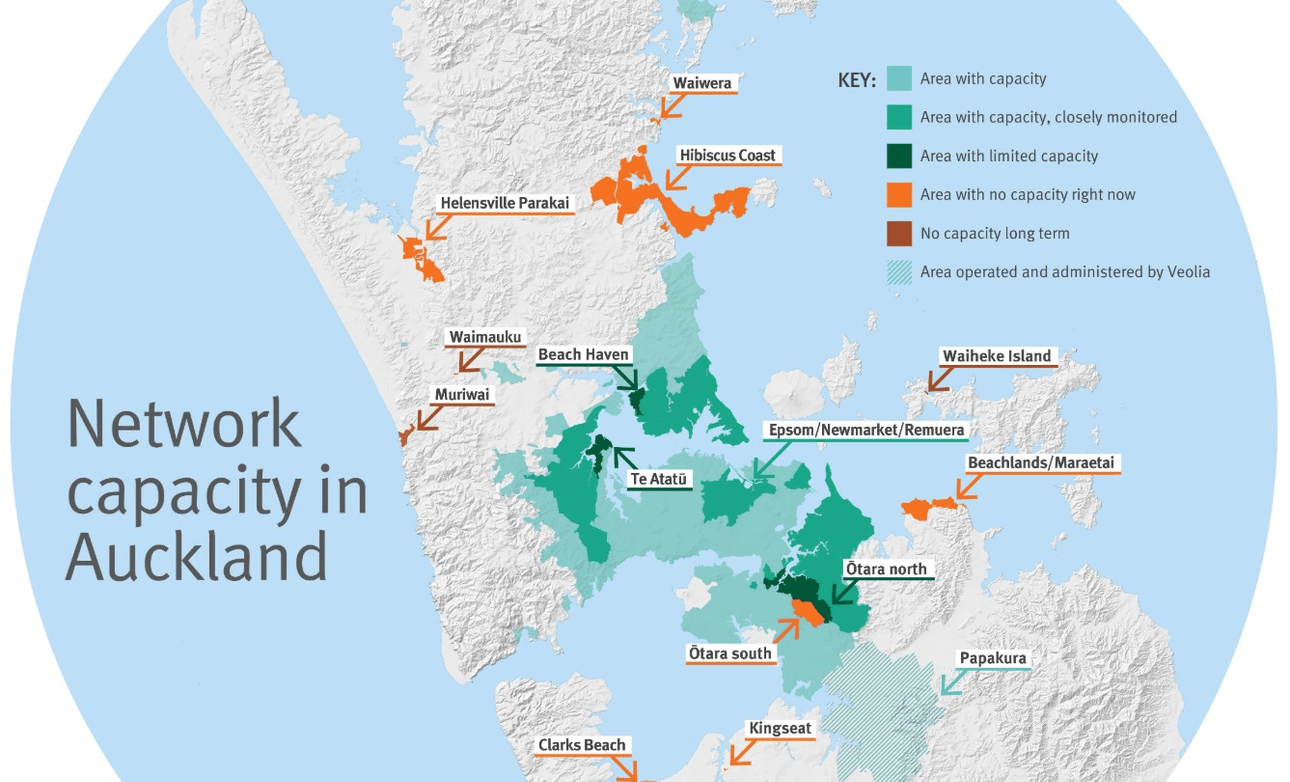
Yesterday the worriers got their wish. Thanks to a government backdown wrangled over chardonnays and summer barbecues, councillors are allowed to reduce the capacity in the new plan from two million to 1.6 million houses. Council’s policy and planning committee was meeting to decide where to make those cuts, and its chair Richard Hills started out explaining the staff recommendations to prioritise places 10km or more from the city centre. Asked why those areas should get first dibs on downzoning, council planner John Duguid was clear: it was because the land within 10km of the city centre had the best access to public transport, employment opportunities, regional amenities like parks and pools and three waters capacity, as measured by Watercare:
Three waters capacity in the central areas is set to improve even more when the Central Interceptor comes online soon. (Image: Watercare)
It should have been a celebration. But what would you know, most of the people who were once so concerned about ensuring housing is near infrastructure weren’t happy. Instead they were stewing over the revelation that the places with the best infrastructure were in their well-to-do wards. North Shore councillor John Gillon had looked at the maps and found that a 10km radius from the city centre would include the entire area he represents. He moved an amendment, seconded by Fletcher, to delete the 10km clause, saying he was “concerned” about the figure.
Waitākere councillor Shane Henderson was having none of it. He pointed out that west and south Auckland had accepted the vast bulk of the new houses in Auckland since the Unitary Plan passed in 2016. As for strain on infrastructure, those areas have limited pipe capacity and less access to public transport, and we see the effects of that outside-in planning in rush-hour congestion, parking shortages and sewage overflows, he said. Henderson argued Fletcher and Gillon were engaged in “a poorly dressed up move to take away intensification from the best-equipped parts of the city”. “The intention is simple: to downzone wealthy suburbs. There is no sensible reason for excluding central isthmus communities – again – from doing their part.”
The mayor was, if anything, more blunt. He said Gillon’s motion was aimed at putting housing in Pukekohe rather than areas close to “all the infrastructure”. “I don’t want to see endless sprawl just so nimbys in Parnell and politicians can get re-elected,” he said, in what appeared to be a shot at his political nemesis, Act leader David Seymour. “That’s disgraceful, I can’t vote for it.” ...
As Brown saw it, his colleagues’ first purpose was elitism. But if they had a second priority, it was delay. Gillon and Fletcher also put forward an amendment proposing to ask the government for more time to enact Plan Change 120. ...
The demand was familiar. Fletcher has asked for more consultation in just about every planning meeting for years, and the mayor was incensed. “I want to get out of this without further delay and dithering,” he said. “God almighty, it would be great to do something this three-year period.” ...
“For fuck’s sake, get on with it,” he said, as Fletcher spoke for the final time. ...
Afterward, Brown expanded on his frustration with Fletcher, saying the meeting was “one long filibuster to stop poor people living in her area.”
Read the whole thing here. It's an entertaining lunchtime read.


.jpg)