Showing posts with label Kingitanga. Show all posts

Saturday, 21 September 2024

A (very) short history of the kingitanga

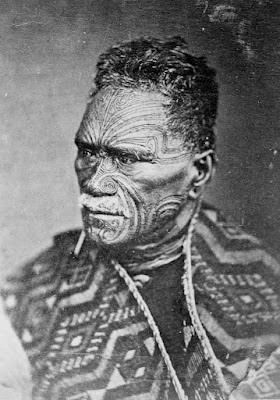
Tawhiao, the second kingi
 

"[W]ith the death of [Tuheitia] and the anointment of his daughter as the new [kingitanga] leader, it is an important time to consider the place of that separatist movement in the New Zealand story.
    "The idea of a Maori king was presented, and defeated, in the Waikato at two great hui of 1857 and 1858 when a majority held on to the promise of loyalty to the British Crown, and the rights that resulted. The activists withdrew and announced the great warrior Te Wherowhero (Potatau) now an aging man who was to die less than two years later, as their king. Te Wherowhero (1858-1860) was abused, kept as a virtual prisoner, and his opinions were ignored.
    "His son, Tawhiao (1860-1894) believed that he was indeed a king; a separate territory was asserted and Government agents were expelled by force, against the wishes of those who were benefitting from the aid that they had requested.
    "After that rebellion was defeated, Tawhiao remained defiant, declaring in 1876 that 'I have the sole right to conduct matters in my land – from the North Cape to the southern end.' That challenge was ignored and he was left to continue his activities. He set up a parallel government, and a bank, and in 1893 the kingite government posted notices advising that 'Pakeha as well as Maori were subject to "the laws of the Government of the Kingdom of Aotearoa".' The continuing acceptance of a rebellious monarchy is a curious feature of [modern] New Zealand."

Monday, 11 December 2023

"AOTEAROA, IT IS WIDELY ASSUMED, is the original ‘indigenous name’ for New Zealand...."


"Some of the major King Movement meetings were held at a
village called Aotearoa, some eight kilometres east of Te Kuiti.
It was still known by that name at the end of the century."
"AOTEAROA, IT IS WIDELY ASSUMED, is the original ‘indigenous name’ for New Zealand. It is certainly the ‘modern’ name favoured by many Māori and others. But our current common use and understanding of the name was probably not in existence before Western contact....
    "Māori appear not to have had a name for what is now called New Zealand. The North Island was Te Ika a Maui – the fish of Maui – and the South Island Tewaipounamu, or the rivers of greenstone. The latter also had other names in legend ...
    "The origins of Aotearoa are obscure. George Grey’s 'Polynesian Mythology' (1855) is sometimes credited with the first written use of the term when he recounted the legends of Maui, saying that the 'greater part of his descendants remained in Hawaiki, but a few of them came here to Aotearoa… (or in these islands).'
    "But there are now long recognised problems with accepting at face value early European interpolations of tribal ‘traditions’. ... [T]here are some traditional generic notions common through much of eastern Polynesia, such as the idea that islands were hauled up from the dark depths into the light, which is where the term Aotea, or dialectical equivalent, as light may have some relevance – perhaps not so much as a specific island name, but as a place that become light. So it is possible the words Aotea, or Aotearoa, were sometimes used, but not in the sense they are commonly used today.
    "For example, it is revealing that the Māori Declaration of Independence of 1835 which asserted the authority of the ‘Independent Tribes of New Zealand’ has both Māori and English versions. The Māori version of New Zealand is ‘Nu Tereni,’ a Māori pronunciation of the English name. Aotearoa is not used.
    "The English version of the 1840 Treaty of Waitangi has several references to the ‘Tribes of New Zealand’, ‘Chiefs of New Zealand’, ‘Natives of New Zealand’. The Māori version, it might be expected, would use the word Aotearoa, if it was in common usage. Instead it translates ‘New Zealand’ as ‘nu tirani’.
    "William Williams’ Māori dictionary, first published in 1844, has no entry for Aotearoa.

"THE EARLIEST REFERENCE I have found in New Zealand’s newspapers is in the Māori language [government newspaper] 'Māori Messenger,' 1855, which mentions Aotearoa which it equated to ‘Nui Tireni.'
    "So it is likely that the word Aotearoa may have had some currency, though it seems not to have been in widespread or specific use. And maybe Grey’s poetic hand [for he was Governor again at the time] is there somewhere? ...
    "But the increasing usage of Aotearoa from about mid-century does have traceable origins in Māori tribal locations and politics in the colonial period, and particularly with the emergence of the Māori King Movement in the Waikato in the late 1850s, early 1860s. Some of the major King Movement meetings were held at a village called Aotearoa, some eight kilometres east of Te Kuiti – but not in more recent times? The village was also then, and is now still called Rangitoto.
  

    "Also in the 1860s there are examples of the use of the phrase ‘the island of Aotearoa’ meaning the North Island. This usage continued throughout the century. The setting up of King Tawhio’s Great Council, or Kauhanganui, in 1892 comprised, it claimed, ‘the Kingdom of Aotearoa and the Waiponamu,’ meaning both the North and South Islands.
    "It is likely that King Movement political aspirations may lie behind the claimed increasing geographic size of the region purported to be Aotearoa. But it was mostly wishful thinking in practical terms. While many Maori throughout New Zealand may have been in support of the King Movement’s general aims, most were far too independent to kowtow to its mana. At least one acerbic commentator noted Tawhiao’s nation-wide ‘constitution’ for ‘the Maori Kingdom of Aotearoa’ amounted only to ‘practically what is termed the King country.’

"THOMAS BRACKEN'S NEW ZEALAND [1870s] anthem was translated into Māori [in 1878] by T.H. Smith. New Zealand he called Aotearoa. This meaning was further entrenched with W.P. Reeves’ 1898 history of New Zealand with the title 'The Long White Cloud: Ao Tea Roa.' James Cowan’s 1907 version is entitled 'New Zealand, or Ao-te-roa (The Long Bright World).' Johannes Andersen, in the same year, published 'Māori Life in Aot-ea.'
    "The now common specific ‘translation’ of Aotearoa as ‘the land of the long white cloud’ probably became more established from the 1920s or 30s.
    "Both Bracken and Reeves are commonly credited with first inventing the word Aotearoa. They did not, but they helped embed the modern view among both Māori and Pākehā that Aotearoa means and is the ‘indigenous’ term for all of New Zealand. ..."
~ Professor Kerry Howe, from his 2020 post 'Aotearoa: What’s in a name?' (Kerry Howe is an internationally regarded academic for his 11 books on aspects of the prehistory, history and cultures of New Zealand and the Pacific Islands)