Showing posts sorted by relevance for query Iron Law of Prohibition. Sort by date Show all posts

Wednesday, 11 October 2023

E‑Cigarettes Are Not Exempt from the Iron Law of Prohibition


Lawmakers everywhere have failed to learn the Iron Law of Prohibition, that is, that prohibition encourages purveyors of prohibited substances to find more potent forms of the banned substance. As Jeffrey Singer explains in this Guest Post, policymakers are now discovering that tobacco and e‑cigarette bans are not exempt from the iron law. Whether these prohibitionists reverse course before causing more harm remains to be seen.

E‑Cigarettes Are Not Exempt from the Iron Law of Prohibition


The New York Times reports today about a flood of illicit e‑cigarettes arriving from China “in Barbiecore colors and fruit, ice cream and slushy flavors,” accounting for a “major share of the estimated $5.5 billion e‑cigarette market in the United States.” This “never‐​ending influx of vapes” comes despite the Food and Drug Administration authorising only a handful of e‑cigarettes for sale to persons over age 21.

The Times reports that many of these vapes contain 5,000 or more puffs per device and have nicotine levels that sometimes exceed those in tobacco cigarettes. Many are being sold in convenience stores even though the FDA has sent them warning letters threatening store owners with fines as high as $19,000 per violation.

The goal of policymakers and the FDA was to curtail the use of flavored vapes. Many states and some cities have enacted bans on in‐​store and/​or online sales of flavored vapes.

According to the CDC, these prohibitionist efforts have backfired, resulting in a surge in flavored vape sales, from 11 million per month in early 2020 to 18 million per month in June 2023.

The Times reports that seven years since Congress granted the FDA regulatory authority over e‑cigarettes in 2016, 40 percent of e‑cigarette users are 25 or younger. And while the FDA has authorized only a couple of dozen e‑cigarette products, vapers find access to more than 2,000 of them. The Times article states:
There are few places where the problem feels more pressing than in high school bathrooms, where students crowd the stalls between classes to get a nicotine fix.
Nevertheless, teen vaping rates have fallen from their peak of 28 percent in 2019 to roughly 14 percent in 2022.

The failure of e‑cigarette prohibition was predictable—as is the advent of more potent and puff‐​packed forms of nicotine vapes now sold on the black market. Though prohibitionists never seem to learn, the “Iron Law of Prohibition” is inescapable. A variant of what economists call the “Alchian‐​Allen Effect,” put simply, the iron law states, “the harder the law enforcement, the harder the drug.”


Prohibition encourages purveyors of prohibited substances to find more potent forms of the banned substance so it can be smuggled in smaller sizes and subdivided into more units to sell. During alcohol prohibition, for instance, bootleggers smuggled whiskey and other hard liquors, not beer or wine.

The iron law of prohibition is why cannabis THC concentration has grown over the years. It is what brought crack cocaine into the cocaine market. And it made fentanyl replace heroin as the primary cause of overdose deaths in the United States.

In the 21st century, law enforcement’s crackdown on diverted prescription opioids (the drug of choice for nonmedical users at the time) led to their replacement with heroin. By 2012, heroin dealers began adding the synthetic opioid fentanyl to heroin so they could smuggle it in smaller sizes and subdivide it into more units to sell. By 2016, fentanyl‐​related deaths eclipsed deaths from heroin and diverted prescription pain pills. By 2017, fentanyl was found in more than 50 percent of opioid‐​related overdose deaths. By 2022, it was involved in roughly 90 percent of deaths.

Policymakers are now discovering that tobacco and e‑cigarette bans are not exempt from the iron law. Whether these prohibitionists reverse course before causing more harm remains to be seen.

* * * * 

Jeffrey A. Singer is is a senior fellow at the Cato Institute and works in the Department of Health Policy Studies. He is President Emeritus and founder of Valley Surgical Clinics Ltd., the largest and oldest group private surgical practice in Arizona, and has been in private practice as a general surgeon for more than 35 years.
    He is also a visiting fellow at the Goldwater Institute in Phoenix. Singer is a member of the Board of Scientific Advisors of the American Council on Science and Health. From 1994 to 2016, he was a regular contributor to 'Arizona Medicine,' the journal of the Arizona Medical Association. He served on the Advisory Board Council of the Center for Political Thought and Leadership at Arizona State University from 2014 to 2018. He writes and speaks extensively on regional and national public policy, with a specific focus on the areas of health care policy and the harmful effects of drug prohibition.
    He received his BA from Brooklyn College (City University of New York) and his MD from New York Medical College. He is a fellow of the American College of Surgeons.
    His post first appeared at the Cato On Liberty blog.

Wednesday, 28 March 2007

"Skunk killed my beloved son" - or did it?

The UK's Daily Telegraph carries a haunting story of a mother who says she lost her son to cannabis. "Guy may have taken his own life, but it was cannabis that killed him," she says.

There are many things to be said about this, and one of the most important is that this when any sixteen-year-old boy takes his own life this is a tragedy. Let none of us miss that point. But many other things are also true, none of which are mentioned in this article -- and all of them are, I believe, relevant.

The first is that signs of adult psychosis do not generally emerge until late puberty. Normal teenagers, as Guy reportedly was, will often exhibit no signs of psychosis at all until those first symptoms emerge. I mention this simply to suggest that the link between Guy smoking cannabis and Guy exhibiting psychosis as reported is not made -- that is, the causal connection is not made. It's quite possible that it developed naturally, and only emerged with adolescence. It is simply not possible to say with confidence, solely on the facts reported, either that "it was cannabis that killed him," or even that it was cannabis that caused Guy's psychosis.

Now, included in this Telegraph article is the additional story that the UK's Independent newspaper is to resile from "its 10-year campaign to decriminalise cannabis" because of a link that is made.
[The Independent] cited new research published in the Lancet, showing that the drug is more dangerous than LSD and ecstasy, and confirmed that a link has been established between strong cannabis and psychosis.
So there is research that does show a link. Let's assume that it does, and the link is not backwards (ie., that people who smoke cannabis develop psychosis because of it, rather than that people who develop psychosis find that they enjoy using cannabis). Does that link mean that cannabis should be illegal? Is The Independent right to resile from its ten-year campaign?

Well, I say no, it's not. The first point to make is that LSD and Ecstacy (and cannabis) are less harmful than alcohol. As is cannabis. That is undoubtedly the reason that these two were chosen by the journalist as the comparison here.

The second point is that the deaths and harm attributed by researchers and newspaper headlines to drugs are occurring in a legal regime not in which drug use is legal, but one in which drugs are already illegal. We are already in the ideal world of which anti-drug campaigners wish for.

But what do we see in this 'ideal world'? We see that demonising drugs does more harm than good. Making drugs illegal has not kept drug dealers off the streets; it hasn't kept drugs out of the hands of youngsters; it hasn't ensured that dealers' profits have gone down while the quality of what dealers supply has gone up; it hasn't ensued that drug-related crime has gone down.

Instead -- in yet another instance of the Law of Unintended Consequences -- making drugs illegal has ensured exactly the opposite of what was supposedly intended. Just as with the prohibition of alcohol in the Twenties, drug prohibition has ensured that those who sell this stuff are people who are predisposed to criminality; that the quality control (or lack thereof) of their products is left in the hands of these criminals; that drug-related crime has gone up; and that (unlike products that are legal), sales to youngsters of illegal products can't be properly policed. And despite their illegality they do get into the hands of youngsters, who in their rebellious teenage stage are predisposed to look favourably at something as rebellious as a widely used illegal substance, and what they're using is of a quality of which no one can really be sure.

A third point to make here is what Milton Friedman called his Iron Law of Prohibition, which states that prohibition causes the prevalence of ever-more virulent drugs.
[Friedman] once told Bill Bennett, Bush Snr’s drugs tsar, “You are not mistaken in believing that drugs are a scourge that is devastating our society. Your mistake is failing to recognize that the very measures you favour are a major source of the evils you deplore.”

Friedman proved, for example, that prohibition changes the way people use drugs, making many people use stronger, more dangerous variants than they would in a legal market. During alcohol prohibition, moonshine eclipsed beer; during drug prohibition, crack is eclipsing coke. He called his rule explaining this curious historical fact “the Iron Law of Prohibition”: the harder the police crack down on a substance, the more concentrated the substance will become.
Why? Read on here to find out whole, straightforward reasoning, but here's the short answer:
Prohibition encourages you produce and provide the stronger, more harmful [product]. If you are a drug dealer in Hackney, you can use the kilo of cocaine you own to sell to casual coke users who will snort it and come back a month later – or you can microwave it into crack, which is far more addictive, and you will have your customer coming back for more in a few hours. Prohibition encourages you to produce and provide the more harmful drug.
A further point to make is to those who say that all that's needed is just to get drugs off the streets and out of the schools, and what's needed to get drugs off the streets and out of the schools is just more vehement enforcement. To that I have one word: "Crap!"

There has been as violent and vigourous enforcement of the War on Drugs as it's possible to have, and what we usually see is not the harm caused by drugs themselves, but the harm caused by the War on Drugs itself. It's not a question of either more virulent or more vehement enforcement -- when governments have spent billions and billions of dollars on the War on Drugs, and they can't even keep drugs out of prisons, which are surely among the most policed places in the country, then they certainly can't keep them off the streets. And they don't.

Most of the harms associated with drugs are those caused by the War on Drugs itself. The harm caused to youngsters like Guy is part of that War. Supply by gangsters, and drugs in schools; ever-more virulent drugs; increased crime; criminalisation of users .... all of these harms exist now in this regime in which most recreational drugs are not legal, and these problems either only exist or are exacerbated by that very illegality.

And here's the last point to make. Consenting adults have the right to make their own choices for themselves, and we do. I do. As with alcohol use, so with drug use, youngsters need to be able to see both responsible drug use, and people saying no because they want to say no, not because their free will has been lobotomised.

Because in the end, that's the most important point. You can't ban free will -- and of course you can't stop people making choices --and if you try to, then you have to deal with the consequences of your Canute-like stupidity. Or, that is, you help to ensure that people like Guy have to. As Milton Friedman concluded, “Drugs are a tragedy for addicts, but criminalizing their use converts that tragedy into a disaster for society, for users and non-users alike.”

LINKS: Skunk killed my beloved son - (UK) Daily Telegraph
UK Study: Demonising drugs does more harm than good - Not PC
Law of unintended consequences - EconLog
Milton Friedman's 'Iron Law of Prohibition': More prohibition, worse drugs: - Not PC
Another iron law of prohibition - Not PC
More drugs, less crimes - Not PC

RELATED: Victimless Crimes, Cartoon

Monday, 12 July 2010

Mayoral hopeful Simon Prast is right. Prohibition does not work. Has not worked. Can not work.

Mayoral hopeful Simon Prast is right. Prohibition doesn’t work.  If no government, however officious, can even keep drugs out of its prisons, then it's clear enough that drugs aren't just going to disappear from the streets no matter how many laws are passed--any more than alcohol disappeared when laws were passed prohibiting that.  All prohibition does is raise the crime rate, criminalise consumers, corrupt the cops, and put profits and quality control in the hands of gangs. 

But don’t ask “What sane person would want to do that?” because prohibition is not about sanity. Says the UK Royal Society for the Encouragement of Arts, Manufactures and Commerce, "Drug laws are driven by ‘moral panic’… Whether we like it or not, drugs are and will remain a fact of life.”

_Quote_thumb[2][5]Demonising drugs does more harm than good… The use of illegal drugs is by no means always harmful any more than alcohol use is always harmful," Professor Anthony King of Essex University, the commission chairman told Britain's Daily Telegraph. Professor King added: "The evidence suggests that a majority of people who use drugs are able to use them without harming themselves or others... The harmless use of illegal drugs is thus possible, indeed common."

It’s didn’t worked for alcohol—banning alcohol in the US was history’s biggest boon for organised crime.

It hasn’t worked for cannabis—banning cannabis in NZ has been the biggest shot in the arm for gangs you could imagine.

It hasn’t worked for party pills—prohibition putting the ‘P’ into BZP, and more profits in gang coffers.

It hasn’t worked any better for ‘P’ either.

_Quote_thumb[2][5]Obtaining methamphetamine may be getting easier despite a Government crack down on the drug, a report says.

These are probably some of the reasons so many former law enforcement officers have joined the international advocacy group, Law Enforcement Against Prohibition (LEAP) (wouldn’t it be great to hear Leighton interviewing one them on air?), which argues that prohibition only exacerbates the harms it purports to diminish…

LEAP Statement of Principles
LEAP does not promote the use of drugs and is deeply concerned about the extent of drug abuse worldwide. LEAP is also deeply concerned with the destructive impact of violent drug gangs and cartels everywhere in the world. Neither problem is remedied by the current policy of drug prohibition. Indeed, drug abuse and gang violence flourish in a drug prohibition environment, just as they did during alcohol prohibition.
To view LEAP's Statement of Principles in its entirety, please click here.

But why on earth is Simon Prast talking only about legalising ‘P’?  Yes, that’s a War that is already lost.  But the best way to get rid of ‘P’ would be to get rid of prohibition across the board. Or even begin formulating a serious transitional plan to start the process. Why do I say that to get rid of ‘P’ we need to get rid of prohibition altogether? Because, as Milton Friedman pointed out with his Iron Law of Prohibition, it’s the particularly virulent drugs like ‘P’ that prohibition actually encourages.  Johann Hari summarises:

_Quote_thumb[2][5]‘You are not mistaken in believing that drugs are a scourge that is devastating our society [said Friedman]. Your mistake is failing to recognize that the very measures you favour are a major source of the evils you deplore.’ Friedman proved, for example, that prohibition changes the way people use drugs, making many people use stronger, more dangerous variants than they would in a legal market. 
    During alcohol prohibition, moonshine eclipsed beer; during drug prohibition, crack is eclipsing coke. He called his rule explaining this curious historical fact “the Iron Law of Prohibition”: the harder the police crack down on a substance, the more concentrated the substance will become. Why? If you run a bootleg bar in Prohibition-era Chicago and you are going to make a gallon of alcoholic drink, you could make a gallon of beer, which one person can drink and constitutes one sale – or you can make a gallon of pucheen, which is so strong it takes thirty people to drink it and constitutes thirty sales. Prohibition encourages you produce and provide the stronger, more harmful drink. If you are a drug dealer in Hackney, you can use the kilo of cocaine you own to sell to casual coke users who will snort it and come back a month later – or you can microwave it into crack, which is far more addictive, and you will have your customer coming back for more in a few hours.
    “Prohibition encourages you to produce and provide the more harmful drug.
    “For Friedman, the solution was stark: take drugs back from criminals and hand them to doctors, pharmacists, and off-licenses. Legalize. Chronic drug use will be a problem whatever we do, but adding a vast layer of criminality, making the drugs more toxic, and squandering £20bn on enforcing prohibition that could be spent on prescription and rehab, only exacerbates the problem. ‘Drugs are a tragedy for addicts,’ he said. “But criminalizing their use converts that tragedy into a disaster for society, for users and non-users alike.’”

He’s still right.  And so is Prast.

So forget the ‘moral panic,’ and think instead of the immorality of telling others what they’re allowed to do to themselves. And consider: If it is impossible to ban drugs and iniquitous to try, then the only relevant question becomes: should we have a legal, transparent, accountable market for drugs, or an illegal, secretive, unaccountable one?

Your call.

* * * *

*No, I never thought I’d be writing a sentence like “mayoral hopeful X is right.”  But there you go.  Well done Mr Prast.

PS: For those not familiar with Uncle Milt’s ‘Iron Law,’ here’s a handy summary:

IronLaw

Thursday, 5 September 2019

In honour of Helen Clark ...


In honour of Helen Clark, I am reposting an old blog about Milton Friedman. Specifically, about what he called his Iron Law of Prohibition:
Johann Hari from London's Independent newspaper is surprised that ten days after Milton Friedman's death he's been eulogised for his monetarism, praised for his proselytising on small government, and buried with his errors ... but few have raised the "one issue [on which] Friedman applied the forensic brilliance of his brain to a deserving purpose. Over forty years," notes Hari, "he offered the most devastating slap-downs of the 'war on drugs' ever written":
He once told Bill Bennett, Bush Snr’s drugs tsar, “You are not mistaken in believing that drugs are a scourge that is devastating our society. Your mistake is failing to recognise that the very measures you favour are a major source of the evils you deplore.”

    Friedman proved, for example, that prohibition changes the way people use drugs, making many people use stronger, more dangerous variants than they would in a legal market. During alcohol prohibition, moonshine eclipsed beer; during drug prohibition, crack is eclipsing coke. He called his rule explaining this curious historical fact “the Iron Law of Prohibition”: the harder the police crack down on a substance, the more concentrated the substance will become.

    Why? If you run a bootleg bar in Prohibition-era Chicago and you are going to make a gallon of alcoholic drink, you could make a gallon of beer, which one person can drink and constitutes one sale – or you can make a gallon of pucheen, which is so strong it takes thirty people to drink it and constitutes thirty sales. Prohibition encourages you produce and provide the stronger, more harmful drink. If you are a drug dealer in Hackney, you can use the kilo of cocaine you own to sell to casual coke users who will snort it and come back a month later – or you can microwave it into crack, which is far more addictive, and you will have your customer coming back for more in a few hours. Prohibition encourages you to produce and provide the more harmful drug.
    For Friedman, the solution was stark: take drugs back from criminals and hand them to doctors, pharmacists, and off-licenses. Legalize. Chronic drug use will be a problem whatever we do, but adding a vast layer of criminality, making the drugs more toxic, and squandering £20bn on enforcing prohibition that could be spent on prescription and rehab, only exacerbates the problem. “Drugs are a tragedy for addicts,” he said. “But criminalising their use converts that tragedy into a disaster for society, for users and non-users alike.”
Read on here for more. Challenge yourself. Or just watch Friedman interviewed:

RELATED POSTS:
.

Wednesday, 14 October 2020

Ifyou want to know how to vote this weekend, ask a gangster


If you want to know how to vote this weekend on legalisation, then ask yourself how the gangs would like you to vote.

Politicians regularly talk about going to war on gangs. But you can’t talk sensibly about a War on Gangs without also talking about the politicians' ongoing War on Drugs. Because, as the prohibition of alcohol proved so conclusively in America—coinciding with the birth of big criminal gangs there – where you have prohibition, you have a ready income stream for criminal organisations. 

Drugs provide the gangs' primary income stream. If you want a real war on gangs, then rip away this secure income stream. (And if you'd rather not have gangs deciding what drugs your children are going to dabble with, because they will, then vote "legalise" to remove this secure monopoly.)

Challenged on this point a few years ago, Judith Collins accepted that gangs monopolised the drug trade, from which comes their primary income, yet bizarrely insisted that if marijuana were legalised they would instead get into legalised prostitution and harder drugs like methamphetamine.

But this is nonsense. First, a Justice Ministry study found that during the in-depth interviews of 656 sex workers “there was no mention of gang involvement or coercion.” Overseeing the research, the Ministry’s Prostitution Law Reform Committee considered “could not find any evidence of a specific link between crime and prostitution.” Legalisation has removed gangs from this trade, without offering any mechanism for their return.

And as thousands of current and former policemen who support drug regulation rather than prohibition argue—including Scotland Yard’s former head of drug policing: it is prohibition itself,  they confirm, that leads to more potent drugs. Whereas legalisation does the reverse. The argument of these on-the-ground experts can be quickly summarised:
  • prohibition doesn't get drugs off the street. The government can't even get rid of drugs in the controlled environment of a prison, so they certainly can't get rid of them from the relative freedom of our streets. Which means…. 
  • outlawing drugs doesn't make them go away; it simply puts them in the hands of outlaws, and the in the hands of the soft targets on whom the outlaws focus. Which means… 
  • the quality of drugs is set by the outlaws, at a price premium set by Prohibition; and because ...
  • prohibition limits demand a little, but it limits supply a lot, then as every economics student knows this pushes up prices a lot, and gives remaining dealers a profit on a plate. 
  • So: prohibition means people don't stop consuming drugs they just change the drugs they're consuming. And the price they're paying to consume them.
Here, Collins and other could benefit from getting to grips with what Milton Friedman called The Iron Law of Prohibition: which says that the more you actively prohibit drugs, then what you are actively encouraging on the streets is the more virulent, the most dangerous, drugs.

Friedman proved, for example, that prohibition changes the way people use drugs, making many people consume stronger, more dangerous variants than they would in a legal market.

Consider this: During alcohol prohibition, moonshine eclipsed beer. For the same reason, during drug prohibition, crack will always eclipse coke. Friedman gave a name to this phenomenon, calling this curious historical fact “the Iron Law of Prohibition”: the harder the police crack down on a substance, the more concentrated the substance will become.

Why? If you run a bootleg bar in Prohibition-era Chicago and you are going to make a gallon of alcoholic drink, you could make a gallon of beer, which one person can drink and constitutes one sale – or you can make a gallon of poitin, which is so strong it takes thirty people to drink it and constitutes thirty sales. Prohibition of alcohol encourages you to produce and provide the stronger, more potent drink. 

This is why, during Prohibition, gangs were not selling watered-down beer -- they were making their fortunes through sales of bathtub gin.

And just as bathtub gin eclipses beer, under Prohibition, so crack eclipses coke. If you are a drug dealer with a kilo of cocaine, say, you can sell it to casual coke users who will snort it and come back a month later – or you can microwave it into crack, which is far more lucrative, and you will have your customer crawling back to you for more in a few hours! Prohibition encourages you to produce and provide the more harmful drug.

For Friedman, the solution was stark: take drugs back from criminals and hand them instead to doctors, pharmacists, and off-licenses. 

Legalise. 

Chronic drug use will be a problem whatever we do, but adding a vast layer of criminality, making the drugs more toxic, and squandering millions on enforcing prohibition only exacerbates the problem, and helps raise the profits for gangs.

If politicians want to talk about a war on gangs, then start with a war on their income.

After all, it’s working exactly that way in Mexico, where legalising American weed has been killing off drug cartels.

In fact, as both Ethan Nadelmann of the N.Y.C.-based Drug Policy Alliance and Richard Branson, the chairman of Virgin Group point out: drug legalisation is pretty much the worst thing that could happen to organized crime.*

So if you want to know how to vote this weekend, ask a gangster.


PS: for those not familiar with Uncle Milt’s Iron Law of Prohibition, here’s a handy summary below. 


.

Tuesday, 27 September 2011

Don’t like drugs? Then legalise cannabis.

Cannabis is supposed to be a “gateway” drug? The drug that leads people on to harder drugs?

Bullshit.

What makes harder drugs so prevalent is Prohibition. If you don’t believe me, then just ask  thousands of current and former members of law enforcement who support drug regulation rather than prohibition—including Scotland Yard’s former head of drug policing.

  • Prohibition doesn't get drugs off the street. The government can't even get rid of drugs in the controlled environment of a prison, so they certainly can't get rid of them from the relative freedom of our streets. Which means….
  • Outlawing drugs doesn't make them go away; it simply puts them in the hands of outlaws, and in the hands of the soft targets on whom the outlaws focus. Which means…
  • Prohibition limits demand a little, but it limits supply a lot -- as every economics student knows, this pushes up prices a lot, and gives remaining dealers a profit on a plate.
  • Prohibition means people don't stop consuming drugs they just change the drugs they're consuming.

Which means there is what Milton Friedman called an “Iron Law of Prohibition” (yes, ACT members, that Milton Friedman) which says that the more you actively prohibit drugs, then it is the more virulent drugs you actively encourage.  Which means instead of the relatively benign drugs like cannabis, alcohol and tobacco being easily available and sold by friendly pharmacists, it’s the nasty stuff instead—and peddled by fearless gang members.   Johann Hari summarises:

_Quote_thumb[2][5]‘You are not mistaken in believing that drugs are a scourge that is devastating our society [said Friedman]. Your mistake is failing to recognize that the very measures you favour are a major source of the evils you deplore.’
    Friedman proved, for example, that prohibition changes the way people use drugs, making many people use stronger, more dangerous variants than they would in a legal market. 
    During alcohol prohibition, moonshine eclipsed beer; during drug prohibition, crack is eclipsing coke. He called his rule explaining this curious historical fact “the Iron Law of Prohibition”: the harder the police crack down on a substance, the more concentrated the substance will become.
    Why? If you run a bootleg bar in Prohibition-era Chicago and you are going to make a gallon of alcoholic drink, you could make a gallon of beer, which one person can drink and constitutes one sale – or you can make a gallon of pucheen, which is so strong it takes thirty people to drink it and constitutes thirty sales. Prohibition encourages you produce and provide the stronger, more harmful drink.
    If you are a drug dealer in Hackney, you can use the kilo of cocaine you own to sell to casual coke users who will snort it and come back a month later – or you can microwave it into crack, which is far more addictive, and you will have your customer coming back for more in a few hours. Prohibition encourages you to produce and provide the more harmful drug.
    For Friedman, the solution was stark: take drugs back from criminals and hand them to doctors, pharmacists, and off-licenses. Legalize. Chronic drug use will be a problem whatever we do, but adding a vast layer of criminality, making the drugs more toxic, and squandering £20bn on enforcing prohibition that could be spent on prescription and rehab, only exacerbates the problem. ‘Drugs are a tragedy for addicts,’ he said. “But criminalizing their use converts that tragedy into a disaster for society, for users and non-users alike.’

It’s not complicated.  If you don’t want gangs deciding what drugs your children are going to dabble with, because they will, then end the War on Drugs now.

If you do want a legal, transparent, accountable market for drugs, rather than an illegal, secretive, unaccountable one, then end the War on Drugs now.

If you want police cracking down on real criminals instead of spending time frisking people harming only themselves, then end the War on Drugs now.

Because if you can’t even keep drugs out of prisons, then you sure as hell can’t keep them off the streets.

How could you end Prohibition easily? Well, here’s a simple proposal: just start by unbanning all the drugs less harmful than alcohol. (According to Britain’s widely respected Lancet journal of medicine, that means we could immediately legalise for recreational use (in decreasing order of harm): Buprenoprhine, Cannabis, Solvents, LSD, Methylphenidate, Anabolic steroids, GHB, Ecstacy, Alkyl Nitrites, Khat, and di-hydrogen monoxide.) On what rational basis could anybody object? Especially if they’re an alcohol “user” themselves?

image

NB, for those not familiar with Uncle Milt’s Iron Law of Prohibition, here’s a handy summary:

DSC_0010

Wednesday, 2 March 2016

Don’t like gangs? Then legalise cannabis.


Ever the populist, Police Minister Judith Collins has announced what she calls “a multi pronged attack on gangs” and a plan to “tackle drugs, illegal gains and firearms.”

But you can’t talk sensibly about a War on Gangs without also talking about the government’s War on Drugs. Not properly. As the prohibition of alcohol proved so conclusively in America—coinciding as that sorry period did with the birth of big criminal gangs there – where you have prohibition, you have a ready income stream for criminal organisations. (It was prohibition, if you like, that caused the Greatness of Gatsby.)

You might have thought then that ripping away their secure income stream would have been the obvious “prong” with which a police minister might begin attacking gangs. Even the most obvious.

Challenged on this point on Morning Report this morning however, Collins airily dismissed the notion. Accepting that gangs’ "primary income is from selling drugs," she was Asked by Espiner what would happen to gangs’ finances if marijuana were legalised, Collins rather bizarelly insisted that they would then get into legalised prostitution and harder drugs like methamphetamine.

But this is nonsensical. A Justice Ministry study that Collins could easily have read in her previous post found that during the in-depth interviews of 656 sex workers “there was no mention of gang involvement or coercion.” Overseeing the research, the Ministry’s Prostitution Law Reform Committee considered “that the links between crime and prostitution are tenuous. The Committee could not find any evidence of a specific link between crime and prostitution.”

The notion is as bizarre as her claim that legalising marijuana, for example, would see an explosion of methamphetamine being sold on the street. As thousands of current and former members of law enforcement who support drug regulation rather than prohibition argue—including Scotland Yard’s former head of drug policing—prohibition doesn’t mean people stop consuming drugs, they just change the drugs they're consuming.

Here, Collins could benefit from getting to grips with what Milton Friedman called The Iron Law of Prohibition: which says that the more you actively prohibit drugs, then it is the more virulent drugs you actively encourage. 

    Friedman proved, for example, that prohibition changes the way people use drugs, making many people use stronger, more dangerous variants than they would in a legal market.
    During alcohol prohibition, moonshine eclipsed beer; during drug prohibition, crack is eclipsing coke. He called his rule explaining this curious historical fact “the Iron Law of Prohibition”: the harder the police crack down on a substance, the more concentrated the substance will become.
    Why? If you run a bootleg bar in Prohibition-era Chicago and you are going to make a gallon of alcoholic drink, you could make a gallon of beer, which one person can drink and constitutes one sale – or you can make a gallon of pucheen, which is so strong it takes thirty people to drink it and constitutes thirty sales. Prohibition encourages you produce and provide the stronger, more harmful drink.
    If you are a drug dealer in Hackney, you can use the kilo of cocaine you own to sell to casual coke users who will snort it and come back a month later – or you can microwave it into crack, which is far more addictive, and you will have your customer coming back for more in a few hours. Prohibition encourages you to produce and provide the more harmful drug.
    For Friedman, the solution was stark: take drugs back from criminals and hand them to doctors, pharmacists, and off-licenses. Legalise. Chronic drug use will be a problem whatever we do, but adding a vast layer of criminality, making the drugs more toxic, and squandering £20bn on enforcing prohibition that could be spent on prescription and rehab, only exacerbates the problem [and helps raise the profits for gangs].

Collins talks about offering “a path out of gangs.” If she’s serious, then most obvious is to make them unprofitable.

After all, it’s working exactly that way in Mexico, where legalising American weed has been off killing drug cartels.

In fact, as both Ethan Nadelmann of the N.Y.C.-based Drug Policy Alliance and Richard Branson, the chairman of Virgin Group point out: drug legalisation is pretty much the worst thing that could happen to organized crime.*

Are you listening, Judith?


RELATED POSTS:

*   Note that they say legalisation, not merely decriminalisation. Decriminalisation can mean that it’s legal to enjoy drugs but still illegal to sell them. Portugal, for example decriminalised every imaginable drug, from marijuana, to cocaine, to heroin in 2001, to discover that to discover that drug use went down rather than up, that the drugs being consumed were far safer than they were before, and most importantly Portugal now enjoys the second-lowest death rate from recreational drugs in all of Europe (after experiencing one of the worst rates with prohibition)
But because the selling of those drugs in Portugal is stil illegal, it is still largely in the hands of gangs – who are certainly being nicer than they were, but are still at heart just gangsters. “Decriminalisation’s flaw,” notes the Economist, “is that it does nothing to undermine the criminal monopoly on the multi-billion-dollar drugs industry. The decriminalised cocaine consumed without criminal consequences in Portugal is still supplied by the gangs who cut off heads in Colombia. Washington, DC’s version of legalisation is similarly flawed: although possession has been legalised, Congress has prevented the city from legalising the buying and selling of the drug. The capital’s pot business will therefore remain a criminal monopoly. The new law is good news for the people who harmlessly get high. But unless it is followed up eventually by legalisation of the supply-side of the business, it is [still] good news for the crooks who sell it.”


Capture1
Capture

Tuesday, 26 May 2009

Can’t we just ban stupidity from office? [updated]

Reports have it that “Prime Minister John Key is proposing to combat the drug P by banning its main ingredient, pseudoephedrine.” This is akin to banning the tides by insisting people close their windows at night so they can’t see the moon.

Have the proponents of the War on Drugs learned nothing in the thirty-eight years since that War was declared by Richard Nixon as diversion from other more pressing personal affairs?

If you ban the stuff it doesn't just go away. Thirty-eight years of "an increasing drug tide" should tell you that.

Have the proponents of bans learned nothing over those thirty-eight years about the results of their bans? That if you ban drugs, you simply put the sale and manufacture of drugs in the hands of outlaws. Sure, we all like to think our kids won't partake -- but how often did YOU ever "Just Say No" back in your day? And drugs are now much nastier than they were when you bought your buds from from a mate of a mate. Do you really want your daughter consuming virulent recreational pharmaceuticals cooked up by a bloke known only as 'Scabies'? Or would you prefer her buying from someone more trustworthy - like a pharmacist, a grower, a cannabis cafe, or from the makers of the formerly legal party pills, for example?

Have ban supporters learned nothing from figures showing lower rates of drug use in more liberal jurisdictions like Europe as opposed to the much higher rates in more prohibition-minded places like the US; have they learned nothing from the results of partial legalisation in places like London and the Netherlands, or of complete legalisation in places like Portugal.

"Judging by every metric, decriminalization in Portugal has been a resounding success," says Glenn Greenwald, an attorney, author and fluent Portuguese speaker, who conducted research [on Portugal's 2001 decriminalisation] . "It has enabled the Portuguese government to manage and control the drug problem far better than virtually every other Western country does." [Read Greenwald’s report for the CATO Institute here.]

Have they learned nothing from the prevalence of drugs in prisons? For goodness sake, if you can't even make them disappear from supposedly the most secure places in the country, then how on earth are you going to make them disappear from people's more private places?

Have they learned nothing from the results of all the bans? That if you ban particular stuff, it just changes its form.

You make it difficult to import cannabis and “buddha sticks,” and people bring in heroin instead. You make it difficult to bring in heroin, and people start making “homebake heroine” made from codeine. You make it harder to get hold of codeine-based drugs, and people find a way to make the even more virulent ‘P’ out of stuff contained in common cold remedies.

What’s next? It's almost like watching an episode of ‘McGyver.' Ban all the ingredients you like, but criminals are still going to find a way to make recreational pharmaceuticals using a roll of toilet paper, a lady's stocking, a tub of shoe polish, and a small bit of blue tack. And the drugs get progressively more virulent each time.

The reason they’ve got more virulent is what economist Milton Friedman called the ‘Iron Law of Prohibition.’

Friedman proved that prohibition changes the way people use drugs, making many people use stronger, more dangerous variants than they would in a legal market. During alcohol prohibition, moonshine eclipsed beer; during drug prohibition, crack is eclipsing coke. He called his rule explaining this curious historical fact “the Iron Law of Prohibition”: the harder the police crack down on a substance, the more concentrated the substance will become.
Why? If you run a bootleg bar in Prohibition-era Chicago and you are going to make a gallon of alcoholic drink, you could make a gallon of beer, which one person can drink and constitutes one sale – or you can make a gallon of pucheen, which is so strong it takes thirty people to drink it and constitutes thirty sales. Prohibition encourages you produce and provide the stronger, more harmful drink. If you are a drug dealer in Hackney, you can use the kilo of cocaine you own to sell to casual coke users who will snort it and come back a month later – or you can microwave it into crack, which is far more addictive, and you will have your customer coming back for more in a few hours. Prohibition encourages you to produce and provide the more harmful drug.
For Friedman, the solution was stark: take drugs back from criminals and hand them to doctors, pharmacists, and off-licenses. Legalize. Chronic drug use will be a problem whatever we do, but adding a vast layer of criminality, making the drugs more toxic, and squandering £20bn on enforcing prohibition that could be spent on prescription and rehab, only exacerbates the problem. “Drugs are a tragedy for addicts,” he said. “But criminalizing their use converts that tragedy into a disaster for society, for users and non-users alike.”

Friedman once told Bush Snr’s drugs tsar Bill Bennett, “You are not mistaken in believing that drugs are a scourge that is devastating our society. Your mistake is failing to recognize that the very measures you favour are a major source of the evils you deplore.” The evils have only got worse since.

Banning pseudoephedrine is just another road down that sorry path. And it will make it damn difficult for all of us presently suffering from cold (and colds) because we haven’t pumped enough carbon dioxide into the atmosphere to warm us up. ;^)

Frankly, and unusually, I agree with Arnold Schwarzenegger: “I think it’s time for a debate.”

UPDATE: Let's be clear, in the Herald report from which I quoted above JohnBoy said "he understood pseudoephedrine was banned in some American states, and he wanted to know if that would work here."

Well he doesn't have to look far to get his information -- only as far as Lindsay Mitchell who has a look at what happened in Oregon when they banned pseudoephedrine. No surprises. More meth - more meth-related crime.

But that's not the sort of conclusion he's calling for, is it.

Saturday, 2 December 2006

A weekend ramble

Another weekly ramble through the clippings from the Not PC off-cut desk
  • Cox and Forkum summarises what's fast becomin an obvious conclusion about Russia's ruler:


  • The stadium sage continues. And as it rumbles along, I was amused to note this comment at Philosophically Made/Red Bears, self-described as a blog by "NZ based bloggers of a leftwing persuasion": "Even though I hate to agree with ACT and the Libertarianz," said blogger STC, "at this point Carlaw Park looks like a pretty terrific option." I should point out that Libertarianz per se really have no view on Carlaw Park -- I do however, and I still affirm that Carlaw Park is a terrific option, particularly for what a stadium there could do for the city, but that's a personal view (I confess, I do like a good stadium), and I've been beaten about the head by my Libz colleagues for daring to say so. The Waterfront - Philosophically Made

  • Joel Schwartz has a whole host of climate science resources at his website, including his latest, a slideshow conference presentation [pdf]. Climate Change: Science, Policy, Politics - Joel Schwartz [PDF]

  • The War On Drugs debate continued here the other day with the discussion over Milton Friedmans' Iron Law on Prohibition, stated by Richard Cowan in this way, "The more intense the law enforcement, the more potent the prohibited substance becomes" -- or as I put it in the post under debate, 'More Prohibition, Worse Drugs.'
    Commenters argued that unlike us "pie in the sky" legalisers they lived in "the real world," and as good prohibitionists they were still keen to make laws for other people. It's worth having a look at how alcohol prohibition worked to see how prohibition does actually work in the real world instead of in the fetid fantasies of prohibitionists. How did alcohol prohibition work in the real world? A: Bloody poorly. And the Iron Law of Prohibition was clearly in effect; see the graph below for example which shows how consumption of toxic bathtub liquors -- the more potent alcohol -- flourished, exactly as you'd expect.
  • Total Expenditure on Distilled Spirits as a Percentage of Total Alcohol Sales (1890-1960)
    If you didn't already know the years in which the fooolishness of alcohol prohibition was in effect, then you can seeit clearly enough from the graph. Unsurprisingly, since the onset of prohibition did more than anything ever before to give piles of cash to violent criminals, these were also years in which murder experiences enormous growth. Pictured below is the US homicide rate from 1910-1944:
    If you really do want to be informed about the disaster of prohibition rather than being guilty of interviewing the inside of your own skull, then just below are some good links to check out. And if you don't wish to be informed, then butt the hell out of the argument, and leave other people the hell alone:
    - Alcohol Prohibition was a Failure - Prof. Mark Thornton, Cato Institute
    - The Re-legalization of Drugs - Tibor Machan & Mark Thornton, FEE
    - How Prohibition Makes Any Drug More Dangerous - Drug Policy Forum of Texas
    - Lessons of History. Lesson 8: Crack - Efficacy Online
    The more intense the law enforcement, the more potent the drugs. If a dealer can smuggle only one suitcase full of drugs ... which would he be carrying - marijuana, coca leaves, cocaine, or crack? He gets more dollars for the bulk if he carries more potent drugs...
    - How the Narcs Created Crack - Richard Cowan, National Review
    Be good to conclude here with a line from the conclusion of Penn & Tellers's 'Bullshit' episode on the War on Drugs: "I don't do drugs, but it's your right to do so if you wish. Just stay the fuck away from my house."

  • Physics and induction -- the science and the method of science that go together like coffee and eggs. Induction itself is the science that provides the foundation for all genuine universal knowledge, yet is still the subject of much misunderstanding: Just how do we form general, universal conclusions from particular observations? What methods must we follow to be confident our conclusions are sound?
    Lisa Van Damme from the Van Damme Academy explains first how physics can be (and is) taught in an inductive fashion at her Academy.
    "My students, she says, "have the extreme good fortune of being taught physics by David Harriman, a scholar of physics who is currently writing a book on the influence of philosophy on the history of physics. With his vast knowledge of physics and pedagogy, Mr. Harriman designed a new, and very effective method of teaching physics."
    You can read about it in her article at CapMag: Physics by Induction: The Genius of Learning Science the Proper Way. And on the Objectivist front, work continues by physicist David Harriman and philosopher Leonard Peikoff on their much-awaited book, Induction in Physics and Philosophy. Meanwhile, however, you can listen to a three-minute sample of a 2003 lecture series by Leonard Peikoff: Induction in Physics and Philosophy available at the Ayn Rand Bookstore and, if you're keen, buy the lectures, a fourteen-CD set [and if you do, I'd love to borrow it :-) ].
    These historic lectures present, for the first time, the solution to the problem of induction—and thereby complete, in every essential respect, the validation of reason.

    Peikoff begins by identifying the axioms of induction and the method of establishing their objectivity, including the role of measurement-omission. This enables him to make clear the parallels between concept-formation and generalization-formation, and leads him to discover the real distinction between induction and deduction.

    Peikoff goes on to discuss the methods used in science to prove non-axiomatic generalizations and advanced theories. He stresses, with many examples (from Galileo, Newton, Faraday, Maxwell and others), the roles of experimentation and of mathematics.

    Diana Hsieh at Noodle Food has a summary of the course (albeit brief, and albeit at third-hand) and the subsequent discussion proved fruitful. And Objectivist Ron Pisaturo takes issue with some of Peikoff's views in his own take on induction: Ron Pisaturo: A Theory of Knowledge.

  • "Public misunderstanding of basic economic principles leaves us easy prey to political quacks, charlatans and assorted hustlers," explains Walter Williams in What Everyone Should Know About Wealth and Prosperity.
  • And finally (well, nearly), Walter Williams takes a brief look at the nonsense of so-called "racial diversity," which he argues flourishes at the expense of genuine intellectual diversity.

    There are some ideas so ludicrous and mischievous that only an academic would take them seriously. One of them is diversity. Think about it. Are you for or against diversity? When's the last time you said to yourself, "I'd better have a little more diversity in my life"? ...When academics call for diversity, they're really talking about racial preferences for particular groups of people, mainly blacks.
    The price, he argues, is steep. Racial Diversity at the Expense of Intellectual Diversity - Walter Williams, Capitalism Magazine.

  • And on the subject of focussing too much on race and so-called "cultural identity," I can't go past an observation made by philosopher Tibor Machan, himself an immigrant from Hungary to the US.
    When, more recently, it began to be fashionable to stress one’s ethnic or cultural or racial identity, I was puzzled. To start with, what kind of identity is it that one acquires by accident? So, I was born in Budapest and heard a lot of gypsy music, ate paprika csirke and palacsinta. And, yes, I liked these things and still do. But how significant a part of me is there in that? My idea from early on was that what’s important about one’s identity is what one contributes to it oneself.
    Who one is shouldn’t be a matter of happenstance but of purposive action. I liked to read and think about philosophy and religion, so if someone wanted to know who I was, I’d tell them about that. Or, in a less serious vein, about things I liked to do such as traveling and playing tennis.Some collage of these aspects of my life, of the things over which I have had some say, some choice, seems to me to make me who I am— not so much how tall I am or where I was born.
    As I got to hear more and more about ethnic and racial pride, I was even more puzzled. How can someone be proud of being, say, Caucasian or black or gay or Asian? What had
    one to do with such things? Perhaps one might be glad of being tall or of having lived among other members of one’s ethnic group if, indeed, this had amounted to a good experience.
    And one could certainly refuse to be ashamed of being black or white or whatever one could not help being.
    Even more, one might feel some affinity with others who were being picked on for attributes one shared with them and be willing, even, to unite with them to resist such treatment.
    But proud? Doesn’t pride require some worthy achievement from oneself?
    In my neighborhood newspaper, there is someone who writes mainly about Hispanics, and in nearly every column Hispanics are urged to feel special for being Hispanic. Why so? What is special about that? Doesn’t feeling special for being Hispanic or Hungarian American or black or tall suggest that others aren’t as special and worthy of feeling similarly about themselves? I have never liked the idea of a chosen people because it suggests that the universe or God picks some to be inherently, undeservedly superior to others.
    When I am told, “Hey there are some other people from Hungary you must meet,” I respond, “Why exactly? Do they play tennis, love philosophy, or like the blues?” The idea of ethnic or cultural pride, it seems to me, suggests something close to an insidious form of prejudice.
    Without having done anything worthwhile whatsoever one gets to be satisfied for belonging to a group. Just whom is one kidding anyway?
    Beautifully put, which is the reason I post it here at such length. It's been nagging me for some time to put it out for you lot to consider. You can read the whole column in PDF form at the link below, where it appears as part of an online copy of Tibor's recent book of his columns, Neither Left nor Right that the Hoover Institute has made available online (which is rather annoying since I paid good money for my copy). The column quoted above, 'Never Mind One's Cultural "Identity",' appears on page 23 of the section 'Sex and Politics in America.' [PDF]

Enjoy.

RELATED: Stadium, Global Warming, Science, Objectivism, Philosophy, Victimless Crimes, Law, Racism, Books, Economics

Friday, 29 June 2007

BZP ban violates first law of street economics

Ban things, and you create a black market. It's the first law of street economics. It's so simple even gangsters know it.

Sadly, it's not simple enough for politicians .

Ban drugs, whatever the drug, whatever the reason, and the people who celebrate loudest are the dealers. Every time an American president declares a War on Drugs (TM), cocaine suppliers in Medellin celebrate because their prices go through the roof. Every time an American president bombs Medellin and takes out a supplier, the other dealers in Medelling celebrate because they have one less competitor ... and their prices go through the roof.

With Jim Neanderton's announcement today of a "ban" on BZP-based party pills, honest suppliers of party pills will be lamenting, but dishonest suppliers won't be. Those bastards will be rubbing their hands with glee: Neanderton has just restricted their competition, and given those who remain in the business a license to print dirty money. Neanderton has made himself their benefactor. Here's why:
  • Prohibition doesn't get drugs off the street. The government can't even get rid of drugs in the controlled environment of a prison, so they certainly can't get rid of them from the relative freedom of our streets -- and in trying to get rid if them they only succeed in curtailing that freedom in the process.
  • Outlawing drugs doesn't make them go away; it simply puts them in the hands of outlaws, and in the hands of the soft targets on whom the outlaws focus.
  • Prohibition limits demand a little, but it limits supply a lot -- as every economics student knows, this pushes up prices a lot, and gives remaining dealers a profit on a plate.
  • Prohibition means people don't stop consuming drugs they just change the drugs they're consuming. BZP-based party pills are safer than both alcohol and tobacco. The drugs party pill users will replace them with won't be.
  • Prohibition makes buyers less interested in quality, and more interested in "the high"; it makes dealers less interested in quality and safety, and more interested in making as much as they can to make up for the risk. Hence Milton Friedman's Iron Law of Prohibition: "Prohibition encourages dealers to produce and provide the stronger, more harmful product. If you are a drug dealer in Hackney, you can use the kilo of cocaine you own to sell to casual coke users who will snort it and come back a month later – or you can microwave it into crack, which is far more addictive, and you will have your customer coming back for more in a few hours. Prohibition encourages you to produce and provide the more harmful drug."
  • Prohibition puts the quality and safety of the drugs your children are consuming (your children are the dealers' soft targets) in the hands of criminals and corrupt police. These people don't care who their consumers are, or what they're consuming.
The people celebrating the most at the announcement that BZP based party pills are being banned will be the dealers. They've just been guaranteed an enormous profit, and Jim Neanderton has ensured that the quality and safety of the drugs people will still consume are in the hands of scum.

You'd think he would learn from history, that prohibition achieves precisely the opposite result to that intended. (Yes, it's our old friend the Law of Unintended Consequences yet again.)

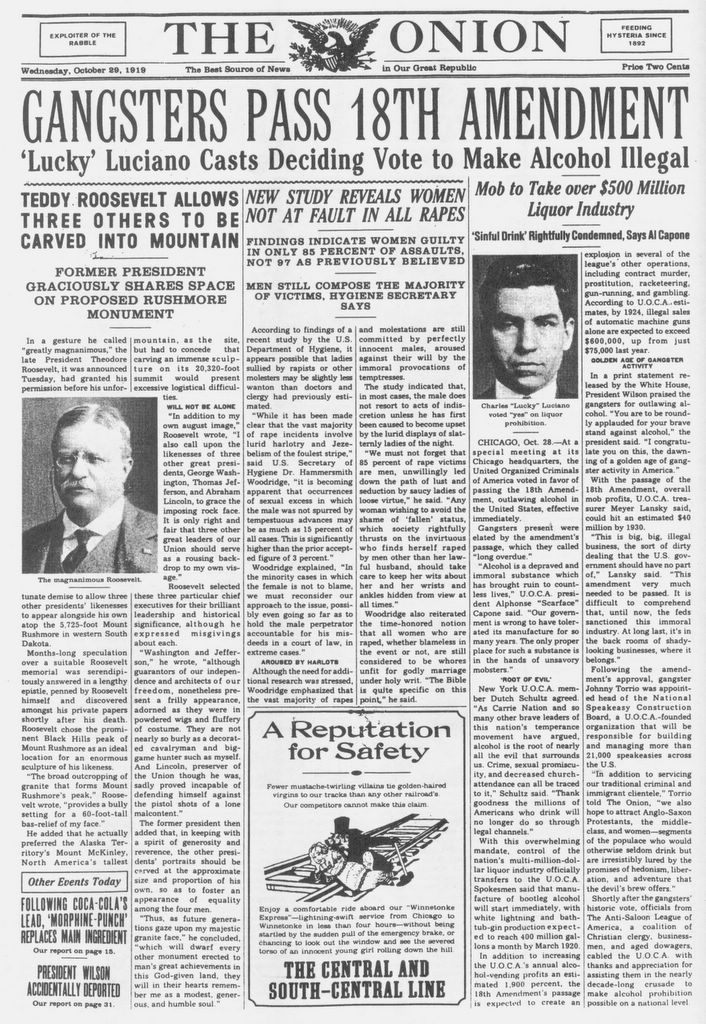
Prohibition: Learning from history

As always, The Onion makes learning from history easy by making the lesson itself so blindingly obvious. (Click on the page to read.)
The Onion - 18th Amendment

You'd think the message would be sufficiently obvious enough even for the likes of Jacqui Dean and Jim Neanderton, wouldn't you? The message is simple enough even for the likes of them:

Never has.

UPDATE: Lindsay Perigo gives "Adolph Anderton" some more to think about:
SOLO Press Release:
It's Not Your Body, Adolf Anderton!

The Socialist Republic of Aotearoa-New Zealand's descent into full-blown tyranny, fresh from its straitjacketing of journalists, cameramen and photographers covering proceedings in the Republic's Reichstag, accelerated further today with the announcement by Associate Health Minister Adolf Anderton that BZP, the active ingredient in party pills, will be made illegal from next year...

"What people put in their own bodies is their own affair. The ingestion of truly harmful substances should be a matter of rational dissuasion, not criminal sanction. Herr Anderton, however, is interested only in indulging his own congenital control-freakery to ensure that everyone is as miserable as he is. He ought to get out more, though it's understandable that no one invites him anywhere.

"I would urge Adolf's physician to place him on a course of Euphoria, to counter his natural misery hormones," Perigo concludes.
Read the full press release here.

UPDATE 2: Mad as hell and not going to take it any more? Julian Pistorius is: "This is bullshit. Let's organise a protest march in Auckland and Wellington, before the bill goes ahead. Who's with me? If you want to help, join this group:
http://health.groups.yahoo.com/group/fightbzpprohibition/ "
Who's with him? How mad are you?

UPDATE 3: Says Lindsay Mitchell, "It's richly ironic that at a time when worries about gang culture are foremost the government has gifted them party pills. And let's not forget who nagged them into it."

UPDATE 4: Jameson has an obvious point that needs making: This is less about well thought-out policy, and more about Anderton trying to assuage his own guilt
[Anderton] abjectly failed as a father to rationally dissuade his own daughter from becoming a drug addict, and I imagine he's still suffering the guilt of her eventual suicide. Once again, a politician’s own inadequacies have become our problem that needs to be fixed. Totalitarian cunt.
That won't stop him becomeing guilty twice over when former party pill consumers prohibited from their relatively harmless pleasure turn instead to something more harmful. Let him add what Russell Brown points out to his guilt trip:
Party people will not suddenly start going to bed early. Some might soldier on with alcohol as a social lubricant, others will seek illegal drugs. Patterns of methamphetamine use may change, with P -- smoked methamphetamine -- retaining its social stigma, but snorting seen (with some justification) as a less risky means of consumption.
Well done Jim.

UPDATE 5: Liberty Scott weighs on on the side of the angels:
You Don't Own Your Body, the Government Does: Jim Anderton's proud announcement, like big daddy telling off all the children - that it's good for them and they wont be allowed party pills anymore, is utterly sickening. It is immoral and it wont work. You see the point to me is simple.

I own my body because I am an adult. As a result of that, I have the right to ingest whatever the hell I like.I hope the families and friends of those who get ruined because the quality of BZP plummets and becomes more poisonous, or those who fear admitting to doctors they take it for fear of being prosecuted, or those prosecuted for the crime of putting something into their own bodies, go and thank Anderton, Jacqui Dean and the other fascists against personal freedom for repeating a failed policy. Can't the likes of them (and the MPs who will support it like the robots they are) leave peaceful people alone?
UPDATE 6:As do the Greens: Prohibition is Not the Answer - Metiria Turei

UPDATE 7: Blair Anderson, the chap who brought out Ex-Scotland Yard drug boss Eddie Ellison to talk sense a couple of years ago, says Anderton Should be Embarrased:
Elevating BZP into an illicit drug rather than improve a legally regulated regime abrogates his own duty 'of care'. Passing control to criminal networks looses not only controlled manufacture and distribution chains, it entrenches failure. The guy is an idiot, and those who serve under him are afflicted by his moral hysteria.
He has a lenthy post highlighting "our erroneous ABC drug classifications system" that is worth reading. The graph below from the Lancet, relating a Mean Harm Rating to summarises just one part of the folly of the ABC system. Do you see the nonsense that drug policy caused by moral panic has become?
RELATED: Victimless Crimes, Politics-NZ