"One long filibuster to keep poor people out of her area"
This is an amusing account below of an important public meeting. Important in the context of making Auckland an affordable city.
Here's some quick context: Auckland's town planners have strangled the city in red tape for years. In recent times however, many planners and councillors (and mayor Wayne Brown) have come around to the realisation that the fewer houses built, the higher the prices for those houses: that, just maybe, people might be allowed to do a bit more on their land, to maybe build a little more densely.
Opposing this, of course, are the councillors and politicians of the leafier suburbs like Christine Fletcher -- and of course David Seymour, who's dropped his party's alleged principles about property rights to wring his hands instead about there being 'no density without infrastructure.'
There's no greater hand wringer than Christopher Luxon however, who decided over summer that Auckland Council must 'downzone' their proposed plan change that would allow greater density.
So this meeting Wednesday night was to confirm where the push for greater density would be maintained in the upcoming Plan (where would be upzoned), and where that push would be relaxed a little (where would be downzoned).
When the government’s efforts to intensify Auckland were debated at council back in August last year, critics took turns wringing their hands about the strain it would place on infrastructure. Plan Change 120 [which will allow greater density] could end up putting apartments in places that weren’t set up to handle them, they fretted. “Ultimately you can’t do all this upzoning without making the commitment to provide the infrastructure that will support it,” warned Albert-Eden-Puketāpapa ward councillor Christine Fletcher ...
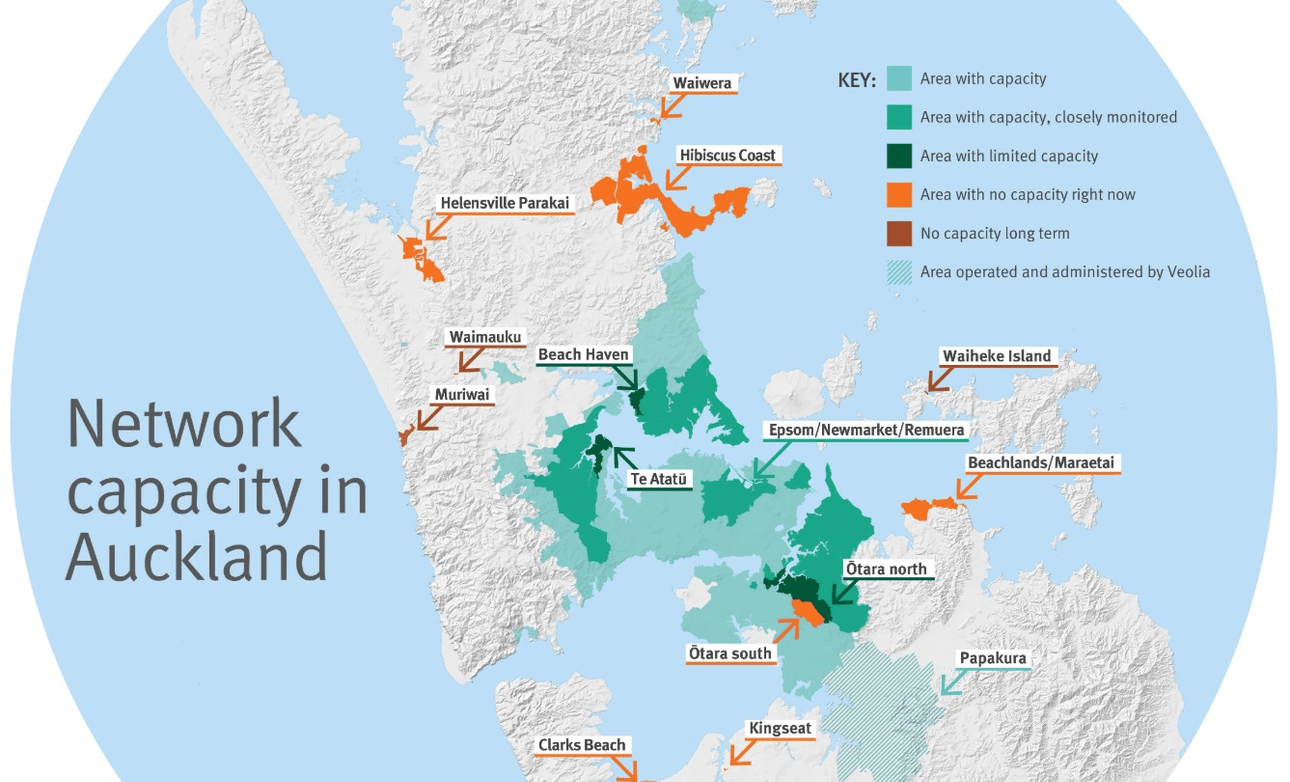
Yesterday the worriers got their wish. Thanks to a government backdown wrangled over chardonnays and summer barbecues, councillors are allowed to reduce the capacity in the new plan from two million to 1.6 million houses. Council’s policy and planning committee was meeting to decide where to make those cuts, and its chair Richard Hills started out explaining the staff recommendations to prioritise places 10km or more from the city centre. Asked why those areas should get first dibs on downzoning, council planner John Duguid was clear: it was because the land within 10km of the city centre had the best access to public transport, employment opportunities, regional amenities like parks and pools and three waters capacity, as measured by Watercare:
Three waters capacity in the central areas is set to improve even more when the Central Interceptor comes online soon. (Image: Watercare)
It should have been a celebration. But what would you know, most of the people who were once so concerned about ensuring housing is near infrastructure weren’t happy. Instead they were stewing over the revelation that the places with the best infrastructure were in their well-to-do wards. North Shore councillor John Gillon had looked at the maps and found that a 10km radius from the city centre would include the entire area he represents. He moved an amendment, seconded by Fletcher, to delete the 10km clause, saying he was “concerned” about the figure.
Waitākere councillor Shane Henderson was having none of it. He pointed out that west and south Auckland had accepted the vast bulk of the new houses in Auckland since the Unitary Plan passed in 2016. As for strain on infrastructure, those areas have limited pipe capacity and less access to public transport, and we see the effects of that outside-in planning in rush-hour congestion, parking shortages and sewage overflows, he said. Henderson argued Fletcher and Gillon were engaged in “a poorly dressed up move to take away intensification from the best-equipped parts of the city”. “The intention is simple: to downzone wealthy suburbs. There is no sensible reason for excluding central isthmus communities – again – from doing their part.”
The mayor was, if anything, more blunt. He said Gillon’s motion was aimed at putting housing in Pukekohe rather than areas close to “all the infrastructure”. “I don’t want to see endless sprawl just so nimbys in Parnell and politicians can get re-elected,” he said, in what appeared to be a shot at his political nemesis, Act leader David Seymour. “That’s disgraceful, I can’t vote for it.” ...
As Brown saw it, his colleagues’ first purpose was elitism. But if they had a second priority, it was delay. Gillon and Fletcher also put forward an amendment proposing to ask the government for more time to enact Plan Change 120. ...
The demand was familiar. Fletcher has asked for more consultation in just about every planning meeting for years, and the mayor was incensed. “I want to get out of this without further delay and dithering,” he said. “God almighty, it would be great to do something this three-year period.” ...
“For fuck’s sake, get on with it,” he said, as Fletcher spoke for the final time. ...
Afterward, Brown expanded on his frustration with Fletcher, saying the meeting was “one long filibuster to stop poor people living in her area.”
Read the whole thing here. It's an entertaining lunchtime read.
I know from experience, and that's dealing with Councils more competent than Auckland that you can't wait for the infrastructure to come before you start consenting, designing, and starting to build new subdivisions. You start that process, and then the infrastructure invariably comes. Councils only act when there's pressure to act.
You fail to address the question. Why build more when there are already too many? These 27k vacant properties are the ones that have been vacant for an extended duration (months and years, decades in some cases). If you were to count all the vacant properties throughout your city and include even the ones that have only been vacant for a few weeks you'd find the figure doubles. That's right, more than 50k are empty right now.
There are other aspects to consider. Lifestyle and community are as important as infrastructure, probably more important. These are not provided by councils. Recent experience across the developed world demonstrates exactly the opposite. Councils/local governments tend to be destructive of them.



5 comments:
There are 27,009 vacant properties your city, Auckland, at present. One in seven town houses in Auckland is vacant. Why build even more?
Henry J
I know from experience, and that's dealing with Councils more competent than Auckland that you can't wait for the infrastructure to come before you start consenting, designing, and starting to build new subdivisions. You start that process, and then the infrastructure invariably comes. Councils only act when there's pressure to act.
Idiot
Mark T
You fail to address the question. Why build more when there are already too many? These 27k vacant properties are the ones that have been vacant for an extended duration (months and years, decades in some cases). If you were to count all the vacant properties throughout your city and include even the ones that have only been vacant for a few weeks you'd find the figure doubles. That's right, more than 50k are empty right now.
There are other aspects to consider. Lifestyle and community are as important as infrastructure, probably more important. These are not provided by councils. Recent experience across the developed world demonstrates exactly the opposite. Councils/local governments tend to be destructive of them.
Henry J
Post a Comment