"For forty years, New Zealanders have been told that fewer councils mean better government, and for forty years, the evidence has refused to oblige.
"Until 1989, New Zealand had around 850 elected local government bodies. ... That year, the fourth Labour government swept it away. Two hundred and forty-nine city, borough, district and county councils became 73 territorial authorities. Most special-purpose boards were consolidated into 13 newly established regional councils. The reform was justified solely on theoretical efficiency grounds. No serious case was made that the bodies it abolished had been doing their jobs poorly.
"In 2010, John Key's National government did it again. Eight Auckland councils became one [super-sized bureaucracy] governing 1.8 million people through 20 councillors and a mayor. The same efficiency case was made. A 2025 analysis by TDB Advisory found that Auckland Council's real per capita spending had risen 34 percent in the 15 years since the reform. ...
"Between 2017 and 2023, the Ardern-Hipkins Labour government extended the pattern across other sectors. Twenty District Health Boards, each with elected members, were rolled into Health New Zealand in 2022. Sixteen regional polytechnics were merged into Te Pūkenga in 2020.
"Three Waters would have consolidated the country's drinking water, wastewater and stormwater functions into a small number of regional water services entities. More than 30 mayors organised against it, and the programme was reversed at the 2023 change of government.
"The pattern crosses party lines, with both Labour and National making the same kinds of moves with the same lack of evidence.
"Last month, the current government announced the next round, called ‘Head Start.’ RMA Reform Minister Chris Bishop and Local Government Minister Simon Watts gave councils three months to put forward their own merger proposals or have mergers imposed on them. Again, the justification is efficiency-in-theory. And once again, hard evidence that efficiency will be achieved in practice is lacking.
"Forty years of this trajectory have produced predictable results. ... "~ Nick Clark from his op-ed 'Why 40 years of council mergers have failed to deliver'
Showing posts sorted by date for query super sized council. Sort by relevance Show all posts
Showing posts sorted by date for query super sized council. Sort by relevance Show all posts
Saturday, 6 June 2026
"For 40 years, NZers have been told that fewer councils mean better government. For 40 years, the evidence has refused to oblige."


Monday, 25 May 2026
More mismanagement, please, ministers demand
 |
| "More mismanagement please," insists Minister |
In 2002 Sandra Lee's Local Government Act took the shackles off local government, and gave them written permission to build monuments and to blow out budgets. Her Act reversed the legal principle that governments may only do what they are legally empowered to do, and instead said they could do what the hell they like unless there was a law to stop them. And so budgets were blown out, monuments were built, and everyone forgot what councils had been originally constituted to do: i.e, that boring stuff like looking after pipes in the ground.
Then in 2010 Rodney Hide super-sized Auckland's Council, and debt ballooned from around $1 billion in total for the 8 councils smashed together (mainly from Manukau and Auckland) to a figure of nearly $15 billion now. And the mandarins heading the new super-sized council immediately added a whole new layer of super-sized egos to run it, or try to, literally hundreds of new six-figure staff there to attend bigger meetings and build bigger monuments.
So what lesson do you think the Ministers for Resource Management Reform and Local Government, Chris Bishop and Simon Watts, draw from this?Are they to insist, in their last few months of government, that Sandra Lee's Local Government Act be reversed, and councils required to go back to their knitting? Back to a better focus, to those pipes in the ground and on the rubbish on the streets?
Not a bit of it. Instead these idiots are insisting that all councils take lessons from Auckland's monumental disaster. In what appears to be a last-minute lurch to a headline, they have given councils three months (just this side of the election) to come up with proposals to merge themselves out of existence, and those that do not will have mergers chosen for them by Messrs Watt and Bishop.
We are led by donkeys. In politics, anyway.
UPDATE: And to reinforce the issue, here's the most recent headline on Auckland's local governance:
'Nerves on edge as Auckland Council finalises record rate rise in cost of living crisis.' What sane person would look at that and say: "Let's have more of that around the country?"
It takes a minister ...
Wednesday, 30 April 2025
ACT leader whimpers about ACT leader
ACT LEADER DAVID SEYMOUR IS outraged that Auckland Council plans to set up a co-governed committee to manage the Waitākere Ranges. "Auckland Council’s plan to set up a co-governed committee to manage the Waitākere Ranges shows why Kiwis need councillors who believe in democracy," says ACT Leader David Seymour.
Except ... it should be further noted that the Waitākere Ranges Heritage Area Act was introduced by the Minister for Local Government in 2008, and brought into law in April 2008. And that ACT leader was himself Minister of Local Government for three years from 2008 to 2011, in which he had ample opportunity to amend the Act.
Local government in New Zealand exists because central government created it, and grants it powers. Instead of drastically shrinking the power of local government, as an ACT leader should have done, that ACT leader instead awarded this super-sized council many more. Including the power — nay, the necessity — to set up a co-governed committee to manage the Waitākere Ranges.
Democracy.
“The Waitākere Ranges belong to all Aucklanders [says the ACT leader] and should be managed democratically. But Auckland Council’s plan would see unelected decision-makers closing tracks and dictating land use in the surrounding rural areas."
“The ranges are governed under the Waitākere Ranges Heritage Area Act," notes the ACT leader. And the Waitākere Ranges Heritage Area Act calls for a "Deed of Acknowledgement" recognising and giving power to tangata whenua. If the ACT leader has a problem with the Deed of Acknowledgement and the giving of power then — since it's the Waitākere Ranges Heritage Area Act that requires the acknowledgement and gives such power — then it's the Waitākere Ranges Heritage Area Act that he has a problem with.
Dictating.
One can only imagine that the ACT leader then was just as outraged.
 |
| Minister for Local Government, 2008-11 |
Except ... it should be further noted that the Waitākere Ranges Heritage Area Act was introduced by the Minister for Local Government in 2008, and brought into law in April 2008. And that ACT leader was himself Minister of Local Government for three years from 2008 to 2011, in which he had ample opportunity to amend the Act.
He didn't.
Ample opportunity to restrict the powers of local government to those in which it enjoyed a "general competence."
He didn't.
What did he do instead?
Oh, that's right. He spent his time, ego, and rapidly dwindling political capital on super-sizing Auckland's already tumescent council, all but ensuring citizens' rates bills would be equally super-swollen.
It's a bit late now to watch this ACT leader whimpering about it.
Tuesday, 31 January 2023
Some gratitude amidst the flooding
 |
| [Pic source Classic Kiwi] |
Anger is said to be the second stage of grieving. The first stage however is denial.
It's natural, when disasters happen, to find someone to blame. To vent your anger. When a natural disaster happens, however, that's pretty pointless. It looks like anger redirected. Like trying to deny the reality of the disaster that's just happened.
I think we've seen a lot of that these lasts few days, which is certainly understandable. There have been many moments of humour in the sudden change in the city's landscape (kids and dogs playing in the floodwater*; people paragliding on the new Lake Domain; ) and at least one blessing (I for one can only celebrate the cancellation of the appalling Elton John) but for many it's been an unrelieved bloody disaster. Who wouldn't want to grieve, and to vent. To be angry at the folk you think caused it!
Sure, there is plenty of bureaucratic bungling in evidence around Auckland since last Friday -- much of it arguably because of Rodney Hide's super-sized bloody council (a predictable man-made disaster about whose formation I'm still angry). And much of it, too, because too many have come to expect far too much from government appointees and electees, as if the power of government somehow makes them all super-human and immune to common bloody sense (well, that last but at least is true).
But what caused the disaster is not those non-entities, you know; it's all that bloody rain!
So the anger against Mayor Wayne Brown for saying this or not saying that -- or for not saying it early enough, or often enough -- looks to me more like anger redirected from the heavens, where the blame really lies for sending down rain in such 1-in-500 year buckets -- and against which there's really no point in ranting. That would literally be old men (and women) yelling at clouds.
We've had (and are still having, it seems) a disaster here in Auckland. A natural disaster. And it seems to me that instead of angry ranting about who said what to whom, and how, it may now be time to begin counting some blessings.
Reality has thrown at us Aucklanders rainfall of a magnitude that just isn't designed for. Engineer's design flood-resistant infrastructure for a 1-in-100 year event. Those buckets of rain represent something like a 1-in-500 year event. Rainfall of a magnitude that no stormwater or infrastructure engineer would have expected, or could realistically design for. Monsoon-level rain that's caused at least four deaths. And yet for all the many slips and outages, and the tragedy of those lives lost and the many homes, families and businesses disrupted, we've come through it a whole lot better than you might have expected.
With exceptions so notable as to be newsworthy, the vast majority of us are still supplied with water and power and refrigeration, and are as warm and dry as we want to be -- and able to offer help to those who aren't.
That it isn't a whole lot worse than it is is almost entirely due to the volunteers and emergency services who have responded to the disaster (who generally do get the praise they deserve at such times), and to the skill of our engineers in designing and building the infrastructure and flood measures that have coped with something well beyond their design load (who however are generally unsung).
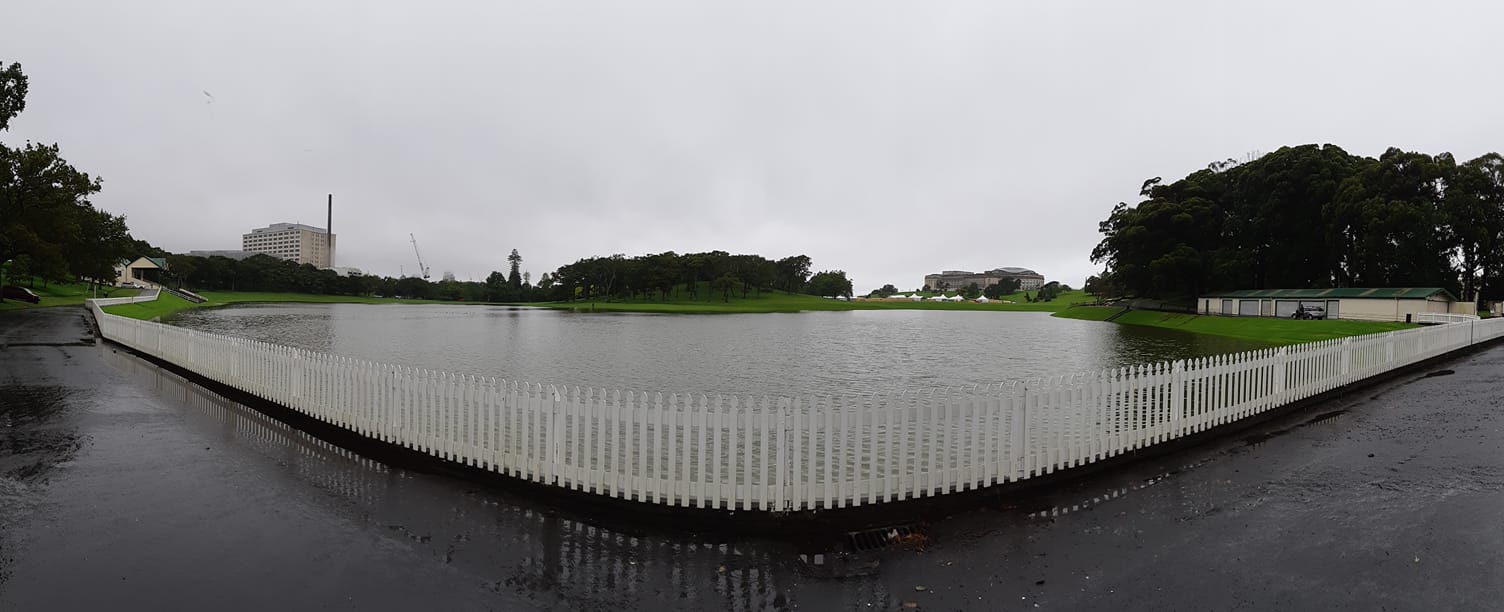 |
| The Auckland Domain's new lake, holding water (as designed) to minimise the water's impact downhill otherwise [pic by Paul. D.] |
Things like the culverts they've designed which are taking away the masses water; the nib walls, flood walls, stop banks and bunds that have kept water away from where it shouldn't be; the de-watering pipes in soft ground; the rain gardens and water diversion devices, which help to slow down the damaging speed at which the water rushes past we fragile humans; there permeable paving that allows water to flow into the ground instead of in damaging sheets across it, and these down overloaded pipes; the work done over many years in identifying and re-engineering all these ways potentially the most dangerous places...
It's not straightforward. Many of the places most effected today were once swamps only a century-or-so ago, or are on soft land that's spent centuries frittering away, and nature is now doing its level best to return those places to their natural state. Yet despite the unprecedented scale of nature's efforts, well beyond what was designed for -- and with the effect of all that rainfall magnified by all the hard urban surfaces built across the city over the last century -- with some well-reported exceptions those places have all held.

[Pic source: Auckland Art Gallery – Toi o Tāmaki. Caption source: Te Ara]
We may not have, nor can afford, world-leading infrastructure. But despite this, that we aren't seeing huge casualty figures and an extremity of damage is something to applaud; applause directed especially to all those unsung engineers who so rarely receive any credit for anything -- and to the folk who created sufficient capital to put their ingenious design-work in place.
So as the city begins to endure the predicted second round of what reality can throw at us, I'm thinking that instead of anger at the grey ones for being as inept as always, we might instead direct more gratitude at those folk who deserve it.
It's time for us all to pause for a moment, and thank an engineer.
We may doubt the just proportion of good to ill.
There is much in nature against us. But we forget;
Take nature altogether since time began,
Including human nature, in peace and war,
And it must be a little more in favour of man,
Say a fraction of one percent at the very least,
Or our number living wouldn’t be steadily more,
Our hold on the planet wouldn’t have so increased.
~ Robert Frost
* * * *
* Kids, don't try this at home without washing your hands afterwards.
Wednesday, 1 November 2017
The ingenious Phil Twyford
The new minister for housing and transport has found a way to pay the unaffordable bill for Auckland's new public transport infrastructure, and that's to help make Auckland housing even more unaffordable.
What could be more ingenious!
He'd already signalled that Labour's faithful promise to voters neither to raise taxes nor to introduce a capital gains tax was going to constrain him -- he'd already announced plans to get around that simply by raising the 'bright line' period for paying National's own tax lie (the 'capital-tax-in-drag' introduced just because lying governments can) from two years out to five. Because there's no politician like a money-hungry politician, is there.
And with Auckland's council having already borrowed way beyond what it can reasonably repay (in political-speak this is known as the Council being "up against its debt limits," as the new minister is quick to acknowledge) and the new Government having no spare cash to throw around after funding all of their promises plus those of Winston and James, Twyford now has the job of filling the $6 billion black hole in Auckland's transport bill that Len Brown and Phil Goff have helped dig.
But he has "big plans" to do that, he tells faithful recorder Bernard Hickey. "Big plans" to fill the black hole. "Big plans to change the way Auckland's multi-billion dollar light rail projects will be paid for," he says. Which means: big plans about who he is going to soak to pay for all the monuments, of which "light rail" is only the most ill-defined. And the answer in four words, dear reader, is: "motorists and property developers."
Now that smokers have slunk away quietly, motorists are the new lepers. Hitting them with new fuel taxes is only the starting point. He has an endless stream of new ideas about how to soak anyone who drives a car. Lock up your wallet now, while you can.
He also plans to sock property developers, hinting he will hit them with a new super-rates bill on developments. This appears to be in addition to "targeted rates" to repay infrastructure bonds (and in addition to the almost already crippling rates rises that Mayors Len and Phil have been exacting to pay for their grandomania and Rodney Hide's super-sized stuff-up.).
At this stage these are only just hints about his big plans. But any added tax burden on the developers who build Auckland's houses will only make it even more difficult for developers to make a margin on building those houses, making it more likely rather than less that lots more affordable housing for would-be first-home buyers will ever easily be built. (Every single change from every single housing minister has made this hope less likely rather than more, so he does at least follow in a grand tradition.)
But motorists, vendors, and property developers and their erstwhile first home-customers will not be left to suffer alone. Mum and dad and several kids already happily home-owning anywhere near any part of Auckland's expensive upcoming light rail- and rapid transit-building orgy will also be hit with something special too, in the shape of extra special "targeted rates" -- Mr Twyford's favourite new phrase, it seems -- all the better for him "to capture the value uplift in property prices" mum and dad might otherwise enjoy.
What he may miss out on with his 5-year capital gains levy on mum and dad if they don't sell their house within that time frame, he'll claw back from them anyway with his "targeted rates" if they stay put.
And if they don't enjoy any value uplift at all? Fear not. They and everyone else will still receive their share of the disingenuous Mr Twyford's $6 billion bill anyway.
TANSTAAFL.
.
Wednesday, 7 September 2016
Mayoral candidates to ratepayers: “Let them eat monuments”
In the old days to win a mayoral election a candidate had to promise bribes and monuments costing in the millions. Now, that wouldn’t even get you into the debates. Now, to head Auckland’s super-sized council bureaucracy, you have to make promises costing ratepayers billions – Victoria Crone to build bridges, Phil Goff for new train sets, John Palino for satelite cities somewhere.
Promises costing billions at a time when the city’s debt, $7.6 billion and rising, has never been higher!
The debt is unprecedented. And not one of them has a plan or any intention to bring it down.
Rates are at an all-time high, and rising – and the council is borrowing hand over fist to keep spending rising even faster! – and yet not one of these pricks has made any pledge* or has any intention of slashing spending or bringing rates down.
Not one.
Oh yes, they all talk vaguely about reducing “waste.” Of making “savings through efficiencies.” About “reducing non-core and wasteful spending.” But this is all just hand waving to suggest they’re concerned about spending while concealing they have no intention to make the savage substantial cuts necessary to begin making the city affordable again.
Instead, they all talk as if there’s a bag full of cash under your couch that they get to spend on monuments.
You might think all the monuments are worth it. You might think they will make the city more liveable.. You might think it will add to the city’s prestige. But whatever you think, for or against, you’re going to be paying for them anyway. And the “prestige” of the projects will fall like manna from heaven on the heads and shoulders of your autocratic leaders.
So it has always been.
One may see in certain biblical movies [writes Ayn Rand] a graphic image of the meaning of public monument building: the building of the pyramids. Hordes of starved, ragged, emaciated men straining the last effort of their inadequate muscles at the inhuman task of pulling the ropes that drag large chunks of stone, straining like tortured beasts of burden under the whips of overseers, collapsing on the job and dying in the desert sands—that a dead Pharaoh might lie in an imposingly senseless structure and thus gain eternal "prestige" in the eyes of the unborn of future generations.
Temples and palaces are the only monuments left of mankind's early civilisations. They were created by the same means and at the same price—a price not justified by the fact that primitive peoples undoubtedly believed, while dying of starvation and exhaustion, that the "prestige" of their tribe, their rulers or their gods was of value to them somehow.
Rome fell, bankrupted by statist controls and taxation, while its emperors were building coliseums [ to deliver bread and circuses]. Louis XIV of France taxed his people into a state of indigence, while he built the palace of Versailles for his contemporary monarchs to envy and for modern tourists to visit. [Meanwhile, as the bread in the kingdom dwindled, his queen Antoinette was advising her subjects’ rulers to “Let them eat cake.”]
And now, in a New Zealand already mired in debt, our mayoral candidates are going to rate us further into penury to make us believe they’'’re making our cities liveable.
Do any of these political leaders really believe anything they say about making the city affordable?
* Yes, to be fair, Palino’s website talks about a “wasteful council” and has a policy of reducing rates by 10% over 3 years. But he has no serious plan to make the savage spending cuts commensurate with that, and since that was set up he’s been talking instead abour “capping” rates to the Reserve Bank’s rate of inflation. In other words, no rate cuts.
.
Thursday, 28 January 2016
Peters, and the path to separatism: It has been long mapped out
WINSTON PETERS ACHIEVED HEADLINES (his only aim) for arguing at Orewa that National's proposed Resource Management Act (RMA) changes will take NZ down a path of separatism.
Maybe he hasn’t noticed that we’ve following that path for some decades – and not just in planning law.
The NZ First leader said that under the new RMA bill, every council would be required by law to invite local iwi to participate in the formulation of policy plans, including water management plans…
National had also backed away from reforming sections six and seven of the RMA, which set out environmental bottom lines.
"It is obvious that National have been brownmailed into making policy concessions to the Maori Party. They were bent over a barrel and, not surprisingly, didn't have the backbone to stand up to them.
"The proposed changes to the RMA are a signal flare to the entire country that the two parties are taking us down the track of separatism. We are no longer one people. We are moving towards two separate groups with separate rights."
This is true. Sections six and seven form part of the “heart” of this egregious Act. National had originally proposed adding the RMA’s first reference to private property rights; removing consideration of so-called “amenity values” and “intrinsic values of ecosystems”; and weakening the ill-defined consideration of “kaitiakitanga” that helps make iwi “guardians” of land they no longer own. Under pressure from the Maori Party and Peter Done-Nothing, they backtracked.
And proposed in the Bill are now so-called “Iwi participation arrangements” that make explicit what has been implicit for some time: that iwi are becoming “partners” with council planners in telling you what you can and can’t do on your own land.
Under the Bill [explained Audrey Young in the Otago Daily Times back in November], every council within a month of being elected will be required to invite the relevant iwi authority to take part in devising an agreement about how they will take part in plans or policy statements of the council… The proposal will be a lightning rod for those who see any consultation with Maori as special treatment.
That last observation couldn’t be more true.
Audrey Young however points out that “the irony of Mr Peters' objections to the Maori Party's plans for iwi participation”: “were it not for him, the Maori Party would not have had the bargaining power to get [the iwi participation arrangements] in the RMA Bill.” Interesting then that Prime Minister Key now suggests with Peters’s support he could “wind back” these consessions.
PETERS IS RIGHT TO say this is separatism. He is wrong to think it is anything new.

I’lll post some excerpts here, starting my story in the University of Auckland School of Planning, where many of those now writing and agreeing to so-called “iwi planning documents” first learned their trade.
Nearly twenty years ago I sat in a lecture at the University of Auckland School of Planning (a place wherein planners’ authority to dictate to property-owners is wholly unquestioned), being lectured at by senior lecturer Hirini Matunga about future progress in “indigenous planning” (“a parallel planning system,” we were told, “grounded in indigenous knowledge, processes and institutions”). Law around the Treaty of Waitangi, said Matunga, currently only recognised an “Anglo-American” concept of property rights; to cement further progress it was important to erect “Maori rights to manage resources.”
To make the point explicit, what was poposed as “progress” over the next two decades would be the erection of “a parallel planning system” that in rejecting the so-called “Anglo-American’ concept of property rights” it would be made possible to “manage” other people’s property.
The Resource Management Act and the ‘tikanga’ already embodied was only the first step, students heard. The next was to gain political power through planning legislation for so-called “iwi planning documents,” and thence to so-called “rangatiratanga” (a “right to self-sufficiency and self-determination”).
Twenty years later, the students at that lecture are now writing the country’s planning documents – and what’s in them should be no surprise.“Maori tribal planning documents are now an indelible part of New Zealand’s planning landscape,” enthused Hirini Matunga [two decades later], teacher now to two generations of planners and currently head of Māori & Indigenous Development at Lincoln.
The “struggle” has been a steady one, beginning from the first time planners gained power over property-owners with the first Town Planning Act of 1926. Major milestones in the process were passed with the Town & Country Planning Act of 1977 (making the relationship between Maori and “ancestral lands” a “matter of national planning importance”); continuing with the 1985 Waitangi Tribunal recommendation for a “comprehensive review” of planning and resource legislation that recognised Maori interests as being independent of property ownership; being further extended with the 1987 declaration in the High Court that “cultural relationships existed irrespective of title”…; through the addition of “waahi tapu” to the protections afforded by the Historical Places Act; to the Resource Management Act itself and its subsequent amendments that built in all this mush and began to turn it towards the goal of plunder.The result, said Matunga in 2006, is that “for the first time in the world [there are clauses in a major planning document that] give statutory recognition to a parallel planning system grounded in indigenous knowledge, processes and institutions.”
Remember, this is separatism. And he says it like it is a good thing.
Remember, even without the provisions now proposed by the Maori Party, Act already
contains [at the heart of the Act all] the obligatory Tiriti-babble. You are counselled by the Act that when doing anything more aggressive than mowing your lawn you “shall take into account the principles of the Te Tiriti o Waitangi” – and to this day the country has yet to find a court willing or able to explain precisely how that might be done, nor a politician willing to acknowledge that the Treaty was intended to impose obligations only on Treaty signatories, not on councils nor on private land-holders.
And note that National had not proposed to remove that imposition.
Note also that
the [original] 1991 RMA legislation also required that authorities “have regard to” so-called Iwi Planning Documents, the “parallel planning system” in which our friend at the Auckland Planning School held out such hope. In a 2003 amendment, this language was strengthened to mean that “decision makers” are legally required to “take into account” these Iwi Documents.
Which is precisely what Auckland Council’s “planners” did [for example] when drawing up their super-sized council’s new “Unitary Plan.” And which is precisely what every planner in every other region of New Zealand will be required to do when they next draw up their own new Planning Documents, which they are legally required to do at reasonably regular intervals…
TWO DECADES AGO NATIONAL’S now-disgraced Minister of Treaty Capitulations Doug Graham told New Zealanders: “The sooner we realise there are laws for one and laws for another, the better." At a meeting in 2013, Professor John Burrows and Tipene O’Regan talked about the Key Government’s Constitutional Review, on which they are panellists, where O’Regan announced “there are ‘big changes’ ahead in terms of how we are governed.” …
The overt changes feared as an outcome of that Constitutional Review may be less important than these covert changes described above that have been effected over several decades by determined activists inside the planning tent.
And in their train have come further innovations, such as section 85 of the National/ACT Government’s Local Government (Auckland Council) Act 2009 that “allowed the Independent Maori Statutory Board to appoint a maximum of two persons to sit as members on each of the Council's committees that deal with the management and stewardship of natural and physical resources. These members are unelected, with full voting rights alongside our democratically elected councillors.”If round about now you feel like saying “we’re moving towards co-governance here,” then feel free.
The activists have been explicit.
Two decades ago that senior planning lecturer handed us a roadmap whose endpoint was “a review of the RMA to provide for rangatiratanga,” making it possible for iwi leaders to “manage” other people’s property.
A 2011 roadmap published by another academic* now sees the endpoint of activism as “explicit devolution of power to Maori,” with “co-management” of other people’s property by government and iwi leaders; “exclusion [of iwi] from control by regulatory regimes; and, finally and explicitly, “Maori veto powers” over all development in the country.
So you see, “iwi participation agreements” are only another station on that journey begun some decades ago—and certainly a very far cry indeed from our “Anglo-American’ concept of property rights
One important question now then would be: does Peters genuinely wish to help those trying to derail that train? Or merely to score another easy headline.
His response to Key’s offer then will be telling.
* Appearing in S.G. Wevers’s 2011 Otago University thesis at the Faculty of Law, Recognising Rangatiratanga: Sharing Power with Maori through Co-Management, p. 22
Wednesday, 16 December 2015
A mayoralty, if you’re interested.
On Monday, Victoria Crone announced she would be standing for the Auckland
mayoralty and, as the former NZ CEO of high-flyer Xero, was immediately installed
by the media as the "business" candidate.
Mind you, being the business candidate doesn't mean you really mean business—nor that running a successful business is the same as being top dog at a super-sized council spending the proceeds of everyone else's super-sized rates bill.
Even Labour-ite adviser Josie Pagani understands that, pointing out that
And on her website, where you might expect at least some answers to some of the big issues? Pagani visited Victoria Crone’s website to see what she plans for Auckland, "only to find my low expectations wildly overestimated."
Mind you, it would be good to hear at least one candidate of any “side” make the firm, cast-iron promise that they intend to either lower rates below the absurdly high level they are now, or even just to cap them in money terms.
The closest any candidate does come to saying that is Affordable Auckland mayoral candidate Stephen Berry, who apart from also being neither Brown nor Goff al agrees that Voters Deserve Specifics on Rates. But all he can come up with as a pledge is to “keep rates increases below inflation” – which, given their explosive increase in recent years, is like a strangler promising only to suffocate you more slowly.
And even Phil Goff can almost match that, telling Morning Report, "There is a limit to rate increases, and I think we've reached that limit."
To be fair, and unlike Berry, Goff provides few concrete examples of how rates increases might in any way be "limited." But slow suffocation is not any kind of promise on which to hang your mayoral hat.
Mind you, being the business candidate doesn't mean you really mean business—nor that running a successful business is the same as being top dog at a super-sized council spending the proceeds of everyone else's super-sized rates bill.
Even Labour-ite adviser Josie Pagani understands that, pointing out that
If you’re going to stand for political office the minimum requirements must surely include some rationale for your candidacy. You want to do the job because you see a job needing doing. You need to have something sensible to say about topical issues and some guide to what you expect to do in office.Victoria Crone does not have these minimum contributions to debate. At her launch, she was wholly unable to articulate an actual concrete position on anything, saying in answer to questions on specifics she had "just announced yesterday" so "I'm not getting into policy." That would all come “later.” Translation: “I’ve given it no thought. But I am sort of interested.” [Listen here to her being interviewed, if you're at all interested.]
If you don’t have these minimum contributions to debate, then your candidacy is pointless.
And on her website, where you might expect at least some answers to some of the big issues? Pagani visited Victoria Crone’s website to see what she plans for Auckland, "only to find my low expectations wildly overestimated."
There’s about as much substance here as Kanye West’s run for president. She wants to ‘Create Win-Win Situations’, ‘Empower People’ and ‘Lead From A Place of strength’; as if she’s running against a candidate who wants to lose, take power away from you, and be a weak leader.It’s a fair point—except to say that every Mayor in Auckland in Auckland in the modern era has achieved the mayoral chains not because they’ve articulated anything at all about their political principles. They’ve simply said they won’t be the last blowhard who held office.
Beneath the blandly moronic motivational platitudes - “I believe anything is possible! (insert emoji) - she lists ‘Issues’: B is for ‘Housing', C is for ‘Transport’. Maybe they’ve changed Sesame Street since I was young.
These summaries reveal a candidate unprepared for office, lacking vision, and free from any meaningful communication of useful ideas…
Take ‘A' for 'Fiscal Management’. Correctly observing that many billions of dollars are needed to meet Auckland’s infrastructure needs, while funding sources like rates and debt are constrained, she offers: "few alternative sources of funding have been secured. This is a major problem for our city to solve, amidst perceptions of wastage in council spending.” Yes it’s a problem, so, what would you do, candidate? Reject new spending plans? Borrow more? Are you ruling out rate increases? Will you raise rates just a teeny bit? New taxes? Tolls? Privatising infrastructure?
Not even a hint of an idea, let alone a fresh one. That’s what makes the platitudes a problem. If you can't answer these most basic of questions about your political principles, you have no place pretending you could lead a major city
- Christine Fletcher took office promising not be Les Mills, and she succeeded.
- John Banks then took office promising not be Christine Fletcher—but was found to be far too much like John Banks, and so was turfed out.
- So Dick Hubbard campaigned on the basis of not being John Banks, only for the public to realise that he really was a real Dick Hubbard.
- At which point John Banks won by promising to be neither Dick Hubbard nor the previous John Banks (this was now the new-improved “transmogrified” John Banks), which turned our much as anyone could have predicted.
- Swiftly realising he wasn’t anywhere as transmogrified as they’d hoped, folk then thought “anyone but Banks” and very quickly found themselves enthusiastically ticking Len Browns’s box. And we all know how that box-tickling turned out.
Mind you, it would be good to hear at least one candidate of any “side” make the firm, cast-iron promise that they intend to either lower rates below the absurdly high level they are now, or even just to cap them in money terms.
The closest any candidate does come to saying that is Affordable Auckland mayoral candidate Stephen Berry, who apart from also being neither Brown nor Goff al agrees that Voters Deserve Specifics on Rates. But all he can come up with as a pledge is to “keep rates increases below inflation” – which, given their explosive increase in recent years, is like a strangler promising only to suffocate you more slowly.
And even Phil Goff can almost match that, telling Morning Report, "There is a limit to rate increases, and I think we've reached that limit."
To be fair, and unlike Berry, Goff provides few concrete examples of how rates increases might in any way be "limited." But slow suffocation is not any kind of promise on which to hang your mayoral hat.
Monday, 9 November 2015
Auckland: The mongrel now has momentum.
It won’t matter which mayor you vote in next year, the super-sized council is now off and running, and it will take a bigger man than Phil Goff or any of those other muppets mentioned to rein it in. The mongrel now has momentum.
Writing last week about Rodney Hide’s defence of his indefensible Auckland city mash-up, I suggested that rather than disestablishing eight sets of councils and their staff, his amalgamation instead built a whole new set of council parasites on top – with egos, power-trips and huge rates bills to match. It’s not a small, efficient organisation that he delivered, but a Frankenstein with an extra, larger head tuned solely towards absorbing more power.
There’s a few ways to think about the extra head.
A commenter at TradeMe picked up the theme, linking to a report last year:
Meanwhile, we hear Auckland City has more than 1500 people who are paid more than $100,000 per annum. In recent years I have lost a couple of corporate people to “jobs at the council.” I couldn’t believe what they were getting paid then and I can’t now. And these are not the top-drawer people; they are actually pretty average.
A quick glance at the annual reports of five of the companies listed on the NZX top 10 (Contact Energy, F&P Healthcare, Ryman, SkyCity and Sky TV) reveals they have just 1387 people who are paid more than $100,000 per annum between them – in total!
These people are there for life. They can’t afford to leave.
Here’s another way to think about it.
Meanwhile, the new building the super-sized council head now occupies –the former ASB building at 135 Albert St—is largely in addition to its portfolio before amalgamation. The building cost you and I over $100m to buy, and where before the building hosted investment companies managing hundreds of billions of dollars of assets out of, perhaps, half a floor, we now have council bigwigs occupying all 29 floors -- 2400 bigger-council staff in total eating their lunch there, with many of those 1500 highly-paid but pretty average people among them.
Here’s yet another way to think about the extra head.
Before amalgamation of Auckland’s borough councils in 1989, if you wanted a decision about your bins or your water or your house, you strolled along to your local borough council and chatted to someone at the counter who knew your house, knew your street, and could probably make a decision there and then,
After amalgamation of those borough councils, if you wanted a decision then you could certainly chat to someone, but the person making the decisions was upstairs, and very important, and you could only get to speak to them by appointment.
It’s even worse after Rodney Hide’s amalgamation of the city councils. If you want a decision now, you’re chatting to someone who’s several layers down the hierarchy, who’s never even seen your part of the city on a map, and the person making the decision is several floors up in a flash new building, and so, so important you’re only ever going to see the tailpipe of their council car taking them off to another important lunch.
Because this extra new layer has an ego the size of Len Brown’s rates demands.
And the problem will still exist whichever muppet Auckland voters make mayor next year.
Tuesday, 3 November 2015
Rodney Hide still defending the indefensible

Rodney Hide took all of ACT’s declining credibility and bet it on the losing horse of super-sizing Auckland council amalgamation—so bad a bet he had to leave the city, ashamed to show his face in front around the ratepayers he shat on. Yet he’s back this week, flogging that same dead horse, telling punters in the face of the abundant evidence to the contrary appearing in every spiralling rates demand they receive that “nothing has changed,” and at the same time that all the changes are “under the hood.”
Apparently service is better, infrastructure is better, bylaws are better, and now every new home has a pony. Sadly, there are nowhere near enough new homes. Partly because of the planners’ plans being written by Rodney’s super-sized and wholly unaccountable council planners…
Housing affordability measures are an excellent ‘test’ of how well local government is performing and coping with growth [points out Hugh Pavletich] …
Around the time of the Auckland Councils amalgamation, 3rd Qtr 2010 data ( 2011 7th Annual Demographia Housing Survey) shows that Auckland housing was then 6.4 times household earnings …
http://www.demographia.com/dhi2011.pdf
… and by the 3rd Qtr last year, as this year’s 11th Annual Demographia Housing Survey illustrates, Auckland housing had hit 8.2 times household earnings …
http://www.demographia.com/dhi.pdf
… with Auckland’s housing inflation exploding these past 12 months by 25.4% from a median price of $615,000 through to $771,000 … near 10 times annual household earnings.
What this means is that the young couple on say $100,000 a year could expect at the time of amalgamation to pay $640,000 to house themselves … but now it is close to a million dollars.
As commenters say in replies to the odious prick’s self-serving Herald puff-piece …


Rodney Hide sold the idea of super-sizing council as delivering smaller council, greater efficiencies and lower rates. Every promise has proved disastrously wrong. The myth-making continues: “We didn't just push eight councils together,” says Hide. “We disestablished eight councils and built a new one. Nothing like it has ever been attempted in Australia or New Zealand.”
Well, yes it had been tried before: in Brisbane. And in Adelaide. And just like Auckland’s council amalgamation, they were disasters.
And it had been tried before in New Zealand, by Michael Bassett, delivering the same result as this amalgamation: not disestablishing eight sets of councils and their staff, but building a whole new set of council parasites on top – with egos, power-trips and huge rates bills to match.
Hide has learned nothing and forgotten everything.
If he had simply remained as the perk-buster who turned poacher he could have simply remained just another political joke. That he instead had the power-trip that saddled us with Len Brown’s super-shitty super-sized council bills means he deserves only contempt.
I suggest you punch him next time you see him. Punch him hard.
RELATED POSTS:
- Making Auckland safe for Len Brown
- Rodney’s ‘My Fair Lady’ clause
- Questions on Auckland not answered
- Owen McShane on the ‘Super’ City
- “Auckland Council execs work with stunning views”
- Let them eat monuments
- One city, one neck, one noose
- And the country's most indebted council is …
- Planning” to stop Aucklanders plan
- When will they withdraw council's “powers of general competence
- Job losses predicted at Auckland Council
- Auckland grandomania ever-more costly
- So why would you want to amalgamate councils ...
- The Taniwha Tax: coming to a home near you
- Monumental council debts
- Hugh Pavletich blames the incompetent council. But who’s really to blame?
- Super? Shitty!
- An affordable Auckland even further away
- 'Super' city, uber state: "Just say NO!"
- Effects of Auckland uber-city already being felt
- Who pays for Len Brown?
- Emancipating govt, enslaving free men
- The Rodney that super-sized your rates
Wednesday, 10 June 2015
So why would you want to amalgamate councils anyway?
There are many lessons that could be drawn from super-sizing Auckland’s council. I’m astonished that one of them from different parts of the country is still “let’s do that too.”
What? Are they blind?
Sure the bureaucrats’ bureaucrats at the Local Government Commission are always going to want more power for bureaucrats. Why wouldn’t they?
But why would a ratepayer, a home-owner, a would-be builder (to take just a few) want to replicate in their own places the disaster Rodney Hide and John Key bequeathed to Auckland?
So thank goodness that the push to amalgamate councils around Northland and Wellington are off the table. For now.
So it’s just Hawkes Bay that’s currently under threat – where plans will proceed “unless 10% of a current Council’s population call for a referendum.” (Get onto that people. Now.)
Aucklanders were sold the Super-Sized City on the basis of promised "efficiencies" and putative cost savings. That canard should be shoved back up Rodney Hide’s arse along with Aucklanders’ pole-vaulting rates bills.
Auckland’s cost blow-outs are only a symptom of the big problems with amalgamation. Here’s one problem that’s compounded by amalgamation: The oxymoronic “power of general competence” granted all councils by the 2002 amendments to the Local Government Act, enabling already over-extended bureaucrats and planners to expand into new areas totally outside their limited areas of competence.a big cause of all the rest.
And that, with amalgamation, unleashed a major power: the Power of Big Egos.

Fast forward to 2005, and the chap or chappess you’re talking to barely knows your street, and the person making the decision is on the next floor – and you can talk to them, maybe if you make an appointment. See, that person is suddenly “important.” And they do a lot of meetings.
And now, in 2015, and you want to add a carport to your house … you talk to someone with no knowledge of your area, little knowledge of your issue, no ability to make a decision – and the person actually making the decision is on the top floor. They’re “very important.” They write policy. They have meetings. They attend conferences – many of them. And they’re a whole new layer of parasites on top 0f the layer that began emerging after Bassett’s blunder.
These are people with egos. Real egos, with salaries and well-appointed corner offices to match.
And egos don’t build or restore multi-million-dollar infrastructure; they build multi-billion dollar monuments – and then have the arrogance to send you the bill.
Instead of “rolling out” more super-sized councils, we should instead be dismantling the one we have.
RELATED POSTS:
- ‘Auckland effect’ scuppers more amalgamations – JO HOLMES
Thursday, 7 November 2013
Len’s “living wage” has a ripple the size of a tsunami
Alan: Hey, great news.
Bruce: What’s that?
Alan: Larry’s getting a raise—up from $600 to $730 a week!
Bruce: Larry? You mean Larry Larry? For what he does?
Alan: Yeah. Living wage mate.
Bruce: But … but … that means he’s pulling down more than I am! And I’m supposed to be above his pay grade.
Alan: Yeah, shitty news, eh.
Bruce: I’m off to see HR.
If Len Brown is successful in his proposal to pay low-paid council workers a “living wage” of $18.40 per hour, that conversation above will he happening around every water cooler in all the many council buildings around the super-sized city.
Red Len reckons paying low-paid council workers a “living wage” of $18.40 per hour will cost nothing, just $3.75 million reckons Len—chickenfeed for a mayor who overspends hundreds of millions and borrows in the billions to pay for it.
But worry not, says Len, the $3.75 million cost will “be paid for through savings in other parts of the council.”
Yeah right. Tell me the last time Len saved you money.
But Len’s figure, that $3.75 million number, based only on what it will cost to pay 550 employees a bit more, ignores completely the very real knock-on results of paying those 550 more.
First of all, it ignores what happens to Bruce if Larry is paid more. If Larry Low-Paid is paid more, then Bruce wants to be paid more to keep rank. And there are a lot more Bruces than there are Larrys, who are being paid already just that much more. And a whole lot more just above Bruce who will want to keep their pay rank as well. And so on, and so on, all the way up, as the effects of the first “living wage” raise ripple through the system.
Add on several million more to ratepayers’ bills to pay for those pay rises too, not to mention all the disruptions of all those heated HR meetings by council “workers” keen to keep their place in the pay scale.
Second, every new employee is going to want more too. And this is a council determined to expand. So add on a whole lot more millions to Len’s fictional 3.75. Not to mention how every employee for every one of the council’s many contractors is going to feel about this. (Expect the cost of every council contract to go up to pay for those wage rises too.)
And what about its effect around the rest of the city? The council is already becoming one of the biggest employers around this super-sized city, so if council is paying more for all its “workers” (which will be the nett result of starting to pay lower-paid workers more) then everyone else will have to as well, or else the over-paying council will be bidding employees away from every other employer in the city. And if those other employers do want to hire employees, or keep the ones they’ve got, as a result of Len’s “this-will-cost-nothing” largesse they’ll need to pay them more as well.

Which eithers raise prices everywhere to pay for all those higher wages, or it reduces employment everywhere to allow employers to afford the higher wage bill. Or both.
In both cases, it will raise prices.
And you know the funny thing. When prices do go up to a level sufficient to cover the costs of all these nominal wage rises, and all those price increases ripple through, it will be found that the real wage that employees now get will be the same (or less) than it was before the “living wage” increase.
In other words, no-one will be better off than before.
And those who are now priced out of a job, being unable to produce more than $18.40 an hour for an employer, will all be very much worse off. (As will the taxpayers, who will have to carry them too.)
Frankly, none of this should surprise anyone. Because unlike every other wage, this so-called “living wage” is based not on how much an employee can produce, but on how much that employee can spend.
Which is to get your causality backwards.
Not that any of this will bother advocates of this so-called “living wage,” because those instigating the “living wage” campaign are not primarily motivated by making the lives of low-paid workers better. It is to enlist them in a campaign of class warfare.
In other words, it’s about politics, not economics.
Which, oddly enough, is where lies one of the solutions to the problem of low wages. In government. Because the best way government can help poorer workers is to cut their tax bill.
If Len is genuine about helping low-paid workers, then let Len go and talk to John about that.
Monday, 17 December 2012
Quoting on Auckland…
Phil McDermott on “A Flawed Case? Auckland’s City Rail Link Project”
“One of the reasons as I understood it for creating a single Auckland Council was to reduce wasting money on uneconomic and unwarranted projects. Well, this obsession with the CRL simply demonstrates how a bigger council can make even bigger mistakes…”
I have still yet to hear a cogent reason for creating a super-sized bureaucracy in Auckland.
I don’t think one ever existed.
Monday, 30 July 2012
An affordable Auckland even further away
Aucklanders were sold the Super-Sized City on the basis of promised "efficiencies" and putative cost savings. With the arrival in their letter boxes this week of their rates bills, Aucklanders will for the first time see for themselves how effective these "cost savings" have been.
Fact is, there have been no savings. The costs have all been the other way.
For some Aucklanders, their rates increase will be more than ten percent—and with the promises doled out in the Super-Sized Council's super-sized Ten Year Plan, it's clear this will be a year-on-year increase.
Ten percent this year.
Ten percent next year.
Ten percent the year after, and every year thereafter for the foreseeable future...
For this disaster, there are several people to thank:
- Mayor Brown for having an ego the size of the super-sized city, with plans to match.
- Rodney Hide, for pushing through the farce.
- John Key, for making him.
Aucklanders should vent their rage in whatever way they can.
If Auckland is ever to be an affordable city, one place to start is with the size of their rates bill. A simple fact of which those responsible for this super-sized debacle are still wholly ignorant.
Wednesday, 7 March 2012
Owen McShane (1941-2012)

In the last couple of years I know he had been suffering from an inherited heart condition, but while he still suffered bad health I didn't realise his end was nigh.
We had much to say to each other over the two decades I knew him, but we didn't always see eye to eye. Over the years we had many agreements, and many, many disagreements. Mostly about the Resource Management Act (RMA), for which he was a consultant and an early champion, and which to the end he argued had simply been "misinterpreted"; about town planners, on which he argued my plans for their enforced unemployment were too harsh; and about gin martinis--which everyone knows should be based on vodka!
I eventually agreed he could certainly make a very drinkable gin martini (but it took a few goes); and he reluctantly agreed that if the RMA could be as abused by power-lusters as it has been then maybe it wasn't such a good piece of law in the first place, and maybe there was something to be learned from common law after all.
On town planners we never really agreed at all. Perhaps because he once was one. In the far off days of the early seventies Owen was a planner at the (smaller) Auckland City Council, and had much to do with freeing up land around Freemans Bay (for which many a townhouse-dwelling Ponsonby-ite might now give thanks) and with promoting the "infill" sections that have allowed Auckland to play host to more people on the same-sized isthmus.
Owen's main public work in the last two decades was on the RMA. He wrote many reports on the RMA both for the Reserve Bank, proving beyond doubt the RMA's role in skyrocketing urban land prices; and for Environment Ministers, bravely pointing out the abuses occurring under the RMA before shamefully suggesting that tinkering with it would help.
For these latter reports he fell out with Lindsay Perigo among others, who claimed McShane was simply providing a convenient smokescreen for the Minister to tinker rather than toss out, for which sin (as many of you will recall) Perigo proceeded thereafter to refer to McShane as "McScam."
That Owen was so clearly mistaken about the tinkering fixing anything hardly needs pointing out. But despite his sadness at being so labelled, and despite his own blind spot, in his latter days Owen remained a tireless battler at defending the rights of property owners under this execrable piece of legislation.
And despite our own disagreements, I think I can say he was a friend.
The RMA wasn't the only thing that got Owen excited.
He could be a very incisive commentator. His column ‘If the Stone Age had run out of rocks...’ on the fraud of so called “Peak Oil” contains the classic line that “the Oil Age will certainly end before we run out of oil. Just as the Stone Age ended long before we ran out of rocks.”It deserves (re)reading now.
He was active with Augie Auer and others in setting up the skeptics' NZ Climate Science Coalition, which has set a serious cat amongst local warmist pigeons (and will soon be facing them in court!). That we now must talk about both the late Augie Auer and the late Owen McShane is very sad indeed for non-warmists.
And he had a very fine sense of good, liveable architecture.
In fact, I first met him 1995 or so ago when investigating a site for sale overlooking Piha. He was doing the same for himself, and discussing its potential it turned out my ideas for my client were similar to what he was thinking for himself. Rare enough.
I remember too one afternoon a couple of years ago walking around a subdivision on the Kaipara which he had developed, and on which he had built a few houses to set the tone. It was a quite magnificent achievement. None of your kerb and channeling or picket fences--indeed, no fences at all. Privacy was maintained by careful planting and thought about sightlines, and there was much shared public space in the form of gardens, nooks, a jetty and a vineyard. None of your grandomania either--the houses, and the whole estate, were hard-working, humble and just very, very liveable. Living with nature in a very sensible by low-impact fashion. It was architecture in the best sense of the word, i.e., as Frank Lloyd Wright had said, “making human life more natural and nature more humane,” and barred therefore from ever appearing in any glossy “starchitecture” magazines.
We had a few discussions over the years about what makes a good house, and I always recall in particular his thoughts on siting a house in the landscape, pointing out especially that a house should first be designed to look OUT, not to be looked AT. On a post of mine about the magnificent ways in which traditional Japanese houses so managed so skilfully to practice this principle he wrote:
Notice how these houses all "look into" the garden and the view.
Sadly our fixation with cinerama views means that many people "look over" their garden to focus on the view.
I like to look for a section shaped like a cupped hand with the fingers pointing up. Drive down the thumb build the house in the palm look over the edge of your hand to the view but look into the curled fingers at your garden.
Simple model – but effective. Views are often static while your garden is changing every day. Garden to the north on an upwards slope and view to the west - for the sundowner.
For these and other observations, he will be greatly missed.
My thoughts go out to his wife Jenny and his family and friends. And I will be making myself one of his gin martinis tonight in his honour.
PS: National Business Review farewells its former columnist:
NB: Owen worked almost until the day he died. Since he put so much into it, here is his last weekly missive, sent out last Friday on his networks:
Background: Why so much Dissent – at this time?
Recent ST Digests have drawn attention to the wave of dissent spreading throughout the Western World in response to the failed experiment in central planning at the local and regional level of Government. For some reason we have suffered decades of top-down local planning in spite of the total failure of central planning in economies as diverse as the Soviet Empire, Maoist China, and North Korea.
This wave has now become a flood and is attracting attention in all quarters.
During the property boom, triggered by the planners’ excessive regulation of land markets, and powered by the speculative bubble and lending, the rapid inflation in land prices allowed the planners to fund their excessive interventions and compliance costs, and of course their own salaries and fees, because the “speculators” and developers could absorb the costs.
But now the bubble has burst the real costs are being revealed. Worse, the drop in revenues means that Council budgets are now hopelessly out of kilter and the anticipated development contributions (fines) do not even fund the interest on the borrowings.
Remarkably, the typical response of Council administrators and their consultants has been too increase fees and charges to try and maintain the lifestyle to which they have become adjusted.
Of course, it doesn’t work any more than a retail store can increase revenues by increasing its prices. So the obvious solution was to raise the rates.
Suddenly, the ratepayers began to ask the hard questions and demanded to know why they should be expected to pay for other people’s profligacy.
A good question, and a hard one to answer. Especially when asked by all those pensioners on fixed incomes.
1. The Generic Problem – Amalgamation Compounded by the Powers of General Competence.
The current crisis in Local Government has two basic causes.
The first is the belief that bigger is always best. Whenever some local government creates a mess the immediate response is to propose amalgamation. But the end result is no more than a local authority considerably larger than the one whose problems have just proved too big for councils to deal with.
Dr Smith, the Minister for Local Government and the Environment, has recognized that Local Government is dysfunctional, drawing attention to the escalating rates and debt levels that are causing waves of discontent all around the country. These symptoms of widespread failure of are largely the result of the last round of amalgamations in 1989.
Councillors suddenly found themselves in charge of multi-million dollar organizations that demanded skills and experience well beyond their levels of competence. Since then, the Chief Executives (previously known as Town Clerks) have been able to exercise largely unbridled power.
Those problems were then compounded by the 2002 amendments to the Local Government Act that gave Councils the power of general competence.
This expansion of powers enabled already over-extended authorities to expand into new policies and activities totally outside their competence.
Their general incompetence has been demonstrated all around the country – as exemplified by the losses on V8 races, entertainment events, swimming pools, sewage schemes, arenas, and exploding levels of debt and rates. Project cost overruns became the norm as a councillors lost control of their staff, consultants and advisors.
The end result has been that most of our councils have been colonized by major corporations who are now busy exploiting the local “environment industry”. These consultancies regard our districts and cities as little more than well-funded ATM machines.
It’s time to take back control of our Councils and their Plans. Hopefully, Dr Smith’s proposed caps on borrowing and rates will restrain these excesses.
2. The Myth that Bigger is Better.
The routine response to any problem in local government is to propose amalgamation. The end result is a local authority considerably larger than the one whose problems have proved too big to deal with.
Dr Smith, the Minister for Local Government and the Environment, has recognized that Local Government is dysfunctional, drawing attention to the escalating rates and debt levels that are causing waves of discontent all around the country. These symptoms of widespread failure of are largely the result of the last round of amalgamations in 1989.
But sadly he is also launching a further round of amalgamation. For example, he is promoting the amalgamation of the Unitary Councils of Tasman and Nelson into a single Unitary Council. Kaipara District Council is in financial meltdown and so he has proposed similar amalgamations for Northland.
He says his general aim is to get rid of Regional Councils. However, his current proposals will actually get rid of Local Councils, leaving behind a few truly massive “Super-Regional Councils”. It will take 4.5 hours to drive from one end of the Tasman/Nelson Council to the other. The merged Kaipara-West and Far North Council would stretch from Kaipara Harbour’s North Head to Cape Reinga – another 4.5 hour drive.
This bias is understandable; Dr Smith is an engineer, and he instinctively focuses on the efficiency of regional services which do enjoy the benefits of scale.
But democracy enjoys no benefits of scale. Small local councils can be effectively governed by local citizens and managed by local staff and consultants who actually know their people and territory.
Many councils are in the midst of RMA plan reviews and any amalgamation means the millions of dollars invested in those plans must be written-off and the whole planning process, including Long Term and Annual Plans, begun again. Proposed reforms to the RMA will generate another round of plan reviews. This endless plan writing halts all development because of the consequent DURT (Delays, Uncertainties, Regulations, and Taxes).
This is the time to implement a comprehensive reform of the legislative framework for the whole of local government in New Zealand.
3. Small really is Beautiful.
The people of Switzerland place great emphasis on both efficiency and democracy. The average Swiss Commune (district council) has two thousand people. The average Canton (region) has 135,000 people. Switzerland is one of the most successful economies in the world.
Maybe small really is beautiful – and we “Power to the People” folk of the sixties had it right all along.
4. It’s Time to take our Councils Back.
Just prior to the last Local Body elections I wrote a pamphlet, widely distributed to the Residents and Ratepayers of Kaipara District called It’s Time to Take our Councils Back. Muriel Newman’s New Zealand Centre for Political Research here, has given me the opportunity to say “I told you so” on her Guest Forum here.
The company is excellent. Muriel’s own essay “The Need for Local Government Reform” and her husband Frank’s recommendations on “Regulatory Controls for Local Bodies” complement my commentary on how we got here, with some forthright recommendations for the future. Frank puts the blame squarely where it belongs. While KDC has its own sorry tale to tell, Frank makes a generic point about Central Government’s actions and intertia across the country when he writes:
The proper place for Kaipara to confess their errors and plead poverty is at the doors of central government. It is they and their agencies that have sat on their hands and watched Kaipara go deeper down the drain. Indeed the failings of central government to adequately oversee local government goes back as far as 2002 when it assumed councils were competent to handle the greater powers given to them with the reform of the Local Government Act in 2002.
Muriel reminds Government that no matter what is strives to achieve it will be defeated so long as Local Government is allowed to continue its spendthrift ways. She writes:
There are widespread problems with local government. At a time when central government is tightening its belt, striving to reduce debt and lower its costs, local government appears to be moving in the opposite direction. In contrast to households and farms, which have been reducing debt since the onset of the global recession in 2008, council debt has been on the rise with borrowings growing from $500 million in 2007, to $800 million in 2008, $1,100 million in 2009, and to $1,800 million in 2010....
5. Kaipara District Council – A case study.
Kaipara’s own Legal Eagle, (a retired Barrister and Solicitor) has been on the Kaipara Case for some time now, focusing on the illegal setting of rates and related charges. He has now been vindicated by an independent report by Simpson and Grierson. His latest report is here:
http://www.kaiparaconcerns.co.nz/
It’s hard to do justice to this collection of “concerns.” All I can do is strongly recommend readers set aside some time to read the whole sorry story.
In particular the total failure of the Government’s watchdogs to take any action in spite of all the evidence is thoroughly documented here:
http://www.kaiparaconcerns.co.nz/200458/html/page.html
6 When Councillors Dissent.
So far I have concentrated on the general conditions that have changed Council behaviour. There is much more to discuss in future Digests.
The general argument in this Digest has been that amalgamation and the extension of powers has meant that the tasks and responsibilities of Councils are now beyond the competence of their own councillors.
This is generally true but there are the exceptions that prove the rule. Bruce Logan and Bill Guest, both former Councillors of Kaipara District, had the necessary skills and moral fortitude to ask most of the hard questions and demand the necessary answers. Their efforts were not appreciated. Current Councillor Jonathan Larsen began raising the same issues during the election campaign and has continued to press for the necessary financial information, and legal opinions, to be presented to Council so as to allow them to properly make their decisions. His efforts have not been appreciated and indeed, he has effectively been prohibited from making any sensible contributions to Council’s decision making. (A future Digest will deal with this general failure of proper process – especially as it relates to the notification of the Proposed District Plan.)
At this stage it is best to let the “Workboot Councillor” tell his own story at his web page here.
In particular, the menu item Workboot Motions documents Cr. Larsen’s multitude of attempts to table notices of motions only to have the great majority of them “censored” or lost, or failed for want of a seconder.
This web page demonstrates that the web allows councilors elsewhere, who find themselves similarly silenced, or stripped of their portfolios and committee memberships, to speak directly to their electorate.
One can also only hope that those Kaipara Councillors who recorded their determination to remain uninformed are now having second thoughts.
We have to ask why the standards now applied to the Lombard Directors do not seem to apply to Councillors, who seem happy to work on the principle that “ignorance is bliss.”
7. Will We Ever Learn?
The planning theory of Smart Growth has proven to be one of the great failed experiments of all time. And yet many people continue to be seduced by the foolish concepts of “Dense Thinking” and “Compacted Cities”. (It does take some flexibility of thought to believe that serious congestion will be reduced by further intensification.)
Anyhow, for those who continue to be persuaded:
In his essay from "The New Blackwell Companion to the City", UK urbanist Richard Sennett argues that to create more habitable, vibrant cities, urban planners need to focus more on revitalisting life at the borders between communities: "The planning of the last century was hopeless at creating or promoting borderlands". Planners need to focus on the "living edge" of communities and on making the city a more open and flexible system"
From TLS February 10th 2012.
8. Indoctrinating our School Kids to make sure we Don’t
Bay of Plenty community leaders got down on the floor this morning to build their dream city using blocks and a giant floor map.
They were getting a hands-on look at a new teaching resource launched for high school students that looks at managing growth in the western Bay of Plenty.
'Managing Growth - SmartGrowth' has been jointly developed by the western Bay of Plenty's growth planning organisation SmartGrowth, Tauranga City Council and Bay of Plenty Regional Council with educational curriculum development company Indigo Pacific.
The free resource uses SmartGrowth and the western Bay of Plenty sub-region as a case study for managing growth, exploring global growth-related concepts and national growth-related trends.
Launching the resource, SmartGrowth independent Chairman Bill Wasley said the resource is free for all education providers to use to develop the knowledge of future generations about issues of population growth and how communities can manage these issues over a long period of time.
"It investigates the nature of population growth, in particular in the western Bay of Plenty sub-region, urban settlements and patterns, planning and decision-making, and population growth and sustainability-related issues relevant to our region," he said.
Read the whole story here – and weep.
http://www.voxy.co.nz/national/managing-growth-teaching-resource-launched-bop/5/114876
9. Census 2011: Urban Dispersion In Canada
This essay on growth in Canadian cities shows where population grows in the real world as opposed to the fantasy world of the Dense Thinkers. (Who are always wrong but never in doubt.)
http://www.newgeography.com/content/002672-special-report-census-2011-urban-dispersion-canada
10. Time To Rethink This Experiment? Delusion Down Under.
Ross Elliot writes on “newgeopgraphy”
The famous physicist, Albert Einstein, was noted for his powers of observation and rigorous observance of the scientific method. It was insanity, he once wrote, to repeat the same experiment over and over again, and to expect a different outcome. With that in mind, I wonder what Einstein would make of the last decade and a bit of experimentation in Queensland’s urban planning and development assessment?
A sample of Ross Elliot’s pungent commentary follows:
So the triple whammy of ‘reform’ in just over a decade was that regulations and complexity exploded, supply became artificially constrained to meet some deterministic view of how and where us mere citizens might be permitted to live, and costs and charges levied on new housing (and new development generally) exploded.
At no point during this period, and this has to be emphasised, can anyone honestly claim that this has achieved anything positive. It has made housing prohibitively expensive, and less responsive to market signals. Simply put, it takes longer, costs more, and is vastly more complicated than it was before, for no measureable gain.
He concludes:
All up, it’s a pretty damming assessment of what’s been achieved in just over a decade. Of course the proponents of the current approach might warn that – without all this complexity, cost and frustration – Queensland would be subject to ‘runaway growth’ and a ‘return to the policies of sprawl.’ The answer to that, surely, is that everything prior to the late 1990s was delivered – successfully – without all this baggage. Life was affordable, the economy strong, growth was a positive and things were getting done. Queensland, and south east Queensland in particular, was regarded as a place with a strong future and a magnet for talent and capital. Now, that’s been lost.
Einstein would tell us to stop this experiment and try something else if we aren’t happy with the results. To persist with the current frameworks and philosophies can only mean the advocates of the status quo consider these outcomes to be acceptable. Is anyone prepared to put up their hand and say that they are?
No doubt, unless we come to our senses someone will cut and past this story to summarise the failure of the great Auckland experiment in Central Planning by the ardent promoters of Dense Thinking.
Read Elliot’s whole essay here.
11. Assistance.
If you need assistance in challenging your Council’s land use policies, or proposals for amalgamation feel free to contact the Centre for Straight Thinking to discuss how we might be able to help.
Or help us finance our own research and submissions by making a donation using the form attached below.
Subscribe to:
Posts (Atom)