Showing posts sorted by date for query helen clark corruption. Sort by relevance Show all posts

Friday, 23 August 2024

Helen Clark is now *against* corruption!


Helen Clark's eponymous foundation has come out against corruption in politics, which is a bit like coming out in favour of apple pie with cream.  

As I outline below, you'd think an organisation using Ms Clark's name might stay quiet on the subject of corruption. What her foundation's report calls corruption however included in one neat package deal the putrid practices of political lobbyists, and the act of people donating to their favourite political party.

These are two very different things.

One has the stench of cronyism. Of peddlers of political relationships forming a parasite class that Ayn Rand once called an "aristocracy of pull." The other is, well, for the most part it is just people donating to a political party because they like the party's policies and/or people.

Yes, cause and effect sometimes goes the other way. There are parties who do sell policies to donors. The ACT party's pathetic capitulations to Auckland council amalgamation and on abolishing the RMA has for years been predicated upon the many consultants who donate to and infest the party, and who never see a trough they don't like. The National Party's silence on China's many misdeeds may be connected to large donations from organisations like the Inner Mongolia Rider Horse group. The link between Winstons First's racing and fishing policies and his racing and fishing donors is oft ignored simply because major parties seek a sweetheart deal with him every three years,  but is tangible, not to mention the link between Labour's policies (education policies for example, favouring teachers unions) and trades union donations of time and money to Labour's campaign. And not to mention all the "green" projects subsidised with taxpayer money to help out the businesses and of Green donors.

But for the most part, donations are small beer. And are fairly transparent. It's the hole-and-corner parasites of political pull who are the biggest evil. And they're everywhere.

PJ O’Rourke used to delight in pointing out that this corruption, the buying and selling of political favour, is simply the price of Big Government — the sort of government that Clark herself has always favoured. Favours for cronies. Jobs for the boys (and girls). Big Government's power and money on sale to the highest bidders.

No one should be surprised. As O'Rourke used to remind us, when legislation proscribes what is bought and sold, the first things to be bought will be the legislators -- and the more legislation is written the higher the demand, and the higher the price.

The answer of course is a separation of state and economy, in the same way and for much the same reasons as the separation of church and state.

But that is not what Clark's foundation prescribes. 

It's not what Clark herself is after.

Helen Clark and her followers have long favoured direct payment of political parties by taxpayers. That's what this is about. Taxpayers forced to donate to parties whose views they may abhor. To political parties whose power would only become more entrenched by the regular involuntary AP from taxpayers' pockets. Clark favours this because her own Red Team suffers by comparison with donations to the Blue Team. (Not that money on its own can win elections, otherwise the ACT Party would have been in power for the last three decades.)

This was the impetus behind then-Prime Minister Clark's infamous user of illegal taxpayer money for her own election campaigns — "illegal" was the Auditor-General's word — passing retrospective legislation to legalise what commentator Chris Trotter called "acceptable corruption." ("Acceptable" because it was his own favoured political regime ransacking the public purse.) And for then-Prime Minister Clark's subsequent passing of the Electoral Finance Act to muzzle her opponents during election campaigns.

Corruption? If there's anyone in New Zealand politics who knows about corruption it's Helen Clark. When I read that Helen Clark's Foundation is "targeting corruption," I immediately searched here at NOT PC for "Helen Clark corruption." It's quite a trove. It runs for three pages. if you feel like diving in, start with the post near the top: ' Cancerous and corrosive and un-democratic and, and, and ...

Or of you want a fuller story, download this PDF copy of The Free Radical from 2006 explaining, as the cover story describes 'How Labour Stole the Election.'


Thursday, 13 April 2023

IDENTITY POLITICS (Part 4): Politics & Polylogism, Marx + Marcuse


So now you know what identity politics is, and something about what makes it stink: it stinks, because it says everyone who's born the same, or are grew up the same, thinks the same. So "stay in your lane"!

It suits the group-think merchants to promote this bullshit because (they hope) they can surf to political power on the group conflict it creates.

But how do they get away with it?

TODAY we burrow down into how this idiotic groupthink emerged into political life, and from where. And for that, we have to go all the way to Germany, and a bearded bloke in the British Museum Library, and their excuse for why the proletariat seems so generally happy with the fruits of capitalism, and wholly un-ready to revolt ...

Some Causes: Politics & Polylogism


"To the Frankfurt School, Freud offered a psychology admirably suited
to diagnosing the pathologies of capitalism… Thus Marcuse has an
explanation for the new generation of revolutionaries-in-training for
why capitalism … seems to be peaceful, tolerant, and progressive—when,
as every good socialist knows, it cannot really be—and for why the
workers are so disappointingly un-revolutionary. Capitalism does not merely 
oppress the masses existentially, it also represses them psychologically."
~ philosopher Stephen Hicks (Explaining Post-Modernism, pp 162-3)

THE POLITICAL OPPORTUNITIES REPRESENTED by encouraging group conflict were grasped early by the philosopher Herbert Marcuse (1898-1979).

Marcuse had a rare heritage. He was a German Marxist from the Frankfurt School, and also a student of Martin Heidegger, who embraced Nazism during the later war. In the rarefied atmosphere of Sixties America, Marcuse's writings on revolt and political power would make him “the father of the New Left.”

From Marx, Marcuse got the rejection of reason as a universal tool.  Like Marx, he promoted instead the notion of poly-logism – of so-called “multiple logics” – the idea that the conditions of one’s birth and upbringing “hard wire” your thinking and your very means of thought. 

You think we're all talking past each other? Of course, say Marcuse and Marx: because what's true in logic for your group is not true for mine.  They do mean this literally:
Marxian polylogism asserts that the logical structure of the mind is different with the members of various social classes. Racial polylogism differs from Marxian polylogism only in so far as it ascribes to each race a peculiar logical structure of mind and maintains that all members of a definite race, no matter what their class affiliation may be, are endowed with this peculiar logical structure. [Ludwig Von Mises, Human Action]
It wasn't born as a "socialist" idea however. It was embraced by both right and left: For the European left at this time, the defining feature was class; for the European right, it was race. For both, the important thing was the collective -- the only difference was how the collective was defined. 

This could seem amusing. For one example, David Ricardo’s 200-year-old Law of Comparative Advantage (which demonstrates the win-win proposition of free trade) was condemned by German Marxists because he was bourgeois, by German racists because he was a Jew – and by German Nationalists because he was English! So that was it: free trade was out, without any need at all to address any of Ricardo’s reasoning. Because by this anti-principle of multiple logics, reason is no longer universal, and each group has its own “logic” – precisely the formula for dissent, disagreement, and disruption that a Marcuse was after.

Marcuse was reinforced in this rejection of reason by Heidegger, who called it that “most stiff-necked adversary of thought" – an obstacle to be discarded. Marcuse was happy to throw it out: bathwater, baby, and all. 

HE THEN SET ABOUT about redressing the problem apparent to every Marxist no matter how blind: that the masses were simply failing to become impoverished under capitalism, and would therefore never rise up in revolt in the manner than Marx had long predicted. 

On this troublesome point, Marcuse found comfort in the ideas of Sigmund Freud. When Freud applied his worrisome psychoanalytics to social philosophy, he found himself arguing that civilisation is “an unstable, surface phenomenon based upon the repression of instinctual energies,” the forces of civilisation having evolved (according to Freud) “by incrementally suppressing instincts and forcing their expression into polite, orderly, and rational forms. Civilisation is thus an artificial construct overlaying a seething mass of irrational energies in the id.”[1]  To Marcuse and, the Frankfurt School, “Freud offered a psychology admirably suited to diagnosing the pathologies of capitalism.”[6]

It was not that the masses were not impoverished, argued Marcuse[3], who was blind to folk around him who were enjoying the fruits of rising post-war prosperity. It was simply, he argued, that individuals en masse were themselves blind to the so-called “structural impoverishment”that is allegedly implicit in the capital system,:“increasingly unaware that the apparently comfortable world they live in is a mask for an underlying realm of brutal conflict and competition.”[8] 

You didn't realise all that was seething underneath the surface of your weekly supermarket shop, did you.

Since the proletariat themselves however are blind to this brutal, if implicit, “structural” oppression -- if Joe Sixpack enjoying his relative peace and comfort to much to even see it -- then Mr Sixpack must have his eyes opened! Opened, insisted Marcuse, by overt political action from outside the proletariat. By a “great refusal.” It was the job of the insightful activist, he said, to "lift the veil" from victims’ eyes. Only then would they rise up and overthrow their structural oppressors. 

ALL THIS SOUNDS MAD enough. But first, he had to sell them a new idea of oppression. Instead of being happy in their own rising wealth and prosperity, they had to be taught to be unhappy in the alleged inequality of this blessings across the land -- to be upset that some others were pulling down more -- to be angry that the majority of the wealth, comfort, and power was in the hands of the "oppressors." To be angry about it, and to act.

One of the first "direct actions" Marcuse called for was to silence these alleged “oppressors.” (This was "cancel culture" back in the sixties.) Silencing the alleged oppressors on the grounds of this new view of equality, based upon so-called “power differentials.” Silenced as a matter of "social justice." In his widely influential 1965 essay titled “Repressive Tolerance,”
Marcuse argued that tolerance and free speech confer benefits on society only under special conditions that almost never exist: absolute equality. He believed that when power differentials between groups exist, tolerance only empowers the already powerful and makes it easier for them to dominate institutions like education, the media, and most channels of communication. Indiscriminate tolerance is “repressive,” he argued; it blocks the political agenda and suppresses the voices of the less powerful. If indiscriminate tolerance is unfair, then what is needed is a form of tolerance that discriminates. A truly “liberating tolerance,” claimed Marcuse, is one that favours the weak and restrains the strong. Who are the weak and the strong? For Marcuse, writing in 1965, the weak was the political left and the strong was the political right.[5]
He went on to argue that that the forces of the left must therefore use the arguments of “tolerance” against the powerful forces of intolerance allegedly commanded by the capitalist class. He therefore demanded 
the withdrawal of toleration of speech and assembly from groups and movements that promote aggressive policies, armament, chauvinism, discrimination on the grounds of race and religion, or that oppose the extension of public services, social security, medical care, etc. Moreover, the restoration of freedom of thought [sic] may necessitate new and rigid restrictions on teachings and practices in the educational institutions which, by their very methods and concepts, serve to enclose the mind within the established universe of discourse and behaviour – thereby precluding a priori a rational evaluation of the alternatives.[6]
Remember, this is what he called "repressive tolerance."

If we summarise, he is arguing that
“Because Western civilisation is inherently oppressive... speech should be free for those who oppose freedom, capitalism and the foundations of Western society, but not for those who defend them.”[7]
And in case the reader misses it, Marcuse makes the point explicit:
Liberating tolerance, then, would mean intolerance against movements from the Right and toleration of movements from the Left. [8]
This is a message impossible for any reader to miss. And they don’t.

[Remember some years ago for example when Chris Trotter was defending Helen Clark's illegal pledge-card spending as "acceptable corruption"? And then applauding her subsequent Electoral Finance Act “shutting down those with money [as] a necessary restriction on freedom of expression”?[10] That's where this comes from. Observe the widespread justification and even denial of the violence in Albert Park earlier this month? That's where it leads.] 

Following this script, those who dissent from the new orthodoxy are shouted down, denied platforms, forced into sensitivity re-education courses, forbidden from speaking, intimidated, mobbed, and even threatened with violence to get them to shut up. Consider again University of Missouri professor Melissa Click’s call to her backers — “Hey, who wants to help me get this reporter out of here? I need some muscle over here!” [9] That was Marcuse’s message in action. So too is the shouting down of "TERFs" and "Nazis" by folk too ignorant to even know what Nazism means.

All is acceptable when it’s your Team’s corruption you're defending.

We see here too, slithering in from stage left, one of the most irrational ideas afloat on this whole sea of abject, anti-rational nonsense: the idea that is called intersectionality. It is this notion – justifying that some groups be made more unequal than others – that powers much of the tribalism shutting down modern debate.

MORE ON THAT TOMORROW.

PART 3 in a series explaining "identity politics," excerpted from one of my chapters in the 2019 book Free Speech Under Attack.


NOTES
[1] In his 1930 book Civilisation and Its Discontents
[2] Summaries of Freud and Marcuse are from Stephen Hicks’s Explaining Postmodernism: Skepticism and Socialism from Rousseau to Foucault (Expanded Edition), (2013), pg 161-2.
[3] In his 1955 book Eros and Civilisation, making the obvious hat tip to Freud’s tome, and the 1964 best-seller One-Dimensional Man
[4] Ibid, pg. 162-163, summarising the Frankfurt School’s Theodore Adorno and Max Horkheimer
[5] Jonathan Haidt & Greg Lukianoff, The Coddling of the American Mind; How Good Intentions and Bad Ideas Are Setting Up a Generation for Failure, pg. 65
[6] Herbert Marcuse, ‘Repressive Tolerance,’ 1965
[7] Steve Simpson, ‘At the Heart of the Attacks on Free Speech, (2015), collected in Defending Free Speech, ed. Steve Simpson (2016)
[8] Ibid.
[9] Tom Palmer, ‘The Three Most Pressing Threats To Liberty Today,’ Cato Policy Report, December, 2016
[10] Editorial, NZ Herald, 18 December, 2017, which noted that “during the controversy over this bill. Illiberalism reigned. ‘People shouldn't be able to say that,’ was a common refrain… There was often an implied trade-off: that shutting down those with money was a necessary restriction on freedom of expression. It reeked of political commentator Chris Trotter's disgraceful conclusion a year ago that the unlawful spending on Labour's pledge card had been acceptable corruption.”

Thursday, 14 July 2016

Helen Clark: UN must “get better” at the core job it’s never done


Helen Clark is still going for the top job at the only place in the world that could teach FIFA something about corruption (not being about merit, a job she’s unlikely to get), yet her speech in support of her goal yesterday tells you something about how it became that way.

“We have to get better at preventing conflict and resolving conflict,” she said in her opening address.

Just think about that for a moment: We, the United Nations Organisation, have to get better at preventing conflict and resolving conflict. Think about that for a moment while you take a small piece of paper on which you write down the very reason for which the UN was allegedly formed.

Now, hands up all of you who wrote down something like “preventing and resolving conflict.”  You know, peace? Do I have a clear majority here? It’s core job, at least what it said on the box it came in, was supposed to be preventing and resolving conflict. It was right there in all the well-wishing speeches that launched it. But that was before it began delivering helpless country after helpless country into the arms of those sitting on the UN’s board; sending Trojan horses into western democracies with names like Agenda 21, Earth Charter, Climate Change, sustainable development and declarations of indigneous psuedo-rights; sending blue-helmeted troops to the world’s most dangerous places to get shot at while unspeakable horrors happened around them; and setting up commissions on what they call “human rights” on which sit some of the biggest torturers on the planet …

You might call all of this “mission creep,” except what else could you expect of an organisation whose mission in its founders’ eyes was never perpetual peace and who had on its founding board, and regularly hosts on its podium, some of the biggest and most devious butchers on the planet. It hasn’t just lost its way. It never had any other.

To see just a small part of the problem, take that small piece of paper again and list on it all the conflicts, genocides or ethnic cleansings the UN has prevented or resolved. Still got plenty of space left? Of course you have. Its abject failure in preventing or resolving any conflict or ending any genocide must surely give pause to even the most ardent supporter of this bastion of bloated corruption. “Get better at preventing conflict?” It would have to begin doing that job at all!

“When an institution reaches the degree of corruption, brazen cynicism and dishonour demonstrated by the U.N. in its shameful history,” suggested Ayn Rand many years ago, “to discuss it at length is to imply that its members and supporters may possibly be making an innocent error about its nature—which is no longer possible.”

I wish Helen Clark well in her bid to cleanse these foul-smelling Augean stables.  It is possibly genuine. She is possibly innocent. Or, like Arthur Schlesinger, close adviser to and hagiographer of President Kennedy, maybe she too “cannot resist the feeling that the UN world is really an immense and picturesque form of make-believe” -- one in which she knows she performs well.

Why wouldn’t you want to make the most of your talents?

.

Thursday, 3 September 2015

World’s Poor: “We Want Capitalism”

Guest post by Iain Murray

In the forests of India, something exciting is going on. Villagers are finally regaining property taken from them when the British colonial authorities nationalised their forests. Just as exciting, in urban Kenya and elsewhere, people are doing away with the need for banks by exchanging and saving their money digitally. All over the world, poor people are discovering the blessings of bottom-up capitalism.

Sadly, though, developed country governments and anti-poverty activists ignore this fact and insist that developing nations need a paternalistic hand up. Both are missing an opportunity, because there are billions of capitalists in waiting at the bottom of the pyramid.

Next month, the United Nations will formally announce the successors to its Millennium Development Goals, the global body’s approach to poverty alleviation since the year 2000. These new goals will be touted as “sustainable.” The event will coincide with a visit by the pope, at which he is expected to concentrate on climate change and materialism as the greatest threats to the welfare of the people of the developing world.

Don’t expect to hear much on the way people in the Western world lifted themselves out of poverty: free-market capitalism.

The phrase “the fortune at the bottom of the pyramid” was coined by the late C.K. Prahalad, building on the work of Nobel laureate Amartya Sen. In his groundbreaking 1999 work, Development as Freedom, Sen pointed out that one of the most important aspects of development is freedom of opportunity, a vital part of which is access to capital and credit. Capital and credit, however, appear nowhere in the draft UN goals.

image

When capital is sufficiently available, would-be entrepreneurs at the bottom of the pyramid have demonstrated a willingness to launch new ventures and invest in their futures — that is, to embrace free-market capitalism to the benefit of all concerned.

There are several ways to ensure access to capital in the developing world, but the most important approach is to unlock the productive potential of the capital already available there.

Land Titling

In many countries, people could possess access to capital by virtue of the real estate they already occupy, but they are unable to prove ownership of the land due to inadequate land-titling systems or because of traditional forms of property ownership where everything belongs to the village chief. As Hernando de Soto explained in his book, The Mystery of Capital, land-titling reforms significantly benefit the poor, enabling

such opportunities as access to credit, the establishment of systems of identification, the creation of systems for credit and insurance information, the provision for housing and infrastructure, the issue of shares, the mortgage of property and a host of other economic activities that drive a modern market economy.

De Soto estimates that up to $10 trillion of capital worldwide is locked away unused because of inadequate titling systems. A recent study by the Peru-based Institute for Liberal Democracy (ILD), which De Soto heads, estimated Egyptian workers’ real estate holdings to be worth around $360 billion, “eight times more than all the foreign direct investment in Egypt since Napoleon’s invasion.”

Similarly, many local assets around the world remain in “common ownership” — in reality, owned by no one. Initiatives such as India’s privatisation of forest resources seek to address this problem by enabling the titling of assets by indigenous peoples, who can then tap into those resources for access to credit to open up new opportunities. Estimates suggest that similar initiatives could be extended to 900 million plots of land across the developing world.

There are also exciting opportunities that could arise for the public recording and utilisation of such capital through the distributed public-ledger system known as the blockchain, best known for its role in the development of bitcoin. Development of the blockchain for property recording and titling would significantly reduce both the transaction costs and the widespread corruption  associated with government-controlled titling systems. Significantly, De Soto’s ILD is promoting these initiatives.

Microfinance

Recent innovations have enabled the development of microfinance — access to small amounts of credit for specific purposes. Today, microfinance institutions all over the developing world provide small loans, access to savings, and micro-insurance to families or small businesses.

By giving them access to proper investment capital and affordable financial institutions, microfinance providers help small- and medium-sized enterprises in developing countries to grow. Often, these businesses are so small that they can neither afford the interest rates on bank loans nor come up with the capital they need on the their own. When implemented correctly, microfinance loans empower their customers to invest, grow, and be productive, all of which contribute to diminishing poverty within communities.

image

One of the most prominent examples of microfinance is Muhammad Yunus’s Grameen Bank, first established in Bangladesh. According to a RAND Corporation study, areas where Grameen Bank offers programs saw unemployment rates drop from 31 percent to 11 percent in their first year. Occupational mobility improved, with many people moving up from low-wage positions to more entrepreneurial ones. There is evidence of increased wage rates for local farmers. Women’s participation in income-generating activities also rose significantly.

The Consumers at the Bottom of the Pyramid

Access to capital and credit enable new markets to spring up where none existed before. Entrepreneurial activity is unleashed. Consider one of Prahalad’s case studies of Nirmal, a small Indian firm that sold detergent products designed for rural village uses, such as in rivers. The products came in small packages at low prices suitable for Indian villagers’ daily cash flow. The company soon found itself with a market share equal to that of consumer-goods giant Unilever’s Indian subsidiary. Unilever responded by introducing similar products, thereby growing this new market. In the process, more environmentally friendly products were invented and sold, too.

As Prahalad points out, over four billion people in the world lived on an annual income of $1,500 or less (in 2002 dollars), with one billion living on less than a dollar a day. Nevertheless, based on purchasing power parity, this market represents an economy of $13 trillion or more, not that far off from the entire developed world.

The underdeveloped world is ripe for capitalism. The “unemployed” protestors of the Arab Spring were, in fact, small businessmen who were pushed to the breaking point by continually having their capital and profits expropriated by corrupt government officials, as De Soto points out. So, while the Western media portrayed the protests as being mostly about politics and freedom of expression, they were as much — if not more — about the freedom to do business.

Kenya: Mobile Phones and Payments

Despite corruption and bureaucracy, strong markets have grown up in developing countries. Kenya is a case in point. It leapfrogged the Western world’s development process for mobile communications technology. Kenyans went from having few telephones to virtually everyone having a mobile phonewithout needing the stage of landline infrastructure in between. A similar process is now taking place in personal finance.

Vodafone, along with its Kenyan subsidiary, Safaricom, developed m-pesa, a mobile payment and value storage system to be used on its phones. Transactions are capped at about $500, but crucially can be person-to-person, acting as digitized cash. Introduced in 2007, it had 9 million users — 40 percent of Kenya’s population — just two years later. By 2013, 17 million Kenyans were using it, with transactions valued at over $24 billion — over half of Kenya’s GDP.

M-pesa has in turn improved access to capital even more, and technology businesses are thriving all over Kenya as a result.

Kenya is not alone. The phenomenon is spreading to other African countries and to some South American countries such as Paraguay.

Environment, education, and health all benefit from wealth creation. Perhaps the real mystery of capitalism is that while neither the pope nor Helen Clark nor her minions at the United Nations recognise the benefits it can bring to four billion of the world’s poor, an Irish rock-singer can see it. Free enterprise and human welfare boom where governments allow new markets with access to capital and credit. That is all it takes to meet the UN’s development goals.


Iain Murray

Iain Murray is the Competitive Enterprise Institute's vice president of strategy, and author of several acclaimed books, including Stealing You Blind: How Government Fatcats Are Getting Rich Off of You and The Really Inconvenient Truths: Seven Environmental Catastrophes Liberals Won’t Tell You About – Because They Helped Cause Them.
A version of this post appeared at The Freeman.

RELATED POSTS:

Monday, 12 January 2015

Property Rights of the Poor Need to be Recognised in Developing Countries

I was standing in line behind Helen Clark getting coffee just before Christmas.  To be fair I didn’t notice it was her until the starstruck barista delayed her fainting long enough to tell me who had caused her heart to flutter so. It was the head of the UN, she said.  (I felt it churlish to point out Miss Clark is actually head of the UN’s development programme and not yet the whole UN, and since I felt protective of my long black anyway I just smiled for her appreciation of how she had just been touched by greatness).

Strangely, Miss Clark didn’t turn to me to ask for advice in her present portfolio area, i..e, how to best help develop developing countries, but if she had I’d have pointed her to something like the works of Hernando de Soto, or this guest post by Peter F. Schaefer and Clayton Schaefer, advising things Miss Clark’s development agency has never (and would never) consider.

Property Rights of the Poor Need to be Recognised in Developing Countries

Monday, 6 May 2013

A written constitution: The speech they didn’t want to hear

Back in the year 200o, in the first flush of the Fifth Labour government, Helen Clark and Margaret Wilson convened a Constitution Convention in Parliament that no-one had asked for. As I said in my post on  this last week, it was a move towards entrenching the Treaty of Waitangi in a written constitution—an effort, back then, that the usual suspects were not ready for and didn’t want.
Attending as Libertarianz leader, and having handed out to all attendees a compilation of articles and essays on constitutional thinking that seemed to be well received, I’d canvassed chairman Paul Reeves at lunchtime about being allowed to contribute. He indicated in private I should just stand up in the afternoon session and ask the chair to be recognised. I did, and he told me in public to sit down and shut up.
This was the printed speech I handed to journalists as I walked out.

Speech prepared for delivery to Constitution Conference, Parliament Buildings, March 2001
‘The Speech They Didn’t Want To Hear’

Let me start by answering the question on the table, 'Should There Be a Written Constitution?' I say yes - but not at any price!

I say this because I hear everywhere the view that democracy, voting for one’s political leaders every three years, is sufficient protection in itself against tyranny. I say that’s wrong. I say there are things that are so important that they should be put beyond the vote, things that need permanent protection--put beyond the grasp of the mobocracy. This is precisely what a written constitution is for: to put the important things beyond the vote.

Because a government big enough to give you everything you want is big enough to violate you as well.

As George Washington recognised: 'Government is Force.'  He said that in the aftermath of revolution—one that successfully threw out an oppressive colonial government—amidst a debate over how to protect against governmental force ever being abused again in that land. Everyone in that debate knew the best way to restrain that force was constitutionally.

For a simpler warning than Washington’s, try Chairman Mao’s dictum. 'Power,' he said, ' comes out of the barrel of a gun.' And he would know.  His decades-long genocide was a good example of absolute political power--unrestrained, unbridled, servant to the whims of a monster.

Many here today ignore the important distinction between economic power and political power. It is the same distinction as between freedom and slavery, between voluntary action and compulsion, between persuasion and force. 

Economic power is simply the power to produce and to trade what one has produced; when the people are left free and unable to use the government’s force as an ally, then real economic power can only be achieved by voluntary means, by persuading others to trade with you. You could say that a businessman’s economic power is exercised by means of a positive—his tool is the values he offers on the open market, and his economic power comes, we could say, from the barrel of his pen.

Political power stands in stark contrast to this. The politician’s power is exercised by a negative, by threats of punishment; his tool is fear, and his power is maintained in the end by force of arms - as we said, it comes from the barrel of a gun. Our discussion here today, we should remember, is about political power.

David Caygill1 admits that political power - once gained - is very hard to give up. Jim Bolger2 said last night that holders of such power, both past and present, form a 'very exclusive club' in which membership is not easily relinquished. Both gentlemen are living examples that what they say is true!

A certain kind of person is attracted to this “club,” and there is no need to wonder at its effect on them since it can be seen clearly enough in the room today.  I am surprised no one here at this event has quoted Lord Acton yet, who memorably reminds us that 'power tends to corrupt, and absolute power corrupts absolutely.' Since that was said, we have a further century of evidence, and many people in this room, to demonstrate his acuity.

So let’s examine our equation of political power. Add force to a tendency for corruption and what should we really expect? In much of the globe today we see precisely what you might be predicted. Life for the inhabitants of many countries involves random violations by an uncontrolled state; there are actually very few places around the globe which successfully protect individuals’ freedom against the power of the state. I expect most of you think that New Zealand is such a place; several tangata whenua at the back of the room might disagree with you3; Adrian Chisholm4—in the public gallery today—will most assuredly disagree!

So what is the answer? How do we restrict the abuse of political power and allow liberty to breath?

My answer is to tie up the practitioners of political power and restrict the range of their possible actions—tie them up to act only as specifically allowed by law, and by contrast to allow citizens the right to do anything unless specifically disallowed by law.

This tying up of politicians and public servants can be done in three ways, none of them mutually exclusive. Either by the checks and balances inherent in a country's political structure; or by eternal vigilance, and constant political activity and agitation (which no sane person can manage for too long); or by a written constitution. I submit that in tying up the beast of state, the tightest bonds will be achieved by a written constitution. As Tipene O’Regan5 said yesterday:

All states commit theft. A constitution should protect us from that.

As I said earlier, there should be things placed in that constitution to be beyond any vote, beyond the reach of both mobocracy and bureaucracy.  Such things include my right to life, to my liberty, and to my pursuit of happiness and of property (in whatever form I may wish to hold it).

Provided it successfully sets up sufficient structural checks and balances to maintain its integrity, then a clear and objective written constitution and bill of rights is uniquely (placed) to enshrine and protect these rights.

So to answer again the question on the table, 'Should There Be a Written Constitution?' I say, yes. And say that’s what a written constitution should uphold.

Roger Kerr6 and others here have argued that 'if it ain't broke, don't fix it.’ I suggest to so argue is to merely fight a holding action against the subjectivist authoritarian tide, for as the cases of Adrian Chisholm's and many others demonstrate shows us, “it” certainly is broke. (And so, now, are they!)

I trust it is obvious from my brief comments that I view the proper function of a constitution not to tie up the citizens, but the government; that this debate should focus on how that tying up should be done.  That we should concentrate on restricting government to its proper role of protecting our rights, instead of leaving it free to ride roughshod over them.

Libertarianz have already contributed just such a constitution to this discussion, and by now you will all have received a copy (and no doubt avidly devoured it). It is a constitution designed to clearly delineate the structure of government and the checks and balances on them, to declare what government's legitimate role actually is and how it is limited to that, what rights government is empowered to protect and how due process of law may properly extinguish such rights, and the method of removal of a government, including one that is in rebellion against it citizens.

I believe our constitution is a powerful contribution to this debate, and I say such a constitution should be on the table here.

Anything less would unleash political power, not restrain it. And any constitution ignoring rights, or (worse) manufacturing them beyond necessity, would make its unleashing permanent. This is why I say I’m not for a written constitution at any price.

Let me conclude by summarising my views. Put simply, government should be like a guard dog rather than a Nanny. The guard dog is there for one’s protection, however left un-watched and unleashed it is instead free to run amok and savage the children.

In the name of the individual liberty of everyone this country--of whatever race--I say it is essential that the dog be chained up. I am in favour of a written constitution to do that—but only if it is to act as that chain.

* * * *

NOTES
1. David Caygill was a former Labour Cabinet Minister, and since retirement never out of the government trough. He was most recently chair of ACC, chair of the Electricity Commission, and a board member of the Energy Efficiency and Conservation Authority (EECA).
2. Jim Bolger was a National Party Prime Minister, and since retirement never out of the government trough. Post-PM he enjoyed an Ambassadorship to Washington, chancellorship of Waikato University, and chairmanship of NZ Post and NZ Rail.
3. Many of whom had spent the event arguing that government had done them nothing but wrong.
4. Adrian Chisholm was a property developer whose project, property and career were ruined by vindictive city councillors and council staff. His High Court case against the council failed, but is now taught in law schools as a limit to the powers “public servants”  may use against their masters.
5. Tipene O’Regan was the chairman of Ngai Tahu, who had shortly before the conference been awarded in their Waitango settlement $170 million and a large proportion of the South Island.  After hearing him say what I’ve quoted above, I suggested to him he could talk about property rights now his tribe had some property to protect. He chuckled.
6. The late Roger Kerr was for many years the head of the Business Roundtable. A heroic battler for business freedom who was more right than wrong, but whose few blindspots could be frustrating.

Friday, 11 January 2013

SUMMER REPRISE: Fiji: Just scratching a living in paradise

I wrote this post back in 2008, with some hope for Fiji’s future—hope not (so far) borne out by developments, as even this morning’s news demonstrates.
One wonders how it might have been otherwise  if New Zealand and Australian politicians had helped instead of hindered Fiji’s necessary constitutional reform over the last half-dozen years since Bainimarama’s coup—or even if they understood the purpose of a constitution at all.

It was the hand plough that got to me most.  There on the main road between two of Fiji's main cities, just minutes from a major town in an area locals proudly call 'Fiji's Salad Bowl,' a man was scratching a living -- or trying to -- on a small handkerchief of land, putting his body through exertions for which it was never intended simply to keep himself and his family somewhat fed, partially clothed and trying to pay the rent on this field and the tiny shack that occupied one corner.

It was like something out of the Middle Ages, which is a pretty fair description of the near-feudal system of land tenure that governs nearly ninety percent of Fiji's land, and which keeps most of the population in poverty -- from the 'squatters' themselves who struggle to survive, to the indigineous squattocracy who can take only pennies from their tenants, to the ten-percent of the population who've been driven from their short-term leases (the only form of ownership allowed to Indo-Fijians) and who now live in shameful conditions in Fiji's cities, excluded as they are from the "mainstream" of Fijian economic life by racist laws, and a racist constitution.

Ironically, the "system" so described was put in place by the paternalistic first colonial governor, Arthur Gordon, who wished to ensure that Fiji didn't turn into New Zealand.  Contrast that man with his hand plough barely deeding his own family with our own machanised agriculture feeding the world, and you can see  just how well he succeeded.

What Gordon wanted was to protect native Fijians from the winds of the modern world. What he did however was to remove any possibility of Fiji itself  ever growing up and being part of that world.  What he introduced was a racially-based constitution dominated by an hereditary based Great Council of Chiefs, and a system of land tenure for most of the country that ensures no one has any genuine rights, and no possibility of economic improvement.  In 1913, US Justice Joseph McKenna declared,

The conception of property is exclusive possession, enjoyment and disposition [by which is meant to include the right to sell].  Take away these rights and you take all that there is of property.  Take away any of them and you take property to that extent. 

Three decades earlier, Gordon set in place a system of property in Fiji that ensured real property was taken away from everyone. One lot was given just the shadow of ownership, and the other was given just the shadow of possession and occupation.  Of real property rights, no-one got either.  If public ownership leads to no public accountability, then how about no real ownership at all.
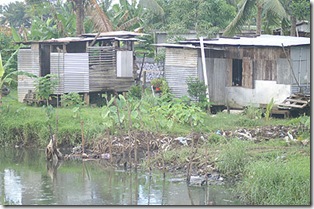
squatter03Imagine if secure title to land existed only in 8.2% of this country, New Zealand.  Imagine if most of the balance was Maori land, with the same system of collective 'ownership' that Maori landholdings have; with all the restrictions on individual ownership that make it impossible to sell, borrow against or develop the land-- with all the false pride that the ruling chiefs like to demand for themselves -- and with the added hindrance that all this land is 'administered' by bureaucrats from a Native Trust Lands Board, who lease small plots out short-term to smallholders like my friend above who make barely enough to keep their own bellies fed, let alone having enough left over to sustain a landlord, and who distribute these meagre 'earnings' to tribal chiefs to distribute it as alms.

It makes the sort of impoverished shanties you see on Northland Maori land look positively luxurious -- and if the same mad land law had been effected over nearly ninety percent of the country here, as it was in Fiji, then those same shanties would be here too over most of the land, and the Maori Browntable here would be as violently opposed to reform of the system as are Fiji’s tribal chiefs.

But then add something else as well to the Fijian picture: these small short-lease-holders are primarily the descendants of "girmit" indentured workers brought over from India at the behest of colonial governors from Gordon on, with few rights either electorally or in property, and the holders of their leases are primarily natives, resentful of the low rents the Native Trust Lands Board distributes, and of the immigrant population who occupies 'their' land with so little to show for it.

One side is barred from decent access to their own land, while the other is refused secure rights and barred from any means of securing the capital or landholdings that might allow properly industrialised agriculture to develop. (You can read here something of the history and details of Fiji's feudal land tenure system, if system it can be called.)

No wonder everyone is resentful.  No wonder there's a 'coup culture.'  No wonder there's so little prosperity, and we witness -- if our eyes are open to it -- the tragic existence of Fiji's squatters, mostly dispossessed Indo-Fijians who racist law has barred from owning land, and who previous governments have left at the mercy of shifting racial, economic and political tides, and of the indigenous Fijians who aren't politically connected, for whom a lifetime of poverty is the only expectation.

No wonder one of the main Fijian exports is people -- whether sportsmen or soldiers or as emigrants just getting  the hell out -- and one of the main imports is tourists -- who avert their eyes from the poverty on the way to resorts on (mostly) freehold land all along the beautiful coastline, gifted to regime donors and well away from the poverty elsewhere.

Despite the condemnations of Pacific leaders like Helen Clark, who has her own racist laws and shifting racial, economic and political tides to navigate, all the evidence I've seen suggests Fiji's interim Prime Minister Frank Bainimarama might be on the right track, and much of the country seems to understand that.  Writing last year in January's Time magazine, Elizabeth Keenan argued::

   When military commander Frank Bainimarama seized power in Suva on Dec. 5, he was instantly denounced by Australia, New Zealand, the U.S., the E.U., the U.N. and the Commonwealth. Exiled Prime Minister Laisenia Qarase continues to vent outrage by phone from his island village, but his countrymen don't seem to be rallying. Soldiers at checkpoints receive abuse, but also smiles, handshakes, food and flowers. Some staunch democrats who condemned George Speight's botched coup in 2000 find themselves endorsing the aims of this takeover, if not the assault rifles that made it possible. The Methodist Church and the Great Council of Chiefs, bastions of indigenous society, have urged Fijians—including Qarase—to support the multiracial interim government "for the betterment of the nation." Writing in the Fiji Times, Catholic Archbishop Peter Mataca called Australia and New Zealand's shunning of the Bainimarama administration "regrettable and shallow." Some Fijians, he wrote, believe democracy and the rule of law "were abused and circumvented long before the military ousted the Qarase government."
In Fiji, it seems, not all coups are equally offensive...
    Qarase's elected government was seen as caring most about the happiness of indigenous Fijians. Bainimarama's force-backed government aims to make Fijians of all races happy. If—and it's a huge if—he can implement his idealistic program, he might just have pulled off the coup to end all Fiji coups.

From what I've seen, that's his explicit intention.  Sure, progress hasn't been as fast as anyone would have hoped -- allowing Clark and Australia's Kevin Rudd to posture as 'democrats' by berating Bainimarama for not yet holding free elections -- but progress has been made, even as measured by 'Fiji Time,' and a 'Draft People's Charter' that's not all bad news is now touring the country gathering support.

The Charter is backed by some hard-headed analysis, underpinned by recognition, for example, that "The economic growth rate in Fiji has been in long term decline since Independence – and the rate of decline is getting faster."

    There are [many] factors that weakened the pace of economic growth... The key among these other factors include a major property rights problem relating to the availability of leasehold land, the lack of investment in infrastructure, incompatible and inconsistent policies in some areas, and a weak legal environment for business.
    Many of these latter issues raise questions about the role of the Government in the economy. In the view of many people, the Government is over-dominant in the economy; i.e. it should reconsider its role if it wishes to achieve stronger growth, greater equity, and sustainability.

I am one of those people.  Government administers most of the land, most of the business and gets to allow or disallow most of the enterprise.  No wonder there isn't much.  Bureaucratic management works as badly in Fiji as everywhere else, and enterprise is further stifled by the lack of secure property rights removing one of the primary means by which feudalism is transformed into capitalism.

Property rights are more important than democracy.  No question.  What's crucial in Fiji is not democracy per se, but real secure property rights that will allow real capital to transform the lives of both squatters and squattocracy. Fijian-Indian activist Thakur Ranjit Singh argues that "democracies that are devoid of or lacking in granting freedom, rights and equality to all its citizens and those without social justice are not worth defending. Qarase's regime that Bainimarama removed was an epitome of such a democracy..."  Singh argues that military commander Commodore Voreqe Bainimarama had saved Fiji from becoming "another Zimbabwe" with serious abuses of human rights and social justice.  Yes, there's been beatings and violations of free speech, which we must all deplore, but it's worth making the point that if he's to be believed (and the more I've seen of him the more I do believe him) then Bainimarama is genuinely if bumblingly trying to right a real wrong: the wrong of corruption in Government, and of a racist Fijian Government system that has in the past favoured indigenous, well-connected Fijians over other citizens -- and it's worth noting that at least some of the resistance to him is along racist lines. This post and comment by a native Fijian writing at The Rotten State of Fiji blog gives some idea:

    Frank has gone completely mad! ...
    A lot of stupid Indians here continue to support Frank and his cronies. This isn't helped by the vengeful mob of Indians settled overseas in Australia and NZ. In the media, they continue to support Frank. In fact, I reckon, Australia and NZ should send those lot back to Fiji and ban them from returning. (Comment: I am with you...this coup was pro Indians and these stupid lot should be sent back to their motherland ... just like Butadroka said, quote Indians will always be Indians...unquote.)
Tim Wikiriwhi argued in The Free Radical last year that Bainimarama's coup wasn't just another power grab, that it had a point in principle:
    Bainimarama’s coup is the complete opposite of the previous three coups, each of which attempted to establish absolutely the UN’s apartheid agenda for "indigenous rights." Whereas Rabuka and Speight were acting to cement the racist laws that raised indigenous Fijians over other Fijians, Bainimarama is a defender of the principle of equality.
Bainimarama said he was compelled to act against the government because corruption had flourished under Qarase, whom he himself appointed after the 2000 coup, and because of proposed laws that would grant pardons to plotters in a 2000 coup and hand lucrative land rights to indigenous Fijians at the expense of the large ethnic Indian minority

Wikiriwhi points to words such as these from the Commodore: “We want to rid the constitution of provisions that facilitate and exacerbate the politics of race,” arguing that

    In seeking to put a permanent end to the racist Fijian electoral system and to permanently abolish laws that grant favouritism to indigenous racists, he is in my estimation worthy of praise and support...
In seeking to permanently abolish laws that grant favouritism to indigenous racists, you're unlikely however to attract the support of the racists themselves.

And what point is democracy anyway without individual rights?  As author Tom Bethell points out, property rights and the rule of law must come first.  What you need first is the rule of law as it was developed in England -- and then denied to England's new subjects in places like Fiji by governors like Gordon.

    If you can get that without democracy, as the Hong Kong Chinese did, maybe you are in business. Democracy, especially at the early stages of development, will only mess things up.  You don't need full liberty of speech either--they certainly didn't have it in Adam Smith's England ...
    To get the political architecture right, you must do things in the right order. It is not hard to understand that to build a house, you have to bring in and assemble the parts in the right sequence. Something like that applies politically as well. I once heard Peruvian economist Hernando de Soto point out that when the correct laws are not in place (as is true all over the Third World), and the people cannot get clear title to land, the construction of informal housing will take place in reverse order. Squatters bring furniture with them; then they put up a makeshift roof, then walls, finally if they're lucky they may get a utility hookup. Foundations are probably never built. In the same way, instant democracy disorders the political economy. Democracy is something that should come later rather than earlier.
    What is needed first is a system of law that treats everyone equally, penalizes wrongdoers, and gives security to property and its exchange by contract. This will foster a sense of justice and encourage people to be productive.
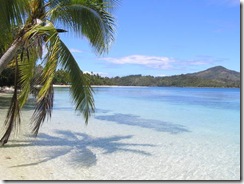
fijiWhile imperfect, it looks to me like Fiji's 'Draft People's Charter' is a step down that necessary track.  Sure, prosperity has its own problems, but as we flew back to New Zealand on Tuesday and looked down on the prosperous New Zealand landscape, it should have been clear even to the most jaundiced green eye that a land with industrialised agriculture and houses derided as "McMansions" offers a lot more comfortable existence than one -- no matter how good the coast looks in the travel brochures -- whose interior is filled with shanties and squats, and is scratched over by people with hand ploughs.

Friday, 17 September 2010

Emancipating govt, enslaving free men [update 2]

IT’S SAID  OFTEN ENOUGH in coaching circles that no matter how well you train someone in a new style of play—changing their golf swing, improving their kicking style, remedying their bowling action—when push comes to shove in a pressure situation, they’ll revert regardless to what they do instinctively.

So it is with this National-led Government who, when the chips are down, revert to what they know best.  Big Government.

Their legislative response to Canterbury’s earthquake is a classic illustration of what I mean. Maintaining  that "we need to be able to … remove bureaucracy that would slow up” rebuilding,  you need to understand that by “we” here they intend not you and me, but themselves. The bureaucracy  they have removed is from them.

To those now expressing surprise at the dictatorial powers they have now granted themselves I say, “Why be surprised?” Because when the rubber that is an earthquake meets the road that is economic reality, you really do see what implicit conviction a governing party really does hold. And whatever their stated principles might suggest about their convictions, enough clues have already been scattered throughout this government’s term to quite easily determine their real, implicit convictions.

Let me give you a few leading examples.

  • EXAMPLE NO. 1: Take a look at what they did with the RMA.  They announced even before the election that they would “simplify and streamline” the Resource Management Act (RMA) to stop the impediments to development.  And so they did.  They simplified and streamlined the RMA, not to make it easier for you and me to get on with our renovations, but to make it easier for the government to get out the bulldozers and get on with its Think Big 2.0 infrastructure programme.  To impose “greater central government direction” (Nick Smith’s words) not less.  To set up a whole new bureaucracy, an Environmental Protection Authority, to ride herd on those pesky property owners seeking the same freedoms from the constraints of the RMA the government was simplifying and streamlining for themselves.   The RMA was streamlined all right – streamlined to make it easier for ThinkBig 2.0, and make like easier for planners.
  • EXAMPLE NO. 2:  “Fibre to the home.” Announcing that the ability for every home to download porn is crucial to this country’s development, this government then continued the meddling in the telecommunications market begun by the last government (ensuring no sane investor would risk their own money on any sort of large-scale fibre network) before announcing the government itself would risk several billion of our tax dollars (that’s $1.5 billion plus cock-ups) by undertaking this important mission itself.
  • EXAMPLE NO. 3:  How about what Rodney Hide is doing in National’s name in Auckland, undertaking “local government reform to “get the city moving.”  How will a super-sized bureaucracy (staffed with super-sized egos) do that, you might ask?  Simple, says Rodney Hide. It will give one mayor and one unified council undreamed of power to dictate what happens from Pukekohe to Warkworth—a megalomaniacal concentration of bureaucratic power “focussed on big picture issues” paid by big city rates, all to make sure the trains run on time.

Are you getting the picture yet?

This is a government that does want to see the country moving forward.  Let’s give them that much.  But when push comes to shove, and despite their stated principles of “maximum freedom and the avoidance of unnecessary controls,” the freedom they seek is not for you and me, it’s for them.  And the avoidance of unnecessary controls is not for the entrepreneurs, investors and businessmen and women who actually do drive the creation of wealth—it’s for themselves and their bureaucrats.

That they don’t even see this themselves was evident only yesterday, when Steven Joyce spoke in Rotorua at a New Zealand Computer Society Conference

_Quote on how Governments are not good at innovation – tried that in an experiment known as the Soviet Union. Said innovation happens in all the companies and firms that are represented at this conference, and the Government’s job is to try and facilitate a supportive environment.

He said all that out of one side of the mouth, while out of the other he was telling the audience how excited he is about the government’s $1.5b urban fibre project, and the urgency of (and votes in) “advancing the rural fibre project….”

And by “advancing,” he means risking bucket-loads of your money on something no private investor can yet see a profit in. Not, at least, while the govt talks like this.

LET ME SAY IT again. Despite their stated small-govt principles, the only agent for change this government takes seriously is Big Government.  The only agent who knows best, they assume, is Big Government.

Every important reform or undertaking this government has undertaken since it came to power has been an expression of that same inner conviction. RMA. Smacking. National Standards. A new War on P. Three Strikes. Boot Camps. DNA Testing. Car Crushing. Infrastructure Spend-Up. Auckland’s Local Government Reform. Fibre to the home. The Canterbury Reconstruction (All-Powerful Govt) Bill.  . .

From the first hundred days to now, it’s been one sopping seamless stream  of state worship. So why should anyone be surprised now when Gerry Brownlee adopts the mantle of Nero and National supporters like David Farrar start writing encomia to benevolent dictatorship.

Mao ZeFarrar THE IRONY OF CHEERLEADER FARRAR being the first one to openly and enthusiastically embrace the dictatorial implications of the Brownlee Brownlee Enabling  Bill was lost on few people. After all , as everyone from The Standard to Kiwipolitico to David Slack points out (“Reading Kiwiblog on ‘wise dictatorship,’ you'd think Thomas Jefferson never put quill to paper,” said Slack) , today’s chief blogetic cheerleader for dictators was 2007’s leader of the campaign against the Electoral Finance Act—a campaign whose ads argued that Helen Clark’s attack on free speech in the EFA put her on a par with dictators like Frank Bainimarama, Robert Mugabe, and Mao Zedong.

How quickly a manatee changes its spots.

But so too, it must be said, have many of those once former advocates of the Electoral Finance Act who now talk so nobly about Thomas Jefferson and the virtues of small government.* As Craig Ranapia said in jest about the complaining going on about the Bill over at Public Address, “I’m shocked how close you commies are to forming an Ayn Rand book club.”

How quickly commies change their spots too, eh, when it’s not their team who’s in power.

Wherein, perhaps, lies a lesson that the various party cheerleaders might think about when they go home at night to their various book clubs. We’re very far from ever having any serous constitutional restraints on governments in this country, more’s the pity. But how about those who are in power, and those who support them, begin by imagining how much power the the legislation they do write will give to the other team should they ever get back behind the Treasury benches.

That at least might exercise the small fibres of small-government thinking still residing in what they call their brains, sufficiently perhaps that these sentiments might burst forth at times other than just their party conferences, or when they’re in opposition.

[* CLARIFICATION: David Slack reckons “you'll find that you'll search high, low and in vain to find anything I've ever written advocating the EFA. I could be mistaken, but I'd be mightily surprised.” e’s not so sure about the commies, but. ]

UPDATE 1:  Chris Trotter opposes the Gerry Brownlee Enabling Bill with some convincing arguments,  somehow contriving not to notice both his blatant violation of Godwin’s Law and the undeniable fact that the intent of this Bill, of Auckland’s new super-bureaucracy, of the sacking of Environment Canterbury’s councillors, of all the other examples I’ve indicated above, are not examples of the government giving power to itself . Instead they somehow demonstrate, says Trotter trying to convince himself as much as his readers, 

_Quotethe continuing radicalisation’ of the neoliberal project… which "works toward" the final triumph of the unregulated market.

A remark that represents either astonishing blindness or a capacity to believe two impossible things before breakfast, since if his own favoured party was packing on the same power this one is he’d be first out there in the cheer squad.

Mind you, this is the same Chris Trotter who, when his own favoured political regime was at the top table and extorting your money to find their election campaign , wrote a very long and learned  piece arguing that this ransacking of the public purse for their electoral war chest was “justifiable” or “acceptable corruption.” 

Which I guess, given the symmetry with Farrar’s “I Heart Dictators” post this week, makes him something like Farrar’s alter ego.  Or maybe his Red twin.

UPDATE 2:  Lyndon Hood at Scoop scores an interview with someone not exactly like, but very like, the Canterbury Caesar. We start in mid-flight…

Scoop: Doesn't this all seem a bit authoritarian to you?

Brownlee: 'Authoritarian'. Yes, I think that's exactly the word. Well done.

Scoop: So your Government…

Brownlee: I'll just write that down.

Scoop: Your Government rammed through the Super City and disestablished the Canterbury local government. One of your Ministers released personal information on people who complained about their policies. Is authoritarianism your answer to everything?

Brownlee: I wouldn't say that.

Scoop: I know you wouldn't say it, but is it true?

Brownlee: I don't think it's very fair.

Scoop: Well can you think of any problem you wouldn't solve with authoritarianism?

Brownlee: Well, I, for example if my problem was I wanted a cup of tea, I might boil the jug or I might ask someone to make some for me.

Scoop: And if there wasn't any tea?

Brownlee: Well, if it was like that I suppose I would go for the authoritarianism.

Scoop: Perhaps you'd commandeer some tea?

Brownlee: Obviously I'd have to suspend the Crimes Act first otherwise it would be stealing. But look, that's not reason to go around calling us names. Some might say that's hampering the reconstruction effort.

Scoop: Oh.

Brownlee: There must still be a gallows somewhere in this country…

Monday, 4 January 2010

Made your New Year's Resolutions yet? [updated]

Made your New Year's Resolutions yet? "Unfortunately," observes Alex Epstein, "this ritual commitment to self-improvement is widely viewed as something of a joke." So here's his idea [hat tip Voices for Reason]:

_quoteThis New Year’s, resolve to think about how to make your life better, not just once a year, but every day. Resolve to set goals, not just in one or two aspects of life, but in every important aspect and in your life as a whole. Resolve to pursue the goals that will make you successful and happy, not as the exception in a life of passivity, but as the rule that becomes second-nature."

See how that works for you. 

And it's not too late--just resolve to be more punctual in future.

UPDATE:  Instead of looking back like everyone does around New Year, I'm looking forward--forward to headlines  that I'd like to see sometime in 2010 [hat tip The New Clarion, from whom I've pinched a couple]. Only some of them are likely:

  • NZers See Through Spineless Nats: "No Clue What They Stand For" say Vox Pops
  • New Finance Minister Announces Cross-the-Board Tax Cuts: "Time We Kept Our Promises" he says
  • Environment Minister Scraps RMA: Announces "Property Rights Best For Environment"
  • "Gareth Morgan hasn't done well for us--too much time off the ball" say Investors
  • Inquiry Into ClimateGate Finds Widespread Corruption. NIWA Sacks Salinger's Spawn
  • Warmists Routed as Emissions Trading Schemes Collapse
  • Bennett's Ministry Told "Start Publishing Honest Unemployment Figures":  "If You Can't Or Won't Work Then You're Unemployed, No Matter What Your Benefit is Called" says Minister
  • Ben Bernanke Fails to Put Multi-Trillion Dollar Genie Back in Bottle: Senate Demands His Head
  • Obama says "Ayn Rand was right!": Begins Dismantling Big Govt
  • United Nations Announces "No Money for Development Programmes": Helen Clark to Head Back Home
  • Teachers Demand Separation of School & State: "Time for Ministry to Go" says Principal
  • Rugby Finds Mojo Again, Makes New Fans: "First Time I've Seen Rucking In Years" says Meads
  • Geelong Wins Third AFL Premiership in Four Years
  • Another Al Gore Lecture on GW Cancelled Due to Extreme Cold, and Violent Disinterest
  • Businessmen Gain Spine, Start Defending Themselves & Capitalism
  • "I'm Going on a Quango Hunt," says Brownlee, "and I'm Taking My Axe!"
  • Economists Announce Huge Attendance at 'Mises Circle' Conference in Wellington: Call for Reserve Bank to Shut Down
  • News Bosses Can Braindead News, Hire Intelligent Presenters: "We're Going to Stop Insulting Our Audience's Intelligence," says  Mogul
  • Nats Prepare Roster of SOEs for Sale, and Close Down Many More: "We're Paying Back Debt and Getting Out Of Your Way" says new Finance Minister
  • David Cunliffe Enrols in Humility Training: "Crunch Came When Head Too Big For Hat" says Wife
  • Greens Say Resource Consent Process "Too Authoritarian": "Common Law Works Best" says Norman
  • Maoris Look Forward To Day in Court After Simple Repeal of Foreshore & Seabead Act: "Common Law Works Best" says Tariana
  • Kelsey & Colleagues Sacked as Students Demand Rational Education on Campus:  "Sick of Warmed-Over Marxism and Post-Modern Crap" say Student Leaders