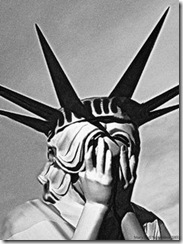
 A post from 'Freedom's Phoenix' laments the death of the US Libertarian Party: Libertarian Party 1972 - 2008: Rest in Peace is the title.
Once billed as “The Party of Principle” those principles were sold down the river [says the 'Phoenix'. On Sunday, May 25, 2008 the principles were abandoned, and the party was last seen gasping for air
before expiring...
Far Right Republican congressman Bob Barr was nominated for president and the loudmouthed, huckster, Wayne Root, an “odds maker” from Las Vegas, traded with Barr in order to become his running mate. They brought to the LP the sort of backroom deal-making once only seen in the larger, corrupt parties.
It is true that the principles did not die easily, however. On the first ballot conservative Barr was leading libertarian Dr. Mary Ruwart by just one vote. On the second ballot it was dead even. On the third vote Ruwart was in the lead. And then the “behind-the-scenes” deal of the two neocon infiltrators was announced...
Realize that neither man is a libertarian, both are conservatives. Both endorse foreign interventionism... Only two weeks ago [Barr] adamantly said he was opposed to ending the war on drugs... Previously Barr was openly and viciously antigay and he authored one of the most discriminatory pieces of antigay legislation around, the Defense of Marriage Act...
They want to take votes from McCain. And how will they do that? By arguing that McCain is not a “true conservative” and that Barr is. And exactly how will that be sold to the public? Barr will have to campaign, not as a libertarian, but as a Far Right conservative...
So the US Libertarian Party is now dead. But the truth is the American Libertarian Party died long ago, right at the very moment of gestation. The so called "leading libertarian" whose failed candidacy 'Freedom's Phoenix' laments demonstrates why. In Mary Ruwart's Short Answers to Tough Questions this appears:
"Children who willingly participate in sexual acts have the right to make that decision as well, even if it's distasteful to us personally. Some children will make poor choices just as some adults do in smoking and drinking to excess. When we outlaw child pornography, the prices paid for child performers rise, increasing the incentives for parents to use children against their will."
Ruwart supporters argue that this answer was "taken out of context" (how do you take "out of context" an enabling statement like "Children who willingly participate in sexual acts have the right to make that decision as well, even if it's distasteful to us personally") but the fact remains that despite the bleating of the likes of the Phoenix, the two leading choices running for the the US Libertarian Party's Presidential candidacy this year were a compulsion-touter who opposes immigration, abortion and gay marriage, and a flake who wants to make the world safe for the likes of the North American Man Boy Love Association -- to paraphrase Ayn Rand, "a Conservative who subordinates reason to faith, and substitutes theocracy for capitalism; or a 'hippy of the right' who subordinates reason to whims, and substitutes anarchism for capitalism."
Thus we see the result of having "principles" without a philosophical base, and party activists who can't even agree what 'freedom' means. This, as I've said before, is why most US libertarians are not pro-liberty, they're just anti-state. (And this is why, by contrast, New Zealand's Libertarianz party, which I support, is called "hard line" by one of the hippies.)
And here we get to the root of the Objectivist argument against irrational libertarianism. Without a rational philosophical foundation, without a decent "philosophical infrastructure," politics is simply a dangerous pursuit of empty slogans, floating abstractions, and range-of-the-moment compromises. How can you call these people allies in freedom, ask hardcore Objectivists, when American libertarians can't even agree on what the word "freedom" stands for, or whether a "free society" allows children to "willingly participate in sexual acts," or a religious community to enslave and rape twelve-year-old girls?
The US Libertarian Party was doomed from its gestation, doomed from the moment the "hippies of the right" who founded it refused to understand that political activism without a philosophical base was worse than just empty sloganeering. As I explained in my 'Cue Card' on Libertarianism:
Libertarianism as a political idea is four-square for freedom. At the basis of libertarianism is the principle that all adult human interaction should be voluntary, or to put it another way, that capitalist acts between consenting adults should be legal. There are many ways to put the point.
In a political context, freedom has only one specific meaning -- freedom from the initiation of force by other men. US libertarian Murray Rothbard puts it this way:
"The Libertarian creed rests on one central axiom: that no man or group of men
may aggress against the person or property of anyone else. This may be
called the non-aggression axiom. Aggression is defined as the initiation
of the use or threat of physical violence against the person or property of
anyone else."
This point has been well enough rehearsed under other Cue Card entries, but it should be noted at this juncture that many advocates of the Non-Aggression Principle, including myself, do not regard it as an axiom. An axiom is a fundamental, self-evident truth; it does not require “grounding’.” The Non-Aggression Principle is fundamental, but far from self-evident; it does need grounding. The question for libertarians is how it is grounded.
Rothbard boasts that not insisting on such a foundation has enabled the Libertarian movement to be "eclectic."
As the party's final demise demonstrates, principles without foundations and "eclecticism" without understanding is not a virtue one should want to emulate.
It's not as if the Non-Aggression principle is difficult to ground, as Tibor Machan demonstrates:
The concept of freedom, in its socially relevant sense, means the condition of individuals being free from aggression by others… It rests on the recognition of every individual’s equal moral nature as a self-determined and self-responsible agent, regardless of admittedly enormous circumstantial difference.
Fact is, it's not enough just to be an advocate for capitalism, or an advocate for freedom, without any understanding of the ideas on which these concepts are grounded. Michael Berliner points out that this is what Ayn Rand sought to make clear in her own writing:
She understood that to defend the individual she must penetrate to the root: his need to use reason to survive. "I am not primarily an advocate of capitalism," she wrote in 1971, "but of egoism; and I am not primarily an advocate of egoism, but of reason. If one recognizes the supremacy of reason and applies it consistently, all the rest follows." This radical view put her at odds with conservatives, whom she vilified for their attempts to base capitalism on faith and altruism. Advocating a government to protect the individual's right to his property, she was not a liberal (or an anarchist). Advocating the indispensability of philosophy, she was not a libertarian.
Let me repeat Rand's summary of her own position to make the final point:
"I am not primarily an advocate of capitalism, but of egoism; and I am not primarily an advocate of egoism, but of reason. If one recognizes the supremacy of reason and applies it consistently, all the rest follows."
And if one doesn't, what has happened to US libertarianism follows just as inexorably.
 Owen McShane from the Climate Science Coalition sends you this reminder: 'The Great Global Warming Swindle' is showing on Prime at 8.30 this Sunday,followed by a panel discussion that includes Leighton Smith.

 10. Roosters Haymaker – A haymaker is a big wild punch which, if it connects, sends you crashing to the floor. Much like this strong beer really…
 5. Lighthouse Fugnose – Made with Fuggles hops. When someone asked the brewer what the beer was called, the brewer is still adamant he really did say “Fugnose.”