Showing posts with label #Paris. Show all posts

Tuesday, 24 November 2015

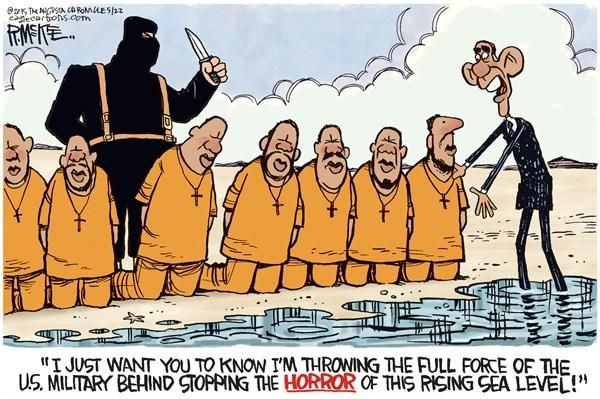
Bonus ‘Stupid of the Day’: Obama edition

Sorry, I thought the previous Quote of the Day was going to be the stupidest thing I heard today.

But it turns out it’s not.

It turns out Obama thinks the Paris climate conference is going to send a message to ISIS . . .

It’s at times like this you realise why satire might be becoming extinct.

Thank goodness for cartoonists.

[Hat tip Steve Milloy. Cartoon by Rick McKee from the Augusta Chronicle]

Quote of the day: On stopping suicide bombers with cameras . . .

The former German Federal Minister of the Interior Hans-Peter Friedrich told Der Spiegel that surveillance cameras are effective in stopping suicide bombers . . .

[Translation]: DER SPIEGEL: Widespread video surveillance in the US could not prevent [the Boston Marathon] attacks. Rather, the perpetrators seem to have been fully aware of the monitoring.
Friedrich: A suicide bomber, who includes his own death in his planning of the attack won't be discouraged by surveillance cameras.
DER SPIEGEL: So the cameras are ineffective?
Friedrich: That'd be a wrong conclusion. If we catch the attacker after the first time, he can't act a second or third time.  That alone is already a success.

[Hat tip Felix Mueller]

Monday, 23 November 2015

Quote of the day: Why are there so few Muslim terrorists?

_quotation_marks1 (1)I think this actually is a great question. Given what a totally vile doctrine Islam is, and given how many people say that they follow it, why indeed do so few Muslims, percentage wise, actually do the kinds of murderous things demanded of them in Islam’s holy scriptures?
The more vile you consider the things that Islam demands of its devotees, and they seem to me to be very vile indeed, the better the question is.

~ Brian Micklethwait, Samizdata post asking ‘Why are there so few Muslim terrorists?

Friday, 20 November 2015

Quote of the Day: On alienation

The proper answer to the question--
    And how am I to face the odds
    of man’s bedevilment and God’s?
    I, a stranger and afraid
    in a world I never made
--is: Why didn't you?
    ~ Ayn Rand

Wednesday, 18 November 2015

And, into that vacuum stepped Islam …


Shadow

Let’s talk about Islam, and its evil. (Beause as we know, the only reason we’re even talking about the religion is because it is evil.)

We should be under no illusions about the evil of Islam, but neither should we grant it any more power than it has: as Ayn Rand used to say, evil on its own is impotent. Evil can only achieve its values through the actions of others—by that which we let evil-doers extort from us.

Never has this underlying impotence been more true of any ideology than Islam:

  • whose allegedly heroic beginnings in historic “conquest” were less the bold display of any great martial ability than the result of occupying the vacuum that emerged after the collapse of the Roman and Persian empires—after which these illiterate marauding heroes cobbled together a religion from the mostly heretical cultural remnants of the desert towns and places they occupied. (Read Tom Holland’s ground-breaking history In the Shadow of the Sword.)
  • whose historic golden age was wholly the result of borrowing from Greek thinkers, contained remarkably few original additions-- and was stopped overnight by the philosopher, Al-Ghazali, more responsible than most for turning Islam into the thing that pulled the pin on Paris (Read my own post ‘The Greatest Story (Hardly) Ever Told’ and Andy Clarkson’s ‘Yes, You Can Blame This Guy For Paris’)
  • whose modern violence has been indirectly financed by the oil purchases of the west, largely armed from the stockpiles of left-behind western military materiel, and whose belligerent limits are imposed only by the acquiescence and appeasement of of western political and intellectual leaders.  (Read the relevant chapters of Daniel Yergin’s classic The Prize: The Epic Quest for Oil, Money & Power and Elan Journo’s Winning the Unwinnable War.)
  • whose very tactic of terrorism relies not on conquest–it is never going to establish a caliphate in Paris—“but through scaring us into panicking, overreacting, and changing our behaviour.” (Read, for example, a former IS hostage’s article: ‘I know Islamic State. What they fear more than bombs is unity,’ and reflect on why western cartoonists and writers—Danish cartoonists, Salman Rushdie, Charlie Hebdo--ended up in the front lines of this battle)
  • whose very western recruits are frequently just idiots with empty lives seeking something seemingly meaningful to fill them. (Reflect, for example, on the comment on the would-be Garland terrorist: “He had been going down a bad path and then he found Islam.")

Face it, the only reason we are even talking about the double-damned religion is because from a population of 1.5 billion Muslims worldwide a few dozen terrorists and just a few thousand ISIS fighters, financed by states long known to finance terrorism but for which the west has little appetite to say so, are allowed because of that appeasement to put whole continents on the alert. (Read the report’s and mis-reports overnight, for example, of panic in the streets around European soccer stadiums.)

It truly is the mouse that roars militarily.

Because these fuckers can’t even send their own fighters to do their job! Astonishingly, little has been written on this highly telling fact, but reflect on this: that with only trivial exceptions all those carrying out the horrors in Europe, from London to Glasgow to Madrid to Paris, have not been fighters sent on a mission from far away but have been educated, prosperous and homegrown. (Read for instance my 2014 post Home-grown horror, and Adam Taylor’s piece yesterday The Islamic State wants you to hate refugees: And the plan may be working.)

The real failure is not that the evil is strong—it neither has been nor can be—but that the good has been weak. While western hipsters download zombie films, we have allowed ourselves to be attacked by literal self-made zombies—zombies who are self-admitted death worshippers. As a commentator said yesterday: ”Can a civilisation cowed by campus millennials summon the resolve to defeat Islamic terrorists?” Even more important question in stopping psychopaths and disaffected youngsters find value in these anti-life zombies—if these awkward kids see the west’s intellectual and political leaders so brazenly apologetic about the values of their own culture, especially when the contrast between life and anti-life is so stark, then why in hell (those few who are seduced must wonder) should anyone at all take these values at all seriously?

Why wouldn’t they wonder if there isn’t something in a fundamentalism from the stone age?

Why wouldn’t they embrace meaning where they do find it—in barbarism?

“The truly and deliberately evil men are a very small minority; it is the appeaser who unleashes them on mankind; it is the appeaser’s intellectual abdication that invites them to take over. When a culture’s dominant trend is geared to irrationality, the thugs win over the appeasers. When intellectual leaders fail to foster the best in the mixed, unformed, vacillating character of people at large, the thugs are sure to bring out the worst. When the ablest men turn into cowards, the average men turn into brutes.”
~ Ayn Rand (from ‘Altruism as Appeasement,’ The Objectivist, Jan. 1966)

By espousing the moral clarity eschewed by those they hear in the west, young homegrown jihadis find something they hadn’t realised existed—and once again Islam steps into a vacuum of others’ creation. The primary problem here of course being that the powerful cultural force they should be hearing from westerners who are sure of their values have instead been silent in defence of the values and moral certainty that make the west great, while pretending that a stone-age culture is in any way equal. As Daniel Pipes asks, how is that “a majority population accepts the customs and even the criminality of a poorer and weaker community? It is the result of a conquest ideology taking the measure of a civilisation that no longer values its heritage, no longer regards itself as worthy of defence.”

Sure,

some of these [homegrown killers] will simply be psychologically susceptible to the nastiness of a violent religion. But what else are they hearing? Where are the voices proclaiming the virtues of reason, individualism and liberty?  Where today will they hear these values proclaimed proudly and unashamedly? Where will they learn of the superiority of reason over religion, of freedom over tyranny?
When Britain was exporting liberty to much of the known world, these values were unapologetically front and centre. These were the values that built western civilisation. These were values absorbed by immigrants and locally-born alike. People  moved to Britain and the west because of these values.
What happened?
In a word: multiculturalism.
Multiculturalism taught that the values of civilisation and those of barbarism were equal.
It taught that liberty and slavery were simply different choices.
It taught that if any culture should be shamed it should be western culture. That the west is responsible for all the world’s horrors, and the rest of the world simply a victim. This is the perversion now taught and promulgated in schools, in universities and in learned commentaries peddled by perfumed academics for the consumption of the self-anointed.
So for all the decades that we’ve been told that Islamic terror is the result of ignorance and poverty, leading westerners have been silent about the superiority of  western health, wealth and freedom over a stone-age theocracy in which beheadings, clitorectomies, slavery and crucifixions still play a part.

So let’s fight for the enlightenment—for Reason, Science, Modernity, and Civilisation--and fill the vacuum.

The Enlightenment is a long-term strategy.
In fact, many westerners would have to discover the enlightenment. The Enlightenment encourages us to be reflective. But to reflect on whether we are doing the right thing, isn’t an invitation to stop doing the right thing. As a civilisation we have become paralysed by self-doubt when we should have become energised by self-reflection. As we have discovered (or as many knew all along) is that a moral and ideological vacuum will be filled by others – as it turns out savages and barbarians.

UPDATE:

Yes, as an emailer suggested to me, there’s a parallel between the impotence of Islam and the impotence of another evil ideology: communism—in that like all anti-life evils they are necessarily parasitic on the good. (Evil is an absence and a negation; evil is impotent and has no power but that which we let it extort from us.)

Observe, for example, that both Marx and Lenin understood that a country could only go communist after it had a period of capitalism—because only then would there be something decent to loot. (Read Marx’s Capital, if you can, and Lenin’s ‘What Must Be Done.’)

Observe that in a country where chess is a spectator sport, stealing wealth and technology was a necessary feature of the Soviet Union, without which neither production nor progress was possible. (Read Werner Keller’s fabulous history on this, whose very title explains the relationship: East Minus West Equals Zero.)

Observe too that while conservatives focussed their anti-communism on arresting the alleged strength of the evil empire, thinkers like Ayn Rand and Ludwig Von Mises who understood that impotent ideology knew that totalitarianism is not a system that ever produces wealth, and that the Soviet Union faced inevitable economic collapse. (Read Mises’s Socialism and Economic Calculation in the Socialist Commonwealth. And compare, for example, the technology-stangant dystopia in Ayn Rand’s Anthem to the technology available in either Huxley’s Brave New World or Orwell’s 1984—or even the films of Suzanne Collins’s Hunger Games.)

.

Tuesday, 17 November 2015

Quotes of the day: On the ultimate impotence of evil

Existence is not a negation of negatives. Evil, not value, is an absence and a negation, evil is impotent and has no power but that which we let it extort from us… The spread of evil is the symptom of a vacuum. Whenever evil wins, it is only by default...”
”When men reduce their virtues to the approximate, then evil acquires the force of an absolute, when loyalty to an unyielding purpose is dropped by the virtuous, it’s picked up by scoundrels—and you get the indecent spectacle of a cringing, bargaining, traitorous good and a self-righteously uncompromising evil.

        ~ Ayn Rand, from ‘Galt’s Speech,’ in For the New Intellectual

“The truly and deliberately evil men are a very small minority; it is the appeaser who unleashes them on mankind; it is the appeaser’s intellectual abdication that invites them to take over. When a culture’s dominant trend is geared to irrationality, the thugs win over the appeasers. When intellectual leaders fail to foster the best in the mixed, unformed, vacillating character of people at large, the thugs are sure to bring out the worst. When the ablest men turn into cowards, the average men turn into brutes.”
        ~ Ayn Rand, from ‘Altruism as Appeasement,’ The Objectivist, Jan. 1966

Post-Paris: More writing & talking [updated]

France bombed ISIS

So much more to think about overnight . . .

“They deal in chaos, but they work from a script. The failure to understand that is costing us dear.
”There is a playbook, a manifesto: The Management of Savagery/Chaos, a tract written more than a decade ago under the name Abu Bakr Naji, for the Mesopotamian wing of al-Qaida that would become Isis. Think of the horror of Paris and then consider these, its principal [and self-contradictory] axioms…”
Mindless terrorists? The truth about Isis is much worse – Scott Atran, GUARDIAN

“It is highly likely that the Paris attackers were operating in a land that was not entirely foreign to them. They knew that they could rely on the help of other like-minded people. They also knew their actions would enjoy the passive support of a significant section of society, which is estranged from, and hostile to, the way of life of European societies. By now they must also know they are holding their own in a battle of ideas with European governments…
”But there’s something different about this type of terrorism, too. Such acts are not simply about unsettling the public and creating a climate of fear – they also aim to encourage others to take up the fight …
”The one response to terrorism that must be avoided, and fought, is appeasement …”
After Paris: We Must Refuse to Be Terrorised – Frank Furedi, SPIKED

“There are good reasons to wait for the full facts instead of jumping to the conclusion that Isis infiltrators are exploiting Europe’s refugee crisis.”
Why Syrian refugee passport found at Paris attack scene must be treated with caution – Patrick Kingsley, GUARDIAN

“Why are so few Westerners standing with, or fighting with, the Kurds?
”… Our leaders talk war on IS, while green-lighting war on the most implacable enemies of IS.
“The dearth of any true solidarity with the Kurds is striking. Of all the wicked things happening in the world today, the terrorising of the Kurds is up there with the worst, yet there’s little anger, barely any protest.
“The dearth of solidarity with the Kurds among Western progressives ultimately speaks to the baleful influence of the politics of victimhood.”
After Paris: Victory to the Kurds – Brendan O’Neill, SPIKED

“Here we go again. The same mantras are dusted down: we must be more assertive of our values, less tolerant of extremism, we must challenge Muslim separatism more effectively, demand better integration.
“And in my opinion the same root question is somewhat evaded: what exactly are our values? It is easier to assume that this is obvious – and it gives an impression of toughness. For example Boris Johnson today: ‘This is a fight we will one day inevitably win – because in the end our view of the human spirit is vastly more attractive and realistic than theirs.’
“But what is our view of the human spirit? What is our ideology, our creed? There are various words we can reach for – freedom, democracy, liberalism, maybe enlightenment. Fine words, of course, but there’s also an air of vagueness. I find it odd that there have not been more attempts to define our values in the years since 9/11. Very few intellectuals seem to ask the most basic questions…”
Islamic State are clear about their values. Are we clear about ours? – Theo Hobson, SPECTATOR

“For all of the commentaries to come detailing the various intelligence, military, and diplomatic responses that France, the United States, and the EU should pursue, nothing will substitute for our recognition of the enemy and a moral resolve to see its ideology defeated totally and permanently. When historians of the future look back on the beginning of the second millennium, they will find the curious spectacle of two civilizations in bitter conflict: one weak but tireless, underwritten by an ideology that demands submission at any cost and beholden to an image of regression back to a primitive way of life; the other strong, built on a heroic legacy of human achievement, but unequal to its inheritance.”
The Vengeance They Deserve – Slade Mendenhall, THE MENDENHALL

“I can understand why many people react to something like what has happened and ask the question, why are they doing this, what have we done wrong to them. Many people cannot wrap their head around genuinely bad people existing. They believe surely people can be reasoned with, if we be reasonable with them. They just don’t get that it’s possible for people to have heinous and ridiculous beliefs that will cause them to want to kill you for not holding those beliefs. As a result they grasp for answers to explain it in a way that is logical, that fits the mould of ‘they’ve only done this to us because we did this to them.’ …
“[They apply our] sense of ethics, an ethics applicable to the living, an ethics that sets boundaries for the living and their pursuit of happiness in a social context, to a metaphysics of the dead, The Walking Dead. So, think of ISIS and other violent sectarian actors as The Walking Dead for a spell. See how it fits, if it has a certain ring to it, given the juxtaposition of their apocalyptic metaphysics with our ethics for the living, the lovers of life.”
The Walking Dead And The Metaphysics of ISIS – Richard Nikoley, FREE THE ANIMAL

“The West’s movement towards the truth is ‘remarkably slow. We drag ourselves towards it painfully, inch by inch, after each bloody Islamist assault.
”In France, Britain, Germany, America and nearly every other country in the world it remains government policy to say that any and all attacks carried out in the name of Mohammed have ‘nothing to do with Islam’….
“‘Noble’ or not, this lie is a mistake. … To claim that people who punish people by killing them for blaspheming Islam while shouting ‘Allah is greatest’ has ‘nothing to do with Islam’ is madness. Because the violence of the Islamists is, truthfully, only to do with Islam: the worst version of Islam, certainly, but Islam nonetheless. …
“Here we land at the centre of the problem — a centre we have spent the last decade and a half trying to avoid: Islam is not a peaceful religion. No religion is, but Islam is especially not. Nor is it, as some ill-informed people say, solely a religion of war. There are many peaceful verses in the Quran which — luckily for us — the majority of Muslims live by. But it is, by no means, only a religion of peace.”
Will politicians finally admit that the Paris attacks had something to do with Islam? – Douglas Murray, SPECTATOR

“It is not a new war, nor has it always been fought with weapons. It is, principally, an ideological war between the secular, liberal Enlightenment of the West and the theocratic, Dark Age philosophy that still dominates much of the Middle East and North Africa. …
“How does one defeat ideologues that do not fear death? While killing one’s enemy is certainly the chief means of victory in war, that alone is not sufficient—unless one manages to somehow kill every last member of the enemy’s force, which one should be prepared to do if necessary…
“…we should not delude ourselves into thinking that defeating the Islamic State will alone defeat Islamic totalitarianism. So long as the ideology is given room to breathe, it will re-emerge. Suffocating it will also mean eliminating its state sponsors—all of them. I do not mean state sponsors of the Islamic State, which are none, but of Islamic totalitarianism generally, in all its forms across all sects.”
Defeating the Islamic State: Toward a Foreign Policy of Reason – Brian Underwood, THE MENDENHALL

”Can a civilisation cowed by campus millennials summon the resolve to defeat Islamic terrorists? …
“In the darker corners of the Internet and the leftward precincts of academia, the Enlightenment values of liberty, reason, and universal human rights—not to mention the world-changing political revolutions they inspired in Europe and the Americas—amount to little more than a cheap intellectual justification for the historical forces of imperialism, slaughter, and subjugation. Usually, it’s easy to ignore those who respond to events such as the attacks in Paris with soliloquies to the effect of: ‘Well, you know who the real terrorists are, don’t you?’ Or, ‘You can’t expect an entire civilization to take centuries of insults lying down.’ Or, ‘Do you know what’s happening in Palestine right now, yesterday, and every day?’
“It’s not easy to ignore those sentiments today.”
Enemies Foreign and Domestic – Matthew Hennessey, CITY JOURNAL

“How did we get to this historical anomaly in France where, as the estimable scholar Daniel Pipes observes, “a majority population accepts the customs and even the criminality of a poorer and weaker community”? It is the result of a conquest ideology taking the measure of a civilisation that no longer values its heritage, no longer regards itself as worthy of defence.”
How France Became an Inviting Target of the Jihad – Andrew McCarthy, PJ MEDIA

“Mistrust of religion is not confined to Islam, but Europeans regard it as more threatening to their national cultures than other faiths (or indeed atheism) …. The threat of Islamic terrorism is rising, to judge not just by today's slaughter but also by other attacks and a recent upward trend in arrests for religiously-inspired terrorism reported by Europol, the European Union's law-enforcement arm. Perceptions can easily run ahead of reality, however…. And European publics wildly overestimate the proportion of their populations that is Muslim.”
Daily Chart: Islam in Europe – ECONOMIST

’The Duke of Wellington famously said that the Battle of Waterloo was won on the playing-fields of Eton: and if that is the case, then the advance of the Islamic State was begun in the nice, tolerant, liberal academies of Britain and other parts of western Europe.’  …
”Many folk otherwise supportive of allowing peaceful people to cross borders freely argue this policy can’t survive Muslim immigration; they argue the policy is untenable since Muslims constitute an objective threat, to whom western borders must be irrevocably closed. But as many [Europeans] are slowly realising … the threat comes not from Muslim immigration: the threat is homegrown. …
”The cause of these homegrown killers? As Ben Caspit explained in an open letter to the UK Foreign Secretary, you would have to be deaf, blind and dumb not to know. …
”Some of these [homegrown killers] will simply be psychologically susceptible to the nastiness of a violent religion. But what else are they hearing? Where are the voices proclaiming the virtues of reason, individualism and liberty?  Where today will they hear these values proclaimed proudly and unashamedly? Where will they learn of the superiority of reason over religion, of freedom over tyranny?
“When Britain was exporting liberty to much of the known world, these values were unapologetically front and centre. These were the values that built western civilisation. These were values absorbed by immigrants and locally-born alike. People  moved to Britain and the west because of these values.
“What happened?
“In a word: multiculturalism.
“Multiculturalism taught that the values of civilisation and those of barbarism were equal.
“It taught that liberty and slavery were simply different choices.
“It taught that if any culture should be shamed it should be western culture. That the west is responsible for all the world’s horrors, and the rest of the world simply a victim. This is the perversion now taught and promulgated in schools, in universities and in learned commentaries peddled by perfumed academics for the consumption of the self-anointed.
“So for all the decades that we’ve been told that Islamic terror is the result of ignorance and poverty, leading westerners have been silent about the superiority of  western health, wealth and freedom over a stone-age theocracy in which beheadings, clitorectomies, slavery and crucifixions still play a part.
“If leading westerners are apologetic about the values of their own culture, especially when the contrast is so stark, then why in hell would others take them seriously? Why wouldn’t they wonder if there isn’t something to be learned from the stone age?
“What, then, can we do? ‘Well, for a start, we can stop taking these losers at their own estimation…’”
Home-grown horror – Peter Cresswell, NOT PC, 2014

NB: I’ve added other related writing here at NOT PC under the tag: #Paris. Head there for more good and related writing.

UPDATE:

“All of the other suspects in the Paris attacks appear to have been European citizens. In fact, large numbers of citizens from France, Britain and other Western nations have travelled to Syria and Iraq to fight, suggesting that the problem is not so much those coming from over there but those who are already here. Nor are these people necessarily the ones with familial links to the Islamic world: There have been a number of European converts to Islam who have travelled to join the Islamic State, and vast numbers of European Muslims have repeatedly condemned the actions of the Islamic State."
The Islamic State wants you to hate refugees: And the plan may be working – Adam Taylor, WASHINGTON POST

But Muslims who call the Islamic State un-Islamic are typically, as the Princeton scholar Bernard Haykel, the leading expert on the group’s theology, told me, ‘embarrassed and politically correct, with a cotton-candy view of their own religion’ that neglects ‘what their religion has historically and legally required.’ Many denials of the Islamic State’s religious nature, he said, are rooted in an ‘interfaith-Christian-nonsense tradition.’
Haykel told ThinkProgress he still supported these claims, although he explained he was specifically referring to two groups of people who declare ISIS un-Islamic: Muslims he says [who] are ‘just ignorant’ of Islam’s legal and political history, and Christians who engage in what he called ‘the Christian tradition of interfaith dialogue’ and declare Islam a ‘religion of peace.’
“Haykel readily acknowledged there are numerous Islamic scriptures ‘that advocate a more kind of pacifist, less violent, and, in fact, an even tolerant and open-minded [religion that is] accepting of, let’s say, non-Muslims.’ But he concluded that the texts ISIS pulls from still exist within the Islamic tradition, thus making them Islamic.”
What The Atlantic Left Out About ISIS According To Their Own Expert – THINK PROGRESS


“Let’s fight for the enlightenment.
”The Enlightenment is a long-term strategy. In fact, many westerners would have to discover the enlightenment. The Enlightenment encourages us to be reflective. But to reflect on whether we are doing the right thing, isn’t an invitation to stop doing the right thing. As a civilisation we have become paralysed by self-doubt when we should have become energised by self-reflection. As we have discovered (or as many knew all along) is that a moral and ideological vacuum will be filled by others – as it turns out savages and barbarians.”
Let’s fight for the Enlightenment – Sinclair Davison, CATALLAXY FILES

Monday, 16 November 2015

Are we all Parisians today? [updated]

Embedded image permalink

“Je suis Charlie Hebdo,” everyone said ten months ago when their offices were shot up by savages. We all spoke up for their free speech – yet Charlie’s cartoons were reprinted hardly at all, and the news now is replete with reports of politicians wanting non-warmists arrested and university campuses demanding that free speech be shut down.

“We are all Londoners today,” we all said ten years ago when London was bombed by savages. Hell, I said it myself---hoping that’s where the barbarians would be sent. Yet the savages are still bombing – and now, ten years later, there is still no sign of a decent, methodical, coordinated, fully-focussed western response to the barbarism. (And hardly a word of what I wrote then needs to change part from the Proper Nouns.)

So are we all Parisians today? If we are—and sympathy and French flags are everywhere, and Facebook is full of French avatars–it's starting to look less like a brave show of solidarity in ending this never-ending threat, and more like embracing a future of never-ending victimhood.

Do we really wish to hunt down and kill all those who just carried out these mass-murders—and to hunt down and kill those who trained them, financed them, coordinated them and supplied them (without whom the barbarians could only sing like impotent castrati)?

No, you don’t want to do that?

You don’t want that done in your name?

Then just add yourself to that list of people impotently wringing their hands while waving a banner declaring their identity to be “victim.”

"Please don’t say things like, “I stand with France,” or “Those poor French people, victims of that attack!” unless you’re prepared to say and do the following things:
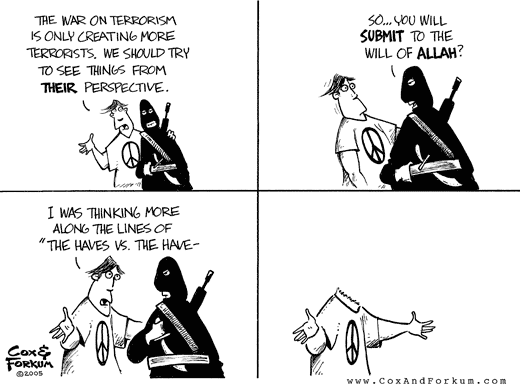
    "Stop saying “Islam” is about peace and love. It’s not. It’s about submission; the people who really get this are the ones who launch these attacks in the name of their religion.
    "Stop supporting politicians like Obama, who insist that Islamic nations like Iran have our same fundamental values and can be trusted with billions of dollars in unfrozen assets (Obama’s treaty), and who don’t mean what they say when they want to wipe Israel off the map.
    "Stop saying we don’t really need a strong military and we cannot, under any circumstances, use the full might of our military arsenal to do things to stop militant Islam in its tracks, to quite literally scare the Allah out of these people.
    "Unless or until you start to rethink your stance, you have no business expressing compassion towards the victims of people in attacks whose perpetrators – knowingly or not – you aid and support via your positions.
    "The president of France calls the attacks in Paris by militant ISIS supporters an “act of war.” Excuse me? Haven’t we been at war since at least 9/11? Even going back as far as 1979, when the first openly organised Islamic government, Iran, took Americans hostage and brutalized them for a year before setting them free?
    "We’re not supposed to admit we’re at war with Islam. But Islam has been at war with everyone else for decades now. And it’s not going to stop."

It’s not going to stop by itself.

It must be stopped.

Contemplate that. Because waving flags of solidarity isn’t enough on its own.

RELATED:

image

  • “"Thoughts and prayers won’t stop the next attack. This war against civilisation must be fought or lost." ~ Garry Kasparov
    How To Prevent The Next Paris Tragedy – Jaana Woiceshyn, CAPITALISM MAGAZINE
  • “It is no coincidence that Paris is the center of Islamic attacks in recent years. The murderous Mohammedans know the value of symbolism. They know what they can win by destroying not only our existential values (World Trade Center, the Pentagon, and Paris -- the Aquinian home of reason), but the philosophical and psychological root of those values -- reason itself.
    ”The choice of Paris as a continual target is no accident. The Islamic leaders know its significance and what they are doing. Do you?”
    The Consequences of The Fundamental Sin: Passivity In Thought and Action. And Why Paris Is The Target – Andy Clarkson, FACEBOOK GROUP
  • “Immediately the French security services will have been confident of two things: Islamic State was likely to have been behind the attacks, and the security services had dropped the ball.”
    A discarded parking ticket in a car near the Bataclan leads detectives to Brussels – GUARDIAN
  • “Indeed, many of the attacks in the West over the past 15 years have been carried out by people either born in or educated in the West. But even if the attackers have foreign passports and got into Europe via the recent influx from Syria — as one of the Paris suicide bombers allegedly did — it’s not their foreignness that is important so much as the unholy marriage that now exists between the nihilistic youths drawn to anti-modern, anti-Western death cults like ISIS and the anti-modern, anti-Western death wish of the West itself. Terrifyingly, horrifically, they are complimentary.”
    After Paris: That’s enough cultural appeasement; let’s fight for the Enlightenment. – Brendan O’Neill, SPIKED
  • “Save this to your hard drive. Pull it out whenever you find yourself thinking that ISIS is merely a reaction to the West's military activities in Iraq, or that it's ‘all about oil’ etc.” ~ Paul McKeever
    What ISIS Really Wants – Graeme Wood, THE ATLANTIC
  • “The world would be an infinitely safer place if the historical Mohammed had behaved more like Buddha or Jesus. But he did not and an increasing number of people — Muslim and non-Muslim — have been able to learn this for themselves in recent years."
    Will politicians finally admit that the Paris attacks had something to do with Islam? - Douglas Murray, SPECTATOR
  • “The … massacre once again has politicians and the media dancing around the question of whether there might be something a little bit special about this one particular religion, Islam, that causes its adherents to go around killing people. It is not considered acceptable in polite company to entertain this possibility.”
    Why Islam Is More Violent Than Christianity: An Atheist’s Guide – Robert Tracinski, THE FEDERALIST
  • “Why do so many people pretend not to know what they know about Islam and its unique role in the world today? Why do so many smear those who speak the truth about this horrendous religion and its devout followers? Why do so many ignore the fact that although other religions involve barbaric commandments, none motivates large numbers of its followers to commit atrocities the way Islam does today? ..
    “Whatever people’s motives, these facts remain: (1) To pretend not to know what one knows is to be dishonest…
    The Evil of Whitewashing Islam – Craig Biddle, OBJECTIVE STANDARD

Humanity's Finest vs Sub-Humanity's Lowest

Guest post by Lindsay Perigo

Garrick Ohlsson Plays Mozart, Beethoven and Brahms
New Zealand Symphony Orchestra
Jaime Martin, Conductor
Michael Fowler Centre, Fri Nov 13, 2015

In reviewing a concert at this moment in history, one is mindful of one's good fortune in being able to attend such an event without being shot, beheaded or blown up by Islamosavages. (How long can it be, one frets, before concert venues become like airport boarding gates?) One is mindful that the music of Mozart, Beethoven and Brahms et al represents the cultural apogee of the values of the Enlightenment, which the terrorists wish to take down and replace with their vicious, totalitarian superstition. Last Friday evening was a fitting time to be savouring Beethoven's Leonore Overture No. 3, Mozart's Symphony No. 35 ("Haffner") and Brahms' Piano Concerto No.1, emerging as they did from an era when reason and freedom were on the march, and superstition and tyranny were in retreat. Had one known a Muslim was about to presage his carnage in Paris with "This is for Syria," one would have relished all the more the proud proclamation, "This is for life, and the grandeur of man" that this concert effectively was.

Alas, the dearth of youngsters in attendance, the surfeit of empty seats and grey hair, were testament to the demise of Enlightenment values in western countries with or without the assistance of mass-murdering superstitionists. (Indeed, the very concert in Paris at which these sub-humans wrought their destruction was by a rock band called Eagles of Death Metal who like to scream, "Haaaaoooowwww! I came to make a bang!")

But those who did venture out to hear the New Zealand Symphony Orchestra were able to bask in the Enlightenment's after-glow.

Friday, 13 November 2015

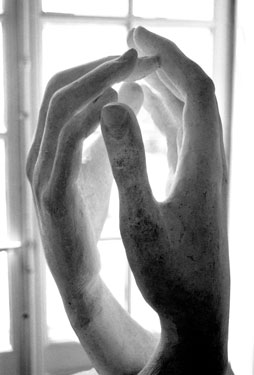
‘Cathedral’ – Auguste Rodin

It would be his birthday today (so I was reminded by Homepaddock), so an ideal time to consider that what Auguste Rodin could do with a mere pair of hands, other sculptors struggled to do with whole galaxies of complete human figures. When I first posted this a few years ago, I quoted now-silent Wellington blogger Oh Crikey'.

_QuoteWho would've thought a mere 'hand' could convey so much anguish & torment, or tenderness & delicacy? ... In Maori terms, we could say Rodin's sculptures have a mauri, or a 'life force.' The more rational among us will scoff, ‘Oh, that's silly, inanimate objects can't possibly have a life force!’ But they're dead wrong, Rodin is alive!

Rodin: the sculptor who breathes life into mere stone.  In a beautiful photo by Mark Klym.

NB: You might enjoy some rare footage of Rodin from 1915 that’s been recently uncovered. Posing for the camera more than really working, but still fascinating to see the great man in motion:

[Hat tip Sandrine L.]

Tuesday, 5 May 2015

"He had been going down a bad path and then he found Islam" [update 2]

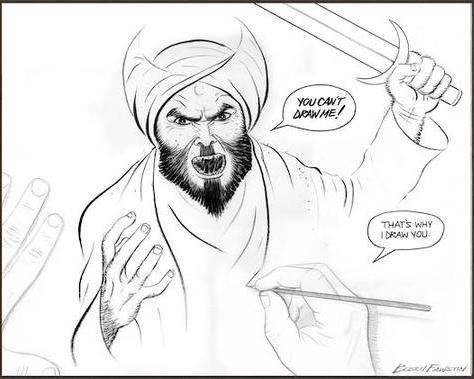
Cartoonists are still in the front line in the War Begun By Islam.

As you’ve probably heard, two Muslim shooters trying to murder people at a Draw Mohammed competition in Garland, Texas, were shot dead by a police officer before they began.

If only it had happened that way at the Charlie Hebdo offices.

The difference between Paris and Texas? Guns. “People are alive today because Garland not only allows guns, but was prepared.”   The would-be murders had assault rifles. The officer used his duty pistol. He was wounded, but okay.

They were not.

Apparently the shooting has begun another “debate” about free speech – a debate among the only people in the US who apparently don’t understand free speech. Academics. Media. Government. Muslims.

As one person said on Twitter:

image

What made them violently bonkers? Contemplate this quote from one shooter’s lawyer: “He had been going down a bad path and then he found Islam.” Let that sink in.

So if you’re wondering what drawing won the competition – a drawing good enough to kill for, it was this, by cartoonist  Bosch Fawstin—which will now get way, way, way more circulation than it ever would have before.

Embedded image permalink
Cartoon by Bosch Fawstin.

Here he is receiving his cheque:

image

[Hat tips and credits CounterMoonbat, David Burge, CBSDFW, Laura A Lorenzo, Jackie, A Libertarian Rebel, Ali A. Rizvi, J.T., Ross McLean, Will Cain, Mehdi Hasan]


RELATED READING:

  • “Freedom of speech; separation of church and state. These are principles to cherish, not to denigrate. The true ‘haters’ out there are the ones who shout the label of ‘hater’ at anyone who dares to take a moment to stand up for them.”
    Hatred of Mohammad … Or Love of Liberty? – Michael Hurd,  CAPITALISM MAGAZINE

UPDATE 2:  “"

'Once Free Speech Goes, It's Over': 'Draw Muhammad' Contest Winner Sounds Off
Bosch Fawstin said that the contest was important to him because it's about freedom of speech, which he asserted is "under siege."
    "I understand the threat that we face and that's why I do what I do," Fawstin said. "I do it because we're being threatened. This has to be fought head-on."
    "As artists, as writers, as thinkers, as Americans, as people who love freedom, and the entire West, we need to hit back. Not with violence, with the truth, with our art, with our writing," Fawstin said. "Once free speech goes, it's over."
    Watch the interview below...

Monday, 12 January 2015

Unity through Diversity Equals Cultural Death

Guest post by Olivia Pierson

Cultural pluralism is as old as the hills – or at least as old as the Babylonian Empire on whose riverbank shores even the captive Jews were tolerated to sit and weep. Multiculturalism, on the other hand, is a 20th Century bastardisation of tolerance, which the United Nations invented to socially engineer Western democracies to cope with overwhelming immigration, mostly from Third World slave-pens. The pious and politically correct preachers of “diversity” and “equality” raised multiculturalism in the West to the status of a new religion, as if the world needed yet another one of those.

With the truth emerging after murderous events in Paris, can there still be any doubt that multiculturalism has epically failed in the West? In the last five years Angela Merkel has admitted its failure; so have Nicolas Sarkozy and David Cameron.

But how has it failed so?

Tuesday, 26 August 2014

Home-grown horror [updated]

“The Duke of Wellington famously said that the Battle of Waterloo was won on the
playing-fields of Eton: and if that is the case, then the advance of the Islamic State was
begun in the nice, tolerant, liberal academies of Britain and other parts of western Europe.”

Mary Kenny, - 'Isis will never be defeated until Western societies
stand up for their own values,'
– IRISH INDEPENDENT

Many folk otherwise supportive of allowing peaceful people to cross borders freely (a policy well-articulated here) argue this policy can’t survive Muslim immigration; they argue the policy is untenable since Muslims constitute an objective threat, to whom western borders must be irrevocably closed. But as many Britons are slowly realising, especially after the jihadi killer of journalist James Foley was revealed as a comfortably-off Briton from Maida Vale, the threat comes not from Muslim immigration: the threat is homegrown.

And as Daniel Murray points out in the Spectator, “This is not even the first beheading of an American journalist to have been arranged by a British man from London.” Daniel Pearl was the first to so suffer, at the hands of a north London-born graduate of a private school and the London School of Economics.

Locally-born too were the suicide bombers of the London Tube, the killers in cold blood of drummer Lee Rigby, and the bomber of Glasgow airport – a registered doctor born and raised in Aylesbury.

The threat they point to is not at the borders; it is being nurtured within. And not just a threat at home. 

4,000 people from Britain are thought to have gone to train or fight in Afghanistan. Estimates of the number of British citizens who have gone to fight in Syria and Iraq range from just over 500 to 1,500 …  significantly higher than the number of Muslims currently serving in Britain’s armed forces….. But it is now obvious that whether we like it or not, this is Britain’s problem…
    The country that brought liberty to much of the world is now exporting terrorism to large parts of it.

Wednesday, 23 April 2014

“So, How Come You Keep Bashing Religion?”

image

A FEW FRIENDS, and friends-of-friends, and friends-asking-me-on-behalf-of-other-blog-readers (“it’s not for me, it’s for a friend”) have kept asking me the same question over and over for the last ten years.

The question usually goes something like this:

“How come you keep bashing religion on your blog? Especially at Easter and Christmas!”

To me, the answer’s bleeding obvious. But to these blokes (and blokesses), it’s obviously not, so here’s my effort to answer.

First answer is: because it’s absurd. And I despise absurdities.

My job as a blogger, as I see it, is to be somewhat of a provocateur; to challenge your thinking; to pull on your coat a little about the small absurdities, and to annoy the bejesus out of you on the big ones. 

And as Richard Dawkins says (and as most us probably thought to ourselves last Friday and Sunday when a mad alliance of religionists and unionists stopped us buying beer and wine if we wanted to) why should religion’s many absurdities get a free pass?

Friday, 17 December 2010

The greatest story (hardly) ever told [updated]

‎"The events of any given period of history are the result of the thinking of the
preceding period. The nineteenth century [for example]—with its political freedom,
science, industry, business, trade, all the necessary conditions of material
progress—was the result and the last achievement of the intellectual power
released by the Renaissance."
- Ayn Rand

HERE’S A STORY FROM history that’s hardly ever told, but yet it’s the greatest story history could tell.

It’s a story that covers two continents and 2,000 years, and is the fundamental reason for all our health,wealth and happiness —and freedom—but most people don’t know anything about it, and couldn’t tell you why it matters.

Here’s a small part of that story, which starts for us in an unlikely place. . .

alhambra THE SEAT OF SCIENCE and civilisation a thousand years ago was in the Muslim world.

While Western Europe endured its Dark Ages—that wasteland of crosses and graves that lasted nearly a millennia, and buried more than a million souls in misery and squalor—the Arab and Persian world was making advances in medicine, mathematics, cartography, astronomy, philosophy, poetry, scientific method and more.

If you were a scientist, an artist, or any sort of human being hoping to breathe free then, from the eighth to twelfth century, the places in which you wanted to breathe had names like Toledo, Cordoba and Baghdad.

And then, it all came to a crashing halt. And within two centuries, the situation in the two places was almost entirely reversed.

What happened? What changed? And what made the  successes happen in the first place?

A fascinating 28 minute interview on Radio New Zealand with scientist Jim al-Khalili, author of Pathfinders - The Golden Age of Arabic Science, tells part of the tale—one of history’s most-interesting yet least told. And he tells a fascinating story. I recommend a listen.

al-Khalili explains how Muslim scientists flourished in a culture that then valued the “this-world” knowledge they were pursuing. But he finds it damnably hard to put his finger on the precise reason for the growth and development of this culture—talking about things like the invention of paper and “the ideas of the Greeks,” without really saying much about what those ideas were.

Equally, he finds it difficult to explain the rapid fall of Islamic science and the slow awakening of western Europe from its intellectual slumber, beyond talking about a “conservative backlash” in Islam, “the discovery of the New World” by the West (which actually happened around three centuries after Islamic decline began) and the transmission of “the ideas of the Greeks” from the Muslim world to the West.

In fact, the reason for both fall and rise is the relationship that both these cultures had with Greek ideas. Specifically, with their relationship to reason, and especially to the man they called The Philosopher of Reason, Aristotle.

Pathfinders: The Golden Age of Arabic Science
(9781846141614): Jim Al-Khalili

A History of Knowledge: Past, Present, and Future
(9780345373168): Charles Van Doren

61BXWMUJZHL._SL500_AA300_ 
Aristotle
(9780231085298): John Herman Randall

“Ancient Greece tore away the heavy shroud of mysticism woven for centuries in
murky temples, and achieved, in three centuries, what Egypt had not dreamed of in
thirty: a civilization that was essentially pro-man and pro-life. The achievements of
the Greeks rested on their confidence in the power of man’s mind—the power of reason.”
- Mary Ann Sures

ARISTOTLE WAS PLATO’S STUDENT, yet the mature philosophies of these two giants could not have been more different.

Raphael’s famous painting shows Plato pointing to the heavens, and Aristotle to this earth. It is an accurate summation of their positions. Plato looked to the heavens for the “true reality,” and found there rules for living on this “imperfect,” non-ideal plane. Aristotle saw instead that happiness on this earth was man’s highest estate, and that knowledge of the things of this earth—observing nature and drawing conclusions from it—is the means by which to begin obtaining it.

aristotle-platoIt’s said that the history of philosophy is described by the duel between Plato and Aristotle. In virtually every important sense, this is true. In both the Muslim and Christian worlds, it’s played out in the duel between mysticism, with Plato and neo-Platonism brought in on the side (literally) of the angels and of other-worldly maunderings; and Aristotle (when he’s been rediscovered) on the side of reason and a focus on success in this world.

It’s the rediscoveries of the ideas of Aristotle that have been crucial in our story.

Aristotle left behind at his death a veritable manual of scientific discovery and how to live on this earth—especially the Organon, six treatises on logic that were a virtual toolkit of logic. These were “the ideas of the Greeks” that mattered most to Muslim scientists when they rediscovered them eleven centuries later, and to western philosophers and scientists when (thanks to Muslim scholars) they rediscovered them for the west fifteen centuries after they had first been buried.

Because these ideas, while powerful enough to turn civilisations around, barely had time to be given even a full road test after their first brief time in the sun, around 300BC. Because this was very quickly becoming very much not a safe time in which to be a philosopher, and just a few short decades after Aristotle’s death his school was closed, his students were scattered, and his works on papyrus rolls were buried for safety in a trench in Asia Minor, not to be uncovered for centuries.

And while they lay buried, the light of reason which had flickered so briefly and so well was going out around the world, in Athens and Alexandria and eventually, finally, even Rome. 

hieronymus_bosch_-_the_garden_of_earthly_delights_-_hell1It was buried by pagan mysticism (which had never fully gone away) and neo-Platonism (which had been around long enough to take hold), but most forcefully and more thoroughly still by those Roman emperors who from the fourth century had already set themselves up as both definers and enforcers of religious “orthodoxy,” and the head of a monotheistic state.  (The Christian insistence on the absurdity of the Trinity, for example, dates from Theodosius’s 381AD decree dictating that all his subjects subscribe to a belief in the Trinity of the Father, Son and Holy Spirit, or else.)

As if to demonstrate that without reason to deal with one another there is only force, the emperors from Theodosius on now began the systematic suppression by the sword of all non-orthodox Christianity, and of all still-surviving pagan philosophies that couldn’t be made hand-maidens of theology as easily as neo-Platonism (which could easily be bent to fill up the gaps in the emerging Christian theology).

With Justinian edicts in the 530s enforcing religious conformity on pain of death, the assault on reason and freedom was complete.

Thus began the inevitable waves of barbarism, looting and darkness that necessarily accompanies the widespread rejection of reason and a culture-wide focus on the next world rather than on this one.

“If there is a philosophical Atlas who carries the whole of Western civilization on
his shoulders, it is Aristotle…. Aristotle may be regarded as the cultural
barometer of Western history. Whenever his influence dominated the scene, it
paved the way for one of history’s brilliant eras; whenever it fell, so did mankind.”
- Ayn Rand

the-alhambraWHILE THE WEST WAS  committing intellectual suicide, the Islamist world was just beginning to wake up. It was the rediscovery of Aristotle in Muslim Spain and the Middle East that was the next light of hope in the world, and that built and underpinned the Islamic Golden Age—which at its three-hundred year peak spread wealth, riches, learning, art and happiness from Baghdad to Spain.

Just as it was built by ideas, so too however  was it killed by them—by what scientist al-Khalili calls the “conservative backlash,” a reaction against science and reason best summed up by eleventh-century theologian Al-Ghazali, who called for the Greek ideas to be thrown out, saying essentially, “If it’s in the Quran we don’t need it; if it’s not in the Quran we don’t want it.” And so out it all went. For good—or at least for ten centuries.

One of the most illustrative examples of Al-Ghazali’s “thinking” was his direct assault on causality. Things don’t act according to their nature, he said, God makes things act any way he pleases:

_Quote_Idiot

The connection [said Ghazali] between what is habitually believed to be a cause and what is habitually believed to be an effect is not necessary…
    For example, there is no causal connection between the quenching of thirst and drinking, satiety and eating, burning and contact with fire, light and the appearance of the sun, death and decapitation, healing and the drinking of medicine, the purging of the bowels and the using of a purgative…
    On the contrary, it is within [divine] power to create satiety without eating, to create death without decapitation, to continue life after decapitation, and so on to all connected things…   

You might think this is insane, and it is; the stuff of madness, and you’d be right; utterly illogical--which is it’s point. al-Ghazali is here simply doing God’s work:

_Quote_Idiot

Our opponents claim [for example] that the agent of the burning is the fire exclusively; this is not a natural, not a voluntary agent, and cannot abstain from what is in its nature when it is brought into contact with a receptive substratum. This we deny, saying: The agent of burning is God, through His creating the black in the cotton and the disconnection of its parts, and it is God who made the cotton burn and  made it ashes either through the intermediation of angels or without…

This is a God for every teenage arsonist seeking an excuse: “Well, yes, I lit the match. But it was God wot burned the school down.”

This is nothing like the “God of the Gaps” that leave God just to fill in what science has yet to discover. This is a God who holds every test tube, sparks every flame, guides every bullet, and detonates every bomb—either  with the intermediation of angels, or without.

According to al-Ghazali—whose “thinking” swept the Muslim world (and swept away reason, logic and science with it)—there is no other causal agent in the universe but God, and therefore “no unity in the world, moral, physical or metaphysical; all hangs from the individual will of Allah.”

Nothing could be more destructive to reason, to science, and to civilisation. Yet al-Ghazali’s fateful rejection of reason swept the Islamic world, which (still proudly waving his flag and that of the Quran) sank into the intellectual mire from which it has yet to emerge.

“Aristotle’s philosophy was the intellect’s Declaration of Independence. Aristotle, the
father of logic, should be given the title of the world’s first
intellectual, in the purest
and noblest sense of that word. No matter what remnants of Platonism did exist
in Aristotle’s system, his incomparable achievement lay in the fact that he defined
the basic principles of a rational view of existence and of man’s consciousness…
    If we consider the fact that to this day everything that makes us civilized beings,
every rational value that we possess—including the birth of science, the industrial
revolution, the creation of the United States, even the structure of our language—is
the result of Aristotle’s influence, of the degree to which, explicitly or implicitly, men
accepted his epistemological principles, we would have to say: never have so
many owed so much to one man.”
- Ayn Rand

STTING HERE IN 2010, it’s easy to laugh at al-Ghazali.  That’s because we, here and now, mostly take reason for granted—so thoroughly that we find it hard to understand those who don’t. That we do take it so much for granted is testament to how thoroughly western culture has supped from Aristotle’s well. But it took a while.

Because in the first ten centuries after Christian theology first gained its toehold, the west was also labouring under similar nonsense to al-Ghazali’s, and with the same existential results as the Islamist apostle of unreason would deliver to his culture. Early Christian theologians were in virtually all respects peddlers of the very same nonsense, just delivered wearing a different brand.

Paul, for example, who took violently against the “upstart” Greek philosophers whose logic he had trouble countering, took instead to attacking the very core of Greek intellectual achievement.

_Quote_Idiot

The more they [Greeks] call themselves philosophers, the more stupid they grew … they made nonsense out of logic and their empty minds were darkened. [Romans 1:21-22]
The wisdom of the world is foolishness to God. [Corinthians 1:25]

(He made more sense when he declared, “I know of nothing good living in me.” [Romans 7:20] On that, I can concur.)

And while Augustine, the second-most influential Christian theologian, was willing to allow reason, he also declared it may only be used to explore “truths” already revealed by his God—and even these revelations were only to be accepted on the authority of the monotheistic state. (“I would not have believed the Gospels except on the authority of the Catholic Church.”)

And Tertullian, “I believe because it is absurd.”

And John Chrysostom: “Restrain our own reasoning and empty our mind of secular learning in order  to provide a mind swept clear for the reception of divine words.”

And Lactantius: “What purpose does knowledge serve—for as to knowledge of natural causes, what blessing is there for me if I know where the Nile rises, or whatever else under the heavens the ‘scientists’ rave about?”

And Philastrius of Brescia, who was ready to declare causality itself implicitly a heresy in a fashion that Cantabrians might appreciate:

_Quote_Idiot

There is a certain heresy concerning earthquakes that they come not from God’s command but, it is thought, from the very nature of the elements… Paying no attention to God’s power  they [the heretics] presume to attribute the motions of force to the elements of nature … like certain philosophers who, ascribing this to nature, know not the power of God.

(T paraphrase al-Ghazali’s similar “arguments” aired above,  it would seem that Philastrius’s God has extended to him the power to think without having possession of a brain.)

Finally, to show that they knew who their enemy was, we have Anastasius of Sinai, who  was ready to declare  that the ten sections of Aristotle’s Categories were ten “heresies” representing the ten horns of the dragon in the Book of Revelation (12:4)

No wonder, under the sway of “thinkers” like these, that western Europe spent so many centuries in darkness.

Fortunately however, in the brief window before the fruits of Islamic thinking disappeared forever, western translators eager to learn the “heresies” that had been buried for so long discovered and began translating Islamic works on medicine, astronomy, mathematics, engineering … and philosophy. They discovered the Arab commentators on Aristotle, and they discovered the great works of Aristotle himself. In short, they re-discovered his manual of reason, and with it the key to begin civilisation anew.

If the industrial revolution of the nineteenth century owes its genesis to the tremendous intellectual power released by the Renaissance, as the quote at the top of the page suggests, then it’s important to realise that the intellectual power released in the fourteenth and fifteenth centuries was generated by the intellectual “atomic power station” of Aristotelian reason that was rediscovered in the twelfth.

The new Latin translations of Aristotle’s Organon (translated in Spain and Sicily from Arabic, which themselves were translations from lost Greek originals) were the transmission belts for the ideas that powered the new thinking of Albertus Magnus, Aquinas, and Francis Bacon; the new art of Giotto, Michelangelo and Da Vinci; the new architecture of Brunelleschi, Bramante and Palladio; the new science of Copernicus, Galileo and Newton; the new conception of human freedom embodied in the ideas of Grotius, and Locke and (eventually) Jefferson—who all of them, as reason requires, began their work by turning their eyes to observing the facts before them before seeking the causal integration that explained the facts observed: a re-use and rediscovery of reason’s method all but lost in the west since the original days of the Greeks.

To that almost fortuitous rediscovery we owe virtually all human progress of the past five centuries. That’s how important this story, and that rediscovery, is.

“The events of any given period of history are the result of the thinking of the preceding period.” That’s what this story makes so plain—that ideas do have tremendous consequences, for good and for ill.

It’s astonishing that the story is so rarely told---and so little understood when it is—told when it is told with, for example, the sort of mechanistic detail that explains the rise of Islam by the discovery of paper or the west by the discovery of the New World; or the fall of Rome by the onset of hyperinflation, or the fall of Islamic science to some undefined “conservative backlash”; without ever seeking to look beyond these outward details to the fundamental facts that caused them.

“There is no future for the world except through a rebirth of the Aristotelian
approach to philosophy. This would require an Aristotelian affirmation of the reality
of existence, of the sovereignty of reason, of life on earth—and of the splendor of man.”

- Leonard Peikoff

YOU’LL HAVE NOTICED by now that I’ve strewn a few books across your path, each of which tells a part of the story. And below I’ve added three more that between them integrate and give the culmination of the story—the first as a guide to the loss and rediscovery; the second, in which the title essay tells the tale told here in far more colourful and sweeping terms than I could; and the third, to demonstrate that the primordial struggle for reason and individual liberty are the same story, whose culmination we find in the discovery of individual rights and their implementation.

Taken together, they tell a remarkable tale. But the astonishing thing to note is how few books there are telling the story itself. When Burgess Laughlin, for example, began work on another project, he looked for a book telling the tale and found none. So he wrote his own, The Aristotle Adventure. To my knowledge it’s still the only book-length survey giving the whole context.

If you want to bury yourself in books on the greatest story (hardly) ever told, then these listed here are a good place to start.

And there’s no time like a long summer holiday to begin.

Enjoy!

The Aristotle Adventure: A Guide to the Greek, Arabic, & Latin Scholars
Who Transmitted Aristotle's Logic to the Renaissance

(9780964471498): Burgess Laughlin

For the New Intellectual
- Ayn Rand
(Signet) (9780451163080): Ayn Rand

Capitalism Unbound: The Incontestable
Moral Case for Individual Rights

(9780761849698): Andrew Bernstein

NB: Note that not all books listed here are entirely without fault or error. I should note that those to be most careful of are Rubinstein’’s Aristotle’s Children and Reilly’s The Closing of the Muslim Mind, which are both sadly infected by the authors’ own religiosity, making them sadly unable to see the full drama of the story they’re trying to tell.

Naturally, I’d be very happy to have other books recommended that might fill in some of the gaps.

And to see the whole story in one graphic, here’s one of the charts from Burgess Laughlin’s Aristotle Adventure that makes it so valuable:

AristotleAdventure 

UPDATEAndy Clarkson points out

It was Arabs qua Aristotelians and not Arabs qua Islamists who are responsible for the accomplishments of Arab Muslims.