Showing posts with label Thomas Carlyle. Show all posts

Monday, 26 February 2024

"The dismal science ... "


"In my interview with economist David Henderson, I asked him how economics came to be called the 'dismal science.' The source, he explained, was Thomas Carlyle, the nineteenth-century historian and essayist. The surprising reason for his coining the phrase? Carlyle was attacking free-market liberals for advocating the end of slavery.
    "Free-market liberals argued that all men were equally deserving of freedom, so the slaves should be emancipated. Carlyle counter-argued — with strong agreement from Charles Dickens and John Ruskin, two other strong critics of free-market capitalism — that blacks were unequal to whites and so undeserving and incapable of freedom. Giving slaves freedom, they believed, would lead to dismal social consequences.

    "Here is a fine essay by David Levy and Sandra Peart with the sorry details: “The Secret History of the Dismal Science. Part I. Economics, Religion and Race in the 19th Century.”
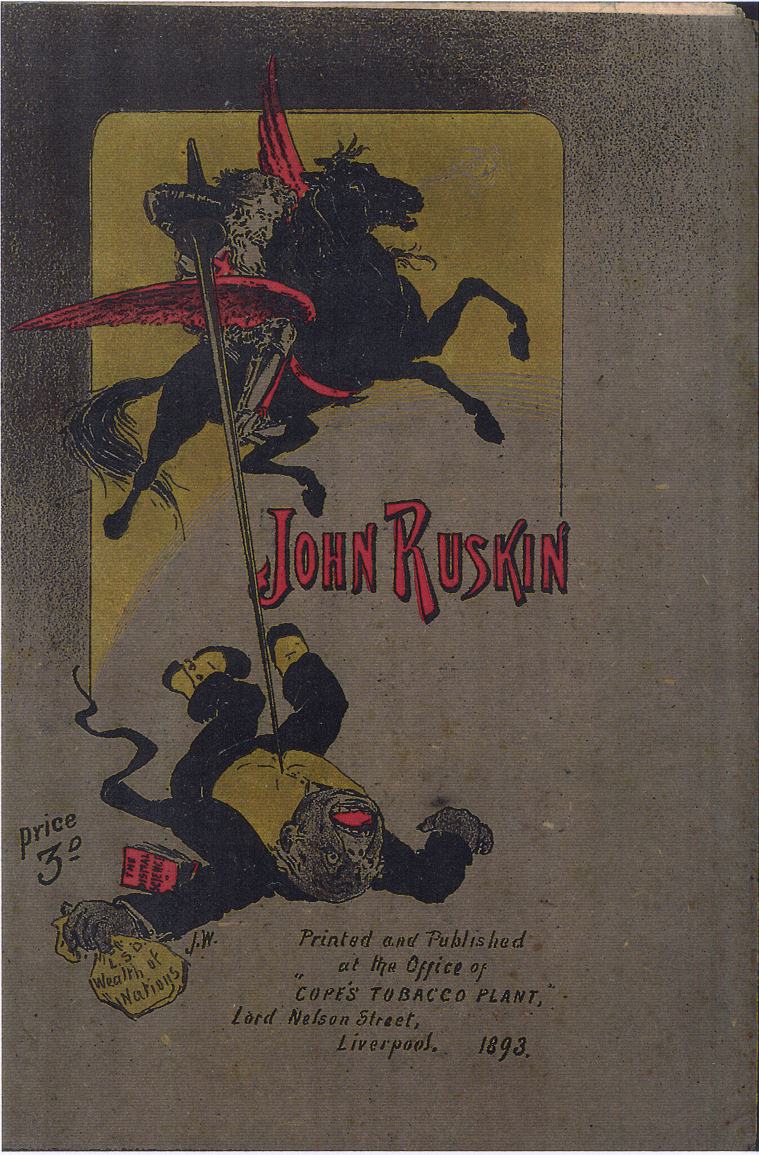
    "The image, as Levy and Peart explain, shows Ruskin as a white knight slaying a black man dressed in gentlemen’s finery and holding a book entitled 'Wealth of Nations,' Adam Smith’s treatise being a major work in the free-market capitalist tradition."

PS: Notable, I think, that Carlyle has also been called one of the founding fathers of fascism, and was also a major influence on New Zealand's Governor Grey, who would frequently “quote Carlyle’s theory of despotism as the best of all systems of colonial government.”[1]

[1] Kennedy, A. New Zealand (1873), 143, 147; cited in Rutherford, Sir George Grey (1961), p.283 

Saturday, 16 March 2019

The Killer Had An Ideology


Guest post by Jeffrey Tucker

“Sir Oswald Mosley is the person from history closest to my own beliefs.” These are the words of the bloody murderer in Christchurch who has shocked the world with gore and reminded us all of the presence of profound evil in our world. It should also remind us of the murderous power of malevolent ideology. Ideology is a force in our world that can and does overcome every theory of decency and morality.

To deconstruct the killer’s ideology, it is best to begin with his own recommendation. Sir Oswald Mosley (1896-1980) was in some ways a clownish figure in interwar English politics, a former Tory MP and Labour Party minister, a displaced member of a once-powerful aristocratic class who warmed to fascist ideology and Hitlerian politics. Speaking in parks and rallying his followers in dingy basements, he never tired of whipping up demographic panic, calling for dictatorship, and raging against the race-mixing enabled by modern commercial life.

As events unfolded and Nazism was revealed to be a murderous racial cult bent on the construction of an industrialised killing machine, Mosley was run out of the country and his organisation banned. He died in disgraced obscurity in Paris.

The ideology Mosley represented, however, lives on, and remains as exterminationist and deadly now as it was in the interwar years. In the sweep of fascist history, Mosley was a spectacle. He continues life as a folk hero among a certain set of deranged but dedicated opponents of liberalism, along with other popularisers of Hitlerian theory like George Lincoln Rockwell in the United States.

I’ve read the killer’s 87-page manifesto, posted just before the mass murder began. Yes, it celebrates Mosley. It also invokes every trope of what is called alt-right politics, or what is more precisely identified as right-wing Hegelian collectivism, complete with its tribalism, longing for control, exterminationist aspirations, anti-capitalism, and panic about birth rates (the anarchy of human reproduction terrifies them). Even his supposed love of nature and the environment has precedent in certain brands of fascist politics (right Hegelians believe that the commercial use of natural resources is dysgenic).

It’s a long tradition of thought, one born in reaction against the progress of liberalism in the early 19th century. The ideology built a bit at a time over the decades (in parallel to the other anti-liberal tradition of Marxism), rolling out objections to core beliefs of the modern world that were breaking down tribal barriers, blurring class distinctions, increasing contacts between peoples, and diminishing government power and the influence of leaders.

In the mid-19th century, the reigning king of proto-fascist thought was Thomas Carlyle, who decried the end of slavery, the rise of free trade, and the dethronement of great leaders. He despised capitalism but didn’t consider himself a socialist or communist; he was instead a nationalist and reactionary. He set the stage for the rise and persistence of a new ideology of control that was reactionary and revanchist at its core. It demanded back (what it imagined to be) the old world of hierarchy, separation, and elite control of resources.

The forces of reaction built over time. It was, as I’ve written, contributed to by the protectionist Friedrich List, the romantic Luddite John Ruskin, the reactionary Houston Stewart Chamberlain, the fashionable race theorist Frederick Hoffman, the Darwinian preservationist Madison Grant, the eugenicist Charles Davenport, the IQ theorist Henry Goddard, the communist turned Nazi philosopher Werner Sombart, the officious puritan misogynist Edward A. Ross, the brooding historicist Oswald Spengler, the anti-Semitic poet Ezra Pound, the Nazi jurist Carl Schmitt, the radio populist priest Charles Edward Coughlin, the pretend-baron and violence worshiping Julius Caesar Evola, the jailed millenarian Francis Parker Yockey, and so many more.

What unites all their views is a worship of power, the sacralising of violence, the dismissal of individual choice, the loathing of the cooperative commercial society, and the adoration of the state. Of course one name stands out in the 20th century as their martyr and hero.

Despite the vanquishing of the architect of the Holocaust, this ideology continues to have a massive presence in our world. It has virtually no life at all in any academic setting, of course, but it has a huge presence in the darkest corners of opinion in many parts of the world. But precisely because of this chasm between respectable academia and trash-talking racist culture, we can sometimes be deceived about the violent threat this alternative form of collectivism represents to civilisation.

As we see from the killer’s manifesto, he was disgusted by commercial life and wanted conflict more than anything. Only a war of tribes would save the world from demographic and environmental disaster, in his view. He was impatient to see it begin. He believed that it was his personal responsibility to give the historical narrative a kick in the right direction, human rights and morality be damned.

It’s possible to commit heinous crimes without carrying around a wicked ideology to inspire and grant cover. But ideology can help embolden the mind with delusions that your evil acts are actually blessed by the forces of history, and that the blood you spill is not senseless killing but rather part of some needed corrective to the unfolding narrative of which you and your people have lost control.

How to combat this wickedness? The post-killing narrative will be is already filled with calls for gun control, controls on the Internet, controls on social media, more power for states to crack down on association and speech. This is precisely what the killer hoped to bring about, in his own words: “To incite violence, retaliation, and further divide… To create an atmosphere of fear and change in which drastic, powerful and revolutionary action can occur.”

The right response is to rededicate ourselves to the worldview that he hated the most, the view that rights are embedded in individuals, that people should have equal freedom to live their lives unencumbered by states and violence, that society contains within itself to capacity to manage itself without the intervention of fanatical ideologues who imagine themselves to be masters of our fate, that every single human life is worthy of dignity and deserving of respect.

The ideology of hate that spilled so much blood in Christchurch is best avenged through a new dedication to a social philosophy of love, harmony, cooperation, and freedom for all.
* * * * * 
Jeffrey Tucker is Editorial Director for the American Institute for Economic Research. He is the author of many thousands of articles in the scholarly and popular press and eight books in 5 languages. He speaks widely on topics of economics, technology, social philosophy, and culture.
This post first appeared at the AIER blog.
.

Monday, 13 August 2018

A brief on alt-right ideology


On the anniversary of the so-called "Unite the Right" alt-right march in the States, when they're apparently marching again in Washington D.C.Jeffrey Tucker points out in this guest post that if the movement has united anyone at all, it's not the right -- but the left! But it would be a grave mistake, he says, to think that the alt-right is just some clownish marchers at some rally waving flags and shouting threatening slogans. The real problem is the underlying philosophy...

* * * * *

Every activist political movement eventually becomes a caricature of itself. This is certainly true of the so-called alt-right that blasted onto the cultural stage with its “Unite the Right” rally in Charlottesville, Virginia, in 2017.

Part 2, today, in Washington, D.C., is revealing the irony. The lasting effect of this movement has been to unite the left. And not just the left: it is uniting most normal people who want to live a regular life, get along with others, and reduce the polarising effects of politics in our times.

Writing about this subject a year after my book came out always leads people to tell me that the alt-right is dead. I won this. I should stop writing about the issue.

The Philosophy

There is truth to this but it is mostly a superficial observation. Yes, the formal movement called the alt-right has become a caricature of itself, one particularly useful to the left-socialists who need an enemy and a threat to scare everyone about the coming dystopia.

What’s not dead, and has been a problem for 200 years, and which is still not understood, is the philosophical outlook that motivated the rise of the alt-right in the first place. It is more properly called Right Hegelianism. [And to paraphrase Keynes, "“Practical men who believe themselves to be quite exempt from any intellectual influence, are usually the slaves of some defunct philosopher like Hegel."]

Hegelianism (which split into left and right branches) was born in Germany in the early years of the 19th century as a reaction to the rise of liberalism in Europe and the world. This new movement rejected the core claim of liberalism that society can regulate itself and that individuals should be free to live good lives, believe what they want, say and print whatever they desire, and trade with anyone, so long as they didn’t hurt people.

Frederic Bastiat summed up the liberal view in the phrase “social harmony.” People figure out how to get along and build great things together so long as they are left alone by state authority. That was the liberal idea and it unleashed wealth creation and peace on the world, built the middle class, dramatically expanded living spans and population, and transformed life on earth. It gave birth to the idea of progress and eventually spread the idea of equal freedom for everyone: no more slavery, no more legal impediments to trade and association, universal rights to everyone, diplomacy instead of war, and free trade between all peoples.

Conflict Not Harmony

Hegelianism posited something very different, and it leads to a much more important way to view politics than the idiotic left-right split derived from French Revolutionary politics - that between those who value the liberal ideal of social harmony, and those who don't.

For those who don't, the social order simply cannot be left to the devices of Individual choice; it must acquiesce to forces of history that are more powerful than the randomness of human volition. These historical forces are the major player in revealing intractable conflict alive in the world. What is this conflict? Over many decades and centuries, the narrative would change. The struggle could be between classes, nations, languages, religions, sexes, mental abilities – really you can take your pick depending on the time and place. The agent that would harness the conflict and make it right would (always and everywhere) be the State.

There were two broad political branches of Hegelianism, left and right, that would become instantiated respectively in Marxism and Nazism --  but this was much later. In the intervening years, each side built its intellectual edifice brick by brick. Left Hegelianism took on many iterations before the Bolshevik variety finally achieved victory. Right Hegelianism began with the idea that history would culminate in total authority being granted unto the Prussian state and church, but it later became the animating force behind nationalism and bourgeoise statism in general.

The right Hegelian rogues gallery is huge. It involves protectionist Friedrich List, great-man theorist Thomas Carlyle, the luddite John Ruskin, the reactionary faux-aristocrat Houston Stewart Chamberlain, the race theorist Frederick Hoffman, the Darwin preservationist Madison Grant, the eugenicist Charles Davenport, the IQ theorist Henry Goddard, the communist turned Nazi philosopher Werner Sombart, the officious puritan misogynist Edward A. Ross, the brooding historicist Oswald Spengler, the anti-Semitic poet Ezra Pound, the Nazi jurist Carl Schmitt, the radio populist priest Charles Edward Coughlin, the pretend-baron and violence lover Julius Caesar Evola, the jailed whacko Francis Parker Yockey who influence postwar rightists, and so many more.

What They Believe

Read enough of this material and you begin to notice certain themes. Yes, anti-liberalism unites them in every way, but what about their positive agenda? What is it exactly that they advocate?

First, they reject social harmony in favor of the friend/enemy distinction, which they believe brings essential drama to the course of what would otherwise be a boring life. There must be struggles. There must be battles. There must be war and violence. To take part is what gives life meaning.

Second, they believe in the centrality of nationhood over the individual, and this takes many forms depending on how one defines the nation. The nation can be based on race, geography, language, religion, or dynasty, or some combination thereof. Whatever it is, it is not for you to choose. It certainly isn’t an affair of the heart. This is terrain in which identity politics takes hold.

Third, trade protectionism is central because the things we use and the services we consume need to reinforce our attachment to nationhood. Free trade is too random to tolerate. Plus free trade lessens our attachment to the leader.

Which leads to, fourth, the leadership principle. The leader must be strong and compel assent. He is the central organizer whether in peace or war. He embodies the nation, instantiating the will of the people and their national identity. He must have a great story of overcoming every obstacle to triumph over all. He may build a wall or make the trains run on time, but in time the great man will conquer all.

Fifth, an essential part of the right Hegelian vision is rooted in demographic panic and opposition to the randomness of human reproduction. For them, there is always some crisis going on beyond our immediate control. The white race is disappearing. Christianity is dying. English is no longer normative. Manhood is disappearing. Nothing is made in America anymore. The wrong people are getting rich. The Jews are taking over. And so on. The presence of crisis necessitates panic that leads people to surrender control of their lives to some external saviour.

Ideas Not Marches

It’s a mistake to think that the fate of the alt-right is bound up with public perceptions toward clownish marchers at some rally where people are waving flags and shouting threatening slogans. The real problem is the underlying philosophy that regards peace as a threat, prosperity as deracinating, and freedom itself as nihilistic chaos that cries out to be replaced by dictatorship, law, and imposed order.

That philosophy is still with us, and it triggers the rise of left Hegelianism, which is another problem to address on another day.

* * * * * 
Jeffrey Tucker is Editorial Director for the American Institute for Economic Research. He is the author of many thousands of articles in the scholarly and popular press and eight books in 5 languages, including his penetrating analysis of the alt-right 'Right-Wing Collectivism: The Other Threat to Liberty'
.

Thursday, 9 March 2017

The Prehistory of the Alt-right


_AltRight

Adherents of the new "alt-right" movement that has arisen with Trump like to see themselves as subversive, as new, as cutting edge. Yet their tale of clashing forces driven forward by strong men is as old and stale s totalitarianism itself, explains Jeffrey Tucker in this guest post.
    Rejecting Marxism is good, he agrees. But we choose mega-states, strongmen, national planning, or religious and racial homogeneity at our deep peril. And if you are feeling tempted toward the Alt-right, look at your progenitors: do you like what you see? Here we have a lineage of non-Marxist, non-leftist brand of rightist but still totalitarian thinking.
    Let us not be deceived. Whatever the flavour–whichever branch of Hegel we choose to follow–the cost of increased government control is greatly diminished human liberty, prosperity, and dignity.

Reading Evan Stern’s “Why I Left the Left” is a solid reminder that there’s not much intellectual heft remaining on that side of the political fence. If an ideology sets out to isolate the locus of evil in people’s very identity, it is pretty well spent. This, in addition to the failure of the socialist model everywhere it has tried, explains why the Left has suffered so much recently at the polls and now faces a serious backlash in campus and public life.

With the failure of action comes reaction; now as the alternative the Western world is dealing with something far less familiar to most people yet just as threatening: the rise of the alt-right. Due to its taboo-breaking, rebel ethos that so easily inflames teachers and protectors of civic conventions, it is highly attractive to some young people.

altright1The movement however is more than just young people being politically incorrect. It has a real philosophical and political history, one that stands in violent opposition to the idea of individual liberty. It has been largely suppressed since World War II and, because of that, most people assumed fascism (and its offshoots) was gone from the earth.

As a result, this generation has not been philosophically prepared to recognise the tradition, the signs, the implications, and the political application of the ideology so many are stumbling to embrace.

Here then is a brief prehistory of what we call the alt-right today, which is probably better described as a 21st-century incarnation of what in the 19th century would have been called “right-Hegelianism” – after German philosopher GFW Hegel, as opposed to what Karl Marx later developed as “left-Hegelianism.” To get right to the core ideas that form something like a school of thought that developed over more than a century, I’m skipping over many political movements (in Spain, France, and Italy), and clownish leaders like George Lincoln Rockwell, Oswald Mosley, and Fr. Coughlin. 

Here we have a lineage of non-Marxist, non-leftist brand of rightist but still totalitarian thinking, developed in fanatical opposition to bourgeois freedom.

1820: Georg Friedrich Hegel published Elements of the Philosophy of Right, which spelled out the political implications of his “dialectical idealism,” an outlook that departed dramatically from the classical liberal tradition by completely abstracting from human experience to posit that what shapes history are warring life forces operating beyond anyone’s control. It turns out that the politics of this view amounted to “the state is the march of God through the world.”
    Hegel looked forward to some age in the future that would realise this apotheosis of State control, towards which he claimed all history was moving.
    In a 1952 lecture by Ludwig von Mises (a strong classical liberal and virulent opponent of this whole worldview) the Hegelian view quickly broke into Left and Right branches, depending on the attitude toward nationalism and religion (the right supported the Prussian state and church, whereas the left did not), and thereby “destroyed German thinking and German philosophy for more than a century, at least.”

altright21841: Thomas Carlyle published On Heroes, Hero-Worship, and The Heroic in History, which popularised the “great man” theory of history. History is not about marginal improvements in living standards by using better tools, he argued, but rather about huge episodic shifts brought about through power.
    A champion of slavery and another opponent of classical liberalism, Carlyle took aim at the rise of commercial society, praising Cromwell, Napoleon, and Rousseau, and rhapsodising about the glories of political power. “The Commander over Men; he to whose will our wills are to be subordinated, and loyally surrender themselves, and find their welfare in doing so, may be reckoned the most important of Great Men.”
    Carlyle's target was Adam Smith and the Scottish Enlightenment generally. Hitler’s biographers agree that the words of Carlyle were the last he requested to be read to him before he died.

1841: On the continent, meanwhile, Friedrich List published The National System of Political Economy, celebrating protectionism, infrastructure spending, and government control and support of industry. His was, for half a century the most influential voice in German economics, a direct attack on laissez faire and a celebration of the national unit as the only truly productive force in economic life. Steven Davies comments: “The most serious result of List’s ideas was a change in people’s thinking and perception. Instead of seeing trade as a cooperative process of mutual benefit, politicians and businessmen came to regard it as a struggle with winners and losers.”
    Today's economic nationalists have nothing new to add to the edifice already constructive by List. 

1871: Charles Darwin left the realm of science briefly to enter sociological analysis with his book The Descent of Man. It is a fascinating work but tended to treat human society as a zoological rather than sociological and economic enterprise. It included an explosive paragraph (qualified and widely misread) that regretted how “we institute poor-laws; and our medical men exert their utmost skill to save the life of every one to the last moment… Thus the weak members of civilised societies propagate their kind. No one who has attended to the breeding of domestic animals will doubt that this must be highly injurious to the race of man.” At the very least, he suggested, we should stop the weak from marrying. This is the “one check” we have to keep society from being taken over by inferiors. Tragically, this passing comment fired up the eugenicists who immediately began to plot demographic planning schemes to avoid a terrifying biological slide to universal human degeneracy. 

1896: The American Economic Association published Race Traits and Tendencies of the American Negro by Frederick Hoffman. This monograph, one of many of the type, described blacks as intractable criminals who are both lazy and promiscuous, the influence of whom in national biology can only lead to a decline of the race. Their mere presence was considered an existential threat to “uncompromising virtues of the Aryan race.” Such views were embraced by Richard T. Ely, the founder of the American Economic Association, and came to dominate the academic journals of this period, providing academic cover for Jim Crow laws, state segregation, business regulation, and far worse. 

altright31904: The founder of the American eugenics society, Charles Davenport, established the Station for Experimental Evolution and worked to propagate eugenics from his perch as Professor of Zoology at Harvard University. He was hugely influential on an entire generation of scientists, political figures, economists, and public bureaucrats, and it was due largely to this influence that eugenics became such a central concern of American policies from this period until World War II, influencing the passage of wage legislation, immigration, marriage law, working hours legislation, and, of course, mandatory sterilisations.

At this point in history, all five “intellectual” pillars of fascist theory (historicist, nationalist, racist, protectionist, statist) were in place. It had a theory of history. It had a picture of hell, which is liberalism and uncontrolled commercial society. It had a picture of heaven, which was national societies run by great men inhabiting all-powerful States focused on heavy industry. It even had a (psuedo) scientific rationale. 

Above all, it had an agenda: to control society from the top down with the aim of managing every aspect of the demographic path of human society, which meant controlling human beings all the way from conception to grave to produce the most superior product, as well as industrial planning to replace the wiles of the market process. The idea of freedom itself, to this emergent school of thought, was a disaster for everyone everywhere.

All that was really necessary was popularisation of its most incendiary ideas. The world didn’t have long to wait.

altright41916: Madison Grant, a scholar of enormous prestige and elite connections, published The Passing of the Great Race. It was never a bestseller but it exercised enormous influence among the ruling elites, and made a famous appearance in F. Scott Fitzgerald’s The Great Gatsby. Grant, an early environmentalist, recommended mass sterilisation of people as a “practical, merciful, and inevitable solution of the whole problem” that should be “applied to an ever-widening circle of social discards, beginning always with the criminal, the diseased, and the insane, and extending gradually to types which may be called weaklings rather than defectives, and perhaps ultimately to worthless race types.”
    Hitler loved the book and sent Grant a note praising the book as his personal bible.

1919: Following World War I, German historian Oswald Spengler published The Decline of the West, which met with huge popular acclaim for capturing the sense of the moment: that the cash economy and liberalism were dead and could only be replaced by the rise of monolithic cultural forms that rally around as the only remaining sources of meaning: blood and race. Blood beats money all over the world, he argued. The interminable and foggy text broods with right-Hegelian speculations about the status of man and predicts the complete downfall of all lovely things unless the civilisation of the West dispenses with its attachment to commercial norms and individualism and instead rallies to this cause of group identity.
    The book kicked off a decade of similar works and movements that declared freedom and democracy to be dead ideas: the only relevant battle, they all argued, was between the communist and fascist forms of state planning. 

1932: Carl Schmitt published The Concept of the Political, a brutal attack on classical liberalism as the negation of the political. For Schmitt, the political was the essence of life, and the friend/enemy distinction is its most salient feature. Friends and enemies were to be defined by the State, and enemy-ness can only be fully instantiated in bloodshed, which should be real and present. Mises called him “the Nazi Jurist” for a reason: he was a party member and his ideas contributed mightily to the perception that mass death was not only moral, but essential to the preservation of the meaning of life itself.

altright51944: Allied troops discovered thousands of death camps strewn throughout Nazi-captured territories in Europe, created beginning in 1933 and continuing through the duration of the war, responsible for the imprisonment and death of upwards of 15 million people.
    The discovery shocked an entire generation at the most fundamental level, and the scramble was on to discover all sources of evil–political and ideological–that had led to such a gruesome reality. With the Nazi forces defeated and the Nuremberg trials underscoring the point, the advance of fascist dogma in all of its brooding, racist, statist, and historicist timbres, came to a screeching halt.
    Suppression of the ideas therein began in Europe, the United Kingdom, and the United States, creating the impression that right-Hegelianism was a mere flash in the pan that had been permanently doused by state power. 

The same year as the death-camp discovery began, F.A. Hayek published The Road to Serfdom, which emphasised that it was not enough to reject the labels, songs, slogans, and regimes of Nazism and fascism. Also necessary, Hayek pointed out, was the thorough rejection of the ideas of planning themselves, which even in a democracy necessarily led to the end of freedom and to the rise of dictatorship.
    His book was met with critical acclaim among a small group of remaining classical liberals (many of whom were involved in the founding of FEE and the Mont Pelerin Society two and three years later respectively) but was otherwise denounced and derided as paranoid and reactionary by many others.

For the duration of the ensuing Cold War, it was the fear of communism and not fascism/Nazism that would captivate the public mind. After all, the latter had been defeated on the battlefield, right? The genesis and development of rightest totalitarianism, despite the earnest pleadings of Hannah Arendt, fell away from public consciousness.

Liberalism Not Yet


The intellectual battle against fascism was never fully or widely-enough waged, its siren song never fully snuffed out.

The Cold War ended 25 years ago and the rise of digital technology has given liberal forms of political economy a gigantic presence in the world. Trade has never been more integrated. Human rights are on the march. Commercial life, and its underlying ideology of harmony and peace, is the prevailing aspiration of billions of people around the world. The failures of government planning are ever more obvious. And yet these trends alone do not seal the deal for the cause of liberty. Instead, they are widely and increasingly denounced, from the White House on up.

altright6With left-Hegelianism now in disgrace, political movements around the world are instead rooting around in the pre-war history of totalitarian ideas to find alternatives [as if classical liberalism had never happened! – Ed]. The suppression of these ideas did not work; in fact, they had the opposite effect of making them more popular to the point where they boiled up from below. The result is what we call the Alt-right in the US and goes by many other names in Europe and the UK. (The transition from the 1990s to the present will be the subject of another essay.)

Let us not be deceived. Whatever the flavour – whichever branch of Hegel we choose to follow – the cost of government control is human liberty, prosperity, and dignity. We choose mega-states, strongmen, national planning, or religious and racial homogeneity at our deep peril.

For the most part, the meme-posting trolls who favour profile pics on their social accounts that are stormfront-stye, (or boasting crusader shields or crosses of St George, or both), and the mass movements calling for strongmen to take control and cast the other from their midst, both are clueless about the history and path they are following.

If you are feeling tempted toward the Alt-right, look at your progenitors: do you like what you see?

What is the alternative to right and left Hegelianism? It is found in the liberal tradition, summed up by Frederic Bastiat's phrase "the harmony of interests." Peace, prosperity, liberty, and community are possible. It is this tradition, and not one that posits intractable war between groups, that protects and expands human rights and human dignity, and creates the conditions that allow for the universal ennoblement of the human person. (For more on the history of despotic ideas in the 20th century, I suggest Mises's epic 1947 book Planned Chaos, now available, free, in epub.) 

The last word on the correct (freedom-loving) path forward was framed by the great English historian Thomas Babington Macaulay in 1830, a statement that would be loathed by every fascist in history:

“It is not by the intermeddling of an omniscient and omnipotent State, but by the prudence and energy of the people, that England has hitherto been carried forward in civilisation; and it is to the same prudence and the same energy that we now look with comfort and good hope. Our rulers will best promote the improvement of the nation by strictly confining themselves to their own legitimate duties, by leaving capital to find its most lucrative course, commodities their fair price, industry and intelligence their natural reward, idleness and folly their natural punishment, by maintaining peace, by defending property, by diminishing the price of law, and by observing strict economy in every department of the state. Let the Government do this: the People will assuredly do the rest.”

To be continued …


Tuesday, 7 March 2017

Why we should never listen to the Luddites


Whitworth5

Guest post by David Waller

When Joseph Whitworth was growing up in Stockport, the man who became the greatest mechanical engineer of the Victorian age witnessed a traumatic sight. In 1812, this unlovely industrial town on the outskirts of Manchester was overrun by Luddite rioters, all the more terrifying as they were wearing women’s clothes as they went on the rampage, smashing power looms and burning down textiles mills. Many of the Luddites were later hanged, their protest against new technology in vain.

Whitworth2Today, the impact of new technology on jobs and social order is as burning a political and economic question as it was in the 19th century. In recent years, millions of Americans and others around the world have lost their jobs in manufacturing, their disaffection helping to propel Donald Trump to the White House.

There seem to be increasingly few jobs that a computer cannot do better than a mere human being, from flipping burgers to driving a lorry to processing an insurance claim. Whitworth, who lived from 1803 to 1887, was at the heart of a similar Victorian debate.

Less celebrated than Brunel or Stephenson (now celebrated only by the standard thread pattern that still bears his name), Whitworth’s impact was arguably more important than these better-known figures. Together with other mechanical engineers such as Henry Maudslay, Richard Roberts, and James Nasmyth, Whitworth pioneered a manufacturing revolution that saw Great Britain transformed from a craft economy to full mechanisation in the space of two generations. Without this, the railways could not have come into being, the textiles industry would not have become so dominant, shipbuilding would not have evolved into a great industry – and Briton’s lives would not have been transformed from grinding poverty to one of radically-increased wealth and life expectancy.

When Whitworth started out, the main tools used in the primitive factories of London, Birmingham, and Manchester were hammer and chisel, wielded by hand. The UK’s craftsmen were highly skilled, but standards of accuracy were poor. Mass production was at a rudimentary stage. By the time of the Great Exhibition in 1851, when Whitworth carried off more prizes for engineering excellence than anyone else, all had changed: the UK was the undisputed workshop of the world.

The mid-century was the age of machinery: machines operated to unprecedented levels of precision. Whitworth designed one that could measure down to a millionth of an inch, admired at the Great Exhibition by Prince Albert and Charles Dickens. He pioneered machine tools, the lathes, boring, planing, milling, drilling and slotting machines and so forth that replicated tasks traditionally carried out by hand. These were sold by the ton from his factory in the heart of Manchester, near Piccadilly Station.

His great rival and fellow Manchester industrialist, James Nasmyth, also won a prize for his steam hammer, an archetypal machine tool that was a source of wonderment to contemporaries as it combined power with delicacy: it could bash a giant red-hot girder into shape as well as be brought to rest on top of a wine glass. This technology was adapted to make the pile driver, a machine that transformed Victorian civil engineering and is still in use on building sites today.

Whitworth1Mass production became a reality as did interchangeable components – the notion that you could make parts for an engine or a ship or a railway carriage in different factories and they would all fit together. Remarkably, it wasn’t until Whitworth completed the job in the 1860s, that there were standard measures for nuts and bolts, the most basic manufacturing components. The Whitworth Standard was in place in much of the world until after the Second World War.

Contemporaries viewed mechanisation, the 19th-century equivalent of automation, with a mixture of horror and awe. We are familiar with the lurid descriptions of the industrial north in the novels of Charles Dickens or Elizabeth Gaskell, written as Britain was being transformed from state of poverty that industrialisation inherited, but less so with the wonderment people felt when they saw the machinery at work.

In the mid-twenties, the Manchester engineer Richard Roberts invented the self-acting mule, a machine that more or less completely automated the fiendishly complicated task of spinning yarn. “I have stood for hours admiring the precision with which the self-actor executes its multifarious successions and reversals of movement,” gushed one observer. The machine was dubbed the Iron Man because it seemed to move and think as if it were a human being.

The Iron Man was invented at the request of Manchester mill-owners who were fed up with the power of their workers to hold production to ransom and demand ever higher wages. As today, one of the motivations for the new technology was to cut costs and eliminate the need for troublesome human labour.

James Nasmyth retired from business in the 1850s after a bruising strike, complaining that workers were feckless and failed to turn up for work, while machines “never got drunk, their hands never shook from excess, they were never absent from work, they did not strike for wages [and] they were unfailing in their accuracy and regularity”. With the help of machinery, he reduced the workforce at his Patricroft factory near Manchester by half.

Whitworth3But, echoing today’s debates, there was another perspective. Whitworth celebrated the fact that mass production brought prices down dramatically: the cost of making a surface of cast iron true with hammer, chisel, and file was 12s per square foot, compared to labour costs of less than one penny if a planing machine were used. Likewise, the price of a 29-yard bolt of printed cloth fell from 30s 6d to 3s 9d.

This spectacular reduction in costs brought benefits to society at large, he contended. Staple goods became cheaper, and there would be more leisure time for workers and less need for strenuous manual labour. The technology created new and better jobs for working people, and wages could go up.

Even Nasmyth agreed. “Brute force is set aside, and the eye and the intellect of the workman are called into play,” he said. “All that the mechanic has to do now, and which any boy or lad of 14 or 15 is quite able to do, is to sharpen his tool, place it in the machine in connection with the work, and set on the self-acting motion, and then nine-tenths of his time is spent in mere superintendence, not in labouring, but in watching the delicate and beautiful operations of the machine.”

By the middle of the 19th century, British engineering had become capital – rather than labour – intensive. Businesses had become larger, and more dependent on expensive equipment and less on an aristocracy of skilled labour. The roots of the UK’s notoriously poor industrial relations were established.

Whitworth himself was sent by the government to examine American manufacturing practices after the Great Exhibition. He found American workers embraced innovation, while the British resisted change and shared some of the destructive tendencies of their Luddite forebears.

A strange and obsessive man, with the looks of a baboon (according to Jane Carlyle), Whitworth had strong humanitarian concerns for his own workforce, installing public baths near his factory, while he was alive giving away a stupendous £100,000 to fund 30 technical scholarships.

Whitworth4In 1874, he converted his business into a limited liability company and became a pioneer of worker democracy, sharing control with 23 senior staff, and encouraging ordinary operatives to invest £25 in shares. When he died childless in 1887, he left £600,000 to fund his favourite causes. This is the equivalent of Bill Gates-style munificence in our own age, and his philanthropy benefits the students of Manchester University to this day, as well as the park and the magnificent gallery that bears his name.

Thomas Carlyle, Charles Dickens, and Karl Marx saw the mechanisation pioneered by Whitworth and his peers only as dehumanising and spiritually impoverishing, failing to see the long-term transformation. For all the poverty and squalor associated with rapid industrialisation, the rapidly expanding population it made possible enjoyed enduring improvements in living standards, and the economy began to grow at an unprecedented rate. In the long run, writes the economist Robert C Allen, the economic growth that got going in the mid-1800s “compounded to the mass prosperity of today.”

The lesson for today is that technological innovation can be extremely painful, but that over the longer term it does not necessarily come at the price of jobs or prosperity: indeed, new technology begets further innovation that creates wealth and employment in entirely unforeseeable ways. This was not appreciated by the frock-wearing Luddites of the early 19th century, nor is it understood by their spiritual heirs two centuries later.


David Waller is an author, business consultant and former ‘Financial Times’ journalist specialising in business and the nineteenth century. He is the author of the book ‘Iron Men: How One London Factory Powered the Industrial Revolution and Shaped the Modern World’ (Anthem Press).
His post previously appeared at
CapX and FEE.

9781783085446

Monday, 29 August 2016

Clinton’s attack on the alt-right, and 7 differences between them and libertarians


Who or what is the “alt-right”? Answer to that very soon, but to the delight of that antediluvian bunch of self-described white nationalists previously confined to the more fetid parts of the internet, the Republican nominee has been forthrightly spreading their memes [read here for background] and in a major speech last week the Democratic nominee has now put them firmly on the map.

Clinton’s attack on this movement she says has “taken over” the Republican Party is “in no small part part, aimed at telling moderate Republican voters and GOP-leaning independents that their values aren’t truly represented by the nightmare ideology otherwise known as Trumpism.”

He may be the GOP nominee, but he has perverted and distorted Republicanism into something so twisted and horrifying, so unlike anything else we’ve seen in modern times, that they shouldn’t feel bound by party loyalty or political habit to stand by him.

The attack is calculated to drive a wedge between these traditional Republicans and the candidate and his team whom they would otherwise be beholden to support.

altright4This crowd of racist-right circle-jerkers being attacked however couldn’t care less about political calculations. The only thing for them worse than being calculated about is not being calculated about. So even if they’re being insulted, they’re a happy bunch of Trumpanzees.

Hoping to collect votes from both Republicans and Democrats appalled at their party’s respective nominees is Libertarian nominee Gary Johnson, who’s been running a very strong “I’m-the-sane-candidate” strategy against the loony tunes winging their way either side of him.

Confusingly however, many commentators mistake libertarians for these alt-right meatheads focussed on “white identity politics, many nascent libertarians themselves have found themselves seduced by the siren songs, and “more than a few” alt-rightists even claim some relationship to libertarianism – or once had one before sadly shedding their libertarianism later on.

What are the differences in outlook between alt-right ideology and libertarianism? Jeffrey Tucker reckons they come down to five – five different views on history, humanity, order, on trade & migration, and on emancipation & progress:

1. The Driving Force of History
Every ideology has a theory of history, some sense of a driving theme that causes episodic movements from one stage to another. Such a theory helps us make sense of the past, present, and future…

Ayn Rand argued that what drives history most fundamentally is ideas, of which reason and liberty are the most potent, but are by no means inevitable.

There is only one power that determines the course of history, just as it determines the course of every individual life: the power of man’s rational faculty—the power of ideas. If you know a man’s convictions, you can predict his actions. If you understand the dominant philosophy of a society, you can predict its course. But convictions and philosophy are matters open to man’s choice. There is no fatalistic, predetermined historical necessity.

altright3Libertarian Murray Rothbard reckoned the specifically libertarian story of history is of that liberty against power. “I see the liberty of the individual not only as a great moral good in itself,” he said, “(or, with Lord Acton, as the highest political good), but also as the necessary condition for the flowering of all the other goods that mankind cherishes: moral virtue, civilisation, the arts and sciences, economic prosperity. Out of liberty, then, stem the glories of civilised life.”

The alt-right reject this outright. On the question of liberty versus power, they come down completely on the side of power.

The movement inherits a long and dreary tradition of thought from Friedrich Hegel to Thomas Carlyle to Oswald Spengler to Madison Grantto Othmar Spann to Giovanni Gentile to Trump’s speeches. This tradition sees something else going on in history: not liberty vs. power, but something like a more meta struggle that concerns impersonal collectives of tribe, race, community, great men, and so on.
    Whereas libertarianism speaks of individual choice, alt-right theory draws attention to collectives on the move. It imagines that despite appearances, we all default in our thinking back to some more fundamental instinct about our identity as a people, which is either being shored up by a more intense consciousness or eroded by a deracination and dispossession from what defines us. To criticise this as racist is often true but superficial. What’s really going on here is the depersonalisation of history itself: the principle that we are all being buffeted about by Olympian historical forces beyond our control as mere individuals. It takes something mighty and ominous like a great leader, an embodiment of one of these great forces, to make a dent in history’s narrative.

Hence the union of white identity politics (an inversion of the identity politics of their political opponents) and the wistful longing for their “man on horseback” to wall out the barbarian hordes.

2. Harmony vs. Conflict

altRight2A related issue concerns our capacity to get along with each other. Frédéric Bastiat described the free society as characterised by a “harmony of interests.” In order to overcome the state of nature, we gradually discover the capacity to find value in each other. The division of labour is the great fact of human community: the labour of each of us becomes more productive in cooperation with others, and this is even, or rather especially, true given the unequal distribution of talents, intelligence, and skills, and differences over religion, belief systems, race, language, and so on.
    And truly, this is a beautiful thing to discover. The libertarian marvels at the cooperation we see in a construction project, an office building, a restaurant, a factory, a shopping mall, to say nothing of a city, a country, or a planet. The harmony of interests doesn’t mean that everyone gets along perfectly, but rather than we inhabit institutions that incentivise progress through ever more cooperative behavior. As the liberals of old say, we believe that the “brotherhood of man” is possible.
    The libertarian believes that the best and most wonderful social outcomes are not those planned, structured, and anticipated, but rather the opposite.
    To the alt-right mind, this all seems ridiculous. Sure, shopping is fine. But what actually characterises human association is deep-rooted conflict. The races are secretly at war, intellectually and genetically. There is an ongoing and perpetual conflict between the sexes. People of different religions must fight and always will, until one wins. Nations fight for a reason: the struggle is real.

The libertarian understands that when force is barred from human interaction and all human interaction is voluntary, that each other individual is a net benefit to us, For the alt-righter however, every other human being is a threat, especially those who are “not like us.”

altRight1Hence their inevitable racism, a “barnyard” form of collectivism  -- “ascribing moral, social or political significance to a man’s genetic lineage—the notion that a man’s intellectual and characterological traits are produced and transmitted by his internal body chemistry. Which means, in practice, that a man is to be judged, not by his own character and actions, but by the characters and actions of a collective of ancestors. Racism;” explains Rand, “claims that the content of a man’s mind (not his cognitive apparatus, but its content) is inherited; that a man’s convictions, values and character are determined before he is born, by physical factors beyond his control.”

Hence for them society is irretrievably divided “vertically” on racial lines, over which each tribe is determinedly in conflict. Ludwig von Mises captures this parallel brilliantly in his identification that, “Nationalist ideology divides society vertically; the socialist ideology divides society horizontally.”

As Tucker observes, “Here, as with many other areas, the far right and far left are strangely aligned.”

3. Designed vs. Spontaneous Order
   
The libertarian believes that the best and most wonderful social outcomes are not those planned, structured, and anticipated, but rather the opposite. Society is the result of millions and billions of small acts of rational self interest that are channelled into an undesigned, unplanned, and unanticipated order that cannot be conceived by a single mind. The knowledge that is required to put together a functioning social order is conveyed through institutions: prices, manners, mores, habits, and traditions that no one can consciously will into existence. There must be a process in place, and stable rules governing that process, that permit such institutions to evolve, always in deference to the immutable laws of economics.
    Again, the alt-right mind finds all of this uninspired and uninspiring. Society in their conception is built by the will of great thinkers and great leaders with unconstrained visions of what can be. What we see out there operating in society is a result of someone’s intentional and conscious planning from the top down.altright6
    If we cannot find the source, or if the source is somehow hiding, we imagine that it must be some shadowy group out there that is manipulating outcomes – and hence the alt-right’s obsession with conspiracy theory. The course of history is designed by someone, so “we” might as well engage in the great struggle to seize the controls – and hence the alt-right obsession with politics as a contact sport.
    Oh, and,
by the way, economics is a dismal science.

4. Trade and Migration
Of course the classical liberals fought for free trade and free migration of peoples, seeing national borders as arbitrary lines on a map that mercifully restrain the power of the state but otherwise inhibit the progress of prosperity and civilisation. To think globally is not a bad thing, but a sign of enlightenment. Protectionism is nothing but a tax on consumers that inhibits industrial productivity and sets nations at odds with each other. The market process is a worldwide phenomenon that indicates an expansion of the division of labor, which means a progressive capacity of people to enhance their standard of living and ennoble their lives.
    The alt-right is universally opposed to free trade and free migration. You can always tell a writer is dabbling in alt-right thought (or neoreactionary or Dark Enlightenment or outright fascism) if he or she has an intense focus on immigration or international trade as inherently bad or fraudulent or regrettable in some sense. To them, a nation must be strong enough to thrive as an independent unit, an economic or cultural sovereignty unto itself.
    Today, the alt-right has a particular beef with trade deals, not because they are unnecessarily complex or bureaucratic (which are good reasons to doubt their merit) but because of their meritorious capacity to facilitate international cooperation. And it is the same with immigration. Beginning at some point in the late 19th century, migration came to be seen as a profound threat to national identity, which invariably means racial identity.

5. Emancipation and Progress

The libertarian celebrates the profound changes in the world from the late Middle Ages to the age of laissez faire, because we observed how commercial society broke down the barriers of class, race, and social isolation, bringing rights and dignity to ever more people. Slavery was ended. Women were emancipated, as marriage altright7evolved from conquest and dominance into a free relationship of partnership and consent. This is all a wonderful thing, because rights are universal, which is to say, they rightly belong to everyone equally. Anything that interferes with people’s choices holds them back and hobbles the progress of prosperity, peace, and human flourishing. This perspective necessarily makes the libertarian optimistic about humanity’s potential.
   
The alt-right mind can’t bear this point of view, and regards it all as naive. What appears to be progress is actually loss: loss of culture, identity, and mission. They look back to what they imagine to be a golden age when elites ruled and peons obeyed. And thus we see the source of their romantic attachment to authority as the source of order, and the longing for authoritarian political rule. As for universal rights, forget it. Rights are granted by political communities and are completely contingent on culture. The ancients universally believed that some were born to serve and some to rule, and the alt-right embraces this perspective. Here again, identity is everything and the loss of identity is the greatest crime against self anyone can imagine.

It should be obvious from Tucker’s analysis that where libertarians view each of us individuals with the power to think and choose, the Alt-Right views each of us instead as part of a “tribe,” our identity irretrievably given us at birth and needing “leadership” to be grafted into its proper whole.

So while libertarianism is indivualistic, the alt-right is demonstrably collectivist. This on its own should stop the mainstream media from lumping us all together. (Yeah right.) And make no mistake, says Tucker: the alt-right knows exactly who its enemies are, and we libertarians are among them. 

To Tucker’s five main differences I would add two more: two contrasting views on The Power of Reason and The Impotence of Evil.

12219593_10153643336842534_6846607398605838587_nFollowing Rand, Libertarian Objectivists recognise both the power of Reason and the impotence of Evil – recognising reason to be not just the driving force of history but man’s unique means of survival and flourishing, and evil (being its negation) being essentially parasitic, unable even to survive without mooching on those it would seek to destroy. (This is just one reason a religion like Islam essentially resides in the moral, cultural and historical vacuum created by others, and always has.)

The Alt-Right however consciously reject this thesis. For them it is not man’s mind that has power in the world but his blood. They repair instead to the notion that “intelligence,” culture and all values are simply a product of race, over which none of us has any control; and they see themselves as the true guardians of “white culture,” which is beset on all sides by evil hordes who cannot be reasoned with yet who somehow possess the power and the means to destroy us.

Evil itself has power therefore, and humanity itself becomes our enemy.(“Humanity as a whole is still sub-human” says one former NZ Objectivist, who desperately need to be “wiped out” by some “intervening cataclysm” so that “we” can start over.)

The irony is that in talking up the power of those forces they feel are arrayed against them, so powerful that they must be banned, barred, wiped out and walled out, they implicity stress both power of evil and the impotence of reason to address its challenges; they argue for the power of the culture they damn and the weakness of the culture with which they identify to stand up to those forces. In other words then, the culture they protect they view implicitly as weak and cowardly, and the “intelligence” that they so fitfully measure has no power for them to ultimately move the world.

In that then, the alt-right is not just a racist movement of un-reason, it is one of irredeemable cowardice.

UPDATE:

Objectivist Amy Peikoff discusses the Alt-Right with Stuart Hayashi, who’s recently been analysing Stefan Molyneux’s brand of “race realism”:


.

Monday, 30 May 2016

The "great man" theory of history


Trumpeters may have never heard of the "great man" theory of history, or realised the connection with the "strong man" who litters history's most destructive moments, but their latest hero is offering historians new material to document the hypothesis, says Jeffrey Tucker in this Guest Post.

The Founding Father of Fascism
Thomas Carlyle fits the bill in every respect

Have you heard of the “great man” theory of history?

The meaning is obvious from the words. The idea is that history moves in epochal shifts under the leadership of visionary, bold, often ruthless men who marshall the energy of masses of people to push events in radical new directions. Nothing is the same after them.

In their absence, nothing happens that is notable enough to qualify as history: no heroes, no god-like figures who qualify as “great.” In this view, we need such men.  If they do not exist, we create them. They give us purpose. They define the meaning of life. They drive history forward.

Great men, in this view, do not actually have to be fabulous people in their private lives. They need not exercise personal virtue. They need not even be moral. They only need to be perceived as such by the masses, and play this role in the trajectory of history.

Such a view of history shaped much of historiography as it was penned in the late 19th century and early 20th century, until the revisionists of the last several decades saw the error and turned instead to celebrate private life and the achievements of common folk instead. Today the “great man” theory history is dead as regards academic history, and rightly so.

Carlyle the Proto-Fascist

The originator of the great man theory of history is British philosopher Thomas Carlyle(1795-1881), pictured right, one of the most undeservedly revered thinkers of his day. He also coined the expression “dismal science” to describe the economics of his time – which inveighed, to his horror, against slavery. The economists of the day, against whom he constantly inveighed, were almost universally champions of the free market, free trade, and human rights.

His seminal work on “great men” is On Heroes,  Hero-Worship, and the Heroic in History (1840). This book was written to distill his entire worldview.

Considering Carlyle’s immense place in the history of 19th century intellectual life, this is a surprisingly nutty book. It can clearly be seen as paving the way for the monster dictators of the 20th century. Reading his description of “great men” literally, there is no sense in which Mao, Stalin, and Hitler -- or any savage dictator from any country you can name -- would not qualify.

Indeed, a good case can be made that Carlyle was the forefather of fascism. He made his appearance in the midst of the age of laissez faire, a time when the UK and the US had already demonstrated the merit of allowing society to take its own course, undirected from the top down. In these times, kings and despots were exercising ever less control and markets ever more. Slavery was on its way out. Women obtained rights equal to men. Class mobility was becoming the norm, as were long lives, universal opportunity, and material progress.

Carlyle would have none of it. He longed for a different age. His literary output was devoted to decrying the rise of equality as a norm and calling for the restoration of a ruling class that would exercise firm and uncontested power for its own sake. In his view, some were meant to rule and others to follow. Society must be organized hierarchically lest his ideal of greatness would never again be realised. He set himself up as the prophet of despotism and the opponent of everything that was then called liberal.

Right Authoritarianism of the 19th Century

Carlyle was not a socialist in an ideological sense. He cared nothing for the common ownership of the means of production. Creating an ideologically driven social ideal did not interest him at all. His writings appeared and circulated alongside those of Karl Marx and his contemporaries, but he was not drawn to them.

Rather than an early “leftist,” he was instead a consistent proponent of power and a raving opponent of classical liberalism, particularly of the legacies of Adam Smith and John Stuart Mill. If you have the slightest leanings toward liberty, or affections for the impersonal forces of markets, his writings come across as ludicrous. His interest was in power as the central organising principle of society.

Here is his description of the “great men” of the past:

“They were the leaders of men, these great ones; the modellers, patterns, and in a wide sense creators, of whatsoever the general mass of men contrived to do or to attain; all things that we see standing accomplished in the world are properly the outer material result, the practical realisation and embodiment, of Thoughts that dwelt in the Great Men sent into the world: the soul of the whole world's history….
    One comfort is, that Great Men, taken up in any way, are profitable company. We cannot look, however imperfectly, upon a great man, without gaining something by him. He is the living light-fountain, which it is good and pleasant to be near. The light which enlightens, which has enlightened the darkness of the world; and this not as a kindled lamp only, but rather as a natural luminary shining by the gift of Heaven; a flowing light-fountain, as I say, of native original insight, of manhood and heroic nobleness;—in whose radiance all souls feel that it is well with them. … Could we see them well, we should get some glimpses into the very marrow of the world's history. How happy, could I but, in any measure, in such times as these, make manifest to you the meanings of Heroism; the divine relation (for I may well call it such) which in all times unites a Great Man to other men…

And so it goes on for hundreds of pages that celebrate “great” events such as the Reign of Terror in the aftermath of the French Revolution (one of the worst holocausts then experienced). Wars, revolutions, upheavals, invasions, and mass collective action, in his view, were the essence of life itself.
Carlyle1By contrast, the merchantcraft of the industrial revolution, the devolution of power, the small lives of the bourgeoisie all struck him as noneventful and essentially irrelevant. These marginal improvements in the social sphere were made by the “silent people” who don’t make headlines and therefore don’t matter much; they are essential at some level but inconsequential in the sweep of things.

To Carlyle, nothing was sillier than Adam Smith’s pin factory: all those regular people intricately organised by impersonal forces to make something practical to improve people’s lives. Why should society’s productive capacity be devoted to making pins instead of making war? Where is the romance in that?

Carlyle established himself as the arch-opponent of liberalism -- heaping an unrelenting and seething disdain on Smith and his disciples. And what should replace liberalism? What ideology? It didn’t matter, so long as it embodied Carlyle’s definition of “greatness.”

No Greatness Like the State

Of course there is no greatness to compare with that of the head of state.  

The Commander over Men; he to whose will our wills are to be subordinated, and loyally surrender themselves, and find their welfare in doing so, may be reckoned the most important of Great Men. He is practically the summary for us of all the various figures of Heroism; Priest, Teacher, whatsoever of earthly or of spiritual dignity we can fancy to reside in a man, embodies itself here, to command over us, to furnish us with constant practical teaching, to tell us for the day and hour what we are to do. [The lethal combination of the Commander and the Priest, seen throughout history, Ayn Rand was to characterise as the union of Attila and the WitchDoctor.]

Why the state? Because within the state, all that is otherwise considered immoral, illegal, unseemly, and ghastly, can become, as blessed by the law, part of policy, civic virtue, and the forward motion of history. The state baptises rampant immorality with the holy water of consensus. And thus does Napoleon come in for high praise from Carlyle, in addition to the tribal chieftains of Nordic mythology. The point is not what the “great man” does with his power so much as that he exercises it decisively, authoritatively, ruthlessly.

The exercise of such power necessarily requires the primacy of the nation state, and hence the protectionist and nativist impulses of the fascist mindset.

Consider the times in which Carlyle wrote. Power was on the wane, and humankind was in the process of discovering something absolutely remarkable: namely, the less society is controlled from the top, the more the people thrive in their private endeavours. Society needs no management but rather contains within itself the capacity for self organisation, not through the exercise of the human will as such, but by having the right institutions in place. Such was the idea of classical liberalism.

Classical liberalism was always counterintuitive, especially to the unthinking and unseeing. The less society is ordered, the more order emerges spontaneously, from the ground up. The freer people are permitted to be, the happier the people become and the more meaning they find in the course of life itself. The less power that is given to the ruling class, the more wealth is created and dispersed among everyone. The less a nation is directed by conscious design, the more it can provide a model of genuine greatness.

Such teachings emerged from the liberal revolution of the previous two centuries. But some people (mostly academics and would-be rulers) weren’t having it. They preferred their order to be compelled, from the top down. On the one hand, the socialists would not tolerate what they perceived to be the seeming inequality of the emergent commercial society. On the other hand, the advocates of old-fashioned ruling-class control, such as Carlyle and his proto-fascist contemporaries, longed for a restoration of pre-modern despotism, and devoted their writings to extolling a time before the ideal of universal freedom appeared in the world.

They wanted their order to be ordered; and they wanted to be the ones to issue them.

The Dismal Science

One of the noblest achievements of the liberal revolution of the late 18th and 19th centuries – in addition to the idea of free trade – was the movement against slavery and its eventual abolition. It should not surprise anyone that Carlyle was both a leading opponent of the abolitionist movement and a thoroughgoing racist. He extolled the rule of one race over another, and especially resented the economists for being champions of universal rights and therefore opponents of slavery.
Carlyle2As David Levy has conclusively demonstrated, the claim that economics was a “dismal science” was first stated in an essay by Carlyle in 1848, an essay in which non-whites were claimed to be non-human and worthy of killing. Blacks were, to his mind, “two-legged cattle,” worthy of servitude for all times.

Carlyle’s objection to economics as a science was very simple: it opposed slavery. Economics imagined that society could consist of people of equal freedoms, a society without masters and slaves. Supply and demand, not dictators, would rule. To him, this was a dismal prospect, a world without “greatness.”

The economists were the leading champions of human liberation from such “greatness.” They understood, through the study of market forces and the close examination of the on-the-ground reality of factories and production structures, that wealth was made by the small actions of men and women acting in their own self interest. Therefore, concluded the economists, people should be free of despotism. They should be free to accumulate wealth. They should pursue their own interests in their own way. They should be let alone.

Carlyle found the whole capitalist worldview disgusting. His loathing foreshadowed the fascism of the 20th century: particularly its opposition to liberal capitalism, universal rights, and progress.

Fascism’s Prophet

Once you get a sense of what capitalism meant and means to humanity -- universal liberation and the turning of social resources toward the service of the common person [leading today to the breathtaking liberation of billions from real poverty]—it is not at all surprising to find reactionary intellectuals opposing it tooth and nail. There were generally two schools of thought that stood in opposition to what it meant to the world: the socialists and the champions of raw power that later came to be known as fascists. In today’s parlance, here is the left and the right, both standing in opposition to simple freedom.

Carlyle3Carlyle came along at just the right time to represent that reactionary brand of power for its own sake. His opposition to emancipation and writings on race would emerge only a few decades later into a complete ideology of eugenics that would later come to heavily inform 20th century fascist experiments. There is a direct line, traversing only a few decades, between Carlyle’s vehement anti-capitalism and the ghettos and gas chambers of the German total state.

Do today’s neo-fascists understand and appreciate their 19th century progenitor? Not likely. The continuum from Carlyle to Mussolini to Franco to Donald Trump is lost on people who do not see beyond the latest political crisis. Not one in ten thousand activists among the European and American “alt-right” who are rallying around would-be strong men who seek power today have a clue about their intellectual heritage.

And it should not be necessary that they do. After all, we have a more recent history of the rise of fascism in the 20th century from which to learn (and it is to their everlasting disgrace that they have refused to learn).

But no one should underestimate the persistence of an idea and its capacity to travel time, leading to results that no one intended directly but are still baked into the fabric of the ideological structure. If you celebrate power for its own sake, herald immorality as a civic ideal, and believe that history rightly consists of nothing more than the brutality of great men with power, you end up with unconscionable results that may not have been consciously intended but which were nonetheless given license by the absence of conscious opposition. 
Carlyle4As time went on, left and right mutated, merge, diverged, and established a revolving door between the camps, disagreeing on the ends they sought but agreeing on the essentials.They would have opposed 19th-century liberalism and its conviction that society should be left alone. Whether they were called socialist or fascists, the theme was the same. Society must be planned from the top down. A great man -- brilliant, powerful, with massive resources at his disposal -- must lead. At some point in the middle of the 20th century, it became difficult to tell the difference but for their cultural style and owned constituencies. Even so, left and right maintained distinctive forms. If Marx was the founding father of the socialist left, Carlyle was his foil on the fascist right. 

Hitler and Carlyle

In his waning days, defeated and surrounded only by loyalists in his bunker, Hitler sought consolation from the literature he admired the most. According to many biographers, the following scene took place. Hitler turned to Goebbels, his trusted assistant, and asked for a final reading. The words he chose to hear before his death were from Thomas Carlyle’s biography of Frederick the Great. Thus did Carlyle himself provide a fitting epitaph to one of the “great” men he so celebrated during his life: alone, disgraced, and dead.


tucker3Jeffrey Tucker is Director of Digital Development at FEE and CLO of the startup Liberty.me. Author of five books, and many thousands of articles, he speaks at FEE summer seminars and other events. His latest book is Bit by Bit: How P2P Is Freeing the WorldFollow on Twitter and Like on Facebook.
A version of this post appeared at the FEE website.

.