Showing posts with label Aristocracy of Pull. Show all posts

Monday, 17 November 2025

"There may be damage – serious damage – to public trust and confidence in the Police when the rot and corruption are present at such a high level."

"The Rule of Law is one of the foundational principles of constitutional democracy. ... Its essence is that law—not individuals—governs the polity, and that all exercises of public power must be rooted in, constrained by, and accountable to the law. ... Public officials—from Ministers to constables—must act within and according to the legal powers Parliament or the Constitution grants.

"All individuals—from Prime Ministers to ordinary citizens—are equally subject to the law. ...

"The Rule of Law constrains Government power and ensures that majorities cannot act outside legal limits.

"It protects individual rights and freedoms. ...

"But the Rule of Law goes beyond the institutional realm. It operates through a culture of legality. It requires respect for legal norms by citizens and officials, habitual compliance by state actors, a commitment to constitutionalism, openness to scrutiny, and entrenched expectations of fair process. ... At the front line of the Rule of Law in our society are the Police and the Courts. Both rely on public trust and confidence for their continued legitimacy. ...

"Society expects the highest standards of its police officers from the constable on the beat to the Commissioner’s office in Wellington. And when those standards are not present there must be an almost automatic erosion of public confidence in the Police.

"Indeed the Police force has had its problems recently. A failure by Police to alert the Beehive when a press secretary’s phone was found at a brothel; more than 100 police recruits who had been allowed to start training despite failing fitness and language tests; that over the last 5 years a total of 159 serving police officers have been charged with crimes including serious family violence and sexual offending – none have been dismissed. In October 2025 it was revealed that more than 100 officers are under investigation for falsifying breath tests.

"And it is clear, from the McSkimming scandal, that the rot was at the highest level. ...

"[Quite] apart from the various other elements of cover-up and evasiveness on the part of the Police top brass there was their use of the Courts to prosecute a complainant and use Court processes to further the cover-up.

"There may be damage – serious damage – to public trust and confidence in the Police when the rot and corruption are present at such a high level. But in addition the activities of these officers challenges some fundamentals that underpin their independence and the Rule of Law.

"Like it or not another institution central to the Rule of Law that depends on public trust and confidence – the Courts – has become involved. ...

"Ultimately, public confidence depends on citizens seeing the courts and the Police as fair, impartial, and accessible - institutions that reflect their values while standing above politics and corruption.

"Without that faith the Police are no more than a paper tiger, distrusted and to be avoided in times of trouble.

"Without that faith, the judiciary’s moral authority—the only sword it wields—grows dangerously blunt.

"And in either case, the Rule of Law suffers."
~ Cranmer from his post 'Public Confidence and the Rule of Law'

Friday, 15 August 2025

"Bad economic ideas don't just create poverty—they destroy the institutional foundations of free society."

"When the line between public and private is erased," explains Reason magazine's Eric Roehm, "then politics is all about special favours."


If you want to understand the silly little scene that played out between Apple CEO Tim Cook and President Donald Trump at the White House on Wednesday," he says, "you might start by remembering something that Vice President J.D. Vance said two years ago."
While attending a conference for nationalist conservatives, Vance offered an astonishing view of politics. The 'idea that there is this extremely strong division between the public sector and the private sector' was flawed, Vance argued. In reality, he went on to say, 'there is no meaningful distinction between the public and the private sector in the American regime. It is all fused together.'
    That's a useful framework for understanding much of what has happened since Trump (with Vance at his side) returned to the White House in January. That includes various trade policies and tariffs, of course, but also the "golden share" in U.S. Steel that Trump secured for himself, and how the administration leveraged its regulatory authority to force Paramount to pay a huge settlement. In each case, the Trump administration has tried to erase (or has ignored) the distinction between the public and the private sectors ...

Trump takes a further step. To him, not only is the private public, but the public is also very personal. ... He will decide what deals are in everyone's best interest, no matter what consenting individuals engaged in peaceful, private commerce might want to do. If he's unhappy about something in Brazil, it will be your problem. And if he's pleased with gifts and tributes, then all is well.
    Do you run a foreign company trying to make a huge investment in American steel manufacturing? You'd better be prepared to cut Trump a piece of the action. Are you unhappy about Medicaid cuts that reduce the reimbursements your company receives from the government? That's nothing a $5 million donation and dinner at Mar-a-Lagocan't fix. There's a good reason why lobbying firms with direct access to the White House are reportedly keeping very, very busy these days.
    And that's why Cook found himself in the Oval Office this week, presenting Trump with a special gift from Apple: A gold and glass token of the company's appreciation for Trump's special attention."
    Shortly afterwards, Trump responded in kind. Apple is now exempt from the 100 percent tariff that Trump is imposing on high-end computer chips made in other countries. Officially, that exemption is because Apple is investing $100 billion in U.S. manufacturing. Unofficially, it sure looks like Cook's gift paid off.
This is how business is now being done in the United Police States. Make sure you give a cut of your business to the boss.


You want to secure an "export license" for chips to China, as Nvidia and AMD needed, then as they discovered too, you'd better pay your 15% bribe. That will apparently fix all security "issues. It's not about security, of course. It's just tribute to the government.

The Students of Liberty twitter feed explains the game.
Ludwig von Mises warned us 80 years ago: when governments start making individual 'deals' with private companies, we're witnessing the transformation from capitalism to something far more dangerous. The news about Nvidia and AMD giving the U.S. government 15% of chip sales to China? Mises saw this exact pattern coming. 

In his 1944 book Omnipotent Government, Mises identified a dangerous transformation he called "etatism." Think of it this way: You still "own" your business on paper, but the government tells you what to make, who to hire, what prices to charge, and who you can sell to. You're a manager, not an owner.

Mises wrote: "The entrepreneur in a capitalist society depends upon the market and upon the consumers. Every entrepreneur must daily justify his social function through subservience to the wants of the consumers." But when business success requires political deals, everything changes.

The pattern is accelerating across recent months: — Apple announced $600B U.S. investment after iPhone tariff threats — Intel's CEO visiting the White House after public criticism — Nvidia/AMD now paying 15% revenue cuts for China market access This isn't capitalism. It's what Mises called "etatism."

Mises warned that under etatism, "the government, not the consumers, directs production." When companies must seek political permission rather than consumer approval, we've crossed a dangerous line. Success becomes about relationships with power, not service to people.

So what's the big deal about these corporate negotiations? Mises saw where this leads. When Nvidia pays 15% to access China markets, they're not responding to consumer demand. They're buying political permission. This fundamentally changes how businesses operate.

Instead of competing on price, quality, and innovation, companies now compete on political connections. Resources shift from R&D and customer service to lobbying and government relations. The best politically connected firms win, not the most efficient ones.

Here's the terrifying part: even if current leaders have good intentions, they're building the infrastructure of control. Once government has the power to grant or deny market access through individual deals, that power doesn't disappear when leadership changes.

Future authoritarians won't need to seize control—they'll inherit a system where economic power already flows through political channels. Small businesses can't negotiate these deals. They face full regulations while big corporations get special arrangements. Perfect tools for political control.

Mises understood this doesn't happen in one election cycle. It's a slow infection of ideas that spreads across decades until everyone accepts that companies should negotiate with whoever holds power. Eventually, people forget that businesses once served consumers, not politicians.

Mises understood that ideas have consequences. Bad economic ideas don't just create poverty—they destroy the institutional foundations of free society.

Saturday, 14 June 2025

Let’s call ‘taxing the rich’ what it really is: Theft

Picture of New Zealand's richest man. Guaranteed a reaction
 against his success by a certain sort of commentator ...

EVERY SO OFTEN A PIECE of dross comes over my monitor that just cries out to be fisked. Like this rant against the latest NBR Rich List by someone called Dr Neal Curtis. His piece argues that "as society groans under the weight of wealth inequality" (can you hear the groans, readers?) there should be a "different slogan to ‘tax the rich'." The one he favours: "reclaim the wealth'."

Yes, he's an ultra-redistributionist. Aka, a thief. Walter Williams knows the type:

Dr Curtis's piece is of course a reaction to publication of the NBR Rich List, which without fail gets a certain sort of person to hyperventilate.

Dr Curtis is that sort of person.

And this screed vomiting forth at Newsroom is the result.

Dr Curtis, by the way, is said by his bio to be "a comics scholar and critical theorist with wide-ranging interests." Lead item on his Areas of Expertise is: Comics. So let's just call him Mr Curtis.

MR CURTIS BGINS: THIS Government, he says, is "gutting government departments and cutting public services."

I wish this were true instead of comical. (Spending is now higher under Nicola Willis than under Grant Robertson. Full-time employees under the Luxon Government was 64,222 when elected, and is now 63,238. There have been cuts, it's true, but none anywhere near as big as I would hope.)

But his beginning is only a drive-by to pass off his credentials. Three paragraphs in we get to the meat. So it's here that I'll begin my fisking.

MR CURTIS: [There are] three central assumptions of current economic dogma that those who question are branded as ‘radical leftists.’ These assumptions are underpinned by the beliefs that wealth trickles down; deregulation is good for business; and the state should stay out of the market and everything should be privatised.

Should I cry "strawman" this early in the piece? Each of these pieces of alleged dogma is both fly-blown and overblown. No-one outside a piss-poor public-choice lecture would anyone say everything should be privatised. (Courts? Police? Army?) And no-one anywhere advocates so-called "trickle-down." His point here is not to make sense, however, it's simply to damn the rich so he can later advocate their being eaten.

So he ploughs on regardless, challenging each of the assertions he's just straw-manned. Like his logic, let's looks at each of them in reverse.

MR CURTIS: ...the state has always been an economic entrepreneur funding all kinds of technological innovation, such as the internet, but this often goes unreported in the dominant economic journalism.

"Always" is doing a lot of work here. There's a reason so much government entrepreneurialism goes unreported in any economic journalism: it's because it's so rare. Sure, the government defence project ARPANET linking dozens of people was transformed into something that now links five billion. But that wasn't a Ministry of Doing Shit that did that. It was private entrepreneurs who turned the great idea into a GREAT IDEA. 

MR CURTIS: ... seen from a purely corporate perspective deregulation is no doubt a path to profit. However, it is also socially disastrous as costs of deregulation are outsourced via public bailouts following financial crises, for example, that are directly caused by the rolling back of legislation designed to safeguard the wider economy.

Without going too much further than this one paragraph (though we can if you wish), let us agree that there is more than one kind of deregulation. There is the kind that mandates safety and (may) safeguard the wider economy. There is regulation that protects intellectual and real property, and that allows for the enforcement of contracts. And then there is regulation about how curved a banana should be, or how far apart hairdressing salon seats should be. You'll notice how carefully Mr Curtis conflates these. And why.

MR CURTIS: ... wealth, especially when given away in tax cuts, does not trickle down. It stays at the top. Ever-increasing wealth inequality as measured by the Gini coefficient or any study of income trends show this.

Now, it's Mr Curtis who insists this to be economic dogma, i.e., that wealth "trickles down." Yet the author of Basic Economics,  Thomas Sowell, insists that there is no-one anywhere outside a lunatic asylum or a comics convention who holds it to be true, let alone as dogma.
Years ago [writes Sowell, I] challenged anybody to quote any economist outside of an insane asylum who had ever advocated this “trickle-down” theory. Some readers said that somebody said that somebody else had advocated a “trickle-down” policy. They could never name that somebody else and quote them, though.

[Mr Curtis] is by no means the first [person] to denounce this nonexistent theory. Back in 2008, presidential candidate Barack Obama attacked what he called “an economic philosophy” that “says we should give more and more to those with the most and hope that prosperity trickles down to everyone else.”

Let’s do something completely unexpected: Let’s stop and think. Why would anyone advocate that we “give” something to A in hopes that it would trickle down to B? Why in the world would any sane person not give it to B and cut out the middleman? All this is moot, however, because there was no trickle-down theory about giving something to anybody in the first place. 

Sowell wrote a whole book exposing the nonsense of those who believe this trickle-down fantasy. [It's free, you can DOWNLOAD IT HERE.] And as I've pointed out myself on occasion, if there is a trickle-down system in operation it's the one whereby large gobs of your own money are taken from you by government, and trickled back down to you in the form of favours, and subsidies and social welfare for working families and the like.

There is an argument however for having capitalists keep their own capital, however— an economic argument, as well as the strictly-speaking moral argument that it's their goddamn money. Mr Curtis et al would like to think that if the "one percent's" capital were not stripped from them it would perhaps be baked into pies or used to light cigars—or would be emptied into money bins so that, like Scrooge McDuck, the owner of capital can spend his time rolling around in it.

This is truly a comic-book version of reality that only one ignorant of the division of labour could hold. 

Because, as George Reisman explains,  the vast majority of the wealth owned by the so-called “one-percent” is not held in the form of chocolate bars or champagne bottles or pies, but in the form of the capital goods and equipment that produce the consumer goods on which we (and Mr Curtis) all depend—capital goods that only come to represent wealth to the extent they are used to produce the goods and services people, in their capacity as consumers, really want. Per-Olof Samuelsson observes
"The productive rich (think Rockefeller, Carnegie, Ford, Bill Gates, Steve Jobs, etcetera, etcetera) actually flood the rest of us with wealth (and themselves become wealthy in the process). Taxing or expropriating them simply means to dam this flood. And this may make it appear 'trickle-down'— because governments and politicians will only allow a small portion of this wealth to trickle down to us; the rest of it lands in their own pockets."
Many of the wealthiest people on earth hold their wealth in the form of a financial asset, like stock in a successful company. And the very wealthiest have no time to swim in cartoon-style money bins because they're also successfully running these companies.
[Mr Curtis and his readers] have no awareness of this, because they see the world through an intellectual lens that is inappropriate to life under capitalism and its market economy. They see a world, still present in some places, and present everywhere a few centuries ago, of self-sufficient farm families, each producing for its own consumption and having no essential connection to markets.
    In such a world, if one sees a farmer’s field, or his barn, or plough, or draft animals, and asks who do these means of production serve, the answer is the farmer and his family, and no one else. In such a world, apart from the receipt of occasional charity from the owners, those who are not owners of means of production cannot benefit from means of production unless and until they themselves somehow become owners of means of production. They cannot benefit from other people’s means of production except by inheriting them or by seizing them.
But in the modern world (at least, to the extent that the so-called “one-percent” are not simply milking government subsidies and bailouts, which is how so many seem to think business should work), all of us benefit from the private ownership of their means of production whoever owns them—just as long as the owners are left free to produce and innovate. We all get the benefit of their production, both as buyers of the products of those means of production, but also as sellers of labour employed to work with those means of production.
The wealth of the capitalists, in other words, is the source both of the supply of products that non-owners of the means of production buy and of the demand for the labour that non-owners of the means of production sell. It follows that the larger the number and greater the wealth of the capitalists, the greater is both the supply of products and the demand for labor, and thus the lower are prices and the higher are wages, i.e., the higher is the standard of living of everyone. Nothing is more to the self-interest of the average person than to live in a society that is filled with multi-billionaire capitalists and their corporations, all busy using their vast wealth to produce the products he buys and to compete for the labour he sells.
    Nevertheless, the world [
Mr Curtis and his readers] yearn for is a world from which the billionaire capitalists and their corporations have been banished, replaced by small, poor producers, who would not be significantly richer than they themselves are, which is to say, impoverished. They expect that in a world of such producers, producers who lack the capital required to produce very much of anything, let alone carry on the mass production of the technologically advanced products of modern capitalism, they will somehow be economically better off than they are now. Obviously, [they] could not be more deluded.

AND IT'S NOW, WITH HIS three dogmas exposed, that we can see Mr Curtis's error more plainly. Like many who are branded as "radical leftists," not only is there an inherent wish to damn the rich, all of them, there is also a paucity of understanding of how the deserving rich got that way. 

Yes, there is more than one way to get rich. One may pull favours and subsidies from government, as cronies all try to, or one may be the government and sell Shitcoins (as one particularly egregious entity is currently doing). Or one may sit tight and rely on central banks inflating monetary assets (what is often called the Cantillon Effect, after the eighteenth-century ex-banker who called attention to this phenomenon of long-term capital consumption). But neither of those examples is any more than short-term, and no amount of short-term skimming is going to get you to the top of even a New Zealand rich list.

Even in this small pond, it does take an entrepreneur risking his or her own capital to really roll in the big returns.

Mr Curtis would like you to conflate all three, as he proceeds to draw his conclusion.

But first, his corollary: that it is government spending that makes us all rich. Mr Curtis phrases it this way.

MR CURTIS: All this [leaving capital in the hands of its owners] results in top-heavy, financially starved economies as governments continually try to make the wealth giveaways fit into a budget by stripping support for public services or selling off public assets at knockdown prices. ...
    The fact that the global economic outlook as well as specific national economies remain so fragile and unstable ... is surely enough evidence that the principle of continually moving wealth upwards doesn’t work...

He really does think that money in the hands of government grows economies, whereas money in the hands of those who made it simply squanders it. 

It's deluded.

And sure enough, having made his three points of alleged dogma, and delivered his corollary, he gets to start eating his meat. 

MR CURTIS: Just as there is no economic justification for structuring an economy in which only the very wealthy are the true beneficiaries, there is also no moral justification.... As our society is placed under increased stresses and strains beneath the extreme weight of amassed, socially useless wealth that sits with a very small class of people, there have been increased calls to tax the rich.
Mr Curtis is, of course, in favour. And now, bringing together what passes for his argument, is his payoff:
MR CURTIS: Instead of a call to ‘tax the rich’, the call should be to ‘reclaim the wealth’. I believe this phrase more adequately represents the request to return a greater share of what was commonly created. It is also a call to give back even just a small amount of what was taken through the design of an economy knowingly and carefully organised to purposefully benefit the few.

You can see his own dogma peering out from under his comical version of how an economic system works:

"Commonly created."

"Give back."

"Reclaim."

One question should be enough to puncture the deceit, and with it we return to Walter Williams at the top of this post. The question is: Who created this wealth?

Nick Mowbray is an almost perfect example here. 

The wealth represented by Mr Mowbray's Zuru Toys quite literally did not exist before Mr Mowbray created Zuru's toys. Pre-Mowbray, there was a pile of stuff. Post-Mowbray and his identification of the value to human beings to be delivered by his toys, there's enough value in them to make him this county's richest man.

I know that can be hard to get your head around, but there it is. Value, in the economic sense, is in the eye of the consumer. Consumers' "vote" every day, with their own hard-earned money on their devices, for Zuru's toys creates a socially-objective price for Mr Mowbray's offerings, and allows him to grow his capital. Which he can then use to create more toys, which creates more capital, which .....

All going well, especially if you like children's toys, that's a life-enhancing spiral that costs no-one else anything.

LET'S NOT BOTHER TOO MUCH to investigate further into the mind of someone who would despise that.

Let's ask instead only what they're trying to achieve. For. Mr Curtis, here's his payoff here, he hopes (now with an added noteto identify his errors:

MR CURTIS: As our society is placed under increased stresses and strains beneath the extreme weight of amassed, socially useless wealth [sic] that sits with a very small class of people, there have been increased calls to tax the rich.

I love the use of the passive verb: "there have been calls..." instead of "I and my colleagues have been demanding..." 

MR CURTIS: In keeping with the dogma [sic], conservative supporters have made tax a dirty word [I wish! -Ed.]. Rather than tax being an individual or corporate contribution to the maintenance of a functioning society, the corporatist right has over the past four decades tried to make it a synonym for theft [I wish - Ed.]. The idea that taxing the rich is really a form of theft also makes it easy for the dogmatists [sic] to present the call as a form of envy; a petty resentment of the successful.
And isn't it envy? Envy, for example, that one person making toys that delight people will earn more in his lifetime than someone with pretensions to intelligence making his living from analysing comic books and posting snide articles on a web page. The envy fair oozes out this piece, and other similar rants by the usual suspects.
MR CURTIS: Instead of a call to ‘tax the rich’, the call should be to ‘reclaim the wealth.

Ah. Here we go: an all-but explicit claim from the mire that "you didn't build that." Which in the next sentence is made explicit:

MR CURTIS: I believe this phrase more adequately represents the request to return a greater share of what was commonly created.

So, in what will no doubt be a surprise to Messrs Mowbray, Hart et al, everybody created the toys for which the world is clamouring, the companies made more efficient, the plastics that store food better, the films that folk queue up for ... We all did it, he claims.

In the end, after all the verbage, that's his major claim. That we made it—an absurdity—so therefore we should keep it. A nonsense.

It is also a call to give back [sic] even just a small amount of what was taken [sic] through the design of an economy knowingly and carefully organised to purposefully benefit the few.
The irony is that, if Mr Curtis lifted his head from his comic books and looked properly at the world around him and at the division-of-labour system that allows even sad sacks like himself to survive and even flourish, he'd understand that (even imperfectly) it already is benefitting all of us.

If there's one benefit of watching a US president tearing down everything that made his own country prosperous, it's that his many political enemies are slowly discovering this truth.  

Many are discovering anew that it is actually poverty that is mankind’s natural state, that it is past wealth production (not redistribution) that has been rescuing people from poverty worldwide in ever-expanding numbers—the great (but almost unheard) story of our era that allows today's worker more easily-available health, wealth, and luxuries than even a king enjoyed in all previous centuries—and that efforts to simply legislate higher wages by law amounts to little more than a “loot and plunder” approach to economics.

The fundamental policy tools of statist politicians [explains George Reisman] are clubs, guns, and prisons... What allows statist politicians to conceal the fact that they’re thugs is the belief that they have a special account with Santa Claus. As though Santa Claus, rather than extortion, were the source of the funds extorted by the politicians.
The statist politicians and the leftist “intellectuals” dismiss the teachings of sound economics by calling it “trickle down.” They do not allow themselves to see that their theory of economics is the loot and plunder theory.
Some have realised and reconsidered. I invite Mr Curtis to consider it too.

PS: Mr and Mrs Marx were at least fully aware of how envy towards the rich is a psychological problem, not an philosophical—or economic—one. Writing to their "embittered" son after yet another tantrum at the world, Heinrich Marx said:
Frankly speaking, my dear Karl, I do not like this modern word, which all weaklings use to cloak their feelings when they quarrel with the world because they do not possess, without labour or trouble, well-furnished palaces with vast sums of money and elegant carriages. This embitterment disgusts me and you are the last person from whom I would expect it. What grounds can you have for it? Has not everything smiled on you ever since your cradle? Has not nature endowed you with magnificent talents? Have not your parents lavished affection on you? Have you ever up to now been unable to satisfy your reasonable wishes? And have you not carried away in the most incomprehensible fashion the heart of a girl whom thousands envy you? Yet the first untoward event, the first disappointed wish, evokes embitterment! Is that strength? Is that a manly character?

Is it? 

Monday, 26 May 2025

Low cunning

"The struggle of well-fed pressure groups for larger shares in the national booty is not a battle which engages the highest faculties of the human heart or mind. It is the consequence of our material health as well as of our spiritual sickness that from the exaggerated structure of the state there emerges something less than the human voice."

~ Hubert Witheford, from his prose article 'Background to a Magazine,' Arachne No. 2, Feb. 1951 (p. 20)

Thursday, 20 March 2025

The public interest ..."

“'The common good' (or 'the public interest') is an undefined and undefinable concept: there is no such entity as 'the tribe' or 'the public'; the tribe (or the public or society) is only a number of individual men. Nothing can be good for the tribe as such; 'good'' and 'value' pertain only to a living organism—to an individual living organism—not to a disembodied aggregate of
relationships.
    “'The common good' is a meaningless concept, unless taken literally, in which case its only possible meaning is: the sum of the good of all the individual men involved. But in that case, the concept is meaningless as a moral criterion: it leaves open the question of what is the good of individual men and how does one determine it? ...
    "So long as a concept such as 'the public interest' (or the 'social' or 'national' or 'international' interest) is regarded as a valid principle to guide legislation [however, then] lobbies and pressure groups will necessarily continue to exist. 
    "Since there is no such entity as 'the public,' since the public is merely a number of individuals, the idea that 'the public interest' supersedes private interests and rights can have but one meaning: that the interests and rights of some individuals take precedence over the interests and rights of others."
~ Ayn Rand, a composite quote from her essays 'What is Capitalism?' and 'The Pull Peddlers,' collected in her book Capitalism: The Unknown Ideal

Thursday, 30 January 2025

The Flattery Towards Trump Reveals Fear


Tech billionaires aren't crawling to Trump because they're powerful, argues Johan Norberg in this guest post. It's because they're weak...

The Flattery Towards Trump Reveals Fear

by Johan Norberg

TECH MOGULS AREN'T FLATTERING TRUMP because they're drunk on power, but because they're afraid. The political arbitrariness that began with Biden risks becoming even worse with Trump.


Mark Zuckerberg, Jeff Bezos, and Elon Musk were among the guests at Donald Trump’s inauguration. 

At Trump's inauguration, the new president was surrounded by a grinning, applauding Forbes list. Among them were the world’s three richest men, Elon Musk, Jeff Bezos, and Mark Zuckerberg, as well as relatively less wealthy figures like the CEOs of Apple and Google. Sitting in more prominent seats than the incoming cabinet members, it certainly looked like the happy plutocrats had bought themselves a president.

They all donated to the inauguration fund and have, in other ways, signalled an approach. Bezos blocked the Washington Post’s official endorsement of Kamala Harris, and Zuckerberg admitted that Facebook became too woke and now needs to be more Texas.

Is the U.S. on its way to becoming a tech oligarchy? Biden’s speechwriters are among those warning of a tech-industrial complex with so much power that they threaten to disable democracy.

As a liberal, I’m conflicted. The only thing worse than a Trump administration run by big corporations is a Trump administration not run by big corporations. Since their position isn’t built on charming inflamed MAGA fans, but on solving technical and business problems in a global economy, they will exert a moderating influence. When Trump wants to imprison opponents, stop global trade, deport all migrants, or invade Greenland, they will try to get him to count to ten (though I no longer dare rule out anything regarding Musk).

Tesla’s 15% stock increase after Trump’s victory shows that someone's proximity to power is disturbingly valuable.

On the other hand, it’s impossible not to feel deep concern when the most powerful state and the largest capital are in the same boat. Tesla’s 15% stock increase after Trump’s victory shows that someone's proximity to power is disturbingly valuable. When I recently interviewed Musk, he said the state should act as a referee but not interfere in the game, which was wise. But it doesn't get better when a player wants to play referee.

Money doesn't buy elections—after all, Harris had more than the eventual victor—but it can buy influence with its recipients. Especially with someone as notoriously "transactional" (we used to say unprincipled) as Donald Trump. Just a year ago, Trump wanted electric car supporters to "rot in hell." Today, he is pro-electric cars, “I have to be because Elon endorsed me very strongly.”

But unsuitability is not the same as oligarchy. In fact, tech companies haven't assumed this role because they're so strong, but because they're so weak.

THIS IS MISSED IF YOU simply follow stock prices, but the big change in recent years is that Big Tech has gone from being everyone’s hero to everyone’s villain. After Trump’s 2016 victory, previously friendly Democrats started seeing social media as sewers of disinformation and demanded strict content control. The Biden administration also launched potentially devastating antitrust proceedings.

And no matter what they do, someone takes a swipe at them. When platforms became cosily progressive and moderated more content (even stories that turned out to be true), the right started seeing them as leftist censorship machines. Republicans like J.D. Vance and Josh Hawley demanded regulation and breakups. Trump threatened fines and monopoly laws to crush Amazon and Google. With few watertight principles for such power exercises, there are real risks of political arbitrariness. During the election campaign, Trump threatened to imprison Zuckerberg for life.

Tech giants suddenly realised they had lost all political allies.

This is especially dire as they simultaneously face existential risks in key foreign markets. Regulation-happy EU threatens their business models. Many were also shocked last year when Brazil's Supreme Court responded to Musk's refusal to block a series of X accounts by shutting down the entire platform and freezing Starlink’s assets—a completely different company with other stakeholders.

If Big Tech wants a chance in international battles over antitrust, censorship, and taxation, they need the U.S. on their side. Zuckerberg explicitly stated this in his recent repentance speech. The world wants to censor us, and “the only way we can counteract this global trend is with support from the American government.”

This isn't about people who love Trump. Except for Musk, none of the major players supported him before his victory. On the contrary, they’ve long fought against him but lost and are now pleading for mercy—and protection. Musk’s new role made it even more important to be there as a counterbalance to him since he's a tenacious critic who, among other things, has said that Amazon is a monopoly that needs to be broken up. Contrary to the notion of a homogeneous flock of bros, these men are jealous rivals vying for each other’s market shares. And suddenly a new Chinese AI model comes along that threatens all their inflated valuations.

So, the tech moguls aren't flattering Trump because they’re power-drunk, but because they’re scared. Bezos doesn’t humiliate himself with an ingratiating Amazon Prime documentary about Melania Trump because he can do whatever he wants, but because he can't.

The sad spectacle of the past few weeks has many calling for a mightier state to put the plutocrats in their place. On the contrary, I feel an urgent need for a few more independent billionaires who aren’t subject to such political arbitrariness that they constantly anxiously follow political trends.

* * * * 

Johan Norberg is a Swedish author and historian of ideas, devoted to promoting human progress, economic globalisation and classical liberal ideas.

This post is translated from Blacksmith, where it first appeared.

Friday, 23 August 2024

Helen Clark is now *against* corruption!


Helen Clark's eponymous foundation has come out against corruption in politics, which is a bit like coming out in favour of apple pie with cream.  

As I outline below, you'd think an organisation using Ms Clark's name might stay quiet on the subject of corruption. What her foundation's report calls corruption however included in one neat package deal the putrid practices of political lobbyists, and the act of people donating to their favourite political party.

These are two very different things.

One has the stench of cronyism. Of peddlers of political relationships forming a parasite class that Ayn Rand once called an "aristocracy of pull." The other is, well, for the most part it is just people donating to a political party because they like the party's policies and/or people.

Yes, cause and effect sometimes goes the other way. There are parties who do sell policies to donors. The ACT party's pathetic capitulations to Auckland council amalgamation and on abolishing the RMA has for years been predicated upon the many consultants who donate to and infest the party, and who never see a trough they don't like. The National Party's silence on China's many misdeeds may be connected to large donations from organisations like the Inner Mongolia Rider Horse group. The link between Winstons First's racing and fishing policies and his racing and fishing donors is oft ignored simply because major parties seek a sweetheart deal with him every three years,  but is tangible, not to mention the link between Labour's policies (education policies for example, favouring teachers unions) and trades union donations of time and money to Labour's campaign. And not to mention all the "green" projects subsidised with taxpayer money to help out the businesses and of Green donors.

But for the most part, donations are small beer. And are fairly transparent. It's the hole-and-corner parasites of political pull who are the biggest evil. And they're everywhere.

PJ O’Rourke used to delight in pointing out that this corruption, the buying and selling of political favour, is simply the price of Big Government — the sort of government that Clark herself has always favoured. Favours for cronies. Jobs for the boys (and girls). Big Government's power and money on sale to the highest bidders.

No one should be surprised. As O'Rourke used to remind us, when legislation proscribes what is bought and sold, the first things to be bought will be the legislators -- and the more legislation is written the higher the demand, and the higher the price.

The answer of course is a separation of state and economy, in the same way and for much the same reasons as the separation of church and state.

But that is not what Clark's foundation prescribes. 

It's not what Clark herself is after.

Helen Clark and her followers have long favoured direct payment of political parties by taxpayers. That's what this is about. Taxpayers forced to donate to parties whose views they may abhor. To political parties whose power would only become more entrenched by the regular involuntary AP from taxpayers' pockets. Clark favours this because her own Red Team suffers by comparison with donations to the Blue Team. (Not that money on its own can win elections, otherwise the ACT Party would have been in power for the last three decades.)

This was the impetus behind then-Prime Minister Clark's infamous user of illegal taxpayer money for her own election campaigns — "illegal" was the Auditor-General's word — passing retrospective legislation to legalise what commentator Chris Trotter called "acceptable corruption." ("Acceptable" because it was his own favoured political regime ransacking the public purse.) And for then-Prime Minister Clark's subsequent passing of the Electoral Finance Act to muzzle her opponents during election campaigns.

Corruption? If there's anyone in New Zealand politics who knows about corruption it's Helen Clark. When I read that Helen Clark's Foundation is "targeting corruption," I immediately searched here at NOT PC for "Helen Clark corruption." It's quite a trove. It runs for three pages. if you feel like diving in, start with the post near the top: ' Cancerous and corrosive and un-democratic and, and, and ...

Or of you want a fuller story, download this PDF copy of The Free Radical from 2006 explaining, as the cover story describes 'How Labour Stole the Election.'


Wednesday, 15 November 2023

...and it will deserve to.


"Is it time to regulate access to the Beehive for lobbyists? With growing awareness of the potential conflicts of interest involved in the 'revolving door' between the Beehive and lobbying firms, it might be possible for some strong rules to be forced on the lobbying industry and politicians. If not, public confidence in the political process will surely erode."
~ Bryce Edwards, from his post 'Lobbyists helping and influencing the new National government'


Thursday, 12 October 2023

Regulation raises elites


"One often overlooked consequence of regulation is that it adds to the complexity of decision-making. Thus government regulation tends to favour the better informed members of the community, over those who are less well informed. Although I have a PhD in economics, I don’t believe that I am anywhere near well informed enough to deal with government regulation. [Even t]he tax code is too complex for me....
    "There are many other areas of life where being well informed [or well connected] helps one to deal with the complexity of regulation. Big companies have an easier time complying with complex regulations than small companies. Occupational licensing laws favour those with more formal education. Our welfare state favours those who understand the complexities involved in applying for benefits. Expertise in taxes favours those who wish to avoid estate taxes, or those who wish to avoid losing wealth to the government after signing up for [a state pension]. Our immigration system is highly complex and difficult to navigate....
    "When the government designs its tax laws and regulations, it seems as though almost no weight is put on the way in which the rules favour those who are better informed. I have two problems with complex regulations:
1. They favour the cognitive elite (as well as big businesses that can hire people to navigate the regulations.)
2. They incentivise people to become well informed about facts with no social utility.
"The first problem relates to equity, the second to efficiency. ...
    "Regulation creates a shortage of painkillers. Who gets painkillers in that environment? Those who are smarter and more well connected. Regulation creates a shortage of kidneys for transplant. Who gets kidneys in that environment? Those who are smarter and more well connected. The safety net doesn’t have enough money for everyone who is needy. Who benefits from government programmes? People smart and well connected enough to navigate through all of the paperwork. (i.e., not the homeless.) Who has an easier time navigating the regulatory gauntlet to build new houses? The big builders. There are many more such examples.
    "Progressives tend to favour big government, thinking it will help those on the bottom of society. Sometimes it does. But big government also creates a system that favours those who are skilled at navigating its complexity—the economic and cognitive elite."

~ Scott Sumner, from his post 'Regulation favours the elites'

Friday, 9 June 2023

"The essence of the strike, then, is the resort to coercion to force unwilling exchange or to inhibit willing exchange."


“Rarely challenged is the right to strike. While nearly everyone in the population, including the strikers themselves, will acknowledge the inconvenience and dangers of strikes, few will question the right-to-strike concept....
    "This is not to question the moral right of a worker to quit a job or the right of any number of workers to quit in unison. Quitting is not striking, unless force or the threat of force is used to keep others from filling the jobs vacated. The essence of the strike, then, is the resort to coercion to force unwilling exchange or to inhibit willing exchange. No person, nor any combination of persons, has a moral right to force themselves—at their price—on any employer, or to forcibly preclude his hiring others....
    "Lying deep at the root of the strike is the persistent notion that an employee has a right to continue an engagement once he has begun it, as if the engagement were his own piece of property. The notion is readily exposed as false . . . A job is but an exchange affair, having existence only during the life of the exchange. It ceases to exist the moment either party quits or the contract ends. The right to a job that has been quit is no more valid than the right to a job that has never been held."

~ Leonard Read, from his 1969 The Coming Aristocracy
"Unionism...[utilises] crude doctrines of sheer force, constraint of anybody and everybody who stand in the way of the immediate end, limitation of numbers and excessive prices built up on monopoly. . . 
    "[T]he labour of the country never can obtain for itself, except at the expense of other labour, more than the free and open market will yield. . . . Extracting more . . . is very near to dishonesty, since he is forcing this higher price at the expense of others. . . .
    "If the employer had behaved badly, the true penalty would fall upon him; those who wished to leave his service would do so . . . That would be at once the true penalty and the true remedy. Further than that in labour disputes has no man a right to go. He can throw up his own work, but he has no right to prevent others accepting that work.
 
    "Force rests on no moral foundations."
~ Auberon Herbert, composite quote from his his 1891 'The True Line of Deliverance,' and his 1908 'A Plea for Voluntaryism
[Hat tip Gary Galles]


Monday, 22 May 2023

"We are at the dawn of a new age..." [updated


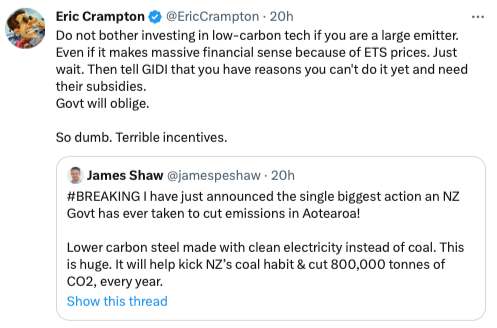
"'The project is forecast to have an abatement cost of $16.20 per tonne.'
"Well that's it then. Everyone should stop investing in abatement projects that are massively cost effective. Instead, beg government for a subsidy to do it. Government Investment in Decarbonising Industry Fund [GIDI] will pay for it."
~ Eric Crampton


 UPDATE:

"Every time I read or hear anything about carbon offsetting or emissions trading I smell tulips.
    "Why? Because it reminds me of the tulip mania in the Netherlands in the 17th century.
    "We can’t see emissions, we can’t smell them and in spite of the exhortations to follow the science, a lot of the business offsetting them appears to be anything but scientific....
    "The smell of tulips gets stronger when a large multinational company which made billions of dollars in profit last year gets money from the government to reduce its emissions ..."
~ Ele Ludemann, from her post 'Does anyone see smell tulips?'


Saturday, 1 April 2023

REPOST: Lobbying + NZ's New 'Aristocracy of Pull'


Political lobbying and those parasites they call "lobbyists" are once again under the microscope, their double-dealings being scrutinised this time by Radio New Zealand's Guyon Espiner. Good for him. And by Bryce Edwards who says "The central and unregulated place of lobbyists in politics has been identified as a key democratic deficit in New Zealand’s governing system. ... vested interests are able to convert their wealth into political influence, raising serious questions about integrity and corruption in New Zealand politics." And yet, both miss the main argument, which I make here in this repost from way back in 2018 [only the names have changed]: that there are so many lobbyists infesting the place because government itself is so big and intrusive; that there would be many fewer political lobbyists if there weren't so much to lobby about. In short, if there weren't so much political interference, the lobbying would matter so much less, and there would be far less of it ...

New Zealand's revolving door of political lobbyists -- political insiders shuttling back and forth between well-paid jobs in government and even-better paid jobs with private lobbyists -- has finally got the attention of political watchers. Turns out it's endemic, bighlighted by the various former, current, and intermittent chiefs of staff peddling their contacts with influence:
This week a perfect example of the "revolving door" of government officials and lobbying has occurred. The Prime Minister's Chief of Staff has shifted from the Beehive to a lobbying firm. Lobbyist Gordon Jon Thompson, has been a political manager – or "spin doctor" – and lobbyist for a long time, and shifts between government and private sector jobs with apparent ease... Another interesting – but less contentious – "revolving door" story [is] another former chief of staff, National's Wayne Eagleson – see: Former National Party chief of staff joins firm of Labour's top advisers...
    Thompson, who has been a lobbyist and PR professional [sic] for many years, worked with Jacinda Ardern last year, helping prepare her for the TV leaders debates. And then when she formed the new government she invited Thompson to be Labour's Chief of Staff, despite the fact that he would remain a lobbyist and director of his Thompson Lewis firm.
    Walters' article states, "Thompson finished a four-month stint as Prime Minister Jacinda Ardern's acting chief of staff, while chief of staff Mike Munro was recovering from illness."  This means Thompson was made Chief of Staff by the Prime Minister, with the full knowledge that he would then return to his lobbying business, where he would be involved with clients with an interest on influencing the new government. Indeed, he finished work last Friday in his job as the number one adviser to Jacinda Ardern, and resumed his lobbying job yesterday.
    The issue immediately raises issues about potential conflicts of interest....
Sure does. But this is only the very tip of a particularly large iceberg, with former MPs and MPs' wives and husbands and party hacks selling their proximity to power, often swapping roles with former advisors from the same or similar lobbyists.

Not to mention former ministers and prime ministers selling themselves to the folk they formerly regulated. 

Cosy.

Whatever the sector, a Cabinet minister who legislates/regulates in ways which are welcomed by the regulated industry are much more likely to find the post-politics doors open than one who regulates in a way the industry finds costly or inconvenient.

Selling themselves -- and at a very nice price thank you very much -- not for what they know (which in most cases is risible), but for whom.

Conflict of interest? The phrase, for these vermin, is simply meaningless. More like: "L'état! C'est ma source de profit."

Token hand-wringing against the practice appears at places like No Right Turn, bewailing that "these former public officials are seeking to leverage the knowledge and contacts they built up in their highly paid public careers for private profit"-- and he calls for "rules" around this practice. And just who does this big-government blogger think will be writing the rules?

PJ O’Rourke points out that when legislation proscribes what is bought and sold, the first things to be bought will be the legislators -- and the more legislation is written the higher the demand, and the higher the price.

Ayn Rand called it simply “the aristocracy of pull.”

One of Ayn Rand's best scenes in Atlas Shrugged has her hero Francisco d'Anconia complete the statement of one of her villains with a surprise ending. Political moocher James Taggart declares to a crowd:
"We will liberate our culture from the stranglehold of the profit-chasers. We will build a society dedicated to higher ideals, and we will replace the aristocracy of money by -- 
the aristocracy of pull
," said a voice beyond the group."
This, you should be aware, is the price of big government -- it's simply what modern government looks like.

If you don't like it, then perhaps you should reconsider your support for Government-With-Everything. Because this is the essential sauce it comes with.


* * * * 


* * * * 
[Cartoon by Wiley Miller]

Saturday, 18 March 2023

"Rights based on group identity is the formula for tribalism, tribal warfare, and injustice.... "


"Providing rights based on group identity is the formula for tribalism, tribal warfare, and injustice....
    "Conflict and wars between tribal collectives are part of world history, and we do not have to look far to be reminded how tribalism has played out over time....
    "If certain collectives are to be favoured, which ones will get priority? Black, White, Hispanic, and Asian are not the only possible collectives. And what of mixed races? What percentage of each racial DNA puts a person in a favoured or disfavoured group? Is the government to be the arbiter of the correct racial mixtures? What about non-racial collectives, such as the overweight, the weak and the uncoordinated in sports, the tone-deaf in music, the dyslexic in reading, and so on. What about the seven definitions of gender that are formally recognised by some organisations?
    "The fact is, when rights are given based on a collective or group identity, rights are also taken away based on a collective or group identity. How would this work? Obviously, it would have to be based on which collective has the most political pull at a given time.
    "As I noted, all this pushes us in the direction of tribalism, tribal warfare, racism, and injustice."

~ Edwin Locke, from his post 'Rights Belong to Individuals, Not Groups' [emphasis in the original]


Friday, 14 October 2022

REPOST: NZ's New Aristocracy of Pull


Since Kris Faafoi's head-first plunge into the lobbyists' trough has got people talking this week, it seemed a reasonable sort of occasion to repost this, from four years ago ...

New Zealand's revolving door of political lobbyists -- political insiders shuttling back and forth between well-paid jobs in government and even-better paid jobs with private lobbyists -- has finally got the attention of political watchers. Turns out it's endemic, bighlighted by the various former, current, and intermittent chiefs of staff peddling their contacts with influence:
This week a perfect example of the "revolving door" of government officials and lobbying has occurred. The Prime Minister's Chief of Staff has shifted from the Beehive to a lobbying firm. Lobbyist Gordon Jon Thompson, has been a political manager – or "spin doctor" – and lobbyist for a long time, and shifts between government and private sector jobs with apparent ease... Another interesting – but less contentious – "revolving door" story [is] another former chief of staff, National's Wayne Eagleson – see: Former National Party chief of staff joins firm of Labour's top advisers... 
Thompson, who has been a lobbyist and PR professional [sic] for many years, worked with Jacinda Ardern last year, helping prepare her for the TV leaders debates. And then when she formed the new government she invited Thompson to be Labour's Chief of Staff, despite the fact that he would remain a lobbyist and director of his Thompson Lewis firm. 
Walters' article states, "Thompson finished a four-month stint as Prime Minister Jacinda Ardern's acting chief of staff, while chief of staff Mike Munro was recovering from illness." This means Thompson was made Chief of Staff by the Prime Minister, with the full knowledge that he would then return to his lobbying business, where he would be involved with clients with an interest on influencing the new government. Indeed, he finished work last Friday in his job as the number one adviser to Jacinda Ardern, and resumed his lobbying job yesterday.
The issue immediately raises issues about potential conflicts of interest....
Sure does. And it's only the tip of the iceberg, with former MPs and MPs' wives and husbands and party hacks selling their proximity to power, often swapping roles with former advisors from the same or similar lobbyists.

Not to mention former ministers and prime ministers selling themselves to the folk they formerly regulated.

Whatever the sector, a Cabinet minister who legislates/regulates in ways which are welcomed by the regulated industry are much more likely to find the post-politics doors open than one who regulates in a way the industry finds costly or inconvenient.

Selling themselves -- and at a very nice price thank you very much -- not for what they know (which in most cases is risible), but for whom.

Conflict of interest? The phrase, for these vermin, is simply meaningless. More like: "L'état! C'est ma source de profit."

Token hand-wringing against the practice appears at places like No Right Turn, bewailing that "these former public officials are seeking to leverage the knowledge and contacts they built up in their highly paid public careers for private profit"-- and he calls for "rules" around this practice. And just who does this big-government blogger think will be writing the rules?

PJ O’Rourke points out that when legislation proscribes what is bought and sold, the first things to be bought will be the legislators -- and the more legislation is written the higher the demand, and the higher the price.

Ayn Rand called it simply “the aristocracy of pull.”

One of Ayn Rand's best scenes in Atlas Shrugged has her hero Francisco d'Anconia complete the statement of one of her villains with a surprise ending. Villain James Taggart states:

"We will liberate our culture from the stranglehold of the profit-chasers. We will build a society dedicated to higher ideals, and we will replace the aristocracy of money by..." 
"...the aristocracy of pull," said d'Anconia.
This, you should be aware, is the price of big government -- it's simply what modern government looks like. 

If you don't like it, then perhaps you should reconsider your support for Government-With-Everything. Because this is the essential sauce it comes with.

* * * * 


* * * * 

[Cartoon by Wiley Miller]

Tuesday, 27 April 2021

The Great Reset, aka: Building up the State


Planners and self-appointed big-government experts are keen to follow the principle of "never allowing a good crisis to go to waste" -- leveraging the pandemic to carry out what they call The Great Reset: building what they call "a more sustainable, inclusive economy" by building up a Big State. And if you think government is “big” already, you’ve seen nothing yet!

But as Richard Ebeling explains in this guest post, building up the State means pulling people down.

The onrush to bigger and more intrusive government, he explains, seems to be happening and accelerating almost everywhere, particularly in the face of the Coronavirus and the massive and compulsory political paternalism that has accompanied it. For instance, U.K. economist and advisor to the World Health Organisation, Mariana Mazzucato, in a recent U.S. article, calls for the Biden Administration to basically impose comprehensive central regulation, direction and planning over virtually all aspects of social and economic life in the name of "fighting climate change," providing health care for all, and overcoming alleged unjust racial and economic inequalities in America and around the world.

It is a prescription from which governments around the world, like our one, will. be eagerly taking notes.

Warning! We are moving into the fast lane on the road to serfdom.

Building Up the State Means Pulling People Down

Guest post by Richard Ebeling

I can still vividly recall sitting with a high school friend and watching on television as astronaut Neil Armstrong stepped down onto the surface of the moon and saying his famous words, “One small step for a man, one giant leap for mankind.” My glance went back and forth from watching Armstrong make his first steps on the moon’s surface and looking out the window at what was a full moon in the clear night sky over Hollywood, California where I lived, and thinking how surrealistic it all seemed.

It wasn't just me who found it inspirational. In our new era of Covid-19 Big Government, there are those who want that famous event of a little over a half-century ago to serve as inspiration and a model for a post-coronavirus epoch of renewed and expanded political paternalism through government-business partnerships to solve the earth-bound problems of humanity. The questions I would ask are, was it really worth it? is this the appropriate role for government in a free society? and what happens to individual liberty and private property if they succeed?

Building Up the State for Expanded Political Paternalism


Mariana Mazzucato is a professor of economics at University College, London, and the chair of the World Health Organisation’s Council on the Economics of Health for All. She is one of the prominent advocates of government taking on “big missions” in society as the political “big brother” that organises and directs those in the private sector who are to follow and obey the lead of governmental paternalists like herself. All, of course, to make "a better world." (See my article, “The Downsides and Dangers of Mission-Making”.)

She featured in Time magazine as one of trio of writers making their case for The Great Reset: calling therein for something she calls "the entrepreneurial state" (one which shackles actual entrepreneurs to big government's mission.) And in another recent article for American readers, “Build Back the State”, she argues that the Apollo mission to the moon demonstrates how government should be doing things that can get big things done, such as combating climate change and reducing income inequality through political leadership. She tells us, “The task for the Biden administration is to provide leadership for the missions that will shape the decades ahead, starting with the fight against climate change.” Leadership (she hopes) that will go around the world.

She makes it very clear that, inn her view, it must be those in political power who should be in charge of the future economic direction of the United States: “We need top-down direction to catalyse innovation and investment across the economy [she says]. And the Apollo era’s example of government’s leadership, bold public interest contracts, and public sector dynamism offer a valuable template.”

Her mantra is that there is no alternative, and (once begun) no turning back. Going to the moon was a “choice,” Mazzucato says, but today in the 21st century, the “same type of visionary leadership is not a choice, but a necessity.” By implication, denying or opposing such a more dominant role for government is to be on the “wrong side of history.” In other words, it’s either political paternalism on steroids, or it's “curtains” for humankind. 
 

The Political Mission-Makers Dictate to the Private Sector


The Biden Government must seize the moment, she argues, setting the goals, determining the best ways to get there, and then enticing specially selected big-business partners to go along with it through the offering of hundreds of millions, indeed, billions, of tax or borrowed dollars to do the investment and innovative work that the political leaders want them to take on. The private sector, therefore, is the “junior partner” who follows the directives and commands of those shovelling out the government money to the corporate coffers. To see that private self-interest never gets in the way of what and how the government wants things done, however, she calls for “fixed-price” contracts to prevent cost overruns, and at the same time to have strict regulations that assure the profits to be earned are what the political authorities consider reasonable and “fair.”

The purpose of the price, cost and profit restraints, Professor Mazzucato tells us, is to ensure that what drives their private business partners is “scientific curiosity” and the public welfare rather than “greed or speculation.” To guarantee that those devious private enterprisers don’t pull a fast one on Uncle Sam, she calls for the government's bureaucracies to be filled with technical experts with the knowledge to keep the profit-seekers on the straight and narrow path of only doing what government knows to be best:
“By strengthening the public sector’s capabilities and outlining a clear purpose for public-private alliances, the Biden administration [she says] could both deliver growth and help tackle some of the greatest challenges of our age, from inequality and weak health systems to global warming. These problems are much more complex and multi-dimensional than sending a man to the moon. But the imperative is the same: effective strategic governance of the space where public funding meets private industry.”

The Apollo Project was not “the People’s” Preference


President Kennedy once told the head of NASA at that time, “I’m not that interested in space.”Going to the moon  not the real goal; the real goal was beating the Soviet Union: a political decision to get there before the Soviet Union did. In fact, Kennedy was more concerned that the cost of going to the moon might “wreck our budget.”

Nor were the American people all that excited and interested in the U.S. getting to the moon first. According to Gallup opinion surveys, in 1965, four years before Armstrong’s walk on the moon, only 39 percent of the respondents supported the moon project to get there before the Soviets, “whatever it costs.” In fact, throughout the 1960s, opinion polls said that near the top of the list of those government programmes respondents thought not to be worth funding was the space programme. Even after the successful landing on the moon in 1969, public opinion surveys reported that only 53 percent thought it had been worth the cost. And in the 1970s, those in favour of the space programme decreased well into the 40s percentage range. 

Americans Are Even Less Excited about Paying to Stop Climate Change


While Professor Mazzucato understands that going to the moon was a “choice,” she insists that government-directed and leadership on climate change, inequality, and health care is now a “necessity.” But in whose eyes? An Associated Press poll in 2019 found that 57 percent of Americans were willing to pay just $1 a month more in taxes to “fight” global warming. But when they were asked whether they would be willing to pay an extra $10 a month to stop the climate from changing, only 28 percent said “yes,” while 68 percent said they were opposed.

Clearly, once told that a cost comes attached to the politically hailed benefit of an “unchanged” climate (whatever that would mean!), the public’s enthusiasm falls precipitously. And once confronted with the actual price tags of higher petrol prices at the pump, increased bills for heating and air conditioning, the inconveniences of mandated restrictions on air flights with increased ticket prices (along with possible mileage limits on driving your car to “save the planet”) the numbers of voters supporting a drastic reduction in the standard and quality of life to combat the climate change bogeyman will most likely become far less than what it may be today.

And her programmes have an enormous cost! The entire Apollo programme in the 1960s and 1970s had a estimated cost at the time of $25 billion, or about $157 billion in today’s dollars. That paid for all the equipment and material, and around 400,000 people working to help put a total of 12 astronauts on the moon. But that's pocket change compared to the projected bill for the Biden administration infrastructure and anti-climate change programmes, which carry a combined price tag over the next eight to ten years of upwards of $4 trillion. That's around twenty-five times the cost of the moonshot, not to mention the deadweight cost of all the economic destruction it will cause. The programme will require higher taxes, increased prices, and reduced living standards that represent far more than that $1 a month that 57 percent of the public said they were willing to pay to “save” the planet. But by the time it's implemented, it will be too late to say anything.

Exciting Missions for Those Planning to Be the Planners


When Professor Mazzucato says that what the White House is taking on is more complex and intricate than just getting men to the moon, she is telling the truth. The federal government would be basically taking over more direct decision-making for various forms of manufacturing methods, residential and business construction standards, and huge additions to expenditures on health-care and welfare redistribution. There would be funding to support increased unionisation of more of the work force, and (of course) subsidies and grants to those in the private sector willing to do the government’s bidding. Not to mention the funding for electric cars and accompanying recharging facilities, along with more funding for public transport boondoggles and broadband internet. Indeed, a number of analysts have made it fairly clear that only a fraction of these trillions would be allocated for what has traditionally been considered the infrastructural tasks of road and bridge repair and rebuilding. These jobs will be wiped from the menu almost completely.

The grand national “mission-making” that Professor Mazzucato happily and insistently endorses and demands from the Biden administration reeks with the pungent odour of political power-lusting, special-interest corruption, and dictatorial direction of virtually every person’s life. It also carries with it the end to all reasonable and rational economic decision-making throughout the American economy.

One can only read the words of someone like Mariana Mazzucato and sense the euphoric excitement of those who dream dreams of planning the future of the world. Clearly, she views herself among those qualified and destined to tell everyone else how they should and will live. Place her in charge, she all but demands, or at the very least among the special ones whispering into the ears of those in power who give the “expert” advice without which the world is doomed to live in misery and injustice. Her current roles as adviser to the UK Government and WHO for her and people like her are merely springboards. (See my article, “If I Ruled the World: A Dangerous Dream”.)

Special-Interest Politicking Grows with More and Bigger “Missions”


Implied by Professor Mazzucato’s vision is a spider’s web of government interventions, regulations and controls and commands of the type that must accompany any top-down system of government planning of economic and social life -- bringing with it inescapably an intensified institutional setting of special-interest favour-seeking and political profit-making. What Ayn Rand called creating "an aristocracy of pull."

To the extent to which private enterprises’ revenues and economic survivability is dependent on government spending and regulating and planning, every affected business will have an increased incentive to develop “relationships” with the agencies and its personnel – the overseeing “experts” in the bureaucracies – and with the politicians and their staffers whose decisions and permissions and contract privileges will determine a company’s success or failure. Political connections, and not market competitiveness, becomes increasingly central to every businessman’s attention and intention. (See my article, “Out-of-Control Government: How, Why, and What to Do”.)

More Political Planning Means Less Personal Choice and Freedom


How can the tentacles of government intervention and planning extend so far into the economic activities of every corner of society and not bring with it a decrease in the degree of liberty and freedom of choice of the citizenry in their roles as consumers and producers? As the “senior partner” in these government-business “mission” relationships, the autonomy of individuals on the producer side of the economy necessarily is confined within the targets and goals, the “carrots” and the “sticks” of what those in political authority demand and determine as the direction of economic activity.

Control and command over production by necessity narrows and dictates what is offered to the consuming public and on what terms. The loss of economic liberty carries with it a narrowing of personal choice and self-determination as to how we live and the options offered to us and at what expense; they are taken out of our own hands in the free associations of an open and competitive marketplace and shifted into the political hands of those imposing the top-down directives over all of our lives. In an earlier period of time not too long ago this would have been labelled tyranny and totalitarianism. (See my article, “‘Great National Purposes’ Mean Less Freedom”.)

The Mutual Benefits in Free-Market Exchange


Finally, Professor Mazzucato’s government “mission-making” weakens and finally destroys all economic rationality concerning what is to be produced in the society, as well as how and for whom. Since the time of Adam Smith, the virtue of the liberal free market economy has been understood as leaving each and every individual at liberty to make his own decisions as a consumer and producer. This is made possible due to the institutions of private property, freedom of association and exchange, and unrestricted peaceful and honest competition among all the participants in the social system of division of labor.

Self-interest is harnessed to the general well-being of all those in society by requiring everyone to creatively and effectively find niches for themselves in the arenas of production and trade by which they may acquire the things they want and desire by offering in exchange some good or service willingly taken by others in the agreed-upon buying and selling. 

Prices Inform and Coordinate All That People Do

On a free and uncoerced market, people express what they want and the values they place on the things they desire by the prices they are willing to pay for them. Sellers articulate what they may be willing to produce and sell through the prices at which they offer their goods and services to others in the market. At the same time, competing producers bid for the labour services and resources and capital equipment they may use in their respective lines of production, and those offering their means of production in the pursuit of employment evaluate the alternative prices and wages offered by the rival producers and decide which ones seem most attractive to negotiate over and accept.

The end result is that the prices for finished goods and the prices for the factors of production offer entrepreneurs, private enterprisers, and businessmen the means of determining what to produce and how to produce; that is, prices provide the tools for the “economic calculation” of deciding which lines of production and with what combination of inputs might bring a profit versus a loss, and if there exists potential for profitability; in what ways of producing the chosen good maximizes the net possible gain.

Production is guided into those directions reflecting the most highly valued wants of consumers, and supply-side competition sees to it that the scarce resources of society, including labour, are allocated and applied in ways that tend to utilise them in the most economically efficient and effective ways. Free markets supply what people, in their role as consumers, actually want and are willing to pay for, and each earns an income based on what the market says their services are considered to be worth in their respective roles as producers.

The entire competitive market process and price system sees to it that supplies and demands are tending to match, that information is provided to everyone about what, how and where to be doing things in ever-changing economic circumstances, and that each participant has a fairly wide latitude to make their own decisions in their joint roles as consumer and producer. 

Political Planning Making Decision-Making Irrational


But if Ms Mazzucato has her way, all that must change. Many, if not most or all of these free decisions are to be taken out of people’s hands and coercively transferred to the control of those in political power. The governmental “mission-makers” will now decide what shall be produced and in what ways and for which purposes. Goods produced and supplied will now reflect the ideas of how people like Mariana Mazzucato, in their roles as “expert advisers,” think these things should be done.

By manipulating prices, setting profit margins, dictating what goods should be produced in what technological ways to meet what they think is good and needed by “society” and “the planet,” the entire economic system loses all reasonable footing for rational decision-making.

Let’s take Professor Mazzucato’s three stated areas of “mission” concern: the global environment, health care, and income inequality
  • How and by whom will it be decided that certain relative quantities of resources and labour will be devoted to infrastructure retrofitting versus wind-power turbine construction versus solar power manufacturing?
  • And how and by whom will it be decided what pieces of land will be dedicated to each of these two latter activities (versus the uses of that land for residential housing, farming, wildlife preserves, retail shopping needs, or manufacturing)? 
  • How will these be weighed and considered versus allocations and uses of the scarce resources of the society for health-care research, the servicing of patients, and the manufacturing of the medical devices and equipment and facilities connected with the provision of health care needs? 
  • How will all these decisions be made versus a reallocation of income and wealth through tax transfers and in-kind services to those deemed “marginalised” and “unprivileged” and “underrepresented” in society? 
  • How will it be decided that not enough disposable income has been redistributed to “people of colour” – and since “colours” come in a variety of shades, the determination of what and how much goes to each racial and ethnic “colour” group? 
  • The same applies to those declaring their chosen gender and sexual orientation. How and who decides the proper “marginal” distribution of employments and relative incomes between “straight” people of color versus white people who are gay or handicapped and who come from differing family income and educational backgrounds?
The problems of central planning are manifold. And they don't simply disappear just by throwing money, propaganda and political power at the problem -- as the Soviet Union so abjectly demonstrated.

Who Selects the “Experts” Like Mariana Mazzucato?


There is a related problem of central planning: Who exactly selects the “experts” like Professor Mazzucato, and on what bases and benchmarks, and how is it known that what they say are the necessary “mission priorities" to which all in society are to be made to conform?

No-one ever really knows, except that their real and most important skill will be that they are politically connected. And that real decision-making will be taken out of the hands of real people, i.e., those with a real stake in the success or otherwise of those decisions.

Because when politically-driven experts rule, all economic and social questions and problems are taken out of the peaceful, voluntary, and private arenas of market exchange and the nongovernmental institutions of civil society, and they are moved instead into the realm of government coercion. Under this mandate, prices can no longer tell people what their fellow human beings actually want and how much they value it. Individuals can no longer pursue ways of earning a living guided by what others might like to buy from them, no longer decide for themselves how best to do it based on agreed mutual terms of hiring and employing. “The people” are no longer allowed to freely speak to each other through prices, and associate with each other as they find best and most advantageous through the free bargaining and contracting that is otherwise central to an open and competitive free market. (See my article, “Price Controls Attack Freedom of Speech”.)

To the extent that climate changes may be occurring that have negative effects on people in different ways in different parts of the world, the advantage and benefit of the free-market system (over the chaos of big-government coercion) is in essence that ,when left unmeddled with, the price system will bring to every individual around the globe all the information about whatever changes are actually occurring. Whatever changing demands, shifting resource and supply possibilities, whatever changing terms-of-trade, are reflected in the relative price structures for inputs and outputs in which is incorporated all the relevant information of all the changing circumstances worldwide. With this information embedded in the price system, free individuals and private enterprises in each and every corner of the global division of labour then have profit-motivated incentives and the personal liberty to utilise their own unique and specialised types of knowledge to competitively discover and bring about the appropriate modifications in what people do, where and in what ways, and with the most cost-efficient uses of resources, capital investments and labour skills to do so. (See my article, “F. A. Hayek and Why Government Can’t Manage Society”.)

By constrast, under Professor Mazzucato’s scheme of things, we will all be reduced to those manipulated pawns on the great chessboard of society about which Adam Smith once spoke, with the social engineers and political paternalists like Ms Mazzucato moving us about and positioning each of us as they think we should be arranged and related to each other; instead of each of us deciding ourselves where we want to be and doing what, in collaborative associations with others, as we peacefully see fit, we will instead be pushed around and trodden upon by bureaucrats with political connections. (See my article, “Adam Smith on Moral Sentiments, Division of Labour, and the Invisible Hand”.)

Yes, Mariana Mazzucato and Joe Biden and all those on the Great Reset path are all on “missions” with “big plans.” But their political missions and their big economic central plans require all of us to give up our own individual and personal plans, and to be straightjacketed instead into their compulsory designs for us all. We need to remember Adam Smith’s words in The Wealth of Nations, that:
“The statesman, who should attempt to direct private people . . . would nowhere be so dangerous as in the hands of a man who had the folly and presumption enough to fancy himself fit to exercise it.”
* * * * * 

Richard M. Ebeling  Richard M. Ebeling is the BB&T Distinguished Professor of Ethics and Free Enterprise Leadership at The Citadel, in Charleston, South Carolina. He is the author of several books including Monetary Central Planning and the State, and For A New Liberalism.
This post first appeared at the AIER blog. It has been lightly edited.