This is an amusing account below of an important public meeting. Important in the context of making Auckland an affordable city.
Here's some quick context: Auckland's town planners have strangled the city in red tape for years. In recent times however, many planners and councillors (and mayor Wayne Brown) have come around to the realisation that the fewer houses built, the higher the prices for those houses: that, just maybe, people might be allowed to do a bit more on their land, to maybe build a little more densely.
Opposing this, of course, are the councillors and politicians of the leafier suburbs like Christine Fletcher -- and of course David Seymour, who's dropped his party's alleged principles about property rights to wring his hands instead about there being 'no density without infrastructure.'
There's no greater hand wringer than Christopher Luxon however, who decided over summer that Auckland Council must 'downzone' their proposed plan change that would allow greater density.
So this meeting Wednesday night was to confirm where the push for greater density would be maintained in the upcoming Plan (where would be upzoned), and where that push would be relaxed a little (where would be downzoned).
When the government’s efforts to intensify Auckland were debated at council back in August last year, critics took turns wringing their hands about the strain it would place on infrastructure. Plan Change 120 [which will allow greater density] could end up putting apartments in places that weren’t set up to handle them, they fretted. “Ultimately you can’t do all this upzoning without making the commitment to provide the infrastructure that will support it,” warned Albert-Eden-Puketāpapa ward councillor Christine Fletcher ...
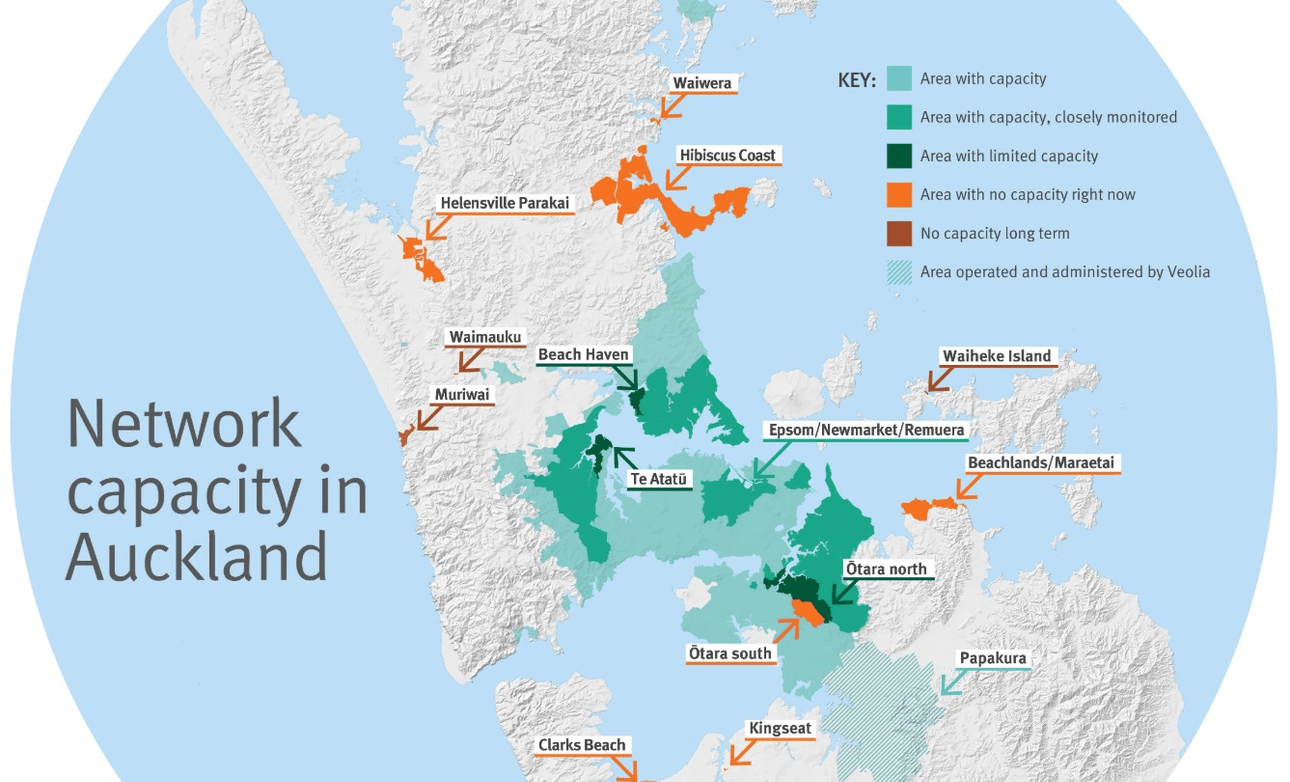
Yesterday the worriers got their wish. Thanks to a government backdown wrangled over chardonnays and summer barbecues, councillors are allowed to reduce the capacity in the new plan from two million to 1.6 million houses. Council’s policy and planning committee was meeting to decide where to make those cuts, and its chair Richard Hills started out explaining the staff recommendations to prioritise places 10km or more from the city centre. Asked why those areas should get first dibs on downzoning, council planner John Duguid was clear: it was because the land within 10km of the city centre had the best access to public transport, employment opportunities, regional amenities like parks and pools and three waters capacity, as measured by Watercare:
Three waters capacity in the central areas is set to improve even more when the Central Interceptor comes online soon. (Image: Watercare)
It should have been a celebration. But what would you know, most of the people who were once so concerned about ensuring housing is near infrastructure weren’t happy. Instead they were stewing over the revelation that the places with the best infrastructure were in their well-to-do wards. North Shore councillor John Gillon had looked at the maps and found that a 10km radius from the city centre would include the entire area he represents. He moved an amendment, seconded by Fletcher, to delete the 10km clause, saying he was “concerned” about the figure.
Waitākere councillor Shane Henderson was having none of it. He pointed out that west and south Auckland had accepted the vast bulk of the new houses in Auckland since the Unitary Plan passed in 2016. As for strain on infrastructure, those areas have limited pipe capacity and less access to public transport, and we see the effects of that outside-in planning in rush-hour congestion, parking shortages and sewage overflows, he said. Henderson argued Fletcher and Gillon were engaged in “a poorly dressed up move to take away intensification from the best-equipped parts of the city”. “The intention is simple: to downzone wealthy suburbs. There is no sensible reason for excluding central isthmus communities – again – from doing their part.”
The mayor was, if anything, more blunt. He said Gillon’s motion was aimed at putting housing in Pukekohe rather than areas close to “all the infrastructure”. “I don’t want to see endless sprawl just so nimbys in Parnell and politicians can get re-elected,” he said, in what appeared to be a shot at his political nemesis, Act leader David Seymour. “That’s disgraceful, I can’t vote for it.” ...
As Brown saw it, his colleagues’ first purpose was elitism. But if they had a second priority, it was delay. Gillon and Fletcher also put forward an amendment proposing to ask the government for more time to enact Plan Change 120. ...
The demand was familiar. Fletcher has asked for more consultation in just about every planning meeting for years, and the mayor was incensed. “I want to get out of this without further delay and dithering,” he said. “God almighty, it would be great to do something this three-year period.” ...
“For fuck’s sake, get on with it,” he said, as Fletcher spoke for the final time. ...
Afterward, Brown expanded on his frustration with Fletcher, saying the meeting was “one long filibuster to stop poor people living in her area.”
Read the whole thing here. It's an entertaining lunchtime read.
"Depressing to see ACT—once upon a time at least ostensibly a pro-market party—apparently opposed to freeing up land use, and enabling urban land prices to fall a lot."
It's a rule in politics. The devils is not always in the details. It's often that the details reveal the real devilry.
If the large print ever giveth, then the small print will surely taketh away.
Let's look at a few examples in an area I know something about: Building.
*** Building Minister Chris Penk seems a jovial character but unfortunately he knows little about his subject area. His first move was to promise faster building consents. Exciting. Encouraging. Mighty work.
Here's hist first step: "requiring councils to submit data for building consent and code compliance certificates every quarter." There are no other steps.
He adds "hope" to the idea of anything being faster. Council inspectors "must" issue building consents in a timely fashion, he insisted. And yet every council inspector ever employed knows how to legally delay a consent application. In fact, if you fine a council for being legally overtime, they'll just legally delay applications for even longer to give themselves some head room. Which is what they've done.
Score One for the Grey Ones.
*** Another move by Building Minister Penk was "remove barriers to overseas building products." At least, that's what it said in the headline. His idea, sensible enogh on its face, is that if enough similar jurisdictions to ours have passed a product (places like Canada, US, UK, Europe, Australia etc.) then that product would be deemed to pass here too.
So far, in the three months since introduction, they'e okayed some taps from Sydney. Next year, they might look at concrete codes in the US. Done properly, with due consideration, this will take most committee members through to retirement.
Score One More for the Grey Ones.
** And then the Minister for Regulatory Reform (sic) stepped up to announce a new measure to "liberate" builders and designers. For years, some of us have suggested that instead of applying to councils for permission to build (which asks for more knowledge than council employees really have, and puts ratepayers on the hook for the risk should they fail) we instead use insurance companies to take the risk.
You know, like if you build a hot rod or street racer instead of a bog standard car, then you ask the insurance company to take the risk, and they use their acumen to discern the risk, and charge you accordingly.
This allows for good design, with risk properly underwritten.
But you see that word above: instead.
Rather than placing the risk and the onus on designers and builders and insurers instead of on councils and ratepayers, the Minister for Regulatory Reform is doing this as well as. So it's no more "liberation day" than were Trump's tariffs: we end up getting the worst of both worlds: councils assessing risk, and insurers granted a monopoly charging like wounded bulls. And the ratepayers? Still on the hook.
So it's Several More there for the Grey Ones.
** It's like education, where a "regulatory review" by the same Minister for Regulatory Reform intends to "clarify" and "simplify" Childhood Education's overwhelmed sector. One imagines a quick fix might be going back to say, 1996, when things were working tolerably well, and just before regulations began piling on and classrooms and centres became over-regulated, under-performing, and wholly unaffordable for parents.
Instead, the "reform" begins by (and I quote) "establishing a new statutory role, the Director of Regulation, with responsibilities for performing key regulatory functions in the Early Childhood Education system." Which means another red carpet rolled out in yet another floor of a new office building in Wellington.
Back of the Net with another great effort by the Grey Ones.
*** It's a bit like the "cap" on rate rises.
Let's stop rate rises!! Yay!! Well, not so fast.
We know that the "cap" will be supplemented for weepy boomers with top-ups for water use, for mayors who plead public transport debts, and councillors who claim infrastructure shortfalls. We also know that the minister "responsible" ( I use the world loosely) is happy with "soaring" council debt, just as long as the effects and the headlines are only felt after he's gone.
Yes, a minimum. By law, councils must increase rates by at least 2% every year.
It a sop, not a cap.
Grey Ones score again.
** And not to mention that the new-fangled means by which councils can "fix" their bloody awful traffic problems—traffic jams being a clash of capitalism (in the form of car production) confronting socialism (in the form of too few roads). The "new" solution is a tax. A new tax to be called "congestion charging," which will of course not replace any other tax but just be added to all those under which we are already burdened.
With this government, as with every other in recent times, it's always one step forwards, and three steps back. Too many ministers with too little nous giving too much help to the unproductive to whom too many of us must seek permission before we can do anything.
Here's the basic problem with David Seymour's Regulatory Standards Bill:
"You can't address a fundamental problem by making marginal changes."
Its remarkable timidity is its underlying flaw. It either makes fundamental change, so is worth passing, or it doesn't — which is now how Seymour is left to defend it. If it doesn't, then one is left to wonder: what's the point?
The defence, however noble, is not helped by the apparent illiteracy of attackers who impute everything into the bland legalese every imaginary vice they can dream up.
The simple yet tragic fact is this:
"Absent a fundamental shift in which our politicians are guided by restoring government to its proper purpose, i.e., the protection of individual rights, there will only be this nibbling at the margins. Meanwhile the leviathan will grow out of control until the unsustainable mess mercilessly self-corrects."
DAVID SEYMOUR'S REMARKABLY TEPID Regulatory Standards Bill is getting frightened and bewildered luvvies to put down their lattes and type indignant emails to their MPs.
Fuel for many of this outraged commentariat (Anne Salmond was the first; Brian Easton is the latest) is provided by a book-length screed by one Quinn Slobodian called Hayek's Bastards, "The premise of Quinn Slobodian’s new book," says the bookplate, "is that authoritarian right-wing populism is a mutated version of classical liberal economics." A version labelled "neoliberalism" by its opponents.
A counter-intuitive thesis to be sure, So I checked on some actual classical liberals to see what they thought of the book. (Pointless asking Trump followers, since we know none of them can read. Or "neoliberals," noneof whomactually exist.)
Phil Magness, an economic historian who most recently convinced over 150 economists and scholars to sign a declaration opposing Trump's economically harmful, constitutionally dubious tariff policies, wonders aloud at the absurdity of the book's central thesis. Which is Slobodian's apparent conviction "that Trumpism traces its intellectual origins to the Austrian economists Friedrich Hayek and Ludwig von Mises." This would undoubtedly astonish all three.
Slobodian's attempts to link the three suffers, Magness says wryly, "from a lack of clear evidence for the parentage. Undeterred, Slobodian supplies the links by making them up."
As they say, if you have to lie to make up your criticisms, it suggests you probably don't have any.
Slobodian of course relies on the fact that few if any of his credulous readers will bother to actually read Hayek or Mises. (Easton for one would benefit hugely from the experience.) But if you want a candid study of how to quote somebody to say the precise opposite of what they say — in this case Mises quoting others to denounce their racial prejudice is used to suggest their vile views are his own — then Magness's review is a good place to start.
This is not even sleight of hand. It's a conjurer simply assuming his audience are too dumb to notice. "Deliberate deception" is how another commentator describes it. It's a consistent pattern. Here's Slobodian in 2015, for example, showing how to get Mises to support something he was writing to oppose:
Slobodian demonstrates his pattern of ripping quotes from their context to give the opposite impression of an author's intention.
It's complete dishonesty: a "scurrilous ... slipshod attempt to taint and tarnish the reputation of one of the leading economists of the 20th century, and one of the most consistent and outspoken defenders of the classical liberal ideal of political, social and economic liberty and the free society," says Misesian Richard Ebeling in his response to the deception.
We live at a time when one of the worst accusations that can be thrown at someone is the charge of “racist.” Have that word tied to your name and it not only results in moral condemnation, it potentially throws into discredit almost anything and everything that person has said or done. That makes it a serious matter when an individual never identified with such racist views or values has that accusation attached to them. ... The actual facts show this is a fundamentally baseless accusation that attempts to taint and tarnish the reputation of one of the leading economists of the 20th century ...
[O]ne of the most embarrassing observations that can made about an author’s work [is] being slipshod scholarship. Professor Slobodian has 93 footnotes in his article. Over 50 of them reference Mises’s writings or correspondence. Looking them up, I found many instances in which the page reference to a paraphrase of a passage or a quote in one of Mises’s works was not to be found where Professor Slobodian indicated it to be.
In some instances, this was not simply being off a page or two; the page referenced turned out to be in a portion of one of Mises’s works that had nothing to do with the theme or idea that Professor Slobodian was referring to....
In addition, there are instances in which Professor Slobodian asserts or implies views or states of mind held by Mises at some point in time. But the footnoted reference sometimes refers to some other scholar’s work that when looked up did not refer to or imply anything about Ludwig von Mises. For example, at one point (p. 4), Professor Slobodian says, “But for Mises, a war had shaken him the most. Japan’s defeat of Russia in 1905 brought about a non-white power into the elite white club of empires. The event resonated with the rhetoric of the ‘yellow peril’ widespread at the turn of the century, understood as both a racial demographic and commercial threat.” And he footnotes a[nother author's] work about Asian intellectuals in the period before the First World War.
Professor Slobodian then says, “Mises’s response was different but no less radical,” and then references how Mises [allegedly] saw the economic significance of increased global competition from Asia ... The juxtapositioning of these two ideas, one following the other, easily creates the impression that Mises, while having a “different” response, was part of the group worried about a “yellow peril.
There is nothing to suggest in Mises’s writings actually referenced that he held or expressed any such race-based fear in the wake of the Japanese victory over Russia. But the implication is easily left in the reader’s mind.
The first two chapters find Slobodian searching for hints of racial prejudice in the work of Hayek and Mises. For the former, the best he can manage is a reference to ‘the Christian West’ in a 1984 speech. For the latter, who may well have been Austria’s least racist man in the 1930s, it is an even greater challenge.
Slobodian revives two articles he wrote about the lifelong supporter of open borders in 2019 that have been heavily criticised by Phillip W. Magness and Amelia Janaskie for ‘inverting Mises’s meaning in a light that erroneously casts him as sympathetic to racism or colonialism.’
One does not need to be an expert on Mises to see that Slobodian is guilty of selective quotation. One only needs to read the whole paragraph from which the quote is taken. For example, Mises is quoted as writing in 1944: ‘There are few white men who would not shudder at the picture of many millions of black or yellow people living in their own countries.’ Slobodian puts this in a context that implies that Mises shared this revulsion and cites it as evidence that Mises had ‘partially legitimised closed borders for nonwhite migrants as a near-permanent feature of the world order.’ But the very next sentence of Mises’ text reads: ‘The elaboration of a system making for harmonious coexistence and peaceful economic and political cooperation among the various races is a task to be accomplished by coming generations.’ It should be obvious that Mises was not endorsing the prejudices of the majority, but merely acknowledging the existence of such prejudices and hoping that they could be overcome.
And here's Slobodian's problem, and the reason he must so transparently mis-quote: "There is simply no through-line from Mises or Hayek to the alt-right."
By referring to right-wing populists of the present day as Hayek’s illegitimate offspring (‘bastards’) Slobodian allows himself a certain amount of wriggle room, but if a student believes the exact opposite of the teacher, can he really be portrayed as a follower?
The fatal flaw in this book is that Slobodian has clearly started with his conclusion and worked backwards. An author who was interested in writing about the roots of the current wave of right-wing populism would start with the right-wing populists and study their words and deeds.
Which is what Misesian Jeffrey Tucker did many moons before Slobodian even thought about slithering into print — "the most important political book in recent memory" is what my own reviewer called it.
BUT THIS BRIEF GLIMPSE into a fetid authorial swamp was not just to alert you to a shitty book from an author too incompetent to even formulate real arguments. It's to show you how bereft of clothing are the nakedly insubstantial objections to Seymour's bill, that so many rest their objections on a ad-hominem without even a home. As Richard Ebeling says so tellingly in a recent article, "“Progressives” Blame F. A. Hayek for Everything They Dislike."
That so many of these "progressive" objections to a fairly unobjectionable Bill rest unthinkingly on Slobodian's animus and deception — for a historian used to checking sources, Anne Salmond's was an example of one of the most dishhonest — suggests the same thing said of Slobodian's book could be said about the objections to the Bill: if you have to lie to make your arguments, then perhaps you don't really have any.
NOT SURE ABOUT YOU, but it looks to me like a whole lot of the commentariat are melting down about David Seymour becoming Deputy Prime Minister — despite the role being as much use as a glass eye at a keyhole.
The most absurd critiques, and here I'm looking at Wee Willie Jackson and Mihinarangi Forbes, goes at him for being "a libertarian." Which poses some kind of a dangerous threat, apparently, despite libertarians famously not caring what goes on behind your closed doors.
ANYWAY, TO FURTHER ASSIST poor Mihi and Wee Willie, who remain confused on this point, Javier Milei explains in the video above the difference between right wing, left wing, and libertarian. (Maybe Mihi could use it in her next scare story re-running her vacuous Atlas conspiracy):
Interviewer: What is it to be libertarian? ... Why do you define yourself as a libertarian?
Milei: I define it for you by default [by opposites].
What would someone on the right be like? Someone who doesn't mind who you trade with -- is a liberal economically speaking -- but it bothers him who you get into bed with. Who is a "cultural conservative."
Int.: Repeat that?
Milei: A right-wing person is someone who is economically liberal, someone who doesn't care who you trade with, but cares who you sleep with. Who is a "cultural conservative."
Int.: Okay. I get it.
Milei: On the other hand, a left-wing person is liberal culturally --- they don't care who you get into bed with -- but is interventionist economically; they don't let you trade with whomever you want.
So, what would a libertarian be?
Someone who believes in unrestricted respect for the life project of others. [W]ho believes consenting adults can get into bed with whoever you want -- with every one you want.
Int.: Is that how a libertarian thinks?
Milei: Exactomento.
And obviously you can trade with whoever you want.
"New Zealand’s low wages can be blamed on low productivity, and low productivity can be blamed on poor regulation. To raise productivity, we must allow people to spend more time on productive activities and less time on compliance. ... "In a nutshell: If red tape is holding us back, because politicians find regulating politically rewarding, then we need to make regulating less rewarding for politicians ... "
ACT LEADER DAVID SEYMOUR IS outraged that Auckland Council plans to set up a co-governed committee to manage the Waitākere Ranges. "Auckland Council’s plan to set up a co-governed committee to manage the Waitākere Ranges shows why Kiwis need councillors who believe in democracy," says ACT Leader David Seymour.
Democracy.
“The Waitākere Ranges belong to all Aucklanders [says the ACT leader] and should be managed democratically. But Auckland Council’s plan would see unelected decision-makers closing tracks and dictating land use in the surrounding rural areas."
Dictating.
“The ranges are governed under the Waitākere Ranges Heritage Area Act," notes the ACT leader. And the Waitākere Ranges Heritage Area Act calls for a "Deed of Acknowledgement" recognising and giving power to tangata whenua. If the ACT leader has a problem with the Deed of Acknowledgement and the giving of power then — since it's the Waitākere Ranges Heritage Area Act that requires the acknowledgement and gives such power — then it's the Waitākere Ranges Heritage Area Act that he has a problem with.
One can only imagine that the ACT leader then was just as outraged.
Minister for Local Government, 2008-11
Except ... it should be further noted that the Waitākere Ranges Heritage Area Act was introduced by the Minister for Local Government in 2008, and brought into law in April 2008. And that ACT leader was himself Minister of Local Government for three years from 2008 to 2011, in which he had ample opportunity to amend the Act.
He didn't.
Ample opportunity to restrict the powers of local government to those in which it enjoyed a "general competence."
Local government in New Zealand exists because central government created it, and grants it powers. Instead of drastically shrinking the power of local government, as an ACT leader should have done, that ACT leader instead awarded this super-sized council many more. Including the power — nay, the necessity — to set up a co-governed committee to manage the Waitākere Ranges.
It's a bit late now to watch this ACT leader whimpering about it.
"I myself cannot see how anyone could possibly object to a bill committing our country to racial equality and to the sovereignty of the Crown and Parliament. "Nor can I see any constitutional objection to our sovereign parliament — the very parliament that has made reference over the years to the ‘principles of the Treaty’ — taking the logical and necessary next step of explaining what those principles are. "Nor can I see any objection to leaving the final decision on the matter to a referendum of ordinary citizens ~ whom we do, after all, trust every three years to decide on our rulers for the next Parliamentary term.... "Nevertheless, some people obviously do object to this bill. Unless they occupy a different reality, however, they must be aware that the bill is, rightly or wrongly, strongly supported by very many other New Zealanders. That is an undoubted and indisputable fact. Those New Zealanders supporting the bill may be misguided, but the fact of their support is absolutely clear. ... "[Some objectors argue] that since governments since 1987 ‘have abdicated responsibility’ for interpreting [sections of law containing these principles], that job has been left to the courts — which has now led, allegedly, to ‘clear understandings’ of what [such a section] means. [For example,] that ‘[t]his Act shall so be interpreted and administered as to give effect to the principles of the Treaty…’ ... "[Some objectors complain] that governments have ‘abdicated responsibility’ for interpreting [these 'principles' sections], but also complain that Parliament, by this bill, is attempting to interpret the section! [They] cannot have it both ways. Surely Mr Seymour’s bill is an acceptance — not before time! — of Parliament’s responsibility to say what the principles of the Treaty are."
Have you ever noticed that Jane Kelsey (sorry, thaat's Emeritus Professor Jane Kelsey to you and I) makes everything to which she's opposed sound better than it is?
David Seymour's proposed Regulatory Standards Bill is, she claims, is a reflection of the ACT Party's commitment to light-handed regulation and private property rights. "It's basically about the protection of private property and wealth," she insists.
Joining in her criticism of the Bill is one Melanie Nelson, who is apparently something called a "cross-cultural consultant." Her concern is that the Bill if enacted would be "constitutional straitjacket" on what government can do.
That's all sounding good so far, right?
Constitutional safeguards should be specifically directed at what government can do, because constitutions are the way by which governments are chained up to do only the things government should be doing: which is to protect individual and property rights.
Which is precisely what David Seymour claims the Bill will prioritise "because 'New Zealanders deserve the ability to make a difference in their own lives,' he said in a statement."
Far be it from me to carp. But that's not what the bill actually does.
The Bill's co-author Bryce Wilkinson instead says it's about "balance." "What's the balance [?] ... That's an open question."
Good quality regulation to economists like myself [says Wilkinson] is one in which the benefits to people who are affected by it exceed the costs to people who are affected by it. So it's regulation which makes people better off.
Read that equation again: to be balanced, it's asserted the benefits to people who are affected by a regulation should exceed the costs to people who are affected by that regulation. So to be accurate, and to correct Wilkinson's mathematics, it's regulation which will by design make some people worse off.
Or to put it another way: if the majority will benefit at the expense of a minority, then (by this equation) that minority can go hang.
And the smallest minority is an individual.
It's hard to see from this equation how on earth individual rights can be assured, not when they may be stripped any time a majority might (allegedly) benefit.
This only adds to concerns about the bill I've already raised.
Maybe for once Jane Kelsey is right. Maybe the Bill is dangerous. Not because it protects individual and property rights. But because it won't.
UPDATE:
Kelsey also says she's "worried about the goal of having minimal regulation of everything," citing in particular concerns about the environment and the "public interest," and "the legacy of leaky homes, the deaths at Pike River, and the lack of regulation around finance companies or aged care facilities." All things, I've argued before, that are caused by over-regulation that makes it hard (or sometimes even illegal) to do the right thing.
More on those arguments below, but let's first let's acknowledge the only coherent meaning of “the public interest”:
[T]here is no such thing as ‘the public interest’ except as the sum of the interests of individual men. And the basic, common interest of all men—all rational men—is freedom. Freedom is the first requirement of 'the public interest'—not what men do when they are free, but that they are free. All their achievements rest on that foundation—and cannot exist without them.
The principles of a free, non-coercive social system are the only coherent form of “the public interest.” More here:
"David Seymour is right. His bill might be killed at its Second Reading, but the issues he has raised will not die. ... "David Seymour’s great sin has been to offer an alternative to this covert effort to change the constitution of New Zealand by changing the Treaty’s historical meaning. Those who argue that the Treaty Principles Bill is a blatant attempt to re-write the Treaty are quite right. What they omit to say, however, is that Seymour is only doing openly what Māori nationalists and their Pakeha allies have been doing, quietly, in legal chambers, common-rooms, and public service offices for the past 50 years. "The critical difference, of course, is that Seymour was proposing to give the rest of us a vote on his version."
While one crowd over there are making a fuss about one of David Seymour's bills—his Treaty Principles Bill—another one is heading to be cemented in as law. And it's ... not bad.
It's his bill for "regulatory reform." And, you know, it's not Javier Milei's "chainsaw" model of bureaucratic reform, unfortunately, that's seen around 50,000 government jobs slashed and more than half Argentina's ministries shuttered — and inflation plummeting from a high of up to one-percent per day to arond 2.7% per month. That would be something to see.
But it might be longer lasting.
“The Bill will codify principles of good regulatory practice for existing and future regulations,” says Mr Seymour. “It seeks to bring the same level of discipline to regulation that the Public Finance Act brings to public spending, with the Ministry for Regulation playing a role akin to that of Treasury."
Wishful thinking, I suspect.
There's already one problem here, of course: that before any regulations are even reformed we already have a whole new bureaucracy: a Ministry of Regulation. And there's a strong suspicion that this new ministry might be less a Treasury-like entity chainsawing offending clauses from new legislation, and more an ombudsman-like sounding board for regulatory nerds.
We shall see.
Seymour is optimistic however. (Well, he has to be.) He says his proposed Regulatory Standards Bill will include:
a benchmark for good regulation [sic] through a set of principles of responsible regulation
mechanisms to transparently assess the consistency of new legislative proposals and existing regulation with the principles
a mechanism for independent consideration of the consistency of existing regulation, primarily in response to stakeholder [sic] concerns.
The last two will see whether or not the ministry will be any more than another drain on taxpayers' wallets. ("Issuing non-binding recommendations" suggests not.) It's the first one I want to look at here. What "principles of responsible regulation" could give a reliable standard for "good" regulation? (Given that, by my standards, I would say "none.")
The principles [says the Bill's preamble] cover 7 key areas, including the rule of law, protection of individual liberties, protection of property rights, the imposition of taxes and charges, the role of the courts, review of administrative decisions, and good law-making processes.
Rule of law, individual liberties, property rights ... sounds good. As enumerated principles. Except "Any incompatibility with the principles is justified to the extent that it is reasonable and can be demonstrably justified in a free and democratic society." Justification for which is to be cleared by either a court so constituted, or a minister signing a certificate. (A bit like our toothless Bill of Rights.)
So expect to hear that exception wheeled out many times, as future ministers explain why keeping society "free and democratic" requires violating your individual liberties.
If they bother at all.
The problem of course is that "You can't address a fundamental problem by making marginal changes." Which is all this really is: raising the political cost of making bad laws, as Seymour admits, without actually stopping the bad laws being made. As Gus Van Horn comments on a somewhat similar approach being made in the US:
Absent a fundamental shift in which our politicians are guided by restoring government to its proper purpose, the protection of individual rights, there will only be this nibbling at the margins. Meanwhile the leviathan will grow out of control until the unsustainable mess mercilessly self-corrects.
I don't recommend many podcast episodes here at NOT PC, but here's one I reckon you should put aside some time for: it's the Working Group's latest podcast, featuring an hour-long debate over his Treaty Proinciples Bill between ACT's David Seymour, and Ngāti Toa's Helmut Modlik.
Hosted by commy bigmouth Martyn Bradbury and libertarian liquidator Damien Grant, it's worth a listen not least because the participants speak with candour, in good faith , and with humour — and (for the most part) are listening to each other. And how many political debates can you say that about today, especially this one!
It's what you feel you have to do sometimes -- not so much to refute idiocies, as to reveal the bad thinking that causes them. Especially if that bad thinking is shared so widely.
Here below is some bad thinking that's shared widely, so I thought I'd do some fisking. Here's the context:
Last week Rawiri Waititi leaked a Ministry of Justice report said to prefigure the Coalition Government's proposed Treaty Principles Bill, which he, the report's author, and TV1 News all say "are at odds with what the Treaty of Waitangi" actually says."
Here's what the relevant bit of the leaked Treaty Principles Bill says:
And here then is a "lecturer in Te Tiriti o Waitangi" who agrees the principles in the leaked Bill have got it all wrong:
So let's follow his arguments and see if he's right.
But first, some history: why does so much law reference "Treaty Principles" rather than the Treaty/Te Tiriti? Simple answer: because from the time of the Fourth Labour Government, governments have been adding at the head of most important legislation words like "must have regard to the principles the Treaty of Waitangi." And because no government then or since have been buying a fight, and also because then Attorney-General Geoffrey Palmer thought that law needed to be vague so that it could be flexible, no bastard ever bothered to define in law what those principles are. So the courts tried to do the job instead, making a complete fustercluck of it, adding nonsense like "partnership," and "participation." (Long story here, if you're interested.) And so, ever since then, embedded at the head of most of the country's important legislation, are weasel words that remain essentially undefined. (Here it is for instance embedded as part of the Purposes and Principles of the RMA.)
Now, as any good lawyer should understand, embedding undefined weasel words into the head of legislation goes against the principle of good objective law. To remind you, good objective law is clear, precise, predictable, contextual, and rights-based. This is none of the above.
So the Coalition Government's proposed Treaty Bill -- alright, let's be honest, David Seymour's bill -- seeks to change all that, change it at least by adding precision to principles that, at the moment, have none. NOTE: the Bill does not seek to change The Treaty/Te Tiriti; it aims instead to change these undefined principles written into so much of New Zealand's law.
That's what Section 8, above, is referring to. It says that the aim of this Treaty Principles Bill is to give to existing legislation both certainty and clarity, so that the written law means what it is intended to mean, not what it could be taken to mean.
Got that? Alright then.
So let's see what our Tiriti lecturer has to say about this, and answer his claims one by one. (His claims in purple; my responses in italics.)
He says that the leaked document "confirms that the government's intention here is not to define the principles of the Treaty of Waitangi but to erase them."
If you've followed what I said above, you'll already see that's not the case.As long as those "principles of Te Tiriti o Waitangi" remain embedded in so much law, they need to be properly and objectively defined. Which is Seymour's aim.
He says "the intention is to replace the existing principles with three new ones, which are supposedly based on the three articles of the Treaty."
See. Even he doesn't think they're going to be "erased." That was just him jacking up his argument for effect.
"The problem," he says, "is that the 'new' principles don't remotely resemble what Te Tiriti (or even the Treaty) actually says."
Two claims there: that neither English Treaty nor Māori Tiriti "remotely resemble" what the principles in the proposed Bill say. Do you get the sense already he's jacking up the argument again ... ?
See, the Treaty/Te Tiriti has three Articles. They've very short -- which doesn't make them clear -- and they're in two different languages -- but there is at least general agreement on the subject of each clause.
Subject of the First Article is governance, or sovereignty. Subject of the Second is land and resources. Subject of the Third is rights. (As with all good law, the earlier Articles take precedence.)
So let's see what his argument is for the Bill's principles not "remotely" resembling the Treaty's/Tiriti's ...
First off, he says, "the paper uses the term kāwanatanga to say that the govt have the right to govern all New Zealanders. This is a complete fabrication - as scholars like Margaret Mutu have repeatedly said the term kāwanatanga in Te Tiriti gave the Crown a limited power to govern its own people."
He agrees at least that kāwanatanga means governance. And so does Margaret Mutu. Mutu says however, "That kāwanatanga was for Pākehā," She says, "It was never intended for us." And she does say it repeatedly. But saying it does not argue for it.
The Treaty (English text) say that chiefs "give absolutely ... the complete government over their land." Tiriti says "tuku rawa atu" (literally: relinquish; very; away) "ake tonu atu" (from below upwards; permanent; away) "kāwanatanga katoa o o ratou wenua" (governorship; completely, without exception; they/them; land).
That's fairly clear. The only thing undefined there really is that word "kāwanatanga," a missionary neologism (governorship) which Māori would have understood from the power of Roman governors displayed in 'Te Kawenata Hou' ('The New Testament') and from having visited New South Wales and seeing the power there that governor exercised. That this was well understood is evidenced from the discussions at the Treaty signing, where rangatira showed they understood that agreement would mean the Kāwana having police power over them, for example -- "If thou stayest as Governor, then," said Te Kemara, then, "perhaps, [I] will be judged and condemned. Yes, indeed, and more than that--even hung by the neck." This would be puzzling if signatories understood things the way Mutu says they did.
Because kāwanatanga exercised only over Pākeha would not give the kāwana this power. So Margaret Mutu and others will need to explain how governorship that clearly gives coercive power over everyone, including rangatira if necessary -- which is what signatories understood kāwanatanga to mean -- means instead that it gives limited power and only over Pākeha. She doesn't, and can't.
Next, our Tiriti lecturer says, "The paper then uses 'tino rangatiratanga' to say that all NZers can exercise chieftainship of their land and property. This is just incoherent. That's not what the term means in tikanga or in state law. Tino rangatiratanga is a power of collective self-determination for Māori."
Two claims there: First, that "tino rangatiratanga" is only for Māori. And on that, in 1840, he's exactly right. (Should it stay that way? Read on.)
Second, that both "tikanga" and "state law" say that "tino rangatiratanga" means "collective self-determination." Well, not quite. "State law" and practice does sometimes suggest it as "a framework from which Māori have continued to challenge governments for recognition of our individual and collective self-determination," so it's certainly an aspirational meaning. And that's sometimes how the courts have decided to interpret this. But that doesn't mean that it did say that at the time, or that it has to say it now. (State law is nothing if not mutable.)
Translating it however even back in 1989, Hugh Kawharu rendered it simply as "unqualified chieftainship." Far from being incoherent, the Bill retains that idea.
But in what way should that chieftainship be directed? For a start, Article Two is about land and resources. (It comes in a natural order from Article One, explaining what sovereignty is for; in this case, to protect land and resources). This is most clear in Article Two (Part Two), which is about how land and resources will be sold, if owners want to. (This part was most important to the colonising government.) And Article Two (Part One) says that government will protect that land and those resources if they don't desire to sell.
Importantly, it also promises this not just to chiefs, but also to "families and individuals [original English text]/"the subtribes and all the people of New Zealand" [Kawharu translation]. This was pretty neat, at the time. (And, yes, at the time "all the people of New Zealand" only referenced tangata māori. And that's because that's who was being asked to sign.)
So that sets the context for what "chieftainship" means in Article Two. Because it can mean many things, based on the agency and power chiefs then had: power, ownership, independence, autonomy, liberty even. But in this Article, Article Two, the context is clearly land and resources. So in this context "unqualified chieftainship" means, as per the English text, that possession of lands and resources would continue "full exclusive and undisturbed," with all the independence and autonomy therefrom, just as long as owners (chiefs, families, individual NZers) didn't want to sell them to the government.
And that's what the Bill attempts to specify as the principle behind this Article Two: that it is about government promising to protect the property rights of all signatories. (And now, by extension, all New Zealanders.) And since no-one now would to enforce a law allowing land to only be sold to the government, it wisely ignores Article Two (Part Two). (As does our lecturer.) And it takes the liberty of extending this protection to all NZers (since, as a principle, it's a good one.)
Mind you, it doesn't specify it as an individual right, which is a pity. But neither does it specify it to be a collective right, since it can't be. Why? Well we're all aware by now (or should be) that both Treaty/Tiriti and contemporary activists confuse and fudge the difference between individual rights (which governments are properly set up to protect) and so-called "collective rights," which only make sense as individual rights voluntarily delegated. (Q: Why do they fudge? A: Because it grants tribal leaders semi-feudal privileges.)
But we do know that the Treaty's framers were unfortunately equally confused. Translator Henry Williams told signatories at Waitangi that Article Two (Part One) "confirms and guarantees to the chiefs and the tribes, and to each individual native, their full rights as chiefs, their rights of possession of their lands, and all their other property of very kind or degree." You can see the confusion right away. The actual drafting is just as confused. But that doesn't make it right.
Williams's explanation however is helpful, because it makes clear that despite the confusion, an individual property right is still being offered. And that's essentially what the leaked Bill is offering to make clear now.
Our Tiriti lecturer continues: "The 'new' article 3 then says all NZers are equal under the law with the same rights and duties. A nice idea (it'd be cool if my Māori whānau had the same life expectancy as my non-Māori whānau but heoi ano), but that's not what Te Tiriti says. Article 3 is a right of equity."
Several confusions here.
First, this is not at all a "new" Article Three. As above, it's intended to clarify law in places in which "the principles of the Treaty/Tiriti" has been inserted.
Second, ensuring to all individuals "the same rights and duties" is not at all the same as ensuring to them all the same outcomes. Much could and has been written on the difference between equality before the law, and equality of outcome, and this isn't the place to replicate it.
But it is the place to make clear that what Article Three offers in the English text is equality before the law ("all the rights and privileges of British subjects"), in the Williams explanation it is also equality before the law ("all the rights and privileges of British subjects") and in the Kawharu translation it is still and remains equality before the law ("the same rights and duties of citizenship as the people of England").
It's true that Kawharu argues that the discussion at the Treaty signing about Hobson being a "father" to signatories suggests a focus on outcomes, or on "equity." But I argue that the repeated use of the “father” figure there is used less in the sense of someone to care over their every need, but more in the sense of either stern judge and a peacemaker, echoing the words of Tamati Waka Nene (harking back perhaps to the need for a mediator after recent wars) and also in the sense of being a teacher or wise adult from the outer world to allow them to learn and grow. Pumuka, for example, chief of the Roroa Tribe, has this sense when he says: "I wish to have two fathers - thou and Busby, and the missionaries." From the latter two he and his colleagues have already learned “Christianity and the Law,” he says (a major theme later at the Kohimarama conference) and they've seen and embraced the cultural change therefrom.
The astute reader will also notice there is a difference between "duties" (per Kawharu) and "privileges" (per Williams and the English text), and it's the former that the Bill plumps for. Which is a shame, since "duties" suggests that government can make us behave in ways of its own choosing. It's a particular shame the word used wasn't "responsibilities," which would make clear who's responsible for outcomes over one's own life. In the formulation of one Ian Fraser several years ago,
"individuals are the rightful owners of their own lives and therefore have inherent rights and responsibilities; and ... the proper purpose of government is to protect such rights and not to assume such responsibilities."
That would make things plainer, perhaps. But that's not what Te Tiriti says. More's the pity.
Our Tiriti lecturer continues: "As this [TV One] article says, the govt's own officials have said the Bill is in breach of both the spirit and the text of the Treaty. That's a fairly direct statement but it's completely warranted. In my opinion this is the most direct attack on Māori by the govt in a generation."
Government officials say all sorts of things. And these government officials are leaking, so clearly they don't agree with it. But, frankly, we're all entitled to form our own personal view of whether or not the Bill is in breach of either or both the spirit and text or, if indeed, it affirms them. After all, we all have agency, right?
Is it an attack on Māori? I can see that some individuals in Māoridom would see it that way -- especially those who have been granted legal privileges under the court's present principles. (To paraphrase Thomas Sowell, those granted extra-legal privileges are apt to howl when they're taken away.)
But if it is an attack, I would characterise it instead as an attack on bad law-making, and an attempt to correct it before extra-legal privileges become cemented in -- if they haven't already.
Continuing... "The great shame is that rangatiratanga can be good for everyone. The exercise of rangatiranga in the lockdowns kept people safe. Kaupapa Māori orgs led the vaccination effort. Our rivers and lakes are always healthier when Māori share decisions. There are so many examples."
I agree, rangatiratanga can be good for everyone, if and only if the meaning of rangatiratanga can be agreed upon. Rangatiranga as liberty is very agreeable, and good for all. Rangatiranga as rights of ownership is also good for all. Folk exercising agency individually and voluntarily did help reduce the spread of COVID. Organisations everywhere, from iwi agencies to pharmacies, vaccinated thousands -- and were paid to do so -- and good on them. Our rivers and lakes are healthier when property rights are protected -- as this proposed clarification of the principles of Article Two might help to do. And more affordable homes can be built when rights to one's own land are recognised in law ... As he says, there are so many examples.
He concludes by saying "Te Tiriti" can be good for us all.
That is possible. But it might first take some clarification.
Here's the Swell Maps:
NB: I've taken both the English text of The Treaty and Williams's explanation of Te Tiriti from Ned Fletcher's book The English Text of the Treaty of Waitangi (reviewed here). Hugh Kawharu's semi-official translation of Te Tiriti appears at the Waitangi Tribunal site.
"A Government’s legacy is defined by its accomplishments when it leaves office, not by what is written about it at the outset. ... good intentions count for nothing. It is achievements and results that matter. ... "The challenges facing the new Government ... are ... acute. There is no point in incremental reform when ... half of our students do not attend school regularly and a similar proportion cannot read and write at an adult level. "Incremental reform is not enough when hospitals have long waiting lists and people have difficulty registering with doctors. "It is not enough to make incremental reforms when gangs and retail crime plague our inner cities. "All these social and economic ills require more than small steps. They require root and branch reform. "Future historians will judge the new Government by its results. The new government will only be deemed successful if it fundamentally turns this country around."