Showing posts sorted by relevance for query stern report. Sort by date Show all posts

Tuesday, 31 October 2006

The Stern Report: Selective modelling?

Blogger Tim Worstall is working his way through the Stern Report. Here's what he's posted so far:
He's not impressed. From his analysis of Chapter 5 he declares himself distinctly unimpressed by the "appalling failure in [Stern's] own modelling: only taking a medium high emissions scenario and then one with further feedback mechanisms to do your sums on. Here: Page 61 in chapter 3... It's almost as if that model were deliberately chosen isn't it? The one that shows the lowest future wealth and thus makes the discounting make current expenditure look good? Surely not?"

UPDATE: Tim has given a more concise summary of his trawl through the report over at the Adam Smith Institute blog.

RELATED: Politics-UK, Environment, Global Warming

Friday, 26 January 2007

Answering the Stern gang on global warming

A new report answering one of the warmists' favourite friends is now online.

The Blair Government's 'Stern Review on the Economic Effects of Climate Change' was released in October last year to great fanfare, following which Sir Nicholas was briefly flavour of the months for warmists everywhere -- economic consequences "worse than the Great Depression" shouted the Report; "the economic effects could be as dire as the last two world wars," burbled Helen Clark; The Guardian meanwhile described the author of the report Sir Nicholas Stern as "the first climate change rock star" -- after which fanfare, Gordon Brown invited Sir Nicholas Stern to spend more time with his family.

Bjorn Lomborg, George Reisman and Christopher Monckton were among those who issued significant criticisms of the Stern Report. And now, a substantive report in answer to the Stern Gang has been authored by a team of skeptic scientists and economists, and published in the Journal of World Economics. The team includes Climate Science Coalition scientists Chris de Freitas and Bob Carter, and prominent American skeptic Richard Lindzen. Concludes the report:
Two distinct aspects are relevant here. First, there is the question of whether it can indeed be said, as the Review asserts in its opening sentence, that
The scientific evidence is now overwhelming: climate change presents very
serious global risks, and it demands an urgent global response.
Second, there is the related issue of how far the Stern Review, in the sections that it devotes to them, gives an accurate account of the scientific issues. We consider that the Review is doubly deficient. The scientific evidence for dangerous change is, in fact, far from overwhelming, and the Review presents a picture of the scientific debate that is neither accurate nor objective.... Overall, our conclusion is that the Review is flawed to a degree that makes it unsuitable, if not unwise, for use in setting policy.
The whole 60-page report can be found here. [PDF]

LINKS: The Stern Review: A new critique - World Economic Journal [60-page PDF]
Stern review: The dodgy numbers behind the latest warming scare - Bjorn Lomborg, Wall Street Journal
Climate change author quits Treasury after Brown freezes him out - Times
Britain's Stern Review on global warming: It could be environmentalism's swan song - George Reisman
Climate chaos? Don't believe it - Christopher Monckton, Sunday Telegraph
Too Stern a view of climate change - Scientific Alliance (UK) [Word Doc]

RELATED: Politics-UK, Environment, Global Warming

Friday, 15 December 2006

Stern's new report: More time with the family

A double whammy this week for promoters of global warming doom.

First, we got a sneak preview of the forthcoming fourth IPCC report, from which all policy is taken, concludes that "Mankind has had less effect on global warming than previously supposed," and further revises possible sea-level rise projections down by half, down to 17 inches by 2100 -- not 20 feet, Mr Gore!

And remember the much-trumpeted Stern Report in October, a report commissioned by the Blair Government that predicted disaster for everyone if something isn't done now? Economic consequences "worse than the Great Depression"! "The economic effects could be as dire as the last two world wars," said Helen Clark! The Guardian described the author of the report Sir Nicholas Stern as "the first climate change rock star."

Now? Alas, Sir Nick, your fifteen minutes is up. If Sir Nick was a "rock star" riding high in the charts in October, now December is here he's looking more like this year's Milli Vannilli: he's quietly leaving The Treasury without even a Lordship to his name after friends said that he was" frozen out" of Gordon Brown’s inner circle. Notes The Sydney Morning Herald,
The news came a day after Mr Brown made a pre-budget statement that embraced virtually none of the recommendations of the Stern report, and dashed hopes the Blair Government would move swiftly to a new environmental agenda..
Is anyone in either the Clark Government or the National pseudo-opposition listening? Anyone? While you wait for anyone here to wake up, perhaps you can laugh at doom-mongering with this South Park clip on You Tube.

LINKS: A downgrade in what we're doing to Gaia - Not PC
Rock star of climate change frozen out - Sydney Morning Herald
Climate change author quits Treasury after Brown freezes him out - Times
Britain's Stern Review on global warming: It could be environmentalism's swan song - George Reisman
South Park/global warming - You Tube

Stern green taxes - Not PC (Oct, 2006)
The Stern Report: selective modelling?- Tim Worstall
Global warming: A godsend for politicians - Not PC (Nov, 2006)

RELATED:
Global Warming, Politics-UK, Politics-World

Tuesday, 31 October 2006

Stern green taxes

The Stern Review on the Economics of Climate Change is a 700-page doorstopper commissioned by the Blair Government to have an effect on an international audience. It is a political document commissioned by politicians to justify political action -- and in Britain and here in New Zealand the 'Stern Gang' was all ready to hit the ground running with respectively "green taxes" and promises of "carrots and sticks" even before the report was released. The report takes the politicised science as read and unsurprisingly concludes with alarmist calls for government expansion. The UK's Scientific Alliance [Word Doc] "believes that Sir Nicholas’s talents have been misused."
His calculations are based on the output of complex computer models, all constructed on the assumption that average global temperatures are directly linked to atmospheric levels of greenhouse gases – in particular carbon dioxide. His estimates are doubtless correct for the scenarios presented, but we question the validity of the starting point.
As they drily note, "Not surprisingly, his conclusions are those which the government wanted..." Philip Chaston at the UK-based Samizdata blog gloomily summarises:

The Letter from David Miliband [PDF], the appointment of the political failure Al Gore and the report by Stern are all designed to provide the intellectual ballast for continued government expansion. These taxes are politically unpalatable and would be rejected by the electorate, if levied without green cover. Therefore, climate change and catastrophism are the reasons for a 'greener than thou' ratchet effect, where politicians use Britain and our money to puff themselves up as a moral example for others.

Since the science and the scenarios are still so uncertain, climate change has been adopted as the vanguard for further taxation and a curb on British consumerism. Using the expansion of the state and taxes, rather than market mechanisms, our politicians will dampen our economic growth, steal our wealth, and wrap us in their parasitical hairshirt. The only light in this gloom is that the British electorate may reject such alarmism and the example of our political stupidity will lead India and other nations to seek technological and free-market solutions that do not curb their march away from poverty.
Reaction from the public to the Stern Report, which is only officially released today, has not been entirely positive. This BBC forum is an example, with the more popular commenters expressing views like these:
  • Everyone in the country is sick to the back teeth of working just to pay ever increasing bills and taxes to this hopeless government.
  • We already have a green tax on cars. Its called petrol duty. And at 80% its already more than enough.
  • Typical government reaction: if you can't solve it, tax it.
  • It seems to me that this government has run out of ideas, and thinks that the failures of tax and spend, can be rectified with new and inifinitely more complex versions of exactly the same thing.
  • More taxes???? This really is the Government's answer to everything!
  • NO! Despite what the greenies would have you believe, there is NOT a consensus amongst climate scientists that humans have (or even can) affect the climate. The government is jumping on the green bandwagon because it allows them to increase taxes without taking the heat for it
Meanwhile, the Junk Science website has a useful round up of UK reactions to the report and to the "green taxes" proposed along with it.

LINKS: The Stern Review on the Economics of Climate Change - HM Treasury, UK
Too Stern a view of climate change - Scientific Alliance (UK) [Word Doc]
Blair's last word on climate change - Samizdata
Miliband draws up green tax plans - BBC
Would you pay green taxes? - BBC forum
News and Commentary - Junk Science [scroll down a little to see the links of reactions]

RELATED: Politics-UK, Environment, Global Warming

Monday, 5 February 2007

Global warming: "The Panic is Officially Over."

"The Panic is Officially Over." That's the assessment of Christopher Monckton, former scientific advisor to Margaret Thatcher and arch-debunker of Nicholas Stern's exaggerated and economically incoherent report, in his ten-page analysis of the UN/IPCC's new report on global warming. That is, his analysis of the summary of their report (the report itself -- the one written by scientists instead of political flunkies -- isn't being released until May). Here's just a few of the highlights of Monckton's analysis:
  • Sources at the center of the drafting [of the IPCC's report on global warming] say that, though the now- traditional efforts are being made to sound alarmist and scientific at the same time, key projections are being quietly cut.
  • One says: "Stern is dead. The figures in the final draft of the UN's Fourth Assessment Report makes the recent report of [the British] Treasury's chief economist on the cost of climate change look like childish panic."
  • The Summary for Policymakers was issued February 2, 2007, but the report on which the Summary is based will not be published until May. This strange separation of the publication dates has raised in some minds the possibility that the Summary (written by political representatives of governments) will be taken as a basis for altering the science chapters (written by scientists, and supposedly finalized and closed in December 2006).
  • Figures in the final draft of the UN’s fourth five-year report on climate change show that the previous report, in 2001, had overestimated the human influence on the climate since the Industrial Revolution by at least one-third.
  • Also, the UN, in its 2007 report, has more than halved its high-end best estimate of the rise in sea level by 2100 from 3 feet to just 17 inches. It suggests that the rate of sea-level rise is up from 2mm/yr to 3mm/year – no more than one foot in a century.
  • UN scientists faced several problems their computer models had not predicted. Globally, temperature is not rising at all, and sea level is not rising anything like as fast as had been forecast. Concentrations of methane in the air are actually falling.
  • The draft of the science chapters, now being circulated to governments for last-minute comments, reveals that the tendency of computers to over-predict rises in temperature and sea level has forced a major rethink.
  • The report’s generally more cautiously-expressed projections confirm scientists’ warnings that the UN’s heavy reliance on computer models had exaggerated the temperature effect of greenhouse-gas emissions.
  • Previous reports in 1990, 1995 and 2001 had been progressively more alarmist. In the final draft of the new report there is a change in tone. Though carbon dioxide in the air is increasing, global temperature is not.
  • The 2007 draft concludes that it is very likely that we caused most of the rise in temperatures since 1940. It does not point out that for half that period, from 1940 to 1975, temperature actually fell even though carbon dioxide rose monotonically – higher every year than the previous year.
  • Of the UN’s six modeled scenarios, three are extreme exaggerations. Two assume that population will reach 15bn by 2100, though demographers say population will peak at 10bn in 40 years and then plummet. The UN’s high-end temperature projection to 2100, up from 5.8C to 6C, is based on these extreme and unrealistic scenarios.
  • The new report confirms the finding of the 2001 report that global warming will have little effect on the number of typhoons or hurricanes, though it may increase the intensity of some storms a little.
  • The UN’s models ... did not predict the timing or size of the El Nino which hiked temperature in 1998. Without it, the satellite record shows little or no greenhouse warming. Land-based temperature records may accordingly overstate the problem.
  • Even if a country the size of Britain were to shut down and cease using energy or cars altogether, the growth in carbon emissions in China would more than make up for our sacrifice long before the Kyoto agreement expires in 2012.
  • Even if the US were to shut down its entire economy, growth in emissions from fast-emerging new polluters such as China, India, Indonesia, Russia, and Brazil would replace the US emissions within the next quarter of a century.
  • The Intergovernmental Panel on Climate Change of the UN will approve the complete report for publication at its 36th session, in Bangkok, Thailand, in May 2007. In the meantime, there will be continuing pressure from a small but vociferous body of politicized
    scientists, bureaucrats, and lobby groups to suggest that the 2007 report is more alarming than its predecessors. However, the sharp downward revisions in the values of the two central variables – the human contribution to warming compared with 1750 and the projected rise in sea level to 2100 – indicates that the UN has come to appreciate the dangers that would have arisen if it were to have persisted in its former exaggerations.
  • The “consensus” clique are displeased at the UN’s new-found moderation, particularly in its halving of its upper-bound projection of the rise in sea level to 2100. But it was they who formerly insisted that the UN, with 2,000 participating scientists, represented the very heart of the “consensus”. Accordingly they find themselves unable convincingly to repudiate the findings of a body whose work they have hitherto represented to us as sacrosanct.
  • Though the mass media are now well-programmed to focus on the more alarmist aspects of the report, the halving of the sea-level projection is in effect a declaration, from the heart of the “consensus”, that the consequences of warmer worldwide weather will be minor and may be beneficial, that the worst scenarios are no longer probable, and that the panic is officially over.
The full ten-page summary can be found here: IPCC Fourth Assessment Report, 2007. Analysis and Summary - Center for Science and Public Policy [PDF].

RELATED: Global Warming, Science, Politics-World

Tuesday, 15 September 2009

ETS: The hobgoblins have arrived [updated]

"The whole aim of practical politics is to keep the populace alarmed - and hence clamorous to be led to safety - by menacing it with an endless series of hobgoblins, all of them imaginary."
-
H.L. Mencken

John Key thinks you’re a prize sap.  If anything is clear from yesterday’s decision to inflict a Maori-Party-endorsed Emissions Trading Scam on you as if you’d welcome it, then it’s that he thinks you think he’s got things sorted.

What a sap.  Ross Elliot sums up what’s going on in ‘A Letter To His Subjects from Master Key’:

   Kia Ora, Taxpayer Bastards
    Today I'd like to announce that with the support of the Maori Party, we have reached
a compromise on the Emissions Trading Scheme. This will enable the government to withdraw from Labour's proposed full-shaft without so much as a kiss and a cuddle, substituting a far less arduous half-shaft with an optional reach-around.
    Power bills will now rise only 5%, fuel by only 3.5 cents, and overall household costs by $165 instead of $330. This should delay the destruction of the New Zealand economy by at least one election cycle.
    When I asked my Climate Change Minister, Nick Smith, why prices had to rise at all, he replied, and I quote, "Go fuck yourself, Honky".
    All the best.
   John Key

John has bought a pup, and if he thinks you’re going to be happy to pay for it then he’s even more stupid than he looks.  You see, John Boy still thinks that an Emissions Trading Scheme is going to “save the planet” – he really does, you know.  He hasn’t yet worked out that Emissions Tax Scams aren’t designed to save the planet, and they never will – they’re about controlling everyone on the planet.

And aren’t they doing well?

You see, environmentalists don’t really want to “save the planet.” If they were, we’d now be buried in tributes from environmentalists to the memory of the great Norman Borlaug who died over the weekend – the  great humanitarian who most of them don’t even know about – the man who saved over a billion lives, and reduced the need for so much of the earth’s acreage devoted to feeding so many. Have we heard a word passed in tribute to his passing from mainstream environmentalists? Of course not.

But human welfare is not their goal – and nor is reducing footprints.

What is the real goal then? It’s as simple now as it was when it was cooked up. Owen McShane has a story that helps illustrate what I mean:

“During my time at UC Berkeley, the New Zealand Government appointed Duncan McIntyre as the world’s first Minister for the Environment. (Sadly they failed to get rid of the now surplus Commissioner.) Flushed with national pride I alerted Professor Wildavsky to the good news. He listened to my homily without noticeable enthusiasm. About twenty minutes later as he walked past me on his way to a meeting he put his hand on my shoulder and said:

You know, Owen, if you are Minister of the Environment, eventually you are Minister
of Everything.’

“About ten years later I began to grasp his meaning.”

Do you grasp his meaning?  Do you see the ruse? It’s very simple, in fact it’s the same as every collectivists’ dream ever was: to put all necks in one noose.  Once you control “the environment” – what you’re “allowed” to put into it and what you’re “permitted” to take out – then you control everyone and everything.  As Bob Murphy points out, the ruse was telegraphed in 1954 by inveterate whinger and pro-apocalypse whiner Paul Erlich in another of his books filled with predictions of global environmental collapse that never happened, where he quoted Harrison Brown saying:

“It seems clear that the first major penalty man will have to pay for his rapid consumption of the earth’s nonrenewable resources will be that of having to live in a world where his thoughts and actions are ever more strongly limited, where social organization has become all pervasive, complex, and inflexible, and where the state completely dominates the actions of the individual.”

This, by the way, is virtually the only prediction in Erlich’s books that has ever been proved right.

And Erlich wasn’t quoting Brown like what he was saying was a bad thing – quite the reverse. Because for Erlich and his followers, reducing consumption of the earth’s resources is not their primary goal – increasing the state’s domination of the actions of the individual is.  This is not some random conspiracy theory, as Murphy goes on to point out :

    “Free-market writers such as Ludwig von Mises and Milton Friedman have stressed that it is impossible for a government to restrict economic freedoms while retaining civil or “personal” liberties. For example, even if a democratic yet socialist government assures its citizens they have “freedom of the press,” that assurance is hollow because the government owns all the newspapers and radio stations. It’s also naive to say that citizens have the right to protest the government, if that same government has the power to reassign workers to Siberia (because they deem it best to maximize national “economic output”).
    “Because of these realities, people who call themselves progressives should rethink their commitment to more government control over energy markets. It’s not simply a matter of abstract property rights and fairness for shareholders of oil companies. If the government can’t be trusted to snoop on our phone conversations or emails–and I wholeheartedly agreed with the progressives who were alarmed at the erosion of civil liberties under the Bush Administration–then by the same token, how can that same government be trusted to fairly administer energy markets with only the fate of the planet in mind?”

Perhaps you could ask Nicky Hager?

Just to nail his point home, Murphy quotes among other things a recent Spiegel Online interview in which “Hans Joachim Schellnhuber, the German government’s climate protection advisor, [proposed] the creation of a CO2 budget for every person on the planet…”;  a new report issued by the London School of Economics concluding that “family planning should be seen as one of the primary methods of emissions reductions”; and a recent article in the Wall Street Journal which detailed just how Orwellian policies to ration water usage can become.   (And there are countless other examples he could have used, including the ongoing to calls to use “renewable energy” – as if you can simply plug “renewable energy” into the grid to replace real energy production; and the visceral resistance of activists to geo-engineered solutions to  global warming, or to simply leaving people free to adapt.) He concludes:

“As with the progressive complaints against Big Brother in the War on Terror, the same applies in the War on Carbon: once you concede the principle that the government can coercively interfere with people’s daily lives, then just about anything goes–and will go when the proponents can cite ‘saving the planet’ as their goal.”

For more fuel on this particular fire, read (or re-read) George Reisman’s timeless article ‘The Toxicity of Environmentalism,’ and read this panoply of man-hating quotes from a litany of mainstream environmentalistsThey do mean it.

Now do you think that our local politicians understand any of this?  I’d say not really.  They probably understand it all gives them more control, and they won’t feel bad about that. Their Maori Party colleagues will understand that it somehow controls whitey more than their own constituency, and give Maori forestry owners more money for not doing anything – and they’ll hardly feel bad about that. And the National-led Government itself is so mired in contradictions that while John Key is bouncing from cloud to heaping praise on his new scheme to tax everybody blind, his Finance Minister Bill English was telling people that that with the NZ dollar so high this government will need to do everything it can to make New Zealand businesses more competitive.

Almost unbelievable.

If you’ve ever wondered how we’ve ended up where we are, then that braindead contradiction sums it up: the men you’ve put in charge over your lives have no bloody idea what’s really going on.  All they understand is that a hobgoblin has arrived on their table that they think allows them to look good.

Pity they haven’t worked out the real stakes – or that the hobgoblin itself is largely a fiction.

UPDATE:  Global warming has now hit New Zealand -- not global warming itself, but the political response to alleged global warming.

On the policy responses to this fiction read (or re-read0 Christopher Monckton’s Open Letter to John Key on The Policy Responses to get some context. It’s a shame John Key didn’t.

And for those like Jeanette Fitzsimons who says that Nicholas Stern’s Stern Report tells us that if governments don’t act now we’ll all be worse off in the end, then they need to realise:

  1. Calls for “action” like Fitzsimons are only calls for govt action to limit private action. Nothing more.
  2. The Stern Report has been thoroughly discredited. 
    1. As Murphy himself points out, “In the climate change debate, people often forget that under all but the most catastrophic scenarios, the future generations who will benefit from our current mitigation efforts will be much richer than we are."
    2. Stern’s “model” was deliberately chosen to show the worst possible outcomes: a medium high emissions scenario and with further feedback mechanisms, combined with the lowest possible estimates for future wealth to make the discounting look good.  See Tim Worstall analysis on this here.
    3. As climate scientists Chris de Freitas and Bob Carter, and prominent American skeptic Richard Lindzen pointed out thoroughly out in the Journal of World Economics, “there is [a question] how far the Stern Review, in the sections that it devotes to them, gives an accurate account of the scientific issues. We consider that the Review is doubly deficient. The scientific evidence for dangerous change is, in fact, far from overwhelming, and the Review presents a picture of the scientific debate that is neither accurate nor objective....”
    4. Bjorn Lomborg talked more about the dodgy numbers behind the Stern Report. “Mr. Stern's core argument [is] that the price of inaction would be extraordinary and the cost of action modest. Unfortunately, this claim falls apart when one actually reads the 700-page tome. Despite using many good references, the Stern Review on the Economics of Climate Change is selective and its conclusion flawed. Its fear-mongering arguments have been sensationalized, which is ultimately only likely to make the world worse off.”
    5. In any case, the window for Stern’s prescription has already passed, the scenarios he posits are outlandish, the action he proposes is simply government action to ban private action, and in the end, “It’s not impossible that what we might end up with is an economic system largely destroyed by environmentalist policies plus the start of a new ice age resulting from government efforts to counteract global warming through the use of technologically inspired counter measures.”  Read George Reisman’s scathing analysis here.
  3. This is not about science.  It’s about politics and about control. Fitzsimons and her brood don’t care how Stern made up his numbers or how their tame scientists over-inflate their figures – that’s all part of the new post-modern scientific method anyway, right. 

It really isn’t about science; it’s about control.  After all, even if the IPCC’s worst prognostications came to pass, it doesn’t follow that we all need to stick our head in a noose. As Bernard Darnton says, we know that socialism doesn’t work at fifteen degrees, so why will it work at seventeen?
So what would a libertarian do about global warmingPlenty. Property rights can still work over international borders.Fact is, it’s not sacrifice and self-abnegation that’s needed, but more self-interested pursuit of technology -- and what's needed to pursue that is more freedom and less big government.

John Boy has just delivered the opposite.

Tuesday, 1 April 2014

EcoRamble: The ‘New IPCC Report’ Edition

“No government has the right to decide on the truth of scientific principles, nor
to prescribe in any way the character of the questions investigated. Neither
may a government determine the aesthetic values of artistic creations, nor
limit the forms of literary or artistic expression. Nor should it pronounce on
the validity of economic, historic, religious or philosophical doctrines. Instead
it has a duty to its citizens to maintain their freedom, to let those citizens
contribute to the further adventure and the development of the human race.”

- Richard Feynman, 1965 Nobel Prize Winner, Physics

As you may have heard, the UN’s alarmist IPCC (Intergovernmental Panel on Climate Change) has issued a new report, part two of a series of reports forming AR5 (Assessment Report 5). The first of which, what’s called Working Group One, “acknowledged a 17-year pause in global temperature rises” which the IPCC’s models struggled to  explain, and now this one has emerged, from Working Group Two, whose aim is to talk up and politicise the problems caused by the temperature rises supposed to have been predicted by Working Group One.
    Here’s a ramble around the reaction to Part Two, preceded by an update on Part One…

“Publication of the IPCC Assessment Report 4 in 2007 was received with international acclaim....Six and a half years later and a week before the release of the IPCC 5thAssessment Report (AR5), substantial criticisms are being made of leaked versions of the Report as well as of the IPCC process itself... What happened?
    “The IPCC was seriously tarnished by the unauthorised release of emails from the University of East Anglia in November 2009, known as Climategate. These emails revealed the ‘sausage making’ involved in the IPCC’s consensus building process, including denial of data access to individuals who wanted to audit their data processing and scientific results, interference in the peer review process to minimize the influence of skeptical criticisms, and manipulation of the media.
    “Climategate was quickly followed by the identification of an egregious error involving the melting of Himalayan glaciers. These revelations were made much worse by the actual response of the IPCC to these issues. Then came the concerns about the behaviour of the IPCC’s Director, Rachendra Pachauri, and investigations of the infiltration of green advocacy groups into the IPCC. All of this was occurring against a background of explicit advocacy and activism by IPCC leaders related to CO2 mitigation policies.
    “The IPCC does not seem to understand the cumulative impact of these events on the loss of trust in climate scientists and the IPCC process itself... Based upon early drafts of the AR5, the IPCC seemed prepared to dismiss the pause in warming as irrelevant ‘noise’ associated with natural variability. Under pressure, the IPCC now acknowledges the pause and admits that climate models failed to predict it...
    “If the IPCC attributes to the pause to natural internal variability, then this begs the question as to what extent the warming between 1975 and 2000 can also be explained by natural internal variability. Not to mention raising questions about the confidence that we should place in the IPCC’s projections of future climate change.”
The IPCC's Inconvenient Truth – scientist Judith Curry, CLIMATE ETC.

Everything you need to know about the dilemma the IPCC faces is summed up in one remarkable graph” from Part One. The coloured strips show the predictions of the IPCC’s models in each report (First Assessment Report, FAR, etc.), the bars show the temperature range across the period, ie., what actually happened according to the warmists; own figures. (The big grey patch is there to make a correlation between the two look persuasive):

IPCC

MORE REACTIONS TO PART ONE:

Consensus?
Contrary to reports, global warming studies don’t show 97% of scientists fear global warming – THE HOCKEY SCHTICK

Oops. Again.
Global warming is just HALF what we said: World's top climate scientists admit computers got the effects of greenhouse gases wrong – SUNDAY MAIL

Get the report with integrity, before the UN issues the one that won’t. “The number one antidote to the corrupt alarmist cabal is the Non-Governmental International Panel on Climate Change.”
A realistic view of the climate – POWER LINE

The whole pseudo-scientific scare story amounts to a claim that parts of the world will get submerged in water unless governments force carbon reduction upon us.  “But a look at natural ocean variation shows that official sea level measurements are nonsense.”
Sea level rise: Climate change and an ocean of natural variability – Steve Goreham, WASHINGTON TIMES

They are unproven computerised hypotheses with zero predictive power.
New paper finds current climate models are 'unable to reproduce present or future climate accurately' – THE HOCKEY SCHTICK

So … what’s the mainstream’s reasons for the pause in global temperature rise?
Article in Nature offers 3 natural explanations for the halt in global warming – THE HOCKEY SCHTICK

So...what is the cost of reducing global temperatures by a measly one-fourth of one degree?
Those Stubborn Facts: The Gargantuan Cost of Reducing Global Temperature By Measly 0.25°C - C3

Any body of scientists that adopts pressure group tactics is endangering its
status as the guardian of principles of scientific philosophy that are worth keeping.”
- New Zealander Charles Fleming (1916–1987), distinguished ornithologist and avian palaeontologist

REACTIONS TO PART TWO:

The new report marks a “formal moving on of the debate from the past, futile focus upon ‘mitigation’ to a new debate about resilience and adaptation.”
If People Are Like Polar Bears, We’ll Be Fine – Patrick Michaels & Chip Knappenberger, CATO

“The Intergovernmental Panel on Climate Change (IPCC) calls itself a scientific body… But a document prepared for the current IPCC meeting in Japan utterly obliterates those claims.”
The IPCC: Providing ‘Hope for Our Earth’ – NO FRACKING CONSENSUS

“The economic costs of 'global warming' have been grossly overestimated, a leaked report - shortly to be published by the Intergovernmental Panel on Climate Change (IPCC) - has admitted.
    “Previous reports - notably the hugely influential 2006 Stern Review - have put the costs to the global economy caused by 'climate change' at between 5 and 20 percent of world GDP.
    “But the latest estimates, to be published by Working Group II of the IPCC's Fifth Assessment Report, say that a 2.5 degrees Celsius rise in global temperatures by the end of the century will cost the world economy between just 0.2 and 2 percent of its GDP.”
Global Warming Will Not Cost the Earth, Leaked IPCC Report Admits – James Delingpole, BREITBART LONDON

If the lower estimate is correct, then all it would take is an annual growth rate of 2.4 percent (currently it's around 3 percent) for the economic costs of climate change to be wiped out within a month

The story of scientist Richard Tol, who asked his name to be removed from the report’s draft because of rampant alarmism that has been inserted:
“[Tol] was involved in drafting the summary but has now asked for his name to be removed from the document.
    "The message in the first draft was that through adaptation and clever development these were manageable risks, but it did require we get our act together," he told BBC News.
    "This has completely disappeared from the draft now, which is all about the impacts of climate change and the four horsemen of the apocalypse. This is a missed opportunity."
Dissent among scientists over key climate impact report – BBC NEWS

“Even while it exaggerates the amount of warming, the IPCC is becoming more cautious about its effects.”
Climate Forecast: Muting the Alarm – Matt Ridley, WALL STREET JOURNAL

“The human impact on global climate is small, and any warming that may occur as a result of human carbon
dioxide (CO2) and other greenhouse gas emissions is likely to have little effect on global temperatures, the
cryosphere (ice-covered areas), hydrosphere (oceans, lakes, and rivers), or weather.”
Climate Change Reconsidered II: Biological Impacts: Summary for Policymakers [20-page PDF] – NONGOVERNMENTAL INTERNATIONAL PANEL ON CLIMATE CHANGE

“In 2007, the IPCC predicted that rising global temperatures would kill off many species. But in its new report, part of which will be presented next Monday, the UN climate change body backtracks. There is a shortage of evidence, a draft version claims.”
IPCC admission from new report: ‘no evidence climate change has led to even a single species becoming extinct’  - Anthony Watts, WATTS UP WITH THAT

“Natural disasters are costing more and more money… it’s tempting to think that it must be because more storms are happening. They’re not. All the apocalyptic “climate porn” in your Facebook feed is solely a function of perception. In reality, the numbers reflect more damage from catastrophes because the world is getting wealthier. We’re seeing ever-larger losses simply because we have more to lose — when an earthquake or flood occurs, more stuff gets damaged. And no matter what President Obama and British Prime Minister David Cameron say, recent costly disasters are not part of a trend driven by climate change. The data available so far strongly shows they’re just evidence of human vulnerability in the face of periodic extremes.”
Disasters Cost More Than Ever — But Not Because of Climate Change –Roger Pielke, Jr., FIVE THIRTY EIGHT SCIENCE

“A paper published today in Biogeosciences finds that prior claims about the effects of ocean "acidification" on calcifying plankton are highly exaggerated…”
New paper finds no effect of "acidification" on plankton from CO2 levels 8 times higher than today – HOCKEY SCHTICK

A lengthy post explaining some of the weaknesses in the models and some of the self-serving pronouncements of the IPCC.
A Different Perspective – Tim Ball, TIM BALL.COM

“They will adapt,” [resigning IPCC author]
Mr. Tol said, “Farmers are not stupid.”
- “U.N. climate author withdraws because
the report has become ‘too alarmist’
,”
Washington Times

[Hat tip On Liberty Street, Bishop Hill, Science and Environmental Policy Project, Watts Up With That]

Friday, 3 November 2006

Selling disaster: The four horsemen of modern apocalypse

"The whole aim of practical politics is to keep the populace alarmed - and hence clamorous to be led to safety - by menacing it with an endless series of hobgoblins, all of them imaginary." -H.L. Mencken

There's money and power and headlines aplenty in scaremongering (and much less and many fewer in good news), but how often is the scaremongering accurate? And does it matter? Disaster sells. It sells politically, and it makes a fair return through the cash register as well. But do the facts matter when we're scaring ourselves to death, or is it okay to lie in order to "wake people up" to calamity?

For the benefit of those readers either not paying attention or under thirty-five (insert obvious jokes here), let's have a look at three hugely influential granddaddies of modern environmental scaremongering: these three invented the 'sky-is-falling' 'something-must-be-done' technique peddled so effectively as a political tool in recent times. Doom and gloom, we're all going to die, the four horsemen of the apocalypse -- these three books launched that whole alarming trend in public relations and political activism; between them they raised pessimism to an art form, and "there-ought-to-be-a-law-against-it" whinging to a central part of contemporary political debate.
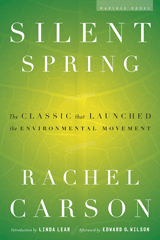
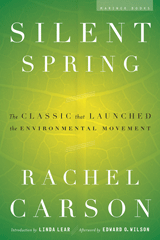
Rachel Carson's Silent Spring (1962) began the popularisation of environmental disaster for political ends. She claimed that DDT, used for malaria control, is killing birds, harmful to humans, and should be banned forthwith. People bought the book in droves. DDT was banned in 1972. The result of the ban was that millions died because of a resurgence in the disease that was formerly being controlled by judicious application of the chemical Carson called a killer. It wasn't. Her book was.
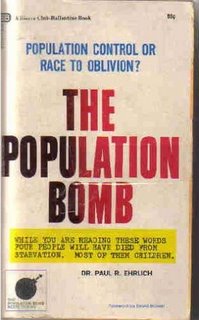
Paul Ehrlich wrote the 1968 best-seller The Population Bomb. Like Thomas Malthus two centuries before him, Ehrlich used shoddy arithmetic to predict a worldwide explosion of population that would see "future generations" stepping on each other's feet all day every day just to survive, and used scary rhetoric about this nonsense to fire up the activists. Fired up they were, and scary indeed were his predictions:
  • Not just millions but "hundreds of millions" would die from "a coming overpopulation crisis in the 1970s," he said, and by 1980 life expectancy in the United States would be just forty-two years.
  • "If I were a gambler, I would take even money that England will not exist in the year 2000."
  • "The battle to feed all of humanity is over. In the 1970s and 1980s hundreds of millions of people will starve to death in spite of any crash programs embarked upon now. At this late date nothing can prevent a substantial increase in the world death rate..."
Nothing except perhaps good sense, hard work and entrepreneurial activity -- and of course the facts. As PJ O'Rourke notes, "Crowded as the country is, is overcrowding even its main problem? Hong Kong and Singapore both have greater population densities (14.315 and 12.347 per square mile, respectively) than Bangladesh, and they're called success stories. The same goes for Monaco. In fact, the whole Riviera is packed in August, and neither Malthus nor Ehrlich have complained about the topless beaches of St. Tropez."

None of Ehrlich's predictions have failed to come to pass -- unless of course you do count the overcrowding of topless beaches of St. Tropz in mid-summer -- but these were not predictions, he now says, they were "scenarios." Despite his abysmal failure as a prognosticator however, the sad old hippy is still tripping over wind chimes and bothering the adults. On the release of Bjorn Lomborg's book Skeptical Environmentalist: Measuring the Real State of the World Ehrlich ranted, "If Lomborg had done some arithmetic, he could have . . . spared us a book as thick as a brick and almost as intelligent." And if Ehrlich had spared us his comment, he might have spared us forming for ourselves the fairly obvious conclusion about himself...

But perhaps Ehrlich was still just pissed off because Lomborg's hero Julian Simon had famously embarrassed him in their 1980 bet on the price of a chosen basket of resources. Ehrlich bet $10,000 and his reputation as an alarmist that the price would go through the roof as resources ran out; Simon bet the opposite. Simon won.
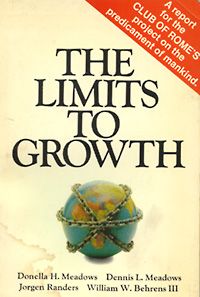
Which leads us on nicely to another failed pack of alarmists and their own contribution to sensationalist history, The Limits to Growth (1972). Like Ehrlich, the Club of Rome had also read Thomas Malthus and had re-used his static arithmetics in the cause of alarmism. You name it, they said, and we're running out of it. "There will . . . be a desperate [arable] land shortage before the year 2000"; we would run short of gold by 1979, they said, of silver and mercury by 1983, of tin by 1985, of zinc by 1988, of petroleum by 1990, and of natural gas by 1992. Um ...

What they got wrong of course was not just their arithmetic, but their whole understanding of the role of price signals and entrepreneurialism -- indeed of the capitalist economy as a dynamic rather than a static engine of production. The capitalist engine of creation is a supple beast when left free and unshackled, allowing human minds to read price signals and opportunities, and to adapt their own resources to suit. The results are astonishing. As Ronald Bailey observed in 2001,
Since the 1970s, the weight of the average car has fallen by 25 percent. Food cans are 50 per cent lighter than they were 50 years ago. A flexible plastic pouch that replaces a steel can reduces the packaging weight by 93 percent. Plastic soda bottles are 30 percent lighter than they were in the 1970s -- which were already much lighter than the glass ones that preceded them. Similarly, plastic grocery bags are 50 percent thinner than they were 20 years ago and lighter than the paper bags they replaced. The invention of the steel frame building did away with structures that needed heavy thick walls to support their own weight.

Functionality is increasing throughout the economy as well—as computers get smaller and faster, air conditioners, refrigerators, furnaces, and all manner of appliances become more efficient and longer-lasting.

. . . [C]orn yields per acre in the United States have more than tripled since 1950. Improving crop productivity is based entirely on technological improvements such as fertilizer, pesticides, and better seeds.
He also notes,
A copper wire can transmit 24 voice channels or about 1.5 megabytes of information per second. Far thinner and lighter optical fiber can transmit more than 32,000 voice channels and more than 2.5 gigabytes of information per second. The first American communications satellite, Telstar 1, was launched in 1962 and could handle 600 telephone calls simultaneously. Modern Intelsat satellites can handle 120,000 calls and 3 TV channels at the same time.
So much then for the three granddaddies of today's scaremongering. Everything about them was wrong, tragically wrong in the case of Carson, but the spectre of their various apocalypses still haunt debate today.
Bidding to joining this prestigious club this week is a new candidate on the scene, a fourth horsemen predicting global apocalypse if Something Isn't Done Now. The already famous Stern Report on Climate Catastrophe is a "bombshell study" was greeted even before its release by a whole Stern Gang of waiting politicians -- it reports We Face Depression If We Don't Act Now! Worse, much worse, Than Even the Great Depression of the 30s! Calamity, catastrophe and 20% of our wealth stripped from our pockets if We Don't Do Something Now! Right Now!!

Guess what? Says Bjorn Lomborg of that headline-grabbing figure:
This figure, 20%, was the number that rocketed around the world, although it is simply a much-massaged reworking of the standard 3% GDP cost in 2100--a figure accepted among most economists to be a reasonable estimate.
In a series of ingenious steps, the modest 3% figure for a century hence if nothing is done now has been "tricked" and finessed and inflated with more imaginary "scenarios" -- Stern, says Lomborg, is "inventing, in effect, a "worst-case scenario" even worse than any others on the table" -- in order to grab headlines and to scream disaster. (And that's just one problem with Stern's report, as Lomborg and others have been pointing out since its release.)

Inventing catastrophe for political effect. What could be more ingenious.

"It's okay to lie," say activists, if you're doing it in the name of a good cause. Is it? Say those same activists: "Bush lied; people died." If it's wrong for Bush to lie, as they claim he has, then why doesn't that work both ways? A founder of Greenpeace Patrick Moore split recently over exactly this issue. "Beginning in the mid-1980s," he says, "Greenpeace, and much of the environmental movement, made a sharp turn to the political left and began adopting extreme agendas that abandoned science and logic in favor of emotion and sensationalism..."
Environmentalism has turned into anti-globalization and anti-industry. Activists have abandoned science in favour of sensationalism. Their zero-tolerance, fear-mongering campaigns would ultimately prevent a cure for Vitamin A deficiency blindness, increase pesticide use, increase heart disease, deplete wild salmon stocks, raise the cost and reduce the safety of health care, raise construction costs, deprive developing nations of clean electricity, stop renewable wind energy, block a solution to global warming, and contribute to deforestation. How sick is that?
Answer: Very bloody sick. Scaremongering sells -- but you don't have to buy it. And neither should you sell it on anyone else's behalf.

UPDATE: George Reisman's in an end-of-days mood, but one of a rather different character to the apocalyptic four. He argues that the Stern Review on Global Warming could be environmentalism’s swan song.

He raises a crucial point about the "action" called for in the report, a similar problem to Erlich's and the Club of Rome's own nightmare "scenarios": Stern simply fails to understand that a capitalist economy is a dynamic, not a static entity. Stern declares that disaster and hellfire and that depressive 20% drop in wealth production will be the inevitable conseqences of "not acting," but as Reisman points out,
Sir Nicholas’s use of the words “don’t act” is very misleading. What he is urging when he speaks of “action” is a mass of laws and decrees—i.e., government action. This government action will forcibly prevent hundreds of millions, indeed, billions of individual human beings from engaging in their, personal and business private action—that is, from acting in ways that they judge to serve their own self-interests. Thus, what he is actually urging is not action, but government action intended to stop private action.
LINKS: Hooray for DDT's life-saving comeback - Africa Fighting Malaria (AFM)
Julian Simon's bet with Paul Ehrlich - Overpopulation.Com
Dematerializing the economy: We're doing more with less. That's good for Planet Earth - Ronald Bailey, Reason Magazine (2001)
Stern review: The dodgy numbers behind the latest warming scare - Bjorn Lomborg, Wall Street Journal
How sick is that? Environmental movement has lost its way - Patrick Moore, Greenspirit

RELATED: Environment, Global Warming, Conservation, Economics, Politics, Politics-UK

Friday, 1 December 2006

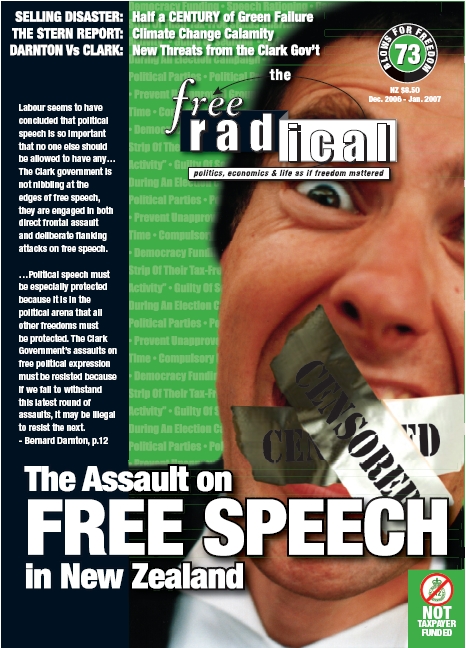
Free Radical 73: The Assault on Free Speech

The new Free Radical is out today!! The Free Radical with the free speech cover, and the inside word on the latest threats to free speech and freedom in New Zealand and around the world is out now, and in shops and letterboxes from Monday.

This Free Radical arrives as you make your plans for summer holidays, and it’s packed with good holiday reading – articles to shock, to enlighten, and to offer ammunition for the inevitable debates of the holiday season.
  • Bernard Darnton examines and attacks the Clark Government's assaults on free speech, highlighting how the exposure of the stolen election has brought the Clark Government’s totalitarian instincts into the foreground. Packed with Cabinet Ministers who once espoused the value of free speech for themselves, the Clark Government now routinely shuts down debate except on their terms. "With these threats, proposals and very real fines and incarcerations in the air, there is being created 'an atmosphere where criticising the government is becoming hazardous'.”
  • "Misleading, one-sided, exaggerating and wrong" -- that's the verdict on both Al Gore and the Stern Report on Climate Change. Free Radical 73 has all you need to gore Gore, and gang up on the Stern Gang. We have the definitive skeptics' guide to An Inconvenient Truth, George Reisman's take on why the Blair Government's Stern Report "could be environmentalism's swan song.," and more -- much, much more!
  • One pledge card ... slightly used ... Bernard Darnton sells a pledge card, one bidder at a time.
  • Turning illiteracy around -- find out about the reading warrior turning illiteracy around for troublesome non-readers.
  • The 'Third Way' of the left and the Neocon new right are two sides of the authoritarian middle, says Peter Cresswell. Find out more inside.
  • One whole half-century of green failure. The Free Radical centre-section has the goods.
  • 'Sustainability isn't sustainable, says Peter Cresswell.
  • Too little globalisation, and too little capitalism, says Johan Norberg.
  • Tax cuts are good for growth, explains Phil Rennie
All that, PLUS humour, insight, all your favourite columnists, and the Best of Beer in 2006!

Get your Free Radical now, and be ready for the summer holiday debating season.

The Free Radical -- out today, and in all the best shops from Monday. Don't miss out: Subscribe now.

(And don’t forget the perfect Christmas present for all your thinking friends: a Gift Subscription to The Free Radical. Just write 'GIFT' on your subscription, and include delivery details and your chosen message.)

Cheers
Peter Cresswell

Thursday, 9 July 2009

Quote of the day: Robert Murphy on climate change

"In the climate change debate, people often forget that under all but the most catastrophic scenarios, the future generations who will benefit from our current mitigation efforts will be much richer than we are."
                                                - Robert Murphy

As I paste that above quote into my blog writer, I have beside me a post from the Green Party’s Frog  Blog called ‘Calling names isn’t nice, especially when you’re wrong.’  It’s a doozy.  Its connection with Murphy’s point above will quickly become clear.  It begins thus:

I previously blogged about last night’s climate change target meeting in Wellington, where amongst other failings, Nick Smith accused the Green Party of only caring about the environment and having no regard for the impact on the economy.

Of  course Smith is dead wrong on this, just as he is on everything – including his decision to keep breathing. The Green Party don’t care about the natural environment.  Not in any genuine sense, they don’t. With their proven penchant for bans and big government, and a caucus composed almost entirely of the intellectual remnants of the Socialist Workers’ Party, they’re just a bunch of  authoritarians with a marketing wing – and with Jeanette Fitzsimon’s departure even their figleaf of genuine environmentalism is about to disappear with her. 
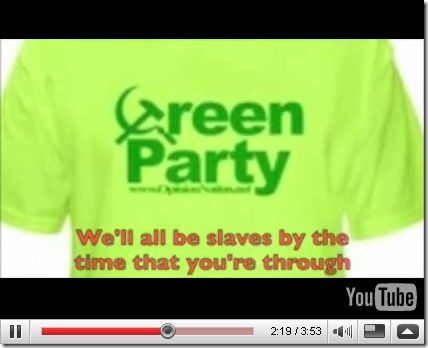
If you really want to see Greenwash in action, then the Green Party is the single most prominent contemporary example.

And it’s not true either to say that they’re unconcerned about the destructive economic impact of their regulation fetishThey and their luminaries are only too happy to have our economic lifeblood destroyed.

Anyway, their mention of Nick Smith is distracting me from from the main point of their post, and of this one.  The post at Frog Blog continues on to its main point, saying (apparently completely without irony):

    In the spirit of economic literacy, I wanted to remind our readers of these words from a recent Australian Treasury report into the economics of climate change: “The Treasury’s modelling demonstrates that early global action is less expensive than later action.”

I say “completely without irony” because if there is any group of people for whom economic illiteracy is a watchword it is the Green Party. There is surely no higher density of economic illiterates than in the un-perfumed climes of the Green Party’s electorate offices – except perhaps in the offices of Alan Greenspan and Ben Bernanke.

And as regards the “Treasury’s modelling,” it has about as much credence as BERL’s now thoroughly discredited report on the social costs of alcohol. Based as it is on the flawed “model” produced by Nicholas Stern at the behest of the British Treasury to justify onerous carbon taxes now to help the British Treasury later, the Australian Treasury’s modelling shares all the errors of Stern’s flawed report, including it’s utterly discreditable use of a carefully selected discount rate – a discount rate selected (like BERL’s careful rejection of the “benefits” side of their cost-benefit study) so as to give him the results his client had paid for.

As William Nordhaus (no friend of free markets) explains the resultant absurdity:

    Suppose that scientists discover a wrinkle in the climate system that will cause damages equal to 0.1 percent of net consumption starting in 2200 and continuing at that rate forever after. How large a one-time investment would be justified today to remove the wrinkle that starts only after two centuries? Using the methodology of the [Stern] Review, the answer is that we should pay up to 56 percent of one year's world consumption today to remove the wrinkle. In other words, it is worth a one-time consumption hit of approximately $30,000 billion today to fix a tiny problem that begins in 2200. [Italics in original]11

The intent of all the “modelling” carried out by the World’s Treasuries is nothing less than to justify strangling industry now (fifty percent by 2050 says our own John Key) for some unknown and unproven benefit in the future for your grandchildren – who, if we can predict anything with confidence, will probably want to know why your stupidity now has left them so poor.

Economist Robert Murphy (whose writings the Greens would do well to read if they do seriously wish to improve their economic literacy), points out in ‘The Economics of Climate Change’ that even the idea of modelling economies one-hundred years ahead is fatally flawed.

    Fans of Austrian economist Friedrich Hayek—who warned against the "pretense of knowledge"—should be even more concerned about the sheer audacity of the field of climate economics. After all, it is rather absurd to argue about the impacts of present tax policies on global temperatures in the year 2150. Yet, it is precisely these projections that provide the foundation for policy recommendations.
  
Many critics have raised this objection before, but it bears repeating: We have no idea what the world economy will be like in the 22nd century. Had people in 1909 adopted analogous policies to "help" us, they might have imposed a tax on buggies or a cap on manure, needlessly raising the costs of transportation while the U.S. economy switched to motor vehicles. This is not a mere joke; "serious" people were worried about population growth, and the ability of large cities to support the growing traffic from horses. Had someone told them not to worry, because Henry Ford's new Model T would soon transform personal locomotion without any central direction from D.C., these ideas would probably have been dismissed as wishful thinking. As famed physicist Freeman Dyson has mused, future generations will likely have far cheaper means of reducing atmospheric concentrations of carbon dioxide, if the more alarming scenarios play out.18
    In the climate change debate, people often forget that under all but the most catastrophic scenarios, the future generations who will benefit from our current mitigation efforts will be much richer than we are. For example, Nigel Lawson points out that even under one of the worst case scenarios studied by the IPCC, failure to act would simply mean that people in the developing world would be "only" 8.5 times as wealthy a century from now, compared to 9.5 times as wealthy if there were no climate change.19

To translate, this means that even if the scare-mongers were correct, they intend to strangle prosperity now – in the midst of the deepest depression in seventy years – simply so that your future generations one-hundred years from now might be able to afford an extra Pan-Galactic Gargle Blaster while they orbit the planets.

May I suggest that instead of bleating about name-calling, the authors of Frog Blog instead acquaint themselves with some real economics.  And read and digest the arguments in Murphy’s ‘The Economics of Climate Change.’ It would leave them looking less embarrassed when they talk so smugly about the economic illiteracy of others.

Wednesday, 14 February 2007

A great politician

While Helen Clark was awash in a feel-good sea of sustainability yesterday -- blathering ineffectually about biofuels, climate change and how many trees six government departments are going to plant to save the planet -- another world leader was making much more sense.

Since 1990 (and in distinct contrast to our own unfortunate history in this regard) the Czech Republic has been blessed with two wonderful leaders: first 'velvet revolutionary' Václav Havel -- described by Reason magazine as "our era's George Orwell" -- and now Václav Klaus.

Václav Klaus is not a warmist. Speaking to a Czech economics daily, Klaus deconstructed the IPCC climate panel of the United Nations, and their latest Summary for Policymakers released in Paris earlier this month. Harvard physicist Luboš Motl translates Czech to 'Czenglish':
  • [Questions and answers about European politics are omitted]
  • ...
  • Q: On Wednesday, the European Commission has approved carbon dioxide caps for new cars. One week earlier, the U.N. IPCC climate panel released a report that has described, once again, the global warming as one of the major threats for the whole civilization. The Stern report about similar threats was published before that. And you suddenly say that the global warming is a myth. Try to explain, how did you get this idea, Mr President?
  • A: It's not my idea. Global warming is a myth and I think that every serious person and scientist says so. It is not fair to refer to the U.N. panel. IPCC is not a scientific institution: it's a political body, a sort of non-government organization of green flavor. It's neither a forum of neutral scientists nor a balanced group of scientists. These people are politicized scientists who arrive there with a one-sided opinion and a one-sided assignment. Also, it's an undignified slapstick that people don't wait for the full report in May 2007 but instead respond, in such a serious way, to the summary for policymakers where all the "but's" and "if's" are scratched, removed, and replaced by oversimplified theses.
    This is clearly such an incredible failure of so many people, from journalists to politicians... If the European Commission is instantly going to buy such a trick, we have another very good reason to think that the countries themselves, not the Commission, should be deciding about similar issues.

  • Q: How do you explain that there is no other comparably senior statesman in Europe who would advocate this viewpoint? No one else has such strong opinions...
  • A: My opinions about this issue simply are strong. Other top-level politicians do not express their global warming doubts because a whip of political correctness strangles their voice.

  • Q: But you're not a climate scientist. Do you have a sufficient knowledge and enough information?
  • A: Environmentalism as a metaphysical ideology and as a worldview has absolutely nothing to do with natural sciences or with the climate. Sadly, it has nothing to do with social sciences either. Still, it is becoming fashionable and this fact scares me. The second part of the sentence should be: we also have lots of reports, studies, and books of climatologists whose conclusions are diametrally opposite.
    Indeed, I never measure the thickness of ice in Antarctica. I really don't know how to do it, I don't plan to learn it, and I don't pretend to be an expert in such measurements. However, as a scientifically oriented person, I know how to read science reports about these questions, for example about ice in Antarctica. I don't have to be a climate scientist myself to read them. And inside the papers I have read, the conclusions we may see in the media simply don't appear. But let me promise you something: this topic troubles me which is why I started to write an article about it last Christmas. The article grew in size and it became a book. In a couple of months, it will be published. One chapter out of seven will organize my opinions about the climate change.
    Environmentalism and green ideology is something very different from climate science. Various findings and screams of scientists are abused by this ideology.

  • Q: How do you explain that conservative media are skeptical while the left-wing media view the global warming as a done deal?
  • A: It is not quite exactly divided to the left-wingers and right-wingers. Nevertheless it's obvious that environmentalism is a new incarnation of modern leftism.

  • Q: If you look at all these things, even if you were right ...
  • A: ...I am right...

  • Q: ...Isn't there enough empirical evidence and facts we can see with our eyes that imply that Man is demolishing the planet and himself?
  • A: It's such a nonsense that I have probably not heard a bigger nonsense yet.
  • Q: Don't you believe that we're ruining our planet?
  • A: I will pretend that I haven't heard you. Perhaps only Mr Al Gore may be saying something along these lines: a sane person hardly. I don't see any ruining of the planet, I have never seen it, and I don't think that a reasonable and serious person could say that he has. Look: you represent the economic media so I expect a certain economical erudition from you. My book will answer these questions. For example, we know that there exists a huge correlation between the care we give to the environment on one side and the wealth and technological prowess on the other side. It's clear that the poorer the society is, the more brutally it behaves with respect to Nature, and vice versa.
    It's also true that there exist social systems that are damaging Nature - by eliminating private ownership and similar things - much more than the freer societies. These tendencies become important in the long run. They unambiguously imply that today, on February 8th, 2007, Nature is protected incomparably more than on February 8th ten years ago or fifty years ago or one hundred years ago.
    That's why I ask: how can you pronounce the sentence you said? Perhaps if you're unconscious? Or did you mean it as a provocation only? And maybe I am just too naive and I allowed you to provoke me to give you all these answers, am I not? It is more likely that you simply present your honest opinion.
  • ...
  • [Questions and answers about Czech politics omitted]
Oh for similar sense from a NZ politician -- from any side of the aisle!

LINKS: Václav Klaus on global warming - The Reference Frame
Such timidity - DPF
Retirement of a velvet revolutionary - Peter Cresswell, SOLO

RELATED: Global Warming, Politics-World, History-Modern

Thursday, 16 November 2006

More capitalism => More forests.

According to the sternly sanctimonious Stern Report, well over one-third of contributions to CO2 emissions are due to deforestation. And what do you think is the best way to minimise deforestation? To get rich.

That's right: as countries get wealthier and as technologies improve, there is less pressure on forests. As a country gets wealthier, for example, it tends to urbanise, and more urbanisation sees rural areas tending to empty out. And as farm technology improves, for another example, farming concentrates more on fertile lands and less on marginally fertile forested areas.

This claim -- that more wealth creates more forests -- may seem counter-intuitive if you view things in a static rather than a dynamic fashion, but a study published in the journal Proceedings of the National Academy of Sciences [pdf] confirms that "forests are increasing in countries across the world after centuries of being destroyed for their wood and to make way for people." Notes The Times in their summary of the report:
Wealth is one of the clearest indicators of a country’s success in reversing deforestation. Of the countries surveyed, all of those with a GDP per capita greater than $4,600 (£2,400) — roughly equivalent to that of Chile — had increased their forest cover since 1990.
Face it, the natural environment is a luxury good. The wealthier we are, the more natural environment we can afford, and the poorer we are ... Well, as Tim Worstall notes, "it's a combination of poverty and population pressure "that inspires large-scale forest clearances. It's increasing wealth that removes that pressure."
The solutions seem to be increasing the efficiency of agriculture, thus reducing the pressure for more farmland (Hellooooo GM!), increased urbanisation and industrialisation, thus drawing labour away from susbsitence peasantry (Helloooooo FDI and the Multi- Nationals!) and getting that average GDP up (Hellooooo Trade and Globalisation!).
So in summary: if you want more trees, then encourage more capitalism. Or as Worstall says: "Free trade to save the planet!"

LINKS: Forests begin to revive as global devastation of trees is reversed - The Times, London
Forests and carbon emissions - Tim Worstall
Forestry and CO2 - Tim Worstall
Study: Returning forests analyzed with the forest identity -
Kauppi et al, Proceedings of the National Academy of Sciences [6-page PDF]

RELATED: Politics-World, Economics, Environment, Conservation, Urban Design, Politics