Showing posts sorted by relevance for query price stability. Sort by date Show all posts

Wednesday, 13 August 2008

Stop playing with Alan Bollard's YoYo

For nearly twenty years the Reserve Bank has pursued a policy of so-called 'price stability' -- setting interest rates at a level they think will keep the 'general level' of prices stable.

It hasn't worked.   There is no such thing as a 'general level' of prices, and the pursuit of general price stability has created just the opposite of stability.

Take the price of the New Zealand dollar. Go on, take a look.   Has this price been stable in recent time?  Not on your life.  In recent times it's been as high as eighty cents against the US dollar (making life difficult for exporters), and as low as sixty-four cents (making it difficult both for importers and for producers reliant on imported factors for their own production).  The YoYo-ing of the NZ dollar does little to help producers plan ahead with confidence, and little to help drive the prosperity of which we're in somewhat short supply.

So as the NZ dollar now starts to slide below seventy cents again, it's clear if we've had price stability anywhere it hasn't been in the price of the NZ dollar.

Let's take another example.  How about the price of borrowed money, so crucially important in driving prosperity -- has this price been stable?  Not half it hasn't. Since 1992, interest rates too have gone up and down like a YoYo -- up to 7.5% and down to 4.5%, up to 10% and back down to 4.5%, and then back up to 9.5%.  Meanwhile mortgages, the price you pay to repay your house, have been down to 6, up to 11.5, down to 6.5, up to 9, down to 6, up to 9.5 ...

So much for the 'price stability' of borrowed money (you can see a graph of the money madness here if you like that sort of thing).  The Reserve Bank's pursuit of the 'price stability' of a nominal 'basket of goods'  -- which is a fiction that mainstream economists use as a proxy for the non-existent 'general price level' -- has led not to rampant instability in the prices that are central to both production and prosperity.

Is this sensible, do you think?

In fact, the Reserve Bank-created YoYo, the result of their gormless fight for a nominal 'price stability,' has created instability in every important aspect of the economy. 

And when you look at some of the biggest ticket items in our own personal 'basket of goods,' which is very real to each of us, we can see that the Reserve Bank's intervention has either made the prices in our own 'basket' either more unstable, or has had no effect at all.

Take house prices, for example.  Would you call them stable?  Not only has the price you would pay for a house gone up and down like a YoYo in the last two decades, so has the price you pay to borrow the money to pay that price.  This instability is almost entirely the result of the Reserve Bank's pursuit of stability.  Go figure.

Take the price we pay to governments both central and local for the job they do in keeping us down.  These have been going up like a rocket in recent years, yet about these the Reserve Bank maintains a monastic silence, while tinkering in other areas to maintain their monetary model.

Take the prices of food and oil.  Have these been stable recently?  Stupid question, of course, but in trying to squelch the effect of these -- something even Alan Bollard should realise is something about which the New Zealand Reserve Bank can do absolutely nothing, and which have no impact on 'inflation' anyway -- Alan Bollard has been very stupid.  His tinkering to bring stability to prices over which he has no control has led to rampant instability in the prices over which he does have some control.

Thank goodness that for all the tinkering to keep prices 'stable,' some real prices are actually falling.  The price of things like cars,computers and clothing -- your basic consumer goods, have mostly been getting cheaper (mostly because of imports from places like Japan and China).  This has helped offset the price rises of the likes of food and oil, but according to the mantra of the Reserve Bank even falling prices are an affront to the grand goal of price stability.

It's just madness, isn't it?  If prices rise for good supply-and-demand reasons, the Reserve Bank moves to squelch these important price signals.  And if prices fall for good production reasons, they move to squelch those boons as well.  We can only 'win' on those rare occasions when increasing production equals increasing shortages.  Dumb, yes?

Fact is, the pursuit of a fictional 'price stability' has led to instability in every important price that you and I pay for goods and services.

No wonder that the real result of of Reserve Bank intervention is not stability, but boom and bust.

Here's my advice for Alan Bollard and his destructive YoYo: just leave us alone.  Or in French, Laissez Nous Faire.

Thursday, 13 March 2014

The Fateful Wish for Price Stability

Everyone expects the Reserve Bank to increase their Official Cash Rate this morning, thereby raising bank inter-lending rates, thereby raising interest rates for commercial borrowers and holders of mortgages. In other words, they’re raising your interest rates – so much for our free market, eh? – raising them after five years in order to “rein in” the inevitable inflation that comes, they say, when growth approaches the economy’s “capacity.”
So after five years of monetary policy pursuing growth at any cost, the Reserve Bank will again be pursuing price stability, the very policy that helped cause the bust…

The Myth of Price Stability
Guest Post by Frank Shostak

"Achieving and maintaining price stability is the bedrock principle of a sound monetary policy."
former Federal Reserve Governor Ben S. Bernanke[1]

There is almost complete unanimity among economists that the most important role of the central bank is to attain price level stability. It is held that price stability promotes economic growth and people's well being by increasing the efficiency of the market mechanism. According to the President of the Federal Reserve Bank of New York, William J. McDonough, "Over the long run, price stability is the one sustainable contribution monetary policy can make to growth. This applies to all countries."[2]

In other words, in the popular view, price level stability is the key to economic growth and prosperity.

Expected versus unexpected inflation

Thursday, 19 July 2007

Cullen changing "price stability" target may be all talk, but may not be all bad

I'm bemused to see suggestions from finance minister Michael Cullen that he is considering amending the Reserve Bank Act so that the focus is on something (anything) other than "price stability." On the face of it removing the focus on "price stability" would be a good thing for a number of reasons (most of which I've canvassed here before), but since no change proposed will result in removing the politicisation of the currency (which it should), whether it is a good move at all depends fundamentally on what the target changes to, and whether or not this is simply another attempt to talk down the currency.

Something certainly has to be done, and urgently -- as US economist Steve Hanke says, "by having a free, floating exchange rate combined with inflation targeting" "the New Zealand economy is on a death spiral" -- and removing the Reserve Bank's legislatively constrained myopic focus on "price stability" would be prime amongst things that should be done, but given the circling of monetary cranks around the rotting corpse of the Reserve Bank Stabilisation Act, I have little confidence in where such a change might end up.

The fact that Bill English is opposed (and solely it seems for the reason that, to paraphrase him in this morning's Herald, "this is how we've always done things") is perhaps good reason however to give it serious consideration, since Billy Boy is almost a beacon for the wrong side of every issue.

Let me just explain briefly why I've placed the words "price stability" in inverted commas above, and my answer to that will help explain why, on the face of it at least, removing this as a target for the Reserve Bank governor would be a good thing. As Frank Shostak explains, "the policy of "price stability" always leads to more instability." That may seem incongruous, but only if you fail to see how prices (plural) are formed. It's true that monetary inflation (that is, the Reserve Bank printing too much money) is the primary cause of inflation of prices, but it's not true that every change in prices is due to such monetary legerdemain; when prices need to fall or to rise for reasons other than monetary reasons -- when say a technological change makes a product line cheaper, or when supply and demand factors make a line of goods or services more expensive -- then mandating price stability puts an artificial constraint on markets, constraints that will and do lead to malinvestments and severe dislocations, just as we're seeing, and with our small currency it leads too to serious foreign exchange problems.

An article in the latest Free Radical explains this apparent paradox of how "price stability" leads instead to instability; says M.A. Abrams, it comes about through a complete misunderstanding of the nature of monetary inflation:
In an economically progressive community (that is, one where the real costs
of production per unit are falling and output per head is increasing), any
additions to the supply of money in order to prevent falling prices will be
hidden inflation; and in a retrogressive community, (that is, one where output
per head is diminishing and real costs of production are rising), any
contraction of the supply of money in order to prevent rising prices will be
hidden deflation. Inflation and deflation can occur just as well behind a stable
price level as when the price level is rising and falling
...

Thus, in the case where [economic progress] due to increased saving is
corrected by additional money for consumers, the result is to prevent any
[increase in the efficiency] of production; and where a fall in prices due to
improved knowledge is corrected by additional money, the result is to force a
transition to less [efficient] methods. In both cases the fruits of
progress are rejected because of a determination to keep prices stable
.
Moreover, in both cases the correction of the attempted advances has involved
the abandonment of some of the higher stages of production where certainly some
of the factors used are highly specialized and these will therefore become
unemployed as a result of the transition.
It's time to cut the Reserve Bank Stabilisation Act loose. That's one thing that could be done immediately. But cutting it loose should not be used to politicise the currency in another way. That would be a remedy worse than the malady from which we're presently suffering.

Thursday, 26 July 2007

Pursuit of price stability gives rampant instability: Go figure.

The Reserve Bank is tasked by law to preserve price stability. To fight inflation. These two things are not, however, the same thing.

Inflation is a curse; inflation steals wealth; inflation (as Milton Friedman used to point out) is always and everywhere a monetary phenomenon: monetary inflation happens as a result of printing money (and our Reserve Bank has been 'printing' about fifteen percent more each year for the past few years). It's a form of surreptitious theft. That's monetary inflation, which Alan Bollard's bank is exacerbating.

What Alan Bollard is concerned about is not the monetary inflation for which his bank is responsible, but price inflation (or deflation), those price movements either up or down that happen for good market reasons such as supply and demand and the introduction of new technologies and the discovery and extraction of new resources and the like. As I've argued before, removing monetary inflation would be a good thing (but not something in which the Reserve Bank is interested), whereas dampening down the free movement of prices is bad -- it distorts those important price signals which the market needs to function effectively.

Yet Alan Bollard will continue to ignore his own monetary inflation and pursue the illusion of price stability, hiking exchange rates to dampen down free price movements and the results of the inflated money supply and inflated government spending and the strangulation by regulation of land supply, and setting up what economist Steve Hanke calls a "death spiral" in which the higher the exchange rate the more "hot money" from the carry trade is attracted into the country, putting up prices and leading to another hike in prices leading Bollard to hike interest rates and . . .

Bad stuff.

But here's the irony: in this headlong and destructive pursuit of price stability, there are two prices whose instability is compounded: the price that's paid for the dollar, and the price we pay for money. That's right, the myopia over price stability has led to rampant instability in interest rates and mortgage rates and the exchange rate. The rationalistic "basket of goods" by which price inflation is measure may be made to appear stable, but the prices we actually pay for mortgages, capital and foreign exchange are all over the place.

Do you think there's something wrong with the economic theory on which the Reserve Bank Act is operating?

Thursday, 7 June 2007

Sacrificed again on the cross of "price stability"

Another interest rate rise (now the highest in the OECD), another rise in the exchange rate, another higher hurdle for exporters and producers, another sign that this pathetic addiction to "price stability" is crucifying everyone except those foreign investors enjoying our over-inflated interest rates.
In the quarterly monetary policy statement issued along with today's OCR review, the bank says previous tentative rebalancing of the economy toward exports and away from domestic demand appears to have stalled because of the high dollar.
See. So just what the hell is he doing this for, and why?
The bank has been nudging the OCR up by a quarter of a percentage point every six weeks since early March, blaming resurgent domestic demand, climbing house prices, labour shortages and government spending for fuelling inflation pressures.

This time it also fingers soaring dairy prices, warning their boost to farm incomes will add to inflation pressures.
It's undoubtedly true that government spending is partially responsible for fuelling inflation, a responsibility shared by the Reserve bank's expansion of the money supply. But the banks' reasons for concern represent a flawed view of the economy -- one that discounts the restrictions that governments place on producers, particularly on house builders -- and a flawed view of economics, a view that aggregates all income without distinguishing the nature of those who receive it.

Farm income is production income -- capital -- money that for the most part will go to increase production despite labour shortages. But Bollard is doing his best to wipe out that windfall by making new production more difficult. We're all being penalised for the amazing success of our country's farmers, and the near-religious fervour for "price stability" blinds everyone to that fact, and instead of rising up in protest everyone whimpers sheep-like under Alan's financial lashing.

And galloping house prices, as we've seen before, are more to do with the restrictions that urban planners and 'green-plated' government regulations have between them placed on land and on the cost of new building. Ignoring these serious dislocations and pursuing "price stability" in spite of them is just flat out dumb. There's no other way to describe it. We all lose as producers are strangled and exporters are priced out of world markets. The irony here is that Bollard appears to share that same concern even as he exacerbates the problem, and commentators are happy to ignore that his fingerprints are all over the murder weapon .
Dr Bollard re-airs concerns about the high exchange rate, repeating his comments in April that the dollar is at exceptionally high and unjustified levels - in what is considered to be a further attempt to head off the spike in the Kiwi dollar that commonly follows an interest rate rise.
The dollar's "exceptionally high and unjustified levels" has one chief reason: Alan Bollard. Higher interest rates attracting foreign money. The dollar is already up on average 0.6% against all currencies but the Australian --and Alan's whimpering won't change that.
"Had we not increased the OCR this year [says Bollard], it is likely that the inflation outlook would now be looking uncomfortably high.".

He warns that it will take a "sustained period of slower growth" in domestic activity to alleviate inflation pressures.
Talk about dumb. We're all being crucified on this pathetic cross of price stability, and the crucifixion could be so easily averted, and prosperity embraced: Just stop meddling. Free up urban land; abandon the green-plated building regulations; reduce government spending; stop inflating the money supply (which is what inflation actually is) and let prices rise and fall just as prices are supposed to.

Just let us alone!

UPDATE:
  • We all need to know more about inflation, and not just Alan Bollard, since inflation of the money supply is one the most devious taxes that government's inflict upon us. Frank Shostak at the Mises Blog has two brilliant recent pieces that rip the scab off the inflationary wound and show the raw scar beneath. A poor metaphor perhaps but consider it an invitation to read (or re-read) the brilliance of Shostak's explanation and analysis of:

  • The Australian has noticed Shostak's commentary. A recent piece noted:
    Dr Frank Shostak has a warning for investors. The [Australian] Reserve Bank's monetary policy is "out of control" and that means inflation is heading up, interest rates are set to rise and the share market is only being supported by excessive money supply.
    He believes the Reserve Bank uses incorrect definitions of inflation and even money itself. As a result, he says, the bank is actually causing inflation, rather than combating it. "The Reserve Bank claims that it does not print money, but merely accommodates demand, but printing money is exactly what it is doing."
    See RBA Policy Causing Inflation. The analysis is just the same for NZ's Reserve Bank. Remember, just because you don't see inflation directly, doesn't mean it isn't there.
UPDATE: Perhaps it's time to re-release Bob Jones prescient 1996 book, Prosperity Denied, one of the best short arguments against this sheep-like addiction to "price stability." This brief excerpt shows you just how prescient it is:
Over the 1994-95 period Auckland's median house price increased by 36 per cent [these days we might say"just 36 per cent"] . . . the Reserve Bank responded by repeatedly increasing interest rates, thereby causing an across-the-board economic squeeze.
All sounds all too awfully familiar, doesn't it. The Bank treated those price rises as some sort of "economic disaster Richter scale," restraining and tightening the entire New Zealand economy as a direct result of a change (then) in some Aucklanders' residential tastes, and an increase (today) in governement meddling in the supply of housing and land. The result, said Jones, is that

the commercial fisherman in Timary, the plumber in Westport, the home-mortage seeker in Wairarapa -- all other New Zealanders -- are obliged as a direct consequence of a change in residential [status] by a small number of Aucklanders ... to pay higher interest rates. This in turn adverselly affected their personal incomes, adversely affected business development confidence and investment decisions and any new job-creation intentions. Thus a relatively small number of Aucklanders [experiencing a problem very easily fixed] ... unwittingly cost thousands of jobs and reduced the income of every other New Zealander.
For that we all have to thank the Reserve Bank and the all-hallowed Reserve Bank Price Stability Agreement set up by Ruth Richardson, and now maintained by Michael Cullen. (Note, by the way, that tenses have been changed to improve the immediacy of Jones' comments.)
The higher interest rates [set by the Bank] drive up the exchange rate,
attracting foreign investors in our money markets and thereby driving the
exchange rate even higher. This influx of money in turn necessitates yet further
tightening by the Reserve Bank, and so the vicious cycle feeds off itself.

Today we have the highest real interest rates in the western world, as a
direct consequence of a foolsih government action, ironically aimed at achieving
low costs. All of this should be deja vu to New Zealanders recalling the
1983 Muldoon price freeze.

Some might argue that the Muldoon technique was worse insofar as the
monetarist method still allows the market, at a price, to call its individual
shots. Perhaps so, but the overall effect is identical in its economic
repression... Regardless, there is little to be gained in weighing the
respective eveils, because whether by shooting or by hanging, the negative
outcome of a death sentence is identical.
Words just as accurate now as they were when first written. Time to bite the bullet and condemn the Reserve Bank Price Stability Agreement to oblivion instead of us.

Thursday, 11 August 2016

RBNZ fixes prices


stabilization (1)

I see, as you’ve probably seen, that Governor Graham Wheeler issued a new diktat this morning on interest rates. The central planner’s central banker has decreed that the price at the heart of our alleged market economy should be made to drop to the lowest level in all human history.

Why?

In his pursuit of what they allege to be “price stability.” Because, they say, “the general price level” is rising insufficiently to be healthy. Because this price stability demands that the money the central banker has been pumping into the system at around 8% every year is still insufficient to get lift-off in the measure they maintain for money’s inflation. It must go higher they say!

Inflation? Price stability? These bozos can’t even measure inflation – and while they bewail the dangers of “low inflation” (the numbskulls) they’re blind to the phenomenon of rocketing asset prices, and exploding house prices, both caused by their own inflation of the money supply bubbling out to cause havoc. Yet they still purport to believe that the price inflation of their monetary inflation is too low to be healthy, so let us all have some more.

InflationNOT
No, folks, this is not inflation. How so? Because Uncle Graham says so.


It’s not because they’re stupid, these smart people. It’s because they’re still in thrall to a Keynesian idea that is.

They do this because they still genuinely believe, via that dead economist, that credit growth causes economic growth—specifically, that bank-created credit growth causes real and sustainable economic growth. This belief lingers despite the gobs of phony credit spewed out worldwide in the form of QE, ZIRP and NIRP returning less and less growth every time the credit spigot is uncorked, and the ever-inceasing amounts uncorked here showing returns only in the ever-inflated prices of houses, shares and other asset classes.

Yet this is not even real capital being lent out. It is counterfeit capital. “Capital in the form of credit is normally and, certainly, properly, extended out of previously accumulated savings,” explains George Reisman. “In sharpest contrast, credit expansion is the creation of new and additional money out of thin air, which money is then lent to business firms and individuals as though it were a supply of new and additional saved up capital funds.  Its existence serves to reduce interest rates and to enable loans to be made and debts to be incurred which otherwise would not have been made or incurred.”

The loans are increasing. The debts are ballooning. Asset prices and house prices are exploding. The fragility is mounting. And the Governor blinds himself to the reality, and decrees that we must have more.

It is insane.

RELATED POSTS & STORIES:

  • “Cheap money! If you can get it. What we now have is a segregated credit regime in which many – ie younger, poorer people – can’t borrow because the loan-to-value ratios prevent them from doing so, but those who can access it – i.e., those with equity – have never been able to borrow at better rates.”
    Low for some – DIM POST
  • “Moreover, the Reserve Bank's target range for inflation is 1-3 per cent, which implies that very low inflation and deflation are undesirable. The Reserve Bank, therefore, foreshadowed a further cut to the nation's base interest rate, the official cash rate, in an attempt to boost inflation.
        “Before trying to solve a problem, though, we need to be sure the problem actually exists. Is inflation actually too low?”
    New Zealand does not need more inflation – Fergus Hodgson, NZ HERALD
  • “’Instead of furthering the inevitable liquidation of the maladjustments brought about by the boom during the last three years, all conceivable means have been used to prevent that readjustment from taking place; and one of these means, which has been repeatedly tried though without success, from the earliest to the most recent stages of depression, has been this deliberate policy of credit expansion. ...
        “’To combat the depression by a forced credit expansion is to attempt to cure the evil by the very means which brought it about; because we are suffering from a misdirection of production, we want to create further misdirection--a procedure that can only lead to a much more severe crisis as soon as the credit expansion comes to an end. ...
        “’It is probably to this experiment, together with the attempts to prevent liquidation once the crisis had come, that we owe the exceptional severity and duration of the depression.
        “’We must not forget that, for the last six or eight years, monetary policy all over the world has followed the advice of the stabilisers. It is high time that their influence, which has already done harm enough, should be overthrown.’”
    "Price Stability" is Chaos – NOT PC, 2012
  • “So after five years of monetary policy pursuing growth at any cost, the Reserve Bank will again be pursuing price stability, the very policy that helped cause the bust…”
    The Fateful Wish for Price Stability – NOT PC, 2014

.

Monday, 26 February 2007

Our "fateful wish for price stability"

The Reserve Bank's inflation-fighting is keeping interest rates high and our dollar high, nailing producers, exporters and home-buyers to a cross of price stability that is itself a mirage. This "fateful wish for price stability" is analysed by Thorstein Pollett at the Mises Economics Blog:
The Austrians' great concern is that a government-dominated money-supply regime would ultimately lead to economic and therefore political disaster; the objective of price stability would not alter such a dismal prediction. Even if a central bank succeeds in stabilizing a targeted price index, it would — by an ideologically motivated increase in credit and money supply — generously increase credit and money supply. It thereby distorts the economy's price mechanism, promotes malinvestment and initiates subsequent economic downturns...
In other words: removing real price signals from the market (or trying to) plays havoc with your markets.

Full article here. Comments here.

LINKS: The fateful wish for price stability - Professor Thorstein Pollett
Denying prosperity by misunderstanding inflation - Not PC (Dec, 2005)
More myths about inflation - Not PC (Sept, 2006)


RELATED POSTS ON:
Economics, Politics-NZ

Friday, 21 August 2015

Friday Morning Ramble–18.08.15


imageAuckland's "unbelievably friendly folk" were found to be some of the most "polite and accommodating" in the world.
One reader was "invited by strangers to the Chinese Lantern Festival on a hill overlooking the city"; another local
recommended taking "the ferry to the north shore Devonport suburb for the perfect combination of funky and
shabby chic." Overall, most agreed that there were "absolutely wonderful people everywhere!"
(And check out the ranking for Queenstown!)

Planners who can’t plan—a whole office full of them.
Independent Panel Slams Christchurch Council Planners – Hugh Pavletich, SCOOP

The RMA has never been amended to make it easier for you and I to build, but will be amended again to make it easier for government.
New 30-year plan for infrastructure rebuild – RADIO NZ NEWS

“The ever-fluctuating price of oil has the ability to humble even the most dictatorial of central planners.”
Oil still has the power to humble leaders who fail to hedge their bets – TELEGRAPH

So you’ve got a 30-year plan, huh?
Capitalists Have a Better Plan – Robert Murphy, THE FREEMAN

Chris Trotter praises the unsung architect of Rogernomics. (Well, it’s praise in everything but the adjectives.)
In praise of Bryce Wilkinson – Eric Crampton, OFFSETTING BEHAVIOUR 

(For young ‘uns who don’t know what Rogernomics was, and old ‘uns who thought it was a “revolution”…)
In the Revolution's Twilight – Lindsay Perigo, FREE RADICAL 

Lots of problems. Zero real solutions.
World-Class Auckland: How to make houses cheaper – NZ HERALD

No problem. The Reserve Bank’s planners have it all under control. Honest.
RBNZ targets Auckland specufestors – HOUSES & HOLES

“Rising house prices make homeowners richer. This is just the reason why we should extend the principle behind the spiralling Auckland housing market to other parts of the economy.” So how about …
A Vehicle Management Act for New Zealand – Oliver Hartwich, NZ INITIATIVE
An apology from the Executive Director - Oliver Hartwich, NZ INITIATIVE

Regulatory capture. NZ edition.
Timaru man warned for 'picking up mates from pub' – STUFF

“It's a curious post-modernist trend for laws to be created not to protect rights based on well-worn principles of individual rights and freedoms … but to "prevent harm" - to have laws to sanitise life so that "everyone" is protected.  However, the term "harm" doesn't even mean physical harm.”
Harmful Digital Communications Act indeed – LIBERTY SCOTT

'"I believe there are more instances of the abridgment of the freedom of the people by gradual and silent encroachments of those in power than by violent and sudden usurpations" -- James Madison, 1788.'"I believe there are more instances of the abridgment of the freedom
of the people by gradual and silent encroachments of those in
power than by violent and sudden usurpations."
~ James Madison, 1788.

“As the third Greek bailout package is currently being debated in eurozone parliaments, it is already becoming clear that it will not be sufficient.”
The third Greek bailout package is destined to fail – Oliver Hartwich, BUSINESS SPECTATOR

So-called “price stability” conceals a tremendous and growing instability.
Don’t Be Fooled By Our Current Price Stability – Frank Shostak, MISES DAILY
After 6 Years Of QE, And A $4.5 Trillion Balance Sheet, St. Louis Fed Admits QE Was A Mistake – ZERO HEDGE

We can tell them what 'Extended period' means: "Forever."
St. Louis Fed official: No evidence QE boosted economy – CNBC

So-called “price stability” has consequences.
The next leg of the commodities carnage – ZERO HEDGE
Crude tumbles to cycle lows despite production cuts – ZERO HEDGE

So-called “price stability” has consequences. “Emerging markets” are doing it tough.
The world should fear an emerging market rout - FT
Emerging markets’ shine dims as capital flight nudges $1tn in a year – GUARDIAN
Tough outlook for emerging markets – BBC NEWS

So-called “price stability” has consequences. Falling oil prices and government bans on food imports means the Russian bear is seething.
Russians experience first ‘horrible’ sustained decline in living standards in 15 years since Putin became president – NATIONAL POST

Easy come, easy go...?
The Great China Ponzi—-An Economic And Financial Trainwreck Which Will Rattle The World – David Stockman, CONTRA CORNER
 China woes pound tech-heavy secondary (Korean) bourse – YON HAP NEWS
China stocks plunge further as investors eye state retreat – A.F.R.
Investors flee the stock markets in China – JOURNAL TELEGRAPH

Embedded image permalink

The world’s most recent experiment in socialism ends the same way they’ve all ended.
Caracas, Venezuela has been voted the world's most unfriendly city – CONDE NAST TRAVELER
Venezuela’s currency is worth less than a napkin – CNN MONEY
If Venezuela Implodes, Will Its Neighbors Be Ready? – BLOOMBERG VIEW
Oil price slide casts doubt on Venezuela’s bonds – FT

image

The human environment. However bad things are, you’ve got to admit it’s getting better.
Life Expectancy by Age in selected Country from 1990 to 2013 – HEALTH INTELLIGENCE
Posts on Health Economics – UTOPIA—YOU ARE STANDING IN IT

Productivity is not about more muscles, or more hours.
Work smarter, not harder - TVHE

Personally I like to think of comfort zones as "resting" zones, a pause to take breath in between periods of effort and growth.”
Comfort, the Ultimate Self-Sabotage? – Tarryne West, HUFFINGTON POST

image

“Almost every single thing Trump claims about foreigners and the economy is false or misleading.”
5 Charts that Show Trump's Immigration Paper Is Nonsense – David Bier, ANYTHING PEACEFUL

“GOP #2 also vows to ‘seal’ the ‘northern border, the Pacific border, the Atlantic border, every border”
Wanting more Drone Kills: Ben Carson Wants to Use Drones on Illegal Immigrants ( one drone strike, boom, and gone) – Matt Welch, HIT & RUN

“Donald Trump and Bernie Sanders are wrong. The history of the United States shows that borders — and nations — can exist without immigration restrictions.”
Nations (and Borders) Can Exist Without Restricting Immigration – Ilya Somin, ANYTHING PEACEFUL

Ed Mazlish says Objectivists have got it wrong on immigration. Amy Peikoff begs to differ.
A Response to Ed Mazlish’s Call for Ideological Screening of Immigrants – Amy Peikoff, DON’T LET IT GO

Beautiful. Pauline Hanson's former fish and chip shop is now run by Vietnamese refugees:

Libertarians say Rand Paul has got wrong on foreign policy. Dalibor Rohac begs to differ. “Besides a political calculus, aiming at the Republic nomination, Paul’s change of heart may also be a result of a clash with reality. Perhaps the senator is beginning to understand what many in the libertarian movement still refuse to see—namely, that a wholesale rejection of any active role for American foreign policy is unwise and reckless, and would ultimately jeopardize libertarian principles of individual freedom.
Time for a Rethink?: Libertarians and Foreign Policy – Dalibor Rohac, WORLD AFFAIRS

“Totalitarianism seeks fusion of self and society, declaring there shall be no such thing as separation. The totalitarian fantasy is that individual and society are one—that human beings are bound inseparably to their nation.”
The Psychology of Totalitarianism: Review Essay of Japan's Holy War – Richard Keonigsberg, LIBRARY OF SOCIAL SCIENCE

“Here's the thing about student radio: everyone has their own story.”
Radio Punks | A history of student radio – RADIO NZ
Radio Punks: So many stories – Russell Brown, HARD NEWS

Screen Shot 2015-06-29 at 10.48.36

"I was always so impulsive … ”

Trumpet tone. Beautiful.

While the Nazis were breaking heads and ripping up Europe, there were Germans still trying to dance.

The cult of celebrity. Seriously.

[Hat tips Hugh Pavletich, Macrobusiness, Michael Strong, Julian Simon, the great liberal, Tarryne West, Asylum Seeker Resource Centre (ASRC), Barry Jenkin saved my life, Jim Matzger, Stephen Hicks, William R Hicks Jr, Lawrence Reed, Jim Rose, Political Cure, Patrick Black, Condé Nast Traveler, Oliver Cooper, Jack, Steve Forbes] ‏

Have a great weekend!
And thanks for reading.
PC

PS: And ….

Friday, 7 December 2007

RESERVE BANK: Cry havoc, and let slip the printing presses of doom

I wrote yesterday that Labour's housing ministers appear like King Canute, believing that by power of decree alone they're able to repeal the laws of supply and demand -- something for which a second year economics student would be failed.

This morning we learn that the government's foremost economist, on whose shoulders responsibility for what Hayek calls the country's nationalised money rests, has similar aspirations. For some reason, he thinks he is able to repeal the laws of supply and demand that have increased world prices of food and oil and the domestic prices of energy and housing and labour, and somehow fight these price rises by adding another one of his own: the ongoing cost of nationalised money.

It's moronic.

The law of supply and demand is not to be flouted in that way, and the danger of trying to flout price signals as Bollard wants markets to do is that price signals are telling us something we need to know -- and two things we need to know with all those prices at present is that on the one hand there are good reasons to enjoy the prosperity coming from increasing and solid demand causing higher commodity prices; and on the other hand it's government meddling of various sorts that have been raising them (not least government meddling in the name of 'the environment' -- see here, here, here and here for example). But Bollard just doesn't want to know, either about the good reasons or the bad.

Instead, to dampen down wage pressures to keep up with a genuine rising cost of living, he's keeping the cost of housing high by an artificial imposition (and at a time when housing is already one of the highest costs of living ). He's making things worse, not better.

And in the name of an illusory price stability, which in itself leads to instability, he's keeping the cost of borrowing high on all producers -- and this at a time when, as ANZ economist Cameron Bagrie argues, what's driving genuine inflationary pressure is in part NZ's low rate of productivity.

Note that among the chief reasons for NZ's low rate of productivity are the high cost of local capital, government meddling adding to the compliance costs and uncertainties for producers, and a high exchange rate making things tough for exporters. Bollard intends to make all these pressures worse, denying (in the name of an illusory price stability) a chance at genuine prosperity. It's worse than moronic, it's deluded.

The reason that Bollard and other mainstream economists are willing to continue nailing our economy to this deluded cross of price stability is that they look at inflation precisely backwards.

They see price rises that are driven by good market reasons -- for the most part at the moment it's the market reacting to the meddling of governments and growing prosperity in India and China-- and they cry " Inflation!" and let slip the dogs of interest rate doom. Yet at the same time they watch the Reserve Bank, under Bollard's direction, inflating the money supply by around fifteen percent year on year, and they pretend that this currency inflation is part of the inflation fight!

Talk about a vicious and moronic circle.

Let's all remind ourselves once again that inflation is always and everywhere is a monetary phenomenon, and its only as a monetary phenomenon that it should be fought. Sadly, with Bollard and his ilk, inflation as a monetary phenomenon is the inflation that dare not speak it's name. Inflate the currency and he's applauded; let slip the printing presses and he's applauded; stamp on producers and exporters and mortgage-payers ... and he's applauded. Deny prosperity by misunderstanding inflation, and he's applauded.

What on earth does it take to see the light?

And just look who's doing the applauding? Morons who see the fight the same way he does. Other mainstream economists who begin by ignoring inflation as a monetary phenomenon and end up endorsing the Reserve Bank's flight from reality -- Cameron Bagrie for example who endorses it with the unintentionally ironic observation that "common sense needs to prevail." An odd way to characterise a complete flight from common sense, you would think.

Bagrie, who's no doubt representative of his breed, compounds the stupidity by calling for a "growth sacrifice" now [audio] to avoid worse down the track. "We now have a real inflation problem," says Bagrie. "That means there is going to be a sacrifice to get the inflation genie back in the bottle." If we could only get this deluded idea about price stability back in the bottle and silence the Reserve Bank's thundering printing presses, we might well avoid the need for any sacrifice at all.

In fact, strip the Reserve Bank of its monopoly powers, cut the govt's apron strings from the currency altogether, and let the market rip, and that would remove the need for sacrifice altogether. Denationalise money, and at a stroke leave exchange rates, producers and price signals free to operate as they need to.

Can I get a Hallelujah?

UPDATE:   Are tax cuts inflationary?  Many commentators have focussed on Bollard's apparent green light for the non-inflationary impact of tax cuts, at least within the guidelines set.  I've argued before that tax cuts aren't inflationary  -- essentially they just change who gets to spend your money-- and as Phil Rennie points out  "The important point about tax cuts is that they are actually less inflationary than government spending.". Eric Crampton explains why:

Even if you start from Bollard's premises, his worries about tax cuts seem odd. If the government has the money, it either saves it or spends it. If it spends the money, it tends to hire people. Hiring people also requires buying office space to put them in. What have been the two big components of inflation? Wages and non-traded goods (housing/buildings). When government spends money, it spends it in the areas most likely to push prices up.

If it provides a tax cut, people either save the money or spend it. If individuals spend money, a fair bit of that goes to buying imported goods which have zero inflationary effect. Price inflation in the tradeables sector has been pretty much zilch for the last year: we're a small player in the grand scheme of things, and our importing more stuff has no effect on prices.CPIandGovtj
I just don't see tax cuts winding up being highly inflationary.

The chaps at The Befuddled Monkey explains these two points graphically (figures are for the USA):

  1. "When government spends money, it spends it in the areas most likely to push prices up.
  2. "...a very sizable proportion of New Zealand’s goods are being made in Asian countries (who are essentially exporting deflation).."*

And you don't need to be a genius to note the difference that meddling makes...

Wednesday, 24 September 2008

Borrowed time - the anatomy of recession

stabilization (1) When the stock market crashed in 1929, it brought on the world's worst disaster since the First World War. In the US, it was the worst calamity to face the nation since the Civil War. 
By the end of 1930, one in four wage earners was out of work. In one day in Mississippi, one quarter of the entire state was auctioned off. Prices of wheat and corn were so low, crops were left to rot in the fields. "Somebody had blundered," wrote F. Scott Fitzgerald, "and the most expensive orgy in history was over."
    It was borrowed time anyhow -- the whole upper tenth of a nation living with the insouciance of grand ducs and the casualness of chorus girls.  Even when you were broke you didn't worry about money, because it was in such profusion around you.  Toward the end one had to struggle to pay one's share...
    Now once more the belt is tight and we summon the proper expression of horror as we look back at out wasted youth ... when we drank wood alcohol and every day in every way we grew better and better and people you didn't want to know said "Yes, we have no bananas" -- and it all seems so rosy and romantic to us who were young then, because we will never feel quite so intensely about our surroundings any more.
Wars and depressions.  Recessions, booms and busts.  They're written about afterwards as if they're natural events over which man has no more control than we do over hurricanes and earthquakes, when they are in every way as man-made as a Monday morning hangover -- which is perhaps the very best metaphor for economic depression. 
Somebody has blundered, and we're paying for it again.
With every depression, with every hangover, if we have any insight we must look back and ask ourselves, "wha' happened?" and make sure we don't do it again.  What happens instead however is we wake up saying something like "Ooh, never again!" -- and within the week we're back on the turps and gibbering again about bananas, whether we have them or not.
History repeats itself, but only if we're too dumb to learn. The pattern of the twenties was replicated over the last decade; the collapse is almost a repeat of the consequent disaster; and the bailouts intended to prolong our own orgy of the last few years replicates the bailouts of Herbert Hoover's abysmal administration. 
They didn't work either.
But what caused the collapse of 1929?  Like every monumental hangover, the collapse was inherent in the orgy. And like that one, those responsible for the monumental blunder are shucking off the blame, and seeking even more power to do it all over again.
Financially speaking, the twenties in the US were characterised by three things: the rise of the central bank to prominence and the idea that there was a "new era of prosperity" in the air; an era of easy credit, which helped to foster the idea that a "new era of prosperity" was in the air; and the single-minded pursuit of "price stability," which led to the pumping of the money supply and all that easy credit.
Sound familiar?
For almost the entire decade of the twenties, the Federal Reserve vigorously pursued a policy of "price stability." The grandaddy of all Fed Governors, Benjamin Strong -- the predecessor to Greenspan and Bernanke -- wrote in 1925,
that it was my belief, and I thought it was shared by all others in the Federal Reserve System, that our whole policy in the future, as in the past, would be directed toward the stability of prices so far as it was possible for us to influence prices.
And again in 1927, when asked in that years "Stabilization Hearings," whether the Fed could "stabilize the price level" through open-market operations and other control devices:
I personally think that the administration of the Federal Reserve System since the reaction of 1921 has been just as nearly directed as reasonable human wisdom could direct it toward that very object.
Sound familiar?
They aimed for "price stability," and they succeeded: Consumer prices and wholesale prices were stable for most of the decade.  But they shouldn't have been.  They should have fallen.  Increased mechanisation, increases in scale and increasing productivity should have made prices fall.  To keep prices up -- to keep them 'stable' -- The Fed had to inflate, and inflate and inflate again.  In 1921, before their inflation of the currency began, the total American money supply was $45.3 billion.  By July 1929, when the stock market first started to crack after a year-on-year expansion of the money supply (which in 1924 was as high as 11.6% !), it had exploded to $73.29 billion.
As economists CA Philips, TF McManus and RW Nelson said in 1937, "the end-result of what was probably the greatest price-level stabilization experiment in history proved to be, simply, the greatest depression."
That $28 billion, created out of thin air, had to go somewhere.  Where it went, for the most destructive part, was into capital goods.  Consumer prices and wholesale prices were stable, but the General Price Level (which included housing, commercial property, foods and farm products) rose considerably.
Sound familiar?
Just as in the twenties, so too over the last decade, where in order to keep consumer prices "stable," the money supply had to be inflated year-on-year to conceal by inflation the productivity effects of the internet age and and of the flood of cheaper consumer goods from Asia -- and the monetary inflation blew out first in the housing market. Just as in the twenties, so too in the 'Noughties,' the expansion of the money supply squandered real wealth and led to economic destruction.  And so it has been every time the expansion of the money supply has been substituted for genuine prosperity, in the US and NZ just as surely as in Zimbabwe -- as this graph so clearly demonstrates:
 
We might write it as a general rule: Monetary expansion always cometh before a fall.
The flood of easy credit always has to blow out somewhere.  Where it first blew out this time was the housing and mortage sector, and Jeff Perren starts a series today tracing the course of that particular sector of the disaster.  (The first two parts are here and here.)  But if you think, as George Bush and Ben Bernanke and Henry Paulson seem to think, that the blow-out will be contained to the housing and mortage sector, then you are even more deluded than we already have good reason to think they are.
As Frank Shostak pointed out yesterday,
    The Bush administration is asking Congress to let the government buy $700 billion in bad mortgages as part of the largest financial bailout since the Great Depression. The plan would give the government broad power to buy the bad debt of any US financial institutions for the next two years. It would also raise the statutory limit on the national debt from $10.6 trillion to $11.3 trillion.
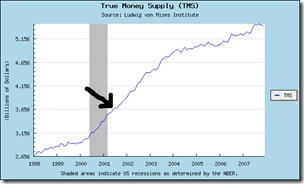
tms-9-11 (1)     At the root of the problem are not mortgage-backed assets as such but the Fed's boom-bust policies. It is the extremely loose monetary policy between January 2001 and June 2004 that set in motion the massive housing bubble (the federal-funds-rate target was lowered from 6% to 1%). It is the tighter stance between June 2004 and September 2007 that burst the housing bubble (the federal-funds-rate target was lifted from 1% to 5.25%).
    Can the "rescue plan" fix the US economy, or will it plunge us into the mother of all recessions?
    On account of the time lag, we suggest that the tighter interest stance of the Fed between June 2004 and September 2007 has so far only hit the real-estate market and financial institutions.
    Various bubble activities that sprang up on the back of loose monetary policy between January 2001 and June 2004 are not only in the real-estate and financial sectors; they are also in the other parts of the economy.
    Consequently, there is a growing likelihood that these activities will come under pressure in the month ahead regardless of the rescue package. Since these activities are the product of loose monetary policy, obviously the banks that supported them are going to incur more bad assets, which will put more pressure on banks' net worth.
    Contrary to popular belief, the rescue package cannot help the economy; it will only severely weaken wealth generators. (The larger the package, the more misery it will inflict.) Hence, once the massive rescue plan is implemented, it will not prevent an economic slump but, rather, runs the risk of plunging the economy into the mother of all recessions.
Shostak is not alone in his analysis.  The whole capital structure is contaminated, not just the housing and mortage sector. The easy credit has worked its way all through the capital structure like termites through your new home -- adding more weight to that structure when what producers need is to be left alone to restructure stick by stick will only extend the misery, and delay the necessary recovery.
And as for calls to regulate the "deregulated" capital markets, only a myopic drone could even take such calls seriously.  As Michael Hurd points out in today's Washington Times:
    I don't understand why the lesson of the recent financial meltdown is that we must return to regulation. The regulatory infrastructure we have today has been in place since the 1930s New Deal - and before.
    This infrastructure was supposed to prevent such a meltdown from happening. The federal government guarantees everything. This transformed capitalism from a system in which all financial institutions are privately run - and financially responsible for their mistakes.
     Deep down, business executives always knew they could appeal to the government if they made foolish decisions that cost untold billions - and that's exactly what happened.
    Our mixed economy - neither capitalism nor all-out socialism since the 1930s - performed exactly as it's supposed to perform in the context of a heavily regulated market.
    We could basically respond in one of two ways. One way would be to acknowledge the experiment in the mixed economy as a failure, refuse to bail out those who counted on the government to rescue them from their mistakes and evasions, and start clean with a private marketplace.
    It would be painful, but there's no escaping pain after a mistake of this kind. The other alternative is what's happening now: to bail out most if not all of the failing institutions; to require American taxpayers to foot the bill; to nationalize and even further regulate what's left of the industry, where possible; and to remove still more - maybe even most, at this point - of the capital out of capitalism.
    Sens. John McCain and Barack Obama don't fight over which direction in which to move. Fundamentally, they agree: We need more regulation, more government and less capitalism.
    Fine. Will one of them please explain, then, how more of the system that brought us to this point is to rescue us suddenly?
Even if either was economically literate, it would be impossible.  And neither of them are.
UPDATE 1: Via Anti Dismal, Don Boudreaux wonders why, since the government's money supply policy is obviously so crash hot, we don't we have the same policy for steel supply.  Good reading.
UPDATE 2: I am in receipt of an excellent letter to the editor of the NZ Herald, in response to their appalling editorial yesterday:
Dear Sir,
In your editorial of 23 September you refer to the US government’s bailout of the financial system as “rewarding the guilty” and then note that “… when markets fail, government is the only solution.” The only truly guilty party is the party to which you are now turning to for “solutions”.
Since the creation of the Federal Reserve in 1913, there has been a significant debasement in the value of the US dollar due to the unrestrained increase in the money supply by the Federal Reserve, i.e they have been printing money. Since 2001, this has manifested itself in a housing bubble, the recent bursting of which is a healthy recognition by the market that the real value of these assets is much lower.
    The seeds of the current crisis were therefore laid many decades earlier with government intervention in the market. It is they who are guilty and they should not be rewarded with additional powers to intervene, actions that will lead to the further destruction of economic wealth.
J. Darby
Auckland

Wednesday, 3 October 2012

Labour loser wants printing presses to run faster to “help” exporters

Labour Finance Spokesman David Parker still talks about giving the Reserve Bank “other targets” than just leaning against inflation. He’d like them to also meddle with our money to lean against (in no particular order) our high exchange rate, rising unemployment, slowing GDP growth, falling savings rates and the quality of chardonnay in Grey Lynn.

How? Somehow.

Why worry about him and his ramblings? Because this ardent inflationist is very likely to be the next Finance Minister.

TI have my own problems with the phony price stability pursued by the Reserve Bank. There’s clear evidence the policy of price stability always leads to more instability. Or worse. Learning nothing however from the lessons of the past suggesting using monetary policy to “target” cherished policies can achieve anything beyond instability, in this penetrating interview with Alex Tarrant (good work, Alex) Parker admits he leans himself towards either “nominal GDP targeting” or targeting the prices of a basket of export commodities instead of the CPI–both ideas espoused by his new hero Jeffrey Frankel.

This, to Parker and to Frankel, would be “modern central banking.” And he’s probably right. Using monetary policy to tinker with “targets,” boost exports and bail out failure probably is thought “modern” by those who never learned the reasons for the failures of antediluvian mercantilism.  Or who still remain blind to

 the role of central banks in this crisis, let alone the very concept of monetary central planning, of the idea that some ‘wise men and women’ in Frankfurt, Washington, ]Wellington] or London can fix the supply of base money and certain prices (interest rates) in order to control, guide and manage overall economic performance. Like [so many of the chattering classes, Parker] is in awe of the power elite that supposedly runs our economies and our societies to our benefit. Difficult times only seem to require more determined politicians and more determined central bankers. And when central planning fails, the central planners simply need a new plan. Or a new target.
    Not surprisingly, [Parker] is an advocate of nominal GDP targeting, the new fad in monetary central planning. There is allegedly nothing wrong with monetary policy. The central bankers only need a new target, and, naturally, a more comprehensive one. [FT journalist and] trained mathematician Münchau lectures us how this works:

“This is a debate about nominal income targeting, where a central bank no longer stabilises the inflation rate directly but focuses instead on stabilising nominal gross domestic product. You can think of nominal GDP as the sum of real GDP and inflation. If real growth falls, the central bank would thus have to drive up inflation. Conversely, if real growth rises, the central bank would have to bear down on inflation much harder than it would do under the pure inflation targeting regime used by central banks such as the ECB.”

There is a dangerous naivete about all of this, a blindness toward real-life complexity. There is also a kind of narrow-mindedness, of which Münchau accuses the central bank critics, but of which he himself is the prime example. Münchau and other advocates of GDP-targeting are consistent macro-economists, which means they necessarily ignore many important micro-economic phenomena.
    Here is the prime fallacy behind the nominal GDP target and, in fact, all of Münchaus’ argument: It tacitly assumes that money is neutral, which money never is.

Those paragraphs above come from a great piece by Detlev Schlicter: “The fallacy of nominal GDP targeting” appearing at his blog Paper Money Collapse. Schlicter points out the abject fantasy of believing the “easy money” of central banks can be used to produce stability.  The fantasy focuses on price indexes and statistical constructs while ignoring the real world; ignoring, for example, that

when new money is injected into the economy, it does not raise all prices simultaneously and to the same degree but some faster than others, and some more than others.
   This is important and has far-reaching consequences. ‘Easy money’ does not just directly affect growth and inflation, or any desired combination of the two. It does not just affect the statistical average of prices, the price level, or the statistical aggregate of economic transactions, real GDP, or any other statistical macro-variable. ‘Easy money’ always means changes in relative prices, changes in resource allocation, and changes in income and wealth distribution. In particular, ‘easy money’ lowers interest rates, which are crucial in a market economy for coordinating investment activity with the public’s time preference, i.e. the public’s propensity to save and thereby support and sustain the capital stock. Monetary expansion means distorted interest rate signals and thus necessarily capital misallocation. This fundamental insight is the basis of all monetary theories of the business cycle, that is, of the insight that monetary expansion leads to booms that must be followed by busts. Every monetary expansion creates distortions, the liquidation of which cause the next recession. Every monetary expansion creates economic instability. This was already the basis of the business cycle theories of the British Classical economists of the Currency School in the 19th century, but more importantly, it was the basis of the so far most convincing business cycle theory, the one developed by
Ludwig von Mises in 1912 and 1924, a theory that is now widely known as the Austrian Theory of the Business Cycle.
    This theory explains why modern fiat money central banks can never be a source of ‘stability’, whether that means the stability of the inflation rate or the stability of nominal GDP. Central banking, whether old fashioned or modern, is always a source of instability. This theory also explains why modern central banking has now maneuvered us into a veritable economic cul de sac. Repeated attempts over the past decades to buy near-term economic growth at the price of persistent marginal debasement of money has now left us with such a distorted and over-indebted economy that any further monetary expansion has to be ever more scarily aggressive to even cut through the thicket of accumulated imbalances and have any effect on inflation and GDP, whether real or nominal.

Here’s a target for the central bank: stop printing new money.

That would be a target they should manage.

Monday, 9 January 2006

Taming the inflation monster

As you might recall, we ended the year wondering why the Reserve Bank of New Zealand is strangling growth in a bid to keep down the prices of property -- nailing producers and exporters and all the rest of us to a cross of 'price stability' that is itself a mirage. This, says Alan Bollocks and RBNZ supporters, is neccessary to underpin the currency and restrain the infltaion monster. "No!" say RBNZ detractors like myself: in focussing only on 'price stability' you're reversing cause and effect.

Mike Shedlock suggests the worlds various central banks should do three simple things before they do us all a favour and self-destruct. While disagreeing with some of his detailed prescription, the general thrust of his recommendations is worth considering:
Instead of trying to achieve 'price stability' which ... is something that can neither be achieved nor measured , how about shooting for "money supply stability" instead? a.. Central banks should refuse to monetize government spending and trade deficits; b.. Central banks should let the market set interest rates; c.. Central banks should embark on a campaign of tightening reserves requirements over time to rein in fractional reserve lending Life would be so much simpler if Central Banks everywhere would stop trying to micromanage both prices and economic cycles. Quite simply, they are trying to achieve nirvana when nirvana can not possibly be measured, nor can nirvana be achieved in the first place with the policies they have in place. Of course if they stop doing these things, they will cease to be Central Banks in the modern sense, so perhaps they will get the hint and just close shop.
We wish. And as for that graph up top, just see the 'success' the US Central Bank has had in their number one job. Been really useful, huh?

Linked Articles: Inflation monster captured
One graph that says it all