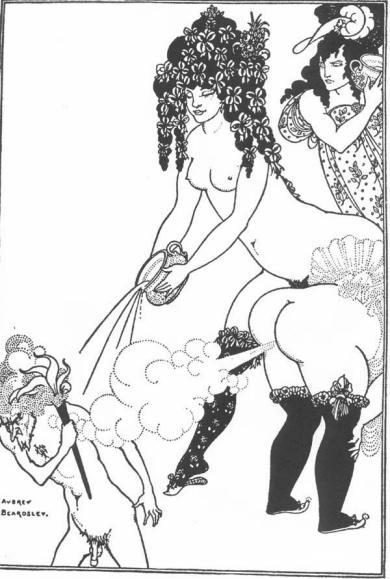
 Aubrey Beardsley's 'Lysistrata defending the Acropolis,' drawn to illustrate Aristophane's hilarious comedy.
Friday, 7 October 2005
Lysistrata defending the Acropolis
Aubrey Beardsley's 'Lysistrata defending the Acropolis,' drawn to illustrate Aristophane's hilarious comedy.


Thursday, 6 October 2005
Girl v crocodile
 ADELAIDE ADVERTIsER: A 14-YEAR-OLD boy helped save his little sister by pummelling a saltwater crocodile as it mauled her in the remote far north of Western Australia... Her ordeal is the latest in a string of crocodile attacks across northern Australia. Two men - a snorkler and a diver - died last month in separate attacks in the Northern Territory. In August, a fisherman was killed when a crocodile pulled him from a canoe in northern Queensland.
Rather than the just repeat the arguments expressed here recently, I'll just point you to what was said before on the subject. Suffice to say that I don't agree with those who felt that the girl is to blame for being attacked. I blame misanthropic environmentalists.
Eaten by absurdity
A new environmentalism: Putting humans first
Protecting a predator
*****************************
UPDATE: Den MT and Ruth have both blogged in response to this and to my earlier posts on this subject here at Not PC. Unfortunately, they both miss the full context and hence the point of what I've been saying -- God knows why, I thought it was clear enough. Maybe not. Anyway, I summarised what my point was here. I'll do it again. Briefly, the position I've been arguing for is this:- First and most importantly, it is an argument for a change in ethics that recognises that 'environmental harmony' can only begin once it is recognised that humans have a right to exist, and that they exist by using and transforming nature (the clearest argument for this appears in Tibor Machans' book 'Putting Humans First').
- There is no such thing as 'intrinsic values' that inhere regardless of context or relationships -- as I argued in this comment, the very concept of 'intrinsic value' is a nonsense, and one often used to smuggle in a person's own 'subjective values.' I argue that 'value' has a context; it implies both a valuer, and a purpose: that is, someone to whom a thing is valuable, and an answer to the question, 'valuable for what?' I argue that real value is objective, not intrinsic. The problem with intrinsic values is outlined briefly here, and illustrated in too much misanthropic environmentalism. :-)
- The practical arguments for rational wildlife management is put here in Dr Graham Webb's PDF article, 'Conservation and Sustainable Use of Wildlife - an Evolving Concept.' I sumarise it very briefly in this comment. In essence, Webb argues you have to give local a property right in the animals in order to make the animals' protection a boon to them rather than a disaster, and he explains the means whereby to do that.
Categories: Environmentalism, Ethics
'Bloody obvious' Nobel Prize winners
 Congratulations to the two Australian doctors who just won the Nobel Prize for medicine for their discovery of what causes ulcers. Contrary to the previously received wisdom that it is stress that causes ulcers, Robin Warren and Barry Marshall knew the real cause -- a bacterium called H. Pylori -- and Marshall swallowed a beaker of bacterium to prove it.
"It is nice to be officially recognised and it gives some sort of a stamp of approval, but we believed it within a few months because it was so bloody obvious," Warren told reporters... The two men made their discovery in the early 1980s, but it took a long time to convince the medical community, who viewed them as eccentric. "The idea of stress and things like that [as the cause of ulcers] was just so entrenched nobody could really believe that it was a bacteria," Dr Marshall told the Associated Press.They do now. Ulcers can now be cured with a short-term course of drugs and antibiotics, and I have formerly ulcer-ridden friends to submit as evidence the cure works. They and thousands of others have been raising a glasss or two to Marshall and Warren for years.
Categories: Science, Achievement
Judy gets the archer
If television news and talkback is anything to go by, the big news of today and yesterday is that Judy Bailey has been given the Spanish Archer* by TVNZ. I'd make a comment, but while I do know how to do a smiley face in writing, I don't know how to a 'who-gives-a-fuck shrug.' This is news?
*Spanish Archer = El Bow.
*Spanish Archer = El Bow.
Steyn on the money
As Simon Pound once said here, "by jillikers, Mark Steyn can sometimes be on the money." Or something like that. You don't read him for a few weeks, and then you find the bastard has been cranking out columns of brilliance that you've been missing out on.
Here's a summary of some recent feats of insight:
Here's a summary of some recent feats of insight:
- 'Media deserve blame for New Orleans debacle': The media were stangers to the truth in the week of Katrina, says Steyn. "Hurricane week was in large part a week of drivel, mostly the bizarre fantasies of New Orleans' incompetent police chief but amplified hugely by a gullible media."
- 'Sayonara Kyoto': Blair concedes Kyoto is a crock; Steyn crows. "Here's what I wrote about Kyoto at the time of the Bush Administration's rejection of it. It's not a complicated issue. The only wonder is that it took Tony Blair four years to concede publicly the conclusion I make in my final paragraph."
- 'Right-Wing Europe': Steyn says if Europe is 'centre-right,' then he's a Dutchman. "That’s right: The EU – you know, the EUnuchs, the Euro-weenies, the proverbial cheese-eating surrender-monkeys, etc – are four-fifths 'centre-right.' Half a decade ago, they were all centre-left Third Wayers. But having put its left foot in, Europe pulled its left foot out, stuck its right foot in and shook it all about..."
- 'Islam or Boom': Terrorists return to Bali. Bali, the west , and 27 familes are poorer for it. "...despite Clive Williams's game attempt to connect the two on this page yesterday, nobody seriously thinks what happened in Bali has anything to do with Iraq. There are, in the end, no root causes, or anyway not ones that can be negotiated by troop withdrawals or a Palestinian state. There is only a metastasising cancer that preys on whatever local conditions are to hand."
Strayhorn WordPress1.5
I'm impressed to find that the new version of WordPress1.5 is called 'Strayhorn,'
in honor of Billy Strayhorn the pianist and sublime composer who worked closely with Duke Ellington and wrote tunes like 'Take the A Train' and 'Lush Life.' We thought he was perfect to represent the power and elegance of this release, which has been under intense development and testing the past few months.As a Strayhorn and Ellington fan myself, I'm most impressed. If you're also impressed, and you've either got your own blog domain or you're planning to migrate from Blogger (Yes, I know, some of you have just migrated to Blogger after problems eslewhere!), then you can go here and download. I'm told very good things about it.
Wednesday, 5 October 2005
Greenspan returns to his roots
 When Federal Reserve Chairman Benjamin Strong died in 1928, the market juggling with which the Fed was struggling fell in a heap, and the world caught a case of economic pneumonia. Incumbent Fed Chairman Alan Greenspan, nearing retirement and speaking at the Kansas City Fed's annual symposium, shows he is both keenly aware of his legacy and his place in history, and concerned too at the prospect of the economy catching a cold with his departure on January 31st.
Bloomberg's Caroline Baum says Greenspan's was a speech of two halves, in which both his heroes Adam Smith and Ayn Rand featured :
[First] Greenspan provided a brief history of the changing attitudes toward the government's role in the economy: the free- market capitalism of Adam Smith that prevailed in the 19th and early 20th centuries; the attempt at interventionist, demand-side management advocated by John Maynard Keynes during the 1930s Depression...; the resultant stifling of competition and economic stagnation of the 1970s; the failure of wage and price controls and eventual disillusion with regulation; and the ultimate triumph of free markets when "the collapse of the Berlin Wall in 1989 exposed the economic ruin behind the Iron Curtain," Greenspan said.
It was Atlas Shrugged without Dagny Taggart and Hank Rearden to lead us through the struggle. Greenspan was present at the creation of Ayn Rand's masterpiece as part of the free-market philosopher's inner circle in the 1950s. It makes perfect sense that as he gets ready to retire from the Fed on Jan. 31, Greenspan would create an idealized image of himself, even if it differs from reality. But that's not quite an accurate portrait of the speech. Rather than talking up his role, Greenspan then declared his unshakeble belief in Adam Smith's invisible hand and the power of market forces, and his view that despite the liberalisation of the world's economies there is perhaps still too much dependence on uber-gurus like himself:
Governments today, although still far more activist than in the nineteenth and early twentieth centuries, are rediscovering the benefits of competition and the resilience to economic shocks that it fosters. We are also beginning to recognize an international version of Smith's invisible hand in the globalization of economic forces.
Whether by intention or by happenstance, many, if not most, governments in recent decades have been relying more and more on the forces of the marketplace and reducing their intervention in market outcomes. We appear to be revisiting Adam Smith's notion that the more flexible an economy, the greater its ability to self-correct after inevitable, often unanticipated disturbances. That greater tendency toward self-correction has made the cyclical stability of the economy less dependent on the actions of macroeconomic policymakers, whose responses often have come too late or have been misguided.He then suggested, counter-intuitively to some, that the Fed's economic management itself somewhat discourages the necessary strength and agility that allows these self-corrections to happen. To the extent the Fed's management is successful, he sggested, it necessarily alters investors' perception of economic risk, and it also makes the Fed the focus when asset bubbles happen, rather than the focus being on the misalignments themselves.
Relying on policymakers to perceive when speculative asset bubbles have developed and then to implement timely policies to address successfully these misalignments in asset prices is simply not realistic.Is he perhaps suggesting that the time has come to diminish the role of the Fed? Or is he just trying to allow his successor -- whoever that may be -- to settle into the job without the same glare of attention the incumbent enjoys. What's your call?
An earlier version of Greenspan's speech is online here.
Categories: US_Politics, Objectivism, Economics
Commies aren't cool.
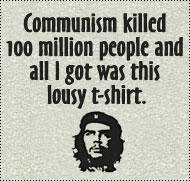
 If like me just don't get this joy some people have in walking around with a picture of a murderer on their chest, here's a bunch of T-shirts you might prefer.
What's inside some of them isn't too bad either.

Tuesday, 4 October 2005
Nandor goes bush
 Nandor's gone as an MP and gone bush to clear his head. Reactions to his departure from the parliamentary complex have ranged from the eulogistic -- "I will never forget the people I met who had life changing stories to say about you" -- to the humorous -- Rasta la vista baby -- to the occasional celebratory "Fuck him; let's dance."
He did mature from his early days as an MP when he helped vandalise a researcher's crops down at Lincoln, and he might perhaps have been the only Greens' MP that had at least a visceral commitment to personal freedom. (This was a party that ran on the policy of raising the drinking age. Go figure.) So that's the end of that then. In that respect at least, there are worse MPs that well-deserved the chop before him. Nick Smith for instance. Or Keith Locke.
Tanczos said his "biggest disappointment is that we did not complete cannabis law reform. There are 20,000 cannabis convictions a year and it's an absolute waste of police and court time and young people's lives, for what is essentially just a herb."
Tanczos said there was a certain irony that if a portion of the 5748 people who voted for the Aotearoa Legalise Cannabis Party had voted Green, he an advocate for reform would have been back in parliament. But as Zippy Gonzales says in response to a similar bleat from the FrogBlog, "Blaming ALCP won't get the Greens anywhere. If they wanted the stoner vote, the Greens should have done something like, y'know, included it in their campaign." Excellent point. Anyone for an instant fine?
[UPDATE: Russell Brown's interview with Nandor Tanczos on the past six years and where-to-now on the 95bFM Wire show is archived here.]
What was the election for, then?
For once, I'm almost in agreement with Rodney.
TV One’s Guyon Espiner reports what the parties want:No steps forward then (with the possible exception of the unjust Foreshore and Seabed Act), but at least only baby steps backwards. Given what we've had to put up with in preceding years, that's some sort of a boon. The legislature will soon be back in session, and as Mark Twain warned neither property nor liberty will be safe, but if this is the extent of the new impositions to be exacted upon us, we might at least reflect that while things could be an awful lot better, it could very well have been much, much worse.
Greens: 500,000 solar panels and a “buy kiwi made” campaign.
Maori Party: Review the Foreshore and Seabed Act.
New Zealand First: Golden Age card increasing entitlements to senior citizens and removing GST from petrol.
United Future: No change to cannabis law and retain the Families Commission.
Add in Labour’s free loans to students. And ask yourself was that really what the whole campaign was about?
Release of the 'Capitalist Manifesto'
 Andrew Bernstein's Capitalist Manifesto is a new book with balls that defends capitalism as the world's most moral and most practical solution. Ed Younkins reviews it here. Australia's Prodos interviews the author in his online radio show here.
From the review:
This tour de force presentation thoroughly and eloquently addresses virtually every question or criticism anyone has ever made about the morality or practicality of capitalism.From the interview:
- Capitalism as "The system of the Enlightenment" - even though that happened a century or so earlier;
- The connection between human rights, freedom, and prosperity.
- What capitalism has done for the Arts.
- What is ACTUALLY the central, foundational principle of the capitalist system?
- Capitalism as the system of the mind.
Linked Articles: A Review of Andrew Bernstein's "The Capitalist Manifesto"
Interview with author Andrew Bernstein
Bagging the Ice-man
 All that banging on that everyone did a few weeks back about people in a disaster zone charging ten bucks for a bag of ice: turns out now that FEMA wasted over $100 million of ice that was intended to help to hurricane victims. So much for the power of government coordination in a crisis.
As the Mises blog notes with some asperity,
One frustrated truck driver had to drive 2,000 pounds of ice around for 4,100 miles, being redirected half a dozen times, and waiting up to a week (with the engine running) for FEMA to make up their mind. 59% of the purchased ice was never used, and much of it ended up thousands of miles from the affected areas because not enough storage space had been arranged. A homeland security report stated that the problem was that there is "no automated way to coordinate quantities of commodities with the people available to accept and distribute them." But not to worry, because “there are programs in the works that will help us better track commodities.”It's called a free market.Hmm, an automated way to coordinate quantities of commodities with the people available to distribute and consume them. I think I’ve read about something like that.
Categories: US_Politics, Economics
A lucky bastard goes to 'Siegfried'
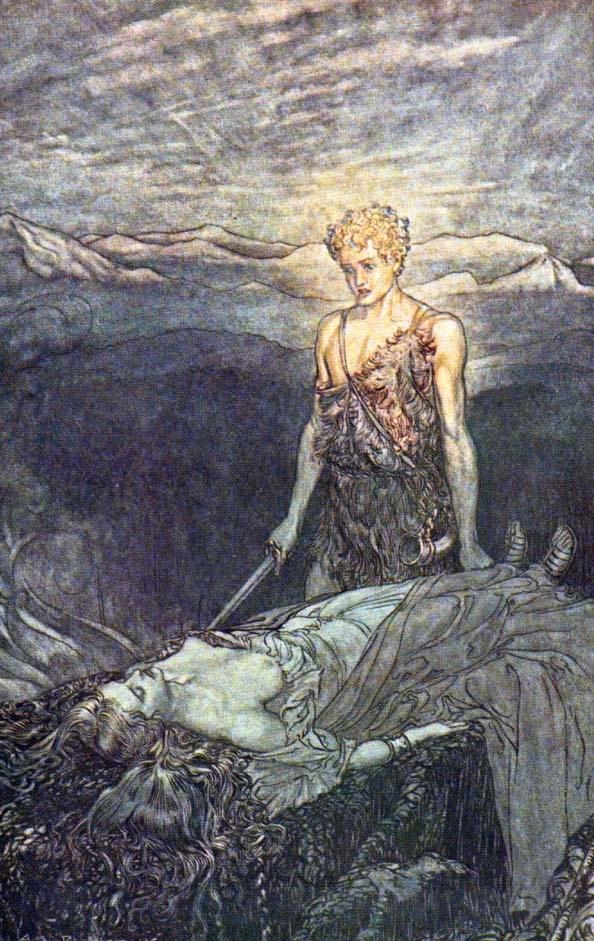 A friend had the good fortune to attend his first Wagner opera: 'Siegfried' at Covent Garden. I'm very happy to report it wasn't wasted on him...
Wow! Wow! Just fucking WOW! You were right, and Perigo is wrong. As wrong as Rand was on Beethoven.
I walked out of that feeling like I had *lived* through that opera, rather than merely watched it. It was exactly as you say: listeners with a three -minute span of attention should look elsewhere. This was five hours of total immersion!
Where to start? I guess the great thing about this production was that the singing was first rate. Siegfried himself was tireless with a very strong voice, and, although I don't have any point of comparison, it seemed to me he expressed the irrepressible joie de vivre of Siegfried just right. I was also blown away by the bass voice of the dragon, Fafner. His voice, was, according to my partner (a soprano singer herself) cleverly amplified, but the booming depth of it was simply wonderful.
However, if there was a show stealer, it was certainly Wotan. The richness, depth and sheer volume of the singer's voice was unmistakeable. And the two stand-out scenes for me both involve his character. The first was the interchange between Wotan, Fafner and Alberich at the
opening of Act II, where Wotan's regal and sumptuous themes are matched by the even more imperious themes of the dragon. This was just mind-blowingly good, and I don't think I've ever appreciated the sheer staunchness and masculinity of the male voice as much as I have while experiencing this booming interchange.
The second was the opening scene to ACT III, where Wotan laments his imminent loss of power. Here the power of John Tomlinson's voice was clear to everyone. This scene brought the highlight of the production itself. Wotan lay on a very large square tilted at an angle that
spun around quite quickly, with swirling clouds somehow projected onto it. It really was a glorious spectacle, and quite befitting the scene. These imperious interchanges were what really grabbed me, however there was plenty of entertainment to be had elsewhere, in particular through the hilarious Act I interchanges between Siegfried and the dwarf, Mime.
The production itself ranged from fabulous (see above), to appalling. Fortunately, the appalling bits did not interfere with the spectacle too much, although the post-modern touches were all too clear. The central piece in Mime's cave throughout Act I was a plane wreckage, and much of the action took place on or around a broken wing. Bizarre. And the "anvil" which gets broken by Siegfried's sword, Nothung, looked to me like a hospital trolley.
Somehow none of this was too intrusive however. The low point was most certainly the sequence where Siegfried goes off by himself in Act II to ponder about his parents in the forest. At this point some sort of stuffed deer and what looked like a stuffed sheep were wheeled in on two
more hospital trolleys. At this point I was shuffling irritatedly in my seat, but I needn't have worried too much because things generally got better from there, except for some weird metallic box on the 'dragon's' head.
And of course the Royal Opera House is itself a wonderful setting, and the orchestra first class. Fortunately, I had forked out a bit extra to get central seats and ensure that we weren't craning our necks around corners or being blocked from part of the view. For a five hour spectacle, it was certainly worth it.
At the end of each Act the audience went wild, and I have never heard such applause for any performance of anything, anywhere as at the end. Nor had my partner, who is obviously far more experienced in these things. The applause for the singers was certainly deserved, however as I stood there clapping like mad with the rest of the cheering, bellowing audience, I felt that I
was clapping Wagner himself more than anyone. I was totally gripped by the whole wondrous spectacle and the time flew by. What a wonderful achievement this epic is, and I still have three more to experience!
You were right PC; today I truly felt like a lucky, lucky, lucky, lucky, lucky bastard.
Monday, 3 October 2005
Ken Ring on 'Sunday'
Last night's 'Sunday' programme examined the Ken Ring phenomenon I blogged about the other day in Lunatic?. Feel free to let me know if you saw it, and if you either changed your opinion as a result of the programme, or had it reinforced.
Some coalition questions
Now the results are in, some questions for the coming week's ducking and diving in the Smokefree rooms around Bellamy's and the Beehive that might be answered by week's end:
Can the Greens bear to be left outside cabinet? But can Labour afford to have then inside cabinet? Could they really be trusted with Energy and Transport? What trophy policies can Labour accept without frightening the horses?
Will Peter Dunne really do anything to be close to power?
When will the Maori Party know the minds of its members, given that their series of consultation hui will only start on Wednesday? And will this tardiness help to make the Maori Party's four seats irrelevant to the final coalition calculations?
If Labour can cook up a deal for Winston to support them, how long before he spits the dummy?
With the possible combinations that Labour can cook up offering such slim and insecure majorities, can Labour afford to contribute the Speaker this time? Might this mean that Clem Simich might have to do something, for the first time in his parliamentary career?
Will Helen just be satisfied with the achievement of a historic third term, even if it proves to be an impotent one in terms of the Labour agenda?
There are presently 300,000 New Zealanders receiving a State benefit. How many more will there be at the end of this term? Will this Government last three years? And when does Kofi Annan retire?
And the final question: Has anyone really minded not having a real government for the last fortnight? How long before the outrage begins again?
Can the Greens bear to be left outside cabinet? But can Labour afford to have then inside cabinet? Could they really be trusted with Energy and Transport? What trophy policies can Labour accept without frightening the horses?
Will Peter Dunne really do anything to be close to power?
When will the Maori Party know the minds of its members, given that their series of consultation hui will only start on Wednesday? And will this tardiness help to make the Maori Party's four seats irrelevant to the final coalition calculations?
If Labour can cook up a deal for Winston to support them, how long before he spits the dummy?
With the possible combinations that Labour can cook up offering such slim and insecure majorities, can Labour afford to contribute the Speaker this time? Might this mean that Clem Simich might have to do something, for the first time in his parliamentary career?
Will Helen just be satisfied with the achievement of a historic third term, even if it proves to be an impotent one in terms of the Labour agenda?
There are presently 300,000 New Zealanders receiving a State benefit. How many more will there be at the end of this term? Will this Government last three years? And when does Kofi Annan retire?
And the final question: Has anyone really minded not having a real government for the last fortnight? How long before the outrage begins again?
Female soldiers


 Do you like your women armed and in uniform? So do the people who contributed to this rather odd site: pictures on this thread of female soldiers from around the world. God only knows what it has to do with an Islamic Republic, but the contributors seem to be enjoying it. Pictured here from L to R, representatives from Italy, Czech Republic and Canada. And if that beauty below really works in a Czech recruiting office, would she be enough on her own to make you think about joining up? Or would you need the image above to help motivate you to think at least about relocating?
A NZ Political Wiki is born
"TopSpin is a Wiki created to document and monitor New Zealand politics and politicians. We intend to document all parties and all mainstream media outlets."
"We" in this case is 'you' -- that is, Bernard Woolley and Antarctic Lemur who have set up the Wiki in the hope and expectation that contributors will volunteer to contribute content and maintain the currency of the content, just as they do with the excellent Wikipedia. Feel free to join in as a volunteer.
"We" in this case is 'you' -- that is, Bernard Woolley and Antarctic Lemur who have set up the Wiki in the hope and expectation that contributors will volunteer to contribute content and maintain the currency of the content, just as they do with the excellent Wikipedia. Feel free to join in as a volunteer.
Sunday, 2 October 2005
A Katrina Sky?
I've been sent some spectacular photos of the threatening skies just before Katrina hit New Orleans. 
[UPDATE: http://www.snopes.com/photos/natural/storm.asp]

[UPDATE: http://www.snopes.com/photos/natural/storm.asp]
A Sunday constitutional
I've been a fan of a constitution for some time, for one very specific reason: an effective constitution is the very best way to tie up a government.
Why is a constitution needed? Because in essence, good government is like a guard dog: it's there to protect us from being done over by others. However, if that dog is badly trained and it gets off the chain, we can be badly savaged -- more so sometimes than we would have been without the dog.
Liberty
Why is a constitution needed? Because in essence, good government is like a guard dog: it's there to protect us from being done over by others. However, if that dog is badly trained and it gets off the chain, we can be badly savaged -- more so sometimes than we would have been without the dog.
A constitution is our means of chaining up the government, and training it to act only in our protection.
As I’ve said already elsewhere, the task of government is to protect us against physical coercion and its derivative, fraud. Good government is the means by which retaliatory force is brought under objective control. A good constitution, properly written, brings the government itself under objective control.
Such a constitution was the intent of
- The Crucial thing within any democratic system is that majority rule is limited; that important things are put beyond the vote, specifically the thing our government is sworn to protect: our rights. Such things should be in a ‘Bill of Rights’, and those rights clearly enumerated are what the government should be constituted to protect. You can see our proposed Bill of Rights here.
· The job of government is to protect its citizens, not to infringe the liberties of its own citizens except by following due process of law – a ‘Bill of Due Process’ clearly outlines under what circumstances and in what manner those liberties may be breached, and for what specifically limited purpose.
· The US Constitution has suffered from interpretations that have often been at odds with the declared intentions of the Constitution’s authors – the Constitution for New Freeland puts the intentions of its authors on the record in the ‘Notes on the Bills of Rights and Due Process.’
Every good constitution relies on two further important restraints on the growth of Omnipotent Government:
1) significant public understanding and support for the constitution and its protections, without which politicians and advocates of a ‘living constitution’ can pervert the constitutional protections as easily as the simple agreements given in the Treaty of Waitangi have been perverted;
2) government’s powers are separated, so that each of government’s three branches – legislature, judiciary and executive -- has some specified veto power over the others. The imperfect separation of powers in our present NZ constitutional arrangements shows the dangers of being without these essential checks and balances on political power.
The task of constitutional law is to delineate the legal structure of a country’s law; it must therefore be superior to all other laws, and law stepping outside the bounds of what is declared unconstitutional must be able to be struck down – an accessible Constitutional Court makes this possible.
The superiority of a constitution to all other law is both a good thing and a bad thing. What’s good is that once a watertight constitution properly protecting individual rights is in place, it acts to chain up the guard dog and to keep it on its leash for good. What’s bad is that once in place, a poor or anti-freedom constitution is very difficult to get rid of.
Saturday, 1 October 2005
Final count
Just announced: Special votes have now all been counted. National lose one seat, leaving an overhang of only one seat There are no other changes. Welcome to Helengrad.
Books around the house

 Here's a bunch of what I'm reading at the moment. If you're not interested, just turn the electronic page.
Putting Humans First: Why We Are Nature's Favorite, by Tibor Machan
Ludwig von Mises: The Man and His Economics, by Israel Kirzner
 Les Miserables, by Victor Hugo
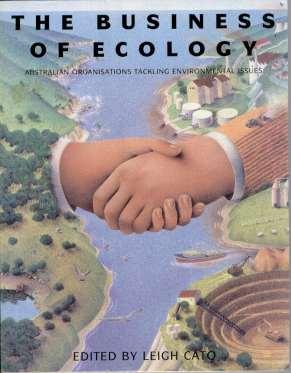
 The Business of Ecology, ed. by Leigh Cato
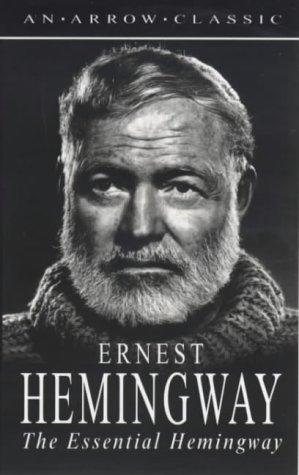
The Essential Hemingway, by Ernest Hemingway
 Music and the Mind, Anthony Storr
 I'm enjoying all of them immensely. Do you generally have more than one book going at once? It's always worked that way for me.
Categories: Books
Unintelligent design, Part 3
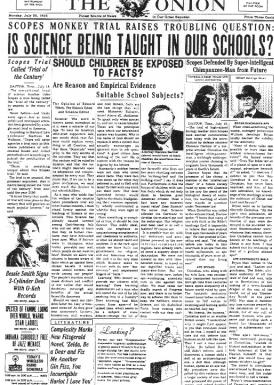 Continued from yesterday.... Do you remember the Scopes Monkey Trial, which was immortalised in a play and two exceptional films titled 'Inherit the Wind'? Creationists in Tennessee passed a law banning the teaching of evolution in schools; when the law was challenged in court, both Creationism and its defenders were shown to be, as Bill Lawrie would say, completely lacking in logic.
The 'Intelligent Design' movement is in many ways a rearguard action against this embarrassing loss. ID attempts to move on from the obvious idiocies of Creationism by wrapping myth in an aura of scientism rather than poetry. Despite the aura, it is still a movement attempting to give respectability to stupidity. Tom Cruise's Scientology almost begins to look sane by comparison.
"Every living cell contains many ultrasophisticated molecular machines," says ID proponent Michael J. Behe. So? There is no logical connection, nor any shown causal connection, between naturally occurring complexity and a Creator that brought that complexity into the world. Just because machines of man-made complexity are products of intention and design is no reason to extrapolate this intentionality into naturally occurring entities or processes. Crikey, that's been pointed out since Greek scientists began their inquiries nearly 2,500 years ago. As Benny Hill used to say, "Why you no 'rissen!"
Ayn Rand pointed out there is a profound confusion in a claim such as Behe's: a confusion between things on the one hand about which there is some choice, that is, things that are man-made, that someone has chosen to design and to produce, and might very well have chosen to produce otherwise; and another class of things that in her words are "metaphysically given," that is, entities or processes that exist in nature, and whose properties are given by the nature of the entity, and about which neither choice nor free will can apply. The key to the difference between these two classes of entities is that human beings have free will, whereas nature does not.
Man-made things are generally as someone chose them to be (I exclude here my numerous failed efforts to produce a decent home brew); natural things by contrast are as their nature determined them to be (in the case of home brew, manifestly determined to piss me off).
Was existence itself brought into existence by a Creator? There's no evidence for that claim, and nor is there any need for it. Nor is there any evidence for the claim of there being a Creator -- and as I said Thursday, if you say that existence was brought into existence by a Creator then you have the 'infinite regression' challenge of explaining how the Creator who brought everything into existence came into existence herself. There is no evidence for a Creator; there is however abundant evidence for existence. That existence exists is axiomatic, meaning that no explanation is actually needed to explain its presence. As Ayn Rand put it:
"To grasp the axiom that existence exists, means to grasp the fact that nature, i.e., the universe as a whole, cannot be created or annihilated, that it cannot come into or go out of existence. Whether its basic constituent elements are atoms, or subatomic particles, or some yet undiscovered forms of energy, it is not ruled by a consciousness or by will or by chance, but by the Law of Identity."Proponents of 'Intelligent Design' completely fail to grasp that point. (And they aren't the only ones.) It is somewhat hard to grasp, it's true, but it's much harder to grasp the fact that otherwise intelligent people believe in an Intelligent Watchmaker who somehow brings order to the universe through his very will. Because here's the thing: if we do see an 'order' in existence, if things look orderly to us, then we might reflect that the 'order' is what we ourselves bring to the judgement of existence; existence itself is neither ordered nor disordered, it is just what it is, and it could be no other way.
That's right. Things couldn't be any other way than what we are -- there is no alternative existence in which all possible forms of existence were worked out; if anything were substantially different, if for instance the weight of the Hydrogen nucleus were something other than what it is, we would not be here to talk about it. Things would be different, and we wouldn't be here to talk about it over a Martini.
Further, to ask 'what caused existence' is itself a silly question. Existence does not require a cause; causality is inside existence, not vice versa. Causal explanations do back to what exists, not the other way around. The universe itself, meaning all that exists, has no cause -- if you insist on poetry, you might say that existence is its own cause. Nathaniel Branden summarises the point:
Existence is all that exists, the non-existent does not exist; there is nothing for existence to have come out of and nothing means nothing. If you are tempted to ask, ‘What’s outside the universe?’ recognize that you’re asking, ‘What’s outside existence?’ and that the idea of something outside of existence is a contradiction in terms; nothing is outside of existence, and ‘nothing’ is not just another kind of ‘something’—it is nothing. Existence exists; you cannot go outside it, you cannot get under it, on top of it, or behind it. Existence exists, and only existence exists: there is nowhere else to go.So there you go.
In any case, who is this all-loving, all-powerful, all-knowing, all-perfect designer that ID proponents posit as the Prime Mover of it all, and that millions around the world worship? According to just some of the evidence produced by those who support the notion of a Creator, their personal choice of God is responsible in the past for razing entire cities to the ground in a fit of pique [Gen. 19:24], encouraging child rape [Gen. 19:8], and sending bears to kill the children of disobedient followers [2 Kings 2:23-24].
So, both all-powerful and all-loving then.
Indeed, if she does exist, then God has been busy since Boxing Day
 . The Asian tsunami killed 200,000 or so, and an all-powerful Being must also have designed -- or at least allowed to happen -- a series of weather patterns that devastated vast swathes of the God-fearing USA. What a great sheila, huh? What a Loving God. Or at least, what a creation, since the only place this entity exists is in the minds of those who need to believe in, or to explain, something they can't, or won't, understand.
Let's move on from the imperfection or unattractiveness of this 'all-perfect' God that's been created by some as a super-position of their own selves. Instead, let's examine the imperfections of her 'creation', the creation that Intelligent Design bunnies praise so highly: what about, for example, our own bodies -- those temples of perfection that God created in her own image and likeness. As an examination of either your own body or your neighbour's will demonstrate (put her down!), it's certainly 'irreducibly complex' (and decidedly pleasurable if you do it right), but WTF is the point of all those coughs, colds, cataracts, cancers, the appendix (what's with that?), gout and all those ongoing chronic spinal problems and arthritis as those bodies get older? What sort of bad design is all that anyway? Baaaad Watchmaker. And what's the deal with people being born with spina bifida and multiple sclerosis, and all those birth defects and congenital deformities? And what sort of way is that to give birth? Who designed the birth canal for goodness sake! Just who is this Creator trying to punish, and for what...?
Now, as sober reflection will demonstrate, there is no supernatural being 'punishing' anyone. The whole idea of a supernatural Creator is just absurd on its face; we are how we are because that is who we are. Our nature was not chosen for us by an Intelligent Designer; our nature is given to us by the Law of Identity: we are what we are, and once we understand that we can, if we understand how to do so, change some things, as long as we do so in a manner consistent with our Identity. There is no more evidence for a Creator or any supernatural Prime Mover than there is for green spiders on Mars, and the onus of proof for those asserting the existence of either is on those who assert that there is.
Nor do we even know anything about this Designer. Apart from the 'evidence' adduced above, all we have boils down to assertions she is all-powerful, all-loving, all-knowing, immaterial, immortal, and infinite, and exists outside what we understand to be the universe. Frankly, this amounts on its face to nothing more than an embarrassing admission that we know nothing about this entity. To say that this is a useful description of the Chief Designer is an admission that 1) we don't' really know what she is specifically, but that she is unlimited in some way we're quite unable or unwilling to specify; and 2) that we're happy to accept the multitude of contradictions that these mutually contradictory descriptions require. The acceptance of the existence of a Designer demands faith, and it demands too the denial of reason.
Bertrand Russell was once asked what he would say if he died and found himself in Heaven, and God asked him why he was not religious during his life. Russell said he would reply, "Not enough evidence!" That's what this whole case boils down to. There's plenty of evidence that existence exists, but none at all for a Designer who created it all, and not a skerrick to suggest that the existence of which we do have immediate first-hand experience even needs a causal explanation. After all, wave your hand around and there it all is. Hard to explain all that stuff away, but hard to explain something about which there is not a scintilla of evidence, only a mountain of wishful thinking called faith.
***************************************
There is one single reason for the birth of the Intelligent Design chimera, and that is to smuggle Creationism back into American schools and so allow the continued indoctrination of impressionable young minds with supernatural nonsense. By giving equal measure to science on the one hand, and to faith on the other, its proponents hopes to give belief in faith and the supernatural some legs for a few more years. It's not intelligent, in fact it's completely transparent, and it amazes me that in the Twenty-First Century such stupidity still gets house room.
And that's my last word.
This is the last of a 3 part series. Part 1 is here. Part 2 is here.
Subscribe to:
Posts (Atom)