Showing posts sorted by relevance for query nicky hager. Sort by date Show all posts

Thursday, 14 August 2014

Hager, rhymes with macabre

Nicky Hager’s thesis appears to be that negative attack politics damages our political system. He makes the case in a book that is a negative political attack, the fourth in a series of attacks he has hoped each time will change an election.

Nicky Hager is a privacy campaigner utterly opposed to government intrusion into private data and communications. Nicky Hager has published four books based on data derived from stolen communications.

Nicky Hager is appalled that some bloggers (Cameron Slater, David Farrar) are National Party members, and are part of National Party campaigning. He is relaxed however about other blogs and bloggers (Martin Bradbury, The Double Standard ) being members of other parties and part of other parties’ campaigns.

Nicky Hager is an unreliable witness.

But so too are the dim bulbs in the mainstream media who allow themselves to be manipulated.

The mainstream media has failed, still, to come to terms with blogs and bloggers -- part of the reason Hager’s claims at this election get traction. The mainstream media and its commentariat section have been ignorant for years about what constitutes objective journalism. Failing to understand that objectivity does not mean neutrality – that even in selecting the facts to report, every journalist necessarily betrays their own position – since the birth of blogs the mainstream has risen up in horror at bloggers broadcasting their own opinions loud and proud in every word, sentence and paragraph they publish.

To bloggers and blog readers, this the pleasure of blogs.  To the mainstream finger-waggers, this is a crime. And not just do bloggers broadcast their own opinions – and none so loudly locally as Cameron Slater – they have the temerity to publish them without the imprimatur of the media’s gate-keepers. This crime, still unforgiveable in some circles, has the MSM ready to convict every time the words Slater and Cameron come up.

I say: note the facts, and beware of hyperbole.

Nicky Hager (rhymes with saga) makes a short story long.  But that is no excuse to make it wrong.

The always-wrong Armstrong for example has already decided Cameron’s openly-boasted-about downloading of documents from an insecure Labour Party website is akin to Watergate – ignoring that Watergate was an amateurish attempted theft that only brought down a president because he tried to cover it up, not a blogger publicly downloading documents the website had made open to the world.

The MSM has mostly accepted unquestioningly Hager’s claim that he is “letting people know about the government” (as he told ZB’s Hosking this morning), yet all he’s told us about, at best, is what some party hacks got up to.  Interesting, maybe; but devastating? Really?

The claims last night that secret SIS dirt on Phil Goff was dished to Cameron to serve up already looks like hogwash: being revealed now as as a claim Cameron was invited to file an Official Information Application to get details of Phil Goff’s briefing by the SIS – a claim some miles down the road of hyperbole broadcast last night, and another already denied by the Whale.

Perhaps the most pathetic of all the claims that have emerged so far (and at the time of writing this, Dim Post seems to have the most concise summary) is the whole chapter of the “explosive” tome devoted to Hager’s belated discovery that David Farrar is an active National Party member and pollster – something evident to most of us since at least 1996 when Farrar was on Usenet, and widely advertised since, not least on the very blog that Hager claims is a National Party front, yet repeated breathlessly this morning by every news broadcast it’s been impossible to avoid. [Farrar answers the hysterics here.]

This is not to totally discount any actual facts that might be found in the book – a book, remember, based on six years of stolen emails, amongst which you’d expect to find at least an interesting tale or two to tell, if you didn’t mind betraying someone’s privacy.

But perhaps the biggest message already from the results of Hager’s carefully-orchestrated document dump is that it’s not a dump at all -- that is, it’s not a dump in the Climategate/Wikileaks sense of dumping a ton of documents online so all the facts can be revealed. Instead, it’s a cherry-picking by Hager of what he considers to be the worst stories imaginable he can spin from the stolen documents.

And if this is the best he can do – if the worst he can say about a collusion between senior government ministers, party staff and high-profile bloggers is that they exchange emails and occasionally post anonymously, then it seems this little country at the bottom of the South Pacific has less to worry about than we might have thought. You know, compared to evidence from, say, the States that the Justice Department there was compiling data from journalists’ phones; that their IRS is actively targeting political opponents of the president; that an opposition film-maker has been jailed based on trumped-up charges …  in the cold light of day I can’t help thinking that by comparison it makes what Hager so breathlessly revealed all seem remarkably benign.

Which I hardly think was the conclusion Hager was inviting us to draw.

Wednesday, 28 October 2015

Nickey Hager: Ugly man, ugly invasion of his property

I’m surprised it’s taken so long for this story to become a thing.

In searching for the source of the data used in his book Dirty Politics, the police enlisted the aid of Hager’s bank, Westpac, who happily handed over to them all his private banking information including over 10 months of his banking transactions from all of his accounts. This was all handed over without a warrant.

The revelation Westpac handed over author Nicky Hager's bank records to the police - without so much as a by-your-leave from the courts - should send a shiver down the spine.
    It ought, too, to be a wake-up call to any other corporates out there who think their customers' records are fair game for any authority figure that comes knocking.
    They are not.
    Kudos to the likes of Spark, Vodafone, Air New Zealand, Jetstar and TradeMe for recognising that - and refusing a similar request from the police.
    In the case of Hager's records - sought when the police were trying to find who hacked blogger Cameron Slater's computer (providing the material for Hager's book
Dirty Politics) - there is more at stake than simply tracking down a potential criminal.

Yes, there is.

Leave aside for the moment that Hager himself publishes book based on illegal access to people’s private data (Whale Oil’s, Don Brash’s, Helen Clark’s, anyone you like really).

(And leave aside that Mr Whale Oil himself ended up in court for publishing a businessman’s illegal data.)

And leave aside if you can the fact Hager’s legal team calls this a “privacy breach.”

So the irony does go all the way down.

But there’s something very wrong with a bank handing over a person’s private banking information to the authorities without that person’s permission, without their knowledge and without the appropriate legal warrant.

Even if that person is Nicky Hager.

There’s something very wrong because to gain that information properly the authorities should provide a warrant—and I include in that number the Inland Revenue. The need to provide a warrant issued by a different branch of government, to whom the authorities requesting it must provide some proof of your culpability—is a small but valuable piece of due process providing all individuals some legal protection against abuse by the authorities of their authority.

It is not something that should be ignored. The more it is, the less protection we have.

And the fact is that small but valuable piece of due process has been ignored too much too recently—banks being required to hand over private information to the Inland Revenue without a warrant whenever Inland Revenue care to ask for it, and to the police whenever the bank thinks you might be handling too much of the folding stuff. So banks are probably so used to handing over to the authorities whatever is asked for and whenever they ask for it—and to give it up three bags full.

Doesn’t make it right.

RELATED POSTS:

  • “The broader concept which a so-called privacy right obscures is our legitimate property rights…”
    Privacy, Property and the #SurveillanceState
  • “The ‘right to privacy’ is a misguided attempt to save some shreds of certain [legitimate] rights while retaining a way to eviscerate others.”
    Some propositions on privacy
  • “In ‘the old days’ the need to obtain a search warrant was your protection against every state agency except the IRD. But we are now in a new age.”
    “The Moment of Truth”: Too many agendas
  • “’Politics is: the gutless in thrall to the clueless. Therein lies its real dirtiness, not in the machinations, grubby though they may be, revealed in equally grubby Nicky Hager’s latest dump of stolen e-mails’.”
    The Real Dirtiness in NZ Politics
  • “The #DirtyPolitics saga saw the commentariat almost immediately begin comparing John Key to their favourite modern-day bogeyman, Richard Nixon. The real connection is not so much dirty trick s or Judith Collins’s alleged enemies list; the real connection is ideology – or, to be precise, the lack of one.”
    The #1 reason for #dirtypolitics: the barrenness of the "centre-right"

Wednesday, 22 November 2006

Hager, Brash and 'Herald' humbug

Unable as I am to post or read substantially from my regular web sources (thanks iHug) I do want to comment on some of what appeared on the front page of this morning's Herald since it does help explain why I started blogging: In short, because there's so much nonsense that passes for educated commentary.

I refer of course to Nicky Hager Vs Don Brash. If you want my opinion, here it is.

Says the Herald, "Hager said he had planned to launch the book yesterday, but was prohibited from doing so." Leaving aside for the moment the reputation of Dicky Faker for honesty and integrity -- a reputation which, based on past history, must be somewhere close to the freezing point of glycol -- as I understand it what is injuncted are emails stolen from Brash's computer. If FaFer has written his book based on emails that weren't stolen -- "Hager said the emails weren't stolen," says the Herald -- then he's free to publish his book. It would seem however that he doesn't.

The man, once again, is lying -- as too it seems is John Armstrong, who writes blandly of the "High Court injunction blocking publication of Hager's book." This is pure humbug, if not outright lying to his readers. I'll say it again: the injunction is against stolen emails, not against Hager's book. If Hippy Daker has data honestly come by (if he would even know what "honest" looks like), then he is free to make if it what he will.

But it seems he doesn't.

The Herald continues with further humbug. "Blanket injunctions of the kind of the kind that Dr Brash has obtained are not healthy for our democracy," pontificates the Herald. "Those who ask to be entrusted with power have to accept that their dealings should be an open book."

Now, this is nonsense. Are they really suggesting that all "those who ask to be entrusted with power" should make their private emails avaliable to whoever asks for them? Apparently so.

They boast they are "in possession of hard-copied emails which are, or may be, the subject of [Brash's injunction" -- in other words, emails stolen from Brash's computer -- and they are presently arguing in court for these to be publicly released. Not to do so, their lawyer is arguing, is "inconsistent with the rights of freedom of expression affirmed and protected by Section 14 of the Bill of Rights Act."

Frankly, this is bullshit, just as much as TV3's argument that injuncting these private emails is an "unreasonable restriction on freedom of expression."

If they really and truly believe this, then I look forward to the Herald senior staff and the producers and presenter of Campbell Live making the contents of their own emails available to us all online, and seeing their applications to the courts for the release of private emails of H1, H2, Alan Bollard, Mark Prebble, and the entire front bench of the Clark Cabinet.

As I say, this is bullshit, nd not just from Hager who is professionally enmired in the stuff.

Hager claims he is doing work "in the public interest," work that "shines a light on many deceptive and unethical activities" etc. etc. etc., and he outlines some of his claims in the press pack up there at Scoop.

Now it's hard to answer this after watching a year of demonisation by the Clark Government, but is there really something wrong with talking to the Brethren? Or constituents? Or business groups? Or donors? When did association with either business or Brethren or making a donation to a political party or releasing an anti-Labour or anti-Greens pamphlet become so demonised, so evil inand of itself, that we need -- as a matter of intense public interest --to see and hear all the private communications about these activities?

What's wrong with criticising all the lies and spin and just complete nonsense that appears right out there in the open and is made and lapped up everyday, like for example the very demonisation of those groups Hater says Brash has been talking to, or much of what appeared on the front page of the Herald today, or on the front page of the Sunday Star Times most weekends?

Or is Nicky Hager just used to shadows himself?

By the way, and to conclude: Having mentioned the Sunday Star Times and Hicky Nager in the same opinion piece, I can't now fail to mention the opinion of Justice Neazor of the worth of their collaboration over the "revelation" of of the SIS bugging Tariana Turia -- "a work of fiction" Justice Neazor called it after a thorough investigation. As I said back then:
Good advice might be to remember this finding next time you read a story written
by either Nicky Hager or Anthony Hubbard and as Justice Neazor suggests, just file it under fiction.
UPDATE: Just to remind of previous 'Hagerings' NBR has a roll call of those previously 'Hagered,' from the SIS to the SAS to Timberlands West Coast to Helen Clark herself.

RELATED: Politics-NZ, Politics-National, Nonsense

Thursday, 7 December 2006

Bassett on Hager the Horrible -- "Why are today’s hacks so easily beguiled by a polemicist?"

Michael Bassett responds with feeling to Hager the Horrible's hollow book. (I'll quote from his response at length because it's lengthy enough that there's much I've left unquoted even so):
Nicky Hager resembles something washed up on a Fiordland beach. There’s something of the Ancient Mariner about him, but his views are narrow like the Exclusive Brethren’s he rails against....
Such is Hager’s righteousness that he’ll stoop to anything. First he acquired stolen property, Don Brash’s emails. Well-brought up people would have returned them to their owner. Not Hager. He convinced himself that he had a higher duty, to publish them. The fact that he stood to gain publicity and profit from doing so was, you must understand, one of the painful duties of a crusader. Did he pay for the stolen goods? Hager is strangely coy about his own funding. He didn’t contact Brash, lest it alert him. Nor did he attempt to find what was missing. Hager possessed no faxes, phone calls, publicly available transcripts, or meeting notes. He seldom referred to newspaper reports. Just a thin incomplete veneer of emails. Some were doctored as I discovered to my surprise. Who did that, I wonder, and why? In the end Hager fixed us with his glittering eye, producing a beat-up over mundane matters of a kind that all political parties deal with every day. How a party positions itself is what politics is about...
Why are today’s hacks so easily beguiled by a polemicist? Because too many of them were intellectually washed up on his same Fiordland beach. In the 1960s and 1970s, universities and journalism courses taught students to test evidence by asking what other factors might be relevant to a story, before drawing conclusions. In today’s post-modernist, politically correct world, instincts, hopes, opinions and feelings are more important than facts. Thus reporter Ruth Berry could write that Don Brash’s views on the Treaty had “alienated” him from “middle voters”. Surely she meant herself? Brash’s Orewa speech doubled National’s poll support. When he resigned, National was ten points ahead. Too many journalists go around the blogs and talk only amongst themselves. Facts seem superfluous. Sadly, they are also foreign to many modern university arts disciplines where some reporters were taught. Evidence is what you say it is, not what it actually is.
I feel sure I've been saying something somewhat similar myself. I suspect the journalists have been visiting the wrong blogs.

I don't say this often, but go read Bassett's piece. It's worth it just for the conclusion.

LINKS: Nicky Hager and the hollow book - Dr Michael Bassett
Thief - Not PC (29 Nov)
Why we need chains - Not PC (28 Nov)
Hager, Brash & Herald humbug - Not PC (21 Nov)

RELATED: Politics-NZ, Politics-National

Wednesday, 13 August 2014

Hager v Whale

Nicky Hager (rhymes with lager) alleges that politics is dirty. He alleges it as if that’s news. As if the corpses of a thousand political victims never happened.

He further alleges that John Key uses a friendly blog, mainly Cameron Slater‘s, to help get his message out. As if that’s unique. As if not one in a thousand leftwing blogs have any affiliation whatsoever with unions, Labour Party, Greens or the German Billionaire Marxist Maori nationalist party.1

He even further alleges, on the basis of emails and webs hacks he alleges were stolen (somehow) while Cameron’s website was hacked (which doesn’t explain how Cameron’s offline emails would be hacked, but there you go), that (and here I quote from Hager’s press release):

During the 2011 election campaign … the prime minister’s office used its knowledge of secret SIS documents to tip off Slater and arrange an attack on the Labour leader.

That last paragraph of mine is as tangled as Hager’s usual reasoning. Nonetheless, if true, it is political dynamite.

But is it true? Can he prove it? Has he proven it? Is this really news?  I have no idea. None whatsoever. And neither does anyone else who hasn’t read the book – but expect a slew of commentary by those who have by this hour tomorrow morning, and a to  of  innuendo from every politician on all sides of the electoral divide whether they’ve read it or not.

It’s no accident it’s released so close to an election that few will bother to check if the mud has any bottom – nor that Hager’s focus on dirt in politics shines a light only on Team Blue, when Teams Red, White, Brown, Black and Green have been and are no angels. Nor has Hager himself (once again, these are stolen communications he’s relying on, right? )

And it’s true too that Cameron has been happy all along to downplay the importance of the SIS and GCSB being granted powers to bug and surveil without warrants, mostly on the basis that it’s okay if his mates are doing it, or it’s being done  their behalf, or they’re the ones in power while it’s done. But if he had been leaked material from SIS with which to attack Phil Goff in 2011, it must have been pretty bloody innocuous since not one member of the commentariat can remember anything remotely larcenous raised against him.

So it’s entirely probable that, as with every other Nicky Hager book since publishing began, he is making too much stew from too few onions.

If however he can prove it, and if that proof is actually and only contained within the pages of his book, I’m sure you’ll hear about it– without having to pay him any money – in every headline between now and Christmas.  And it will be an outrage.

And Cameron will still enjoy every headline,interview and new blog reader that he gets. Which by September will probably be counted in their hundreds, if not the thousands.


1. Liberty Scott’s quip was so good I had to borrow it.

RELATED POSTS:

Thursday, 30 November 2006

Thief

I've been listening all week to Nicky Hager telling us we have a "right to know" what was in Don Brash's emails, that the theft of these emails is in "the public interest," and how he has no regrets about publishing a book filled with someone else's mail. A book published as the result of theft.

According to Hager, if "the public interest" demands it, then anyone's private mail should be available to bottom-sniffers like himself to cherrypick and pull together into whatever story he can try and make from it all.

Now, Hager insists the emails weren't stolen (at least not by him), but refuses to give the name of the person who did, um, borrow this stuff. Don't we, by Hager's own reasoning then, have " a right to know" who the bottom-sniffer's muckraker is? Isn't the name of this thief and the means by which these private communications liberated a matter of"public interest" so we may judge for ourselves the context and provenance of the mails? In short, don't we have a right to the contents of Hager's own inbox, however unedifying the contents might be?

The answer, of course, is that we have no such right, any more than Hager had any right to publish a book based on receipt of private communications.

And here's something else Hager might like to think about: the story of the News of the World 'journalist' currently in the dock in London for intercepting and publishing private communications. Clive Goodman (right), who intercepted the calls of royals, MPs and celebrities, has been told by the judge that he faces jail time. Hager meantime has been led to believe by our own complicit media that he faces a best-seller.

Justice?

UPDATE: How do you think Hager would look in court if one or others of the owners of Hager's stolen communications were to take him there?

LINKS: Goodman pleads guilty - Guardian

RELATED:
Politics-NZ, Politics-UK, Politics-National

Wednesday, 6 December 2006

Brash responds to Hager

When Don Brash resigned from Parliament, he indicated that he wanted to respond substantively to Nicky Hager's book full of stolen emails. His latest newsletter, he says, is that response.
The information which Hager uses was stolen, of that I have no doubt, [says Brash] and he has almost certainly broken the law in doing so. How the information was stolen is still not clear, though of course I have views on that which I have conveyed to the police investigating the matter...
After discussing each of the claims in about as much detail as they merit -- "It is, of course, impossible to reply to every allegation in that book short of writing a book of my own" -- he concludes, accurately:
Hager never lets the truth get in the way of a good conspiracy theory. He has used information very selectively, apparently modified some of the emails he has obtained, and drawn conclusions which are, in many cases, quite absurd. One could get the impression from reading the book that the only thing my close advisers and I did all day was meet with narrowly-based religious groups, wealthy friends, and American neo-conservatives, which is patently ridiculous.

A few months ago, Hager fed the line to a Sunday paper that the SIS had infiltrated the Maori Party. Subsequent investigation proved that claim to be, in Helen Clark's words, a "work of fiction". Mr Hager specializes in outrageous claims. Nobody should take them too seriously.

As indicated earlier, there are lots of statements in Hager's book with which I disagree strongly. I do not intend to comment further on the issue until the police form a view on who stole the emails which provide some of the titillating material in the book.
The newsletter is online at Scoop. Incidentally, I note that Helen Clark commented recently that the practice of using the 111 computer system to access private information was "disgraceful." How much more disgraceful is the theft and publication of private correspondence. "Police take a very, very dim view of inappropriate use of the computer," said Clark over the use of 111 system, "and wherever it is detected they will act." So too should they act in the case of Hager's use of stolen correspondence. Consistency, if not integrity, demands that Clark support the prosecution of the theft.

UPDATE: The thief responds, conceding two errors, ignoring the charges of theft and that he fails to tell the whole story, and essentially demanding nothing less than a 500-page rebuttal of his own 350-page book. "The most notable feature of Don Brash's rebuttal, of course, is that he does not mention or bother to respond to all the hundreds of pages of revelations about his party where he was unable to find fault."

LINK: Nickey Hager's book - Don Brash Writes, Scoop

RELATED: Politics-NZ, Politics-National

Wednesday, 29 November 2006

Why we need chains

I've been meaning to respond, however briefly, to Idiot/Savant's post on the lessons of Nicky Hager's book: Why we need transparency.

People donated money to a political party. Big deal? Hager thinks so. Hager refers to pots of money "reportedly promised" to National in meetings, letters and emails before the 2005 election -- and frankly neither I nor Idiot/Savant nor Hager have any idea whether any of this money or any of those promises were anything more than hot air -- and from that money proffered by business donors, I/S and Hager and others draw the conclusion that the money was spent (or at least promised) to buy policies. I/S quotes Hager:
When National MPs oppose measures to control smoking or gambling, or to allow greater subsidies for or advertising of pharmaceuticals, the public has every right to know whether those interests have been giving the party money.
We need, concludes I/S, "an end to money laundering and anonymous donations."

Do we? I take a different view.

In the present context governments "redistribute" upwards of forty-five percent of the country's GDP, and vote on legislation that at the stroke of a pen can help one company (Fletcher Building, Slingshot, Air New Zealand) and devastate another (Telecom, Origin Pacific, Air New Zealand). That's a lot of potential winners and losers, an awful lot of favours to deliver, and a lot of motivation for a lot of controls, subsidies, and legislation to be "bought off."

As PJ O'Rourke famously observed, "When buying and selling are controlled by legislation, the first things to be bought and sold are legislators."

So do we need controls on party donations? NO! We need controls on legislators being able to control buying and selling. Controls on Governments who use their office to buy elections. We don't need controls on whom people may donate to (that's their business): We need controls on what those donations can buy. In short: We need controls on the legislators, and on legislation!!

In my view, people may donate money to whomever and to whichever political party they like, but what can be done by those political parties in the way of delivering policies should be severely and constitutionally circumscribed. You see, as long as politicians can deliver absolutely anything (as they can presently), then -- rules or no -- everything will be delivered, everything will be bought and sold, everything is potentially up for sale.

But as long as politicians are properly chained up, there would very few favours they would be able to deliver.

And that's my preference.

LINKS: Why we need transparency - No Right Turn (Idiot/Savant)

RELATED: Politics-NZ, Constitution, Law, Darnton V Clark

Tuesday, 12 April 2005

No buggers interested in Tariana

Tariana Turia’s claims that she was bugged by the SIS have now been undone, and are confirmed as “a work of fiction” by Justice Paul Neazor.

No surprise. The claims were first aired by Sunday Star Times 'journalist' Anthony Hubbard and Nicky Hager - a gentleman with even more tinfoil in his hat than Ian Wishart - and endorsed by a party leader desperately keen to garner publicity for her new party.

Worked, didn’t it.

Good advice might be to remember this finding next time you read a story written by either Nicky Hager or Anthony Hubbard and as Justice Neazor suggests, just file it under fiction.

Saturday, 25 November 2006

Saturday morning ramble, 25 Nov

More offcuts this morning from the 'virtual desk' of this blogger. Here's what didn't or won't make it into its own post this week or next, but which I picked up and kicked around and aime to write about at length but didn't, or won't.
  • Jason Quintana reflects that as the world becomes more advanced technologically, scientifically and economically -- in other words, as we become more a world primarily of mind instead of muscle -- the education for that world will of necessity take longer and maturity will come later, and those most suited for that world will be those least suited to be penned up for so long in factory schools being 'socialised' while awaiting their chance to soar. I give you: Why Nerds Are Unpopular.
  • What role does philosophy play in history? According to standard Objectivist theory, it is ideas that move history. But Robert Tracinski, the editor of magazine The Intellectual Activist, challenges that view in a three-part series that has attracted much attention, and much of that negative. The three parts can be found here: Part 1: What Went Right? The Non-Collapse of Civilization; Part 2: What Went Right? The Implosion of the Population Bomb; and Part 3: What Went Right? Pajama Epistemology. Author Ed Cline takes up the cudgels on behalf of the opposing point in The Intellectual Activist's Lost Guide. His main point is this:
    [Honest hard-working] men are today working in a philosophical vacuum. Unless a philosophy of reason salvages our culture and civilization, civilization cannot move forward and the work of such men will be for nought. Their work will constitute the rubble of a civilization that committed suicide because it rejected a fully consistent philosophy of reason.
  • Tibor Machan reflects on them old Market Blues: "The free market economy is the most suited to human commercial affairs, there is no reasonable doubt about this. But a free market leaves some people with various laments that then tempt them to undermine this great institution..." Why? Read on for a new take on those who make the perfect the enemy of the good, and their whims the enemy of markets. 'Market failure?' No, says Tibor, just people doing what people value.
  • Why will people intervene to help the victims of violence, except when the thugs are wearing police uniforms? That's the question posed in Police = Man by Vigesimal Pundit, who suggests we're still to fully outgrow our attraction to kings, emperors and Nanny-knows-best government.
  • Milton Friedman videos abounded this week: here's another in which the late Uncle Milt expounds on libertarianism, beginning by contrasting his own utilitarian libertarianism with the more principled 'libertarianism' of Ayn Rand. (For her own part, Rand repudiated the label 'libertarian,' and described Friedman's "value-free" economics as giving the game away.) Uncommon Knowledge: What is a Libertarian? - with Milton Friedman.
  • Meanwhile, Ed Younkins's survey of the intellectual history of liberty and a free society is worth some investigation to see the intellectual stream in which Rand and Friedman sit. It is a broad stream going back to Aristotle and Lao Tzu, and continuing today with thinkers such as the late Robert Nozick, Michael Novak and Thomas Sowell. Younkins's survey allows you to see these thinkers in context, with both strengths and errors magnified by comparison to other thinkers. Revisiting the Intellectual History of a Free Society. [Broken link fixed.]
  • And speaking of videos and the intellectual tradition of liberty, Marcus Bachler has discovered a video interview with the author of a new book, The Age of Rand – Imagining an Objectivist Future World. Notes Marcus, "The author claims that there will be an 'Age of Rand' 50-100 years from now." "If only!" we might say. Watch it yourself to see if this is wishful thinking on the author's part, or something else: The Age of Rand – Imagining an Objectivist Future World [video].
  • Stephen Hicks links to a "an excellent series of reflections by Marsha Enright at the College of the United States’s website, reflecting chiefly on "What makes a great teacher great?" Highly recommended. Her answer: First We Must Inspire, Not Just Inform.
  • And Stephen uncovers another gem: Two pieces by Kathy Sierra explain "why creative people shouldn’t wait for the muse to show up"; or, how deadlines help your creativity. Don't Wait for the Muse, and How to Make Something Amazing, Right Now.
  • Borat. I confess, I'm a fan. But sundry others aren't. The LA Times has a story on the people suing Borat and making lawyers rich-- from the drunken frat boys pillloried in the film to some of the Romanian villagers of Glod, in which some scenes were filmed and numerous attractive Kazakhstani women were featured. And goats. Villagers to Sue Borat. Meanwhile, the Kazakhstani ambassador to Britain gets the joke, but wishes he didn't have to. He begins:
    LET ME admit it: we Kazakhs owe Sacha Baron Cohen, Borat’s creator, a debt. Not only is he capable of making many of us — myself included — laugh out loud, but his spoof documentary Borat: Cultural Learnings of America for Make Benefit Glorious Nation of Kazakhstan, has resulted in the kind of media attention of which previously I could only dream...
  • Cactus Kate looks at Nicky Hager and sees at once a hollow man and a peddler of the bleeding obvious. Somewhat cynically (and who can blame her) she makes the point: Politicians lie? Big deal. "It's called politics you stupid little man. It's their JOB. Whole industries are created on this... Next he will be publishing a tell-all book on how the tax consulting industry is profiting from IRD policy. The next book really should be about Nicky Hager himself. Maybe a job for Ian Wishart. Oh. That's right. He's busy."
  • Architectural drawing is an art all its own. Have a look at this year's winners of the KRob Architectural Drawing Competition, the sort of stuff you have to do if winning architectural competitions is your thing. I have to confess that too often the slickness of so much architectural drawing is intended simply to obscure the banality of the architecture delineated, and my own preference for architectural drawings are those that are clear, explanatory and still delightful in their own right -- and there are very few of the latter to be found here. There's an example on the right. The 32nd Annual Ken Roberts Architectural Delineation Competition.
  • Now to Tonga. An interesting letter appeared on the Matangi Tonga website, castigating the leaders of the so-called pro-democracy movement for their involvement in the recent and ongoing violence. Mobocracy at work is the view of the author, one Inoke Fotu Huakau.
    One of the worst forms of social incompetence reared its ugly head that day, apathy in its worst form. The helpless owners and employees of businesses that were looted and burned, right in front of a church-going public, with only a few daring to lend a helping hand. A public severed of their social responsibility and altruistic values through years of mindless propaganda of hatred and the principle of “them and us” in the name of democracy. But above all that, is the total failure of our Police force to plan for such social occurrence, and to protect the property and rights of the business sector that has been the target of hate campaign by the leaders of the pack ‘Akilisi Pohiva and ‘Uliti Uata... The government has been trying to appease the Pangai Si’i Mob in a number of ways, but with the irrationally intoxicated mind of the pack leaders, they take any indecision by government as a weakness of leadership and it fueled their arrogance by the day.
    Strong stuff. PRs [ie., MPs] Who Instigate Terrorism Should Resign
  • Strong stuff too from Amy Brooke at The Critical Review, who has been Sickened by the Media and what the media have done to Don Brash. She occasionally misses the point (her objection to cheap Chinese imports for example, and some of her choices of reading material) but this long and angry post is worth reflecting on.
    As thick as two planks - but bloated on self-esteem - the verdict on too many of our media reporters and interviewers.

    The climate of unpleasantness the media systematically built up around Don Brash in recent months, intensifying because of the contemptible act of his emails being stolen, will be a pyrrhic victory for the fourth estate. It is already regarded as among the lowest of professions in this country. It will now be reckoned as the lowest. But it never seems to strike home why this is the case.


  • And finally here's a neat website that you can play with yourself to show which countries you've travelled in. Really useful for ... adding colour to blog posts on a Saturday morning, as I've done with mine, above. Enjoy adding your own. Create your own visited countries map. I'm sure you can improve on mine.
There you go. Plenty of good weekend reading for you. While, you're investigating all or some of that, I'll be putting the finishing touches on the next Free Radical magazine, due out at the end of the week. Do keep an eye out for it: it's going to be a beauty!

Monday, 1 October 2007

'Hollow Men'?

As you might now realise, there are two sets of popularly named Hollow Men: those whom Nicky Hager undeservedly dubbed 'Hollow Men,' and the successors to that crew who are doing their level best to live up to the term.

Of the former group, I agree with Elijah's characterisation of the fuss that became a book that became a drama (one that Deborah Coddington reviews):

One thing which I have never been able to understand the fuss about the Hollow Men, and my response to the hysteria was ..."So what?"
Prime Minister Brash would seek to implement his policies...."So what?"
Brash had a meeting with some religious people...."So what?" Brash hates left wingers ..."So what?"
National would privatise certain health services ..."So what?"

When you see Brash's successor shivering in fear of taking up any policy position that hasn't already been deemed acceptable by the ruling party, you realise just how vigorously "So what!" should have been shouted when Hager's trash first hit the sewers of the mainstream.

Thursday, 21 May 2009

Non-investigation files still Brashly unreleased [update 2]

Whale Oil is right. Why are the police releasing unedited in all its glory the Tony Veitch file, but not the full unedited file of their non-investigation into who illegally stole the Leader of the Opposition's emails?

What's going on here? As a commenter at Whale's blog suggested, does someone have to kick Nicky Hager in the spine to see some action? This was a serious security breach at the very highest level of state . . . and it's treated with all the importance of a theft at a school tuck shop.

Who exactly are the police protecting? And what does this say about their partiality? Fran O'Sullivan's conclusion is unchallengable:

This is [all] frankly unacceptable in a democratic system where authorities like the police should be expected to get to the bottom of what was obviously a politically motivated burglary.

UPDATE 1: Brash has called for a formal inquiry into the email theft.

Phil Goff agrees with him. Bill English apparently doesn't.

Is this a clue?

UPDATE 2:  Police Commissioner Howard Broad has appointed an "independent commissioner" to look at the whole issue -- so independent he  just happens to be Broad's Assistant Commissioner.  Reports The Herald [hat tip DPF]:
    Commissioner Broad said continued questioning of the police role could undermine public trust and confidence in the force.
    He ordered a full review of the case, including the recent release of the highly edited file, to be conducted by Assistant Commissioner Steve Shortland of Auckland, with an independent adviser working alongside him. …
    Dr Brash said he was happy with the steps being taken.

Tuesday, 10 May 2016

Panama in NZ? Overblown. [updated]


Radio NZ, NickyHager and Uncle Tom Cobley and all have prowled through the stolen Panama Papers at length and delivered several much-hyped reports and extensively researched stories (so thorough these “journalists” have even braved sites as diverse and exotic as LinkedIn and Facebook!) that inform us, in the end, after all the shouting, little more than we already knew.

That Mossack Fonsecca was in the business of setting up trusts.

So what?

That they have/had “an office in New Zealand” – “EXCLUSIVE - Panama Papers NZ - Mossack Fonseca is sending its clients to New Zealand for "wealth protection", and has set up an office in Auckland”! – which amounts to little more than one accountant here whose address, for the last three years, is gven as their registered office.

That he sets up trusts – as many accountants and lawyers do.

That many clients are – gasp – foreign!

That other law firms here setting up trusts lobbied government to stop the ability to set up trusts being diminished.

That this, somehow, according to the breathless reports of these “journalists,” trying to make something out of very little, puts NZ “at the heart of the Panama money-go-round” – or, in other words, that NZ is a place to which foreigners send their money to be kept safe.

So what?

Hardly world-shattering news. But since they have had reams of private paper dumped on them, you will hear these morsels on non-news talked up by the media – who have gone all-in on note very much --- for many more days to come.

If they have a king hit, they should bring it. But this stuff is just envy-ridden garbage.

Just another reason to keep your radios and TVs turned off.

UPDATES:

**

Opinion: Publishing the names of thousands of people who have dealt with Mossack Fonseca irrespective of wrongdoing is reckless, unfair, and worthy of Kafka’s The Trial, argues Ben Thomas.

** I searched and I searched, and I just couldn’t find NZ at all in the list of top 10 ‘tax havens’ mentioned …

chartoftheday_4587_the_most_popular_tax_havens_in_the_panama_papers_n

… and the best Nicky Hager can pull out of his arse so so far is a bizarre reference to Elvis. Good times.

Thursday, 1 August 2013

#SurveillanceState: When acts of honour are made illegal

"When robbery is done in open daylight by sanction of the law, as it is done
|today, then any act of honour or restitution has to be hidden underground."
-Ragnar Danneskjold

The government wants to spy on your communications and harvest your private details. Actually, they already consider they have the power to do that—and have done  it to some—now they just want to do it legally.

Their argument is they need to spy on you to protect you.

But this argument falls at the first hurdle. If the “war” they are engaged in involves warding off terrorists, then that war requires naming and targeting the enemy. It does not require, and nor should it involve, a massive spying dragnet on New Zealanders.

The government says it will be careful with the information about us that it harvests.

But the kerfuffle over the public release of journalist Andrea Vance’s private details gives us a clue how little the agents of government value the privacy of our private details.  We have their assurance this is not the tip of an iceberg. But people’s private details have been made public in vast numbers by ACC, by the Ministry of Health, and by Paula Bennett’s Ministry of Social Development. “Oops,” they say after it happens. But “oops” doesn’t help those who’ve been blundered upon.

And the news that government departments who extract private information from us will soon be sharing information with the Inland Revenue, the department dedicated to extracting money from us, gives cause for great alarm--particularly in an age when cash-strapped governments will do anything for money, and in the US the Inland Revenue Service has been used by Presidents past and present to frighten and scare off their political enemies. 

This is just one reason to spurn the argument that if you have nothing to hide you have nothing to fear from Big Brother monitoring your communications. Because those communications will more and more routinely be used against you to enforce, right or wrong,either the government’s will or the will of those in government.

Consider the revelations that the very journalist who broke a story about illegal spying was snooped on by Parliament’s bureaucrats. “The violation of Vance’s privacy is a prospect now facing every citizen in the country under the GCSB Bill,” says Gordon Campbell, and he’s right. Get offside with the government of the day, and don’t be surprised if your private details become public, whether by design or by incompetence. “The boundaries of privacy are being erased for no discernible reason, and in the absence of any proportionate threat… But who will be watching the watchers [under the new bill]? Why, it will be the same kind of people – in key respects, the very same people – who brought about the Andrea Vance scandal.”

Bullied investigative journalist Jon Stephenson is another local case in point. His communications were allegedly monitored on behalf of the very defence force that a leaked NZ Defence Force document reveals lists investigative journalists as subversive threats.  Would you like to be surveilled by the American NSA at the invitation of our Army? Or bullied by the SAS because what you say makes someone uncomfortable?

Kim DotCom is another case in point.  What he is alleged to have committed is a crime, fair enough. But while that crime has still yet to be proven, his life has been made public, his property has been stripped, and the NZ government has bent over backwards to give agents of the US government access beyond law, and without proof, to do over a New Zealand citizen.

Which makes the argument ‘we have nothing to worry about’ absurd. Because at the moment the US government’s departments and security agencies are going rogue. Journalists are bugged and surveilled; political campaigners are targeted by the IRS; air travellers are humiliated and delayed; and a programme of drone strikes controlled by the CIA, and apparently monitored by no-one, suggests any idea the powers given them by the PATRIOT Act to fight terrorists has long become simply power itself, exercised for the sake of itself.

Again, you may not like everything about Bradley Manning or Edward Snowden, or even Nicky Hager, but if what they and others have been revealing does not leave you using the word “frightening” to describe many of those revelations, then your head is planted more firmly in the sand than Cameron Slater’s fingers are in his ears.

If it was disturbing when we learned Rupert Murdoch’s News of the World hacked people’s phones,  then how much more frightening is it when folk are surveilled by people with an arsenal of guns, drones and IRS agents, and not just a basement full of printer’s ink.

When you realise what they can do to you, why would you not think twice about what you’re doing.

Whistle blowers like Manning and Snowden have become heroes to many because what they’ve exposed about illegal hidden government operations would not have appeared in public without them—and what have exposed about legal government operations is frightening.  As Ragnar Danneskjold says in Ayn Rand’s Atlas Shrugged,

"When robbery is done in open daylight by sanction of the law, as it is done today, then any act of honour or restitution has to be hidden underground."

That’s a dangerous place in which to operate.

The Ayn Rand Center’s Yaron Brook makes the relevant final point that only needs one addition to make it local:

A proper government is the agent of its citizens, not the master. In its role as the agent, the default should be openness, not secrecy;  in very few contexts is it appropriate for the government to operate in secrecy. Only when the government can convince its citizens that secrecy is necessary for protecting their rights is it acceptable. With respect to the NSA [and GCSB and SIS] surveillance programs, that burden has not been met.

And nor is it likely to be.

Monday, 15 December 2008

Police investigating greens?

The Sunday Star Times published claims yesterday that a police intelligence unit was spying on Greenpeace protestors.

Since this was the same Sunday Star Times, and the same so-called reporters, that not so long ago published claims that Tariana Turia was being bugged by the SIS – a claim investigated and subsequently demolished by Justice Paul Neazor, who called it "a work of fiction"  – you’ll forgive me if I don’t lend any credence to the report without better evidence than Nicky Hager and Anthony Hubbard provide.

But let’s assume for argument’s sake that the claim is true.  So what? The groups are said to include the likes of Safe Animals from Exploitation (SAFE), Peace Action Wellington, GE-free groups, and Save Happy Valley.  All of these are law-breakers – as is their ‘mother ship’  Greenpeace, who if you’ll remember were supporters of the likes of the Sea Shepherd, which spends time in freezing Antarctic waters trying to sink Japanese whaling ships with all the lives on board. 

These people are not part of a knitting circle.

SAFE have a history of breaking and entering, and destroying people’s property.  It was GE-free groups who broke into Lincoln University a few years back and destroyed experiments worth millions (and, incidentally, risked spreading the GE virus against which they were protesting).  And Save Happy Valley and Peace Action Wellington are nothing like as benevolent as they sound: members of both these groups have been arrested and investigated in the past for wilful damage, and both were included in those arrested last year as part of the Te Qaeda/Urewera 17 operations. 

So even if the claim was proven true, if these groups are being investigated is simply means the police are doing their job.

PS:  If you harbour peaceful feelings about any of these groups, do yourself a favour and search Trevor Loudon’s blog for information on what they get up to, and what they’re involved with.  You’ll raise more than just your eyebrows.  Here’s a few links just to get you started:  Greenpeace, Peace Action Wellington, Save Happy Valley Coalition and animal rights groups.   Says Trevor, “Can't think why the police would be interested in these people. Any ideas?”

UPDATE: From the Dim Post:

    Left wing activists targeted by the police in an ongoing and controversial domestic intelligence operation have reported that they are ‘greatly relieved’ that information about their massive conspiracy to defraud the Social Welfare Department was not passed on to police by paid informer Rob Gilchrist.
    ‘We would have been totally busted,’ admitted Aro Valley resident Jules Fletcher, a 43 year old sickness beneficiary and tactical intelligence officer of the two man revolutionary cell ‘Tino-rangatiratanga People’s Global Jihad for Social and Environmental Justice Now!’.

Monday, 8 September 2014

The Real Dirtiness in NZ Politics

The subject has thankfully gone cold, but Lindsay Perigo is running hot on the real dirtiness in NZ politics:

Lindsay Perigo's picture“Every election” said H. L. Mencken, “is a sort of advance auction sale of stolen goods.” Elections, we may agree, are a process whereby loot is exchanged for votes, to gratify the power-lust of sub-humans who crave control over real humans.
    Our 2014 election campaign kicked off with a frenzy of auctioneering that would have startled even Mencken. Tens of millions here, hundreds of millions there—in reckless indifference to where it might all come from and flagrant contempt for the Other People whose Money it is.
    Reacting to Labour’s multi-trillion dollar health package, outgoing Health Minister Tony Ryall was moved to note, “The bidding war between parties on the left is now out of control.” Was it ever under control? Did National ever behave any differently?
    The best that might be said of National is that its bribery has been marginally less irresponsible than Labour’s.
    What is especially ominous about this latest bribery epidemic is that it takes place against a backdrop of the most dumbed-down electorate ever. Our latter-day child-molesters of the mind, the education bureaucracy and the teacher unions, have seen to that—in faithful obeisance to their unacknowledged mentor, Antonio Gramsci, the Italian Marxist who enjoined communists the world over to destroy Western Civilisation not by overt revolution but by stealth, a “Long March through the Culture,” infiltrating and mortally corrupting all core institutions and organisations.

The real dirtiness in NZ politics – the real source of all the alleged dirty laundry aired and being aired?

Conviction politics has become extinct. “Opinion polls,” Mike Moore once admitted, “have made cowards of us all.” Politics is: the gutless in thrall to the clueless. Therein lies its real dirtiness, not in the machinations, grubby though they may be, revealed in equally grubby Nicky Hager’s latest dump of stolen e-mails.

What to do?  Read on, MacDuff.

RELATED:

Thursday, 7 January 2010

SUMMER SIX-PACK: Whales, Christians, babies, beer & credit!

Six more of the best from the NOT PC archives. Enjoy!

* * * *

Wednesday, January 11, 2006

Opening a whole new can of whales

    We eat cows. The Japanese eat whales. The only difference is that cows are privately owned, and whales are much larger. Despite the hand-wringing over the killing and eating of whales , it's no more nor less barbaric than the killing and eating of cows.
    Fact is, if you don’t like where food comes from, then don’t eat it yourself.
    But here's what really is barbaric: trying to stop whaling by sinking whalers with a 'can opener' -- as the self-appointed Sea Shepherds have done nine times before. Meeting these efforts with defensive force -- as the Japanese whalers have now asked their military to do -- is simple prudence. Good for them. When you're being rammed by a ship with a 'can-opener' attached, being piloted by people intent on sinking you, why wouldn't you defend yourself?
    In that context, Jeanette Fitzsimon's call to have a New Zealand frigate sent to protect "the safety of our citizens on the protest ships" is worse than stupid. Much like she is really. Best she stick to marketing her Green Organic Defoliant.
    PS: Robert Winefield's comment below on Green inconsistency is worth highlighting:

    “The fact that Fitzsimons wants the RNZN to fight the Japs over a bunch of sodding whales just shows you how idiotic she and her minions are. Do the Greenz not provide the Minister for Disarmament from within their own ranks?
    “Sure, let Osama and Saddam rape, kill and torture MEN, WOMEN and CHILDREN in Iraq and Afghanistan and it's ‘How dare anyone raise arms against them.’ 
    “But harm one hair on some blubbery sea-beast... and it's ‘let's send in the navy!!!’"

PPS: Samizdata contributor James Waterton makes socially responsible whale-meat of the arguments made against minke-whaling by anti-whaling zealots. "Soft-headed, shallow and emotionally driven," he calls the points raised by Greenpeace's eco-pirates. And you thought I was harsh.
 

* * * *

Monday, December 15, 2008

Police investigating greens?

The Sunday Star Times published claims yesterday that a police intelligence unit was spying on Greenpeace protestors.

Since this was the same Sunday Star Slime (and the same so-called reporters) that not so long ago published claims that Tariana Turia was being bugged by the SIS – a claim investigated and subsequently demolished by Justice Paul Neazor, who called it "a work of fiction"  – you’ll forgive me if I don’t lend any credence to the report without better evidence than that provided by Nicky Hager and Anthony Hubbard.

But let’s assume for argument’s sake that the claim is true.  Then so what? I’d be far more surprised if green groups weren’t being investigated. After all, the groups said to be under investigation are said to include the likes of Safe Animals from Exploitation (SAFE), Peace Action Wellington, GE-free groups, and Save Happy Valley, all of which are law-breakers – as is their ‘mother ship’  Greenpeace, who if you’ll remember were supporters of the likes of the Sea Shepherd, which spends time in freezing Antarctic waters trying to sink Japanese whaling ships with all the lives on board. 

These people are not part of a knitting circle.

  • SAFE have a history of breaking and entering, and destroying people’s property. 
  • It was GE-free groups who broke into Lincoln University a few years back and destroyed experiments worth millions (and, incidentally, risked spreading the GE virus against which they were protesting). 
  • And Save Happy Valley and Peace Action Wellington are nothing like as benevolent as they sound: members of both these groups have been arrested and investigated in the past for wilful damage, and both were included in those arrested last year as part of the Te Qaeda/Urewera 17 operations. 

So even if the Sunday Star Slime’s claim were proven, if these groups are being investigated then it simply means the police are doing their job.

PS:  If you harbour peaceful feelings about any of these groups, do yourself a favour and search Trevor Loudon’s blog for information on what they get up to, and what they’re involved with.  You’ll raise more than just your eyebrows.  Here’s a few links just to get you started:  Greenpeace, Peace Action Wellington, Save Happy Valley Coalition and animal rights groups.   Says Trevor, “Can't think why the police would be interested in these people. Any ideas?”

* * * *

Wednesday, August 02, 2006

What's wrong with designer babies?

    Otago University Researchers have been very quick to affirm that the start to government funding* for genetic screening of human embryos for birth defects will not mean designer babies.

But why shouldn't it? What's wrong with choosing characteristics of your offspring if that's scientifically possible? Why limit parents to selecting for sex only on compassionate grounds? It's very good news that a complete handbrake on this life-affirming work hasn't been applied, but why has any been applied at all?
    "We shouldn't play God," say religionists motivated by religious dogma -- who say it's wrong to end the suffering "chosen by God," and wrong even to stop suffering beginning -- who say that screening for genetic defects "cheapens human life," when in fact it does exactly the opposite.
    This isn't playing God -- it's being precisely and heroically human.
    "We shouldn't meddle with nature," say commentators, without perhaps realising that meddling with nature is exactly how we human beings stay alive: from morning to night, from birth to a hopefully far-off death, our lives and longevity are made possible precisely because we do meddle with nature.
Staying alive because of advanced medical technology is not 'natural' -- if Nature had her way we'd all be dead at thirty or less once our teeth decay and our bodies start failing -- in fact staying alive at all is unnatural. If we didn't meddle with nature to produce food, we wouldn't even be alive. 'Meddling' with nature keeps us alive.
    Constructing and living in buildings 'meddles with nature' -- if Nature had her way we'd still be in caves instead of planting crops, breeding animals, building dams and abattoirs and factories and oil rigs and hospitals and cyclotrons and skyscapers ... all examples of how we 'meddle with nature' to make our lives better. Indeed, these are the very means by which we human beings stay alive.
    You see, unlike other animals, man, the rational animal, cannot live as nature delivered us into the world -- naked, unarmed, without the claws, the fur, the sharp teeth of other animals. Without our brains and the science and the industry and the food and the shelter and the clothing we produce by applying our brains to nature, we'd die. The first man who hunted down and killed and ate another animal was meddling with nature, as he was when he began making the weapon to do it with. Man as a species has to discover and produce for himself all the values needed for survival and flourishing.  Everything we do 'meddles with nature' -- we investigate, we rearrange, we tinker, we plan, and by so doing we work to make human life much better, much longer, and more abundant.
    That, by the way, is a good thing.
    Trish Grant from the IHC, on the other hand, who says that this research "devalues the lives of those children who are living with a disability" is just talking errant nonsense. What hatred of human beings she must have to demand that other human beings live with crippling dieases just so her charges (she says) can feel better about themselves. She would condemn other human beings to live by her choice with Downes Syndrome, with achondroplasia, with Marfan syndrome, with Tay-Sachs disease, with cystic fibrosis, with haemophilia, with Duchenne muscular dystrophy, with all the other possible genetic birth defects when it's completely and utterly unnecessary. Meddling with nature to avoid this is good. Not meddling with so as to ensure such suffering is criminal.
    Technology such as this truly values human life.
    The real enemies of human life are those who stand in its way.

-----

* Yes, the taxpayer is being forced to pay for this. No, you shouldn't have to. Yes, when governments pay for such things, some of those required to pay for it actively object to what their money is paying for, yet their views are just overridden. And yes, that is wrong.
As
Yaron Brook from the Ayn Rand Institute said recently when commenting on Bush's disgraceful stem-cell veto,

    “It is only because science today is so dominantly funded by the government that restrictions on [state] funding can wreak the devastation they have--severely hindering a promising area of potentially life-saving medical research.
"If science were left free, as it should be, funded solely by private sources, a scientist would not have to plead the merits of his work before a majority of politicians, however ignorant or prejudiced by religious or other dogmas they might be."
LINK: Embryo report calls for changes - TVNZ
Government versus science - Yaron Brook, Ayn Rand Institute

* * * *

Thursday, April 12, 2007

A Christian nation?

    WHAT’S THE BASIS OF western civilization? A commenter here at Not PC suggested that religion, specifically Christian religion is the foundation for western civilisation.
   Now that's a widespread view to be sure, but being widespread doesn’t mean it’s not totally wrong. Which it is.
    As I said in response to that commenter, "I suspect the Classical Greeks might raise some objections to the proposition, as might several historians of both the Dark Ages and the Enlightenment." If the basis of western civilisation can be described as a focus on reason, individualism and happiness on this earth -- ideas that were a product not of theologians but of Classical Greeks; ideas which were fortunately rediscovered for the west in the Renaissance, and developed further in the Enlightenment -- then far from being any sort of foundation for these ideas, Christian religion is at odds with all of them. (More on that below.)
    Now, my commenter suggested that as leading proof of his thesis the observation that the US,

   “a heavily Christian country ... produced 173,771 patents in 2006. Check all Islamic countries since 1700 and you might get 1000.”
     Now observe that being “heavily Christian” is not a leading cause of scientific inquiry--the Enlightenment focus on reason and this earth is. Fact is, theocracy -- any theocracy -- is bad for free-wheeling scientific research, and it's equally true that religion -- any religion -- is a hindrance rather than a help to scientific research. (Faith and mysticism are not handmaidens to truth, but they are the twin handmaidens of religion, so-called shortcuts to knowledge that are nothing but short-circuits destroying the mind, and destroying science if we would let them.)
    Observe that the number of patents issued during the Dark Ages, over which the Christian church presided, can be counted on the fingers of one foot. Given that Islam is now enduring its own Dark Ages, it’s no surprise to find that their religious darkness is just as stultifying as our own was.
    Fact is, the reason for the disparity in those quoted figures is not because there are different religions in the US and in Islamic countries, it is because the influence of religion is far less and far less all-pervasive in the US than it is in the Islamic theocracies. The separation of religion and state was well done by America's Founders.
    NOW IT MIGHT BE argued here that in fact the US was founded as a Christian country. Well, it wasn't. The Founding Fathers never intended that. John Adams himself declared,
    “The government of the United States is not in any sense founded on the Christian religion.”

    Read that again just so you take it in:

    “The government of the United States is not in any sense founded on the Christian religion.”

    That was John Adams totally dismissing the claim. You can't get too much more of a blunt declaration than that. 
    Fact is, America's revolution was not founded on God or religion, but upon a view of human freedom and a declaration of rights that were both a product of the Enlightenment. As Thomas Jefferson explained (and he would know):

    “Our civil rights have no dependence on our religious opinions, no more than on our opinions in physics and geometry...”

    So declared Thomas Jefferson. 
    Fact is, the US was not a nation founded on religion, it was fully a Nation of the Enlightenment, that proud era in human affairs that represented an overthrow of religion and a renaissance of reason. [More quotes in this vein here, courtesy of the Ayn Rand Institute] In fact if religion is anything to America it’s a handbrake, not a bulwark. It’s a threat, not a foundation—which is a  what philosopher Leonard Peikoff maintains.
    Think about it: Just what did religion bring to history? Founding Father James Madison has the summary:

    “Religious bondage shackles and debilitates the mind and unfits it for every noble enterprise....During almost fifteen centuries has the legal establishment of Christianity been on trial. What have been its fruits? More or less, in all places, pride and indolence in the clergy; ignorance and servility in laity; in both, superstition, bigotry, and persecution.”

    Ignorance, superstition, bigotry and persecution. They do not describe western civilisation, but they do describe the Dark Ages to a 'T'; that ordure-strewn wasteland of crosses and graves and misery; those dark centuries over which the Christian church so dolefully presided.
    As philosopher Leonard Peikoff explains,

    "The Dark Ages were dark on principle. Augustine fought against secular philosophy, science, art; he regarded all of it as an abomination to be swept aside; he cursed science in particular as "the lust of the eyes". . .
    “As the barbarians were sacking the body of Rome, the Church was struggling to annul the last vestiges of its spirit, wrenching the West away from nature, astronomy, philosophy, nudity, pleasure, instilling in men's souls the adoration of Eternity, with all its temporal consequences.""

   The church made Augustine a saint for his views. No wonder. Augustine distinguished between what he called the City of God (based upon faith) and the City of Man (based upon reason) – he praised the former and damned the latter. Concern solely with life on Earth was a sin, he said. For Augustine, man was "crooked and sordid, bespotted and ulcerous."   

    "Intellectually speaking [concludes Peikoff], the period of the Middle Ages was the exact opposite of classical Greece. Its leading philosophic spokesman, Augustine,
held that faith was the basis of man's entire mental life. ‘I do not know in
order to believe,’ he said, ‘I believe in order to know.’ In other words,
reason is nothing but a handmaiden of revelation; it is a mere adjunct of
faith, whose task is to clarify, as far as possible, the dogmas of religion.
    What if a dogma cannot be clarified? So much the better, answered an earlier
Church father, Tertullian. The truly religious man, he said, delights in
thwarting his reason; that shows his commitment to faith. Thus, Tertullian's
famous answer, when asked about the dogma of God's self-sacrifice on the
cross: ‘Creo quia absurdum. (‘I believe because it is absurd.’)
    "As to the realm of physical nature, the medievals characteristically
it as a semi-real haze, a transitory stage in the divine plan, and a
troublesome one at that, a delusion and a snare - a delusion because men
mistake it for reality, a snare because they are tempted by its lures to
jeopardize their immortal souls. What tempts them is the prospect of earthly
pleasure.
    "What kind of life, then, does the immortal soul require on earth? Self-
denial, asceticism, the resolute shunning of this temptation. But isn't unfair
to ask men to throw away their whole enjoyment of life? Augustine's answer is:
what else befits creatures befouled by original sin, creatures who are, as he
put it, "crooked and sordid, bespotted and ulcerous"." [Religion vs America, Leonard Peikoff]

In his book A History of Knowledge ,Historian Charles Van Doren points out that

"God was the last of the three great medieval challenges [note: others being the “struggle for subsistence” and a “world of enemies”], and the most important. Human beings had always been interested in God and had attempted to understand his ways. But the Greeks, and especially the Romans, had kept this interest under control…In the early Middle Ages it overcame the best and the brightest among Europeans. It can almost be said that they became obsessed with God." [‘A History of Knowledge’, Charles van Doren, p. 100]

    What were the practical results of this approach to life?
    Dutch economic historian Angus Maddison points out that from 500 to 1500 AD Europe suffered from zero percent economic growth, this in a period in which a slice of bread per day could be considered a good meal, and in which the average infant had a life expectancy of just 24 years -- if that is they weren't of that third who failed to live beyond their first year. [See Angus Maddison, 'Phases of Capitalist Development, pp 4-7, and Angus Maddison, 'The World Economy: A Millennial Perspective']
    Says French historian Fernand Braudel of the pre-eighteenth century era,

"Famine recurred so insistently for centuries on end that it became incorporated into ma's biological regime and built into his daily life..." [Fernand Braudel, 'The Structures of Everyday Life: Civilization and Capitalism, 15th-18th Centuries,' pp 73-78]

Everything human took a dive, only re-emerging centuries later with the Renaissance (and the rediscovery by the west of Aristotle and the Classical Greeks) and the Enlightenment (which represented the application of Aristotelian reason to human life).
    Life during the Dark Ages was shit. Sanitation collapsed, and disease rocketed; agriculture barely fed those who worked the fields, and that in good years; literacy and education plummeted; learning almost vanished; scientific research was non-existent, replaced instead by arcane theological explorations into the nature of the supernatural ; life expectancy as we've said was just barely above the teens ... and the ethic of faith, sacrifice and suffering oversaw it all. The only thing that flourished in this time was the church, and its churchmen.
    The result was not a flourishing of reason and a devotion to life on earth. Quite the opposite. For that we had to wait for the rediscovery of Aristotle (for the west) in the Renaissance – and for that we have to thank the world of Islam (whose scholars had preserved Aristotle’s works, and during the period those works and their secular focus were valued Islam enjoyed its own Golden Age.)
    W.T. Jones, the 20th century's leading philosophical historian summarises the state of the west at this time:

    "Because of the indifference and downright hostility of the Christians ... almost the whole body of ancient literature and learning was lost... This destruction was so great and the rate of recovery was so slow that even by the ninth century Europe was still immeasurably behind the classical world in every department of life... This, then, was truly a 'dark' age." [W.T. Jones, 'A History of Western Philosophy, vol. 2, The Medieval Mind,' pp141-142]

    And so it was. An age in which ignorance, superstition, bigotry and persecution flourished. In no way do those qualities describe western civilisation, but they do describe the Dark Ages to a 'T'—those centuries over which the christian church so dolefully presided, and whose shackles the west had to break to emerge, like a butterfly, from its pagan chrysalis.
    And those qualities also describe to a ‘T’ the present-day Islamic theocracies—who like the west of that Dark era rejected the sunlit secularism of the Greeks only to embrace its polar opposite. 
    So in summary, the basis of western civilization is not Christian religion. The leitmotifs of western civilisation are not ignorance, superstition, bigotry and persecution, but their polar opposites: reason, freedom and individualism.
    We got these beneficient ideas from the Greeks. And we had to shake off centuries of religion to rediscover them.

LINKS: Murdering tall poppies - that's what Easter is all about - Not PC
The Founding Fathers on religion - Ayn Rand Institute
Religion vs. America - Leonard Peikoff

* * * *

Monday, November 03, 2008

The global financial/economic crisis: causes & solutions

Sovereign Life's David McGregor has penned a great summary of the global financial and economic crisis: it's real causes and the only long-term solution.

If you're looking for some clarity as to why the current financial crisis has happened - and what needs to be done to not only fix it, but to ensure such events need never happen again -- then I urge you to read and reflect -- and to download the quoted publication at the conclusion.

The Global Financial/Economic Crisis:
The True Causes And Only Long Term Solution
    As financial and market instability persist, as governments flail and fumble, one thing is for sure - we're on the brink of a most serious economic event - a "depression" which is the BUST component of the typical "boom/bust" cycle.
    Popular criticism is centred on blaming the bankers, the financiers, and to some extent the politicians, and the overall lack of "regulation." And above all there is a consensus emerging that it is ultimately the fault of the free market, of capitalism - and that what is needed to "fix" this problem is more regulation, more easy credit (debt), and ultimately more government.
    Nothing could be further from the truth.
    The cause of the "bust" is the same as the cause of the previous "boom" - the willy-nilly creation of credit out of thin air, for the purposes of creating political and economic advantage in the short term.
    To understand the root cause of this crisis you need to understand the root cause of "boom and bust". Contrary to popular opinion, this is not the result of capitalism or the free market, rather it's caused by the nature of the banking and monetary system itself - the way it operates.
    The boom cycle is achieved by the three pillars of the global financial system - the "Trinity" of the banking "religion" - which are fiat money, fractional reserve banking, and central banks. When the pyramid of debt generated by this unholy Trinity gets out of control, it must be liquidated, creating what we call the "bust."
    Consider these facts:

  1. Banks lend out more than they take in. The reason banks
    can and do fail, is because if all depositors ask for their
    money back at the same time, the bank is unable to meet such
    a demand. The money is simply not there.
  2. Banks employ what is termed a  "fractional reserve" policy,
    which means they can literally take in $1 on deposit and
    lend out $10. Thus the basis of the banking system we all
    take for granted is fundamentally fraudulent. The money you
    think the bank has on your behalf is in fact not there. The
    business of fractional reserve banking is based on faith and
    confidence. In other words, it's a CONfidence trick.
  3. It's fraudulent because banks are lending out money held
    on deposit which is supposed to be "on demand" and are
    effectively making money on money they do not have, and
    have no right to use.
  4. Because of this fractional reserve system, and the essentially
    fraudulent nature of it, it's always possible that banks can
    fail - if enough depositors suddenly show up to withdraw all
    their money. And to avoid this "ugly" scenario, central banks
    were created to be "lender of last resort"  - in other words to
    provide the money (out of thin air) the banks don't have, in
    order to make good on their bogus promises. This is designed
    to maintain the "faith" in banks.
  5. Central banks manipulate the money supply at will, by
    controlling all elements of the fractional reserve process,
    by altering the reserve requirements and the total money
    supply as and when deemed necessary. Operating under a state-
    granted monopoly, central banks wield enormous "hidden"
    power.
  6. Governments love fiat money, fractional reserve banking
    and central banks, because it allows them access to "free"
    money with which to bribe the electorate and carry out their
    objectives. It allows governments to appear "generous" by
    over-promising on social welfare - and to take aggressive
    actions by financing wars and mayhem out of the same
    store of "funny money".
  7. Money can be manipulated in this way because it is money
    by edict/command - or what is called fiat money. Fiat money
    is paper money without any true or inherent value - and is given
    "value" simply by government command, via the legal tender
    laws in each country. Unlike the money which naturally evolved
    during history - gold and silver - fiat money has no natural
    constraints and no historical precedent for long term success.
    When the state inflates the fiat money supply ad infinitum, then
    such money simply loses its purchasing power, becoming a
    stealth tax on the people. And when the end-game arrives it
    becomes as valuable as toilet paper (but not as absorbent!).
  8. Governments and bankers love fiat money and fractional
    reserve banking because they are "partners in crime" and
    co-conspirators in the business of engaging in fraudulent
    financial transactions - at the expense of the rest of us.
  9. The current financial/economic crisis has its roots in
    the expansion of easy credit (debt) - which creates the boom
    and bust cycles. This is made possible by loose monetary
    policy as initiated by central banks and endorsed by their
    political masters - using the mechanisms of fiat money,
    fractional reserve banking and central banks.

    The only solution to all these shenanigans is to unwind the CONfidence trick, and de-nationalise the world's money:

    1. Abolish fiat money and reinstitute sound money, backed by
      real commodities.  Ideally, make all currency backed once
      again 100% by gold - the only money that has evolved over time via
      the true free market in money. [George Reisman explains very simply how to go
      about it
      .]  Note that gold (and to a lesser extent silver)
      is "market" money, whereas as fiat money is government
      money - backed by force.
    2. Change the laws so that banks must hold 100% of all
      demand deposits in reserve - and put an end to all fractional
      reserve banking. Make banks behave like any other business
      - and to ensure no fraud takes place.
    3. Close down/abolish all central banks.
    4. Remove the issuance of money from the government's
      hands - because as long as they control its issuance, either
      directly or via their central bank proxies, they can and will
      manipulate it to their own political advantage.
    5. Allow private banks to issue money -- 100% backed by
      gold -- and keep them in line via anti-fraud legislation,
      i.e. legal provisions to ensure they do not lend any more
      than what they have on deposit. In other words, end fractional
      reserve banking.
    6. Do away with national fiat currencies and floating exchange
      rates. Instead, allow gold to become the naturally evolved
      global currency - a money fully backed by something which
      cannot be manipulated by banks OR politicians.
    7. Establish a free banking, non-fractional reserve, 100%
      gold-backed global monetary system - the only monetary
      reform that attacks the problem at the root, and the only
      reform that will not only abolish boom/bust, but will bring
      about a rational international system of exchange.
    8. Abolish the "boom and bust" mentality and reality, and
      allow purchasing power to increase over time, as production
      grows in relation to the gold held as currency backing.

    Any monetary "reform" that does NOT attack the cause of the
problem - fractional reserve banking and monopolised banking
using fiat money - is doomed to failure.
    Don't let those who have caused the problem in the first
place be the only ones writing the "rules" of reform - because
you can bet your bottom dollar, it will not be the reform we
need or want.

    If you think the proposal is crazy, or that commodity-backed or gold-back money doesn't work, or leads inevitably to instability,  then just see how things worked out in New Zealand and Britain in the nineteenth-century, back before our money was nationalised.  What you see below (which shows The Course of Prices in NZ, 1960-1910) is a stable currency in both countries, gently easing prices and increased purchasing power for every pound in your pocket-- which effectively means increasing real wage levels and more prosperity for all -- with no great schocks or monetary booms and busts -- and this is despite the over-borrowing by the likes of Julius Vogel:

Gold-Century-web

And compare that to all the ups and downs in the price levels over the twentieth century once the gold standard was abandoned in 1914, and money was finally completely nationalised in 1936, two years after the Reserve Bank's founding in 1934 [graph courtesy Bryce Wilkinson from Wellington's Capital Economics Ltd, referenced in Frederic Sautet's article: 'The Disastrous Effects of Central Banking: Let’s Get the Story about Inflation in New Zealand Straight.']
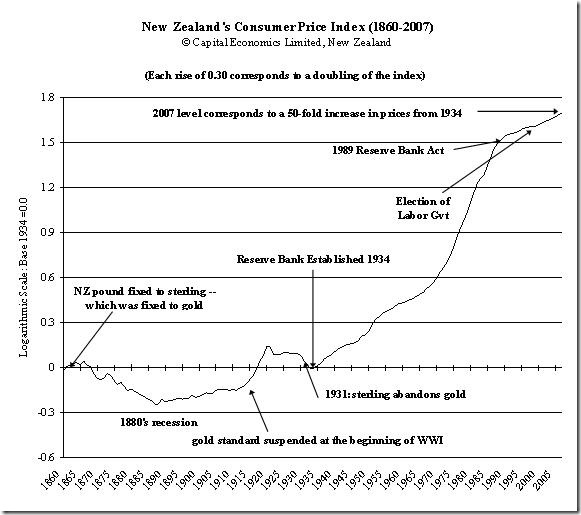
6a00d83451eb0069e200e55074d96c8833-800wi

Anyway, David McGregor concludes (and I thoroughly approve his recommendation):

    “For a complete theoretical and practical exposition on all of
the above - and a rigorous assertion of the viability of a 100%
gold backed currency and non-fractional reserve banking, I
recommend you download the following e-book. At 876 pages
it's not your average bedtime read, but if you have any interest
at all in where all this is headed, then you owe it to yourself
to discover why it has happened and the only sure way to prevent
it happening over and over again in the future.

    "Money, Bank Credit And Economic Cycles"
    By Jesus Huerta de Soto

    “Published by the Ludwig von Mises Institute and available for
free download here:  http://mises.org/books/desoto.pdf
    “Like I said, it's a BIG book - but even if you only read
certain chapters, the ones that immediately interest you,
you will already be better informed on this crucial subject
than all your ‘leaders’ put together!”

To get a heads up on the brilliance of De Soto's analysis, listen to this richly explanatory recent interview while you sort out your download, and check out his article: Financial Crisis & Recession.

* * * *

Thursday, June 19, 2008

Hot songs about cold beer

    NOT PC beer writer Neil Miller talked to Radio NZ's Jim Mora recently about beer tours, beer songs and other things beer.  He did well (audio here) but disgracefully, the best he could come up with in the way of great beer songs was Th' Dudes' 'Bliss.'  Uuugh.
    I figure between us you and I can do a lot better than that so the poor chap is better equipped next time he's put on the spot.  Here's a list to start with:

Great songs about beer, and drinking.
'One Bourbon, One Scotch, One Beer' - George Thorogood
'Warm Beer & Cold Women' - Tom Waits
'Pub With No Beer' - Dubliners
'Beercan' - Beck
'Six Pack' - Black Flag
'Special Brew' - Bad Manners
'Milk and Alcohol' - Dr Feelgood
'Beer' - Reel Big Fish
'I Spent My Last $10 (On Birth Control and Beer)' - Two Nice Girls
'Drink, Drink, Drink' - from Sigmund Romberg's 'Student Prince'
'Look What I Found in My Beer' - Beautiful South
'Long Neck Bottles' - Captain Beefheart
'Beer Goggles'- Brilleaux
'Beer Drinkers & Hell Raisers' - ZZ Top
'Boys From County Hell' - Pogues
Two Pints of Lager' - Splodgenessabounds
'Drinking Song' - from 'The Vagabond King'
'Let Us Drink' - from Verdi's 'La Traviata'
'Beer is a heaven's gift indeed...' - From Smetana's 'Bartered Bride'
'A Long Hard Thirst Needs a Big Cold Beer' - TISM
'Last Lager Waltz' - Kevin Bloody Wilson
'Titties and Beer' - Frank Zappa
'Philosophers' Drinking Song' - Monty Python's Flying Circus

What's yours?  (Remember, "a lot better than that " excludes anything sung by anybody wearing a stetson hat, meaning this is out -- and probably excludes songs you sing after a bucket load of beer. Probably.)

* * * *

Thanks for reading.  As your reward, here’s Tom: