Thursday, 22 September 2005

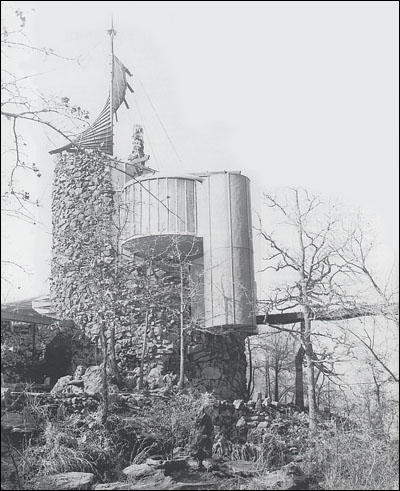
Frank Lloyd Wright's Massaro house

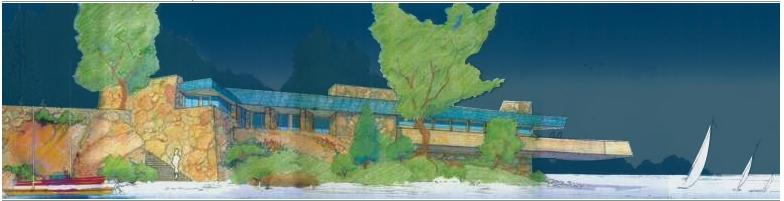
Fifty-odd years ago Frank Loyd Wright designed a house in upstate New York on a rock protruding into a lake . It was never built. Now, Wright archivist and architect Thomas Heinz has been commissioned to have the building built, based only on the five pencil drawings produced by Wright in the fifties. Story here.

To produce the house, Heinz chose to use the same CAD programme that I use, ArchiCAD. Graphisoft, the company that produces ArchiCAD, have put together a fascinating 1-hour presentation with Heinz explaining the design and building process, which you can find here. You will need broadband to download the presentation (it's 92MB!), but well worth it! A documentary on the project is on its way.

Linked presentation here.

Wednesday, 21 September 2005

Farewell Simon Wiesenthal

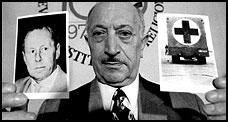
Other bloggers have already covered the death at 96 of holocaust-survivor and Nazi-hunter Simon Wiesenthal (right). As Mark points out, his work lives on the form of the Simon Wiesenthal Center. NZ Pundit points to an excellent Washington Post editorial that, as he says, "should act as the perfect comeback to those who wonder why people like Wiesenthal weren't willing to 'get over it, and move on'," and the perfect introduction to those unfamiliar with his life and his heroic work.
Called the "deputy for the dead" and "avenging archangel" of the Holocaust, Wiesenthal after the war created a repository of concentration camp testimonials and dossiers on Nazis at his Jewish Documentation Center. The information was used to help lawyers prosecute those responsible for some of the 20th century's most abominable crimes.
Wiesenthal spoke of the horrors first-hand, having spent the war hovering near death in a series of labor and extermination camps. Nearly 90 members of his family perished...
Following the principle "justice, not vengeance," Wiesenthal said trials of Nazis would provide moral restitution for the Jews and have the best chance of preventing the anti-Semitism that defined the first half of his life.
"I'm doing this because I have to do it," he once said. "I am not motivated by a sense of revenge. Perhaps I was for a short time in the very beginning. . . . Even before I had had time to really think things through, I realized we must not forget. If all of us forgot, the same thing might happen again, in 20 or 50 or 100 years."

You can read the full editorial here. Holocaust deniers needn't bother.

A new environmentalism: Putting humans first

Icehawk and DenMT objected to me "green-bashing" when, in my blog on Techno-Environmentalism, I linked mainstream environmentalism with the anti-human views of deep ecologists. This is my reply.

I'm very pleased that you're repudiating the deep ecology insanity, guys, and presumably also the idea that nature possesses intrinsic value in and of itself. But let me ask you if you both agree with an environmentalism that accepts humans as first in the hierarchy of nature; if so then we are in agreement. But I would challenge you both to point me to more than a few mainstream environmental organisations that do so.

To be fair, I believe the number of deep ecologists is decreasing from where it was when Bidinotto wrote 'The Green Machine,' from which came the quote to which you objected, but a 1997 survey published in American Demographics found that fully a fourth of all Americans "see nature as sacred, want to stop corporate polluters, are suspicious of big business, are interested in voluntary simplicity, and are willing to pay to clean up the environment and stop global warming." That's one quarter of Americans who see nature as sacred, just as the deep ecologists do.

 It's true that there is now a growing tension between those who sympathise with the view of the deep ecologists--what you might call the 'romantic' or 'religionist' environmentalists-- and a growing minority who have reversed their views on issues of population growth, urbani­zation, genetically engineered organisms, and nuclear power (as I discuss in a previous blog called 'Religionists for Nuclear.'), but this latter group is not yet in the environmental mainstream, although they do deserve to be.

On this question of who comes first, consider the case of Florida boy Jessie Arbogast, whose arm was bitten off by a shark. It's easy to agree (or to maintain a discreet silence as animal rights activists did) with the shark being shot so the arm could be retrieved and successfully reattached (but do note that such an action might now be illegal if the shark was one of Chris Carter's protected Great Whites) . That's an easy case with which to agree, and the justice of shooting the shark and retrieving the boy's arm should be obvious, as Tibor Machan quite properly points out:

Few among us would have hesitated at this choice: boy's arm versus life of shark. Of course the boy's arm is more important, and so the shark had to go. Yet, there are millions of animal-rights advocates around the world, many of them Hollywood celebrities with easy access to talk shows and news reporters, who have remained completely silent about their professed view—namely, that human beings are not more important than non-human animals.
But consider Tibor's further point. An environmentalism that honestly puts humans first would go further and apply the same principle applied correctly to secure the boy's survival and well-being to all the day-to-day activities human must undertake to secure their livelihood: Rather than seek to shackle human production and fecundity, they must recognise that the unique nature of human beings requires that they use, alter and sometimes despoil nature in order to maintain their lives and to produce wealth: no other means of livelihood is possible to the human animal.

Supporting human life means opposing the 'religious' environmentalism that is often economically devastating to farmers, fishers, miners, loggers, and others who necessarily 'despoil' untrammeled nature in the necessary pursuit of their, and our, livelihood.

So that's the challenge I put to you: do you agree that humans should be put first in the hierarchy of nature? And if so, do you agree with my conclusion from the article to which you objected; that is, in an "environmentalism ... that...eschews any idea of 'intrinsic values' or deep ecology, and embraces instead the idea of seeking and advancing those environmental values that support and enhance human life."
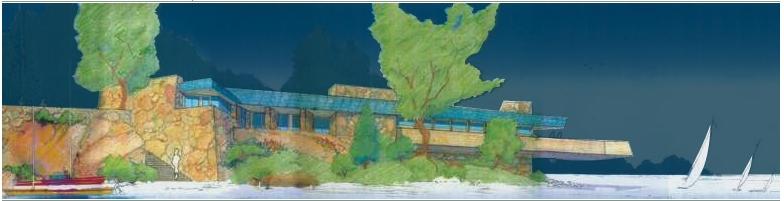
Frank Lloyd Wright's Massaro House

Fifty-odd years ago Frank Loyd Wright designed a house in upstate New York on a rock protruding into a lake . It was never built. Now, Wright archivist and architect Thomas Heinz has been commissioned to have the building built, based only on the five pencil drawings produced by Wright in the fifties. Story here.

To produce the house, Heinz chose to use the same CAD programme that I use, ArchiCAD. Graphisoft, the company that produces ArchiCAD, have put together a fascinating 1-hour presentation with Heinz explaining the design and building process, which you can find here. You will need broadband to download the presentation (it's 92MB!), but well worth it! A documentary on the project is on its way.

Linked presentation here.

A sad story

A sad story the other morning that "a Wellington man lay dead in his armchair for 10 months before he was discovered... Neighbourhood Support and Grey Power say the case is a sad indictment on society..." etc., etc. Monday's Herald has the story offline.

It is a sad story, and there's no doubt a city can be a lonely place, but it's not an indictment on society, it's just sad. The man, 62 year-old Timothy Miles, chose to live alone and he shunned company. One neighbour, a "Mrs Palmer said more people needed to get involved in neighbourhood support programmes because it was not about being a nosy neighbour but about looking out for each other." A difficult balance when a neighbour just wants to keep himself to himself.

It brings to mind two songs: one written by Scottish-Australian musician Eric Bogle (the chap who wrote 'And the Band Played Waltzing Matilda') about a similarly sad case in Sydney some years ago, which he called 'A Reason For It All.' The other is a song by Tom Waits satirising the nosy neighbours Mr Miles may well have been wanting to avoid, 'What's He Building?' (Lyrics here, snippet here on the Amazon site.)
What's he building in there?
What the hell is he building in there?
He has subscriptions to those magazines...
He never
waves when he goes by
He's hiding something from
The rest of us... He's all to himself...
I think I know
why...
What's he building in there?

We have a right to know...
No, you don't.

Introduction to profit/interest

George Reisman offers a free introduction to his theory of profit/interest and its major applications: an integration of the classical school's notion of profit with the Austrian idea of original interest.

(The file is a 29 megabyte Adobe pdf file, with each page accompanied by oral commentary. You will need a special Adobe plug-in, here is a download for Adobe 7.0 including the necessary plug-in.)

Reisman is the author of the book Capitalism, his magnum opus, available free on pdf at his site. Larry Sechrest has described it as
"probably the most remarkable textbook written by any economist in this century. It is a book that will broaden the horizons of economics students at the same time that it challenges and provokes their professors. It is, quite simply, must reading for anyone interested in economics." This oral presentation offers a good introduction.

Linked presentation here.

Bart Prince's Price House

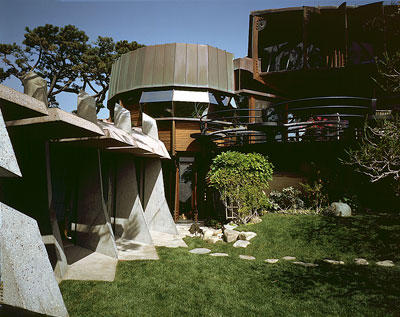
By special request, tonight's featured artwork here at Not PC is Bart Prince's house for Joe Price. (Requests for artworks to feature here are always welcome.)

Like architect Herb Greene, Bart Prince was a student of and a succesor to Bruce Goff, whose Bavinger House was featured here yesterday. And Joe Price himself commisioned an earlier house from Bruce Goff, and was instrumental in his father commissioning the Price Tower from Frank Loyd Wright--Wright's only built high-rise, in which Goff himself lived and worked for a number years.

Tuesday, 20 September 2005

Rodney says "do a deal"

Rodney Hide is suggesting that the Blue Team can cobble together a government if the Nats drop their Maori policies and do a deal with Tariana, Sharples, Flavell and Harawira. Herald report here:
Mr Hide said National should accept it does not have the electoral mandate to scrap the Maori seats and should shelve its plans. It should also change its position on the foreshore and seabed.

It should offer to scrap the Foreshore and Seabed Act and then leave decisions in that area to the courts on a case by case basis.

In principle, that would gel with National's policy of "one law for all", he said.
The Nats are on the wrong side on the issue of the Foreshore and Seabed, as Rodney says and as I argued here a while back, so scrapping the Foreshore and Seabed Act would be a good thing. And it's undoubtedly true that the abolition of the Maori seats wouldn't get through the present Parliament anyway, but isn't the strategy here just a little optimistic? "The Act leader said establishing a National-led centre-right government was more important than holding onto its Maori-related policies." Is it? And can you realistically see Hone Harawira voting with National?

[UPDATE: TinCanMan astutely notes below that "
National has taken a sensible approach on the Maori seats, to back down now is simply peer pressure politicking," and of course he's right. I thought my view on that would be obvious to regular readers, but it's worth reiterating as TCM has done. Ta. ]

Lunatic?

Ken Ring told Leighton Smith this morning he predicted the Christchurch cold snap eighteen months ago in his long-term weather almanac. I haven't got the quote (you should find his interview with Leighton here, about 10:30am) but to me it sounded about as vague a prediction as one given by Nostradamus.

Ken Ring doesn't predict weather by the usual meteorological methods, he relies instead on the gravitational effect of the moon and the cycles he says it produces. Here's his explanation of why this works, and here's his Free Forecast page if you want to test him.

Now, if he wasn't already a member of the Skeptics Society (or is that former member), on the face of it I'd be referring him there immediately for investigation. It sounds like nonsense, but by all accounts (Ring's own, to be fair) he has has about an 85% success rate, with all the appropriate disclaimers, to be sure.

Does anyone have any Ring successs stories to report? Or is he just a nut?

Bill Keir, from both the Auckland Astronomical Society and the Skeptics Society, is in no doubt:

Obviously Ken Ring has a significant loyal following, and his weather forecasts are correct often enough to convince impressionable people. But why do the news media love this man so much?

I suggest several reasons. Ken Ring probably pesters them so much they can’t resist, and he is charming, affable and a master of bluff... Most media people have a poor understanding of the sciences.... The electronic media especially have an aversion to anything that taxes the brain for more than a few seconds. This is obvious from the way factual corrections are handled – they are either not published at all or hidden away where they will be missed. I wait in vain for a front-page headline reading, “Moon did not cause floods – yesterday’s headline wrong.”

...The fringe theorists won’t go away. We are dealing here with a growing trend. These people are exploiting modern information and publishing technology, and freedom-of-speech principles, to spread fabrication posing as fact. They go largely unchallenged. The Ken Rings of this world are purveyors of falsehood with the gullible collusion of the news media. The whole process increases public ignorance – the exact opposite of what the information explosion is thought to be doing.

But will Ken Ring and his followers listen to serious refutations? I fear not. Expert refutation will probably only reinforce their conviction that the establishment is suppressing their brilliant ideas. And that’s just the sort of juicy story angle some people fall for.

That's just how it seems to me. Read Keir's detailed analysis of Ring's output beginning here, and Ring's response is here. I'd love to hear your thoughts.

Snowed in?

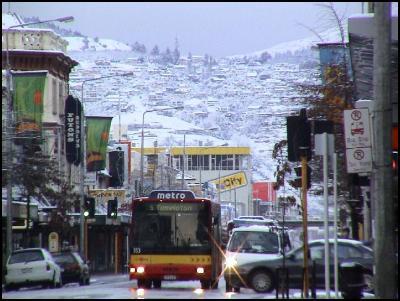
When cities are used to snow, when snowfalls come its generally business as usual. Not so elsewhere though where snow only hits irregularly, and snowfalls bring a gentle sort of chaos, especially when they arrive out of season.

Christchurch is still apparently a picture postcard, with roads, parks, airport, Lincoln University, Christchurch Polytech and Inland Revenue closed. Not all bad then.

I remember a few years back when living in London that the trains were on a limited service when heavy snow came, not because British Rail were unprepared but because, as a BR rep famously said at the time, it was "the wrong kind of snow." Businesses and offices closed for several days due to the transport difficulties. People didn't stay snowed in at at home though: people couldn't get to work, but shops, pubs and restaurants were full.

Blair disses Kyoto; Rice plugs nuclear power

When George W. Bush says he needs a bathroom break, the note is read around the world. But when Tony Blair says he wants to pull the plug on the Kyoto Agreement the news is barely whispered. TechCentralStation has the news.

Speaking at the Clinton Global Initiative, an otherwise feelgood snoozefest boosting former-President Clinton's formidable ego, Blair said of Kyoto that nothing much should be expected:
"My thinking has changed in the past three or four years." So what does he think now? "No country," he declared, "is going to cut its growth." That is, no country is going to allow the Kyoto treaty, or any other such global-warming treaty, to crimp -- some say cripple -- its economy.
So much, so irrelevant then for Kyoto. (A shame though that we've left ourselves $1 billion in the hole here in NZ, though.) How about after 2012, when Kyoto expires?
Blair is acknowledging the obvious: that after the current Kyoto treaty -- which the US never acceded to -- expires in 2012, there's not going to be another worldwide deal like it. So what will happen instead? Blair answered: "What countries will do is work together to develop the science and technology….There is no way that we are going to tackle this problem unless we develop the science and technology to do it." Bingo! That's what eco-realists have been saying all along, of course -- that the only feasible way to deal with the issue of greenhouse gases and global warming is through technological breakthroughs, not draconian cutbacks...

And there was some potentially significant news from Condi Rice, who was also on-stage all this time, sitting with Clinton and Blair in an Oprah-like format. Speaking of world energy policy for the future, Rice said, "Nuclear power is going to have to be part of the mix." Imagine that -- nuclear power! That's been the Bush administration view all along, of course, but the W. folks haven't gotten very far in resuscitating the industry. Yet if Blair is starting to show realism on Kyoto, he and other leaders around the world will see that nukes have to be part of the energy solution.

Oddly, you won't see this reported anywhere except TechCentralStation.

Bavinger House

The 1955 Bavinger House, by Bruce Goff.

Monday, 19 September 2005

Did ACT really win?

GMan asked the question, "Did ACT really win?" It got me thinking--a dangerous thing.

I think the answer has to be: "No." ACT has lost seven MPs out of nine, a huge loss by anyone's standards (although the loss of ACT's conservative wing is long overdue, and will perhaps follow this loss). But there's something in the numbers that shows, I think, a greater loss, and which Rodney's against-the-odds victory in Epsom has somewhat obscured.

Rodney received 13,661 electorate votes to win the Epsom seat, 44% of the total votes cast. A tremendous personal achievement, and a tribute to him and his enthusiastic team in the face of naysayers everywhere, including myself. He and his team has earned the right to gloat (feel free to do so below).

But across the country, with all its profile and all its advertising and money, ACT itself received only 31,074 party votes, and of those only 1,078 were from Epsom. Compare that to Rodney's 13,661. Rodney's personal support in Epsom then was just under half that of his party's support across the country, and even in Epsom--awash with ACT campaigners--the ACT party vote failed to even reach the 5% 'threshold.'

So Rodney won, but ACT lost.

This wasn't just the collapse of the minor party vote that all minor parties experienced; this suggests to me at least that the support for Rodney is largely personal support, rather than support for ACT's principles and policies, and the support for ACT's principles and policies themselves is largely down to its rump. Who after all could even name some of those policies, or the principles?

What that means for ACT's future then is unclear, but it seems to me that if it does want to pick itself up then it needs to become principle- and policy-driven, rather than being just another of Parliament's 'attack dogs.' That Rodney is the man who would need to drive the party's change of direction is perhaps an interesting irony.

PC on the Libz result

Naturally, we Libertarianz are very disappointed today.

As a campaign this was by far the best one we've run. Twelve electorate candidates and thirty on the list. Principled policies, professional candidates and professional administrators. Superb billboards, a nationwide cinema campaign, and wonderfully pithy TV ads. We Libz measure our successs by how far our ideas go rather than numbers achieved, and we never did break through the 'media barrier' to get real name recognition, but we were nonetheless dismayed despite all this to receive barely 1,000 votes across the country (1006 on the night, but strangely only 926 now)-- that's roughly 1.5 times fewer than the Alliance Retards; 4 times fewer than the ALCP; 12 times fewer than Density; and 30 times fewer than ACT. All these received greater media exposure, but any thoughts that greater consistency and acuity would be rewarded was proved wrong on the night.

Every minor party was squeezed, but this was grim indeed. While numbers are not our be all and end all, that's still pretty disheartening. We knew were not going to be troubled by calls from the Governor-General, but even the most pessimistic guess in the party sweepstake was 6,500 (my guess, incidentally.)

Still, we do AFAIK have votes in every electorate across the country, with the highest (60) oddly enough in Tariana Turia's seat, Te Tai Hauauru. And it's clear, as we've been saying, that Libz ideas have been given lip-service right across the spectrum, from Rod Donald describing himself to Grim Pill as a "radical capitalist"; to Helen Clark declaring twice in the last two days of the election, "I'm in favour of maximum person freedom, as long as other's rights aren't impinged"; to Don Brash running on the argument that it's your own goddamn money, that one law for all is not racist, and that freedom and property rights deserve attention, if not substantive policy.

So that much is pleasing. As Mrs Marsh used to say in that toothpaste ad, "It does get in." Our ideas are getting there, some reward at least for our consistent advocacy, but our numbers on the ballot this time to help give those ideas wings are not encouraging. In any case, each one of those votes we did receive was an honest, firm, committed vote, given in the full knowledge of what each person was voting for. For that, I am truly thankful to very one who cast a libertarian vote. Thank you all.

Celebrating genius

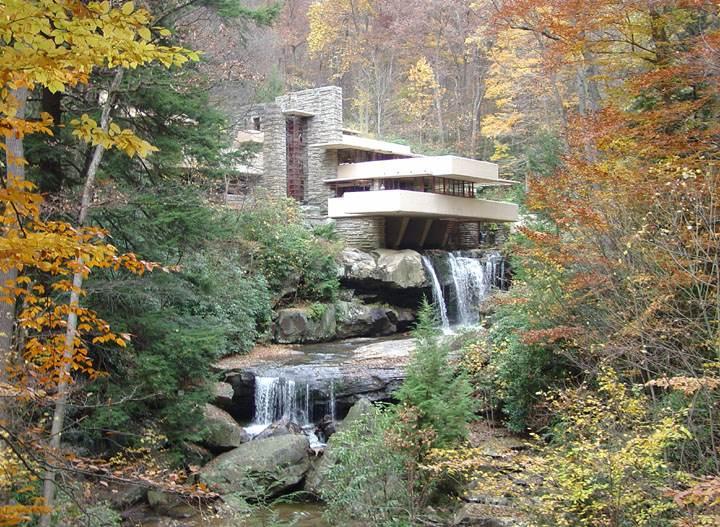
This Thursday marks the 70th anniversary of the morning architect Frank Loyd Wright received a call from his client Edgar Kaufmann to say he was driving out to see Wright's progress on the house he had commissioned from him. Wright got to work, and in a few short hours drew up the idea that was already full-grown in his head: what he produced was the twentieth-century's architectural masterpiece. It became known around the world as Fallingwater. That's it there on the right (and in larger form if you click on it.

It's an inspiring story of human creativity, and an event well worth celebrating. A new exhibition opening soon at Pittsburgh's Carnegie Museum celebrate's Wright's creativity by showcasing two more examples of his genius: the 1903 Darwin D. Martin House, and the 1952 Harold Price Tower.

And a new feature at America's PBS allows you to use an online map of Frank Loyd Wright's creations to plan a series of Wright-based discovery trips (one of my seven things planned for a time in the future) . As the Kansas City Star notes, it's just one of a "whole new world of maps unfolding online" that, following on from Google Maps, are revolutionising the way maps, landmarks and locations are displayed online.

Red v Blue: What's the difference?

A Labour minority Government, with support from minor parties on an issue-by-issue basis, is what we've had for the last three years, and it's looking increasingly likely that a Labour minority Government working on a similar basis could be pulled together, but would likely be more hamstrung.

A hamstrung Government is good. It means that existing legislation doing us over won't be repealed, but at least it makes more difficult the imposition of new legislation that does us over.

In any case, an analysis of real policy differences between Red Team and Blue Team is instructive. Substantive policy differences between National and Labour come down to differences over tax, and over racial legislation. On all other issues you can hardly pass a sheet of blue policy paper between the parties. A minority National Government would find it near-impossible to pass its flagship One Law for All policy and probably even its tax cuts as promised, and the chances of Maori Party MPs supporting a minority Government wanting to abolish the Maori seats is about the same as Keith Locke's naked run bringing an offer from Steve Crow to star in Vixen Production's next porn flick.

So in that sense, a minority government of either hue would look much the same. And both would be hamstrung, at least for a while. That may be the best outcome we could have hoped for.

Site Poll: Can the Maori Party support Labour

Speaking on Breakfast News, Pita Sharples indicated the unlikelihood of the Maori Party offering support to National, but given their formation was inspired by Labour's Foreshore and Seabed legislation, can they now offer Labour support?

What do you think? Vote now over there on the sidebar.

The result of the last Site Poll, while hardly overwhelming, indicates a fairly even split between those who enjoyed the election ads (10 votes) and all the mudslinging (16 votes), and those who had just had enough of it by Saturday (29 votes). And 6 people didn't give a toss. Thanks for voting.

Techno-Environmentalism

DenMT criticised me last Thursday for what he called an "emotive, pandering bullshit quote of [mine] from this Michael Berliner character," ie,
The fundamental goal of environmentalists is not clean air and clean water; rather it is the demolition of technological/industrial civilization. Their goal is not the advancement of human health, human happiness, and human life; rather it is a subhuman world where "nature" is worshipped like the totem of some primitive religion.
Berliner, it's true, is a little hasty in ascribing to every environmentalist the goal of demolishing technological/industrial civilization, however that goal is certainly true of those who subscribe to the environmental fundamentalism of 'deep ecology'--what you might call the environmental religionists, and those who defend them.

The origins of the deep ecology movement are described by Robert Bidinotto:

In a famous 1966 essay, UCLA historian Lynn White, Jr., blamed the ecological "crisis" on the West's Judeo-Christian heritage, which, he said, was based on the "axiom that nature has no reason for existence save to serve man." He called for a "new religion" based upon "the spiritual autonomy of all parts of nature" and "the equality of all creatures, including man."

Norwegian philosopher Arne Naess took all this a step further. Individuals do not exist, he said; we're all only part of larger "ecosystems." The "shallow ecology" of mainstream conservation groups, he argued, was still anthropocentric, or homocentric. It aimed only at improving the environment for the benefit of humans. "Deep ecology," on the other hand, led to a view of "biospheric egalitarianism...the equal right to live and blossom."

In short, all things are created equal; they should be venerated as ends in themselves, as intrinsically valuable apart from Man; and they have equal rights to their own kinds of "self-realization" without human interference or exploitation.

This is now the basic outlook of most mainstream environmental groups, despite their moderate posturings.
So there you go. If they're not fundamentally opposed to human life like the 'Right Virus' man David Graber--"until such time as Homo Sapiens should decide to rejoin nature, some of us can only hope for the right virus to come along"-- they're at least fundamentally indifferent to human survival. Witness for example the indifference to the 55 million dead due to Rachel Carson's mistaken campaign against DDT.

Some environmentalists are different, of course. TechCentralStation has a piece on precisely that kind of forward-thinking environmentalism here, what author James Pinkerton calls Ultimate Environmentalism.

You might say that the defining characteristic of Ultimate Environmentalism is that it eschews any idea of 'intrinsic values' or deep ecology, and embraces instead the idea of seeking and advancing those environmental values that support and enhance human life. Embrace that.

Sunday, 18 September 2005

'Haters and wreckers' hold the key

As the dust clears this morning, it looks by all the numbers that the Maori Party--formed in opposition to Labour's Foreshore and Seabed Bill--holds the key to any "strong stable government" that Labour can now cobble together. Which means that the key to a stable Labour-led government are Helen Clark's "haters and wreckers" whose post-Hikoi company she shunned, explaining she would take time to meet Shrek the merino sheep but would not take time to meet Hikoi members, "Because Shrek was good company."

Shrek must now be spurned, and the haters and wreckers embraced. Is any deal possible?

Maori Party Co-Leader Pita Sharples, new MP Te Ururoa Flavell and and Party President Whatarangi Winiata are all talking tough: they know who holds the whip hand. Winiata says "he would rather return the country to the polls than compromise the party's principles. 'It may be better to go back to the electorate and have another vote.' Sharples himself says everyone will have to wait while hui are held amongst their members. "It's not just Maori time, it's Maori custom."

It's a good thing we don't need a government, because we may not have one for some time.

It may be that the other minor parties, over the five-percent threshold only by the skin of their teeth, would baulk sufficiently at the thought of putting their necks on the line in another poll so soon after this one that they will roll over and put their feet in the air for Helen. Or for Don? But will that be enough when the first motion of no confidence is raised in the House?

The sheeple have spoken, and it seems we have an impasse. What I wonder will be traded away to make that impasse disappear? Someone will be shorn, and it's likely it's going to be us.

A hung Parliament

The sheeple have spoken, and we have a hung Parliament, and hopefully an ineffective one. That perhaps is the best result from tonight: Several months of legislative logjam.

To my ACT-supporting readers, I concur with Aaron:
I recognise the enormous energy and passion of the ACT team in Epsom who saw Rodney Hide through, when ACT around the nation had been brought to its knees. The passion, in particular of the ACT On Campus people ought to be noted, the people who fought like hell to ensure that their dream stayed alive.

This victory is not a victory for ACT, but a victory for Rodney Hide on a personal level. He will not be remembered as the man who saw ACT die on his watch. Conversely, he will be remembered as the man who saw it live to fight another day. But I have no doubt that ACT's fightback will be an arduous, nigh-on herculean task given the overall result for ACT. It may not yet be possible, but time will be the judge of that.

That can wait for now. For on election night, Rodney Hide won Epsom.
Congratulations to everyone that deserves it. Twenty-two politicians lost their job. That can't be all bad.

Friday, 16 September 2005

Last thoughts before tomorrow


After a gruelling campaign that seems to have lasted several months, the smoke and fireworks are about to clear for one day, and you are left with one choice that is wholly yours to make: who you are going to vote for, or if you're going to vote at all.

Your vote is the one thing you do that politicians actually do listen to. If you do want to send them a message, tomorrow is the time.

Politicians only understand one thing at election time: that you voted either for them or against them. If for example you hold your nose and vote Team Blue just to get out Team Red, then Team Blue will see that as a vote for them, and an endorsement of their people and their policies. That you don't see it that way is irrelevant: an endorsement is what you've just delivered, and three years of Blue-tinged bossiness is what you'll receive--and you will have voted to receive it.

Don't forget what the Blue party did last time they were in power. Don't forget who introduced the RMA and the NCEA. Behind Brash the same pathetic old hacks are still there. And as Lindsay Perigo points out in the latest Free Radical, the pathetic old hacks are still the ones writing Blue policy:
National under Don Brash has been a huge, but entirely predictable, disappointment. The runaway success of his Orewa 1 speech should have taught Dr Brash that this was the way to go. The same ringing advocacy of one law for all should have been brought to bear on all policy areas: the economy, defence, health, education … Instead, what has he done? He has capitulated to marshmallow middle-grounders in all of them.
Don't just vote against Hard Labour by giving your vote instead to the marshmallow middle-grounders. Vote instead for what you do believe in: Your life, your liberty and and your pursuit of property, prosperity and happiness. I can only repeat what I said the other day in this speech:

There are 20 parties this election. 19 of them think it’s OK to help themselves to your money and boss you around with it. We don’t. We say that’s wrong.

We say that at this election there are twenty parties but only two choices: Nanny State in nineteen different guises, or Freedom, and Libertarianz.
It's true. If you want nannying, vote elsewhere.

Only Libertarianz promises to get government completely out of your pocket, out of your face, and out of your life. How will we do this? I answer that one here, in What's the Point of Political Activism, and here in Brushfires of Liberty. In the former I argue:
Who should you vote for? Vote for yourself. Only a vote for Libertarianz allows you to do that. "It does not take a majority to prevail … but rather an irate, tireless minority, keen on setting brushfires of freedom in the minds of men.”
We are that tireless minority. Your vote gives our efforts wings.

At this election, I urge you to free yourself from the politicians. Cast a vote for your life, and for your liberty. Cast it for Libertarianz. We may not be in parliament this election, but you can be damn sure our ideas will be. Your vote will help that happen--every vote cast for Libz will help it happen. Every vote for Libz is a message to Parliament saying "I own my life!"---it is a message the politicians will hear, and that we will keep on making them hear.

If you do want to start getting your life back from the politicians this election, then Vote Libz. Any other vote is just a vote for more of the same.

And after the election? I invite you to join us in 'Putting the 'P' into Politics', and help keep the brushfires of liberty alight! We at least know that if it's your freedom you want, there are no shortcuts.
=============================================

BTW: Readers of Not PC are invited to call in and join other highly intelligent, like-minded people at an Election Night gathering in Mt Eden, where we can celebrate at least some politicians losing their job.

WHERE: 45A View Road.
WHAT: BBQ and BYO wine, whiskey, what-have-you.
WHEN: Sat Sept 17, from early evening on.

See you there!

Election Night Drinking Game

If you haven't yet been sent the Official Government Drinking Game for Election Night, then fret not, 'tis here in PDF, and over there in Jpeg.

Enjoy!

"I hate..."

If you base your vote on who or what you hate, then Three Point Turn have a handy voting card to help you choose. [Hat tip DPF.]

Cunliffe cuts loose at supporter

We've had Hodgson wrestling women at Otago, and Pita Sharple's kidnapping children in Auckland... a Libz supporter told me that when picketing outside David Cunliffe's caravan in West Auckland yesterday Cunliffe stormed over and threatened him, "Go away, go home, get off the street now. I'll ring the police and get you arrested." The supporter told me he didn't leave, the police didn't arrive, and instead Cunliffe hitched up his caravan and buggered off.

Nothing like threats and physical violence to show the true nature of politics. Freedom of speech, eh?