Showing posts sorted by date for query futuna. Sort by relevance Show all posts

Tuesday, 12 March 2013

Sagrada Familia, by Antoni Gaudi

Construction on the Sagrada Familia began in 1883, when famed architect Antoni Gaudi first laid the blueprint for his now-iconic Barcelona church. Gaudi devoted his last years to the project, and 130 years later, it's widely regarded as one of the most stunningly unique buildings on Earth. It also has yet to be completed…

But it will be:

Using advanced aeronautical design software, [New Zealand born architect] Mark Burry* and other architects have been able to reverse engineer Gaudi's models from leftover shards. Today, Burry is among a group of architects leading construction on the church's central tower, which, when completed, will stand 566 feet above the ground, making it the tallest church on Earth.
    But the fact that they had to use 21st century software to realize a 19th century vision stands as testament to Gaudi's avant garde design language.
    "We had to look to other professions who've actually tackled the complexities of the Família," [says Burry]. The only equivalents, he added, are the initiatives undertaken by today's car, plane, and ship designers. "They've been grappling for decades with the very same issues that Gaudí was putting up as architectural challenges."
    It also speaks to Gaudi's breathtaking ambition. According to biographer Gijs van Hensenberg, Gaudi envisioned the Sagrada Familia as an encapsulation of the entire Catholic history — a "Bible written in stone" that radically blends Gothic tradition with modernist sensibilities. "He's someone who reinvented the language of architecture," van Hensenberg said.

*Interested in this? Then you might like to know that Mark Burry will be lecturing around the country next week as this year’s Futuna Lecture:

Professor Mark Burry is a New Zealand born architect and was a lecturer at Victoria University before moving to Australia and is now Professor of Innovation and Director of the Spatial Information Architecture Laboratory at RMIT University, Melbourne.
    Mark will speak about his ongoing work with the construction of Antonio Gaudi's Catholic Basilica 'Sagrada Familia' in Barcelona Spain as well as his continuing spatial design research at the Design research Institute (DRI) in Melbourne.

Thursday, 14 December 2006

Futuna Chapel, Wellington: Event this weekend

I've blogged before about John Scott's Futuna Chapel as one of my favourite New Zealand buildings, and this weekend you can visit and look around almost as much as you like: the Friends of Futuna have an open weekend including videos, stories and a 'haunting' -- and also a talk from Nick Blake on the architecture of the chapel at 8:30 each evening. [Hat tip Idiot/Savant]

If I were in Wellington, I'd sure as hell be getting along there.
When: Friday December 15th - Sunday December 17th, 10am - 10pm
Where: Futuna Chapel, 62 Friend Street, Karori
How much: Free!
RELATED: Architecture, Wellington

Tuesday, 17 October 2006

Futuna Trust making progress towards goal

I've just heard news from the Friends of Futuna Charitable Trust (story about building and Trust here) that they're already a third of the way there towards their goal of $500,000 to complete the purchase and preserve the now-moribund Futuna Chapel in Karori, and to set it up as "a spiritual and architectural retreat, and a home and display place for the John Scott architectural archive. In addition," they say, "the building can become a place for lectures and exhibitions, musical and artistic performances and other events in keeping with the nature of the building."

So, one-third of the way there already. Great news. As long as they refrain from political criticism they should reach their target. If you want to donate to help preserve a work of native genius, you can do so here.

LINKS: Friends of Futuna Charitable Trust
Chapel of Futuna - John Scott Architect
Futuna Chapel - John Scott (Karori, Wellington) - Not PC (October 9, 2006)

RELATED:
Architecture, New Zealand, Wellington

Thursday, 12 October 2006

Popular posts. Popular searches.

Listed here are popular posts presently here at 'Not PC.' Evenly distributed between art, architecture, politics, humour and sex.
  1. Frank Lloyd Wright: Broadacre City
  2. Counterfeit Korea?
  3. Government changes tack in pledge card defence
  4. 'Evening, Fall of Day' - William Rimmer
  5. Becky wants to knock her school down
  6. UK libertarian Chris Tame passes away
  7. Futuna Chapel - John Scott (Karori, Wellington)
  8. 'Price Tower,' by Frank Lloyd Wright
  9. Female soldiers
  10. More "enormous" trade deficits
Popular searches:

broadacre city
structure twa terminal 3d
art of female soldiers
empire state building portrait construction eating
evening, fall of day
frank lloyd wright's environmental concepts
annette presley
the scream found
does budvar contain yeast
peter cresswell
frank lloyd wright broadacre city
price tower architectural
evening fall of day
warning fascism
broadacre wright
exclusive brethren - gadsden
becky from dublin
adam hamilton university of colorado
leighton smith news talk
mark inglis
prduction point in a perfect competitive market
christina's world history
new zealand bill of rights 1688
bruce goff bavinger layout
geoffrey howe savaged lettuce

RELATED: Blog

Wednesday, 11 October 2006

Futuna Chapel - John Scott (Karori, Wellington)


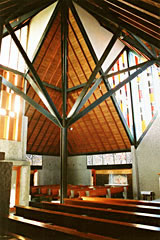
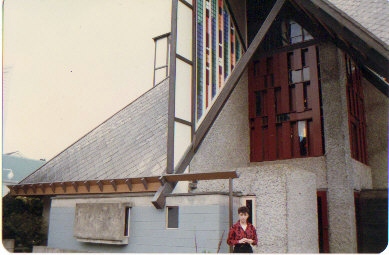
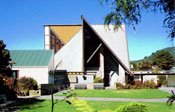
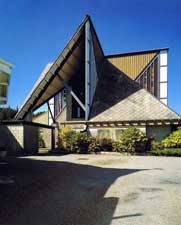
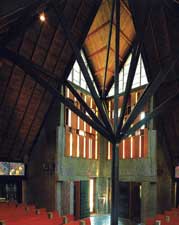
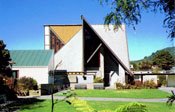
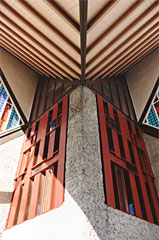
I've mentioned this building before, but blogger Well Urban sent me to a new site with photographer Gavin Woodward's superb (but small) pics so you lot can get some idea of why it is so special. Given its enclosure these days by townhouses (and worse ignominies just a few short years ago), it's difficult to imagine it now as the spiritual retreat it was when built.

It's one of the most delightful small buildings in the country -- in fact it's probably one of the most delightful buildings in the country full stop -- and I say that as someone who is not a religious person (in case you hadn't already guessed) but this building gives perhaps a sense of the religious feeling at its best. Peaceful. Contemplative. Worldly.

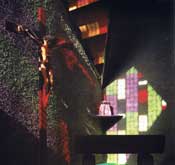
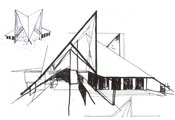
Its simply-developed but suitably mysterious roof geometry shelters a perfectly scaled space inside, and allows light (beautifully modulated by the stained glass) to paint the thick, roughcast protecting walls. It is a space in which one feels protected, and can feel reborn. It is a masterpiece.

Now, I should also tell you that the website that hosts these photos, the Friends of Futuna, is trying to raise money to buy it.
The intention of the Friends of Futuna Charitable Trust is to conserve the building, and to make it available on a regulated basis to the public now and into the future.
Essentially, the Friends Trust sees the Chapel as a spiritual and architectural retreat, and a home and display place for the John Scott architectural archive. In addition, the building can become a place for lectures and exhibitions, musical and artistic performances and other events in keeping with the nature of the building.
If you have the money to help, this really is a good cause: you will be helping to preserve a work of genius. John Scott was one of New Zealand's very best architects (though often inconsistent) , and this building is without a doubt his greatest achievement -- it is genuinely world class. Think about it.

And if you're in Karori pay a visit, and do try and stay a while.

LINKS:
Friends of Futuna Charitable Trust
Chapel of Futuna - John Scott Architect
Inside Job - Well Urban

RELATED:
Architecture, New Zealand, Wellington

Tuesday, 19 September 2006

Architecture V Architecture: Artist's House, by Organon Architecture

This last post of my own 'Top Five' in this architectural series is, per request, of my own favourite New Zealand building.


There's some serious contenders here for my own favourite local building. Karori's Futuna Chapel by John Scott is a personal favourite -- the scale, the light and the playfully geometric 'simple yet mysterious' roof is intensely evocative, even in its current setting -- but the photographs available hardly do justice to the space. Auckland University's famous Clock Tower Building and its related campus buildings is another personal favourite, and this is as much for its original ornamentation and its qualities as an innovative inaugurating College Building from which to begin a campus as it is for the excitement of knowing that it's architect was Frank Lloyd Wright's draughtsmen's draughtsmen, and so the closest we've got to our own original NZ Wright -- however, for mine the aggressive symmetry and the similarity to a wedding cake are a detraction.

Architect Claude Megson has several candidates, but with Claude's buildings we encounter a familiar problem: Claude did not design for those who flick loftily through magazines or to impress a building's neighbours, he designed houses for his clients, houses so good that those who commissioned them often didn't want to leave them. But they don't photograph well.
Their qualities are 'built in' rather than worn on the sleeve, and you often don't notice them even when you're driving right past.

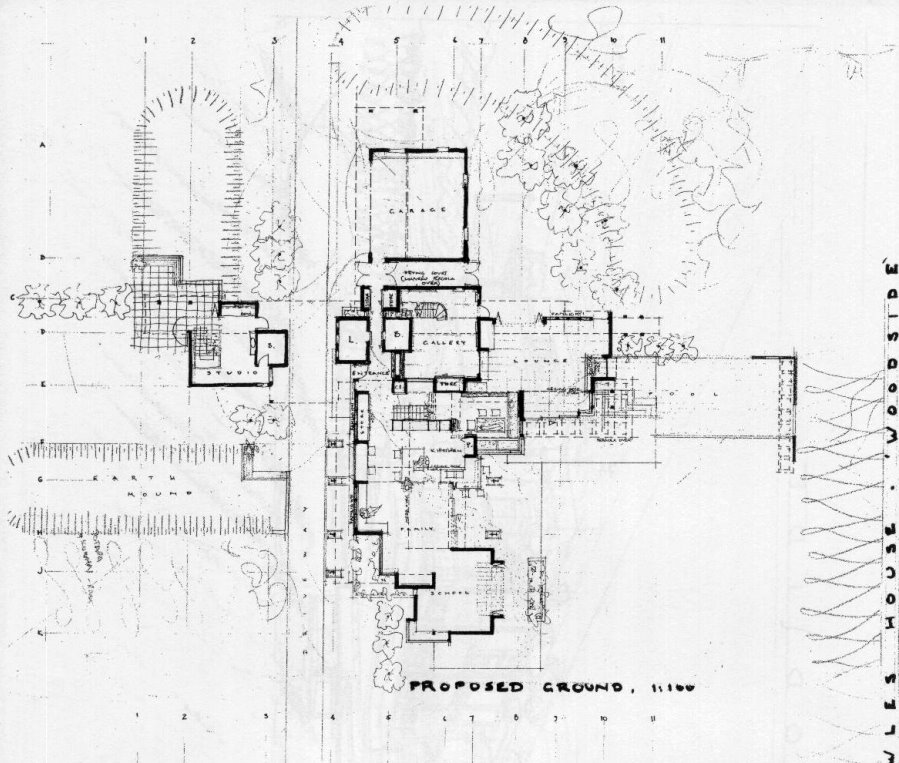
So in this case then for my own personal NZ favourite I not so humbly submit one of my own sketch designs, as yet unbuilt, for an artist's house in the Wairarapa. It largely follows my own ideas on the promise of the New Zealand house.


This is a two-level house with roof deck, set in rural Wairarapa beneath the Tararua Ranges (to fit the landscape in the painting at bottom). The site is is very near the rail line to and from Wellington, and the intention is for a home from which the artist can work, enjoy life with his family, and welcome in 'art tourists' who can view his work, watch him paint, and buy, buy, buy.

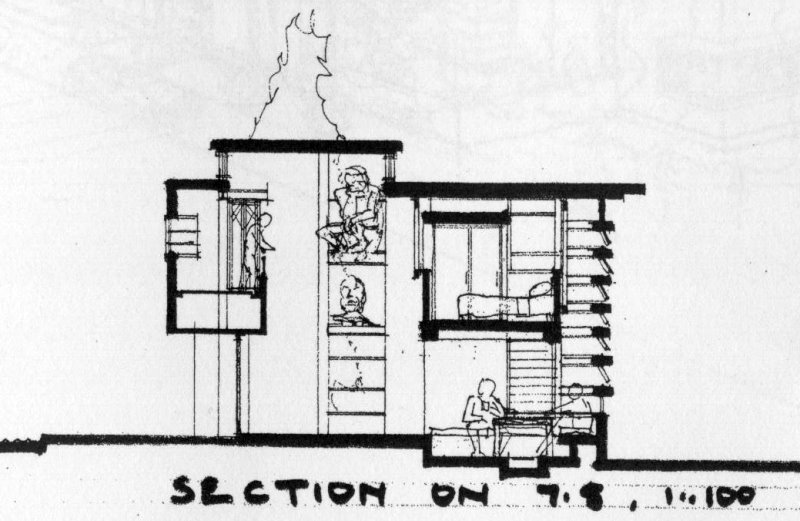
The house has four wings and four courtyards-- each with its own definite aspect and character -- all centred around the reason for the house: the artist's own work displayed in the double-height cubic gallery around which the various wings pinwheel out, and above which a roof deck offers a lookout to the beauty of the surrounding landscape, (captured in paint in the image at the foot of this post.)

Working clockwise around the four compass points of the house:
  • we first have the studio wing and studio garden at the eastern part of the compass, over the driveway from the gallery and connected through the upper level east-west axis, and looked over by the mezzanine gallery and an internal 'picture frame' window' from the master bedroom;
  • to the south is the garage and service court, accessed from the driveway which runs under the bridging upper floor;
  • the west axis is the more formal, accessed from the main entrance through the gallery and into the lounge and sculpture gallery, and then out to the pool and the two contrasting courtyards and the landscape beyond;
  • running from the entrance the north wing comprises in order kitchen, family room and homeschooling room: this, with children's bedrooms above is the family wing, spilling out to the afternoon courtyard
The gallery is the heart, the anchor, the very reason for the house, around which the life of the house plays out, and spills out into the landscape. Vertical concrete 'pylons' -- which share with portal steel frames the job of supporting the house -- display more of the artist's work throughout the house, all of it carefully lit from above.

An upper-level steel catwalk passes east-west through the top-lit gallery from 'studio wing' to 'guest wing,' taking guest all the way across the house from mezzanine lounge level (where provision is made for future guest bedrooms) in a straight line through the upper gallery and over the drive to the studio. This axis emerges at each end of the house with decks that reach out to the landscape, as does the family wing, from which a large deck offers sweeping views over the landscape to the east, north, and west.

The more I rediscover this house, designed over five years ago, the more I enjoy it. To see it built would be, well ... I'd be very excited.

RELATED: Architecture

Saturday, 30 July 2005

Futuna, by John Scott


An unsung New Zealand masterpiece, sadly now in a state of deterioration: John Scott's Futuna Chapel, unloved and undeserved by the people of Karori.