Showing posts sorted by relevance for query insane. Sort by date Show all posts

Thursday, 18 December 2008

Negative real sanity [update 3]

The US Federal Reserve – the Fed – has now set interest rates at negative real levels, which means it’s given up on a recovery by saving, and with its “blunt announcement” that it “will print as much money as necessary to revive the frozen credit markets” it’s now obvious to everyone that it’s given up on the US dollar. 

Which means, says blogger Jeff Perren, the Fed is now officially insane.

UPDATE 1: There’s a reason the Fed is insane – and most of the world’s economic ‘experts’ who comment with so much apparent authority on the Fed are all equally insane: it’s because of the power of ideas.  To be accurate, I mean the power of bad ideas. And to be specific, I mean the ideas of John Maynard Keynes, the long-dead so-called economist to which today’s so-called experts turn in times of trouble.

Check out this of the frankly frightening praise of the Fed’s frankly insane Ben Bernanke to see conclusive evidence for the charge of insanity for all of CNBC’s talking heads, and to help you understand just how much in thrall these so-called experts are to this so-called economist (so-called experts, it should be pointed out, who are wholly responsible for causing the bloody crisis in the first place).

I won’t repeat all I’ve already said about the bad ideas of this so-called economist -– if you’re keen you can read all those posts here -– except to say that popular advice in times of crisis used to be, “When in trouble or in doubt, run in circles, scream and shout.”  That pretty much describes Keynes’s advice too, leaving somebody else at some time much later to pick up all the pieces.

So why is this the default position in an economic crisis?  Says William Anderson, “the eternal default position on economic crises – the Keynesian one – arises because academic economists foolishly have rejected Austrian Economics and the wise counsel it provides.”  “It is clear, he says

    that modern neoclassical economists are clueless in general about capital… In order to even comprehend the Austrian claims, the mainstream economist needs to discard the simplistic homogeneous notion of the capital stock, and seek a richer framework that reflects the time structure of production…
    Even accomplished economic thinkers like [Nobel prize-winner Gary] Becker seem incapable of understanding the basic Austrian notion of "malinvestment," instead mistakenly calling it "overinvestment" …
    The Austrian School are correct in pointing out that typical academic economists really don’t understand capital very well, and their few attempts at formulating a theory of capital have been failures. Yet, I believe that the mainstream failure of capital theory is due to the greater failure of economists to understand that simple good: money.
    Economists can speak of "money supply" or "price levels," but very few understand the very nature of the money economy and what happens when governments predictably abuse their monopolies of "money creation." Even the "free market" economists often stumble over the issue of money, even when they "specialize" in it, as did Milton Friedman.

All too sadly true.  So why are so many so clueless?  Why so unwilling to embrace, or even to properly address, the answers of the Austrian school of economics? Anderson’s answer:

The failure of economists to embrace Austrianism comes both from ignorance about the economy in general and the fact that Austrian "solutions" do not provide a central role for economists to be seen as heroes or "fixers" of the economy.

So in the absence of genuine knowledge, the so-called experts are competing instead in devising increasingly desperate schemes to "jump start" the economy. As Anderson says, “The blind are leading the blind.”

UPDATE 2: One of the so-called “experts” mentioned above who were heaping praise on the so-called hero of the hour, Ben Barnanke, was Paul McCulley, managing director at PIMCO, the world's largest bond fund, which is unaccountably treated with rapt respect by so-called financial “experts.”

McCulley called Tuesday's move "a glorious day in the history of central banking" in which the Fed "went all in, in poker terms, in the fight against deflation and depression."  This is just fucking insane.

Fortunately, I don’t need to write a long post here explaining why the opinions of McCulley and PIMCO should be treated with kid gloves at best, because Mike Shedlock (known as Mish) has already done a thorough job in a piece I meant to post a few weeks back.  Read it here. Mish gives McCulley a “blue ribbon for complete economic silliness.”  That’s a polite way of saying “this boy’s batshit fucking crazy.”  And he is.

UPDATE 3: The astute Peter Schiff reckons Bernard Madoff’s fraudulent Ponzi scheme offers an important economic lesson, and a candidate for high government office:

    As the multi-billion dollar Ponzi scheme orchestrated by Wall Street insider Bernard Madoff unravels in the media spotlight, the nation is being presented with a rare opportunity to understand the true nature of many of our most cherished financial structures. Hopefully we have the wisdom to connect the dots.
    Although the $50 billion loss engineered by Madoff is truly a staggering accomplishment (and was done using old-fashioned fraud rather than the mathematical wizardry that has characterized Wall Street’s recent larcenies) the size of the scheme pales in comparison to the multi-trillion dollar Ponzi structures run by the United States government. In fact, rather than looking to jail Madoff, President-elect Obama should consider making him our new Treasury secretary…

Read on here: In Madoff We Trust.

Monday, 28 August 2006

"Not guilty by reason of insanity." Really?


I haven't followed the case at all, but I understand there was a recent verdict of 'not guilty by reason of insanity' in the case of a Hawkes Bay mother who killed her six-day-old son by smashing his skull.

I'll just pause for a moment and let that news and the verdict sink in.
In the High Court in Napier yesterday [Friday] Justice Paul Heath found the mother not guilty of murdering her baby on the grounds of insanity and ordered she be detained as a special patient, as her lawyer Bill Calver had requested...

The crown prosecutors did not challenge the five psychiatric reports presented to the court, all of which pointed to the woman being legally insane at the time.
The woman was "legally insane at the time," and the court concluded this provided a reason to declare her not guilty of murder.

What do you think? Do you think being insane makes you any less culpable? Do you think being declared insane by psychiatrists -- however many of them declare it -- somehow absolves someone of responsibility for their actions?

I don't. I'm all in favour of abandoning the 'insanity defence' altogether.

If you can commit murder, it might be said that at first sight that was already proof of insanity. But the main point surely is that people must be held responsibility for their actions. Drunkenness, drug-taking, PMT, post-natal depression, "my team just lost," etc. -- none of these provide an excuse for theft or assault, for beating the kids, for kicking the cat, or for bludgeoning to death your new-born son.

Allowing a defence of 'not guilty on the grounds of insanity' makes a murder victim no less dead, and is an injustice to their memory.

That said, I'm not in favour of state treatment of 'mental illnesses' either. In my view, the only reason to lock someone up is when they have committed a provable crime -- an actual initiation of force or fraud against another. In that, I'm entirely in agreement with psychiatrist Dr Thomas Szasz who in books like The Myth of Mental Illness questions the idea of mental illness altogether, and in The Therapeutic State challenges the state's role in locking people up for no more reason than having been declared "mentally ill."

In Szasz's view, there are certainly organic conditions that cause brain problems that in many cases can be cured relatively easily with medication -- and the illness then is a specific and curable physical illness, not a mental condition which is often only a symptom of the illness itself.

"True brain diseases," says Szasz, "are the province of neurologists, not psychiatrists." Labelling as "mental illness" the symptoms of an organic physical condition is as wrong as calling 'thinking problems' or 'problems with living' "illnesses," and declaring that the state can or should somehow cure or treat or lock people up for these afflictions.

As Szasz points out, such a thing is very, very dangerous indeed.

The state's only case for locking people up, says Szasz, should be for some crime they have actually committed, not for being, by the state's definition, "mentally ill." I agree with him. And murder is very much something for which they should be locked up.

You can read a good interview with Szasz here in Reason Magazine: 'Curing the Therapeutic State.'

LINKS: Baby-killing mother was insane - Hawkes Bay Today
'Curing the therapeutic state' - Reason Magazine
The Thomas Szasz Cybercenter for Liberty and Responsibility -- Thomas Szasz's official website
'The Myth of Mental Illness' - Text of the original 1960 paper that formed the basis of Szasz's first book - Psych Classics, York University
The Therapeutic State - Amazon.ComThe Myth of Mental Illness - Amazon.Com

RELATED: Law, Science, Politics-NZ, Health

Tuesday, 12 June 2007

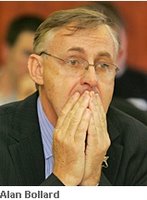
Alan Bollard is insane.

If ever there was doubt that Alan Bollard is out of his depth, then his efforts earlier today supplied the proof. This is just insane, denying the cause of the high exchange rate -- himself and his interest rate hikes -- and seeking to lower it by letting off his peashooter full of our money into the nuclear battlefield of international finance. George Soros and the like will be rubbing their hands with glee.

Alan Bollard is insane.

See Stuff: RBNZ confirms intervention in NZ dollar.

UPDATE 1: Gareth Morgan calls it right:
Economist Gareth Morgan said: "Overall, this is high-stakes poker. I think we're gonna end up dog tucker here."
The "we" here, by the way, is those of us whose money Bollard is gambling with.

UPDATE 2: Gonzo comments:
This intervention may set the stage for some very nasty arbitrage. Let's hope the fund sharks don't take the bait.
"Hope" is all Bollard has. When the big sharks start biting, Bollard's going to lose our shirt.

Wednesday, 21 February 2007

Smacking is not beating

It is insane that an MP promoting a Bill to ban smacking one's own children is completely unable to distinguish between smacking and beating, between smacking and violence. Insane, just insane.

Her Bill she said removes "an excuse for violence towards children," and it does it by criminalising those who, in her words, "beat, assault and hit their children." This is how she characterises smacking: as beating, assaulting and hitting children.

But smacking is not violence, smacking is not beating or assaulting children -- failing to distinguish between smacking and violence is a failure to distinguish at all -- and a failure too to understand that there are already laws on the books against beating, assaulting or inflicting violence against children, but those who do beat their children simply ignore them. A new law criminalising smacking is utterly unlikely to influence those parents who do inflict violence towards children; instead, it will criminalise parents who don't.

UPDATE 1: I was interested in this comment below: " Smacking is morally wrong, as is a ban on smacking." Some people won't understand that comment, so a link to this article might help, explaining the difference between persuasion and force. As the author Mark Skousen says, "persuasion instead of force is the sign of a civilized society." Read the piece to see just what he means. It's not quite what you think. ;^)

UPDATE 2: Given that Bradford is a Green MP, would anyone like to explain the connection between the environment, and having smacking banned?

UPDATE 3: You may choose to take it or leave it, but if you're struggling to answer the above question with anything other than "no idea," then the explanation is surely that she's not in the Green Party for the environmental politics. This, remember, is the woman who left Anderton's hard-left New Labour Party in 1990 because she saw a "definite move to the right."

Two blogs have some relevant background:
Writing at his Whoar blog last year in the midst of the Greens's co-leader's contest, Green member Phil U. warned of the left acquiring a "death grip" on the party. [Punctuation has been somewhat cleaned up to make it readable.]

I’d like to finish with what I think is a telling anecdote. I was present when Sue Bradford and Catherine Delahunty made their first appearance at a green party meeting, this after both being hounded out of the alliance part of the alliance by Jim Anderton -- it was at his feet they learnt their organisational ‘chops’(and it shows...) -- the left are very ‘top-down,’ bordering on control freaks.

The Green Party at that time was a very low-key affair, [with] meetings held in the low-roofed attic of a bookshop on K. Road. At this meeting, Bradford said to me out of the corner of her mouth (I had known her for some years) that “this party is ripe for taking over” -- and she wasn’t wrong.

Later in that same evening I approached the then-leader of the Auckland Greens (a lovely lady but lacking that political killer-will), and told her that “that woman over there is going to take your job." This duly came to pass.

And if Trevor Loudon is correct in his five-part exegesis of Bradford's history, the environment was the last thing on Bradford's mind for which she was "taking over" the Green Party: Part 1, Part 2, Part 3, Part 4, Part 5.

Her Green party bio states: There are three ways to make radical social and environmental change. 1) Working within the system; 2) throwing rocks at the system from outside; 3) building new organisations within the shell of the old system.

Which of those three ways do you think she is working on here with her anti-smacking Bill? She is intent on removing parents' hands from their own children; but she has no problem with governments getting their hands on children's minds, or even getting her hands on them herself -- as Catherine Delahunty, her co-trustee at the Kotare School -- "a centre for radical and liberating education for social change," she says -- makes clear enough in this speech outlining the Kotare School's aims. Part 2 is here.

RELATED: Politics-NZ, Politics-Greens, Smacking

Tuesday, 10 July 2007

Watch out, there are Scientologists about

Many mental conditions are the result of an organic condition, being the result, for example, of a "chemical imbalance" in the brain that can often be dealt with relatively painlessly with modern psychiatric drugs. That's a good thing. Scientologists however deny it's a good thing -- in fact scientologists deny the very legitimacy of psychiatry. PZ at Pharyngula links to news that this denial has consequences:
Now their insane denial of the legitimacy of modern psychiatry leads to an insane woman butchering her family. It's appalling: the parents were scientologists who refused to give anti-psychotic drugs to their daughter, and the end result is that they and another daughter are slaughtered.

This is where delusional, irrational, wishful thinking leads you — to a rejection of reality that has the potential to crash in on you in lethal ways.
Scientology is evil, says PZ. Evil, and coming to Grafton -- they've recently bought the former monastery overlooking the motorway currently occupied by Whitecliffe Art School. Keep an eye out for them.

Tuesday, 20 May 2008

NZ blog rankings, March/April

The lads at Tumeke have again done blog readers a service with their ranking of the NZ political blogosphere for March-April just out overnight, with some big changes in the top ten.  You can see it here.  Not bad work for "an insane, radical, anti-semite, Maori-lover, thieving, prisoner-whore" and "a fat, lefty, peacenik, traitor, fag."  Not bad at all.

The chief value of the rankings isn't just boasting rights for bloggers (oh, okay, I'm up from sixth to fourth, jumping ahead of the Green Party's Frog Blog, nyahh, nyahh), it's in the service it offers blog readers.  You may not be able to read the news from twelve different angles as you can in the UK, for example with their wide-ranging and entertainingly opinionated newspapers, but if you read the top dozen NZ political blogs every day you can achieve something of the same effect.  (And if you do read the top dozen NZ political blogs every day, you'd be well advised to download and use an RSS newsreader to make your reading easier.)

But there's still plenty of gems outside the top twelve, some of which Tim Selwyn (he's the the insane, radical, anti-semite, Maori-lover, thieving, prisoner-whore) has highlighted in his summary of the rankings. (And don't worry, that's his own self-loathing autobiographical description.)

I like Tim's summary of #34 Liberty Scott -- "think: Idiot/Savant's style, Trevor Loudon's research, Peter Cresswell's thinking" -- but  I'm not sure the description is entirely intended to be a compliment.

Anyway, take some time and do some exploring.

Wednesday, 5 February 2014

“Trickle down”

Here’s Thomas Sowell at his best.  A slice (but do read the whole column):

Years ago, this column challenged anybody to quote any economist outside of an insane asylum who had ever advocated this “trickle-down” theory. Some readers said that somebody said that somebody else had advocated a “trickle-down” policy. They could never name that somebody else and quote them, though.

Mr. de Blasio is by no means the first politician to denounce this nonexistent theory. Back in 2008, presidential candidate Barack Obama attacked what he called “an economic philosophy” that “says we should give more and more to those with the most and hope that prosperity trickles down to everyone else.”

Let’s do something completely unexpected: Let’s stop and think. Why would anyone advocate that we “give” something to A in hopes that it would trickle down to B? Why in the world would any sane person not give it to B and cut out the middleman? All this is moot, however, because there was no trickle-down theory about giving something to anybody in the first place. [Hat tip Cafe Hayek]

But Thomas Sowell is wrong. “Trickle down” does exist.

It emanates from government.

It emanates from government in the form of favours, and of subsidies and of welfare social. Perhaps the best place to see it in action was Labour's 2008 Welfare for Working Families package: the govt takes some large part of your money, waste a large portion of it (fiscal drag, you see), and then dole out some small proportion of it back to a selected class of voters (for which those voters are supposed to be pathetically grateful). That's trickle-down for you, as administered by the residents of an insane asylum.  (And, since the electoral effect of each tranche of trickle is short-lived, that’s the same sort of “trickle down” proposed for this election by the current Labour leader in the form of his baby bonus election bribe.)

Trickle down also emanates from government, and in ever-larger gobs in recent years, from the likes of central bankers. Here’s newly-appointed Federal Reserve Chairthingy Janet Yellen, making it explicit in her defence of The Fed’s programme of Quantitative Easing:

_Quote5You know, a lot of people say, this is just helping rich people. But it’s not true. Our policy is aimed at holding down long-term interest rates, which supports the recovery by encouraging spending. And part of it comes through higher house and stock prices, which causes people with homes and stocks to spend more, which causes jobs to be created throughout the economy and income to go up throughout the economy.

You want to find the failing apostles of trickle down? You’ll find them in big government.

Tuesday, 30 August 2011

Warmism jumps the shark [updated]

So what does it mean when the religion of global warming goes from insane to batshit insane?

Amy Peikoff reckons it means they’ve jumped the shark.

If an idea’s proponents grasping at ever more implausible straws is an indication of how badly that idea is faring in the court of public opinion, it seems that global warming alarmism is not doing so well. Set aside the predictable, feeble speculations about the existence or severity of Hurricane Irene being due to global warming. I have seen, in about one week’s time, three more examples of how desperate the global warming alarmists are becoming.

Read on, oh wise ones.

UPDATE: Here’s one warmist doing a Fonzie over carbon (dioxide) and water, the root of many a tasty beverage. [Courtesy of cartoonist Blunt]:

Obama-jumps-the-shark

Monday, 2 April 2007

The new Iranian hostage crisis

There are several instructive points to take from Iran's hostage-taking of British naval personnel, but perhaps the first is a simple suggestion that would take some pressure of the captives. Having watched several statements purportedly made by British prisoner Faye Turney, the Blair Government and senior media organisations should announce that they will encourage the hostages to say whatever they need to say to appease their captors, and that anything they do say that is issued by the Iranian Government will be discounted and ignored as the forced statements of those subject to unreasonable pressure -- pressure we can't even begin to imagine.

Such a coordinated statement would at a stroke remove needless pressure on the captives to stay silent, remove any point in Tehran applying any such pressure, and would instantly discount any propaganda value to be gained from forcing such statements to be made. That would be one simple thing that could be done, and more effective than all the dithering to date.

The reactions from Washington and London to Tehran's capture of these hostages has been revealing. What it has revealed has been summarised by Elan Journo at the Ayn Rand Institute.
The U.K. government and Washington are widely regarded as aggressive defenders of their interests in the face of Islamist aggression. But the present Iranian hostage crisis shows, again, how these would-be defenders of our life and freedom are pathetically timid--while our enemy is shameless and ever more confident.

"Iran is a leading world sponsor of Islamic totalitarianism and has long been waging a terrorist proxy war against the West, through groups such as Hezbollah. In Iraq, Iran's proxies have been slaughtering U.S. and British troops. Iran initiates all of this aggression--to say nothing of its nuclear weapons program--with the confidence that it has an Allah-given right to murder. No surprise, then, that when 15 British naval personnel came near Iranian waters, Teheran took them hostage--and unabashedly demanded an apology from Britain, its victim.

"What has been the British, and American, response to Iran's outrage? What has the West done in the face of such a confidently evil regime?
The response has been universal hand wringing, and an invitation to even more agression.

Remember Jimmy Carter's weak-kneed and ineffective response to the 1979 Tehran hostage crisis, a response that reinforced for an insane and aggressive Iranian regime that they had nothing to fear from a United States unwilling to stand up and defend its own people. It's only early days in the current hostage crisis, but it seems that pathetic response is now being repeated by the Blair Government in the face of an equally insane promoter of Middle East terrorism.

The world looks to Tony, and what it finds is hardly the warmonger of myth, but instead a figure of timid deference. As Elan Journo concludes, "While the British may hope that their timid, deferential approach will avoid inflaming the crisis and antagonizing Iran, they are accomplishing the opposite. The spectacle of Western nations bowing in submission is an encouragement to Iran and Islamic totalitarians worldwide."

UPDATE 1: The Neo-Jacobin takes a similar line: 'It's War, Jim, But Not As We Know It.'
Britain’s precautionary approach to Iran has only succeeded in slowly dragging this whole affair along, rather than settling it - none of this has been lost on the Iranian authorities who have used the past few days to ratchet up the political and military stakes. With a government like ours, there is one thing we can be certain of, their increasing obsession with risk, and aversion to risk, will only succeed in inviting even more ambushes, and other such 'gestures of defiance' in the not so distant future.
UPDATE 2: Marcus notes with unerring accuracy that the Iranian regime "continues as it began, with intimidation and violence." Read the litany.

UPDATE 3: The Iranian regime is like a hard-boiled egg with a thin sell, argues Victor Davis Hanson. We should tap it lightly wherever we can - until tiny fissures join and shatter the shell." See Victor Davis Hanson - Given Enough Small Taps, Iran Regime will Crack. [Hat tip, Regime Change Iran]

RELATED: WarWorld Politics, UK Politics, Cartoons

Saturday, 3 March 2007

'Trickle down' again

One or two bloggers have erupted in consternation over Idiot/Savant's discussion of co-called 'trickle-down' economics, but none that I've seen has gone to the heart of his characterisation of 'trickle-down economics,' in my view between them succeeding only in throwing more heat than light on the subject -- and I suspect I/S is a man who responds better to the latter than the former. Let me see if I can succeed in throwing some light, with perhaps a little appropriate heat to follow swiftly on its heels.

I/S began his discussion in this way:
"Remember “trickle-down economics”? That was the lie the Revolutionaries told us in the 80’s and 90’s to justify tax cuts for the rich. The idea was that they would get richer, but that some of their gains would “trickle down” to the rest of us, thus making everyone better off. It didn’t work - instead, the rich got richer, and the rest of us got poorer in real terms."
Leave aside for the moment I/S's claim that we all got poorer, but according this somewhat naive view of economics, capitalism is supposed to be characterised by the poor getting the crumbs that have trickled down from the top tables of the rich. The eminently naive John Kenneth Galbraith characterised it thus: "If you feed the horse enough oats, the sparrow will survive on the highway."

But no sane economist has ever advocated such a view. For a long time now, the eminently sane Thomas Sowell has been inviting anyone -- anyone -- to prove him wrong in that assertion:
A year ago this column defied anyone to quote any economist -- in government, academia, or anywhere else outside an insane asylum -- who had ever argued in favor of a 'trickle down theory'... a stock phrase on the left for decades and yet not one of those who denounce it can find anybody who advocated it. The tenacity with which they cling to these catchwords shows how desperately they need them, if only to safeguard their vision of the world and of themselves.
Frankly, if you want to see "trickle-down" in action -- that's the literal trickle-down as described by I/S and the naive but quotable John Kenneth -- the only place you're going to see it is in Government. In fact, that's precisely where the phrase came from: it was being used to describe the New Deal's quasi-fascist Reconstruction Finance Corporation. It can be seen today in all its Clark Government glory in Labour's Welfare for Working Families programme -- a very model of "trickle down": they take your money, pour a very large portion of it down various departmental drains (boosting 'consumption,' property prices and bar bills around central Wellington), and then dole out a small proportion of it back to some voters (for which these voters are expected to be pathetically grateful).

And you are, aren't you? You're happy to get anything back.

That's trickle-down for you, as administered by the residents of the country's pre-eminent insane asylum, the Beehive.

Now, I suspect that I/S won't agree with me on that point. His loss. (And there are others who won't agree either, some of whom claim the late Wolfgang Rosenberg as a mentor.) But he did make the point, if you recall, that "in the 80's and 90's ... that not everyone shared in the country's growth." This point of his, which is probably the one on which he would wish to stand, I haven't seen anyone address (please let me know if I've overlooked someone -- I make no claim to omniscience on that score), and it is a point on which he assembles a fine array of statistics in support of the claim.

I'll only comment in passing of the unsuitability of undue reliance on changes in the number of people in 'poverty,' since the official poverty figure changes with the seasons. But let's allow him his point. Let's agree that inequality increased after the New Zealand economy, described by David Lange as being like "a Polish shipyard" -- and that in the days when Polish shipyards were less likely to make ships than revolutions -- was freed up, at least to some extent. (We've talked before about how the Douglas years were far from the revolution they were claimed to be -- scroll down to the rocketing tax graph for the chat.) Let's agree that there are many more rich people now than there were when Muldoon had laws that specifically prohibited rich people, excepting those who donated to the Muldoon campaign for subsidies and re-election.

But to concede I/S's point is not to concede the problem. More rich people means more inequality. It's obvious. If Bill Gates, Warren Buffett and Ted Turner were to move themselves and their disposable income here, the country would at once be wealthier, and so too would the 'income gap' have increased. It would only be very few who would call this is a problem, and those few are named Bradford, Kedgley and Trotter.

I doubt however that this point will be convincing enough, since it doesn't quite address the substantial point. The substance of I/S's claim is that the poor have got poorer over recent years, even as the economy has been 'freed up.' This isn't supposed to happen. As it happens, economist Paul Krugman (today's John Kenneth Galbraith) pointed out the same thing in the American context not so long ago. And as it happens, George Reisman (today's Ludwig von Mises) agreed with him. But he and and his mentor Ludwig von Mises pointed out three things that Galbraith, Krugman and I suspect I/S and his critics have overlooked:
  1. Neither the American nor the New Zealand economies have been 'freed up.' Look again at that graph of NZ tax rates in the post linked to above, and contemplate too the points made in Lindsay Perigo's speech 'In the Revolution's Twilight,' delivered to an international audience, on the revolution that New Zealand didn't have in the eighties and early nineties.
  2. Rich people who like to remain rich do not consume the majority of their wealth on champagne, caviar, nights out with Paris Hilton and large donations to global warming deniers -- more's the pity -- instead they invest their money, producing new capital goods. Explains Reisman:
    The truth, which real economists, from Adam Smith to Mises, have elaborated, is that in a market economy, the wealth of the rich—of the capitalists—is overwhelmingly invested in means of production, that is, in factories, machinery and equipment, farms, mines, stores, and the like. This wealth, this capital, produces the goods which the average person buys, and as more of it is accumulated and raises the productivity of labor higher and higher, brings about a progressively larger and ever more improved supply of goods for the average person to buy.
  3. What make wage rates higher in richer countries is, in a word, investment. Explained Ludwig von Mises, back when Krugman was just a boy:
    The average standard of living is in this country higher than in any other country of the world, not because the American statesmen and politicians are superior, but because the per-head quota of capital invested is in America higher than in other countries — because up to now the institutions and laws of the United States put fewer obstacles in the way of big-scale capital accumulation than did those foreign countries.
    This point is frequently overlooked, but it is at the heart of any mature understanding of wage rates and productivity. Explained simply, this means that if we're being paid to move a mountain of dirt and all we have is a shovel, we're going to be significantly worse off than the chap who has a steam shovel; the other chap's wages will be commensurate to the greater productivity brought about by the greater capital investment, as will ours, with the lesser investment.
There are other wrinkles with greater capital, such as greater demand and the like, but the point made here is a simple one when understood: greater capital accumulation in general means higher wages.

A simple point when understood, but let's attack that "in general" point above, since we haven't yet quite finished making our point, have we?

If greater capital accumulation in general means higher wages, then (if we concede I/S's stats) why haven't we seen that happen in recent years? Once again, Reisman has the answer, and since it goes for a few paragraphs and, since I believe it goes right to the point of answering I'S's specific objection, you might want to get a drink ready so as to savour it properly. The answer, says Reisman, is "suggested, surprisingly enough, by Krugman himself, when he referred to 'power relations' in contrast to 'market forces'.”
“Power relations”—i.e., the use of physical force by one person or group against another—are present in all forms of government intervention in the economic system. There is no law, regulation, ruling, edict, or decree whose enforcement does not rest on the threat of sending armed officers to arrest and imprison violators, and, if they resist, to kill them if necessary...

Government intervention in the economic system is the use of force not against common criminals, who have previously initiated its use, but against peaceful citizens engaged in production and voluntary exchange and whose only “crime” is that they have done something the government has decided it does not like. This force serves to prevent people from doing what they judge to be in their interest to do and to compel them to do what they judge to be against their interest to do.

In all cases of this kind, the government’s force operates to make people worse off than they could have been. And the more extensive the government’s intervention becomes, the greater becomes the gap between the life that people must live and the better life they could have lived had the government not stood in their way. At some point government intervention becomes sufficient to cause people to live not only worse than they might have lived, but worse than they actually did live in the past.

This last is what has been happening to the American people since the era of the “New Frontier” and the “Great Society.” Since that time, the weight of government intervention has become sufficient to stop or nearly stop economic progress for large numbers of Americans and to cause actual economic decline for many.

Inflation, Social Security, and Medicare [and we might add to this Working for Families] undermine the incentive to save and accumulate capital. Vast government budget deficits absorb large amounts of the savings and capital that do exist and divert them from business investment to financing the government’s consumption [as of course do equally vast government surpluses]. More recently, the government-engineered housing boom, built on the foundation of [easy credit] imposed by the Federal Reserve, has operated in a similar way and diverted further vast sums from business investment to housing purchases. And before the housing boom, the dot-com bubble, also created by the Federal Reserve, created the illusion of vast wealth and capital that served to squander substantial portions of the capital that did exist.

Inflation has also played a major role in enlarging the highest incomes in the economic system. This has been the case insofar as inflation (understood in terms of an increase in the quantity of money) entered the economic system in the form of new loans that served to drive up securities prices and thus the value of stock options. Take this away, and the rise in the highest incomes over the period that Krugman complains about would be much less, if it existed at all.

But there is more. The last forty years or so have seen the imposition of environmental legislation and consumer product safety legislation, and numerous other government programs that serve to increase the costs of production. The great majority of people assume that the higher costs simply come out of profits and need not concern them. But the fact is that the general rate of profit in the economic system remains more or less the same, with the result that increases in costs show up as increases in prices, or as decreases in other costs, notably, wages.

The real wages of the average American [and New Zealander] are stagnating in large part because the higher real wages he could have had—precisely on the foundation of the work of today’s great businessmen and capitalists—have instead been used to pay for the cost of environmental and safety regulations. Money that might have been paid as higher wages has instead been used to buy equipment, materials, and components required to be in compliance with these regulations. Larger supplies of goods that might have come into existence and driven down prices or at least prevented inflation from raising them as much as it has, have been prevented from coming into existence, especially by environment regulations.

This is the answer economic theory gives to Krugman and to the hordes of other intellectual dilettantes whose writings and lectures on the subject of economic inequality proceed in ignorance and thus end up amounting to just so much clutter—clutter irrespective of the prestige attached to the venues in which it accumulates.
Make sense? I'll leave you to savour your drink and decide for yourself, thinking it all through perhaps as the liquid in that drink trickles down your throat, and you perhaps reflect that that's the only kind of 'trickle down' that really makes complete sense.

LINKS: Answer to Krugman on economic inequality - George Reisman, George Reisman blog
Capital supply and economic prosperity - Ludwig von Mises, Mises Institute
In the 'Revolution's' twilight - Lindsay Perigo, The Free Radical
Trickle-down in action - Not PC (June, 2006)
Do the rich really make us all poorer? - Not PC (March, 2006)
The 'Trickle Down' left: Preserving a vision -Thomas Sowell
Statistics - Idiot/Savant, No Right Turn
'Trickle down' fails again - Idiot/Savant, No Right Turn

RELATED POSTS ON: Economics, Nonsense, NZ Politics, US Politics

Monday, 12 February 2007

More stalking

This blogger template doesn't really allow me to stop particular commenters commenting, and my own preference anyway is to simply ask people who have disgraced themselves not to bother coming back I prefer to rely on their own integrity. So far, I've only had to ask two people to please stay away; one of them has, and one of them hasn't. One of them has integrity, and one woman has shown she hasn't. Here's a recent post from Ruth here at Not PC, variations of which she also posted all round the internet.
The Libertarian Party and admirers of Ayn Rand keep having to expel racist and violent yahoos from their midst. As an example I have [deleted] and [deleted]- [deleted]; [deleted], and others who spew bigoted filth about drowning Muslims in swimming pools and murdering their political opponents all over the internet. Libz are constantly being infiltrated by neo-Nazis, and many of their spinoff groups are riddled throughout with extremists and racists.This is nothing new - I remember Nazis threatening you on an email list years ago.
This is simply insane. Apart from the lies and the out and out stupidity -- "murdering their political opponents all over the internet"! -- this post can't even tell the difference between being threatened by someone and being associated with someone. It's insane. Feel free to visit her own blog and tell her that everything else she writes here will be deleted.

Tuesday, 6 June 2006

Trickle-down in action

For years we've heard from the likes of anti-capitalists like Russel Norman, John Kenneth Galbraith and Michael Cullen about "trickle down." According to one view, capitalism is supposed to be characterised by the poor getting the crumbs that have trickled down from the top tables of the rich. Galbraith characterised it thus: "If you feed the horse enough oats, the sparrow will survive on the highway."

But no sane economist has ever advocated such a view. Thomas Sowell invites anyone -- anyone -- to prove him wrong in that assertion:
A year ago this column defied anyone to quote any economist -- in government, academia, or anywhere else outside an insane asylum -- who had ever argued in favor of a 'trickle down theory'... a stock phrase on the left for decades and yet not one of those who denounce it can find anybody who advocated it. The tenacity with which they cling to these catchwords shows how desperately they need them, if only to safeguard their vision of the world and of themselves.
Frankly, if you want to see trickle-down in action, the only place you're going to see it is in Government. The best place to see it in NZ is in Labour's Welfare for Working Families package: they take your money, waste a large portion of it (fiscal drag, you see), and then dole out a small proportion of it back to some voters (for which they're pathetically grateful). That's trickle-down for you, as administered by the residents of an insane asylum.

LINK: The 'trickle down' left" Preserving a vision - Thomas Sowell
The 'Trickle down' economics straw man - Thomas Sowell (Sep, 2001)

TAGS: Economics, Labour, Welfare, Cue_Card_Libertarianism, Nonsense

Friday, 28 April 2006

New Auckland car tax voted for 'closer look'

Auckland City Council voted last night "for more research into charging motorists to use congested roads, but said it could not accept such a system without a greater regional share of fuel taxes." See the Herald's report for the full story of who was for and who against the proposed new car tax . Some strange bedfellows in some unusual positions.

If you want a one-sentence sumary of why Auckland's transport system isn't one, try this:
Transport committee chair Richard Simpson said the number of cars "eating" Auckland was insane.
"Insane" may be the very word to describe Mr Simpson. May I recommend Andrew Galambos to Mr Simpson:
A traffic jam is a collision between free enterprise and socialism. Free enterprise produces automobiles faster than socialism can build roads and road capacity.
LINKS: Council votes for closer look at tolling - NZ Herald
Charging cars to enter Auckland: A bad idea
- Not PC

TAGS: Auckland, Economics

Thursday, 23 June 2005

Morally-blind cricketers head to Zimbabwe

If it's true as Martin Snedden says that New Zealand cricketers "unanimously agreed" to tour Zimbabwe then, sadly, that says little for New Zealand's leading cricketers.

It's true as Snedden says that many of the countries on the cricket circuit are "volatile," but that doesn't even begin to describe the Zimbabwean situation. It was clear enough when this tour was only a twinkle in the ICC's eye that Robert Mugabe's insane politically-driven thuggery was a totalitarian step ahead of anything going on elsewhere at the time.

Destroying the country's free press; arresting opposition leaders; eviscerating property rights; murdering white farmers ... even the otherwise morally-blind cricketers must have wondered what was going on when Zimbabwe fast bowler Henry Olonga fled to England in fear for his life after speaking out about "the death of democracy in his beloved Zimbabwe," or when he subsequently called for test cricket with Zimbabwe to be discontinued.

As I said myself back in 2001 when on behalf of the Libertarianz I called for "Zimbabwe's expulsion from the Commonwealth and other world bodies... 'No regime...that engages in such abhorrent acts should be welcomed in respectable world circles. Mugabe is probably clinically insane. But he certainly is a monster who should be shunned.'" The insanity was even clearer by 2002 when I called for New Zealand to "fast-track visa applications for refugees from Mugabe's atrocities."

So even though the NZ Government was itself morally-blind for a time, if NZ Cricket had kept their own eyes open they could have refused the tour in the planning stages. To complain now that their hands are tied and they have no choice is a disgrace.

But there is no case for the New Zealand government to stop the tour. For once I agree with Helen Clark: how would the government physically stop the tour? By stopping New Zealand cricketers at the airport and putting them under house arrest? You don't help freedom elsewhere by infringing it at home.

And neither do you disabuse yourself of reponsibility for your actions by laying the blame for your actions at the door of others, or blinding yourself to their immorality as Snedden and the NZ cricketers are doing. Shame on them.

Morality is not something just for sermons on Sunday, it's part of day-to-life. Time some sportsmen and their administrators took some responsibility for their actions.

Friday, 1 March 2013

FRIDAY MORNING RAMBLE: A slow news week?

This week I’ve had time to ramble around the internet.  Here’s some of what I found.

Nice for those who can get it.  “A Crown Treaty negotiator has pocketed $1.5-million, another more than $1m and several others large six-figure sums according to information released in response to detailed questioning by New Zealand First leader Winston Peters. Treaty Negotiations Minister Chris Finlayson revealed that $5.5-million has been paid to 14 individuals since 2008, several of them former Cabinet ministers and MPs.”
Mike Butler: Treaty troughers revealed – Mike Butler, BREAKING VIEWS

Larry Mitchell has ranked all NZ’s councils on the basis of how heavily indebted they are—and how much liability you as ratepayer have for that debt. Highlight’s exposed by this year’s report include persistent deficits; debt continuing to build up; average debt per ratepayer up 10% from $3,834 to $4,176; and continuing low levels of asset replacement reserve funds.
How does your council do?
A Brief Summary of the 2013 Local Government League Table and its results – LARRY N. MITCHELL

Tim Watkin is having a commuting crisis due to rubbish Auckland trains, the very trains he once so loved. Here's why.
An open letter on Auckland trains. Grrrr – Tim Watkin, PUNDIT

There is no reason for EQC to exist, and every reason for it to be exterminated as soon as practically possible. More evidence here: (“Usual grain of salt warning about blogs written by former employees, but still…”)
EQC Truths

So why does the government own a coal company anyway?
Some Solid questions on energy – Colin Espiner, BULL DUST

So who owns graffiti? Passersby?
It's not "your" Banksy – LIBERTY SCOTT

Well, the Maori Party and the ACT caucus are nominally in coalition, so why should this be considered unusual?
Maori Party president makes plea for charter schools – RADIO NZ

The Oscar Pistorius case is a good illustration of the dangers of turning athletic stars into role models or symbols of evil.
Oscar Pistorius: when good metaphors turn bad – Duleep Allirajah, SPIKED

“Ninety eight percent of the adults in this country are decent,
hardworking, honest folk. It's the other lousy two percent that
get all the publicity. But then, we elected them.”
           — Lily Tomlin

Economist Armen Alchian, who died the other day at age 98, puts it plainly: “Economic law is not suppressed by legislated law.” Yet politicians think they can keep raising the minimum wage with no consequence to those they claim to be helping.
What support for the minimum wage reveals – Sheldon Richman
Real minimum wages – Eric Crampton, OFFSETTING BEHAVIOUR

You want proof that Keynesian economics is insane. Well, here it is. From The Telegraph in London: a strategy to discourage saving! What complete fools/
Keynesian insanity reaches a new peak – Steven Kates, CATALLAXY FILES

The British Pound is getting pounded. It deserves to be.
The British Pound Gets Pounded – MONEY MORNING AUSTRALIA

It looks like whatever he tries, David Cameron’s Treasurer can’t get the British economy off its knees.  Except that he hasn’t actually tried anything sensible.
Osborne cornered – Alasdair Macleod, COBDEN CENTRE

Maybe he wouldn’t be cornered if he stepped outside his ‘paradigm.’
My 10-point plan to reboot Britain – Allister Heath, TELEGRAPH

Ask Yaron:

“Having mostly failed to see this crisis coming before failing to predict even the general pattern of events, senior economists now want more of the medicine which already nearly killed the patient. This may look like madness or stupidity to those of us without a high level of formal education in economics. It is neither. Contemporary economists are trapped in an intellectual prison founded on now-old errors of method and epistemology: the knowledge and simplifications necessary to make their mathematical models work are unavailable and invalid respectively.”
The madness of contemporary economists – Steven Baker, MP, COBDEN CENTRE

There is little evidence economic forecasting is any better than guessing, abundant evidence that economic forecasting, abundant evidence that economic forecasting by “elite economists” such as those in Treasury or the Reserve Bank performs worse than guess-work, and no evidence whatsoever economic forecasting has improved in recent decades.
Dispelling Some Big Myths About Economic Forecasts – Murray Dawes, MONEY MORNING AUSTRALIA

It’s sometimes worth reflecting that Paul Krugman may be insane. Except that he’s not—he’s just the perfect reflection of the insanity of mainstream economics.
Krugman's Call for a Housing Bubble – Daniel Sanchez, MISES DAILY

It’s far from perfect, but “the Pulitzer Prize-winning book Lords of Finance: The Bankers Who Broke the World reveals the destructive, surreptitious, incestuous, and highly corrupt nature of central banking… One of the jewels here is the rare look into the lives of the powerful men, the ‘lords of finance,’ who were behind the solidification of modern central banking in the US and Europe during the years 1910 to 1935.”
Lords of Finance: The Backroom World of Central Banking – Dan O’Connor, MISES DAILY

“Once the rule of law is established, an economy thrives
despite government, not because of it.”
                 - Adam Creighton, writing in The Australian

When is the U.S. getting rid of “too big to fail?” Says America’s central banker “ah, uh…”
Elizabeth Warren Grills Bernanke on "Too Big to Fail" Policy – MISH’S GLOBAL ECONOMIC ANALYSIS

More key excerpts from Bernanke's first Humphrey Hawkins testimony before the Senate. “Highlights obviously ours..”
Bernanke's Tools: "Belts, Suspenders... Two Pairs Of Suspenders" And Other Senate Testimony Highlights – ZERO HEDGE

“Waiting for Japan's economy to make a strong recovery has been an ongoing game since 1990. Shall we play that game one more time? There have been many false dawns in Japan over the past 20 years. Is this another false dawn for the rising sun? Or sunset?
The Arrival of Japan's Sunset: The repercussions will be tremendous 
- Gregor McDonald, PEAK PROSPERITY

“It is becoming more apparent that modern macro with its Keynesian Y=C+I+G is utterly defective to the point of vacuity but the problem remains what ought to replace it? Here is my formula in brief…”
How to manage an economy – Steven Kates, CATALAXY FILES

Austerity?
Austerity? I Do Not Think That Word Means What You Think It Means – Don Watkins, LAISSEZ FAIRE

The “Third Way” of politics has been tried and failed. So it’s bound to be tried again. And again. And again.
“Third Way” politics and its fruits – STEPHEN HICKS

But what are think tanks? Who funds them? And what the hell does the LSE Review of Books know about them anyway?
Farcical Concept of the Day – Jim Harper, CATO AT LIBERTY

From the “this is total nanny state bollocks” file:
Man Charged With Felony for Letting Go of Balloons – HIT & RUN

Conservative pundit Ann Coulter calls libertarians pussies for “sucking up to liberals” on pot and gay marriage. "’We're living in a country that is 70 percent socialist,’ she says. ‘The government takes 60 percent of your money. They take care of your health care, your pensions ... who you can hire ... and you (libertarians) want to suck up to your little liberal friends and say, oh, we want to legalize pot?’
“Coulter has a point.  Government rarely makes a dent in people's drug use or their ability to partner with people of their own gender.
“’Seventy percent socialism’ does much more harm. It kills opportunity and wrecks lives.
"But Coulter doesn't just want to downplay ‘liberal’ parts of the libertarian agenda. She opposes them…”
Libertarians' Awkward Bedfellows – John Stossel, REAL CLEAR POLITICS

“Here’s what I don’t get about the drone debate. Why the @#$% did it take so long to start?”
Drone Rage: A Day Late and a Sequester’d Dollar Short? – Wilton Aston, BASTIAT INSTITUTE

“No one expected outgoing Mexican President Felipe Calderon to make the speech he made to the UN General Assembly in September 2012. Calderon, the staunch drug warrior, called time on the Drug War… On the same Wednesday that Calderon made his speech, two other Latin American leaders told the UN Assembly the same thing… Collectively, the three leaders formally asked UN Secretary-General Ban Ki Moon for a review of the organisation’s drug policies.” The UN’s first reaction to the call? Expunging their speeches from the record.
When the drug warriors turn – Russell Brown, HARD NEWS

I didn’t (don’t) watch the Oscars. But it sounds like it was a blast!
Seth MacFarlane: we saw him boob, that’s all – David Bowden, SPIKED

Government regulations hurt small business. How much do they hurt? Here’s one story:
Subway 'Wouldn't Exist' If Started Today Due to Regulations: Founder Deluca – CNBC

“A man's liberties are none the less aggressed upon because
those who coerce him do so in the belief that he will be benefited.”

                 — Herbert Spencer

Hope for Solid Energy? The age of coal may not be altogether over. “Liang-Shih Fan, professor of chemical and biomolecular engineering, and director of the Clean Coal Lab, has just completed a 203 hour test of a radical new way of obtaining energy from coal. Typical coal-fired power plants burn coal to boil water, and run the resultant steam through turbines to produce electricity. Fan’s process, a new technology called “coal-direct chemical looping,” does not burn the coal. Instead, it chemically converts coal to heat in a sealed reactor chamber. Tiny iron oxide beads help to deliver oxygen to the coal particles, which are then cycled through an airflow chamber for re-oxygenation, then run back through the reaction chamber. This is the “looping” in the technology’s name. The process gives off no air pollution, and the captured carbon dioxide is ninety-nine percent pure, enough to make it a valuable commodity.
Scientists Generate Electricity from Coal Without Burning It – Howard Roerig, T.O.S. BLOG

They came, they saw, they confronted and counter-protested the ragtag “anti-energy” rally in America’s capital. This is their report.
The Light Brigade: Confronting the Anti-Energy, Pro-Blackout Rally in DC 
– Travis Fisher, MASTER RESOURCE

image“Fossil fuels improve the planet.” Download the free e-book by Alex Epstein NOW!
Fossil Fuels Improve the Planet: The E-Book – CENTER FOR INDUSTRIAL PROGRESS

Is dark matter the next scientific discovery? Or the latest “ether” or phlogiston? We’ll know, or not, in the next few weeks.
AMS-02 dark matter results in 2-3 weeks – Lubos Motl, REFERENCE FRAME

“What space-age material is two hundred times stronger than structural steel?
What conducts electricity so insanely quickly that researchers at IBM see ‘no intrinsic limits into how fast it can go’?
And which new substance is the subject of three thousand new research projects, and has just been given a one billion Euro research investment from the European Commission?
Amazingly, the answer is the same for all three questions…”
Graphene: The Two-Dimensional Diamond That’s Set to Turn Your World Upside Down – Alex Cowie, MONEY MORNING AUSTRALIA

A new study from the National Bureau of Economic Research by Pinka Chatterji and Sara Markowitz indicates a way that bicycle helmet laws may be creating less bicycle-related head injuries: discouraging getting on the bike in the first place.
Bicycle Helmet Laws: Good At Keeping Kids Off Bikes – Brian Doherty, HIT & RUN

Useful news for parents of autistic children?
Children With Autism Show Increased Positive Social Behaviors When Animals Are Present – SCIENCE DAILY

Dense cities don’t have to be ugly. Take the 3d cities of visionary architect Paolo Soleri, for example…

…or the Mile High city of Frank Lloyd Wright:

Succinctly answering the question so many readers have asked me:
What is Objectivism? – Craig Biddle, OBJECTIVE STANDARD

Succinctly answering another frequent question: What is Montessori?
Listen here to neuropsychologist Dr. Steven Hughes, chair of the Association Montessori International Global Research Committee, and Matt Hillis, executive director of Bergamo Montessori Schools in California:
AUDIO [14:31 min]– CAPITAL PUBLIC RADIO

“I'd suggested last year that there's no alcohol crisis in New Zealand… Well, it turns out that there could be a crisis. Here are the latest figures from Statistics New Zealand…”
A real alcohol crisis [warning: may not actually contain crisis] – Eric Crampton, OFFSETTING BEHAVIOUR

He’s the literary figure who refuses to die. So who owns him?
Who owns Sherlock Holmes?  - THE ECONOMIST

“Is peace or war the natural state of man? Do men fight primarily over material possessions or over women?” Napoleon Chagnon’s controversial study of the Yanomamö, a remote constantly-warring tribe in South America, tells us more.
An Anthropologist’s War Stories – NEW YORK TIMES

Sex Addiction? Yeah right.
You’re Addicted to What? – Dr Marty Klein, THE HUMANIST

Not sure why it’s news, but it has emerged Britain’s most commonly spoken language is now Bollocks. True story. (Almost.)
Bollocks is Britain’s first language – DAILY MASH

While we’re at the Daily Mash site …
Secret of successful relationship is getting pissed together
Most people don't have any potential

It’s the first day of Autumn. Time for a Vodka Mojito?
Homemade Vodka Mojito – Will de Cleene, GONZO FREAKPOWER

There’s sure to be more in your Vodka Mojito than in my Vaportini.
The Vaportini: A Cocktail Inhaled, Not Stirred – THE SALT

Now this is good. But Brent Grapes’s performance of the Arutinian Trumpet Concerto last night with the Auckland Philharmonia was even better!


Speaking of trumpets, here’s Dizzy Gillespie (turn it up loud!)

Pianist Van Cliburn, hero of the Cold War and creator of the best-selling classical album for a decade (Lindsay Perigo tells the story), passed away this week.  Here on YouTube, he still plays Beethoven.  He plays it beautifully:

This is how the Gods end, not with a whimper but with a bang: In the climax to Richard Wagner’s 'Götterdämmerung', we see Brunnhilde (Anne Evans) throw herself on Siegfried's funeral pyre, setting off the cataclysm that destroys the Gods' castle of Valhalla, and the Gods themselves—who have proved themselves unable to cope in a world with free will.  Only Alberich, the opera's villain, and the new human race are left. (See more at: http://www.greatoperavideos.com/videos/gtterdmmerung/gtterdmmerung.html#sthash.HkDRinHu.dpuf )

[Hat tips Stephen Hicks, Kiwiblog, The Classical Liberal, Geek Press, Eric Crampton, Anthony Smith, Joel Rowan, Erosophia]

Thanks for reading
PC

Monday, 4 March 2013

DOWN TO THE DOCTOR’S: An important constitutional

_McGrath001This week, Dr Richard McGrath has been sending out submissions…

This afternoon I sent the Libertarianz Party's submission to the Constitutional Advisory Panel, in the hope that its members will be swayed by its themes of limited government, equality and justice for all New Zealanders.

Without further ado, I reproduce it here:

To the Constitutional Advisory Panel

Introduction
This submission is forwarded on behalf of the Libertarianz Party, a registered New Zealand political party formed in 1995.

The Libertarianz Party says our country should have a written constitution protecting the equal rights of all citizens. Several years ago, a small working group of party members formulated a Constitution loosely based on that of the United States, with the errors fixed. An abridged version of the main parts of that document, its Bill of Rights and a Bill of Due Process, appears below.

But first, we make some general comments about the parliamentary and electoral systems, the Treaty of Waitangi, and our party's proposal for a constitutional republic.

General comments
Libertarianz supports the following changes to the current parliamentary and electoral systems:

  • Parliament should be limited to 100 seats in a House of Representatives, including the Speaker; but there should also be an upper house composed of 30 members.
  • The parliamentary term should be kept at 3 years, with dates fixed in advance and only changed in the event of a no-confidence vote or state of emergency, natural disaster, war or other calamity.
  • There should be a 10-15% tolerance for the size of electorates, with adjustments in electorate boundaries made only every 5 years in the interests of economy, with safeguards put in place to prevent political manipulation of electorate boundaries.
  • There should be no guaranteed minimum number of seats for the South Island; the number of seats should reflect population distribution.
  • There should be no guaranteed minimum number of seats for any race.  All race-based representation at all levels should be abolished, each individual having the same voting power regardless of skin colour or other accidents of birth. Thus, seats reserved for Maori should be dissolved at all levels.
  • Political parties should make their own decisions via their own rules and constitutions regarding members who 'party-hop.'  That is not a matter for the state.
  • All regulation of political-party funding should be abolished, thus respecting the rights to free speech and association.
  • The Treaty of Waitangi should be recognised as the basis for equal citizenship. All Treaty claims should be full and final, settled within a set finite period of time, with all tribunals and committees then disbanded permanently. No Treaty claim should take private property, nor impose any on-going financial burden on taxpayers and ratepayers.
  • The Treaty of Waitangi is neither sufficient nor appropriate nor ever intended to be the supreme law of the country, and the so-called “Principles” of the Treaty of Waitangi should be expunged from the law books as so much made-up manufactured nonsense.
  • The views of individual New Zealanders of Maori or other descent should be aired during any decision-making process through normal democratic means in the same way as New Zealanders of other racial and ethnic ancestry.
  • A written Constitution including a Bill of Rights, similar or identical to that proposed by the Libertarianz Party, should be the supreme law of the land—a constitution clearly delineating the rights to be protected, with all law past, present and future inconsistent with this Constitution struck down.
  • New Zealand should become a constitutional republic with an elected President.  

*    *    *

Proposed Constitution for a Republic of New Zealand

A. Preamble

We, the citizens of New Zealand, hold these truths to be demonstrable in reality: that because the mind is our species' means of survival and full flourishing, human beings are individually possessed of certain inalienable rights, which are the rights to life, liberty, and the pursuit of private property and happiness; that to secure these rights, governments are instituted among people, deriving their just powers - and only such powers - from the consent of the governed; that all laws legislated by governments must be for the purpose of securing these rights; that no laws legislated by government may violate these rights; that all citizens are equal before such laws; and that whenever any government becomes destructive of these rights, it is in rebellion against its citizens, who may then remove it and institute new government.

Therefore, the citizens of New Zealand, in the name of that which is the glory of man - his sovereign, rational mind - do solemnly declare that our country is henceforth free; that we are absolved from all further allegiance to the Dominion of New Zealand and its government, both of which are hereby dissolved; that we do by this and the associated documents presented here establish instead the Republic of New Zealand; that these documents supersede all previous constitutional and quasi-constitutional documents, including the Treaty of Waitangi; that the laws of this country shall be based on a single moral premise, which is the expression of the afore-mentioned rights: no person or group of persons may initiate the use of physical force, or its derivative, fraud, against any other person or group of persons, and the only justification for the use of force is self-defence against those who initiate it; that the government of this country shall have no other function than to formulate, enact and uphold such laws and to secure and glorify the supreme values of reason and freedom in human affairs.

B. The Bill of Rights

Article I - Free Speech and Privacy

The government shall make no law abridging the freedom of speech, of the press, of electronic or optical communication or of any other form of communication or expression; or restricting the right of an individual to petition the government for a redress of grievances; or respecting an establishment of religion or prohibiting the free or non-exercise thereof; or requiring an individual to possess the means of identifying himself, unless he may be employed on the public payroll, or may be casting his vote, whereupon identification shall be required in the polling booth only.

Article II - Right to Self-Defence Against the Initiation of Force or Fraud

The right of an individual to preserve, protect and defend his life, liberty and property, or that of any other party subject to the initiation of public or private force or fraud, and to organise himself into private militia for these purposes, shall not be infringed.

Article III - Right to Repudiate a Government in Rebellion

The right of an individual to organise the overthrow of a government initiating force against its citizens shall not be infringed; and a member of the Armed Forces, private militia, intelligence, or police may disobey any order which conflicts with the rights and liberties eternally enshrined in the Bill of Rights and Bill of Due Process.

Article IV - Property Rights

The right of an individual to be secure in his person, home, papers, effects, reputation, intellectual property and other properties, against unreasonable searches and seizures or arbitrary arrest and detention, shall not be infringed, and no warrants shall issue but upon probable cause, supported by oath or affirmation, and particularly describing the place to be searched, and the person or things to be seized; and no member of the Armed Forces, militia, intelligence or police shall be quartered in any house or property without the consent of the owner; and no individual shall be deprived of rights, liberties or properties without due process of law; nor shall private property ever be taken compulsorily for public use.

Article V - Right of Self-Ownership

The government shall make no law restricting the right of an individual to take his own life or to have his own life taken, if sufficient evidence of his informed consent has been provided in advance or at that time; and it shall make no law requiring an individual to be medically treated or undergo medical experiments, unless he presents an objective threat to the rights and liberties of other individuals, whereupon he may be confined at home, or if he still presents a threat, confined elsewhere or treated, but not experimented on, in an hospitable place; and government shall make no law restricting the right of an individual to ingest substances or to participate in practices which may or may not cause ill health or injury, provided such actions contravene none of the rights and liberties of other individuals eternally enshrined in the Bill of Rights and Bill of Due Process.

Article VI - Free Association

All interaction between adult individuals shall be voluntary and any voluntary association of individuals shall be deemed to have the rights of the individuals comprising it.

Therefore the government shall make no law restricting the right of an individual peaceably to assemble or to join together in marriage or friendly association; or requiring an individual to join, contribute to, be registered or be enrolled with any association; or establishing a monopoly and otherwise restricting the number or nature of businesses; or requiring an individual to join any branch of the Armed Forces, private militia, intelligence or police.

And while the government itself shall discriminate only on the basis of merit, it shall make no law restricting the right of an individual to discriminate on any basis whatsoever.

Article VII - No Compulsory Taxation

The government shall extract no compulsory tax or involuntary contribution of any kind from any citizen for any purpose whatsoever.

Article VIII - Free Trade, Investment and Migration

The government shall make no law regulating commerce, investment or migration; but the government may regulate the immigration of any individual who has aided or given comfort to the enemy in any war or revolution respecting the establishment of the Constitution.

Article IX - Sound Money

The government shall make no law in respect of the establishment of a central bank, monetary authority or currency of exchange, or to otherwise require the coining, printing or use of money; and any action by the government to purchase debt or equity of companies or trusts, or to purchase or speculate in land, buildings and other properties located in the Republic is expressly prohibited.

Article X - Rights Held in Trust

Nothing in this Bill shall be construed as permitting activities which can be shown beyond reasonable doubt to destroy the potential of a child to become an adult with full rights and liberties eternally enshrined in the Bill of Rights and Bill of Due Process. Subject only to this constraint, parents and legal guardians shall have full freedom to raise their children as they see fit; equally, they shall be deemed responsible for the actions of their children.

The age of independence shall be deemed by law, but the courts may deem an earlier age on application of the child, if the child can demonstrate its independence.

C. The Bill of Due Process

Article A - Treason

Treason against the citizens and permanent residents of the Republic shall consist only in levying war against them, or in giving aid and comfort to an enemy which shall pose an objective threat.

Article B - Arrest and Detention

Every individual shall enjoy, and shall be informed of, the right to know the reason for his arrest or detention; to remain silent; to consult and instruct a lawyer of his choice before questioning without delay; to have a lawyer of his choice present with him during questioning; if he cannot afford this lawyer, to have one appointed for him; to the writ of habeas corpus so that a court shall determine the validity of his arrest or detention without delay; to have the assistance of counsel and interpreters for this determination; to be released immediately if his arrest or detention is not valid; and if he is arrested or detained, to be charged promptly or to be released immediately.

Article C - Charge and Depositions

Any individual who is charged with an offence shall enjoy and shall be informed of the right to know in detail the nature and cause of the charge without delay; to consult and instruct a lawyer; to have the assistance of counsel and interpreters for his defence; to have sufficient time and facilities to prepare a defence; and to be brought before a court without delay.

And no individual shall be held to answer for an imprisonable offence unless a High Court judge decides there is a case to answer.

Article D - Criminal and Civil Procedure

In all criminal prosecutions and civil suits, the accused or defendant shall enjoy the right to be presumed innocent until proven guilty or found against; to a fair, speedy and public trial or case, at his election, excepting a trial of impeachment, before either a judge or an impartial jury preferably of the locality wherein the breach, liability or offence shall have been alleged; to be informed in detail of the nature and cause of the allegation; to be presented with the evidence against him; to have the assistance of counsel and interpreters for his defence; to have sufficient time and facilities to prepare and present a defence; and to be present at his own trial or case.

Article E - General Procedure

No individual shall twice face a hearing, inquiry, civil suit or criminal prosecution for the same breach, liability or offence; nor shall face a hearing, inquiry, civil suit or criminal prosecution for a breach, liability or offence which at the time of its alleged commission was not a breach, liability or offence; nor shall be compelled in any hearing, inquiry, suit or trial to be a witness; nor shall be prevented from requesting a witness or examining any witness whose evidence has been brought before the court; nor shall be prevented from appealing a determination, judgement, award, conviction or sentence in a higher court or requesting a judicial review.

And a jury shall be directed that it shall find, in favour of or against and innocent or guilty, the defendant and the accused in accordance with the rights and liberties eternally enshrined in the Bill of Rights and Bill of Due Process; and a judge, jury, commissioner or authority shall be provided with a copy of the Constitution and any supporting documents whatsoever.

Article F - Private Prosecutions and Civil Suits Involving Government

All civil suits involving the government shall be heard in the same manner as civil suits between individuals, and all criminal prosecutions brought by an individual, including a prosecution against the government, shall be heard in the same manner as criminal prosecutions brought by the government; and the right of an individual to bring or defend these proceedings shall not be infringed.

Article G - No Excessive Bail, Excessive Fines or Cruel and Unusual Punishments

Excessive bail shall not be required, nor excessive fines imposed, nor cruel and unusual punishments, including the pain of death, inflicted.

Article H - Asset Forfeiture and Victim Restitution

Private and public property shall not be deemed the proceeds of crime unless the criminal burden of proof is met, nor shall be deemed the award of costs or damages unless the civil burden of proof is met; and the proceeds of crime shall be returned to the victims from whence they came or alternative but equivalent restitution enforced.

Article I - Finding of Fact and Mistake

Judges may repair to the traditional precedents of common law, equity and admiralty law where appropriate and create new precedents, provided all these precedents shall be consistent and shall not conflict with the rights and liberties eternally enshrined in the Bill of Rights and Bill of Due Process; and no fact tried by a judge or jury shall be otherwise re-examined in any court of the Republic than according to these rules; and if an individual shall mistakenly be convicted by an error of fact, he shall speedily and appropriately be either pardoned by a Commission of Inquiry, without restriction on his right to a retrial, be retried or have his conviction overturned, and a Commission of Inquiry shall be established to investigate the miscarriage; and he shall receive public compensation without delay.

Article J - Rights Suspended

Every individual who shall be lawfully incarcerated or declared legally and medically insane shall enjoy only those rights and liberties eternally enshrined in Articles III, IV, V, VII, IX and X of the Bill of Rights and in the Articles of the Bill of Due Process; and in respect of this individual, the government shall make no law requiring the recording or disclosure of the contents of any communication and restricting the right of the individual to encrypt this communication, excepting communication to, from and within his place of incarceration; and no law restricting the right of the individual to petition the government for a redress of grievances; and no law respecting an establishment of religion or prohibiting the free or non- exercise thereof or requiring the observance of any religious custom, including that of any indigenous or local culture; and no law requiring the individual to join any branch of the Armed Forces, private militia, intelligence or police.

And any individual declared legally and medically insane may make a final appeal against this declaration before a panel of experts, which shall be composed of five individuals drawn from reputable institutions.

*    *    *


Notes on the Libertarianz Party's proposed Constitution
  • It is intended that this document would stand alone as the Constitution for New Zealand. All laws past, present and future incompatible with it could be challenged and struck down, and replaced only by laws compatible with the Constitution (or not replaced at all).
  • The purpose of the Constitution is to protect New Zealanders against encroachment on their rights and liberties by the Government. It limits the functions and roles of the Government and defines its relationship with the citizens it represents and serves.
  • Further to this last point, this Constitution actually empowers New Zealanders to resist Government when it does violate their individual rights and liberties.
  • It permits such actions as assisted suicide, voluntary euthanasia and substance use by adults by upholding the concept of self-ownership.
  • Free speech and action by New Zealanders would be implicitly restricted by the need to respect other people and their property. Fraud, assault, defamation and other crimes would remain illegal.
  • Taxation would be outlawed under this Constitution as a violation of property rights. Voluntary funding of legitimate government activities such as upholding the Rule of Law would, however, be not only possible but - in our view - likely to occur, without any need for the coercive extraction of wealth.
  • Similarly, eminent domain or the confiscation or nationalisation of private property would be expressly forbidden.
  • The Reserve Bank would be dissolved under this Constitution, with no further government manipulation of the currency and no further printing of money tokens (i.e. legal tender not backed by assets such as precious metals). All remaining government-sourced currency would have to be redeemable in gold, silver or some other suitable commodity.
  • The Government would not be allowed to burden current or future generations of New Zealanders with debt; it would have to operate strictly within its budget.
  • Under the freedom of association clause, private discrimination, even on irrational grounds such as skin colour, would be permitted. Government departments would, however, be permitted to discriminate only on the grounds of merit.
  • Many of the clauses in the Bill of Due Process are long standing common law protections that already exist; this document explicitly lists and codifies them.
  • A restorative approach by the justice system is required. The death penalty is explicitly forbidden.
  • Protection for persons imprisoned or declared medically insane, via a robust review process, is strengthened.

*    *    *

I hasten to add that the Preamble in that submission was a toned-down version of the kick-ass original, which was less restrained in calling out New Zealand governments for their repeated human rights violations.

*    *    *

PS: There has been much media interest in resistance to tomorrow’s census, and last Thursday night I was interviewed by Vinny Eastwood who runs a radio show and posts his Skype conversations online. Apologies for the ums and ahs, but here it is.

See ya next week!
Richard McGrath
Leader, Libertarianz Party