Showing posts sorted by relevance for query smart growth supply. Sort by date Show all posts

Friday, 9 February 2007

Message to planners: "Don't fence me in!"

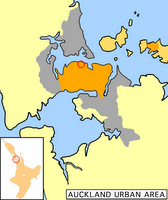
Most of the planners in New Zealand's major cities have imposed what's called a Metropolitan Urban Limit around the cities. This is sometimes called an 'urban fence,' inside which development proceeds (in theory) according to the planners' whims, and (in reality) to the extent that developers and builders can get around these whims and get something done.

Outside the urban fence, development only proceeds to the extent that land-owners outside the fence can dodge the planners' desire to make a rural museum of the area surrounding the cities, and to the extent that developers who have built up land banks around the city can encourage their chums on council to relax the zoning, or to release the urban fence just a little. You might call this a sort of 'informal' public-private partnership. (Ask around, for instance, about how the car yards of Henderson were re-zoned from rural and who benefited most from the re-zoning; and -- more recently -- ask yourself who the major beneficiaries were of the recent relaxation of controls around Botany, Flat Bush and Albany.)

In Auckland, the Auckland Regional Council (ARC) rigorously police this fence, even to the extent of taking other councils to court for attempting to overturn it. As I noted a few months ago, even Auckland's mayors have now realised this urban fence might have some role to play in limiting the supply of houses, and this helping to make houses more unaffordable in NZ cities than in less constrained cities elsewhere. Said the mayors in a joint press release:
Mayors of Manukau and Waitakere say the region's master plan for growth is throttling economic opportunities in their cities and needs an urgent overhaul. When it was introduced in 1999, the Auckland Regional Council's regional growth strategy [which set in place the present Metropolitan Urban Limits] was hailed as the answer to managing the effects of growth such as in urban sprawl...
... The shortage of land for housing was pushing prices sky-high and making it difficult for young people to get homes.
Waitakere Mayor Bob Harvey said he also wanted a review of the strategy to be completed as soon as possible.
He was impatient about the lack of progress in having potential new development areas at Westgate, Whenuapai and Hobsonville brought inside the metropolitan urban limit and made available.
"Anyone that is in local government is frustrated by long delays, procrastination and the inability to see the big picture - not by this council but by regulatory officialdom that stifles growth and prosperity."
Let me remind you, this is Bob Harvey -- Bob Harvey! -- and his fellow mayors talking about relaxing the urban limits, and talking about "growth and prosperity" being stifled by "regulatory officialdom."

Things have to be pretty bloody obvious for people like Bob Harvey to notice them, and to come out in favour of "growth and prosperity" over "regulatory officialdom."

Not so fast however, replied ARC chairman Mike Lee a few weeks back. Over the past five years, says Lee, "Auckland councils have released 1000ha of land for development." Ten-thousand hectares! Gee thanks, Mike. At 500 square metres per unit (which applies on average through much of Auckland's metropolitan area), this represents land for just 4,000 new houses per year (and this figure ignores the roads, parks, shopping areas, service centres and workplaces that will be built to accompany these new houses). This land has been "released" by councils by the simple expedient of relaxing the urban fence in areas deemed appropriate by planners, which simply means rezoning land which is otherwise idle -- land which individuals own who are restricted by these regulations as to what they can do on their own land.

Four thousand new houses doesn't go far when as the ARC's own website concedes, fifty people every day are moving to the region --that's "one person every 29 minutes" (or nearly 20,000 per year). And those new houses are built according to the planners' so-called 'smart growth' dogma: laid out in row-upon-row of regulated sameness, just as the planner ordered.

The sameness and the sprawl that many people object to in our present-day suburbia are in large part due to the regulatory measures that the anti-sprawlists themselves favour. Specifically, the "carpet sprawl" that would have few explicit defenders is created by the very 'Smart Growth' policies considered so progressive by so many planners. Owen McShane explained the process in a recent presentation (pdf), of which this the briefest of excerpts:
WHY SMART GROWTH DELIVERS CARPET SPRAWL.
Smart Growth delivers Carpet-Sprawl because even the most rigorous Smart Growth city eventually has to extend its Metropolitan Urban Limit (MUL) to provide more land for residential, commercial and industrial use.
In recent weeks the Mayors of both Waitakere City and Manukau City have pleaded for extensions to their MULs. Even Smart Growth planners acknowledge these “adjustments” will be necessary from time to time.
The sequence of events is as follows:
• The MUL is initially set to allow for the next period of growth to take place within the existing “urban form”.
• Eventually this enclosed area fills to the point where there is essentially no zoned land left for further growth or it has become so expensive that no one can afford to use it.
• In the meantime many activities have simply leap-frogged into territory outside the Smart Growth planners’ jurisdiction, which is why Northland Region is now growing so rapidly.
• Open space inside the MUL is sacrificed to high density carpet development to “save” open space outside the MUL.
• At some point the situation becomes intolerable and the people and their representatives demand an extension of the MUL to enclose some piece of surrounding rural land.
• Once this “bulge” is made legal then development and intensification begins again until the new “bulge” is also full of high density carpet development and some relief is allowed in some other part of the city.
Obviously, as this process is repeated the city expands into the rural area as medium or high density “carpet sprawl.” The only difference from the post-war sprawl is that there will be a greater variety of housing types because the market demand is more varied and regulations covering section sizes and housing types have been relaxed since the sixties, and the overall density will be higher.
I'd be interested in hearing from supporters of planning, zoning and so-called 'Smart Growth' how they feel about producing the very thing they say they oppose.

LINKS: Some Auckland mayors realise ring-fencing the city is 'unsustainable' - Not PC East Germany in East Auckland - Not PC
Alternatives to Smart Growth - Owen McShane [15-page PDF]

RELATED: Sustainability,
Housing, Urban Design, Politics-NZ, Auckland, RMA

Monday, 5 October 2009

‘Smart Growth’ and the coming ‘Housing-Led Recovery’ – or, to put it another way: ‘Oxymorons for Morons’ [updated]

I don’t know about you, but if I keep hearing excited talk about the oxymoron of a so-called “housing-led recovery” I’m either going to scream or blow up a housing project. News that mortgage lending is outstripping business lending by several percentage points is not news to about which we should be excited, but alarmed.

Haven’t we learned already that family homes are not productive investments but consumer goods? That buying consumer goods with investment capital is a great way not to recover, but to go broke?  That durable consumer goods whose prices are inflated by truckloads of the central bank’s counterfeit capital don’t represent “growth” but an asset bubble ready to pop?

If any other class of goods inflated as fast as houses do, and have, we’d want to do something about it.  But not when it’s housing.

The inflation and then the popping of the housing bubble, for which we’re all now paying, was brought about, in simple terms, by the ability of banks in a fractional reserve system to create credit out of thin air; all that newly created credit going predominantly into housing instead of genuine productive investment; and the supply of new housing being kept down by so called “town planners” – more specifically. those planners’ obsession with what they amusingly call “Smart Growth.’ 

None of these things has changed.

There’s no pressure to change or rein in the fractional reserve banking system, and little understanding of the urgent need for this to be done.  There’s very little mainstream understanding of the difference between productive investment and unproductive consumption.  And planners are still obsessed with so called Smart Growth.

If you only come here to read the economics posts, then you probably still unaware of the effect of this Smart Growth delusion on the economic disaster, so do yourself a favour and read Randal O’Toole’s latest critique of Smart Growth – which as Owen McShane says “is a ‘must read’ seeing so many local authorities are rushing to write Smart Growth into their current Plan Reviews” – go here to read How Urban Planners Caused the Housing Bubble. And in case you think this will be totally American centred, or of little interest to economists, then note this quote from page 17:

“In a recent survey of 227 housing markets around the world, former governor of the New Zealand Reserve Bank Donald Brash observes that ‘the affordability of housing is overwhelmingly a function of just one thing, the extent to which governments place artificial restrictions on the supply of residential land’.”

Would that Don, or his successor in the Reserve Bank, understand the effect of that particular institution on the housing bubble.

UPDATE: Vin Suprynowicz points out that continual government interference during the  Depression served only to delay economic adjustment and recovery.  As it was in the Great Depression, so too for this one.

Monday, 19 August 2013

How do you stop land banking?

The case of the land-owner in Auckland’s Flat Bush who stands to make  a profit of over $100 million on land he bought for less than a million eighteen years ago—and having done nothing to it—has everyone hating “land bankers.” So everyone hates “land banking,” but no-one apparently knows how to stop it.
But what if, with one hit, you could stop land banking and provide affordable housing? Guest Poster Phil Hayward reckons it’s a snip. You just stop ring-fencing the city …

Consider basic urban economics: if we draw a curve showing land values for an urban economy, it slopes up gradually from the fringe to the centre and is based, among other things, on the cost of transport that might be saved at a more central location.

Where there is no Urban Growth Boundary (UGB) and no bidding war for the land on which planners have imposed a quota, this curve's slope is gentle and continuous. It actually extends miles out into the country beyond the existing fringe, and the amount of land involved is massive; like 100 years or more "supply" for urban growth. If some speculator "corners" all the land within the first mile or two, which is quite some feat, then competitors can simply "leapfrog" the holding. It is only two minutes drive on an open road anyway, and about another $1,000 worth of real estate value versus "transport costs saved."

At least, this is how it works in cities without an Urban Growth Boundary. "Affordable housing" is basically an issue of whether or not people can "leapfrog" land bankers’ holdings to build themselves houses. When there is no Urban Growth Boundary, as is the case with affordable US cities, no-one bothers to land bank.  The "supply" of land in these cities that is economically accessible with only a few minutes and a couple of dollars worth of further car travel is far too big for anyone to "corner."  [And nor would there would be any expected economic windfall from landbanking, which only offers massive returns when land supply is artificially restricted.]

When the land supply is not constrained, land prices are determined more by the price able to be paid for alternative users of fringe land i.e. farming, forestry, etc. Therefore, there always ends up being houses available (or potentially available) with little or no "planning gain" incorporated into the price of land.

This anchors the price of all housing, in "rural value plus location/transport cost saving premium" – which is far lower than "planning gain" when there is a growth boundary.

Here then, based on the above understanding, is the basic flaw with the oft-argued idea that central planners have “released” rural land formerly outside the Urgan Growth Boundary, such that (as they might say) "X years supply of land has been zoned, or released."  The flaw is this: this newly “released” amount is not the amount that would normally come to market in the next X years on the "rural land" market. It is only the total quantity of land within the zone, whether or not it is economic to use at the prices it can now command.

To really have "X years of economic supply," it would be necessary to include in the zone enough land such that the quantity truly needed for "X years supply" would come up for sale anyway in a normal rural market, and at normal rural prices. Which is to say, at prices that would be affordable on which to build. This would mean a zone with about ten to twenty times as much land as the planners’ notion of "X years supply for urban growth," and without the high prices produced by the zoning constraints.

Note that the land parcels comprising "X years supply" (by the planners’ standards) is being used for something already by those parcels’ present owners, and no present owner has any inducement to sell their parcel at the value that it is worth in its present use. But property developers who need to secure land for new developments will rapidly exhaust the "supply" of land that is coming onto the market anyway.

Since each development takes years, and sites for the next development need to be secured before the previous one is completed, they will soon need to start "door knocking" to plead with land owners to sell.

Meanwhile, having become aware that they are part of a newly created oligopoly holding of the next "X years supply of land for urban growth," the land owners cease to think in terms of rural land values at all, and start thinking like
investors or speculators. Or land bankers.  None of them will be satisfied with a 10% capital gain, or even 20%.
Expectations of gains become a reason to hold land rather than sell it, just as with speculators in bullion or commodities in a rising market. So the planners’ "X years supply" becomes a lot less than the "X years supply" they thought it would be, purely because of typical investor psychology. By their interference in what would have been a natural process, the planners have actually reduced the likelihood that any one land owner within the zone will in fact sell the land within the "X" years at all.

Which means in order to make a purchase, developers will have to offer land owners an amount greater than the
"present value" of what the land owner thinks the value might reach if he holds the land. And every developer has to out-bid every other developer for the parcels that might go on the market.  Meanwhile, the rising prices paid by developers feed heightened expectations on the part of the remaining land owners. And so it goes on like a nuclear chain reaction, blowing up this time in the face of would-be affordable-home owners.

And as with a nuclear chain reaction, it is impossible to have "just a little, harmless explosion." Urban planners need to understand that an Urban Growth Boundary does not cause a little, harmless explosion in greenfields land values.
Setting time limits on land banks won't change this. Neither will land taxes or capital gains taxes. Regardless of the mechanism, the developers are the meat in the sandwich between land vendors and the ability of the consumers of housing to "pay." An increasingly thin slice of meat.

Hence the prices will always find their level at the point at which the population's ability to pay for housing is maxxed out [Are we there yet? – Ed] ; and developers are being sorted into winners and losers in what has become the gaming of the land supply, with some going broke and the rest making a killing.

The fact that no-one involved in modern urban planning advocacy has ever shown any evidence of having thought of this, is just a sign of how grossly unqualified they are to be dictating outcomes at all in the first place. These economic realities at least were far better understood decades ago, when the paternalists who devised the original UK Town and Country Planning System decided they would have to include in their proposed system compulsory acquisition of land. When an Urban Growth Boundary is set, they said, the government should buy the land within it compulsorily at the same prices as still apply outside it, and then seek proposals from developers regarding what they would put on the land and what prices they would sell it for, if they were allotted some at the government's cost price.

Horrible? Yes. But this is the logical economic extension of the mess the planners have created. Another demonstration of the dictum that controls necessarily lead to further controls, and on ad infinitum.

Then, of course, we could simply not "restrict" urban fringe growth in the first place…

RELATED POSTS:

Tuesday, 14 August 2007

It's not easy being sustainable, or smart.

Saving the Planet. It's not easy, is it--even if you want to 'do your bit' for Gaia--especially when emotions and politics replace reason and good hard sense. Let's face it, most people doing most 'planet-saving' things aren't doing that stuff for any actual tangible good their actions will produce, but more for what they see as the 'intrinsic value' of the sacrifice they've made for The Planet.

Think globally; sacrifice locally--and be seen doing it. That's the mantra. It's all about feeling good while doing what's been decreed as good.

But just imagine you genuinely wanted your actions to 'make a difference.' How would you know? As I've blogged here recently, if walking is less 'green' than driving, does that mean you should take the car down to the shops? When plastic bags and disposable nappies are 'better' than their paper and cloth alternatives, how do you display your 'green credentials' to your friends? Or when diesel 4WDs are more green than diesel trains, how should one go to work? Should you even go to work? What about all those old lightbulbs you need to dispose of--is it better for the landfills not to install the new feelgood models, and just sit around in the dark instead? (All examples produced by Chris Goodall recently.)

And if recycling paper uses more energy than producing new paper; if burning wood is better than recycling it; if Priuses are less energy efficient over their life time than gas guzzlers; if buses and trains are more wasteful when considering whole-of-day costs than the private vehicle fleet; if planting trees at mid- to high-latitudes is worse than cutting them down . . . then it seems that "thinking globally and acting locally" is actually more difficult than the easy smug answers might suggest.

It really isn't easy appeasing Gaia, is it? Or appeasing Gaia's smug representatives here on earth. The easy certainties that many of them want enshrined in law would do less for the planet than just letting price signals, property rights and human ingenuity do the job they're supposed to: send information on resources and markets and avoid the destruction of environments, while leaving the productive free to invent new ways of doing thing.

The problem really is that we're not being left free to work things out in the way best suited to human life on earth; instead we're being made to feel guilty for the sin of being alive, and being corralled into doing what Gaians wish we should do in pursuit of ends which are sometimes only peripherally related to human life and human wellbeing.

And the Gaians won't take no for an answer, even when their notions are proved wrong. The theory of Smart Growth is literally one of the most all-encompassing of foolishnesses--it is stupidity that literally encircles and encloses our major cities, reducing the supply of land and pushing up house prices. But as Owen McShane notes in the latest National Business Review, the green theory that many assume must be behind Smart Growth just doesn't stack up.
...Smart Growth theory has been further undermined by a recent Australian study called “Consuming Australia” by Sydney University’s Australian Conservation Foundation, using data collected by the Centre for Integrated Sustainability Analysis. You cannot get a much more PC organization than that.
...The Sydney researchers found that total transport activity – including private vehicle use, public transport and aircraft – accounts for only 10.5% of the carbon footprint of the average Australian family. This was the smallest slice of the carbon footprint “pie”. Food accounted for over 28% of the footprint. Putting everyone on a diet would have a greater impact.
...Now there’s a new campaign for Weightwatchers – “Join up and Save the Planet!”
...The Government should note that “construction and renovations” account for only 11.8% of the family’s carbon footprint – a bit more than transport, but much less than “other goods and services” at almost 30%.
...The report bluntly concludes:
If every Australian household switched to renewable energy and stopped driving their cars tomorrow, total household emissions would decline by only about 18%.
...So why do our social engineers focus on transport and construction which are such small slices of the carbon footprint pie? Again, I suspect it’s just because “They are there” – and, in particular, they are there to tax, inspect, and regulate.
...This Australian study also examined the carbon footprints of families living in different states, different cities, and in different locations within cities. The researchers probably expected to come up with support for Smart Growth claims that high-density inner-city living will help save the planet while suburban living sends us down the pathway to toast.
...Instead, they found that “place doesn’t matter.” Household income was the major variable. Families with the smallest carbon footprints are on lower incomes and live on the outskirts of town. The carbon footprint “criminals” are on high incomes, and live in “vibrant downtown communities”. Burning up all that midnight ethanol must pump out the CO2.
...The researchers had to declare that:
“Despite the lower environmental impacts associated with less car use, inner city households outstrip the rest of Australia in every other aspect of consumption. … the opportunities for relatively efficient compact living appear to be overwhelmed by the energy and water demands of modern urban living. In each state and territory, the centre of the capital city is the area with the highest environmental impacts, followed by the inner suburban areas. Rural and regional areas tend to have noticeably lower levels of consumption.
...There goes the Smart Growth neighbourhood!
...Yet the ARC’s summary report of their decisions on Proposed Change 6 simply asserts:
Urban living is more transport efficient than rural living.
...Oh, really?
...Smart Growth has always been a policy in search of justification. It started out as a means of pricing blacks and Hispanics out of white enclaves in the US. It worked but proved “inappropriate”. Then Smart Growth would “save” rural land from urban growth. There is no such thing as “productive land” so it didn’t work. Then it would save us from the oil shocks. The shocks went away. Most recently it would deliver us from global warming.
...The Australian report knocks the props out of the carbon footprint argument.
...What will they come up with next? Central planners need some excuse to push us round.
MORE from the Archives: Urban Design, Global Warming, Environment, Property Rights

Tuesday, 23 May 2006

Restricting growth is not smart, and neither is it cheap

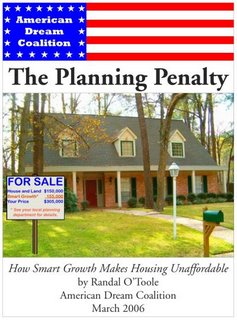
The busybody nostrums of town planners are slowly being seen for what they are: restrictions on people's lives; an insistence that people live as planners wish them to, rather than as they might choose for themselves -- and the planners' restrictions are adding enormous extra costs to housing. Two recent articles confirm that view, one from San Francisco and one from Boulder, Colorado.

Boulder has been described as "twenty-five square miles surrounded by reality." Boulder's town planning regime seems to confirm that view, says the Thoreau Institute's Randal O'Toole, who notes that a whopping ninety-percent of American housing markets are less expensive than Boulder.

Why? "Restrictive land-use planning has driven up housing prices in Boulder... The Boulder policies include restrictions on the number of building permits issued each year and purchases of huge amounts of open space outside of the city to prevent development." It's not only NZ housing that is undergoing an affordability crisis -- the same crisis affects every western city where development restrictions have been widely adopted. Boulder's restrictions are amongst the most restrictive anywhere.

As any fourteen-year-old student of Economics could tell you, if you restrict supply without any lessening in demand you will push prices up. Unfortunately, town planners don't have even that much understanding of economics -- they seem to think that for them, laws of economics can be suspended. They can't. The result of what is fatuously called 'Smart Growth' by the planners -- ie., restricting development - is estimated by O'Toole to add "$117,000 to the median price of a home in Boulder County, even when adjusted to reflect affluent residents' buying power. He writes that a planning-induced housing shortage added $3 billion to the cost of homes [Colorado-wide] in 2005."

So, not very smart at all then.
In an interview, O'Toole said high housing costs are both an unintended consequence of well-meaning land conservation and the result of deceptive efforts by city planners to dictate how people live. "The real goal is not to preserve open space, but to force compact development, also known as smart growth," he said. "The planners don't really care about open space. All they want to do is force people to live on tiny lots or in multifamily housing instead of in single-family homes on large lots — which is where 80 percent of Americans say they aspire to live."

And the silliness is not confined to Boulder -- as I say above, the silliness is worldwide and it is expensive. The Boulder story and a similar story in San Francisco are highlighted in two articles, 'The Price of Smart Growth' and 'The High Price of Land-Use Planning' respectively. Read them. The silliness is slowly having the light of reason shone upon it as the truth becomes more and more obvious: there is Zoned Land, where house prices are high, and Unzoned Land, where they aren't. Our planners are pricing people out of new housing. That's not smart at all.

LINKS: The price of smart growth - Boulder Daily Camera
The high price of land-use planning - Randal O'Toole, San Francisco Chronicle

NZ Housing affordability "in crisis" says report - Not PC (Peter Cresswell)
Housing un-affordability - denying the obvious - Not PC (Peter Cresswell)

TAGS: Politics-US Environment Property Property_Rights New_Zealand Economics Urban_Design Auckland

Monday, 23 April 2007

New report confirms runaway regulation feeding runaway house costs

A new study commissioned by the Housing Corporation and released this afternoon says that policies set to restrict sprawl and to limit choice are making housing in Auckland severely unaffordable -- findings that due to the inanity of Alan Bollard and the Reserve Bank Act affect us all, and effectively confirm what previous studies by Wendell Cox, Hugh Pavletich and Demographia have been saying all along: that envy is making housing unaffordable; that so-called sustainable cities are unaffordable cities; that sprawl is good, but regulation is not; that 'smart growth' is not green; that NZ housing affordability is in crisis, and the dream of home ownership is now just that: a dream.

Among the key findings of today's report from the Centre for Housing Research[pdf] are:
  • Since 2000, increases in demand for housing [in Auckland] have outstripped increases in its supply. The result has been a major increase in land and house prices. A range of factors have contributed to increased demand including positive net immigration, higher incomes and higher employment, coupled with strong ability to borrow to finance house purchase. A number of factors have constrained supply. One of these has been a supply of land limited by regulation and zoning. Another contributor has been difficulties in the consents process, especially its time consuming nature; lack of appropriate resources within councils to handle both non-notifiable and notifiable consents is partly responsible for this situation.
  • Population in the region grew 35.0% in the fifteen years to 2006. Over the same
    period, the stock of dwellings rose faster (36.9%). In the five years to 2006 however, this
    relationship reversed: population increased by 11.6% while dwelling stock rose
    10.9%.
  • Between 2000 and 2005, the median house sales price rose by over 60% in Rodney District, North Shore City and Auckland City, by over 50% in Waitakere and Franklin, and by 48% and 39% in Manukau and Papakura respectively. Over the decade to 2005, the median ... price increased in a range of 88% (Papakura) to 131% (Rodney and Franklin). Apartment prices also rose strongly, but not as much as for house prices. This lower rate of apartment inflation may reflect a variety of factors including: more responsive supply of apartments than houses; differential construction costs for the two types of dwelling; temporary oversupply of (some types of) apartments; differences in investor versus owner-occupier attitudes to risk and yield; and a preference by purchasers for stand-alone
    houses over apartments.
    The difference between house and apartment inflation also reflects land inflation. Vacant section prices doubled or more than doubled in the five years to 2005 in Auckland City, Waitakere and Franklin. Over the decade to 2005, the median vacant section price across all areas rose from a 'low' of 108% in Manukau to highs of 334%, 329% and 315% in Auckland City, Franklin and Rodney respectively.
  • Auckland's Regional Growth Strategy (RGS), adopted by the ARC and by all seven councils in 1999, sets the overarching strategy for Auckland development and urban form. The 'Growth Strategy' promotes a compact city capable of accommodating at least 2 million people by 2050. Intensification of dwellings and population is sought around growth nodes situated around town centres and transport links.
    The Regional Growth Strategy adopts Metropolitan Urban Limits (MUL) that set a boundary within which residential, business and other 'urban activities' are to occur. Proposed Plan Change 6 to the Growth Strategy sees urban activities effectively banned outside the MUL.
  • Surveyed private sector stakeholders (including developers) identify two key themes concerning Auckland house supply constraints: land constraints and council-related issues relating especially to consent processes and infrastructure.
  • Most see three land issues as posing major constraints to development: land availability, land ownership, and cost of land. Land availability reflects the existence of urban growth controls (that is, the Metropolitan Urban Limit).
  • The Metropolitan Urban Limit results in limited land supply available for greenfields development... Greater restrictions on development beyond the existing Metropolitan Urban Limit under [the Auckland Regional Council's] Plan Change 6 would make [this] even more problematic.
  • The overall effect of actual and proposed zoning changes is to limit urban expansion, leading to a shortage of land suitable for large scale development. Zoning changes have done little to enhance the rate of intensification. The latter is occurring but not at the rate envisaged in the Regional Growth Strategy.
  • High land prices promote intensification by incentivising apartment living over stand-alone dwellings. This has acted to the benefit of larger scale CBD developers. However others note that where land prices (and other costs) become too high, any kind of development becomes unprofitable and so does not proceed.
  • Council planning procedures and consent processing times are the subject of huge dissatisfaction amongst private stakeholders. Over 80% of respondents see these two features as major development constraints. Consent approval processes tend to proceed iteratively within councils, each item having to be 'solved' before the next officer becomes involved. This leads to a prolonged process. Developers consider that councils are neither aware of the length of the consent process nor of the implications of delay.
  • Delays are most extensive where a development is notifiable, opening up the potential for objections and lengthy hearings. Developers seek to avoid notification at all costs. This frequently means they settle for 'lowest common denominator' developments that meet all District Plan requirements, rather than including innovative features that might make the development notifiable.
  • Freeing up land supply, while necessary to alleviate high land prices, is not sufficient. The manner in which land is made available is as important as any extension. Dribbling new land onto the market in a pre-specified pattern allows existing landowners to retain monopoly rights and high land prices.
To most of us trying to work in Auckland's increasingly frustrating regulatory environment none of this will come as news, but it might help explain to those who don't work here why the work is becoming much less enjoyable, and why the number of small private developers working in and around Auckland is diminishing.

The losers here are many: would-be new home-owners priced out of the market; developers and designers priced and regulated out of profits and innovation; producers and exporters suffering under the Reserve Banks' high and higher interest rates (and the resulting soaring exchange rates) hiked in an impotent attempt to cure the ills of a market that is being strangled by red tape.

This disaster, allow me to point out, is almost single-handedly the fault of people who almost ironically go by the title of "planner." It's time to make "planning" a dirty word.

LINK: Housing supply in the Auckland region, 2000-2005 - Centre for Housing Research [145-page PDF]

Monday, 23 November 2009

Rising house prices not the result of a ‘strong market’ but of a totally malfunctioning market [updated]

Bad as the Reserve Bank’s focus on bogus “price stability” is, which as Phil Goff bewailed last week it targets with the blunt instrument of interest rates, it turns out there is little it can do about housing prince inflation – but as we’ve explained many times before, and as Owen McShane explains in his latest newsletter, there’s something Phil and crew could do that could, and would:

    “The Reserve Bank is well aware that local government policies that restrain the supply of land raises house prices because supply cannot respond to changes in the scale and nature of demand.
    “The only way the Reserve Bank can respond to these real estate bubbles is to increase interest rates which in turn increases the value of the dollar.
    “New Zealand’s housing supply is even more constrained than ever because massive compliance costs and development contributions mean the cost of creating new lots now exceed their sale value.
    “These rising prices are not the result of a ‘strong market’ but of a totally malfunctioning market.
    “New Zealand cannot blame low interest rates for our housing bubble.
    “We have had one of the least affordable housing markets in the world and yet during the bubble years the RB maintained a high interest rate regime.
    “Indeed, international urban economists cite NZ as the counter-factual case study to challenge those who blame the bubble on cheap money rather than constraints on supply.
    “The so-called “Smart Growth” planners refuse to learn. They insist we have unaffordable housing because we have not had sufficient Smart Growth (dense thinking.)
    “Their response is to have even more restrictive plans, and in Tauranga they are now proposing enforced minimum densities.
    “Most true communists believe the Soviet Empire collapsed because its communism was not pursued with sufficient rigour.
    “Most central planners blame their failures on other people’s failure to do as they are told.
    “So beware. Smart Growth is coming to a town near you.”

‘GREAT DAY OUT’ UPDATE:


CLICK HERE FOR DETAILS

Why not join Owen and supporters at Alan Gibbs’s Kaipara farm for the Great Day Out?  Great food, great beer, and some alleged art – all in aid of a good cause.

Come and support Owen’s Centre of Resource Management Studies and Muriel Newman’s Centre for Political Research – and have a great day out.

Standard Donation supporters will enjoy a day at the farm and the Champagne lunch, and have a chance to share ideas with the Trustees and Directors and their friends and colleagues.

Premium Donation supporters will also be able to chose from:

  • A guided tour of the alleged works of art by jeep.

  • A ride in the Aquada on the lake.

  • A helicopter flight over the farm

Head here for details, and to register.

Monday, 21 January 2008

Welcome to the land of milk and honey ... and the world's most unaffordable housing

Several years on from New Zealand's housing affordability problems becoming all but obvious, they've now gone past being serious and becoming tragic.  Auckland and Wellington might rank just eighteenth equal in a survey of the world's most liveable cities, but measured against our incomes New Zealand cities now top the polls as the most unaffordable places in the developed world in which to buy a home.  Where it takes less that ten years work for household on the median income to buy a median-priced house in Ireland, the US and Canada, it takes the NZ's middle-income household nearly twenty years! [Herald story here.  Worldwide housing affordability study here at the Demographia site.]

Little wonder. As income levels elsewhere have been soaring, wages in this pathetic authoritarian backwater have failed to keep pace (see graph at right, and story here).  Meanwhile -- as demand for housing continues to soar -- when regulators aren't making it well-nigh impossible for builders and developers to build and develop on the land they own, planners are making it well-nigh impossible to buy land on which anyone is even allowed to contemplate building and developing. [See many, many previous posts here on Building, Housing, Sprawl, Urban Design and the RMA.]

Both rural and urban land is in huge demand for development; but the supply of land has been effectively nationalised.  Our cities have been ring-fenced by eco-zealots eager to calcify rural New Zealand into a bucolic museum, while within our cities (which represent just 1.4% of the country's land) restrictions on land supply and the development of that land is severely restricted, and the choice of housing types severely limited.  (Greater London area is about the same size as Greater Auckland, for example, yet while London houses over ten million people in a mixture of terrace housing, walk-up apartments and tower blocks, Auckland is home to just over one million -- and as Auckland's planners argue against the sprawl their policies induce, they severely restrict the density within the city that their restrictive ring-fencing demands.)

The result of these restrictions on building and on land supply is that New Zealand needs around 35,000 houses a year to keep up with demand, while home builders are restricted to producing just 24,000 houses every year -- and thanks to the explosion of building regulations and the increasing emigration of skilled builders, each of those houses costs much more to produce than it ever has, on land that is more expensive than it's ever been.

It's instructive that the most expensive houses in New Zealand relative to income are now no longer those in Auckland.  Tauranga -- whose 'planners' have enthusiastically embraced the anti-development 'sustainable' philosophy of so called 'Smart Growth' -- now has the country's most unaffordable houses.  No coincidence when you consider that the world's most unaffordable cities are overwhelmingly those who have most enthusiastically embraced 'Smart Growth.'

The real culprit here isn't the council officers or planners or regulators who make the plans that restrict the supply of land and the ability of bui9lders to develop it for would-be home-owners; the real culprits are the Resource Management Act that gives planners and regulators the power over other people's property, and a culture that assumes that local governments need planners and regulators to plan and control.

All this, and the bastards responsible still airily deny they're the problem, while proposing measures that will only make things worse! 

This lack of clearsightedness is perhaps because the situation seems irredeemable -- which it is, unless the red-tinted glasses of the planners and their acolytes are removed.  A similar problem is easy to see in the traffic jams that snarl up our cities, which as Andrew Galambos says are "a collision between free enterprise and socialism. Free enterprise produces automobiles faster than socialism can build roads and road capacity."

That same collision of capitalism and socialism in our daily traffic jams is ever present too in NZ's severely unaffordable housing markets: a bubble inflated by the freewheeling demands of prosperity and credit and new immigration colliding with a simultaneous suffocation of supply by the socialism of the state. At a time when greater supply is desperately needed to mop up exploding demand, 'planners' -- those throwbacks to the failed central planning regimes of socialist states -- are throttling the supply lines we do have.

It's time that unemployment was urgently increased, among the fraternity of planners who have condemned New Zealand's home-owners to half a lifetime of paying off their houses.

UPDATE:  As reader Wayne points out, with the usual suspects busy patching up their server stories, there's an unusually good thread on this topic at Kiwiblog.

Friday, 29 January 2010

Task Force to clear the way for more affordable homes [updated]

I’m almost speechless. Here’s why:

    “Environment Minister Nick Smith has announced two new taskforces to look at Resource Management Act (RMA) reform, issues surrounding urban design, metropolitan urban limits and housing affordability. . .
    “ ‘I don’t think we have the incentives right for developers to do the best urban design in our largest cities. There are also questions about the policy of metropolitan urban limits, the effect they have on section prices and the negative flow-on effects to the broader economy. . . ,” he said.

See what I mean?  I’m astonished.

After seventeen years of having to endure the Resource Management Act, after a decade of evidence showing that restricting the supply of urban land is sending house prices through the roof, there’s finally a “taskforce” to “look at” it.

Slow progress.  But progress.

    “The Urban [Task Force] will be chaired by barrister Alan Dormer and includes planning consultant Adrienne Young Cooper, research economist and consultant Arthur Grimes, architect and urban designer Graeme McIndoe, Chief Executive of the Property Council of New Zealand Connal Townsend and Ernst Zollner of the New Zealand Transport Agency. It has a report date of 31 March 2010.”

I don’t know much about the others on that group (anyone able to shed any light?), but Alan Dormer and Arthur Grimes have both been upfront about their opposition to the RMA and to metropolitan urban limits respectively—Dormer’s submission on the original RMA Bill back in 1991, for example, was a cracker, and Grimes’ Centre for Housing Research has said very cogent things on housing unaffordability and the reasons for it.

That’s astonishing.  So something might even come of this.  Not RMA repeal, it’s still too early for that, but this could be a very good baby step.

So I’m excited. Excited in a guarded fashion, because this is being announced by the same chap who calls the RMA “far-sighted environmental legislation, and who said just before the election that he intends to “review” the Resource Management Act to, quote, “look at how companies win the right to take private land.” 

So while I’m still getting my composure and my breath back, and wondering whether to be excited or concerned, read a little about the issues from previous posts to see what’s at stake:

All posts on Urban Design here and here.

    “The [advisory]  groups are stacked to give Gary Taylor’s Environmental Defence Society (EDS)what they want.
    “Townsend and Grimes will be outvoted.
    “Alan Dormer Chaired the [advisory] group for the first round but everything was hugely diluted in the Select Committee by submissions from EDS etc.
    “So I am not so optimistic - much as I would like to be.
    “If he was serious why put Adrienne Cooper on BOTH groups.
    “Subject: The Cooper History
    “It is worth noting that when I wrote my report for the Reserve Bank in which I predicted all these negative outcomes; the Auckland Regional Council (ARC) appointed Hill Young Cooper ‘to prove it wrong.’
    “They accepted the commission and Adrienne Cooper and David Hill wrote a truly disgraceful report.*
    “She has been a strong supporter of Smart Growth ever since.
    “From the Business Roundtable document ‘Turning Gain into Pain’:

The Growth Strategy recognises that with intensification house prices would
be higher than otherwise. This acknowledgment seems to be an about-face by
the ARC and other councils that previously dismissed Owen McShane's view
that restrictions on the supply of land for urban development were putting
upward pressure on house prices.**
Policy-induced increases in house prices lead to higher interest rates and distort consumption and investment patterns.
The policy would adversely affect housing options available to people,
particularly those on low incomes and with few resources, and is inequitable.
It could be expected to accentuate overcrowding and reliance on
accommodation provided by caravans and garages.
3.6 For these reasons, the Growth Strategy provides an unsound basis for the Transport Strategy. In particular, the emphasis placed on urban intensification and reliance on passenger transport services is mistaken and should be reconsidered by the Forum.

**Cooper, Adrienne Young and Hill, David (1996), A Local Authority Response to the McShane Report, a report commissioned by the Auckland Regional Council, Auckland City Council, Franklin
District Council, Manukau City Council, North Shore City Council, Rodney District Council
and Waitakere City Council, Hill Young Cooper Ltd, Newmarket.

** McShane, Owen (1996), The Impact of the Resource Management Act on the 'Housing and Construction' Components of the Consumer Price Index: A 'Think Piece', a report prepared for the Reserve Bank of New Zealand, Reserve Bank of New Zealand, Wellington.

    “Papakura (with their ACT Mayor David Hawkins) refused to contribute to the Hill Young Cooper report, the saying surely the ARC should ask for a review, not instruct the consultants to prove me wrong.
    “The report does not turn up on the web - on the wrong side of the Digital Time line.
But Arthur Grimes should be able to get it from the ARC library.”

Monday, 20 January 2014

NZ housing now more unaffordable than everywhere but Hong Kong [updated]

image

Every year since 2005, the Demographia organisation has been measuring housing affordability across the cities of the English-speaking world. As the planning virus continues with no abatement, the results have been increasingly horrific – especially for New Zealand house-buyers.

This year, with even more cities included, is no exception, with New Zealand’s major urban markets more unaffordable as a whole than any place measured outside Hong Kong.

Do you hear me, planners? More unaffordable than any place outside Hong Kong …

clip_image002

MEDIA RELEASE
Monday 20 January 2014

10th ANNUAL DEMOGRAPHIA INTERNATIONAL HOUSING AFFORDABILITY SURVEY

Super City ... with price tag that matches – New Zealand Herald INTERACTIVE MAP

The 2014 10th Annual Edition …

The 2014 10th Annual Demographia International Housing Affordability Survey covers the expanded 360 urban markets of Australia, Canada,  Hong Kong,  Ireland, Japan, New Zealand, Singapore, United Kingdom and the United States.

The Annual Demographia International Housing Affordability Survey rates housing affordability , based on the Median Multiple – that is, the median house price divided by the gross annual median  household income of specific urban markets, for the 3rd Quarter of the previous year.

The “median multiple” is a robust measure – essential for the basic understanding of the structural health (or otherwise) of a specific urban markets.

If housing exceeds 3.0 times annual household incomes (requiring mortgage loads of about 2.5 times), it illustrates that there are serious political impediments that need to be addressed, with respect to land supply and infrastructure planning, provisioning and financing.

The fringes of an urban market are the only effective and sufficiently responsive supply and inflation “vents.”

Normal healthy urban markets, where housing is at or below 3.0 times annual household incomes are rated “affordable”; 4.0 times and below “moderately unaffordable”; 5.0 times and below “seriously unaffordable” and above 5.0 “severely unaffordable.

The results for all 360 urban markets covered within this year’s Survey are as follows …

image

The results of the 85 major urban markets (with populations in excess of 1,000,000) of the geographics covered  are as follows …

image

The Survey Schedules provide detailed specific gross annual household incomes, median house prices – and from that the Median Multiples.

Alain Bertaud, researcher and former Principal Planner – World Bank contributes the introduction …

The Introduction to this year’s Survey is Alain Bertaud, Research Scholar, Stern School of Business, New York University and former Principal Urban Planner – World Bank. Mr Bertaud has vast grounded experience internationally within the urban planning field.

Alain Bertaud makes it clear within this year’s Survey, why urban planning needs to change, asking …

“Are planners in the worst performing cities paying any attention?”

“And are they drawing any conclusions on how to improve the situation?”

Or do local governments conclude that the best way to increase the supply of affordable housing is to impose new regulations that will mandate developers to build housing units at prices, standards, and in locations selected by the government?”

“The last approach, under the name of inclusionary zoning is unfortunately the most common response, as recently seen, for instance, in New York and Mexico City.”

“Urban planners have been inventing all sorts of abstractly worded objectives to justify their plans for our future cities – smart growth, liveability, sustainability, are among the most recent fads.”

“There is nothing wrong, of course, for a city to try to be smart, liveable, or sustainable.”

“But for some reasons these vague and benign sounding objectives usually become a proxy for imposing planning regulations that severely limit the supply of buildable land and the number of housing units built, resulting in ever higher housing prices.”

“In the name of smart growth or sustainability, planners decide that densities should be lower in some places and higher in others.”

“Population densities are not a design parameter whose value depends on the whim of planners but are consumption indicators which are set by markets.”

“Even the Communist Party of China recently recognised that resource allocation is best achieved through markets; why can’t urban planners in so-called market economies reach the same conclusions and let markets decide how much land and floor space households and firms will consume in different locations?”

“It is time for planners to abandon abstract objectives and to focus their efforts on two measurable outcomes that have always mattered since the growth of large cities during the 19th century’s industrial revolution: workers’ spatial mobility and housing affordability.”

“As a city develops, nothing is more important than maintaining mobility and housing affordability.”

“Mobility takes two forms: first, the ability to travel in less than an hour from one part of a city to another; and second, the ability to trade dwellings easily with low transactions costs.”

“Housing mobility allows households to move to the location that best maximize their welfare.”

“Affordability is the ability for any urban household to be able to rent a dwelling for less than a 25% of its monthly income, or to buy one for less than about three time its yearly income.”

“The mobility and affordability objectives are tightly related.”

“A residential location that only allows access to only a small segment of the job market in less than an hour commuting time has not much value to households, even if it is theoretically affordable.”

image


UPDATE 1:  “Among all 360 markets in the principal analysis, there were 95 affordable markets,” none of which were in New Zealand …

image

image

The key correlation … ?

image

Tuesday, 27 January 2009

Planners still stitching up home-owners: NZ cities world’s second-most unaffordable [updated]

Despite the recession, houses in New Zealand cities are as unaffordable as they’ve ever been – that’s the conclusion of the fifth annual survey [pdf] by international organisation Demographia, who’ve found that the average price of houses in NZ’s eight major cities are still more than 5.7 times the average household income in that city.

In the parlance of the study, this makes the New Zealand housing market seriously unaffordable – just as it has been for the last decade. The survey of English-speaking countries finds that UK, Ireland, Australia and New Zealand have no affordable major urban markets, while Canada has 10 (of 34) and the United States 77 (of 175). There are no moderately unaffordable urban markets (at and below 4 times household income) in Australia, New Zealand, Ireland and the United Kingdom.  Reports NBR:

    The 2009 Demographia study of international housing affordability found Australia has the most unaffordable housing at 6.3 times annual household earnings.
    New Zealand was second on 5.7. Ireland registered 5.4, the United Kingdom 5.3, Canada 3.5 and US 3.2.
    None of the eight urban markets in New Zealand covered by the survey are considered to be affordable. Seven were severely unaffordable and Palmerston North was considered seriously unaffordable.
    A figure above five is regarded as severely unaffordable.
    Auckland is the least affordable larger market, with a median multiple of 6.4, while Christchurch (6.1) and Wellington (5.9) are also severely unaffordable.
    Tauranga-Bay of Plenty was the least affordable market, with a median multiple of 6.6. Out of the eight New Zealand markets only Palmerston North is not severely unaffordable on 4.9.

Just to clarify what this degree of unaffordability means, this is unprecedented both historically and geographically – so simply saying that young couples need to hunker down and save like their grand-parents did is not even the beginning of the whole story.   Outside the current period, at no other time in NZ’s history has this price-income multiplier been so high.  And outside New Zealand, only Australia has a higher price-income multiplier.

The reasons for contemporary NZ cities being so seriously unaffordable compared to other cities (and to other times in NZ’s history) can be deduced, if you’re smart enough, from the policies of those cities at the upper end of the Demographia survey. 

The reason for some cities being more unafforable than others is not just the excessive demand created by loose credit in recent years, since that loose credit operated across all markets; it’s not just the increased cost of construction in recent years (although that hasn’t helped the level unaffordability), since (especially across the US) those increased costs have been imposed across all markets; it’s not just the increasing attractiveness of these unaffordable cities, since domestic migration figures for most of these cities are showing either strong outflows or decreasing inflows from (and to) these cities; and it’s not like some of the world’s most unaffordable cities are running out of land: there’s no shortage of land in the likes of British Columbia, California, Victoria, or the deserts of Western Australia (and nor is there in NZ).

No, to see why some cities are more unaffordable than others you have to look at the differences between those cities, and the biggest difference is in how the cities regulate land. 

In Tauranga, for example, 'planners' have enthusiastically embraced the anti-development 'sustainable' philosophy of so called 'Smart Growth'. At a multiplier of 6.6, Tauranga has the country's most unaffordable houses. At a multiplier of 6.4, Auckland has the second most unaffordable housing – and for years Auckland’s planners have rationed the land supply, ring-fenced the city, and restricted the range of urban housing.  No wonder.  If you ration supply while demand stays the same (or increases), then you’re going to ensure prices go through the roof.

And in the most unaffordable places land is being rationed.  Ring-fencing cities to slap down “sprawl” is squeezing the supply of land in those cities; heavily regulating land-use and subdivision in cities is squeezing the supply of land in those cities.  The fact is, as I’ve pointed out before, that the world’s most unaffordable cities are almost without exception those cities who cite themselves as being the most “sustainable” –- another example of the price of fashion.

But in this case the fashion victims are us.  And even as the followers of fashion defend their advocacy of land-rationing – an imposition that all of us get to feel --  the evidence from around the English-speaking world is clear: that "smart growth" cities are unaffordable cities.

Graph from Demographia 2009 survey, pg . 26

Frankly, both ring-fencing around cities and enforcing lower densities within them are the twin causes of the problems (and it’s the state giving planners power to do both that needs to be expunged).  

There's no problem with “sprawl” if the ring-fencing were relaxed: New Zealand's urban areas account for less than 1 percent of the total country, one quarter of that in the Auckland region. If all of NZ's 1,471,476 existing households were to be rebuilt on an acre of land -- which was the sort of thing proposed by Frank Lloyd Wright in his Broadacre project-- we'd all fit in an area less than one-quarter the size of the Waikato , and just think how easy it'd be to thumb a lift out to Raglan!. 

And there's really no problem with higher densities within cities if the planners are muzzled, if the private sector gets to offer buyers what they want, and if the state is barred from building the sort of thing the state always likes to build -- which is building the slums of tomorrow.

What it comes down to is choice.  If people were only left free to live in the way they wanted -- however apoplectic that made all the many enemies of choice -- the problems of housing unaffordability would disappear overnight.

For further information, read all PC’s posts on …

Tuesday, 4 October 2016

The record shows that to make more affordable housing that’s affordable, it’s better to build more OUT rather than up


The mandarins who have made Auckland housing unaffordable have decreed in their new Unitary Plan that the city shall grow up, not out, and other NZ cities are following suit.
    The same decree has just gone forth from Obama’s White House – instead of relaxing artificial constraints on horizontal development, the decree advocates even
tighter constraints to force even denser housing in American cities.
    But the fact remains, explains Randal O’Toole in this guest post, that no matter how often urban planners chant, “grow up, not out,” the fact is that no urban area anywhere has ever made housing more affordable by increasing its density.

A new Housing Policy Toolkit from the White House admits that “local barriers to housing development have intensified,” which “has reduced the ability of many housing markets to respond to growing demand.” The toolkit, however, advocates tearing down only some of the barriers, and not necessarily the ones that will work to make housing more affordable.Randal1

“[Cities in the American sunbelt] with more permeable boundaries have enjoyed outsized growth by allowing sprawl to meet their need for adequate housing supply,” says the toolkit. “Space constrained cities can achieve similar gains, however, by building up with infill.” Yet this ignores the fact that there are no cities in America that are “space constrained” except as a result of government constraints. Even cities in Hawaii and tiny Rhode Island have plenty of space around them–except that government planners and regulators won’t let that space be developed.

Instead of relaxing artificial constraints on horizontal development, the toolkit advocates imposing even tighter constraints on existing development in order to force denser housing. The tools the paper supports include taxing vacant land at high rates in order to force development; “enacting high-density and multifamily zoning,” meaning minimum density zoning; using density bonuses; and allowing accessory dwelling units.[All of these things are part of Auckland’s Unitary Plan, or are promised by several of the leading mayoral candidates – Ed.]  All of these things serve to increase the density of existing neighborhoods, which increases congestion and–if new infrastructure must be built to serve the increased density–urban-service costs.

Urban areas with regional growth constraints suffered a housing bubble in the
mid-2000s and are seeing housing prices rise again, making housing unaffordable.
Source:Federal Housing Finance Agency home price index, all transactions.

Developers learned more than a century ago that people will pay a premium to know that the neighbourhood they live in will not get denser. Even before zoning, developers used restrictive covenants to limit density because they knew people would pay higher prices for lots with such covenants. When zoning was introduced to do the same thing, many neighbourhoods were built without such covenants, but that doesn’t mean the people in those neighbourhoods will be happy to see four- and five-story buildings pop up among their single-family homes.

Urban areas with few regional growth constraints see only moderate changes
in housing prices over time and still have plenty of affordable housing.

Planners argue the market has changed and more people want denser development. This is belied by the toolkit, which also supports the use of property-tax abatements and value capture incentives (i.e., tax-increment financing) to promote higher densities. If there really were a market for higher densities, such subsidies would not be necessary.RAndal2_thumb[2]

If there really is a market for higher densities, then developers should be allowed to build such densities in areas that are not already established low-density neighborhoods. But developers should also be allowed to build low-density neighborhoods at the urban fringe to meet the demand for that kind of development. Instead, state and local planning rules in California, Florida, Hawaii, Oregon, Washington, and most New England states have essentially made such low-density developments illegal.

Moreover, there is little reason to believe that “building up with infill” will make cities more affordable. Artificial constraints on urban growth make land many times more expensive than in unconstrained areas. Mid-rise and high-rise housing costs more to build per square foot than low-rise housing.

Increasing density generally correlates with decreasing housing affordability.
Source: 2010 US census.

No matter how often urban planners chant, “grow up, not out,” the fact is that no urban area in the nation has ever made housing more affordable by increasing its density. In fact, as the chart above shows, there is a clear correlation between density and housing unaffordability.

The urban areas that have been increasing their densities through artificial growth constraints are precisely the ones that are having affordability problems. For example, from 1970 to 2010 the density of the San Francisco-Oakland urban area grew by 43 percent while its median home value-to-median family income ratio (a standard measure of housing affordability) grew from 2.2 to 7.1. Portland’s density grew by 14 percent and its value-to-income ratio grew from 1.6 to 3.9. Honolulu’s density grew by 23 percent and its value-to-income ratio grew from 3.2 to 6.6. Growing up has made these regions less affordable, not more.

Ultimately, what is wrong with the White House toolkit is that it is focused on local zoning which it should be focused on urban growth constraints. If there are no urban growth constraints, local zoning won’t make housing more expensive because developers can always build in unrestricted areas. Dallas has zoning; Houston doesn’t, yet in 2014 both had house price-to-income ratios of 2.4. Only regional growth constraints make housing expensive. Every major city in America except Houston has local zoning, yet only those cities that have growth constraints have become unaffordable.

The increased regulation advocated by the White House will make those areas less affordable, not more, while it won’t do anything at all for areas that already have lots of growth constraints.

The White House toolkit calls its proposals “smart housing regulation.” [So too do Auckland planners decribe their Unitary Plan – Ed.] Truly smart regulation would rely on policies that work, not policies that only work in the fantasies of urban planners. The policies that do work would better be described as “smart land-use deregulation,” as they involve dramatically reducing constraints in unincorporated areas. Until that happens, housing will continue to become less affordable in constrained areas.


rotoole_thumb[4]Randal O’Toole is a Cato Institute Senior Fellow working on urban growth, public land, and transportation issues.
This post first appeared at Cato.

.