“The purpose of architecture is to make a home for man.” ~ Aldo Van Eyck
The purpose of architecture is not just to look nice in magazines. In five words or less, the primary purpose of good architecture is: giving meaning to ourlives. To quote the late, great New Zealand architect Claude Megson, "If it doesn't have meaning, then you're just wanking."
In this three-part post, I argue that architecture ‘marks our spot,’ engages our spirits, and tells us daily who we are.
Read on to begin . . .
*** WHEN MAN FINALLY CONQUERED mountain, when Hillary and Tenzing reached the top of Everest for the first time, the story goes that Tenzing fell to his knees and gave thanks to the spirits that had helped their journey; he prayed to each of the four winds who had remained in abeyance; and he carefully placed in the ground at each compass point a small stake on which prayer ribbons were attached. While he was doing this, Hillary stuck a flag in the ground, unzipped his fly and took a piss.
We each mark our territory in very different ways. But we do each mark our territory.
We make buildings to keep the rain off, and in doing so we raise a crown over our head and mark out from the world our own space below.
We mark out for ourselves a place in the world by building a campfire that we keep burning and around which we make comfortable for ourselves, or by raising high our own totem that seems to say “here I am!”
We recognise the important rituals we’ve built into our own lives by making these rituals concrete, literally making them concrete, and by doing so we are saying, “This is important.”
We erect buildings to perform some useful function, and in the act of erecting them they unavoidably perform another crucial useful or symbolic function for us: They embody our values. They tell us we exist. They show us who we are.
Buildings are a concrete expression of values – the values of the people who commissioned, designed, erected and occupy them.
Like every art, architecture is a shortcut to our philosophy. In building architecture we erect an armature that will support ourselves and our important values, and offer us as a place from which to look out upon the world around us. Amongst the myriad of ways this could be done, we each choose the one that does it for us. Live every artformm architecture is a shortcut to our philosophy – which is why our choices are so often so personal to us. The way architecture does that is as an extension of ourselves.
Architecture, as architect Aldo van Eyck says, is about ‘making a home for man.’The space we build is space for human life, for us to inhabit, and from which we can emerge to 'do battle.' It is a place that expresses what a home for man looks like, smells like and sprawls like; it is here that we begin to find the meaning in architecture: the meaning resides in how it makes its home for man.
In the act of making and placing our buildings in the world, we make decisions about what’s important in the world. What values need to be 'built in' and made concrete.
What should we include from the immediate environment around us?
What of oit should we keep out?
Early morning sun is good; later-afternoon sun often isn’t. Gentle breezes are good inside the house; heavy rain is not. Views of the lake and the trees and the beautiful hills about us are wonderful – views of the local slaughterhouse are not.
Some of these things are highly contextual. Early morning sun is great in Reykjavik, but not always in Dubai in mid-summer. Later-afternoon sun is bad in most parts of the world, but in Murmansk, inside the Arctic Circle, “late afternoon” extends for several months, and is always a welcome guest. Gentle breezes in Hawaii are welcome; in Siberia they might be called a draught. A view of the local slaughterhouse from your lounge window might be highly prized if you’re … okay, I’m stretching on this last one.
The fact remains nonetheless that the choices we make about how we build our shelter, mark our place and decide what functions our building serves for us define something both about us, and about the place we make -- and about the context in which we make it.
HERE’S A VERY BASIC fact from which we start:
WE NEED TO BUILD.
Why so? Animals in general adapt themselves to nature, and they’re mostly already adapted to do that. But humans can’t. We adapt nature to ourselves. We must. We either adapt nature to ourselves, or we die. Unlike animals with their claws and armour, their feathers and strong hides, with all their multiple defences against the world, we human beings have but one: our reasoning brain. On its own this offers no physical defence against predation, and no guarantee of survival: we must learn to use our brain to plan, to invent, to create; to understand the nature of the world around us and to make sense of it and to adapt it to ourselves; to make of it a place in which we are protected, and (as we become more accomplished and learn more about our psychological as well as our physical needs) a place in which we can feel ourselves at home.
We need buildings to shelter us, and not just in the physical sense of shelter. We need a place that is a home: our place, wherein we see ourselves and our own values reflected back, including the value of the home itself and all of us it contains. (When we build a house, in the words of architect Claude Megson, we don’t just build a roof over our heads, “we build a whole universe for ourselves to inhabit” – that place must reflect our whole universe of needs and emotions; the universe of our own soul. In Part 3, we’ll take a tour around our ‘soul’ as reflected in our houses.)
Good architecture then is not just functional on the bare physical plane. We've been out of the caves long enough to do much better than that. “A house is a machine for living,” declared Le Corbusier on behalf of today's cave dwellers. “But only if the heart is a suction pump,’ responded Frank Lloyd Wright.
Architecture is not just shelter; it is not just ‘marking a spot’: its function is also to delight. Our crown might become a dome . . .
Bread and water nourish our stomachs; we need also to nourish our souls. Thirteenth-century Persian poet Muslih-uddin Saadi Shirazi offered this wisdom:
If of thy mortal goods thou art bereft And from thy slender store Two loaves alone to thee are left Sell one, and with the dole Buy hyacinths to feed the soul.
But buy them only if your heart is not a suction pump.
What good architecture does then is to deal with the totality of a human existence, to provide at one level the support structure to make human life possible, and at another much richer level to express back to us what it means to be human by giving a sense of place to all our occasions, by building in all our important rituals, by connecting us to what is meaningful in our lives: To sunrises and sunsets; to the sharing of food together; to relaxing with friends; to having time and space for contemplation and for conversation, and for rest, and for sex -- and for rest and contemplation (and conversation) after (and during) sex.
That’s about as important as a job gets, right?
Writing about Ferraris, PJ O’Rourke expressed it this way: “Only God can make a tree, but only man can drive by one at 250mph.” THAT is the feeling good architecture should communicate! We take the material that nature provides, and the needs that we have, and those moments where we say to ourselves, “Ah, this is what being alive is all about!” and we give those needs wings -- and we build in and celebrate those moments, and by doing so we express our lives, and we help bring meaning to them.
What could be more important?
In Part 2, we’ll answer the question: if architecture is about ‘making a home for man,’ then what exactly is man?
And in Part 3 we’ll discover what it is about man that needs a home—and we’ll take a tour of the ‘places’ he needs a home for.
WE’VE ALL FELT IT. That moment when a piece of art has touched us.
Paintings, movies, literature, sculpture, music, architecture ... all have the ability to make us cry, make us laugh, and -- just occasionally -- to make us feel ten feet tall. Why is great art so powerful? – how does it acquire this profound ability to affect us? Simply, because it speaks personally to each of us. It is our shortcut to our very souls. When we experience art that truly touches us, we don’t just feel, “I like this;” if we have souls we feel “This is Me!”
So what gives art this enormous power?
Great art has enormous scope: it subsumes an enormous range of experience and thought and emotion; it offers insight into the deepest questions we can ask about our place in the universe and our own evaluation of that; it and it integrates it all into a mental unit that our particularly human consciousness is able to grasp. It might be a painting, a sculpture, or a play or a building, but if it is done well we can all look at it or walk through it and almost immediately know -- without even being able to put it completely into words -- how the artists see the world around them, and whether or not we agree. By experiencing the art they’ve produced, we should have a pretty fair idea of what they see as important in the world, and whether or not we too see the world in that same way, or not.
Think, for instance, of the lightning-like evaluation you make when you see this painting. Or this one. Or this collection of buildings. Or these. See what I mean? The integration involved in a good work of art subsumes all the experience, thought and emotion that goes into our own view of the world and, if we identify with it, allows us to point and say: “That’s Me!” or “That’s Not Me!” (So on that score, ask yourself about your reactions to those linked pieces, and what it tells you about the way that you see the world.)
San Marcos Water Gardens Proposal, sketch by Frank Lloyd Wright
The point here is that art isn’t just a way to kick back after a difficult week -- which is one reason elevator music and abstract painting are so execrable. (The first is just background at best; the second might manage to be good interior decoration; but neither has little ability to offer much more.) The point is that great art offers us a shortcut to our very souls; a means whereby we can examine and understand our own implicit philosophy; a way to see and to experience our deepest values, and also to celebrate them.
Art -- good art -- shows us our way of seeing the world, while celebrating that that is the way we do see the world; more particularly, it celebrates our own individual way of seeing the world, and affirms it.
WHY DO WE NEED art to see the world when we’ve already got eyes and ears and fingers and hands with which to experience it ourselves, and a brain with which to organise those experiences? Answer: We need art precisely because of the nature of that brain, and because of the way it organises the experiences.
Look at the way our knowledge of the world is acquired and held: our knowledge of the world around us begins with our senses, which provide us with material that is then organised by our brain into concepts; those concepts in turn are then integrated into propositions and theories. We start with sensations, derived from particular experiences, and these form the basis for all our higher abstractions: all our ideas, from ideas of love, of justice, of rights, of value ... all high-order abstractions; all derived from earlier concretes which are subsumed into concepts, and then subsumed into even wider concepts, and so on.
This process of abstraction-leading-to-further-abstraction creates both the enormous power of the human mind, and its great weakness: both its power to think in vast abstractions, and its inability to see these abstractions as one unit. That’s what art does for us: it gives us each the power to see all of our important abstractions as a single unit.
To ‘fix’ each particular abstraction, as Ayn Rand points out in her Introduction to Objectivist Epistemology, we integrate the concept into a single mental unit: a word. Each word acts as a unit that integrates the constituent units of that particular concept, which brings together and holds for us in our minds the vast material referred to by the particular concept which that word is used to delineate.
But as we integrate these high-end abstractions into even wider abstractions, we run into a problem: the scope becomes too vast and too amorphous to grasp as a whole,even with a word. For that, we need art. Think for example of the Statues of Justice and of Liberty, and of Delacroix’s “Liberty Leading the People.” These don’t just sum up the concepts of liberty and justice; they offer a dramatic evaluation of them to boot.
THE RELATIVE POSITION OF our higher abstractions works of art is analogous to the position of a poem to a word; or that of a book to its chapter; or that of a piece of furniture to a building: the greater work orders, makes understandable and gives context to all the units subsumed, and brings into existence a new mental unit integrating them all. In making a work of art, we are offering a new mental unit that is at once a higher abstraction than those it subsumes, and a more concrete one. In making our abstractions concrete, it takes us back to the concretes from whence they came, but in a much more powerful form.
Art allows us to see the totality of our worldview. If we follow Leonard Peikoff’s idea that philosophy is like a skyscraper, we can see that it is a rather oddly-shaped one. Peikoff's skyscraper begins at the lower levels with metaphysics, the nature of existence. It continues upwards with a few floors dedicated to epistemology, how we know what we know. On top of these lower floors and dependent on them are floors describing the nature of human beings and how we should live in the world as it is, i.e. ethics, and then how we should live together, i.e., the field of politics.
Now, if we understand the true nature of art we can see that art does fit on top of the other floors, since it requires all the other floors below to give it support. But in an important sense, the upper floors of art actually lead directly back to the basement, rather like one of those strange buildings in a science fiction story in which we keep going up, yet we end up in the basement instead of the penthouse. Good art is both penthouse -- in the sense that it is a glorious summation and culmination of all that is below it -- and it is also basement, because it is both fundamentally necessary to human survival (witness the cave scratchings of even primitive men, who sought to find meaning in his world) and also intensely explicative of our own deepest metaphysical value judgments.
Deep art really does go deep: right down to the bottom floor.
Why, then, is art so intensely personal? If it’s just a higher form of abstraction, why do we so readily get up in arms over it? Again, it is because of the nature of the human mind. We are endowed not just with a cognitive mechanism, but also with an emotional mechanism. “It is man’s cognitive faculty … that determines the content of both.” The premises and abstractions we form and accept are the programming for our subconscious: based on this ‘subconscious programming,’ our emotional faculty provides us inexorably with lightning-like evaluations of the things we see and experience around us -- the extent of our emotion at these experiences is the extent of the import and resonance they have for us.
We get a very real visceral pleasure when great art goes down and touches our own personal bottom floor.
As Ayn Rand said when identifying the nature of our emotions, they offer a lightning-like evaluation of the things around us. But our emotions do not spring from nowhere; they themselves are “an effect, not a cause.” Every single thing we see or experience is value-laden. It is our previous thinking (or lack thereof) that determines the nature of the evaluation.
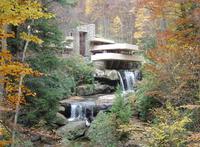
If one has finished a hard day’s work and sees a beer, one might feel a fierce thirst and a yearning to sit down and enjoy it; if one’s a poor student and sees an exam paper, one might feel nausea and a desire to escape the classroom; but if one is a human being with a healthy soul, and one hears Beethoven’s Ninth or sees Frank Lloyd Wright’s Fallingwater, then one feels exalted. The difference in the feelings is determined by what it is we experience. The intensity of feeling is the measure of the extent of the intellectual and emotional abstractions subsumed.
Why does great art move us? Because it speaks to the whole of us, and to everything we know and stand for.
“’But I believe being a Maori in Enzed is a more negative experience. All that compulsion to live by the myth of whanau, hapu and iwi. Ask many Maori who have moved to Australia; they'll tell you living as an individual is infinitely better. If I was a benign dictator I'd pack every Maori off out of the country so they could realise what a wonderful thing it can be to be Maori and Kiwi and individualistic at the same time. Many of our Maori leaders have to invest in this potential and step away from the Champagne tap.’” Alan Duff rides again – LINDSAY MITCHELL
“It looks like New Zealand's version of three-strikes for criminal offending is working. Here's Graeme Edgeler's analysis…” 3 Strikes – Eric Crampton, OFFSETTING BEHAVIOUR
“The rest of the world seems to be trying to ignore it, but slowly and surely the United States of America, until recently leading the charge in the war on drugs, is legalising marijuana possession. Twenty states, from Alaska to Vermont, have already decriminalised adult cultivation and use of cannabis. “If Kaikohe businesswoman, community leader and mother Kelly van Gaalen knows about this, I'm sure she would have had a wry chuckle to herself about the irony of it all as she was taken away to begin her two-year sentence for possession of cannabis for supply... “Meanwhile, back in the US, guess what hasn't fallen in? That's right - the sky.” Our weed ban is simply dopey – Paul Little, NZ HERALD
“Is Council’s position really that pool owners should have fewer rights than criminals?” Swim – Eric Crampton, THE SAND PIT
“Those damn Chinese. Coming over here. Taking our jobs. Driving up house prices. And... you know... donating $10 million to cancer research!” $10 million gift for cancer research in Auckland – AUCKLAND UNIVERSITY
“The early weeks of a world cup are like a Monkees album. There’s some classics all right, but plenty of filler too. Before it gets better, here’s what’s happened in the first fortnight… The hosts were as tentative as an Englishman trying to get a French waiters’ attention … and South Africa looked as organised as Alan Donald running a quick single.” Rugby’s coming home, and potentially leaving again quite quickly - SPORTREVIEW.NET.NZ
“An error in the promotional materials means the All Blacks will have to perform a haiku before each of their remaining matches in the Rugby World Cup. Cup organisers apologised for the mix-up, but said consumer protection rules meant their hands were tied.” Typing error means All Blacks will perform pre-game haiku – EVENING HAROLD
He’s wet, he’s not funny, but with “millions of migrants seeking asylum in Europe face hostility, racism, and red tape. John Oliver does one admittedly tiny thing for one of them.” Last Week Tonight with John Oliver - Migrants and Refugees – DAILY MOTION
West Berlin policemen and East German soldiers face each other after a young girl made it across the border, 1955. By conservative logic, she should've been forced back to East Germany because she could've been a communist…
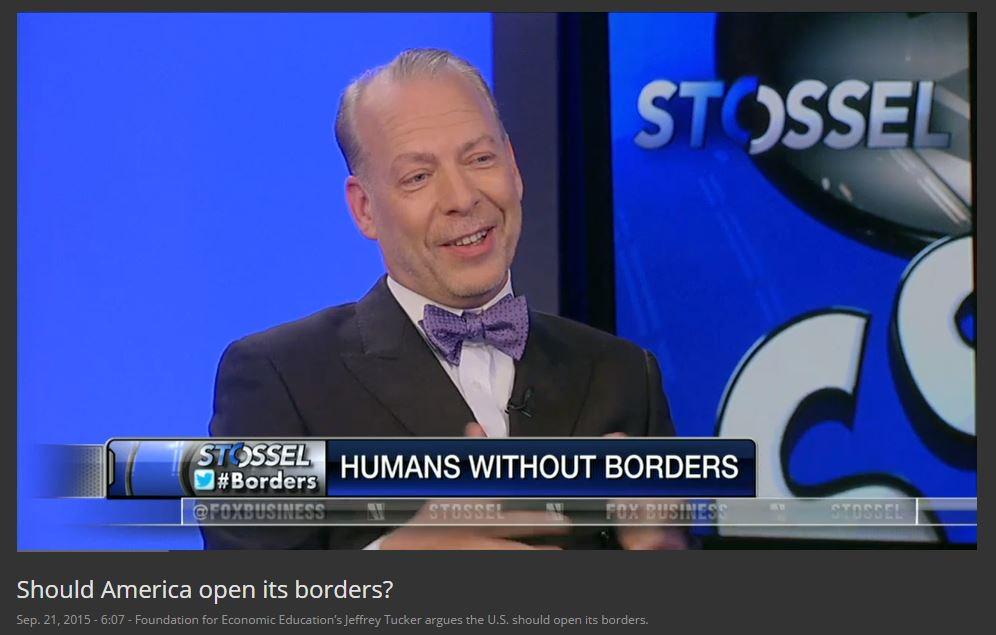
Humans without borders …
“Irrational regulation and green posturing are the real causes of the Volkswagen debacle.” The VW 'Scandal' – ERIC PETERS AUTOS VW: a panto of green politics - Paul Seaman and James Woudhuysen, SPIKED
"It is the power of the human mind, especially in science and engineering, that has brought about the benefits of our modern world. Yet where are the parades, the speeches before Congress, and the celebrations that recognize the sources of such benefits and encourage reason and achievement as foundational values in our culture? Why do so many seek hope in faith and otherworldly miracles when real achievements—“miracles” of the human mind—are all around us? Why do so few understand that training minds and encouraging entrepreneurship is the best way to ensure a healthy, prosperous future? With all the enthusiasm we see for the Pope, where is the enthusiasm for the actual creators and achievers in our world?" Pope Francis vs. the Cure of Reason – Ed Hudgins, SOLO
“Few Latin Americans have enjoyed the economic freedom that Pope Francis prefers to denounce.” Show Me the Way to Poverty – Dylan Pahman, OIKONOMIA
"There is increasing speculation that Uber’s long-anticipated initial public offering could be valued at $100 billion, a value that has been created by undercutting the prices of traditional taxis and offering more and better service. If that’s how much wealth can be generated just by rediscovering the laws of economics in this one narrow area, think what could be accomplished if we do it for the economy as a whole.” The Free Market: It's Like Uber, But for Everything – Robert Tracincski, THE FEDERALIST
““Many people, without thinking about it, like the corporate tax because they think it is a tax on greedy billionaires. In fact, the corporate tax is paid by consumers in the form of higher prices and by workers in the form of lower wages and fewer jobs. It results in less investment in new plants and equipment and fewer new goods and services — which is why most tax economists view it as a bad tax. Investors are also hit by the corporate tax, but they have many options, including investing elsewhere or just consuming their savings, which hurts economic growth and future job creation.” Global Tax Bullies – Richard Rahn, CATO
F. A. Hayek and the peculiar problem connected with what we call capital… Pure Theory of Capital (excerpt) – F.A. Hayek, GOOGLE BOOKS
“Paul Ehrlich’s apocalyptic rhetoric was dealt a crushing blow by economist Julian Simon who argued that humans are not only mouths to feed, but also hands to work and brains to think up new solutions. Prior to the emergence of humanity, Simon and others had long pointed out, the Earth was replete with fertile soils and hydrocarbon and mineral deposits, but there were no resources. It was human action that turned otherwise useless physical stuff into valuable things, a process that could go on forever as it was ultimately powered by the always renewable and expanding human intellect. Creative and entrepreneurial populations could thus grow almost indefinitely as, building on past advances to which they added new ideas, they would find ever better ways to feed themselves and improve overall standards of living. Any notion of natural limits or “carrying capacity” was therefore nonsensical.” No limits to growth – Pierre Desrochers & Vincent Geloso, FINANCIAL POST
"... what if there were a dataset of temperature that was so well done, so scientifically accurate, and so completely free of bias that by its design, there would never be any need nor justification for any adjustments to the data? Such a temperature record exists, it is called the U.S. Climate Reference Network, (USCRN) and it is also operated by NOAA/NCDC’s (NCEI) head administrator. ”But while publicly accessible, this data is never promoted by NOAA or any other government organization, never mind the IPCC. All datasets used to "prove" man-made global warming ignore this data completely and 99% of the data they are based on have been "adjusted" and "homogenised" repeatedly, each adjustment further showing increased warming trend.”
“This week marks the 10 year anniversary of the publication of the Danish cartoons that sparked a crisis and a discussion on the importance of free speech. ARI champions the unconditional right to the freedom of speech. Read more about this crucial right …” Freedom of Speech: We Will Not Cower – Onkhar Ghate, VOICES FOR REASON
“Saudis are active at every level of the terror chain: planners to financiers, cadres to foot soldiers, ideologists to cheerleaders.” The evil empire of Saudi Arabia is the West’s real enemy – Yasmin Alibhai-Brown, INDEPENDENT (UK)
“At the United Nations two days ago, Obama said waging war against such terrorist groups won’t accomplish anything. “Ideologies are not defeated with guns,” Obama told UN delegates. “They are defeated by better ideas — a more attractive and compelling vision.” What happens if the ideology is openly and consistently committed to violent actions against others who do not agree?” Peace Through Weakness Will Never Work – Michael Hurd, DR HURD.COM
“Dear anarchists, Please stop asking me to go the Mises Institute to learn about anarchism. Thanks Justin Templer”
“The driving force of the market is not material; it is a product of the individual human mind.” Mises in the Digital Age – Jeffrey Tucker, F.E.E.
“If you could wave a magic wand and make one or two policy or institutional changes to brighten the U.S. economy’s long-term growth prospects, what would you change and why? That was the question asked to the 51 contributors to this volume.” Reviving Economic Growth: Policy Proposals from 51 Leading Experts – CATO STORE
“At this point 15 years ought to count for something. After all, we have now used up one-seventh of this century. So you can’t say its too early to tell what’s going on or to identify the underlying trends.” 15 Years Of Stimulus—–Nothing To Show – David Stockman, CONTRA CORNER
“The recent debate surrounding Fed policy is whether or not they will start to ‘normalise’ interest rates by beginning with a rate increase ... I contend that this debate is somewhat moot, especially once the market has initialled a waterfall selloff.” Why the Fed can’t stop the next market crash – Gregg Jamke, TAO MACRO
“[The debt load] is not manageable at all, because thanks to Yellen and her merry band of money printers, we are not paying the true cost of the debt. This year, it’s $230 billion on $13 trillion of public [debt]. That’s 1.75%. That’s ridiculous. When it normalizes – which it will someday – we’ll be paying $400-500 billion more at a minimum. So I blame the Fed. The Fed is the number one culprit in this whole fiscal paralysis, because it’s told all the politicians, ‘You can kick the can, you can dodge the bullet.’” The US Is a “Fiscal Titanic” with the Fed as Captain (Video) – SCHIFF GOLD
“Newly printed money. Of course. When isn’t that the answer? Adding water to milk does not produce more milk. It only produces the illusion of more milk.”
“The natural rate of interest is a rate that emerges in the market as a result of borrowing and lending activity and governs the allocation of the economy's resources over time. The neutral rate of interest is a rate that is imposed on the market by wisely chosen monetary policy and is intended to govern the overall level of economic activity at each point in time. Exploring this distinction and its implications can go a long way toward understanding the current state of Federal Reserve policymaking and the difficulties that a central bank creates for the market economy.” Natural and Neutral Rates of Interest in Theory and Policy Formulation – Roger Garrison, MISES DAILY
“In the more heavily regulated industries, costs are skyrocketing. In other industries, costs are falling, sometimes at ridiculous paces: Think USB drives. Technology naturally pushes costs down, while the Federal Reserve pushes them up.”
Surveys the ills of government-run schools, shows the general superiority of private schools, and zeros in on the reason for the difference. The Educational Bonanza in Privatizing Government Schools – Andrew Bernstein, THEOBJECTIVESTANDARD.COM
“I choose a Montessori school for my son almost as an act of faith. At that time my knowledge of the method was null, besides having heard of small chairs and colored beads. But seeing my son happy day after day encouraged me to study and deepen the Montessori’s ideas. What I had discovered astonished me as a father and as a scientist. As a father, I found how children are really respected and prepared for the future. As a scientist, I found solid scientific foundations for everything Maria Montessori proposed.” Montessori, why not? – MARIO VALLE
“In a world full of turmoil and uncertainty such as ours, fine art can provide emotional fuel to sustain positive, life-affirming, universal, humanistic values. Because all art acts as a shortcut to our most fundamental premises (whether good, bad, rational, or irrational), it possess irresistible vitality and puissance for both immediate “gut” impact and lasting resonance.” Romantic Realism: Ideas and Emotions in Art – Alexandra York, NEWSMAX
“Every town has a dozen guitarists or bass players that could play in a top group, but circumstances didn’t work that way. You're better off engaging with the thing for the reason you want to do it, because the universe will give you what it wants. You better be putting your belief into something that’s meaningful and sustainable, which is your relationship with yourself." "Talent Is Vastly Overrated": Billy Childish's Anti-Guide to Succeeding in the Art World – ARTSPACE
Philosopher Leonard Peikoff presents the essentials of Ayn Rand’s philosophy to a group of students, then answers their questions. Peikoff, who was Rand’s friend and associate for three decades, is the author of Objectivism: The Philosophy of Ayn Rand -- 42-minute lecture followed by a 33-minute Q&A session. Questions and Answers: 0:45:21 Q&A#1: How can selfishness be compatible with respecting other people's rights? 0:48:09 Q&A#2: Does the term "objective" have different meanings? 0:50:17 Q&A#3: Who would regulate the economy under laissez-faire capitalism? 0:54:53 Q&A#4: Are people programmed by the culture they are raised in? 0:57:57 Q&A#5: What will happen to the needy under capitalism? 1:02:55 Q&A#6: Does government have a role in disease control and education? 1:06:11 Q&A#7: Who would fund medical research if government didn't? 1:08:35 Q&A#8: How do you know that reason is the only means of knowledge? 1:11:27 Q&A#9: In what sense is religion opposed to morality? 1:14:05 Q&A#10: Can our senses fool us, as in the case of optical illusions? 1:15:15 Q&A#11: Why do virtues have to be practiced consistently?
At Massey University, when they say “free stuff” what they mean is “paid by students to pass the class.”
Painting, movies, literature, sculpture, music, architecture ... all have the ability to make us cry, to make us laugh, and -- just occasionally -- to make us feel ten feet tall. Why is great art so powerful? -- why does it have this profound ability to affect us? Simply, because it speaks personally to each of us. It is our shortcut to our very souls. When we experience art that truly touches us, we don’t just feel, “I like this;” if we have souls we feel “This is Me!” Great art has enormous scope: it subsumes an enormous range of experience and thought and emotion, and integrates these three into a mental unit that our particularly human consciousness is able to grasp. It might be a painting, a sculpture, or a play or a building, but if it is well done we can all look at it or walk through it and almost immediately know -- without even being able to put it completely into words -- how the artists see the world around them. By experiencing the art they’ve produced, we should have a pretty fair idea of what they see as important in the world, and whether or not we too see the world in the same way. Think, for instance, of the lightning-like evaluation you make when you see this painting. Or this one. Or this collection of buildings. Or these. See what I mean? The integration involved in a good work of art subsumes all the experience, thought and emotion that goes into our own view of the world and, if we identify with it, allows us to point and say: “That’s Me!” or “That’s Not Me!” (So on that score, ask yourself about your reactions to those linked pieces, and what it tells you about the way you see the world.)
The point here is that art isn’t just a way to kick back after a difficult week -- which is one reason elevator music and abstract painting are so execrable. Art is a shortcut to our very philosophy; a way to see and to experience our deepest values, and also to celebrate them. Art -- good art -- shows us our way of seeing the world, while celebrating that that is the way we do see the world; more particularly, it celebrates our own individual way of seeing the world, and affirms it. Why do we need art to see the world when we’ve already got eyes and ears and fingers and hands with which to experience it ourselves, and a brain with which to organise those experiences? Answer: We need art precisely because of the nature of that brain, and because of the way it organises the experiences. Look at the way our knowledge of the world is acquired and held: our knowledge of the world around us begins with our senses, which provide us with material that is then organised by our brain into concepts; those concepts in turn are then integrated into propositions and theories. We start with sensations, derived from particular experiences, and these form the basis for all our higher abstractions: all our ideas, from ideas of love, of justice, of rights, of value ... all high-order abstractions; all derived from earlier concretes which are subsumed into concepts, and then subsumed into even wider concepts, and so on. This process of abstraction leading to further abstraction creates both the enormous power of the human mind, and its great weakness: its power to think in vast abstractions, and its inability to see these abstractions as one unit. That’s what art does for us: it gives us each the power to see all of our important abstractions as a single unit. To ‘fix’ each particular abstraction, as Ayn Rand points out in her Introduction to Objectivist Epistemology, we integrate the concept into a single mental unit: a word. Each word acts as a unit that integrates the constituent units of that particular concept, which brings together and holds for us in our minds the vast material referred to by the particular concept which that word is used to delineate. But as we integrate these high-end abstractions into even wider abstractions, we run into a problem: the scope becomes too vast and too amorphous to grasp as a whole. For that, we need art. Think for example of the Statues of Justice and of Liberty, and of Delacroix’s “Liberty Leading the People.” These don’t just sum up the concepts of liberty and justice; they offer an evaluation of them to boot. The relative position of our higher abstractions works of art is analogous to the position of a poem to a word; or that of a book to its chapter; or that of a piece of furniture to a building: the greater work orders, makes understandable and gives context to all the units subsumed, and brings into existence a new mental unit integrating them all. In making a work of art, we are offering a new mental unit that is at once a higher abstraction than those it subsumes, and a more concrete one. In making our abstractions concrete, it takes us back to the concretes from whence they came, but in a much more powerful form. Art allows us to see the totality of our worldview. If we follow Leonard Peikoff’s idea that philosophy is like a skyscraper, we can see that it is a rather oddly-shaped one. Peikoff's skyscraper begins at the lower levels with metaphysics, the nature of existence. It continues upwards with a few floors dedicated to epistemology, how we know what we know. On top of these lower floors and dependent on them are floors describing the nature of human beings and how we should live in the world as it is, i.e. ethics, and then how we should live together, i.e., the field of politics. Now, if we understand the true nature of art we can see that art does fit on top of the other floors, since it requires all the other floors below to give it support. But in an important sense, the upper floors of art actually lead directly back to the basement, rather like one of those strange buildings in a science fiction story in which we keep going up, yet we end up in the basement instead of the penthouse. Good art is both penthouse -- in the sense that it is a glorious summation and culmination of all that is below it -- and it is also basement, because it is both fundamentally necessary to human survival (witness the cave scratchings of even primitive men, who sought to find meaning in his world) and also intensely explicative of our own deepest metaphysical value judgments. Deep art really does go deep: right down to the bottom floor. Why, then, is art so intensely personal? If it’s just a higher form of abstraction, why do we so readily get up in arms over it? Again, it is because of the nature of the human mind. We are endowed not just with a cognitive mechanism, but also with an emotional mechanism. “It is man’s cognitive faculty … that determines the content of both.” The premises and abstractions we form and accept are the programming for our subconscious: based on this ‘subconscious programming,’ our emotional faculty provides us inexorably with lightning-like evaluations of the things we see and experience around us -- the extent of our emotion at these experiences is the extent of the import and resonance they have for us. As Ayn Rand said when identifying the nature of our emotions, they offer a lightning-like evaluation of the things around us. But our emotions do not spring from nowhere; they themselves are “an effect, not a cause.” Every single thing we see or experience is value-laden. It is our previous thinking (or lack thereof) that determines the nature of the evaluation. If one has finished a hard day’s work and sees a beer, one might feel a fierce thirst and a yearning to sit down and enjoy it; if one’s a poor student and sees an exam paper, one might feel nausea and a desire to escape the classroom; but if one is a human being with a healthy soul, and one hears Beethoven’s Ninth or sees Frank Lloyd Wright’s Fallingwater, then one feels exalted. The difference in the feelings is determined by what it is we experience. The intensity of feeling is the measure of the extent of the intellectual and emotional abstractions subsumed. Why does great art move us? Because it speaks to the whole of us, and to everything we know and stand for. Who needs great art? You do.
Another six-pack of gold from the archives to add to your summer reading. Enjoy!
* * * *
Friday, September 07, 2007
"There is no means of avoiding a final collapse of a boom brought about by credit expansion"
Would-be pundits such as Brian Gaynor et al who offer their opinions on the collapses and troubles in finance houses might want to add to their researches the two subjects "malinvestment" (a misallocation of resources often following a period of artificially excessive credit) and "creative destruction" (that “process of industrial mutation … that incessantly revolutionizes the economic structure from within, incessantly destroying the old one, incessantly creating a new one”—two concepts every would-be economic pundit needs to have in their kitbag, or else be considered misinformed. Without that understanding the various pundits are unable to see the malinvested writing on the wall, and unqualified to realise how important it is to everyone to let the creative destruction rip—not to prop it up. Writing in 1949, Ludwig von Mises might have been talking to today's pundits-of-ignorance:
“There is no means of avoiding a final collapse of a boom brought about by credit expansion. The alternative is only whether the crisis should come sooner as the result of voluntary abandonment of further credit expansion, or later as the final and total catastrophe of the currency involved.”
If only the pundits were listening. There are no shortcuts to the inevitable. Tell failing finance houses "Screw up and we will bail you out," and what do you think that will do to the number of screw ups, and to the amount of extra risk the screw-ups take with your money?
* * * *
Tuesday, November 13, 2007
Objective journalism? Non-neutrality is objective, stupid
What a fantastic cartoon in The Herald on the Clark Government's democracy rationing, following up yesterday's front page effort! Now as you might have heard, The Herald has drawn criticism from the commentariat for not being "neutral" in taking against Clark's democracy rationing. But objective journalism does not mean neutrality. That’s just flat wrong. The premise here is that if you have a point of view, then you can't possibly be objective. But as Paul Blair explains, "that's just plain false."
“An objective report gives the audience all the information needed to draw a valid conclusion... But facts lead to conclusions. Just because one doesn't want to accept those conclusions doesn't make the facts wrong or the presentation non-objective: rather, the person who resists the logical conclusion is the one who lacks objectivity... Being objective means recognizing that not everybody's point of view is equally valid or deserves equal respect.”
Over to you, critics.
* * * *
Thursday, February 16, 2006
Those dirty Americans
News just in from BATTLE CREEK, Michigan, USA—the former stamping ground of dirty old Dr Kellogg, doctor at the Battle Creek Sanitarium and inventer of the eponymous corn flakes—that “a man who pleaded no contest to a sodomy charge involving a sheep says he should not have to register as a sex offender...” Hah! Time, I think to turn the tables. Time for some sheep jokes about Americans for a change.
A Canadian bloke was walking down the street in Michigan when he saw a farmer going hammers and tongs on a sheep. The Canack yelled out, "Hey mate, in Canada we shear our sheep." The American turned around and said, "Piss off mate, I'm sharing none of this."
Q: What do you call safe sex in Michigan? A:Marking an 'X' on the sheep that kick.
'A Michigan Nursery Rhyme' Mary had a little sheep With the sheep she went to sleep The sheep turned out to be a ram... Mary Had A Little Lamb.
A Canadian farmer and a Man From Michigan were walking out in the field one day and they spotted a sheep tangled in the wire fence.. "Wow!" said the Canack. "I wish that was a woman all tangled up in that there fence." Said the Man From Michigan, "I just wish it was dark!"
An American walks into his bedroom with a sheep under his arm and says: "Darling, this is the pig I have sex with when you have a headache." His girlfriend is lying in bed and replies, "I think you'll find that's a sheep, you idiot." The man says, "I think you'll find that I wasn't talking to you."
That man from Michigan would be right at home in Brigend, Co. Donegal, Ireland, where a some years ago a publican installed some sheep in a house behind his pub for the pleasure of his patrons. He was convicted of running a brothel. (Yes, that’s a true story). So in honour of that publican:
Q: What do you call four sheep tied to a lampost in Donegal A: An Irish leisure centre
Q: What do you call an Irishman with a sheep under his arm? A: A pimp.
Q: What do you call an Irishman with sheep under one arm, and a goat under the other? A: A bisexual.
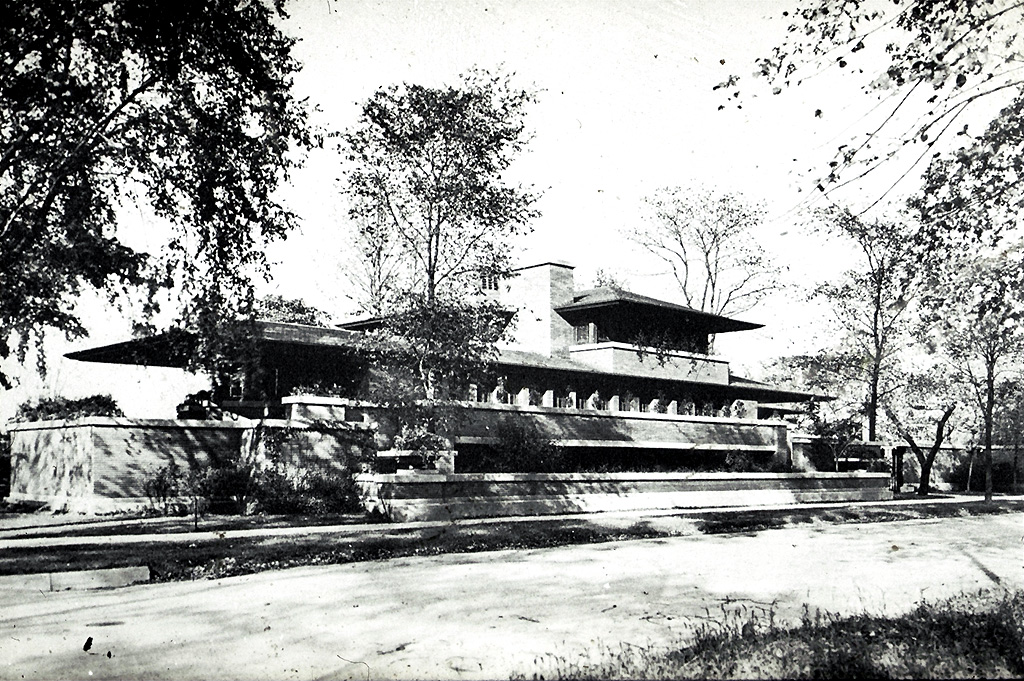
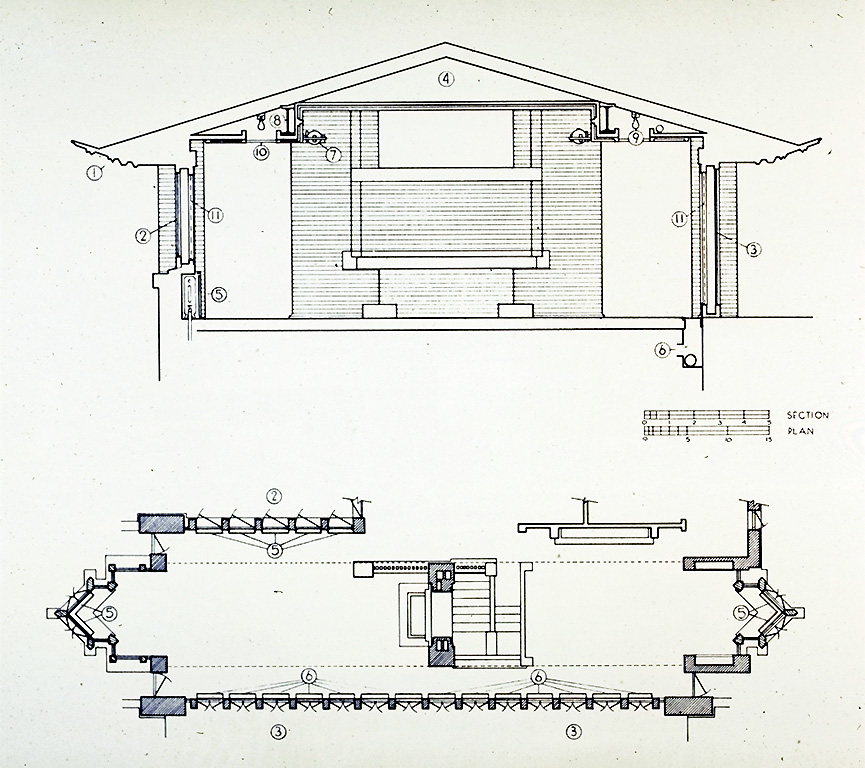
From the Chicago of 1906 comes Frank Lloyd Wright's house for the Robie family. (As it is today, here). Forward-thinking living room section showing environmental appurtenances here. And the floor plans here adumbrating Wright’s revolution in space planning. In many ways the culmination of Frank Lloyd Wright's 'Prairie House' phase in both drama and spatial sophistication, the Robie House of 1908-10 is currently undergoing restoration to restore it to its former glory, before reopening as a fully restored architectural house museum on May 1, 2010. Story here at Prairie Mod, and more details including pictures here at the FL Wright Preservation Trust. And even more pictures here, including the original presentation sketch
* * * *
Wednesday, May 27, 2009
Von Sternberg House – Richard Neutra
I was sure I’d blogged this house before, but for the life of me I can’t find a decent post on it. (Well, apart from this one.) This is by far my favourite house by Neutra (pronounced NOI-tra). Designed in 1934 for film director Joseph von Sternberg, director of Marlene Dietrich in The Blue Angel. (Von Sternberg famously insisted that there be no door locks on the bathrooms, in case a temperamental actor or actress or two decided to end it all in the stalls.)
“’I selected a distant meadow,’ von Sternberg recounted later, ‘in the midst of an empty landscape, barren and forlorn, to make a retreat for myself, my books, and my collection of modern art.’ “The building’s major space was a double-height living area surrounded by a balcony that was used as an art gallery. Displayed there were works by Gauguin, Kandinsky, Matisse, Léger, de Chirico, Kokoschka, Brancusi and Archipenko. Von Sternberg’s mirrored bath and bedroom, with a view of the rooftop reflecting pool, were the only rooms on the second floor. “On the first level, east of the living area, lay a studio and kitchen, followed by staff quarters and the garages, one for regular cars and a larger one for the Rolls-Royce. A specially designed space for the owner’s huge dogs was behind the garage. To enliven the otherwise simple, aluminium-clad façade, Neutra designed—in the best Hollywood manner—a series of remarkable “special effects,” which extended into the landscape. Most prominent was the high curvilinear wall around the front patio, which emphasized the streamlined personality of the house. A shallow moat-like lily pool surrounded the wall and, in broken stretches, the entire house. A long thin wall extended from the west façade, exaggerating the house’s size and dividing the front and rear gardens.”
Head to the house’s website here to see a stunning slideshow of the Julius Shulman photographs of the house and, if you don’t already know, to discover which influential novelist lived here after Von Sternberg, where she began the novel that has come to define our times – the novelist who described the house as “unbelievably wonderful.”
“Later, in answering a query from a fan, she [the novelist] described it as being ‘extremely modern—made of steel, glass and concrete, mostly glass. So you see, I’m the kind of ballplayer who endorses only what she really smokes—and smokes only what she really endorses.’”
* * * *
Wednesday, August 9th, 2006
What Architecture is All About
Now we're at the halfway point of our architectural debate over at my main blog 'Not PC,' here's a very brief meditation on what, at bottom, architecture is really all about: In five words or less, it’s this: giving meaning to our lives. Or to use the words of the late Claude Megson, "If it doesn't have meaning, then you're just wanking." Simple, huh? Read on now for the thousand-word meditation...
WHEN HILLARY AND TENZING reached the top of Everest for the first time, the story goes that Tenzing fell to his knees and gave thanks to the spirits that had helped their journey; he prayed to each of the four winds, and he carefully placed in the ground a small stake on which prayer ribbons were attached. While he was doing this, Hillary stuck a flag in the ground, unzipped his fly and took a piss. We each mark our territory in very different ways. But we do each mark our territory. We make buildings to keep the rain off, and in doing so we raise a crown over our head and mark out from the world our own space below; we mark out for ourselves a place in the world by building a campfire that we keep burning and around which we make comfortable for ourselves, or by raising high our own totem that seems to say “here I am!”; we recognise the important rituals we’ve built into our own lives by making these rituals concrete, literally making them concrete, and by doing so we are saying, “This is important.” We erect buildings to perform some useful function, and in the act of erecting them they unavoidably perform another crucial useful or symbolic function for us: they embody our values. They tell us we exist. Buildings are a concrete expression of values – the values of the people who designed, erected and occupy them. Like every art, architecture is a shortcut to our philosophy. In building architecture we erect an armature that will support ourselves and our important values, and offer us as well a place from which to look out on the world around us. Amongst the myriad of ways this can be done , we choose the one that does it for us. It is a shortcut to our philosophy – which is why our choices are often so personal to us. The way it does that is as an extension of ourselves. “Architecture,” as Aldo van Eyck once said, “is about making a ‘home for man’.” The space we build is space for human life, for us to inhabit, and from which we can emerge to 'do battle.' It is a place that expresses what a home for man looks like, smells like and sprawls like; it is here that we begin to find the meaning in architecture: the meaning resides in how it makes its home for man. In the act of making and placing our buildings in the world, we make decisions about what’s important in the world. What values need to be 'built in' and made concrete. What should we include from around us? What should we keep out? Early morning sun is good; later afternoon sun isn’t. Gentle breezes are good inside the house; heavy rain is not; views of the lake and the trees and the beautiful hills about us are wonderful – views of the local slaughterhouse are not. Some of these things are highly contextual. Early morning sun is good in Reykjavik, but not always in Dubai in mid-summer. Later afternoon sun is bad in most parts of the world, but in Murmansk, inside the Arctic Circle, “late afternoon” extends for several months, and is always a welcome guest. Gentle breezes in Hawaii are welcome; in Siberia they’re called a draught. A view of the local slaughterhouse from your lounge window might be highly prized if you’re … okay, I’m stretching on this last one. The fact remains nonetheless that the choices we make about how we build our shelter, mark our place and decide what functions our building serves for us define something both about us, and about the place we make -- and about the context in which we make it.
WE NEED TO BUILD. Animals adapt themselves to nature, and they’re already adapted to do that. Humans can’t. We adapt nature to ourselves. We must. Unlike animals with their multiple defences against the world, our means of survival is our reasoning brain: on its own this offers no physical defence against predation, and no guarantee of survival: we learn to use our brain to plan, to invent, to create; to understand the nature of the world around us and to make sense of it and to adapt it to ourselves, to make of it a place in which we are protected, and in which we can feel ourselves at home. We need buildings to shelter us, and not just in the physical sense of shelter. We need a place that is a home: our place, wherein we see ourselves and our own values reflected back, including the value of the home itself. Good architecture then is not just functional on the bare physical plane. We've been out of the caves long enough to do much better than that. “A house is a machine for living,” declared Le Corbusier on behalf of today's cave dwellers. “But only if the heart is a suction pump,’ responded Frank Lloyd Wright. Architecture is not just shelter; it is not just ‘marking a spot’: its function is also to delight. Bread and water nourish our stomachs; we need also to nourish our souls. Thirteenth-century Persian poet Muslih-uddin Saadi Shirazi offered this wisdom:
If of thy mortal goods thou art bereft And from thy slender store Two loaves alone to thee are left Sell one, and with the dole Buy hyacinths to feed the soul.
Buy hyacinths to feed the soul . . . but only if your heart is not a suction pump. What good architecture does then is to deal with the totality of a human existence, to provide at one level the support structure to make human life possible, and at another much richer level to express back to us what it means to be human by giving a sense of place to all our occasions, by building in all our important rituals, by connecting us to what is meaningful in our lives: To sunrises and sunsets; to the sharing of food together; to relaxing with friends; to having time and space for contemplation and for conversation, and for rest, and for sex -- and for rest and contemplation (and conversation) after (and during) sex. That’s about as important as a job gets, right? Writing about Ferraris, PJ O’Rourke expressed it this way: “Only God can make a tree, but only man can drive by one at 250mph.” THAT is the feeling good architecture should communicate! We take the material that nature provides, and the needs that we have, and those moments where we say to ourselves, “Ah, this is what being alive is all about!” and we give those needs wings and we build in and celebrate those moments, and by doing so we express our lives, and we help bring meaning to them. What could be more important?
*** PS: if you want to think about architecture a bit more deeply, may I humbly offer a piece written a few years back as a book review: 'What Architecture Is.'
It begins by boldly declaring what architecture is not ...
*** And if you're already emboldened to read much more about architecture than this humble blogger can provide, here's a suggested reading list on architecture to help you begin your own architecture library. Enjoy the adventure.
The art you like is a shortcut to your philosophy. It really is. And you know, each time I say that here it annoys people. I mean it really annoys people. Which tells me that their view of art really means something to them: it touches their values – their own personal philosophy --- something deep inside themselves.
Which means the very virulence of the (over)reaction is evidence for the thesis.
You see, every choice an artist makes demonstrates his own values, his own personal philosophy, just as your reactions to what the artist has done demonstrates yours.
There’s nothing to fear about that, it’s simply the nature of real art. That’s why art is art: it has the power to tell us something about ourselves and the way we see the world. Not the way we might pretend to others (or ourselves) about how we see the world, but the way we really see it, and evaluate it.
“But how,” I hear you ask, “does an artist translate his philosophy into his art?” Good question. And fortunately for all of us, artist Michael Newberry is supplying the answers in a new addition to his art tutorials called ‘Connecting Your Philosophy to Your Art.’ His first post in this new series focuses on perception, using this painting below. He asks, and answers, the question: what do you think the artist’s evaluation of the value of perception is? What do you think it might be? And what clues in the painting make you think so? (Try to answer the question for yourself before looking at Michael’s concise explanation.)
Vase of Flowers in a Niche about 1732–36 Jan van Huysum, Dutch, 1682–1749
So, what do you think the artist’s evaluation of perception is? And what, dear reader, is yours?
Yes, it’s witty. Yes, it’s amusing. Yes, he does so much with just a few lines. Yes, it’s Picasso (and Pablo Picasso never got called an arsehole, did he). But does it really say anything at all that’s really worth a damn? Does it communicate a worldview? If so, what? Is it a shortcut to your very philosophy; a way to see and to experience your deepest values and to celebrate them in the process?
In other words, is it art? Or is it just good graphics to chatter about with your friends?


![[Icarus[3].jpg]](https://blogger.googleusercontent.com/img/b/R29vZ2xl/AVvXsEj1PmtJ2R6ULP8XyCRvRtXIGxu3OLto5NasT5ADFGaoJqr1vHsmky6QqR8XTq8whEzRMZbPXheeZAdSV7PI0bDeal4I9BlQnWupbcPRINAk4jgx-1HRY7h_OpQiNsJD84ANNUje1A/s1600/Icarus%5B3%5D.jpg) Icarus Landing, by
Icarus Landing, by 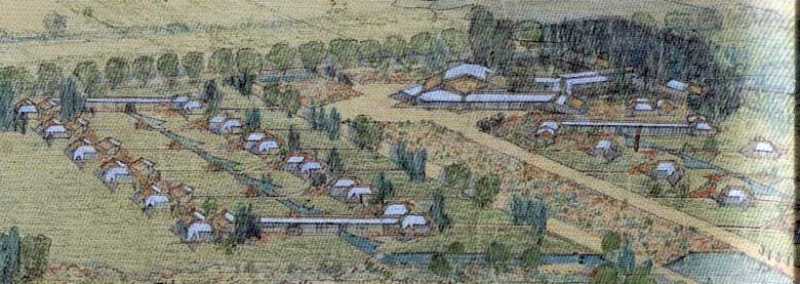 San Marcos Water Gardens Proposal, sketch by Frank Lloyd Wright





![Sam_Marcos_Gardens_L[2]](https://blogger.googleusercontent.com/img/b/R29vZ2xl/AVvXsEg1vFUzTw9Us_uO41nET3sSGlqBfCBHe6o3bigzZLnBe2NWotTShlOYK7JQZ5rNgU_G-Q9HMx3vgLlYnGKaE5ZDFAnKfUjSmsTUmB3_wWE8isz_uFT8fPNJE6oqZxqJfacgi4Md/s1600-h/Sam_Marcos_Gardens_L%5B2%5D%5B5%5D.jpg "Sam_Marcos_Gardens_L[2]")