"Co-governance is not the goal.
"Co-governance is not our term. Mana Motuhake is our term. So we are committed to washing away dependency on the Crown, and raising maximum authority for Tuhoe people.
"I don’t see it as the final destination. I don’t see co-governance as the answer. But I think it’s the next bus stop in a journey that has to be made. It’s everyone’s journey. It’s like gravity, you can’t defy it. It’s on its way."~ Tuhoe negotiator Tamaki Kruger, "keeping a watchful on conversations about co-governance." Cited in Thomas Cranmer's article 'Three Waters, co-governance and the lessons from Tuhoe'
Showing posts sorted by date for query tuhoe. Sort by relevance Show all posts
Showing posts sorted by date for query tuhoe. Sort by relevance Show all posts
Wednesday, 5 October 2022
"Co-governance is not the goal ... it’s the next bus stop in a journey that has to be made."


Friday, 20 November 2015
Friday Morning Ramble, after a bad week …

“The heartbreakingly simple front page of today's Irish Examiner” ~ Super Rugby
GST to go on digital goods – STUFF
The latest Dirty Politics stories in 140 words.
Shorter Ng/Rachinger/Slater/Key – DIM POST
“While ‘dirty politics’ Lusk style will never disappear altogether I think his influence is over-rated (by himself), and with increasing sunlight on murky political dealings politicians with a view to future prospects will be more wary of doing business with the politically toxic.”
Story on the Lusk for power – YOUR NZ
“The way to boost web traffic is to” not suck?  Anatomy of a Corporate Disaster – Inside Weldon and Glucina’s Gossip Site Scout – Duncan Grieve, THE SPINOFF
Yes. Yes they are.
Helmets 'a barrier to spread of cycling' – THE AGE
“Over the last few days, one of the most important books I have read in a long time has become available. It is called One Treaty One Nation, and was written by eight authors from a wide variety of political backgrounds – National, Labour, Greens, NZ First, ACT and Libertarians, indeed from every significant political party in New Zealand with the single exception of the Maori Party …
Don Brash on One Treaty, One Nation – FACEBOOK
“Tuhoe chief executive Kirsti Luke said a majority of Tuhoe people in that area were on benefits, and tribal leader Tamati Kruger said the iwi aimed to change that. "We are declaring war on dependency," Mr Kruger said.” Hopefully, with their own money.
"...being a beneficiary is a type of servitude" – LINDSAY MITCHELL
How Special Housing Areas frequently work in practice – UK edition.
The last woman left on a derelict street – BBC NEWS

“This was not an "attack on all humanity." It was an attack on Western liberal values. And it wasn't an attack on "the universal values we share," since there are in fact few universal values that humanity shares. If humanity shared universal values, there wouldn't be wars, or hundreds of millions of subjugated women, or theocratic and secular tyrannies.”
The Left and the Attack on Paris – Dennis Prager, TOWN HALL
“Please pay attention to the recurrent shrieks of Allahu Akbar. This is the cat call from the Middle Ages, or from Middle Earth, that we will have to live with for the rest of our lives. So this fight against Jihadism — this is a generational fight. This is something we are doing for our children, ultimately, and for our children’s children.
”We have a war of ideas that we have to wage, and win, and unfortunately we have to wage it and win it with ourselves first.”
The Meaning of the Paris Attacks – Sam Harris, THE BULLY PULPIT
“War is hell, and war is bad. But when someone declares war on you, there are two choices: Roll over and die, or fight back. To advocate fighting back is not to confess a love of war; it’s to embrace a love of life.”
Are Americans Willing to Die for Political Correctness? – Michael Hurd, LIVING RESOURCES CENTER
“Yes, Maajid Nawaz came up with the Voldemort Effect.” ~ Robert Tracinski
Why Not Calling ISIS “Islamic” Hurts Muslim Reformers – Maajid Nawaz, THE BULLY PULPIT
“Officials are again pointing to the need for mass surveillance to take down terrorists. Here’s what we know about how well it works… ‘Putting more hay in the hay stack just makes it harder to find the needles.’”
What’s the Evidence Mass Surveillance Works? Not Much – Lauren Kirchner, PROPUBLICA
Metadata Surveillance Didn’t Stop the Paris Attacks. Intelligence Officials Want More of It Anyway. – SLATE
Two Irish bands, one with balls …
Paris attacks: Punk heroes Stiff Little Fingers vow to play concert in the French capital – BELFAST TELEGRAPH
Cancelling Paris Concerts After Attacks Was the Biggest Mistake of U2's Career – OBSERVER

“’Do not suppose that I have come to bring peace to the earth. I did not come to bring peace, but a sword’ (Matthew 10:34).
One of the great achievements the United States was to separate religion and state or said another way ‘ethical philosophy and political philosophy’.”
How to Tame Religious Terrorists – Stephen Hicks, EVERY JOE
“Here's what a rearguard action must consist of, at minimum, if it is to have any hope of being effective…”
Six Steps (Non-Exhaustive) toward the Saving of Western Civilisation – Lindsay Perigo, SOLO
Also: Starving the recruitment network.
Anonymous Takes Down 5,500 ISIS Accounts After ISIS Calls Them "Idiots" – ANON.HQ
Also: “The fight for free speech has been key to the historic struggle that has brought humanity from the caves to something approaching civilisation. It is how we decide what we believe to be the truth. That is why the freedom to question everything has been central to the advance of everything from scientific progress to political democracy. Today we need it more than ever.”
Free speech: our best weapon in the war for the west – Mick Hume, SPIKED
Also: “Allowing people to proactively respond to threats has always been a better idea that trying to anticipate what assailants might consider to be an easy target.”
Armed Citizens May Be the Solution to Terrorism, Says Interpol Secretary General – HIT & RUN

Q: What were the circumstances that led to the rise of Islam in C7th? A: War, Plague, Economic Collapse.
Also: “The defectors provide unique insight into life in the Islamic State,” the report says. “But their stories can also be used as a potentially powerful tool in the fight against it. The defectors’ very existence shatters the image of unity and determination that I.S. seeks to convey.”
ISIS Defectors Reveal Disillusionment – NY TIMES
Also: “They’re drawn to the movement for reasons that have little to do with belief in extremist Islam… a detailed, or even superficial, knowledge of Islam isn’t necessarily relevant to the ideal of fighting for an Islamic State, as we have seen from the Amazon order of Islam for Dummies by one British fighter bound for ISIS.”
What I Discovered From Interviewing Imprisoned ISIS Fighters – Lydia Wilson. THE NATION
“ISIS will hit the same wall as Al Qaeda: Globalized terrorism is no more effective, strategically, than conducting aerial bombings without forces on the ground. Much like Al Qaeda, ISIS has no support among the Muslim people living in Europe. It recruits only at the margins.”
The Attacks in Paris Reveal the Strategic Limits of ISIS – Olivier Roy, NY TIMES
“Belief in a cruel God
makes a cruel man.”
~ Thomas Paine
“In the wake of the horrific atrocities in Paris, France, committed by Islam's heroes, the Jihadists, ‘Moderate Muslims’ are running over the dead bodies of Islam's victims to tell us how peaceful Islam is, and they're attempting to "prove" it by quoting from the Koran.”
Countering the Immoderate Lies of "Moderate Muslims" – BOSCH FAWSTIN
“We infidels are only just beginning to understand the flexibility of the Koran. There is a ready-made verse for every occasion – to prove the peacefulness of Islam or, more frequently, to proclaim the wrath and terrible vengeance of Allah to be visited on idolators and kafirs (despised unbelievers).”
Slaughter by Koranic Command – Roger Franklin, QUADRANT
“There is currently no word to describe someone who manifests ... ‘an irrational fear of honestly and openly discussing Islam.’ The current usage of the term "ISLAMOPHOBIA" has no redeeming features.”
Sign my Petition: That ISLAMOPHOBIA be defined as "An irrational fear of openly and honestly discussing Islam"’ – Prodos Marinakis, CHANGE.ORG
“To be critical of Islamism, to be critical of the beliefs and principles of those determined to destroy the ‘camp of kufr’, and to start asserting and defending the values still manifest in Western society, has nothing to do with persecuting Muslims, or rendering Islam unacceptable.”
After Paris: the myth of Islamophobia – Tim Black, SPIKED
“The ‘kill us, we deserve it’ school of political analysis after Paris.” ~ Josie Pagani
Jeremy Corbyn isn’t anti-war. He’s just anti-West – Nick Cohen , SPECTATOR

“Refugees weaken the Islamic State, and they are less likely to commit terrorism than other immigrants or even Americans.”
6 Reasons to Welcome Refugees after Paris – David Bier, FEE
“Evil on its own is impotent. Evil can only achieve its values through the actions of others—by that which we let evil-doers extort from us.Never has this underlying impotence been more true of any ideology than Islam.”
And, into that vacuum stepped Islam … – NOT PC
Are we all Parisians today? – NOT PC
Post-Paris: More writing & talking – NOT PC
““All of the other suspects in the Paris attacks appear to have been European citizens. In fact, large numbers of citizens from France, Britain and other Western nations have travelled to Syria and Iraq to fight, suggesting that the problem is not so much those coming from over there but those who are already here. Nor are these people necessarily the ones with familial links to the Islamic world: There have been a number of European converts to Islam who have travelled to join the Islamic State, and vast numbers of European Muslims have repeatedly condemned the actions of the Islamic State.”
The Islamic State wants you to hate refugees – WASHINGTON POST
“The “foreign policy as master key” people will have to explain to me why so many of the perpetrators in French terrorist attacks are not only European-born, but have backgrounds in Algeria or even Morocco, as in the case of the tentatively identified mastermind of the latest assault. These young people may come from families that have historic grievances against the French Republic, but there are no American drones raining death down on to Casablanca. “Blowback” seems like a badly incomplete explanation…”
Colby Cosh: After Paris, are we sure the map that needs changing is in the Middle East? – Colby Cosh, NATIONAL POST
“The vetting has served us relatively well so far, too: There have been no vetted refugees in the United States who have gone on to become terrorists.”
We Should Welcome Syrian Refugees – Jason, Kuznicki, ORDINARY TIMES
“Very few of the 11.8 million Syrians who have fled their homes during the current conflict are now in Europe.”
Reality check: Number of displaced Syrians in Europe – AL JAZEERA
"Perceptions can easily run ahead of reality, however…. And European publics wildly overestimate the proportion of their populations that is Muslim.”
Daily Chart: Islam in Europe – ECONOMIST
“But as many [Europeans] are slowly realising … the threat comes not from Muslim immigration: the threat is homegrown. …”
Home-grown horror – NOT PC
“Once it has been established that this implicit right [by nation states, instead of the entire EU, to protect their borders] can be used and the basic boundaries inside of Europe are the old European borders, we have entered a new Europe, or rather the old one.”
Paris, Sharm el-Sheikh, and the Resurrection of Old Europe – George Friedman/John Mauldin, OUTSIDE THE BOX
“For all the individuals protesting the Syrian refugee crisis, if you are using an Apple product to mount your protest, please stop.” ~ Rick Wilmes
Steve Jobs was the son of a Syrian refugee – DAILY NEWS BIN
“From here Rockwell continues to elaborate on an argument whose basic assumptions are — I say without equivocation — mind-numbingly stupid… The fact that these two are so desperate for a pretext, any pretext at all, for excluding brown immigrants from Mexico who might “deconstruct their culture,” that they’d grasp at a straw as idiotic and morally bankrupt as this, tells us all we need to know about “paleo-libertarianism.” It isn’t libertarian at all, but is motivated by an overpowering desire for a society controlled by people who look and think exactly like themselves, where nobody is allowed to do anything people like themselves disapprove of.”
How Low Can Lew Rockwell Go? – Kevin Carson, C4SS
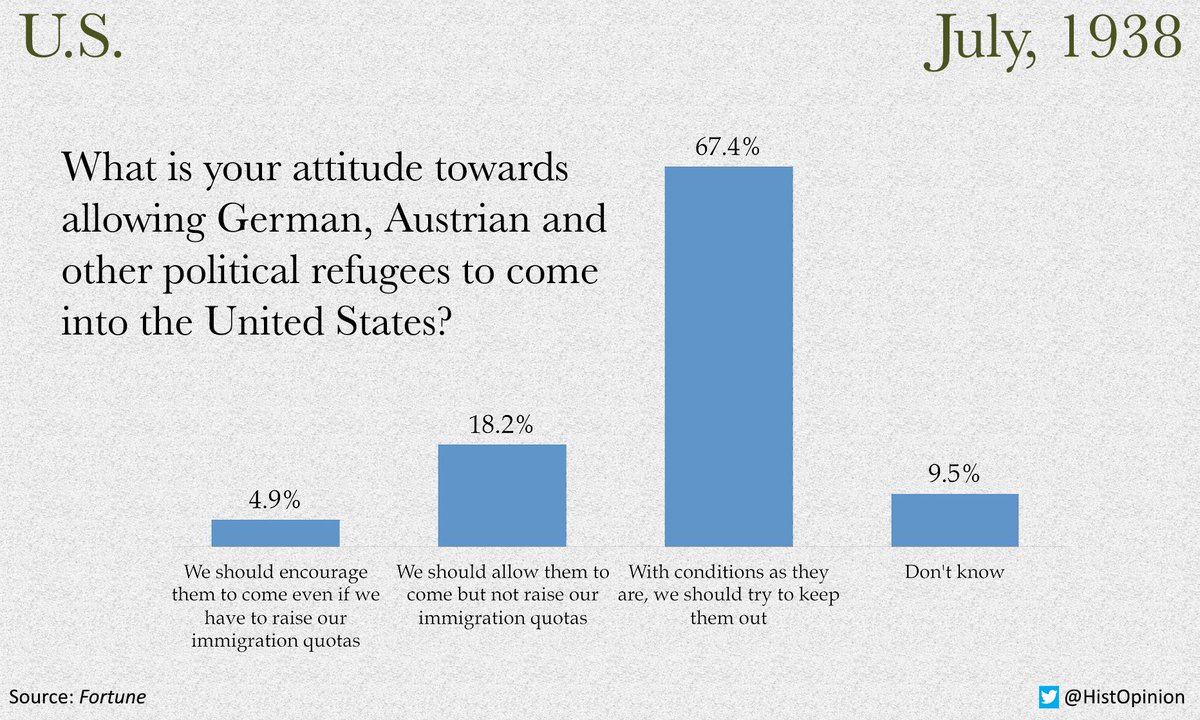
Ever wondered what Americans thought of Jewish refugees on the eve of World War II?
Another disaster looms in Paris. "The U.N.’s climate chief, Christiana Figueres, says openly that the aim of the [global warming] talks is ‘to change the economic development model that has been reigning for at least 150 years, since the industrial revolution.’ That outlook will be welcome among attendees like the delegation from Bolivia. That country’s official material submitted for the talks proposes a ‘lasting solution’ for climate change: ‘We must destroy capitalism’."
Gambling the World Economy on Climate – WSJ
“When the raw data is used, there is little if any evidence of global warming and some evidence of global cooling.”
Global warming ‘fabricated’ by NOAA & NASA – James Delingpole, BREITBART
Meanwhile, in an Indian village … “Life has improved after Greenpeace came, say the villagers. But not because the group brought solar. Rather, they said, they appreciate that the group brought the chief minister, who brought in the grid.”
Coal Trumps Solar in India – SCIENTIFIC AMERICAN
“100 million of the world’s poorest people will be better off thanks to Australian legislation that was passed last month.
”In contrast to the rhetoric that claims to help people, this legislation had nothing to do with increasing foreign aid or redistributing wealth. It had everything to do with the new $16 billion dollar Queensland coal mine that is set to become ‘the biggest Australia has ever seen’.”
The Moral Case for Coal – Celeste, AUSTRALIAN TAXPAYER’S ALLIANCE
Another milestone of failure by Al Gore: No change in Arctic sea ice for a decade.
Another Milestone Of Failure By Climate Experts – Tony Heller, REAL SCIENCE
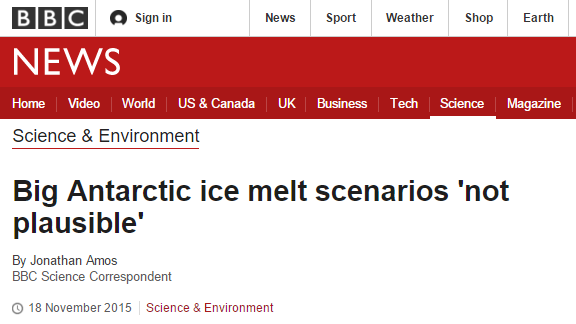
Meanwhile, the BBC has just discovered that ice doesn't melt at –30C.
William Gladstone’s story is a fascinating one. He almost invented the political implementation of classical liberalism. But he was far from a liberal at first: On every important political issue of the day he challenged his own thinking, and came out against the abuse of power and the protection of privilege. This is heroic, and scarcely normal today. “Today, when a citizen gets elected to make government smaller but ends up moderating his positions while in power, conventional wisdom credits him with having ‘grown in office.’ William Gladstone’s philosophy evolved in precisely the opposite direction — from a hodgepodge of statist notions to principled application of liberty.”
When the Power of Love Replaced the Love of Power – Larry Reed, FEE
“Here is the problem that continues to elude academic theory; falling gasoline prices has no “net effect” on economic growth.”
Economic Theory Meets Main Street Reality—–It’s Not All Good – Lance Roberts, CONTRA CORNER

“Universities seem increasingly to focus on the so-called student experience over the students’ education … University has become the place for teenagers to go when they wish to delay being an adult, rather than being the bridge to independence it was once considered to be.”
On not going to university - Jennifer Richards, SPIKED
“Post modernism, deconstructionism and progressive education have caused today's rebellion against the mind.”
Campus Insanity? Blame The Philosophers – Robert Tracinski, THE FEDERALIST
Never let school get in the way of your education.
Homeschooled with MIT courses at 5, accepted to MIT at 15 - NEWS.MIT.EDU
“I still utterly fail to understand how 'management' exists as an undergraduate degree. … if there are 22 year olds out there who are fit to manage anything, they're likely doing it already without having bothered with a degree.”
Econ testimonials – Eric Crampton, OFFSETTING BEHAVIOUR

“The world is on the cusp of a ‘post-antibiotic era,’ scientists have warned after finding bacteria resistant to drugs used when all other treatments have failed… It is likely resistance emerged after colistin [the drug of last resort] was overused in farm animals.”
Antibiotic resistance: World on cusp of 'post-antibiotic era' – BBC NEWS
Just so you know: “The research by Dr. Cullen and many other scientists has shown that despite the high levels of contamination in Japan, the levels across the Pacific are so low they are difficult to detect.”
Fukushima Findings – DOLLARS AND CROSSES
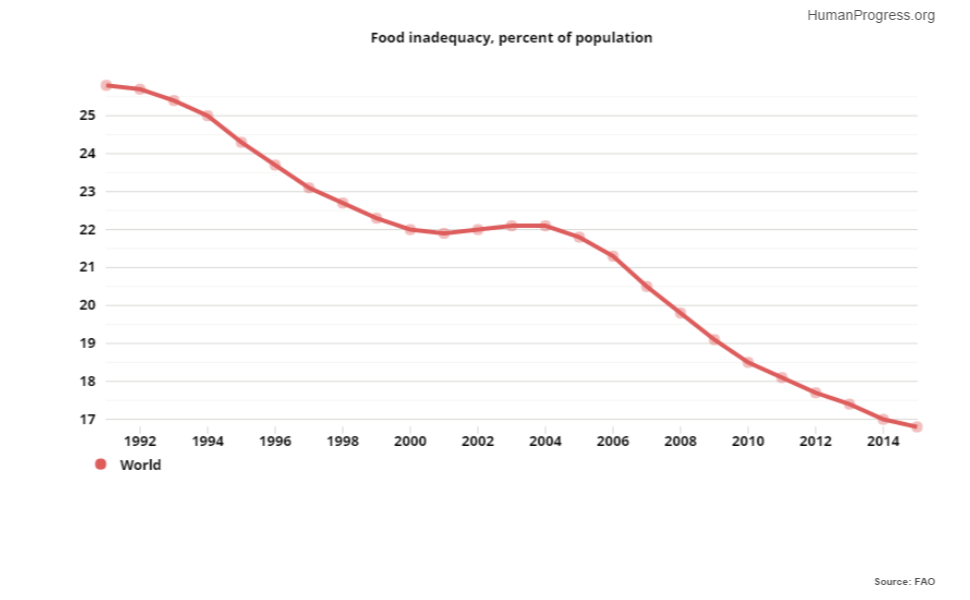
And now for some good news: “Food inadequacy affects a far smaller share of the population in 2015 than in the 1990s.”
 “Bond is driven by a lust for life — for adventure, for sleek luxury cars, for truffles and foie gras and martinis, and yes, for beautiful women. He is certainly out of place in our age of Neo-Puritanism. He probably eats processed meat, the scoundrel.”
Why We Need James Bond – Robert Tracinski, THE FEDERALIST
“James Bond represents the individual spirit that is cultivated by the West against the communist idea of the regnant collective… An individual like Bond who thwarted communist schemes and plots without the Party or the collective was Fleming’s answer to Marx.”
Ian Fleming’s Coldest Warrior: The Anticommunist Origins of James Bond – VICTIMS OF COMMUNISM
“To further understand why the ownership of ideas is important, we’ll look at the 3 characters in Rand’s works to find out.”
Intellectual Property On Trial: John Galt, Howard Roark and Steve Ingalls – Sylestor Kuo, KUO’S GULCH
“P. J. O’Rourke introduces you to the wonderful world of a profession that literally anyone can do.”
P.J.’s Guide to Talking Like A Pundit – DAILY BEAST
Peter Singer: The end point of utilitarianism.
Fun with Singer – Eric Crampton, OFFSETTING BEHAVIOUR
“Why is the seemingly straightforward concept of objective value so difficult for many people—especially those with a background in economics—to understand? The answer is that many economists confuse agent-relative value—value in relation to some valuer—with morally subjective value... they assume that there is no objective standard for determining moral value; they assume that value is only a matter of personal opinion.”
Economists’ “Subjective Value” and Ayn Rand’s Objective Value Reconciled – Ari Armstrong, OBJECTIVE STANDARD
“We talk a lot in these pages about what to do with one’s money, but I question whether most subscribers (forget about the public at large) have an adequate grasp of the basics.”
Rethinking Money As The Greater Depression Deepens – Doug Casey, ZERO HEDGE
“It's a paradox. Music has this incredible power to evoke, but
we don't know what it evokes. You can't talk about it as being
'very emotional' or 'very passionate' because that's bullshit. So
I only ever talk about it in its own terms…”
~ Richard Gill, music educator
“How is success gained by people of whom little is expected? Tom Petty was once one of them.”
Should Everyone Be in a Rock Band? A New Freakonomics Radio Podcast – FREAKONOMICS
Now this is cool …
Scroll through the "new New York Skyline" with this interactive infographic – ARCHINECT
“There are two overs to go and we need ten to win. I have just come in and am on strike. Malcolm Marshall is brought on for the penultimate over. ‘Finish this off, Macco!’ they call from behind the wicket. ‘Two balls will do it!’ He probably can’t hear as he’s at least 70 yards away at the end of his curving run.”
The strange things real fast bowlers make you do – Simon Hughes, THE ANALYST
Wasim Akram: the fastest bowler I never saw – Simon Hughes, THE ANALYST
Answers many questions: "In the cells of fruit flies, Chinese scientists say that they have found a biological compass needle: a rod-shaped complex of proteins that can align with Earth’s weak magnetic field."
Long-sought biological compass discovered – NATURE
So what hope for an architect who writes?

Balm for a bad week. [Trans: ‘Wach auf” = “Wake Up!”]
Antidote.
Fuel.
Hat tips, thanks and quips … Nathan Michael Blunsdon, Australian Libertarian Society (ALS), Samizdata, Dim Post, Duncan Bayne, Steve Milloy , Ezra Klein, Laila al-Zwaini , World Economic Forum, The Four Horsemen, uberfeminist , Rudolf E. Havenstein, Steve Goddard, HumanProgress.org, Today's News, Richard Calhoun, Tom Holland, Josie Pagani, Students For Liberty, Martin Kramer, Terry Baucher, Full Comment, Famous-Quote.net, The Hay Festival, maajid nawaz, Quilliam, Craig Ranapia , Trigger Warning, Vinay Kolhatkar, Christian Wernstedt, Kenneth Weaver, Mother of Exiles, Rick Wilmes, Marvin Adams, Keith Speary, Rani ShriVidya, Dale B. Halling, Wyatt Storch, For New Intellectuals, Monica Beth, Counties Manukau Steelers, Prodos Marinakis, Michael Neibel, Matthew Sullivan, Steve Bock, Hilton Wayne Holder, Jim Matzger, Peter McCaffrey, Celia Cobo-Losey, James Dalton]
Thanks for reading, and thinking.
Have a great weekend.
PC
Wednesday, 5 August 2015
Marae architecture: Traditional does not meant traditionalism
This is going to create a kerfuffle with traditionalists.

A non-traditional marae – “a contemporary marae with solar lighting and large glass panels to be built overlooking the lake and mountain at Tarawera. The marae will be the first rebuilt in the area since the 1886 Mt Tarawera eruption, which obliterated the land, marae and many members of the Tuhourangi tribe.”
The building is contemporary and modern but still had "traditional marae elements."
"All the elements of a wharenui are there, they are just expressed differently. There hasn't been a marae out here since the eruption so we want to make this project really dynamic and symbolic of rebirth and moving into the future."
You don’t have to be a traditionalist to build in traditions.
Architect Louis Sullivan used to say that good architecture should always follow nature’s rule, that form follows function.
His student, Frank Lloyd Wright, talked about “the deeper truth” that form and function are one --- that, in architecture for man, architectural forms will suggest and embrace functions.
It’s about building in rituals. In the modern era of steel, glass, concrete and solar panels, building in traditional rituals in modern form – in a spirit embracing the future – well, what could be more appropriate. Architect Fred Stevens understands this.
And let’s be honest. It s**ts all over the shed that Jasmax did for Tuhoe.

Tuesday, 4 June 2013
“If you have any questions about Tuhoe, go and read your history.”
As a former lawyer for Ngai Tahu, Treaty Negotiations Minister Chris Finlayson is obviously able to play both sides of the fence when it comes to both pulling down and distributing taxpayer dollars by the million.

Part Two of the Waitangi Tribunal’s report into the history of government actions against Tuhoe described
sweeping confiscations, … and how … land was removed by fraudulent methods. And it describes unjust war too, highlighting a series of engagements from the end of 1865 to May 1866.
So much so apparently unjust.
But as one prominent commentator pointed out at the time, what the Waitangi Tribunal’s sanitisers historians “neglect to do is set those dreadful deeds in the context of the equally dreadful deeds that preceded them.” That commentator is Chris Trotter.
Those reading the full context of Tuhoe’s history, and New Zealand’s, will realise that in the mid-1860s the country was poised delicately between two possible futures—one offering civilisation, and the other a return to the tribal savagery the Treaty had promised to end. As Trotter says, “Tuhoe picked the wrong side in the war to decide what sort of country New Zealand would become.”
And how!
To tell that history, let’s start with a story.
Imagine, if you will, that a savage murderer has been moving up the country, and he's heading your way. He seeks refuge in your large, rambling property (which you share with extended family). Instead of either handing him over or doing him in (in both of which you would be justified), you and your whanau choose instead to join him in his savagery and plunder, heading out on expeditions of rapine and looting before coming home to hunker down in the least accessible parts of your refuge to fend off John Law, who naturally wants to put a stop to your lawlessness and brutality.
The law decides the safest way to stop you and your partner in crime is to starve you out, a strategy that meets with success—but whose perfectly justifiable results a century-and-a-half later are used to justify further pillage, this time of taxpayers apparently ignorant of the reasons for the original dispossession.

It is akin to you and I having our pockets picked to pay compensation to the grandchildren of Ted Bundy or Fred West for police having damaging the Bundy/West properties while removing all the bodies stored under the floor.
Quite apart from the issue of the national parks, does this seem in any way either fair or justified?
Did Tuhoe’s behaviour not constitute some sort of reason for punishment?
While you consider those questions, just read in some more detail about what actually happened.
The year was 1869, and the Kooti One had gone on the run after murdering around sixty people (both Maori and non-Maori) in Poverty Bay, eventually finding support for his campaign of continuing murder under the shelter of a supportive Tuhoe. For three years from their base in the Ureweras, with the full support, backing and connivance of Tuhoe leaders, he and his Tuhoe allies distributed rapine, murder and pillage to all around them—regularly crossing the Kaingaroa plains, the Ureweras and surrounding districts to pillage, burn and kill. Just one example of his blood lust was the slaughter of 64 defenceless women and children in the Ngati Kahungunu pa at Mohaka, murdered in cold blood as a “lesson” to their fathers and husbands.
Any decent government is going to put a stop to this, which is precisely what the colonial government did.
To drive him out of his lair, says the Oxford History of New Zealand, "Government forces applied a scorched earth policy so that the Tuhoe tribe could not shelter Te Kooti and the dwindling remnants of his band," following which he was driven out and 448,000 acres of Tuhoe land was confiscated as punishment, 230,600 acres of which was later returned. (Ironically, as reward for his murders, Te Kooti himself was eventually given several acres of land in Ohiwa, BoP, in 1891! So much for justice.)

“Violent dispossession”? It looks to me like the initiation of violence went largely one way.
In some circles, mere partial confiscation would be seen as being let off easily.
If violent dispossession is to be despised, and it is, then surely the violent dispossession of people’s lives by Tuhoe and Te Kooti must be worth at least addressing, no?
Because to talk about Tuhoe’s dispossession without any reference at all to the reasons for that dispossession is just inexcusable, particularly when such context-dropping is used to justify scores of millions of taxpayers dollars heading towards the wallets of the descendants of those who helped harbour the thug Te Kooti all those years ago.
In today’s age of hand-wringing and revisionist history however, nothing (least of all the facts of history) is a barrier to today's tribal 'leaders' receiving large amounts of taxpayer largesse as a reward for living in the past -- a past which is largely a fiction of their own making.
So (to come back to where we first started), it seems the history the Minister wishes us to read is not the history he thinks it is. Or at least not all the history. But then, lawyers-for-pay don’t really do history so much as they do special pleading-- but then, when it comes to “doing history,” neither do the more mainstream media, the Government, or the Waitangi Tribunal.
Not to mention here the farce of signing a Waitangi settlement with a tribe who never signed the Waitangi Yreaty, for an injustice that was anything but.
The only injustice perpetrated here is that being dealt to the taxpayers of New Zealand -- who once again will be forced to pay large amounts of money to tribalists for things we didn't do -- and to the tamariki of Tuhoe, who are being taught once again that tribalism and a focus on the imaginary grievances of the past will have a bigger payoff for them today than will addressing and meeting the real challenges of the future, and taking up the genuine opportunities of the present.
Which would really be a start.
-----------------------------------------------------------------------------
* Figures and quotes are taken from the Oxford History of New Zealand, (pgs. 186, 187); Penguin History of New Zealand, (pg. 219); 'Te Kooti,' NZ.History.Net; 'Te Kooti,' An Encyclopaedia of New Zealand, 1966.
Friday, 31 May 2013
FRIDAY MORNING RAMBLE: The “It’s a Cartoon” Edition
A former cartoonist wonders whether we’ve lost the art of robust debate.
Is This Racist, Susan Devoy?- CoNZervative
Her office shouldn’t exist. And as for this: “Well unfortunately we have a right to the freedom of expression and freedom of speech.” “Unfortunately”?
Cartoon prompts call for racism threshold change - TVNZ
Free speech for me, but not for you, say Minto, Henare, Flavell…
AUDIO: Former editor and Minto debate role of cartoons – RADIO NZ
Press Council won't act over cartoons yet – 3 NEWS
Some propositions on free speech – NOT PC, 2011
Message from George Carlin to John Minto et al: “I believe you can joke about anything… It all depends on the exaggeration…”
Fail to offend, and this is the sort of political humour you’re left with.
Party leaders on the wintry blast – KIWIBLOG
Start banning political satire, and this is where you’re headed.
Tajikistan Blocks YouTube After Video Of Dancing President Goes Viral – CONSUMER AFFAIRS
While folk are still up in arms about the government’s plans and programme for half-arsed, half-privatisation of its state-owned power companies,* they’ve failed to spot or even oppose two “full and final” privatisations happening right in front of their eyes.
By which I mean the “full and final” privatisations of the Whanganui River and the Urewera National Park—which, when you strip away the mumbo jumbo about how (for example) the river will “own itself,” is what is happening. Sadly, however, without any opportunity for on-selling.
* Call that a proper privatisation? Pfffft. Come on, they’re only selling 49%!
90 year claim process nears resolution – WANGANUI CHRONICLE
Tuhoe win control over national park – STUFF
Q: What would 'Party X' do about the environment?– A: They’d use it to push privatisation.
– NOT PC, 2011
'Recognise rights in river' says PC – NOT PC, 2006
“One of the motivating forces for politicians and economists rethinking their position on state-owned enterprises was a history of under performance by these firms worldwide. Some of the more extreme cases of poor SOE performance that have been publicised include…”
How not to run a business: examples of poor SOE performance – Paul Walker, ANTI DISMAL
The PM is looking for advice on Doug Graham’s knighthood? Here’s mine: He should never have been awarded one.
PM seeks advice on Sir Doug's knighthood – STUFF
Schadenfreude, thy name is Graham – NOT PC, 2010
You know, I appreciate the link, Bryce Edwards, but surely a qualified political scientist should know that libertarians are not “far right.”
Political round-up: Food in Schools - victory and defeat – NZ HERALD
Left? Right? A plague on you both – NOT PC, 2005
Cue Card Libertarianism: Political Spectrum – NOT PC, 2007
NZ's Political Spectrum – NOT PC, 2005
Right Plus Left = Wrong – Lindsay Perigo, CRACCUM
Left and right and other nonsense – PC, SOLO, 2006
Looks to me like a new political party has just launched … “Our objective is colour-blind law and colour-blind government. We insist that all New Zealanders be treated equally before the law with neither fear nor favour, regardless of race.”

Given several recent experiences when going for consent, this theory rings true: that Auckland Council’s push for intensification may be about more than just so-called “Smart Growth”—it could be they know Auckland’s underground infrastructure is screwed. And they’ve just found more saps to pay for it.
Auckland's Intensification Ponzi Scheme, Funded With Your Rates Bill - Policy Parrot, WHALE OIL
Yes, it’s true:
Misinformation about the Unitary Plan continues – AUCKLAND TRANSPORT BLOG
However…
Getting the housing equation wrong – Phil McDermott, BREAKING VIEWS
My own three cents worth:
“Sprawl” versus “intensification” – NOT PC, 2012
Decentralisation, and those who oppose it – NOT PC, 2005

Economic blunders have consequences—but, these days, not for those who blundered: While central bankers and politicians continue to draw a salary, nearly two-thirds of 16 to 25-year-old Greeks are unemployed. Two-thirds!
Greece's young: Dreams on hold as fight for jobs looms – BBC NEWS
See, this is what charity looks like.
Awesome Spanish Restaurant Says If You Can’t Pay, You Won’t Go Hungry – CONSUMER AFFAIRS
While the western world goes down the path of increasing statism, China continues its long walk in the other direction. “This is both noble and desperate.” And necessary.
Elite Retreat: Now Chinese Leaders Plot a Freedom Reformation! – DAILY BELL
With the closure of Ford Australia, what future now for manufacturing in a place with a combination of high labour costs and restrictive work practices?
Sunrise industries like food manufacturing – Judith Sloan, CATALAXY FILES
10 reasons why so many people are moving to Texas – BBC NEWS
Keeping Austin Weird – Max Borders, THE FREEMAN
How long now with the Quantitative Easing? As long as the non-recovery it’s created continues. The Quantitative Beatings will Continue Until Economy Improves – Keith Weiner, KITCO
“If you know someone that actually believes that the U.S. economy is in good shape, just show them the statistics in this article.”
40 'Frightening' Facts On The Fall Of The US Economy – ZERO HEDGE
You have to ask:
AUDIO: Based on the facts of our debt, isn’t an imminent collapse of the U.S. economy inevitable? – Yaron Brook, LEONARD PEIKOFF
Congratulations to Ben Bernanke for creating another housing bubble. Fast work!
U.S. Home Prices Post Biggest Jump Since 2006 – NPR
When stock prices no longer match reality: the “Bernanke Put” edition—does this look like a real U.S. housing recovery?

“The only reason we’re talking about Islam is because it doesn’t mean peace.”
My Name is Bosch and I’m a Recovered Muslim – Bosch Fawstin, FRONT PAGE
“Violence is in Islam’s DNA…. Brutality and violence are endemic to Islam’s history because it rejects on principle the only civilized means of settling disputes peacefully: persuasion, debate, discussion, i.e., man’s faculty of reason. Islam regards man as a helpless plaything in a chaotic universe ruled by a spiteful, omnipotent, supernatural deity (Allah). The common man must submit to Allah (and his representatives here on Earth) because he is by nature incapable of thinking for himself. Every totalitarian ideology starts by attacking man’s faculty of reason. Much is made of the "peaceful" verses in the Koran. But those passages are as irrelevant to Islam’s essence as is the fact that Mafia hit men might be ''peaceful'' at a child’s birthday party.”
"Islam's Reign of Terror": An Excerpt – Ed Cline, RULE OF REASON
Politicians versus volunteers—the different responses to the Oklahoma tornado today and a great disaster of yesteryear.
What is the Difference Between a Tornado and a Fire? – BURT FOLSOM
See, when it comes down to it, most people aren’t complete arseholes. (Except maybe for the feller who wrote the opening line.) This is the sort of stuff human beings just do.
“I think George W. Bush was a disastrous President, but I don’t doubt that he is a good man at the personal level. It is probably true, though, that truly good men don’t make very good Presidents.” – Bill Quick
At the Wounded Warrior 100K, How George W. Bush Really Rolls – DAILY BEAST
So how’s that “peer review” system working for you?
What Would We Do Without Peer Review? – SMALL DEAD ANIMALS
Always worth re-reading: “This is a defence of phasing-in open immigration…”
Open Immigration – Harry Binswanger, HBL
Yes, its true.
Free Objectivist Books for Students
Jason Crawford on Free Objectivist Books for Students – PHILOSOPHY IN ACTION
Researchers in Australia have demonstrated that, contrary to what the Heisenberg uncertainty relation may suggest, particle properties such as position and momentum can be measured simultaneously with high precision. But it comes at a cost.
More Precision from Less Predictability: A New Quantum Trade-Off – SCIENCE DAILY
Australian scientists have also narrowed the predicted range of global warming through groundbreaking new research…
Australian scientists take 6 degrees of global warming off the table, say it is closer to 2 degrees – WATTS UP WITH THAT
Recantations on man-made global warming beginning in 3, 2, 1 …
'Trougher' Yeo recants on global warming – James Delingpole, TELEGRAPH
Turns out Obama was right. The seas have started to fall.
Hansen falsified: His extreme sea level rise projections are drowning in hubris – WATTS UP WITH THAT
“What is your "Fair Share" of what someone else has worked for?”
- Thomas Sowell
A cry for values in a post-modern age.
"Perhaps Culture is Now the Counterculture" – Leon Wieseltier, NEW REPUBLIC
See, we told you this would happen and you scoffed…
7 Newly Classified Mental Illnesses – EPJ
The man who thought psychiatrists were nuts – Doug French, NOT PC
“I've posted several times about the amazing new 3D printing technology and how technology experts predict it will dramatically change our world. Well, the famous management consulting firm McKinsey has just released a report where they detail 12 "disruptive technologies" they feel "will transform life, business, and the global economy". 3D printing is number 9 on the list.” – On Liberty Street
McKinsey report: 12 disruptive technologies that will transform life, business, and the global economy – Mark J. Perry, AEI IDEAS
But don’t wait for summer.
To Avoid Jet Lag This Summer, Travel Like a Scientist – WALL STREET JOURNAL
“I Do Dream” by sculptor Michael Wilkinson, at Quent Cordair Fine Art:

The rich history—and rich present—of a unique art form.
Opera Is Not Dead – G.W. Bowersock, NEW REPUBLIC
Oh crikey. New Russian fashion trend: Ironic Stalinism.
Back in the (’30s) U.S.S.R. – NY TIMES
The Chicago Architecture Foundation is kicking-off a month of celebrating Frank Lloyd Wright in June.
Celebrate the legacy of Frank Lloyd Wright all month long - CAF

 So many of today’s prominent “artists” (e.g. Jenny Saville, left)are “heroic mediocrities … outshone by your average newspaper cartoonist. And art critics, like their literary counterparts, should be encouraged to say so.”
The mystery of the Mona Lisa’s flickering smile solved: blink, and you’ll get it.
Don’t Blink: The Science of the Mona Lisa’s Flickering Smile – CREATIVITY POST
Top tip for your wedding photos: don’t get photobombed by a llama. That, and 30 more…
31 Tips For Taking The Perfect Wedding Photo – BUZZFEED
Written by a former evangelical Christian who is now an atheist and skeptic living in the Deep South, Godless in Dixie is an atheist blog you should be reading.
Introducing Godless in Dixie – ATHEIST REVOLUTION
It’s a simple question. If Noam Chomsky was such an anarchist, then how come he likes so many government programmes.
Chomsky the ‘Anarchist’ – TOM WOODS
Worth watching? “He is a market-oriented professor of economics who talks about Milton Friedman to his young Danish students. She is — suddenly — Prime Minister of Denmark and leader of a moderate left party, but not actually prepared to wield power…”
Borgen, season one – Tyler Cowen, MARGINAL REVOLUTION
Son of God used to play at Geelong. And will again this weekend.
Best Of Gaz Jnr at Geelong: Highlights from Gary Ablett's career with the Cats – AFL VIDEO CENTRE
Because you asked…
21 Quick Tofu Dinner Recipes: Tasty reasons to give tofu a try for dinner tonight. – EATING WELL
[Hat tip Jasmine Kamante, Stephen Hicks, Keith Weiner, Jeff Perren, Diana Hsieh, Arts & Letters Daily, Prairie Mod, On Liberty Street, Ari Armstrong, Sam Schulman, Oren Kessler, JWSpry, Doug Henwood, Foundation for Economic Growth ]
Thanks for reading
Cheers
PC
Thursday, 2 May 2013
Here’s what separatism looks like up close
Iwi are taking the pot of taxpayers’ gold given them by Chris Finlayson et al and are now “exploring long-term autonomy”—Tuhoe for example, after their $170 million settlement, are looking at "the possibilities that 'Mana Motuhake' opens up … to develop as its own nation in the decades to come," or at least to “eventually achieve something close to independence."
But what would this look like? And since Maori separatists with the ear of Government have been talking up ideas like iwi “self-rule” and “self-governance” for some time, isn’t it worth looking at how these things have played out elsewhere? Perhaps the closest thing around the world to the kind of separatism being talked about here is the separatist Native American Reservations in the US, what some folk call “a socialist archipelago” …
Native American Reservations: “Socialist Archipelago”
by Andrei Znamenski
 Imagine a country that has a corrupt authoritarian government. In that country no one knows about checks and balances or an independent court system. Private property is not recognized. Neither can one buy or sell land. And businesses are reluctant to bring investments into this country. Those who have jobs usually work for the public sector. Those who don’t have jobs subsist on entitlements that provide basic food. At the same time, this country sports a free health care system and free access to education. Can you guess what country it is? It could be the former Soviet Union, Cuba, or any other socialist country of the past.
Yet, I want to assure you that such a country exists right here in the United States. And its name is Indian Country. Indian Country is a generic metaphor that writers and scholars use to refer to the archipelago of 310 Native American reservations that occupy 2 percent of the U.S. soil. Scattered all over the United States, these sheltered land enclaves are held “in trust” by the federal government. So legally, many of these land enclaves are a federal property.
Within this archipelago you cannot freely buy and sell land, or use it as collateral. On top of this, since the Indian tribes themselves are wards of the federal government, one cannot sue them for breach of contract. Indian reservations are communally used by Indian groups and subsidized by the BIA (the Bureau of Indian Affairs, Department of the Interior) with a current annual budget of about $3 billion dollars. Besides being a major financial resource that sustains the reservation system, BIA’s goal is also to safeguard indigenous communities, or, in other words, to make sure that they would never fail when dealing with the “outside” society. People in the government and many Native American leaders naïvely believe that it is good for the well-being of the Indians to be segregated and sheltered from the rest of American society.

This peculiar trust status of Indian Country, where private property rights are insecure, scares away businesses and investors. They consider these forbidden grounds high risk areas in which to invest or do business. So, in Indian Country, retarding economic development we have an extreme case of what Robert Higgs famously labelled “regime uncertainty.” In fact, this “regime uncertainty” borders on socialism. James Watt, Secretary of the Interior in the first Reagan administration, was the first to publicly recognise this. In 1983, he said (and then dearly paid for it), “If you want an example of the failure of socialism, don't go to Russia, come to America and go to the Indian reservations.”
In the 1990s, I had a chance to travel through several reservations. Each time I crossed their borders I was stunned by the contrast between the human landscapes outside Indian reservations and those within. As soon as I found myself within a reservation, I frequently had a taste of a world that, in appearance, reminded me of the countryside in Russia, my former homeland: the same bumpy and poorly maintained roads, worn-out shacks, rotting fences, furniture, and car carcasses, the same grim suspicious looks directed at an intruder, and frequently intoxicated individuals hanging around. So I guess my assessment of the reservation system will be a biased view from a former Soviet citizen who feels that he enters his past when crossing into Native America.
I am going to make a brief excursion into the intellectual sources of this “socialist archipelago.” Since the 1960s, the whole theme of Native America had been hijacked by Marxist scholarship and by so-called “identity studies,” which shaped a mainstream perception that you should treat Native Americans not as individuals but as a collection of cultural groups, eternal victims of capitalist oppression. I want to challenge this view and address this topic from a standpoint of methodological individualism. In my view, the enduring poverty on reservations is an effect of the heavy blanket of collectivism and state paternalism.
Endorsed by the federal government in the 1930s, collectivism and state paternalism were eventually internalized by both local Native American elites and the federal bureaucrats who administer the Indians. The historical outcome of this situation was the emergence of a “culture of poverty” that favours groupthink and disparages individual enterprise and private property. Moreover, such an attitude is frequently glorified as some ancient Indian wisdom — a life-style that is morally superior to the so-called Euro-American tradition.

These policies were set in motion during the New Deal by John Collier, a Columbia-educated social worker, community organizer, and utopian dreamer who was in charge of the Native American administration during the entire administration of Franklin Delano Roosevelt. His chief sources of his intellectual inspiration were not Thom,as Jefferson or the Lockean individualism of the American Founding Fathers, but English Fabian socialism, the anarchism of Peter Kropotkin, communal village reforms conducted by the Mexican socialist government, and the romantic vision of Indian cultures.
Collier dreamed about building up what he called “Red Atlantis,” an idyllic Native American commonwealth that would meld modernisation and tribal collectivism. He expected that this experiment in collective living would not only benefit the Native Americans but would also become a social laboratory for the rest of the world. [And in that at least he was right. – Ed.]
The backbone of his experiment was setting up so-called tribal governments on reservations, which received the status of public corporations. Collier envisioned them as Indian autonomies distributing funds, sponsoring public works, and setting up cooperatives. In reality, financed by the BIA, these local governments began to act as local extensions of its bureaucracy.
It is interesting that these so-called native autonomies received peculiar jack-of-all-trades functions: legislative, executive, judicial and economic — a practice totally unfamiliar elsewhere in America. For example, in the rest of the United States, municipalities and counties do not own restaurants, resorts, motels, casinos, and factories. In Indian Country, by contrast, it became standard practice since the New Deal. By their status, these tribal governments are more interested in distributing jobs and funds than in making a profit. Under normal circumstances, these ventures would have gone bankrupt. But in Red Atlantis, these enterprises set up on reservations have instead been subsidised by the government for decades. This system set up in the 1930s represents a financial “black hole” sucking in and wasting tremendous resources in the name of Native American sovereignty—not to mention the al-pervading aura of failure it communicates to anyone growing up within it. This situation resembles the negative effect of foreign aid on Third-World regimes that similarly use the excuses tribalism and “national sovereignty” as a license to practice corruption, nepotism, and authoritarian rule—but to practice them within the borders of a country that supposedly shuns those practices, and to require the citizens of that country to pay for the practices to continue.

Collier’s utopian project (the restoration and subsidisation of tribal collectivism) was not a strange out-of-touch-with-reality scheme but rather a perfectly natural offshoot of the social engineering mindset of Roosevelt’s New Dealers. Moreover, the “Indian New Deal” was a manifestation of standard policy solutions popular among policy makers in the 1930s, both in Europe and North America. These solutions were driven by three key concepts: state, science, and collectivism. Recent insightful research done by German-American historian Wolfgang Schivelbusch into the economics and cultures of three “new deals” (National Socialist Germany, Mussolini’s Italy, and FDR’s United States) shows that in the interwar period, governments in these three countries (and in other countries, too, like the New Zealand of Michael Joseph Savage) pursued extensive state-sponsored modernisation. But, simultaneously, to better mobilize their populations and ease the pressure of modernization on the people, they cultivated a sense of “community,” the organic unity with land and folk cultures.
For example, in 1930s Germany, along with the grand autobahn building project and genetic experimentation, there existed a strong back-to-land movement and attempts to revive Nordic paganism. In the United States, in addition to the National Recovery Administration, Tennessee Valley Authority and similar giant projects, there flourished the community-binding Civilian Conservation Corps (CCC), the Federal Art Project that produced “heroic” community murals as well as thousands of craft items for civic, state, and federal organizations. Furthermore, as “one of the noblest and most absurd undertakings ever attempted by a state” (W. H. Auden), the Federal Writers’ Project (also part of WPA) employed thousands of intellectuals who were directed to collect regional folklore and ethnographies, and promote the heritage of local communities. Last but not least, there were projects like the Arthurdale settlement (West Virginia) — a federally sponsored scheme to place unemployed industrial workers on land and mould them into new wholesome American citizens. Even Stalin’s Soviet Union, which was going wild with its own aggressive modernization and industrialisation, somewhat muted the cosmopolitan message of Communism and became more “organic” in the 1930s, trying to root itself in Russian history, mythology, and folklore — pursuits that became known as National Bolshevism.
Another common sentiment shared by social engineers from California to the Ural Mountains was an unconditional faith in science. We can call it science worship. At that time, policy makers assumed that by using science and expert-scholars government could plan and engineer a perfectly ordered crisis-proof society. F. A. Hayek was the first to draw attention to this deluded aspect of modernity in his seminal book The Counter-Revolution of Science (1955).
The Indian New Deal fits perfectly into those policy trends. In fact, federal bureaucrats began suggesting as early as 1928 that Indians be organised as public corporations — a fancy innovation they copied from Europe. Collier, a middle-level New Deal bureaucrat, personified all the sentiments of modernism I mentioned above. On one hand, he praised Indian tribalism that would help not only the Native Americans but would also help anchor Americans in land and nourish a sense of community among them. Yet, on the other hand, like a mantra, Collier repeated that only a scientific approach would resolve the problems communities faced in the modern world. A recurrent message throughout his essays and articles is a demand that Indian communities be used as “laboratories for sociological experimentation.” In one of his speeches — which by the way is labelled “United States Administration as a Laboratory of Ethnic Relations” — Collier gave himself an unrestricted political license to experiment with Indian Country. In this speech, he stressed that if a government tried to impose something on an ethic group it would be harmful. Yet, if government intervention was backed up by science and supplemented by generous financial injections to local communities, then the interference would be very benign.

Pressured by the federal government and lured by an offer of easy credit, a majority of Indians approved of Collier’s plan to restore “tribes” and organized themselves into public corporations. Still, a large minority — more than 30 percent of the Indians — rejected the Indian New Deal. Many of them informed Collier that, in fact, although they were Indians, they had nothing against private property and did not want be segregated from the rest of Americans into tribes under federal supervision. They stressed that they could not stomach his communism and socialism, and wanted instead to be treated as individuals. Collier was very much surprised and angered by these dissidents, who organized themselves and founded the American Indian Federation (AIF) to oppose him. In a bizarre motion, he dismissed them as fake Indians. To him, the true Indian was expected to be a spiritually-charged die-hard collectivist. Historian Graham Taylor, who explored in detail Collier’s attempts to railroad tribalism in Indian Country, stressed, “His basic orientation was toward groups and communities, not individuals, as building blocks of society.” Later, Collier even resorted to nasty tricks, labelling his Indian opponents Nazi collaborators, and arranging to have one of them investigated by the FBI. Eventually, government squashed the AIF as part of a larger FDR effort to use the FBI to phase out what he called the “right-wing fifth column” elements in the United States. British novelist D. H. Lawrence, who rubbed shoulders with Collier as early as 1920, had a chance to personally observe his aggressive zeal on behalf of Indian culture, prophetically noting that Collier would destroy the Indians by setting “the claws of his own white egoistic benevolent volition into them.”

To those dissident Native Americans who repeatedly challenged him about going tribal, Collier explained that their individualism was obsolete. In his view, state-sponsored tribalism was modern and progressive. In his address given before the Haskell Institute, Collier instructed students to cast aside “shallow and unsophisticated individualism.” He warned the Indian youngsters that this useless trait of dominant culture would not be “the views of the modern white world in the years to come.” Instead, he called on the new Indian generation to come help “the tribe, the nation, and the race.” He invited them to step into a radiant future that included such “necessities of modern life” as municipal rule, public ownership, cooperatives, and corporations.
The system set up by Collier is still in place and functioning well … for tribal leaders. Not so well for everyone else.
Andrei Znamenski, Associate Professor of History, teaches at the University of Memphis.
This post first appeared in slightly different form at the Mises Daily, where you can find all the original notes.
Subscribe to:
Posts (Atom)