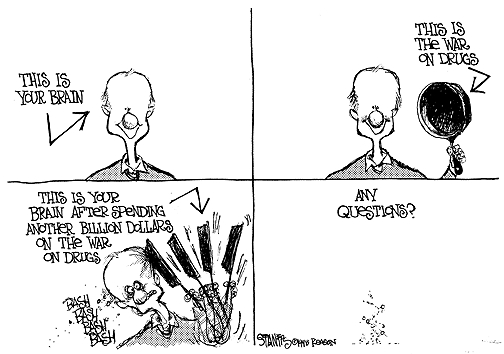
We're reminded today of a man ranked by Hayek as one of the greatest classical liberals. In this guest post by Jim Powell, we learn about William Ewart Gladstone, who so often started on the wrong side of an issue, and so frequently thought his way to the right side ...
William Ewart Gladstone’s Great Campaigns for Peace and Freedom
by Jim Powell
IN THE HEYDAY OF CLASSICAL LIBERALISM, British politics was dominated by one man: William Ewart Gladstone. He entered Parliament at age 23, first held a cabinet post at 34, and delivered his last speech as a Member when he was 84. He served as Prime Minister four times.
Nobel Laureate F.A. Hayek ranked Gladstone among the greatest classical liberals. Lord Acton believed Gladstone’s supremacy was undisputed. Paul Johnson declared there is no parallel to his record of achievement in English history. One might add there are few parallels anywhere.
As Chancellor of the Exchequer in four ministries, Gladstone fought the most powerful interest groups. He helped abolish more than 1,000—about 95 percent—of Britain’s tariffs. He cut and abolished other taxes year after year. Imagine, if you possibly can, our income tax with a single rate of 1.25 percent. That’s what was left of the British income tax when Gladstone got through hammering it down. He wasn’t satisfied, because he wanted to wipe it out.
Gladstone believed the cost of war should be a deterrent to militarism. He insisted on a policy of financing war exclusively by taxation. He opposed borrowing money for war, since this would make it easier, and future generations would be unfairly burdened.
Gladstone’s most glorious political campaigns came late in life: to stop British imperialism and to give the oppressed Irish self-government. Gladstone showed that even in such lost causes, friends of freedom had the strength and courage to put up a tremendous fight that would never be forgotten.
TO BE SURE, GLADSTONE WASN'T A perfect hero. Having matured in an era when his government had limited power and committed few horrors, Gladstone figured it could do some good. For instance, he approved taxes for government schools. But part of the problem was that government revenues soared as Gladstone cut tariffs and other taxes, and political pressure became overwhelming for government to spend some of the loot.
Despite his errors, Gladstone towered above his rivals. His most famous opponent was Benjamin Disraeli, the Tory who promoted higher taxes, more powerful government, and imperial conquest. Gladstone’s liberal rivals were mostly fans of Viscount Palmerston, best known for his bullying of weaker countries. During the late nineteenth century, Gladstone’s chief Liberal rival was Joseph Chamberlain, a socialist who became a vigorous imperialist. Without Gladstone’s influence, there probably would have been fewer gains for liberty, and the losses probably would have come faster.
Gladstone’s enduring contribution was to stress the moral imperative for liberty. Influential British philosophers Jeremy Bentham and John Stuart Mill had almost banished morality from political discussion, as they touted the greatest-good-for-the-greatest-number principle, but Gladstone brought out the moral dimension of taxes, trade, everything. Whatever he did, remarked historian A.J.P. Taylor, was a holy cause.
Gladstone’s moral fervor was a key to his popular appeal. As historian J.L. Hammond observed: It is safe to say that for one portrait of anybody else in working-class houses, there were ten of Gladstone.
"Trump’s [first] speech [to Congress] was a performance of contradictions—proclaiming the virtues of capitalism while advocating economic controls, calling for individual rights while violating them, and celebrating American greatness while embracing policies that betray its foundations. "Nowhere was his dishonesty more blatant than in his discussion of Ukraine. He claimed that both Ukraine and Russia were ready to negotiate and that his leadership would end the war. This is a lie. Trump is not offering peace—he is offering surrender. ... "Trump’s immigration stance was another betrayal of America’s principles. ... America was built by those who arrived with nothing but a willingness to work and build a better life. Trump’s vision replaces that with state-controlled borders and tribal loyalty. ... "Tonight, he claimed America is entering a “golden age.” That is another lie. His economic policies increase state control. His foreign policy rewards dictators. His governance breeds chaos. If America is to remain great, it must reject the strongman tactics Trump embraces. He does not seek to restore America’s greatness; he seeks to twist it into a closed-border, state-run, nationalist machine where power—not principle—rules. "His promises of peace will lead to more war. His economic plan will lead to more government. His leadership will bring more instability. Trump is not America’s saviour—he is its greatest betrayer."
PS: Trump’s speech to Congress exposes "two foundational fallacies that surround his protectionism." Don Boudreaux explains:
One fallacy is that tariffs are used against foreign countries. In fact, tariffs are used against the citizens of the government that imposes the tariffs. Canadian tariffs, for example, are taxes on Canadians’purchases of imports, and U.S. tariffs are taxes on Americans’purchases of imports. And so while foreign exporters do suffer when the U.S. government raises tariffs, the bulk of the suffering is by Americans – by American families who pay higher prices for food, clothing, and other household goods, and by American producers who pay higher prices for raw materials and intermediate products used in production here in the U.S. Moreover, these higher prices at home are by design: U.S. tariffs will not cause American manufacturing and agricultural outputs to rise unless these tariffs increase the prices that Americans pay for these outputs. When Trump and other protectionists deny that Americans will pay higher prices as a result of tariffs, they are either lying or displaying frightening economic ignorance. The second fallacy is the frequently heard excuse that Trump’s tariffs are bargaining chips to compel other governments to step up actions to stop the flow into America of illegal drugs. Yet last night, Trump himself identified other countries’ tariffs – which, again, ‘rip off,’ not Americans, but their own citizens – as the principal justification for his tariffs. In short, Trump insists that, because other countries use tariffs to rip off their citizens, he’s going to use tariffs no less harshly to rip off Americans.
PPS: And a question for you is if you are an advocate for capitalism and also, somehow, still, an apologist for the toddler ...
"[S]upporters of Donald Trump do not like people referring to his upcoming presidency as dictatorial, notwithstanding his own promise to be a dictator on Day 1 of his administration (and possibly beyond). ... "[R]ecently, in the finest Godfather tradition, [he] made Mexican President Claudia Scheinbaum an offer she can’t refuse. He told her that if she fails to enforce his war on drugs and his war on immigrants, he will impose a 25 percent tariff on Mexican products exported to the United States. ... "For decades, the U.S. government has had a drug war and a system of immigration controls, ... [that] have produced nothing but death, suffering, corruption, and the destruction of liberty and privacy. ... "This is America’s drug war and America’s war on immigrants, not Mexico’s. Why should Mexico be required to enforce America’s dysfunctional and unworkable systems, especially since such enforcement constitutes a destruction of the liberty and privacy of the Mexican people? ... "What if Scheinbaum succumbs to Trump’s threat and lines the Mexican border with Mexican troops. ... Does Trump expect the Mexican military to shoot them, just as East German troops were called on to shoot East Germans who were trying to enter West Germany? ... "[U]nder [the American] system of government, [a unilateral imposition of tariffs] were supposed to be made by the elected representatives of the people in Congress. But I suppose that Trump’s thinking is that in a Day 1 dictatorship, who needs a stinking Congress? It’s much easier to simply issue dictatorial decrees. ... "[And] guess what happens if Trump makes Mexico even more poverty-ridden with his imposition of tariffs. Yep, more immigrants fleeing Mexico to come to the United States, just as millions of Venezuelans fled that country after the imposition of U.S. sanctions on the Venezuelan people. ... especially given that Mexico already has significant poverty, which is why so many Mexican citizens risk their lives and liberty to come to the United States. ... "I wonder if Trump has thought about that."
"How can the United States reduce illegal immigration? ... "The reality is that only four policies can significantly reduce illegal immigration. "The first is allowing more legal immigration. … "The second … is to expand free trade. … "A more controversial way to shrink illegal immigration is to de-escalate the war on drugs. … "A further policy that might reduce immigration is scaling back the U.S. welfare state ... to either reduce that generosity or condition benefits on legal residence for a significant number of years. ...
"The policies that will do little to shrink illegal immigration are increased border enforcement, stiffer punishments for employers who hire illegals, or aggressive arrest policies ... These measures are ineffective because they do not change the fact that wages in the U.S. are attractive compared to wages in poor countries. And, for centuries, immigrants have endured amazing hardships to seek higher income or a better life in America. Longer or higher fences will not change that. "Instead, stepped-up enforcement will drive more activity underground....
"[T]he U.S. should abandon its obsession with the anti-immigration policies of the [recent] past and instead address the real causes of illegal immigration."
"When President Nixon declared drug addiction Public Enemy Number One in 1971, it was with his 1969 declaration to Congress that the full forces of government must be marshalled “to cope with this growing menace to the general welfare of the United States.” Again, the nation was told, we would reduce crime and poverty, lower the scope and costs of incarceration, and stamp out a danger to the American family. "It is a vast understatement to say that these assurances were wrong ... "As of 2015, the rate of prisoners as a function of the population has grown from 100 per 100,000 in the period before Nixonian drug policy to over 500 per 100,000. As a result, the United States has become the world’s largest jailer, both in absolute terms and in rate. ... "Between 1973 and 2013, over $1 trillion was spent on drug enforcement in the U.S. alone. Yet, in 2016, Americans spent $150 billion on heroin, methamphetamines, cocaine, and marijuana, which doesn’t even factor in other classes of illicit drugs. Perhaps the most troubling aspect of these sunk opportunity costs is that despite a regime of increasing funding for supply-side enforcement, drug prices have continued to decline over the last four decades. This isn’t to say that they exist in cost parity with legal substances; their prices are still higher. What it does say is that current policy does little to abate demand. "Moreover, instead of reducing crime, prohibition simply creates more criminals. Everyone involved in the drug market, from supplier to distributor to consumer, is automatically a criminal. Absent the property rights protections and dispute resolution apparatus available via normal legal channels, interested parties must resolve their own conflicts, often leading to violent means. ... "Just as it was with alcohol during Prohibition, quality control is an issue with illegal drugs. As we discussed earlier, prohibitory laws create incentives to minimise the costs of production and transport while maximising profit, which in turn trends towards potency as the major concern. Because the product is manufactured by local entrepreneurs, however organised, there are no industry-wide safety standards. Hence, the current issue of heroin laced with fentanyl, for example. This leads to an increase in drug-related overdoses, and other related problems. "These are just a few of the more obvious social costs related to the War on Drugs™."
The US southern border is a mess. But it's not a warzone. There is no "invasion." But it is a problem. How to improve safety at the border and reduce illegal immigration? In this short guest post, Jeffrey Miron offers three strong libertarian solutions ....
Reducing Illegal Immigration
by Jeffrey Miron
What policies, if any, can reduce the flow of illegal immigration?
The libertarian answer is expanded legal immigration. Libertarians believe this would benefit the United States, the sending countries, and the immigrants.
The more popular answer is roughly the opposite: stricter bans on immigration via guards or border walls.
Numerous examples, however, suggest that banning something (drugs, guns, prostitution, abortion) has only a modest impact on its prevalence.
Thus, without expanding legal immigration, the US can only curtail illegal immigration by reducing the demand to migrate here.
Fortunately, the US has two options that fit the bill. The first is repealing the War on Drugs, which is responsible for much of the violence in Latin America. Absent this chaos, fewer people would attempt to migrate.
The second is the elimination of trade restrictions against Latin America (and other countries). This would raise wages and improve economic conditions south of the border, again reducing the flow of migrants.
Happily, both policies make sense independent of immigration policy. Two “win‐win” options, if the US only has the sense to adopt them.
* * * *
Jeffrey Miron is an American economist. He served as the chairman of the department of economics at Boston University from 1992 to 1998, and currently teaches at Harvard University, serving as a senior lecturer and director of undergraduate studies in Harvard's economics department.
His post previously appeared at the Cato at Liberty blog.
What's happening down at the Texas border crossings, why does it have State and Federal Government at each other's throats, and what does it have to with the US Constitution? Alex Nowrasteh explains all in this guest post — the border is a mess, he admits, but it's not a warzone ...
Explaining the Border Standoff Between Texas and the Federal Government
by Alex Nowrasteh
From the beginning of the Biden administration in January 2021 to December 2023, the US Border Patrol had over 6.3 million encounters with illegal immigrant border crossers. Almost 4 million of those encounters, or about 58 percent, were in border sectors partly or wholly in Texas. In addition, the Department of Homeland Security estimates that about 1.6-1.8million illegal immigrant “gotaways” entered without being apprehended by Border Patrol.
Most of the massive surge in encounters over the last several years is explained by the strength of the US labour market and incredible demand for foreign labour at a time of historically low unemployment and near‐record job openings. Many migrants come illegally because there are so few ways for lower‐skilled immigrants to enter lawfully and US labour demand is so high.
Many of those coming illegally are allowed into the United States with a Notice to Appear (NTA) in front of an immigration judge or on parole. In fiscal year 2023, the Border Patrol released 908,788 migrants on parole or with an NTA, and transferred an additional 372,018 to other federal agencies like Immigration and Customs Enforcement, Health and Human Services, or to the US Marshals. (There were 583,051 removals, returns, voluntary returns, and other detentions.)
Border Patrol processes large numbers of illegal border crossers who are allowed into the United States, many of whom ask for asylum under US law until they get their day in immigration court (the Biden administration is trying to change this). The immigration court backlog is currently about 3.3 million, more than ten times more than in 2012. Those migrants are going to be waiting, working, and living in the United States for a long time before their hearing, and many won’t leave even if the court orders them to go.
The escalating number of illegal border crossers prompted Texas Governor Greg Abbott to commence Operation Lone Star, a state‐level initiative to support border security in March 2021d. It deploys the Texas National Guard, the Texas Department of Public Safety (DPS), and other law enforcement personnel.
Right from the get-go, there were disputes between the Federal Government's Border Patrol and the Texas agencies.
Most contentiously, by October 2023 the Texas National Guard had placed about 70,000 rolls of concertina wire on the border near Eagle Pass. The Federal Government's Border Patrol was upset about that because it reduced their ability to move along the border, especially to move from the riverbank into the Rio Grande, where many migrants were crossing and some were drowning. The Texas National Guard and Texas DPS occasionally cut the wire to assist migrants in danger or process them for removal or release, but the Federal Border Patrol and the Texas agencies disagreed about when to cut it, and Border Patrol sometimes did so without permission.
In September 2023, the Federal Border Patrol began to cut the concertina wire placed by the Texas National Guard in Eagle Pass, Texas. And from then to now, the Feds and state have battled each other in court.
On October 24, the State of Texas sued in federal court to make the Federal Border Patrol stop cutting the wire. Three days later, Texas Attorney General Ken Paxton filed an emergency motion for a temporary restraining order to halt Border Patrol from removing concertina wire. The court granted a temporary restraining order on October 30 to halt Border Patrol from further removing concertina wire. The Federal district court ruled against Texas’s request for a temporary injunction pending trial on November 29th. Texas appealed to the United States Court of Appeals for the Fifth Circuit the next day. The court granted an emergency stay on the district court’s order, and the court enjoined Border Patrol on December 19 from further destruction of the concertina wire except in cases of medical emergency. And on January 2nd, 2024, US Solicitor General Elizabeth Prelogar filed an Application to Vacate the Injunction Pending Appeal with the Supreme Court.
Until this point, all parties in the case were playing nicely. And then on January 10, the situation spun wildly out of control when the State of Texas seized Shelby Park, which is owned by the city of Eagle Pass and abuts the Rio Grande. The Texas National Guard then built fencing around the park and denied Border Patrol access to the park’s facilities, including the boat ramp.
A spokesperson for Governor Abbott justified the seizure by arguing that “Texas is holding the line at our southern border with miles of additional razor wire and anti‐climb barriers to deter and repel the record‐high levels of illegal immigration invited by President Biden’s reckless open border policies … the Biden administration allows unfettered access for Mexican cartels to smuggle people into our country.”
Solicitor General Prelogar filed a supplemental memorandum with the Supreme Court on January 12 arguing that the state’s seizure of the park and the construction of fencing prevented Border Patrol from accessing part of the river by denying them access to Shelby Park’s boat ramp, which was to become crucially important. The day before, January 11, Border Patrol stopped operating boats along that section of the river because Texas denied them access to the boat ramp in Shelby Park. On the night of January 12, a Mexican woman and two children drowned in the river by Shelby Park in the area where Border Patrol was patrolling before being denied access to the park.
Prelogar filed a second supplemental memorandum with the Supreme Court on January 15, noting that Mexican authorities informed Border Patrol of the drowning on the night it occurred but after the fact, and that the active Border Patrol supervisor went to the gate at Shelby Park to inform the Texas National Guard that there were migrants in distress in the river. The Texas National Guard denied Border Patrol access to the park. Texas disputed many of those facts a few days later, and some details remain unanswered.
On January 22, the Supreme Court vacated the Fifth Circuit’s ruling that barred Border Patrol from removing wire, and granted them access to all areas of the border. The next day, the Department of Homeland Security (DHS) asked for Border Patrol to be allowed access to Shelby Park by January 26. On that day, Texas denied DHS’ request to “once again transform Shelby Park into ‘an unofficial and unlawful port of entry.’” Texas will be arguing its case in front of the Firth Circuit on February 7. Expect another appeal regardless of the ruling.
In response to the Supreme Court allowing Border Patrol to access the border, Governor Greg Abbott made an incredible statement that is worth reading in its entirety. The most important section is this:
James Madison, Alexander Hamilton, and the other visionaries who wrote the US Constitution foresaw that States should not be left to the mercy of a lawless president who does nothing to stop external threats like cartels smuggling millions of illegal immigrants across the border. That is why the Framers included both Article IV, § 4, which promises that the federal government “shall protect each [State] against invasion,” and Article I, § 10, Clause 3, which acknowledges “the States’ sovereign interest in protecting their borders.” Arizona v. United States, 567 U.S. 387, 419 (2012) (Scalia, J., dissenting). The failure of the Biden Administration to fulfill the duties imposed by Article IV, § 4 has triggered Article I, § 10, Clause 3, which reserves to this State the right of self‐defense. For these reasons, I have already declared an invasion under Article I, § 10, Clause 3 to invoke Texas’s constitutional authority to defend and protect itself. That authority is the supreme law of the land and supersedes any federal statutes to the contrary. The Texas National Guard, the Texas Department of Public Safety, and other Texas personnel are acting on that authority, as well as state law, to secure the Texas border.
Twenty‐five Republican governors issued a joint statement supporting Governor Abbott and his claim that Texas is being invaded by “illegal immigrants, deadly drugs like fentanyl, and terrorists.” Abbott’s statement hasmanyothersupporters.
Invassion? There is a world of difference between a soldier crossing a border at the head of an army and an illegal immigrant crossing a border because he wants a job.
Blind to the difference, Abbott is claiming nonetheless that Article I, § 10, Clause 3 of the Constitution gives Texas the power to declare that illegal immigrants are invading and that Texas can wage a war against them. That clause states:
“No State shall, without the Consent of Congress, lay any Duty of Tonnage, keep Troops, or Ships of War in time of Peace, enter into any Agreement or Compact with another State, or with a foreign Power, or engage in War, unless actually invaded, or in such imminent Danger as will not admit of delay” [emphasis added]
Illegal immigration and the chaos that accompanies it are big problems. But the only thing that illegal immigrants coming here to work and the German Army entering Paris in 1940 have in common is that in both cases people are moving.
Ilya Somin and Aaron Reichlin‐Melnik have explained in detail why “actually invaded” means “actually invaded by a foreign military” — and this according to the Founding Fathers who wrote the Constitution and to every court since then. However, I’d just like to highlight a quote from the case of Padavan v. New York where several state senators sued the federal government for compensation for state costs incurred by illegal immigration. They claimed, among other things, that New York was being invaded under the definition of Article I, § 10, Clause 3—just like Abbott's claim now. The court dismissed the complaint for failure to state a claim, using this robust logic:
Assuming, arguendo, that the plaintiffs’ Invasion Clause claim is justiciable, the claim still must be dismissed for failure to state a claim upon which relief can be granted. In order for a state to be afforded the protections of the Invasion Clause, it must be exposed to armed hostility from another political entity, such as another state or foreign country that is intending to overthrow the State’s government. See The Federalist No. 43 (James Madison) (stating that the reason for the Invasion Clause is to protect the states from “foreign hostility” and from “ambitious or vindictive enterprises” on the part of other states or foreign nations). Clearly, New York State is not being subjected to the sort of hostility contemplated by the Framers.
You would that that the statement by the Father of the Constitution on one page of The Federalist Papers should carry more weight with Originalists than all the press releases by all the governors in the United States. After all, Madison was president when Washington DC was burned in 1814 when the British invaded during the War of 1812—so unlike Gov Abbott he knew from personal experience what “actually invaded” means.
None of this is to deny that illegal immigration is a serious problem. Bad legal arguments and linguistic confusion do not obscure the disaster of a chaotic border. In my first Cato blog post in 2012, I argued that, so long as the United States is a desirable destination. the only way to reliably and permanently reduce illegal immigration is by expanding legal immigration. That still stands.
President Biden could reduce illegal immigration by expanding the successful parole programme that allows some American‐sponsored Cubans, Venezuelans, Nicaraguans, and Haitians to fly into the United States legally. Governor Greg Abbott should help the Biden administration by dropping Texas’s other lawsuit against parole and refraining from further inhibitingtrade for no good reason. Other than crashing the economy, expanding legal immigration is the only reliable way to massively reduce illegal immigration without committing crimes against humanity.
Not every serious problem is an invasion that requires the government to shoot people. I hope that Governor Abbott and President Biden tone down the rhetoric and de‐escalate this situation. In President Biden’s case, it means relying on the courts without federalizing the Texas National Guard. In Governor Abbott’s case, it means reading Federalist No. 43 by James Madison.
Some of the noisier anti-immigration posters on Twitter and elsewhere could do with reading it too.
* * * *
Alex Nowrasteh is an American analyst of immigration policy currently working at the Cato Institute, a libertarian think tank located in Washington D.C. Nowrasteh is an advocate of freer migration to the United States. He previously worked as the immigration policy analyst at the Competitive Enterprise Institute, another libertarian think tank. Nowrasteh is a self-described "radical" advocate for open borders to and from the United States. He has published a number of peer-reviewed studies on immigration and co-authored with Benjamin Powell the book Wretched Refuse?: The Political Economy of Immigration and Institutions.
"When you ask people, "What's America's longest war?" they usually answer "Vietnam" or amend that to "Afghanistan," but it's neither. "America's longest war is the war on drugs. "[Almost fifty] years and counting.... And drugs are more plentiful, more potent, and less expensive than ever." ~ Dan Winslow, from his book The Cartel
If you want to know how to vote this weekend on legalisation, then ask yourself how the gangs would like you to vote.
Politicians regularly talk about going to war on gangs. But you can’t talk sensibly about a War on Gangs without also talking about the politicians' ongoing War on Drugs. Because, as the prohibition of alcohol proved so conclusively in America—coinciding with the birth of big criminal gangs there – where you have prohibition, you have a ready income stream for criminal organisations.
Drugs provide the gangs' primary income stream. If you want a real war on gangs, then rip away this secure income stream. (And if you'd rather not have gangs deciding what drugs your children are going to dabble with, because they will, then vote "legalise" to remove this secure monopoly.)
Challenged on this point a few years ago, Judith Collins accepted that gangs monopolised the drug trade, from which comes their primary income, yet bizarrely insisted that if marijuana were legalised they would instead get into legalised prostitution and harder drugs like methamphetamine.
But this is nonsense. First, a Justice Ministry study found that during the in-depth interviews of 656 sex workers “there was no mention of gang involvement or coercion.” Overseeing the research, the Ministry’s Prostitution Law Reform Committee considered “could not find any evidence of a specific link between crime and prostitution.” Legalisation has removed gangs from this trade, without offering any mechanism for their return.
prohibition doesn't get drugs off the street. The government can't even get rid of drugs in the controlled environment of a prison, so they certainly can't get rid of them from the relative freedom of our streets. Which means….
outlawing drugs doesn't make them go away; it simply puts them in the hands of outlaws, and the in the hands of the soft targets on whom the outlaws focus. Which means…
the quality of drugs is set by the outlaws, at a price premium set by Prohibition; and because ...
prohibition limits demand a little, but it limits supply a lot, then as every economics student knows this pushes up prices a lot, and gives remaining dealers a profit on a plate.
So: prohibition means people don't stop consuming drugs they just change the drugs they're consuming. And the price they're paying to consume them.
Friedman proved, for example, that prohibition changes the way people use drugs, making many people consume stronger, more dangerous variants than they would in a legal market.
Consider this: During alcohol prohibition, moonshine eclipsed beer. For the same reason, during drug prohibition, crack will always eclipse coke. Friedman gave a name to this phenomenon, calling this curious historical fact “the Iron Law of Prohibition”: the harder the police crack down on a substance, the more concentrated the substance will become.
Why? If you run a bootleg bar in Prohibition-era Chicago and you are going to make a gallon of alcoholic drink, you could make a gallon of beer, which one person can drink and constitutes one sale – or you can make a gallon of poitin, which is so strong it takes thirty people to drink it and constitutes thirty sales. Prohibition of alcohol encourages you to produce and provide the stronger, more potent drink.
This is why, during Prohibition, gangs were not selling watered-down beer -- they were making their fortunes through sales of bathtub gin.
And just as bathtub gin eclipses beer, under Prohibition, so crack eclipses coke. If you are a drug dealer with a kilo of cocaine, say, you can sell it to casual coke users who will snort it and come back a month later – or you can microwave it into crack, which is far more lucrative, and you will have your customer crawling back to you for more in a few hours! Prohibition encourages you to produce and provide the more harmful drug.
For Friedman, the solution was stark: take drugs back from criminals and hand them instead to doctors, pharmacists, and off-licenses.
Legalise.
Chronic drug use will be a problem whatever we do, but adding a vast layer of criminality, making the drugs more toxic, and squandering millions on enforcing prohibition only exacerbates the problem, and helps raise the profits for gangs.
If politicians want to talk about a war on gangs, then start with a war on their income.
Don Boudreaux was asked to list the "five most ridiculous beliefs that many people hold about economics or politics – beliefs that should be recognised as ridiculous by any sane adult, regardless of education or exposure to economics." And they are, in ascending order:
1. Free trade is a plot by elites to enable corporations to profit at the expense of ordinary people.
2. The war on drugs protects us and our children from violence and other crimes.
3. Those immigrants – you know, the kind who mow your lawn, work as maids in the motel you last stayed at [or at the old folks home your mum is at], deliver and install the new dishwasher you bought, and are part of the construction crew building the new road in town – are lazy welfare leeches who are stealing jobs.
4. Government officials who do not know you care about you enough for you to trust them with power over you.
5. The most precious right an individual can have is the right to vote.
In honour of Helen Clark, I am reposting an old blog about Milton Friedman. Specifically, about what he called his Iron Law of Prohibition:
Johann Hari from London's Independent newspaper is surprised that ten days after Milton Friedman's death he's been eulogised for his monetarism, praised for his proselytising on small government, and buried with his errors ... but few have raised the "one issue [on which] Friedman applied the forensic brilliance of his brain to a deserving purpose. Over forty years," notes Hari, "he offered the most devastating slap-downs of the 'war on drugs' ever written":
He once told Bill Bennett, Bush Snr’s drugs tsar, “You are not mistaken in believing that drugs are a scourge that is devastating our society. Your mistake is failing to recognise that the very measures you favour are a major source of the evils you deplore.”
Friedman proved, for example, that prohibition changes the way people use drugs, making many people use stronger, more dangerous variants than they would in a legal market. During alcohol prohibition, moonshine eclipsed beer; during drug prohibition, crack is eclipsing coke. He called his rule explaining this curious historical fact “the Iron Law of Prohibition”: the harder the police crack down on a substance, the more concentrated the substance will become.
Why? If you run a bootleg bar in Prohibition-era Chicago and you are going to make a gallon of alcoholic drink, you could make a gallon of beer, which one person can drink and constitutes one sale – or you can make a gallon of pucheen, which is so strong it takes thirty people to drink it and constitutes thirty sales. Prohibition encourages you produce and provide the stronger, more harmful drink. If you are a drug dealer in Hackney, you can use the kilo of cocaine you own to sell to casual coke users who will snort it and come back a month later – or you can microwave it into crack, which is far more addictive, and you will have your customer coming back for more in a few hours. Prohibition encourages you to produce and provide the more harmful drug.
For Friedman, the solution was stark: take drugs back from criminals and hand them to doctors, pharmacists, and off-licenses. Legalize. Chronic drug use will be a problem whatever we do, but adding a vast layer of criminality, making the drugs more toxic, and squandering £20bn on enforcing prohibition that could be spent on prescription and rehab, only exacerbates the problem. “Drugs are a tragedy for addicts,” he said. “But criminalising their use converts that tragedy into a disaster for society, for users and non-users alike.”
In the end, it seems, nothing summarises the time in Parliament of Peter Dunne quite as much as his timing in choosing to leave.
After thirty years in office, around twenty of them as a lapdog to power, he had signalled that he might, for the first time, be able to see his way clear to effecting some sort of liberalisation of the War on Drugs -- his first move of any significance in all his time as the various politicians' poodle.
So the very moment he may have proved himself to be of some use to the wider world proved instead his complete and utter impotence.
And instead of a liberalisation that has been far too long in coming, an achievement for which he would have deservedly been remembered, he leaves the Parliament instead after thirty years without a single credible achievement to his name.
He will be able to look back back, in other words -- just like many another politician -- at a wholly and completely wasted life. .
Reports suggest a chance that French nationalist Marine Le Pen stands a chance to take out the French presidency in the 2017 elections, starting April 23rd. But there is is more to Le Pen’s appeal than just populist xenophobia. Guest poster Bill Wirtz has 6 “non-racism reasons” to roundly reject her and the ideas for which she stands.
On the road to the French presidential elections, Marine Le Pen's presidential campaign is oddly similar to that of Donald Trump: confrontation with the media, nativism, and accusations of xenophobia. To avoid creating sympathy for the far-right candidate by throwing labels at her, let's give substantive reasons to oppose her. Here are six reasons to reject Marine Le Pen other than "because of racism."
1. Free Speech
Members of Le Pen's far-right political party, National Front, talk an awful lot about free speech, but only regarding their own free speech interests. For example, in October 2015, the party campaigned with the slogan “Je Suis Marine” (translation: I am Marine) after their leader was sued for comparing Muslims praying in the Parisian streets to the Nazi occupation.
It turns out that National Front’s love of free speech only goes so far. Le Pen recently called on the government to ban all protests against police brutality. Le Pen was quoted as saying that ultra-violent, far-left protestors need to be stopped, in order to restore respect in the public order.
As some protests have indeed sparked violent riots, one might suggest that Le Pen’s concerns are justified. However, please note that when labour law protests turned violent last June and the government decided to ban all new protests, the National Front leader tweeted:
The ban on demonstrations against the #LabourLaw is a resignation in the face of thugs and a serious breach of democracy. MLP
2. Freedom of Religion
The National Front is one of those political groups that interprets secularism as not only state neutrality towards religion, but also towards citizens. The party wants to ban "ostensible signs of religion" from public places, including hijabs and yamakas. During her visit to Israel, Marine Le Pen said that this ban is a necessary sacrifice for the best interests of France.
It is clear that Le Pen confuses secularism with the eradication of religion altogether. Some scholars say that the proposed ban will be rejected by the French Constitutional Council no matter what, believing that "the state cannot prescribe what you can and cannot wear." Yet, considering that the French ban on the burqa, introduced in 2010, was upheld by the European Court of Human Rights in 2014, nothing seems impossible. One thing is clear: the National Front is unwilling to uphold rights to freedom of religion.
3. Trade Policy
In Le Pen’s 144-point plan for her presidency, she calls for the defence of French jobs by something she calls “smart protectionism.” Whether or not Le Pen’s protectionism is “smart” or “targeted,” this idea has been in the vocabulary of France’s far-Right for a few years already – but there’s still no explanation for what it actually entails.
Presumably, it will involve leaving the EU’s Single Market and imposing import tariffs, but the question of how Le Pen will adjust when other countries respond, and how she will deal with the inevitable rises in consumer prices, remains unsettled. Potential supporters need to recognise what protectionism actually entails: fewer choices, higher prices, fewer jobs, and toxic diplomatic relations.
4. Immigration
Even if you don't approach immigration from a moral perspective, that of offering opportunities to those who want to improve living conditions for themselves and their families, there are numerous economic reasons to support immigration, including immigration to and from France.
In a 2015 study released by the Pantheon-Sorbonne University in Paris for example, entitled ‘Immigration Policy and Macroeconomic Performance in France,’ researchers found that immigration has a "significantly positive" impact on GDP growth and in some cases, overall employment:
Diverse places of birth is a positive factor for the economic performance of a country. In addition, the entry of immigrants reacts significantly to the macroeconomic performance: all immigrants react positively to GDP per capita and immigrants in search of work react negatively to the unemployment rate.
Meanwhile, Le Pen has promised to crackdown on immigration.
5. The War on Drugs
On marijuana, Marine Le Pen follows a “zero tolerance” drug policy. For her 2012 presidential run, she stated that she’d introduce anything but the legalization of drugs and that France is losing the Drug War “because it is not actually fighting it.” In 2016, Le Pen’s tone hasn’t changed:
The idea of legalisation is profoundly dangerous. In places where cannabis has been legalised, the results have been dramatic, with an explosion of drug consumption and public health problems.
France’s public health agency reports that 700,000 French consume cannabis daily while 1.4 million citizens smoke at least ten joints per month. The République is one of the strictest European countries when it comes to drug prohibition, with penalties of €3,750 and up to one full year in jail for mere possession.
Paris officials should consider a policy similar to that of Portugal, where the decriminalisation of all drugs has been in effect – with measurable success -- since 2001.
6. No Reforms
Most notably, Marine Le Pen is no change from the big government system that has brought France to its knees over the past decades: she is part of it. The National Front is not planning on reforming entitlements or the overblown public sector. To the contrary, the party suggests lowering the retirement age to 60, forcing banks to lend money to small and medium-sized French enterprises, and employing more public sector workers while also increasing their wages.
The economic and institutional reforms that required for economic growth and subsequent prosperity, which are needed to foster social cohesion, are being ignored by the French nationalists. Their obsession with social conservatism and left-wing economic policies would be disastrous for France; so disastrous that the question of whether or not Marine Le Pen is personally racist is not even politically irrelevant.
From Luxembourg, Bill Wirtz studies French Law at the University of Lorraine in Nancy, France, and writes about the virtues of a free society at his blog. His post previously appeared there, and at FEE.
Sport itself is good for us, and the best sports are genuine metaphors for life – and many of the very best sportsman absorb their sport’s life lessons to become better human beings. But to be good at sports is no guarantee of being good at life. And the commentators who insist that sportsmen and women are “role models” do us all a disservice – and, if taken seriously, would require these heroes and heroines to live their lives for others instead of themselves, and to live them as if they were cardboard cut-outs and not the real flesh-and-blood human beings they are.
Real flesh and blood human beings don’t all go home after a big game to a nice currant bun and a dry sherry with the vicar. They go out sometimes and party, to enjoy themselves, to let off steam, to meet up with friends and teammates to carouse and debate and dance and argue and have fun (you remember fun, don’t you?); and sometimes – just sometimes -- like all of us --they do things they may regret in the morning – about which these people whom the media make into something they’re not are compelled to deliver mawkish apologies some time later that only their sponsors and small children generally believe.
Sometimes too these flesh-and-blood sportsmen will do things that are against the law. And some of those times it might be worth recognising that the media, on our behalf, are measuring these young men and women against a ridiculous standard – that we should insist the media commentators themselves should grow up -- and that it is the law itself that is an ass.
So good on Herald writer Chris Rattue (a line I’m sure I’ve never written before) for reminding readers that:
At this point, Ali Williams and James O'Connor, two former test rugby stars, are guilty of nothing having been arrested on cocaine charges in Paris. And guilty of nothing they are, whatever the outcome. Has there ever been a more futile, damaging legal line than the ridiculous war on drugs? It has created so many victims, in so many ways. Prohibition, as it inevitably does, has created a disaster it can't solve.
And so it has. And so we have documented here many times.[See posts on Prohibition and on the War on Drugs.]
Role models? Better for us all to grow up, and for commentators to explain to punters that admiring someone for one thing theyu they do doesn’t necessitate admiring every thing they do – and that these people are simply human beings like us who in their chosen trade can often so some super-human things. And those are the things we should, and do, admire them for.
Trump's potential incoming Commerce guy, Wilbur Ross, has a bizarre take on sales taxes. And it might mean that the New Zealand government should rethink how it treats imports and exports in GST. Tax and trade barriers – Eric Crampton, OFFSETTING BEHAVIOUR
“Of those children born in 2010 who'd been abused or neglected by age two, 76 percent were born into a single-parent setting. This startling fact comes from government research which received little or no publicity. Why?” Child abuse and family structure – LINDSAY MITCHELL
“It is illegal to pay organ donors for their gift. Economists can easily explain the consequences: at a price of zero, you have a big shortage… Most of the time, economists would just take this as example of the stupid that happens when people can't think clearly about prices and exchange. Al Roth instead saw it as a constraint to work around, and came up with matching donors as a way of making things suck less given the constraint that money can't be involved. And Chris Bishop, in an excellent bit of policy entrepreneurialism, saw the opportunity to save lives by repackaging things.” Compensating organ donors – Eric Crampton, OFFSETTING BEHAVIOUR
“Dear Mr Goff, Only a politician would think that introducing new targeted rates is the best scheme to ‘keep rates down’ … “ Letter to Phil – RATEPAYER’S ALLIANCE
“Over the course of the last twelve months, there has been increased focus on the role of policing drugs in the UK. TV presenter and writer Alex Stewart spent six years working on the front line combating drug related crime in London as a Metropolitan Police Officer. Here he provides a genuinely eye-opening insight into the capricious nature of policing the illicit drug market in the capital.” Why Policing Drug Crime in London Simply Isn’t Working – Alex Stewart, VOLTEFACE
“About 3% of all medals awarded in Beijing 2008 & London 2012 have been stripped due to doping retests (= 52/~1800).” A Summary of Olympic Drug Re-Testing So Far – Roger Pielke Jr., THE LEAST THING
“Well, the claims of the “first climate refugees” are coming up again. I think we’re up to the ninth first climate refugees, it’s hard to keep track. In any case, I came across this..” The Ninth First Climate Refugees – Willis Eschenbach, WATTS UP WITH THAT
“’I’m a Muslim, it’s not what the media portrays me to be. If people look at me, a Muslim praying, I don’t know what they’re going to think, what’s going to happen,” the future killer stated in a school profile of him. So your way of coping is to brutally attack innocent people, Mr. A**** R*** A** A****? Poor baby!” Islam and P.C.: No Evidence Need Apply – Michael Hurd, LIVING RESOURCES CENTER
“This is the pure evil Mitchell and his colleagues confronted each day at CIA ‘black sites.’ ‘I have looked into the eyes of the worst people on the planet,’ Mitchell writes. ‘I have sat with them and felt their passion as they described what they see as their holy duty to destroy our way of life.’ … ”But perhaps the most riveting part of the book is what Khalid Sheikh Mohammed told Mitchell about what inspired Al-Qaeda to attack the United States – and the U.S. response he expected.”” A horrifying look into the mind of 9/11’s mastermind, in his own words – WASHINGTON POST
“Liberals have really failed on the topic of theocracy. They’ll criticise white theocracy, they’ll criticise Christians. They’ll still get agitated over the abortion clinic bombing that happened in 1984. But when you want to talk about the treatment of women and homosexuals and free thinkers and public intellectuals in the Muslim world, I would argue that liberals have failed us. . . . The crucial point of confusion is that we have been sold this meme of 'Islamophobia,' where every criticism of the doctrine of Islam gets conflated with bigotry toward Muslims as people. . . . We have to be able to criticise bad ideas, and Islam is the mother lode of bad ideas.” ~ Sam Harris Sam Harris States the Obvious about Islam, Enrages Ben Affleck – OBJECTIVE STANDARD
“Conflict across the Middle East has many causes. But the combination of an interconnected world in which young people can see and hear how others around the world are living, combined with a system of political and economic governance that makes it extremely difficult for many of them to attain even a modestly secure middle-class economic future, is a recipe for social turmoil.” Youth and the Economic Future of Arab States – Timothy Taylor, CONVERSABLE ECONOMIST
Surprising, but true: “Venezuela’s infant mortality rate has actually been above Syria’s since 2008.” Socialism Kills More Babies than War – Chelsea Follett, FEE
Looks promising: “Australia and New Zealand Students For Liberty is compiling a selection of student and academic works on freedom in society, and is releasing a new, semesterly magazine, with its first edition out on December 21st, and print copies to be distributed in O-Week 2017!” Keep your eyes peeled for their first edition – or contribute! Coming Soon: ‘The Gold Standard’ – STUDENTS FOR LIBERTY
“The son of a domestic worker raised by his sisters in a black township near Pretoria under apartheid, Herman Mashaba became a self-made millionaire in a country that systematically excluded blacks from economic opportunities. Sworn into office on August 22, he must wrangle a coalition that includes the revolutionary socialist Economic Freedom Fighters as he tries to implement an anti-regulation, pro-market agenda.” Meet Johannesburg's New Libertarian Mayor – Leon Louw, FEE
“If leftist critics want to decry the focus of modern economics on consumption, they should turn their sights on the Keynesian interventionists.” Consumerism Is Keynesianism - Steve Horwitz, FEE
“Economists are too detached from the real world and have failed to learn from the financial crisis, insisting on using mathematical models which do not reflect reality, according to the Bank of England’s chief economist Andy Haldane.” Economists need to get into the real world, says Bank of England chief economist – TELEGRAPH
Deirdre McCloskey on the origins of the minimum wage…
“Contrary to the dominant political narrative from members of both parties, which is parroted uncritically by most of the press, there is little evidence that these public works projects promote long-run economic growth.” The Great Infrastructure Myth – Marc Scribner, FEE
“The Fed's policies continue to cripple the middle class while favouring those few who benefit from the Fed's inflationary policies.” End the Fed To Really ‘Make America Great Again’ – MISES INSTITUTE
“One of the leading delusions of social engineers, central planners and government regulators is that they know enough to redesign, direct and command the development and evolution of human society and its social and economic institutions… “It was Adam Ferguson who coined the phase so often used by Austrian Economist F. A. Hayek, that “nations stumble upon establishments [institutions], which are indeed the result of human action, but not the execution of any human design.” Economic Ideas: Adam Ferguson and Society as a Spontaneous Order – Richard Ebeling, FFF
“How have economic ideas transformed over the past hundred years?” Lawrence H. White, author of The Clash of Economic Ideas, talks to EconTalk host Russ Roberts about the economists and their ideas of the past one hundred years. They discuss Keynes and Hayek, monetary policy and the Great Depression, Germany after the Second World War, the economy of India, and the future of monetary policy.” Lawrence White Podcast on EconTalk: The Clash of Economic Ideas – MERCATUS CENTER/ECON TALK
Cowardice asks the question, is it safe? Expediency ask the question, is it politic? Vanity asks the question, is it popular?" But Tu Quoque asks the question, did Hillary do it first? ~ Keith Weiner, with apologies to Martin Luther King
“For us non-Americans it is sometimes hard to understand Donald Trump because he speaks and writes in what the British philosopher Bertrand Russell called “little patches of color”—micro-facts that must be pieced together to form a meaningful picture… ”As I’ve pieced together Mr. Trump’s little patches of color, I’ve come to realize that his real enemy is not globalism but mercantilism…” The Real Enemy for Trump Is Mercantilism, Not Globalism – Hernando de Soto, WALL STREET JOURNAL
“Donald Trump won the presidency with a promise to ‘drain the swamp’ of crony insider deals in Washington, DC.” Yet “there’s always an excuse for why your gang’s favour-trading is in the public interest, while the other guy’s favour-trading is cronyism. So before Trump even takes office, he’s letting us know that he definitely won’t drain the swamp. You didn’t really think he would, did you?” Change the swamp – Robert Tracinski, TRACINSKI LETTER Trump meeting with Goldman Sachs president – THE HILL
“Six months of fake news stories about Hillary Clinton didn't doom her election chances; two decades of real news stories did. But the fake-news meme provides Democrats with an excuse to avoid self-reflection; it clears Clinton (and them) of any responsibility for the loss." The Liberal Postmortem on 2016 Is Not Going Well – Barton Hinkle, REASON
“Instead of keeping them in place, we must finally understand that such policies are seen as acts of war and that they do not hurt the ones they are intended to. Instead, only the poor in nations targeted by these embargoes suffer the consequences.” Castro Was Monstrous, and So Is the Embargo – Alice Salles, FEE
"A president on his way out of town, like a dinner guest who frets the next morning that he talked too much and stayed too long, is obsessed with how he’ll be remembered" -- from this Washington Times editorial. My view: Obama should be remembered as the vapid ideologue who fanned the fires of racial tension; imposed a ludicrously expensive and unworkable health care scheme that broke virtually every promise he made on the subject; ballooned the national debt more than all previous presidents combined; shamelessly politicized the Justice Department, IRS and FBI; supervised a foreign policy of one flop after another; vilified the productive and successful of the country; delivered the weakest economic recovery of the last hundred years; and projected an endless aura of arrogance amid massive incompetence. If there's one program of his eight years that serves as the best metaphor for his presidency, it would be "cash for clunkers." We paid a monumental sum of our hard-earned cash for one sorry clunker of an eminently forgettable administration. If this had been a private sector operation over the past eight years, it would be fiscally and morally bankrupt; most of us would be suing on grounds of breach of contract, negligence, malfeasance, extortion and fraud--and we'd win easily.” Obama’s legacy rhetoric belies scandal-scarred presidency – WASHINGTON TIMES
“Q: You talk about capitalism and that the politics would just be the police and the law courts and the military. So, what is going to be done for like the sick people that are needed of healthcare and they can't pursue their own happiness if the government is just restricted to that. What's going to happen to them? ”A: …” From the Q&A following Leonard Peikoff's talk Introduction to Objectivism – FACEBOOK
“The Quotes of Steven Wright: 1 - I'd kill for a Nobel Peace Prize. 2 - Borrow money from pessimists -- they don't expect it back. 3 - Half the people you know are below average. 4 - 99% of lawyers give the rest a bad name.” More here: The Quotes of Steven Wright – THIS BLEW MY MIND
This looks great, coming up at the Auckland Art Gallery: 'The Body Laid Bare: Masterpieces from Tate' to open at Auckland Art Gallery Toi o Tāmaki from 18 March 2017. Journeying through time, from the classical, biblical and literary subjects of the 1800s to the body politics of contemporary art, 'The Body Laid Bare' brings together masterpieces by renowned artists including JMW Turner, Auguste Rodin (pictured above), Pierre Bonnard, Pablo Picasso, Henri Matisse, Louise Bourgeois, Cindy Sherman, Sarah Lucas and many more … International masterpieces to reveal the naked truth at Auckland Art Gallery in 2017 – AUCKLAND ART GALLERY
Told as a conversation between Marco Polo and Kublai Khan, Italo Calvino’s Invisible Cities offers descriptions of imaginary cities Polo hopes will delight his host as much as they delight the reader. Every lover of architecture should have a copy – and in imagining each city for themselves, will delight in these beautiful illuminated illustrations by Lima-based architect Karina Puente of how her mind’s eye sees them … Italo Calvino's Invisible Cities, Illustrated – ARCH DAILY 55 (In)visible Cities Project – KARINA FUENTE
“Craft brewing’s growth is supply-driven. Production is growing fast, not because breweries are growing bigger, but because new brewers are entering the industry. The industry as a whole is showing excellent (and very tempting) growth, but breweries are not growing nearly as much." Yee Ha! The Great Craft Beer Gold Rush! – BEER TOWN