Tuesday, 13 December 2016

What John Key once told the ‘Wall Street Journal’


With all the in memoria issued to John Key’s premiership, both gushing and otherwise, I’m surprised no-one remembered to repost or to raise Key’s astonishing 2008 Wall Street Journal interview. Astonishing in that he was playing Adam Smith to investors abroad while ramping up to be a Mini-Maynard Keynes at home. “You can’t spend your way out of a crisis” he told the WSJ, then went on to prove it.

Test out his testimony then against what you know now of his record:

"We don't tell New Zealanders we can stop the global recession, because we can't," says Prime Minister John Key, leaning forward in his armchair at his office in the Beehive, the executive wing of New Zealand's parliament. "What we do tell them is we can use this time to transform the economy to make us stronger so that when the world starts growing again we can be running faster than other countries we compete with."
    That idea -- growing a nation out of recession by improving productivity -- puts Mr. Key and his conservative National Party at odds with Washington, Tokyo and Canberra…

New Zealand is very little more productive now that in was in 2008. In 2008, in per capita terms, NZers made $34.50 in GDP/hours worked; by 2014 the figure was $36.90. Over the same period Australia raised its same figure from $48.10 to $52.60. We are still very much the poorer cousin.
More worryingly, over the 7 years from 2008 to 2015, capital inputs grew 2.0 percent, while capital productivity (perhaps the best measure of productivity) fell 0.6 percent.

…Those capitals are rolling out billions of dollars in stimulus packages -- with taxpayers' money -- to try to prop up growth. That's "risky," Mr. Key says. "You've saddled future generations with an enormous amount of debt that then they have to repay," he explains. "There is actually a limit to what governments can do."

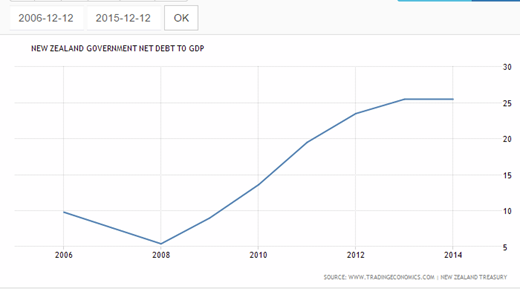
When John Key took office,  government debt was just over $10 billion. After swallowing multiple dead rats and embarking on a $7 billion-plus infrastructure binge it is now over six times that amount.

imageSource: Trading Economics: ‘NZ Government Debt to GDP

The Journal continues:

Mr. Key is returning the country to a formula for prosperity that's worked in the past. As in Britain, the U.S. and Australia in the 1980s, New Zealand's government implemented a wide-ranging program of economic liberalization, including deep reductions in tariffs and subsidies, and privatization of state-run industries. The plan, nicknamed "Rogernomics" after then-Finance Minister (now Sir) Roger Douglas, was akin to Reaganomics, and the island nation grew smartly.
    But while the U.S. and Australia broadly continued their economic liberalization programs under both right- and left-wing governments, New Zealand didn't -- until now.

Not a whiff of that, was there.

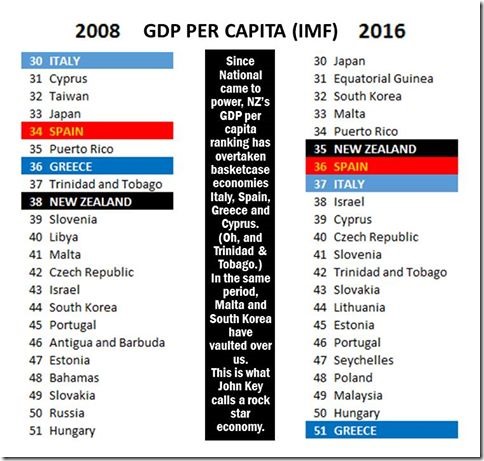
"We have been on a slippery slope," Mr. Key says, pointing to the country's slide to the bottom half of the Organization for Economic Cooperation and Development's per-capita GDP rankings. "So we need to lift those per-capita wages, and the only way to really do that is through productivity growth driving efficiency in the country."

Labour productivity growth in 2008 lagged the OCD average. It still does.

The slide in OECD per-capita GDP rankings continues. In 1970 we were 16th out of 26; in 1980 19th; in 2000, 20th out of 26. New Zealand is now 19th out of 34, with no movement to alter that. As John Ansell explains, using IMF rankings, “Far from running a "rock star economy", in terms of GDP per capita Key's major achievement seems to be that we're no longer quite as poor as basketcases Italy, Spain and Greece. (Imagine a New Zealand sportsperson settling for 35th. (And being called a great leader!) With all our natural resources, why shouldn't we be aiming to be World Champion Nation?)”

15356774_10154892537544883_1053487088603512359_n

You can read all the things he tells the journal he is going to do, including those tax cuts lies, and compare them all against the reality. [Another link here.]

"I'm not deeply ideologically driven," he [concludes].

He got that much right.

.

Monday, 12 December 2016

Q: The modern reason for the season? A: Capitalism.


Christmas as we know it? It’s mostly a modern invention – and that’s mostly good.
In this guest post, B.K. Marcus tells a little bit of of the little-known tale of how American capitalism created both the modern Christmas and the market innovation of Peace on Earth.

Rowdy men in colourful rags gather outside the city’s nicer homes, demanding to be let in. Some have disguised themselves with mock-fancy outfits that ridicule their less-than-willing hosts, while others have blackened their faces or dressed up as animals. If you try to keep them out, they will shatter your windows, break down your door, and help themselves to food and drink. If instead you grant the rabble access, your costumed guests will drink your best booze and demand a cash “tip” for slurring a noisy song at your family.
Welcome to a traditional Christmas, as it was celebrated for over a thousand years: from the last days of Rome, through late-medieval London, to 18th-century New York.
No Santa, no Christmas tree, no wreath or holly or mistletoe. And no more sign of the Holy Family than you would have seen at any other season.

“It was all a little like Halloween today,” writes historian Stephen Nissenbaum in The Battle for Christmas, “when, for a single evening, children assume the right to enter the houses of neighbours and even strangers, to demand of their elders a gift (or ‘treat’) and to threaten them, should they fail to provide one, with a punishment.”
    But unlike modern Halloween, the traditional Christmas involved real intimidation: the costumed petitioners were not small children but lower-class young men; they were already drunk and demanding yet more to drink.
    How did this annual ritual of clamour and extortion turn into silent night, holy night?
    Despite centuries of effort by Church authorities, that transformation was not at all a religious conversion from pagan bacchanal to pious observance. The modern, domestic Christmas is younger than the Industrial Revolution, and like that revolution, it was part cause and part consequence of commercial capitalism.

The Clash of Christmas Cultures
Whether it’s Starbucks cups or the ever-popular “Happy Holidays” greeting, every year it seems there is a controversy over Christmas and how it’s celebrated. The most amusing so far this year is the story about Minneapolis’s Mall of America hiring its first black Santa's helper that outraged so many readers of the Minneapolis Star Tribune they had to shut down online comments. As one journalist responded to the controversy, “Nothing says ‘Peace on Earth, Good Will Toward Men,’ like a tsunami of hatred over a black man honouring the legend of a Turkish bishop, in celebration of the birth of a Palestinian Jew.”
    “The blowback,” she continues, “is yet another chapter of on ongoing saga that a ‘war’ is being waged against Christmas.”
  Whatever official tradition is allegedly being dropped, it has become an unofficial tradition in Europe and North America at least that as the nights grow longer and the temperature drops, there must be a public skirmish in an on-going culture war over the season and its sundry greetings.
    The central winter holiday (claim the protectors of tradition) has grown either too secular or too exclusionary, either too politically correct or too incorrect, and always—always!—they bleat that it’s far too materialistic.
    Implicit in the charges is the idea that unsympathetic forces have corrupted our holiday and degraded our longstanding traditions. We have, it is ever contended, lost track of the true meaning of Christmas.
    But older than most of our modern Christmas traditions is the tradition of fighting over how to celebrate in late December — or whether to celebrate at all. The traditionalists and their many followers seem to believe that a failure to explicitly observe Christmas is an attack on Christianity. But once upon a time, some of the most zealous Christians, especially in America, took precisely the opposite position…

The Traditional Enemies of Christmas
For the first two centuries of European settlement in New England, writes Nissenbaum, there was no official celebration of Christmas at all.

In fact, the holiday was systematically suppressed by Puritans during the colonial period.… It was actually illegal to celebrate Christmas in Massachusetts between 1659 and 1681.
Why such hostility toward Christmas from pious Christians? According to the Puritans, Christmas was not really a Christian holiday at all.
It was only in the fourth century that the Church officially decided to observe Christmas on December 25. And this date was chosen not for religious reasons but simply because it happened to mark the approximate arrival of the winter solstice [and the birth of a  legendary number of pagan gods], an event that was celebrated long before the advent of Christianity. The Puritans were correct when they pointed out — and they pointed it out often — that Christmas was nothing but a pagan festival covered with a Christian veneer.
When you consider how Christmas had been celebrated for over a millennium — with drunken misrule, menace, and open invasion of property — it’s easier to understand the Puritan antipathy to the holiday.
    But over time, the opponents of this carnival Christmas found that they couldn’t suppress the celebration.
    Today, “diversity” is a buzzword for the sort of political correctness that traditionalists contend is the enemy of Christmas. But the only era in which Christmas was even partially suppressed was when a homogeneous population of the pious dominated the culture and the government.
    As both Europe and America grew more diverse in backgrounds and beliefs, Christmas reasserted itself.
    The Puritan attempt to ban Christmas was part of a larger campaign to impose a particular understanding of biblical religion on England and America, but it also had a more practical, secular goal: dispersing the crowds that gathered in public to pursue their disorderly version of holiday cheer.
    In the early 19th century, a different group of rich and powerful men tried to re-engineer the holiday for their own social agenda. That their efforts were ultimately so successful has less to do with their specific goals than with how well their invented traditions served the emerging commercial culture of industrial capitalism.


Inventing Tradition
In 1975, a small group of Boston artists were seeking an alternative way to celebrate New Year’s Eve, one that avoided the usual emphasis on drunken revelry. Their solution was called First Night, a gathering of performers and public audiences seeking to welcome the New Year without alcohol. The event was a success, and nearby communities soon adopted it. By the end of the 20th century, it had spread to more than 250 North American cities. By 2006, First Night attracted more than a million visitors.
    A century and a half earlier, wealthy New Yorkers pursued a similar mission: to offer an alternative to the sort of Christmas that historian Susan G. Davis called “riotous disorder, racial violence, and jolly foolery for neighbours and audiences.”
    The combination of “customary Christmas license” and the seasonal unemployment that still occurred in an economy based largely on agriculture, Davis writes in Parades and Power, “made the winter holiday a noisy, drunken, threatening period in the eyes of the respectable.”
    Some of the respectable took it upon themselves to fashion an alternative to the traditional Christmas. The Knickerbockers (the name comes from a pseudonym used by the group’s best-known member, Washington Irving) were “a small group of antiquarian-minded New York gentlemen,” who, according to Nissenbaum, “felt that they belonged to a patrician class whose authority was under siege,” especially during the annual winter riots.
    Like the First Night artists, the Knickerbockers decided that the solution was not to ban the unwanted activity but to offer it some competition. Unlike First Night, the Knickerbockers’ alternative was to celebrate not in public but at home, not among crowds of strangers but rather with immediate family.
    This attempt to invent a newly domestic Christmas took several forms, but the one that captured the public imagination was the family Christmas that centred around small children, Christmas presents, and a new patron saint of gift giving: Saint Nicholas.
    The established wisdom may be that the American Santa Claus, now a global figure, was “a creature of ancient Dutch folklore,” as Nissenbaum puts it, “who made his way to the New World in the company of immigrants from Holland.” But Santa was, in fact, an invention of Anglo-Saxon Protestants, and in particular of Clement Clarke Moore, the author of “A Visit from Saint Nicholas.” Better known as “‘Twas the Night before Christmas,” the poem was first published on December 23, 1823, and has become, according to one New York historian, “arguably the best-known verses ever written by an American.”

Reinventing Children
Santa had predecessors, for sure, most notably the historical Saint Nicholas (known in Dutch as Sinterklaas), but before the 19th century there was no widespread tradition in America of Christmas gifts for children — in part because our current idea of childhood is itself a recent invention.

In pre-modern times, most children were treated as proto- or mini-adults — not yet fully formed but otherwise not essentially different from anyone else. There is some disagreement among historians about parents’ affection and attitudes toward their offspring in the eras of high infant mortality, but if we put aside the historically thorny issue of familial tenderness, we can see that the parental duty, commonly understood, was to prepare children for adulthood as directly as possible.
    Only in the early period of capitalism, with the rise of a large, commercial middle class, did the notion arise that children should be segregated from the grown-up world of work — and of bacchanalian carousing. Where Western attitudes toward childrearing had previously focused on a conception of the young as little savages who needed to be civilized, the modern bourgeoisie, influenced by the writings of John Locke and Jean-Jacques Rousseau, came to perceive children as fundamentally innocent — a state that needed to be preserved, protected, and celebrated.
    With the more widespread wealth and increasing privacy brought about by a growing commercial economy, a new divide emerged in the minds of the middle class: a separation between the corrupting public sphere and the protective shelter of the home. The new icon of Santa Claus offered New Yorkers, Americans, and eventually the whole world a figure around whom to ritualise this newfound domesticity and to raise new generations of parents who would come to believe that their childhood memories of Christmas were part of a timeless tradition.

Removing the Price Tag
What was not perceived as timeless was the commercial revolution that made it all possible. Memories of a simpler time were fresh, if not entirely accurate. As industry, urbanisation, and immigration increased, so too did a desire for at least one time of year when we could retreat to a world of preindustrial craftsmanship, nonmonetary exchange, and quiet familial ties. Nissenbaum writes of the tension between the new economy and the new Christmas:

Perhaps the very speed and intensity with which those essentially new rituals were claimed as timeless traditions shows how powerful was the need to keep the relationship between family life and a commercial economy hidden from view — to protect children (and adults, too) from understanding something troublesome about the world they were making.
As merchants recruited ‘Saint Nick’ to promote their shops and mass-produced products, an antithetical image of Santa’s workshop became well established: one with no sign of machinery or modern production, only hand tools and individual craftsmanship. The presents exchanged on December 25 were overwhelmingly store-bought items; but with price tags removed and wrapping paper applied, they were presented as existing outside the commercial nexus.
    Even the Christmas tree, another seemingly ancient folk tradition that was in fact invented in the 19th century, “first entered American culture as a ritual strategy,” writes Nissenbaum, “designed to cope with what was already being seen … as a holiday laden with crass materialism — a holiday that had produced a rising generation of greedy, spoiled children.” The Christmas tree made gift giving less one-sided. The family tree became the locus of not only surprise and gratitude but also of mutual generosity, the hub of a material exchange “forged outside the fevered crucible of market relations.”
    The meaning of Christmas, according to the tree-centred ritual, lies not in material gain but in gratitude and generosity.

The Season of Light
Our current holiday rituals can be seen, then, as a dance between capitalism and an on-going cultural ambivalence to commerce. The world of economic production and exchange produces a need to escape our awareness of the marketplace — and the market itself meets that demand.
    If we need that annual hiatus to be more spiritual, less materialistic, more familial, and less anonymous, the commercial culture will adapt, even with seemingly non-commercial solutions.

Those who want to celebrate the winter solstice as the birth of their saviour[s] have centuries of tradition behind them. But that has never been the way most people celebrated the season, no matter what our selective memory may suggest. Drunken revelry in the streets is now confined to New Year’s Eve [sadly – Ed.], and is a much older tradition, one the Church sought to counter with its celebration of the Nativity. A religious Christmas may be more peaceful, more admirable, and certainly more high-minded, but in the appeal to tradition, it loses out to older and more popular forms of low-minded merrymaking.
     Where religious authorities tried and failed to rein in the noise and menace of the solstice season, modern capitalism succeeded, displacing the winter carnival with its own invented tradition: the domestic Christmas, a 19th-century creation merging Christian and pagan symbols in a celebration centred around two other historical innovations: the modern family and modern childhood.
    For millennia, people have wanted to spend the darkest part of the year celebrating in a way that diverges from the normal rules and routine. In an agricultural age, that meant overindulging in meat and drink. In a rigid social hierarchy, it meant reversing the ranks, making the wealthy serve the poor. In a commercial age, where mom and dad head off to separate jobs while the kids are sent to school, it means spending the holiday together in leisure, practicing a form of mutual generosity that is ritualized to obscure its capitalist origins.
    As long as the demand continues for an annual hiatus from the normal rules, the market will supply whatever is necessary to mark the season, even when what is required is the impression that we have somehow transcended the commercial world that makes our modern Christmas possible.


B.K. Marcus
B.K. Marcus is editor of the Freeman,
where this post previously appeared.
Santa pic by Prodos

.

Quote of the Day: On who may be fit to govern


"The danger is not that a particular class is unfit to govern. Every class is unfit to govern."
~ Lord Acton

[Hat tip James Valliant]

.

Friday, 9 December 2016

The three most pressing threats to liberty today


Populism, identity politics (left and right), and radical Islam --- they share both the prize of being the three most pressing threats to liberty today, argues Tom Palmer in this guest post, and many common intellectual fountainheads.

A spectre is haunting the world: the spectre of radical anti-liberty movements, each grappling with the others like scorpions in a bottle and all competing to see which can dismantle the institutions of liberty the fastest. Some are ensconced in the universities and other elite centres, and some draw their strength from populist anger. The leftist and the rightist versions of the common anti-libertarian cause are, moreover, interconnected, with each fuelling the other.

All explicitly reject individual liberty, the rule of law, limited government, and freedom of exchange; all promote instead radical, albeit aggressively opposed, forms of identity politics and authoritarianism. They are dangerous and should not be underestimated.

Palmer1In various guises, such movements are challenging libertarian values and principles across the globe. They share a radical rejection of the ideas of reason, liberty, and the rule of law that animated the American Founding Fathers and are, indeed, the foundations of modernity. .

INTRO: THREE THREATS

There are at least three symbiotic threats to liberty on the horizon:

  • identity politics and the zero-sum political economy of conflict and aggression they engender;
  • populism and the yearning for strongman rule that invariably accompanies it; and
  • radical political Islamism.

Surprising to some, they share certain common intellectual fountainheads and form an interlocking network, energising each other at the expense of the classical liberal consensus.

Although all those movements are shot through with fallacies (especially economic) they are not driven merely by lack of understanding of economic principles, as so many statist interventions are. While most support for the minimum wage, trade restrictions, or prohibition of narcotics rests on factual misapprehensions of their consequences, the intellectual leaders of these illiberal movements are generally not thoughtless people. [And often embrace the negative outcomes as a positive – Ed.]

They often understand libertarian ideas fairly well, and reject them root and branch. They believe that the ideas of the classical liberal consensus are are phony, self-interested camouflage for exploitation promoted by evil elites; that equality before the law, of rule-based legal and political systems, of toleration and freedom of thought and speech, of voluntary trade — especially among strangers — for mutual benefit, and of imprescriptible and equal individual rights are all illusory, delusional and merely a front for exploitation by the evil elites they each rant against, and that those who uphold them are either evil themselves or hopelessly naïve [or “cucks” – Ed.]

It’s time for advocates of liberty to realise that some people reject liberty for others (and even for themselves) not merely because they don’t understand economics or because they will realise material benefits from undermining the rule of law, but because they oppose the principles and the practice of liberty, and embrace the consequences of its obliteration.

They don’t seek equality before the law; they reject it and prefer politics based on unequal identities.

They don’t believe in your right to disagree with them, and they certainly will not defend your right to do so.

They consider trade a plot of some sort.

They prefer a politics of will to one of processes – the rule of men, and not of law.

And they will attack anyone for offending their sacred identities.

In short, they do not want to “live and let live.” To that, is what they are opposed.

THREAT #1: IDENTITY POLITICS

It took decades, but a robustly anti-libertarian and anti-tolerationist movement on the left side of the spectrum has effectively taken over a great deal of academia in much of Europe and North America, and elsewhere.

Their goal is to use administrative punishment, intimidation, and disruption to suppress all views they consider incompatible with their vision. This movement is rooted in the writings of a German Marxist who studied under the Nazi theoretician Martin Heidegger. His name was Herbert Marcuse, and after he came to the United States he became very influential on the far left.

Marcuse’s 1965 essay “Repressive Tolerance” argued that to achieve liberation, or at least his distorted vision thereof, would require

the withdrawal of toleration of speech and assembly from groups and movements that promote aggressive policies, armament, chauvinism, discrimination on the grounds of race and religion, or that oppose the extension of public services, social security, medical care, etc. Moreover, the restoration of freedom of thought [sic] may necessitate new and rigid restrictions on teachings and practices in the educational institutions which, by their very methods and concepts, serve to enclose the mind within the established universe of discourse and behaviour – thereby precluding a priori a rational evaluation of the alternatives.

For Marcuse, as for his contemporary followers (many of whom have never heard of him), “Liberating tolerance, then, would mean intolerance against movements from the Right and toleration of movements from the Left.” Following that script, those who dissent from the new orthodoxy are shouted down, denied platforms, forced into sensitivity re-education courses, forbidden from speaking, intimidated, mobbed, and even threatened with violence to get them to shut up. Consider again University of Missouri professor Melissa Click’s call to her backers — “Hey, who wants to help me get this reporter out of here? I need some muscle over here!” That was Marcuse’s message in action.
Palmer2Political correctness on the left has called forth an equally anti-libertarian reaction on the right. The far-right movements that are gaining ground in Europe and the “alt-right” fusion of populism and white nationalism in the United States have attracted followers who are already convinced that their existence or way of life is threatened by capitalism, by free trade, and by ethnic pluralism, but they have been infuriated and stirred into action by the illiberal left-wing domination of speech and witch hunts against dissidents. In a sense they have become the mirror image of their persecutors. In European parties they have resurrected the poisonous political ideologies and language of the 1930s, and in the United States they have been energised by and attached themselves to the Trump movement, with its attacks on international trade, its denigration of Mexicans and Muslims, and its stirring up of resentment against elites.

The call for politically correct “safe spaces” reserved for minorities is mirrored by white nationalists who call for affirming “white identity” and a “white nation.” The doyen of white nationalism (also known as “Identitarianism,” in the United States) is one Jared Taylor, who recently told National Public Radio that

_Quote_Idiotthe natural tendency of human nature is tribal. When black people or Asians or Hispanics express a desire to live with people like themselves, express a preference for their own culture, their own heritage, there’s considered nothing wrong about that. It’s only when whites say, well, yes, I prefer the culture of Europe and I prefer to be around white people — for some reason, and only for whites, this is considered the profoundest sort of immorality.

One collectivism begets another.

Embracing the common thread tying the illiberal left with the illiberal right is philosophy professor Slavoz Žižek, an influential voice on the far left, better known in Europe than America, but with a growing following worldwide. Žižek insists that freedom in liberal societies is an illusion, and works to make it so.

That common thread also runs through the work of the National Socialist law professor Carl Schmitt, a collaborator of Martin Heidegger who famously reduced “the specific political distinction … to that between friend and enemy.” Žižek affirms “the unconditional primacy of [this] inherent antagonism as constitutive of the political.”

Palmer3For thinkers such as these, ideas of social and economic harmony and philosophies of “live and let live” are just so much self-delusion; for them what is real is only the struggle for dominance. Indeed, in a very deep sense, the flesh-and-blood individuated person does not even exist for such thinkers; for what truly exists, to them, are only social forces or identities: indeed, the “individual”(they hold) is nothing but the instantiation of forces or collective identities that are inherently antagonistic to each other.

THREAT #2: POPULIST AUTHORITARIANISM

Populism often parallels the various forms of identity politics, but adds angry resentment of “elites,” crackpot political economy, and a yearning for a leader who can focus the “authentic will” of the people. Populist movements have erupted in numerous countries, from Poland and Spain to the Philippines and the United States. This is the modern version of the nineteenth-century longing for The Man On Horseback. [For all his posturing, Winston Peters is but a pale simulacrum of the real thing – Ed.] 

In his book The Populist Persuasion Michael Kazin defines populism as: “a language whose speakers conceive of ordinary people as a noble assemblage not bounded narrowly by class, view their elite opponents as self-serving and undemocratic, and seek to mobilise the former against the latter.” The normal tendency of such movements is to follow a charismatic leader who, in his or her own person, embodies the people and focuses the popular will.

A common theme among populists is to empower a leader who can cut through procedures, rules, checks and balances, and protected rights, privileges, and immunities and “just get things done.” In The Road to Serfdom F. A. Hayek described that impatience with rules as the prelude to totalitarianism:

It is the general demand for quick and determined central government action that is the dominating element in the situation, dissatisfaction with the slow and cumbersome course of democratic processes which make action for action’s sake the goal. It is then the man or the party who seems strong and resolute enough to ‘get things done’ who exercises the greatest appeal.

Populist and authoritarian parties have taken over and are cementing their power in several countries.

Palmer4In Russia Vladimir Putin has created a new authoritarian government that dominates all other institutions in society and depends on his own personal decisions. Putin and his cronies systematically and completely took over the media and used it to generate a deep feeling of a nation under siege, whose uniquely great culture is constantly threatened by its neighbours, and which is defended only by the “strong hand” of their leader.

The government of Hungary, after securing a two-thirds parliamentary majority in 2010, began to institutionalise control of all organs of the state by ruling Fidesz party loyalists. It depicted its leader, Viktor Orbán, as a national saviour and launched an increasingly anti-libertarian agenda of nationalisation, cronyism, and restrictions on freedom of speech. Orbán declared that “[We are] breaking with the dogmas and ideologies that have been adopted by the West and keeping ourselves independent from them … to construct a new state built on illiberal and national foundations within the European Union.” (“Within the European Union” translates into “subsidised by the taxpayers of other countries.”) [No surprise that Viktor Orbán has been lauded by many in the alt-right – Ed.]

After Fidesz’s 2010 victory, the leader of the nationalist and anti-market Polish Law and Justice Party Jaroslaw Kaczyński declared Orbán’s nationalist, populist, and cronyist strategy “an example of how we can win.” Kaczyński managed to combine identity politics with populism to oust the centre-right government of a country with a growing economy and then began to institute the kinds of populist and protectionist measures that have proven themselves inimical to prosperity.

The classical liberal Timbro Institute of Sweden’s 2016 Timbro Authoritarian Populism Index concluded that on both left and right, in contemporary Europe “populism is not a temporary challenge but a permanent threat.”

Putin, the pioneer in the trend toward authoritarianism, has poured hundreds of millions of dollars into promoting anti-libertarian populism across Europe and through a sophisticated global media empire, including RT and Sputnik News, as well as a network of internet troll factories and numerous made-to-order websites.

Palmer5Russian media pioneer Peter Pomerantsev in his remarkable book Nothing Is True and Everything Is Possible notes that “the Kremlin switches messages at will to its advantages… . European right-wing nationalists are seduced with an anti-EU message; the Far Left is co-opted with tales of fighting US hegemony; US religious conservatives are convinced by the Kremlin’s fight against homosexuality.” Clouds of lies, denunciations, denials, and more are issued to undermine the confidence of defenders of classical liberal institutions. It’s a well-financed post-modern assault on truth in the service of dictatorship. [Libertarians too have been seduced. See in this vein Mikhail Svetov’s ‘Putin’s Libertarians’ – Ed.]

WHAT TRIGGERS AUTHORITARIANISM?

Such movements are not solely the result of a lack of education. They are deeply ideological in character. They embrace collectivism and authoritarianism while rejecting individualism and constitutional rules. What has caused them to generate so much popular support so rapidly?

Current research indicates that authoritarian responses are triggered by the perception of threats to physical security, group identity, and social status. When all three are present, conditions are ripe for an explosion of authoritarianism.

Radical Islamist violence, recycled through the 24/7 news cycle to seem even more widespread and common than it is, certainly presents an apparently alarming external threat.

Group integrity and status are also at stake. Research by the political scientist Karen Stenner supports the idea that there is an authoritarian predisposition that is triggered by “normative threats,” that is: perceptions that traditional views are endangered or no longer shared across a community. Such normative threats trigger a response among those predisposed to authoritarianism to become active “boundary-maintainers, norm-enforcers, and cheerleaders for authority.”

Threats to social status further exacerbate such authoritarian responses.

Palmer6The core support for authoritarian populist movements in Europe, as well as the radical fringe of the Trump movement in America, has been less-educated white males, who have seen their relative social status decline as those of others (females and foreigners) have risen. In the United States, white males 30-49 with high school degrees or less have seen their labour force participation rates drop precipitously, to the point where more than one in five are not even seeking work but have left the labour force entirely. Without remunerative and fulfilling work they have experienced a substantial loss of social status.

Absolute living standards can rise for all (and living standards and real wages have risen dramatically over the past decades), but relative status cannot rise for all. If some groups are rising, others must be falling. Those in the groups that have been falling and who are predisposed to authoritarianism will be strongly drawn to authoritarian figures who promise to redress things, or to restore lost greatness.

THREAT #3: RADICAL ISLAMISM

Radical Islamism mirrors some of the themes of the other anti-libertarian movements, including

  • identity politics (the belief that the community of believers is at war with all infidels),
  • authoritarian populist fears of threats to group identity and social status, and
  • enthusiasm for charismatic leaders who will “Make Islam Great Again.”

Radical Islamism even shares with the far left and far right common intellectual roots in European fascist political ideology and collectivist ideas of “authenticity.”

Palmer7The Islamist movement in Iran that created the first “Islamic Republic” was deeply influenced by European Fascist thinkers, notably Martin Heidegger. Ahmad Fardid promoted Heidegger’s toxic ideas in Iran, and his follower Jalal Al-e Ahmad denounced alleged western threats to the authentic identity of Iran in his book Westoxification.

As Heidegger pronounced after the victory of the Nazi Party, the age of liberalism was “the I-time. Now is the We-time.” Ecstatic collectivism promised to deliver the German people from their “inauthentically historical existence,” and lead them toward “authenticity,” the cause now embraced alike by such apparently diverse bands as social justice warriors, alt-right “identitarians,” and radical Islamists.

All those trends are mutually reinforcing: Each demonises the other; and as one grows, so grows the existential threat against which the others struggle. The growth of radical Islam draws recruits to populist parties in Europe (and America), and the hostility toward Muslims and their alienation from their societies increases the ability of Islamic State and other groups to recruit. At the same time, politically correct social justice warriors cannot bring themselves to condemn radical Islamism — after all, isn’t it just a response to the colonial oppression visited on non-Christians by the dominant Christian/white/European hegemony? — and often they find themselves not only unable to condemn Islamist crimes, but they even promote anti-Semitism themselves.

Indeed, hostility to Jews and to capitalism is a disturbingly common feature of all three movements [as they have been commonly tied throughout history – Ed.].

CONCLUSION: THE NEED TO DEFEND LIBERTY

The various anti-libertarian movements grow at the expense, not of each other, but of the centre, as it were, made up of tolerant producing and trading members of civil society who live, whether consciously or not, by the precepts of classical liberalism.

Palmer8We have seen that dynamic before, in the 1930s, when collectivist movements vied with each other to destroy freedom as fast as they could. The Fascists claimed that only they could defend against Bolshevism. The Bolshevists mobilized to smash Fascism. They fought each other, but they had far more in common than either wished to admit.

Unfortunately, the best argument that the defenders of civil society typically offer in response to those challenges is that the complex of personal liberty, the rule of law, and free markets creates more prosperity and a more commodious life than the alternatives. That’s true, but it’s not enough to deflect the damaging blows of the illiberal triumvirate of identity politics, authoritarian populism, and radical Islamism who value neither. [Their nihilist emotionalism is real – Ed.]

The moral goodness of liberty needs to be upheld, not only in head-to-head encounters with adversaries, but as a means of stiffening the resistance of classical liberals, lest they continue retreating. [And the philosophical underpinnings of morality and markets must be both well understood, and well articulated – Ed.]

Freedom is not an illusion, but a great and noble goal. It’s moral justification lies not in what it can do for the group, but in the moral space it allows each individual.

A life of freedom is better in every respect than a life of submission to others. Violence and antagonism are not the foundation of culture, but their negation.

Now is the time to defend the liberty that makes possible a global civilisation that respects and protects the individualist values that underpin and enable friendship, family, cooperation, trade, mutual benefit, science, wisdom — in a word, life — to challenge the modern anti-libertarian triumvirate, and reveal the emptiness at its heart.


Tom Palmer

Tom Palmer is executive vice president for international programmes at the Atlas Network and a senior fellow at the Cato Institute and director of the Institute's educational program, Cato University.
This piece previously appeared as a
Cato Policy Report and at FEE.

.
The ruins of the “City of Culture,” Galicia – by Peter Eisenman


ENTR ECOT | Cidade da Cultura from urbanNext on Vimeo.

Back when I was studying architecture at Auckland uni, starchitects like Peter Eisenman were all the rage.

Galicia3

My own sympathies were with the architecture of Frank Lloyd Wright, and work like it that embraced human life. Architecture like Eisenman’s I characterised as neutron-bomb architecture – architecture from which all human life and humanity were rationalistically erased.Galicia2

For the most part however, neutron-bomb architecture was what my lecturers wanted. This, they held, is architecture with real rigour. Wright, and work like it, was mostly shunned.  What they wanted was architecture generated not by life, but by diagram.

Galicia4

So it’s with great sympathy for the good people of Galicia, Spain, who had inflicted upon them in the name of said rigour the architecture of Mr Eisenman, an abomination never completed but which has left them €475.9 million in a hole. All that’s left to show for it is the

hulking cultural complex Ciudad da Cultura de Galicia (City of Culture of Galicia) sits incomplete and empty. Commissioned to the American architect after an international competition hosted by the Parliament of Galicia, the cultural center presented an ambitious feat of construction on the slopes of Mount Gaiás… [C]onstruction of the six-building complex endured during the 2008 Spanish recession, and as costs for the building’s materials and construction continued to rise, the project became a crippling burden on the regional government of Galicia… Considered a “white elephant” to the government and the people of Galicia, construction of the project was halted in 2013.

What rigorous vision is being imposed here?

The parametrically configured design was conjured by overlaying the map of the city of Galicia on top of Mount Gaiás’s sloping topography. The result was a series of granite-clad slopes interconnected by streets and plazas meant to invoke an urban environment.

This is what passes for rigour in the rarified world academic architecture: a 3-dimensional multi-million-euro equivalent of the scribble patterns you drew in kindergarten. The result, in reality? A White Elephant, as Peter Eisenman’s Ambitious “City of Culture” Fades Into Ruin.

[U]ndulating marble forms that extrude from the earth are flanked with scaffolding, metal barriers and caution tape. Shrubs and weeds have already begun to sprout between the cracks of the pink granite panels. Despite a few pedestrians, the site remains empty, untouched, all too uncannily fulfilling Eisenman’s vision of an “archaeological” site.

How appropriate.

Galicia1

The suspicion will be that if completed the work may have appeared more humane. If you truly think so, just Google his finished work …

[Film by ENTR_ENCOT. Pics by Architizer.com, Alex Lievens]

.

Thursday, 8 December 2016

The hidden costs of saving those Carrier jobs


Rarely has a deal done by a President-elect been heard so loudly around the world. And what a deal: 1,100 Americans keep their jobs, Carrier gets lower taxes, and Donald Trump gets many thousand approving headlines. That, as Bastiat would say, “is what is seen.” What is not seen, explains Tom Mullen in this guest post,  is the vast amounts of wealth destroyed by this protectionist deal.

Donald Trump has not taken office and already he is delivering on his promise to keep manufacturing jobs in the United States. Last week, he visited Indiana to celebrate his part in persuading Carrier to keep 1,100 jobs slated to move to Mexico at its Indiana facility. Speculation abounded of bullying, corporate welfare, and some kind of tax-funded quid pro quo (Carrier’s parent company, United Technologies, holds large defence contracts).

Zero Hedge concludes however that Carrier was persuaded by none of the above. Instead, the company received “$700,000 a year for a period of years in state tax incentives.” That means keeping the jobs cost the government about $636 per job annually in tax revenues.

Carrier1It would seem a win-win. 1,100 Americans keep their jobs, Carrier gets lower taxes to avoid having to pass on the cost difference to its customers and all the local businesses in Indiana benefit from the purchasing power that remains there with the domestic Carrier employees instead of being exported to Mexico.

That, as 19th century political economist Frederic Bastiat would say, “is what is seen.” What is not seen is all the consequences of Carrier not moving those jobs to Mexico, where they could produce their products at a lower cost. When those consequences are considered and the ledger is balanced, the deal will have made the United States as a whole poorer and will have cost it jobs.

Let’s first consider the decision in a vacuum, without the tax incentive. Carrier was moving the jobs to Mexico because it could produce the same air conditioner there at a lower cost, which it could then pass on to its customers. Keeping the jobs in Indiana raises the cost of production above what it would be with the move. That forces Carrier to raise its prices.

And we must assume Carrier would have saved more than $636 per worker per year in tax breaks had they moved those jobs to Mexico, or the move wouldn’t have made financial sense. With each worker on average producing many air conditioners per year, saving $636 per worker works out to a negligible cost savings per unit. So, Carrier is likely absorbing some of the higher costs of keeping the jobs in Indiana, over and above what they are receiving from the government. Those costs must be passed on to customers or taken out of profits, the latter resulting in either lower dividends or less money reinvested in future improvements to production.

Wealth Destroyed

“Ah,” says the supporter of this move, “but many people are willing to pay a little more to keep those jobs in America!” Perhaps, but the economic consequences remain. Assuming the price of an air conditioner would be $5,000 if produced in Mexico and keeping the jobs in America only raises prices by the $500, Americans are now paying $5,500 for an air conditioner instead of $5000. They get no more for their money than they would have paying $5,000. All they have in exchange for the $5,500 is the same air conditioner.

Had the job moved to Mexico and that same air conditioner been available for $5,000, the customer would have been able to afford, for the same $5,500 he now spends to get the air conditioner only, an air conditioner and a bicycle, or an air conditioner and a new carpet, or an air conditioner and a new suit. The consumer is poorer because of the deal.His standard of living is lower. And the economic system is short one bicycle, one new carpet, or one new suit.  

And let’s not forget that for every one employee producing air conditioners, there are hundreds or thousands of people consuming what those employees produce.

At the end of the day, the ledger balances to this: the same number of air conditioners are being produced, but at a higher cost. That difference in the cost of production is lost. The standard of living of everyone who consumes air conditioners is lowered by however much more it costs to produce air conditioners in Indiana instead of Mexico. We assume it is $500, but the exact figure is not important. They are poorer by whatever amount the diminished efficiency increases production costs.

A Net Loss

Carrier2“But kind sir!” says the apologist, “you have missed something. You have forgotten the purchasing power of those 1,100 employees, which will help local businesses and keep that wealth in America. That creates jobs that otherwise would have been lost!”

No, it is not forgotten. It is merely balanced against purchasing power lost by all those consumers of air conditioners and against all the jobs they would have created with the $500.00 they would have spent with local businesses, had they saved it in purchasing the air conditioner. The air conditioner customer who also bought a bicycle, a new carpet or a new suit also created jobs or supported existing jobs, which are now lost. And not one in a million knows where they went. The unseen killer of those jobs is the decision to make the same air conditioner at a higher cost in Indiana than at a lower cost in Mexico.

It doesn’t end there. Let us not forget the 1,100 jobs lost in Mexico, the third largest importer of U.S. exports. Because of the lost purchasing power of Mexican consumers, U.S. companies who export to Mexico lose revenue and must lay off workers.

When the whole ledger is balanced, the jobs lost in the U.S. at least equals those 1,100 retained and likely far exceeds them, as inefficiency grows exponentially as its effects ripple throughout the economy.

What About the Tax Savings?

Finally, the apologist for the deal makes his last stand. “Yes, good sir, you make many fine points. But this deal involved lowering taxes for Carrier, which bestows upon them the same savings they would have realised by moving the jobs to Mexico. And even you must agree that lowering taxes and paying productive workers is better than allowing the government to use it less efficiently!”

Well, there is the rub. The government is doing with those lost taxes precisely what the apologist said. It is using them less efficiently than the market would have. The market would have moved those jobs to Mexico and lowered the cost of air conditioners. The government has used its taxing power to keep the jobs in Indiana and raise the cost of air conditioners above what it would otherwise be if the jobs moved to Mexico, with or without the tax incentive..

Carrier3But even on the tax incentive there is more that is not seen. It is not as if the $700,000.00 in tax revenues were left in the hands of the taxpayers, who might use it productively. 100% of it went to subsidise the higher cost of producing an air conditioner in Indiana instead of Mexico. And the government went on spending the same amount as before, simply collecting the $700,000.00 Carrier doesn’t pay from others, now or in the future.

So, while the cost of the tax break is not added to the sticker cost of the air conditioner, the public is still paying that additional $636 per worker per year in the additional taxes collected to make up the government’s loss on Carrier. The public is also poorer by whatever price increase or profit reduction is necessary to offset the additional costs the company agreed to absorb to make the deal work.

No matter what defence the apologist offers, there is no escaping this.

By keeping those jobs in Indiana instead of letting them move where the market is directing them, the net effect is the United States as a whole is at least $636 poorer per year for every employee kept in Indiana by the deal. It also loses jobs due to the higher prices it still pays for air conditioners, over and above what the tax break could alleviate, or the wealth lost in dividends or reinvestment Carrier sacrificed to absorb whatever additional cost savings it had to forego to keep the jobs in Indiana.  

And this is only one little company and just 1,100 jobs. Imagine if Trump delivers on his promise to keep or bring back millions?


Tom MullenTom Mullen
Tom Mullen is the author of
Where Do Conservatives and Liberals Come From? And What Ever Happened to Life, Liberty and the Pursuit of Happiness? and A Return to Common  Sense: Reawakening Liberty in the Inhabitants of America. For more information and more of Tom's writing, visit his blog at www.tommullen.net.
This post previously appeared at his blog, and at FEE.

.

Quote of the Day: On socialism v fascism


"Both Communists and Fascists describe themselves as socialists, since unlimited power over the economy entails unlimited power over everything, and vice versa. Socialism, however, is a narrow term, referring primarily to economics. The broader term, which covers the state’s power over everything, is totalitarianism."
~ Leonard Peikoff, from his book The DIM Hypothesis

.

[Hat tip Anoop Verma]

.

Pity the poor immigrant?


If ever there were a man who demonstrated the principle of Benefits from Genius it is Aristotle – Aristotle, the founder of three sciences and the Prime Mover in several others – Aristotle, the man from whom the ideas we now call “common sense” first sprung, back when sense was very far from common – Aristotle, from whose genius we still benefit more than two millennia later, but today would be treated by many as a … well, as Stuart Hayashi points out he would undoubtedly have bestowed upon him the labels gifted him by today’s identity politics:

Aristotle was an immigrant (the term was "metic"). Having grown up as a cultural Macedonian, he moved to the city-state of Athens, where he imbibed the wisdom of others and then disseminated his own. But because of violent attacks by Philip of Macedon on nearby city-states, Athenians came to distrust Macedonian immigrants in general, fretting that Macedonian immigrants were secretly violent subversives disloyal to Athens, getting ready to betray Athens for Philip . . . the sleeper agents and terrorists of their day. Anticipating what a prejudiced mob might do to him, Aristotle fled Athens to the island of Lesbos . . . a refugee.
    Aristotle was an immigrant and refugee whom other people distrusted as possibly violent . . . feared even in what was, and should have remained, the freest society of his day
.

The thing is, it’s not pity we need to direct towards immigrants, refugees and foreigners, but simply justice. The justice of treating them each as individuals, not as the average of some average.

Immigration is not about measuring averages. Nor is genius.

Here’s Christy Moore.

.

Gareth Morgan wants to tax your home


So let’s talk about Sam Morgan’s dad, Gareth. Because for an apparently smart man, he can be awfully fricking dumb.

There he was yesterday announcing the very first policy of his spanking new party, the Opportunists’ Party, capitalising on the opportunity of the Prime Minister’s resignation by flying up from Wellington to be photographed outside the Prime Minister’s Parnell home so he can announce a new tax. In a country that values home ownership, he announced he wants to tax your home.

Nice policy announcement by which to launch a new party.

What’s the connection with Parnell, you wonder? Why outside the Prime Minister’s home? Because Sam Morgan’s dad is very much an opportunist, and there were already reporters stationed there. And because his very first policy being so gleefully unwrapped is a new tax that will make those Parnell home-owners’ eyes water. A new tax that reveals Morgan senior to be something of an old-fashioned redistributionist – the sort that should have long ago been put out to pasture.

Morgan Sr says in essence that NZer’s houses, boats and cars are unproductive assets, so therefore (the “therefore” is his) his party would tax them all as if they were. He will simply “deem” your asset (his word again) to be a productive asset, and then tax you as if it has generated an income stream. Even if it hasn’t.

So not a direct property confiscation then, just confiscation by a thousand cuts.

Morgan Sr says not to worry about that however. It will only hurt some people (many of them in that leafy suburb he and his charts took over yesterday).

And, Morgan Sr says, don’t complain that this is just a tax grab, because we have it balanced out with income tax cuts for those other people who it won’t hurt. That will however hardly comfort those for whom it will.

This, he has said before, is a “fresh idea” that all makes sense. In point of fact, it is as stale as redistributionist dogma and makes no economic or moral sense at all.

  • It may or may not be “balanced” overall by income tax cuts, but even if true that would be cold comfort to those on low or little incomes. If you have a large house but little income, you’re going to have to find Morgan’s nut every year or sell out. If you have a small house but no income (perhaps because you’re retired and on a pension) then Morgan’s tax lords will simply “deem” you to have one and confiscate their tax anyway. And if you have any kind of house on leasehold land that doesn’t turn an income, then if Gareth’s policy were implemented you may as well just hand him over your wallet and all your credit and debit cards to with as he pleases.
        In any case, if you’re income poor and asset rich, this would come at you like Len Brown’s rate rises, only at a rate many times higher. (Expect rental margins to be squeezed, and slum landlording to be encouraged.)
  • And why on earth would we expect it to be balanced by a promise of commensurate tax cuts? Has any politician since Pericles ever kept a promise not to raise taxes? And Gareth himself seems fairly new to the idea since, when he first floated this new tax way back when he was talking about “Big Kahunas,” he talked about using have the new tax to pay for his Universal Basic Income – i.e., a godawful and expensive scheme making everyone in the country a beneficiary. So he’s not even wedded to that tax-cut linkage himself.
    And in an MMP environment, neither would any major party either who was likely to adopt the policy, if any. When you consider that a politician is someone who has never seen a new tax they wouldn’t like, nor an income tax cut they would offer (except in election year), the chances of it being tax-neutral are essentially nil.
    Yet even if not nil, it would still not be tax neutral for those he intends to harm. Who would be many

Morgan says that this new tax is necessary to hold down house prices and direct capital to more productive uses. But the fact remains that no tax on houses anywhere in the world has held down house prices when, in our hampered markets, the things hampering the markets are holding those prices up. And as economist Jim Rose pointed out to Gareth back in April when he was floating this particular trial balloon, “optimal tax theory, including that pioneered by Stiglitz and Merrlees, economists of impeccable left-wing credentials, show that taxes on the income from capital should be low because the deadweight social costs of taxes on capital are very high.” For that, Rose was threatened with banishment as a troll.

Because basically, Morgan thinks he knows best how to run things, and in the end doesn’t care that he’s wrong or who he may hurt in the process.

So if you’re a cat-loving retiree who owns a leasehold home, you may want to start a club. It could have as its first aim doing to Morgan pere what he’d like to do to your family pet.

[Hat tips Jason Krupp, Stephen Berry, Jim Rose]

PS: A reader sent me this link to Captain Morgan being interviewed this morning by Paul Henry, for whom I generally have little time – but when he begins by telling the Captain (accurately) that what he proposes is an Envy Tax, he immediately has my attention.

.

Wednesday, 7 December 2016

“The Top Ten Greatest Beers in New Zealand”


Luke1

It’s important, it’s official – and just in time for summer, Michael Donaldson at Beer Nation has revealed their Top Ten New Zealand beers for 2016. Or as he likes to call their list, The Top Ten Greatest Beers in New Zealand.

He has criteria, It includes:

  • Ratings on sites including Untappd and Ratebeer;
  • Gold medals / trophies won at the Brewers Guild of New Zealand Awards and other competitions;
  • The influence the beer has had on the New Zealand brewing scene;
  • Enduring quality;
  • Personal taste preferences.

It’s hard to argue with the carefully-crafted selections. The top three are produced by what’s arguably the country’s three top brewers – and the fourth by a fine chap who was once a beer writer at this very blog, before somehow going on to fame, fortune and world conquest without us.

Every beer in the top ten, every beer bar one, is a killer brew that has all but become a staple of sundry great beer fridges and the centre of many a local beer drinker’s social drinking sessions. And every one of the beers has a great story to tell!

But see if you can spot that odd one out.

And don’t panic if you don’t agree with the Beer Nation’s Top Ten List. You have a whole summer to make up your own.

How bad a project could that be?

PS: You can find the beers they ranked 20-11 here; 30-21 here; 40-31 here and 50-41 here.

Go wild!

.

Meanwhile, back in Brazil …


Any Brazilian interested in politics has developed a new morning habit: checking to see which politicians were arrested in the earliest hours of the day. Such arrests have become common lately, writes Raphaël Lima in his guest post on ‘The Glorious, Hilarious Political Chaos in Brazil’—a tale with a moral that affects us all.

Any Brazilian interested in politics has developed a new morning habit: checking to see which politicians were arrested in the earliest hours of the day. Such arrests have become common lately.

This very morning, there was a police raid on two former big kahunas who are being investigated for taking bribes and disrupting investigations on the mega-company Petrobrás. On the evening of the same day, I left my gym to find that the president of the Senate has been ousted by order of the Supreme Court.

Because he is standing trial for corruption, he can´t legally be in the succession line to the presidency. In his seat now sits another senator accused of essentially the same corruption scheme, but investigations haven’t caught him yet. Any morning now.

Operation Carwash

Brazil1This is all part of a gigantic clean-up operation called Operation Carwash, and if politics is a sport in Brazil, Carwash just elevated us into a new World Cup. Scoring comes in the way of the feds knocking on politicians' doors at 5:30 a.m. with search and arrest warrants.

It all started in a very unassuming way. Your average money launderer gets arrested in an international drug trafficking scheme. It turns out that his books list a Petrobrás director as a client. Said director is then arrested and confesses to taking bribes from a huge construction cartel operating within Petrobrás. Some of the bribes are traced to politicians who appointed him.

The construction companies’ owners and directors are arrested and confess to operating as a cartel. Everyone who is anyone in Petrobrás knows it and they are indirectly financing a big scheme to buy support in the legislature, control Congress, and elect politicians allied with the government.

This is not tall tale, but all true. Investigators officially dubbed it a “bribocracy.”

Somewhere in the thick of all of this there was a car wash and gas station that was used as a front to distribute the money: hence the name Operation Carwash.

Delightful Devastation

Fast forward two years and in the last hundred days we have impeached a president, ousted and arrested a leader of the house, arrested a senator for interfering with investigations under orders from the former president Lula da Silva, arrested and convicted dozens of politicians involved, and just hours ago ousted the president of the senate.

And the political World Cup is only going to get better from here on.

Any morning now, we’ll get to see the plea bargain from Odebrecht, the largest construction company involved in the scandal. The bargain was signed last week and statements are being taken as I write this article.

Odebrecht was so organised that they had a “Department of Structured Operations,” entrusted with handling the hundreds of millions of dollars that went to different politicians and parties. It’s expected they will rat out somewhere north of 150 politicians: the current president, two former presidents, and pretty much everyone else in between.

Those politicians aren’t silly gooses though. They realised ending the investigation was a simple matter: pass a law stopping it. In fact, a senator was recorded explicitly talking about that. He’s now the leader of the government in the senate, and was also in Odebrecht’s “Structured Operations” list.

Any morning now.

But back to their plan. The idea was to create a law saying that all illicit or unaccounted donations are pardoned. The law created very strict mandates to arrest judges and investigators for “abuse of power.” The result, they believed, would be simple: any politician accused of anything could simply say it was an unaccounted donation and get away with everything, and if Sergio Moro, the judge in charge of the investigation, or the investigators themselves pushed too hard, they could simply be jailed.

To add insult to injury, they took a law proposed by the very same investigators and undersigned by 2.5 million people, dubbed “10 measures against corruption,” and turned it into, “10 measures in defence of corruption.”

The original proposal included harder sentences for corruption, easier seizure of property from illegal operations, and measures to speed trials, as 96.5% of corruption-related trials that go to the Supreme Court end up with no punishment and one-third get thrown out for being too old. The new proposal slashed eight measures, made the other two pointless, and added many devices to defend against investigations.

Back to the Streets

We Brazilians decided we’re not having any of that and took to the streets again. That was what last Sunday was all about.

The people came out in the tens of thousands in many cities in support of Sergio Moro, Operation Carwash, and for justice. Because it's Brazil, the protests included 20-feet-tall inflatable puppets of politicians in jail uniforms.

blowups

Some opposition politicians came out to get some press and had some success, but the general mentality was that attacks against the investigation would not be tolerated. As far as we can see, the message was heard and the attacks have stopped, for now. Protests were peaceful, friendly even, but the truth is that everyone is at the breaking point.

It´s a protest that unites all people, old and young, in the same sense of revolt and disgust against the whole political system, its parties and politicians, its institutions and bureaucracy. It feels like everyone is angry, but at the same time joyous to find that everyone else is also angry. It reminds me of the story about Warsaw´s blinking lights. Add to that the major economic crisis we are suffering, and you have yourself a good ol’ powder keg of angry masses.

On November 16, we saw how close we are to flipping out: between 50 and 100 people invaded the House floor in protest, sang the national anthem and chanted for a few hours. Some even demanded the military take control. The leader of the House ordered all media evacuated for “security reasons” and ordered TV transmissions cut. My guess is he didn´t want that stunt to get publicity and become a new national habit, because it very well might.

The Next Shoe

Brazil2And so here we are. Any morning now the biggest political shoe in our history will drop with Odebrecht´s plea bargain. Or maybe another former governor or senator will be arrested. Or maybe a new spinoff of Carwash will open a new path of investigations with big raids. Or maybe a new law will be passed halting everything, and we will all collectively lose our cool.

But one thing is for sure: something will happen. In the early days of Carwash, there was a general feeling that this would be all for nothing, Director Comey-style. As the investigation broadened, we the people grew bold. But even during the impeachment process, there still was a strong feeling that nothing would come out of it. As it is now, there is no putting the cat back in the bag. Something will have to happen.

The people stand closer now, united by something we all have in common. We all got the bill, and it was paid in unemployment, taxes, collapsing public services or what have you. And the politicians, who are not us, have collected. For example, one former governor of Rio de Janeiro was recently arrested with roughly one million dollars of jewellery in his apartment, all bought with cash, while the state is in a fiscal calamity and officials are discussing pension cuts.

The State Is Them

Brazilians have understood something deep, even if only implicitly: the state is not us, politicians are not us. The system exists for this theft; it´s working for the thieves.

We are coming to the realisation that the system cannot be repaired, and more and more people are willing to entertain apparently crazy ideas such as privatising everything, the free market, maybe even capitalism. Efforts to block investigations and pardon crimes have only made this more explicit to anyone who was living under a rock or was in flat-out denial: a condition ever more common to the remaining defenders of socialism in Brazil.

It´s impossible to tell what will happen. But something will.

Any morning now.


Raphaël Lima


Raphaël Lima
Raphaël Lima is a popular media commentator and author in Brazil. His YouTube channel is one of the largest and most closely watched in the country.
His post previously appeared at FEE.

.