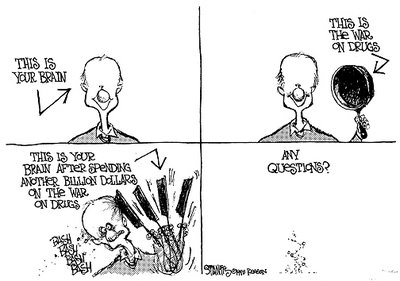
Showing posts sorted by relevance for query "war on drugs". Sort by date Show all posts

Thursday, 1 May 2008

"What can we do to win the war against the drug P?"

With commendable honesty Minister Annette King confesses that the War on the Drug P is already lost.  The Herald follows up and asks, "What can we do to win the war against the drug P?"

Have they ever considered that this is a war than can't be won?  That the real damage is done by the War on Drugs itself? As Milton Friedman once told Bush Snr’s drugs tsar Bill Bennett, “You are not mistaken in believing that drugs are a scourge that is devastating our society. Your mistake is failing to recognize that the very measures you favour are a major source of the evils you deplore.”

I won't bore you with another reiteration of the arguments why the War on Drugs can't win (you can read most of my previous posts here), but just consider these few pointers:

  • Since the government can't even keep drugs out of prisons, how can they keep them off the street?
  • Removing the legal market for recreational drugs (even relatively benign party pills) has created an illicit one, run by criminals.
  • Banning and arrests only reduces supply.  Since it does nothing to reduce demand, what do you think that does to price, and the profits of drug suppliers?
  • Since banning and arresting drug suppliers puts police in conflict with huge amounts of money, what do you think this does to police morals (hint: Clint Rickards was once an undercover cop).
  • Outlawing drugs leaves drugs in the hands of outlaws -- with huge profits driven by the reduced supply. (All praise the War on Drugs.)
  • Criminals have no interest in things like quality control, honesty about the composition of a substance, or refraining from selling to children. (All praise the War on Drugs.)
  • Outlawing drugs only increases the virulence of recreational drugs.  As Milton Friedman explained with his Iron Law of Prohibition, 'P' is precisely the sort of drug you get when you start a War on Drugs, since the more intense the law enforcement, the more potent the prohibited substance becomes.
  • If it is impossible to win the war on drugs, and no government anywhere ever has, then the question surely becomes: should we have a legal, transparent, accountable market for drugs, or an illegal, secretive, unaccountable one?

So what do you think? Could it be that what's too often overlooked in the link everyone sees between illegal drugs and crime is the 'illegal' rather than the drugs?  That's certainly the position of the cops and former cops  from an organisation called LEAP (Law Enforcement Against Prohibition) who argue that, "We believe that to save lives and lower the rates of disease, crime and addiction, as well as to conserve tax dollars, we must end drug prohibition."

In the end, none of these practical arguments will convince a soul, not as long as good people are convinced the health of their soul depends on having drugs banned. In other words, not as long as the morality behind the war on drugs remains unchallenged.  In the end, here's the telling point: That consenting adults have the right to make our own choices for ourselves, and we do. As with alcohol use, so too with drug use: youngsters need to be able to see both responsible drug use, and people saying no because they want to say no, not because their free will has been lobotomised.

Perhaps if you won't listen to the cops or to people like Friedman, you'll listen instead to the criminals:'
                                         

Friday, 8 May 2009

“Routine”? [Update 4]

Another victim of the War on Drugs overnight: Senior Constable Len Snee, shot and killed in Napier "during a routine drug bust."  His name may be added to that of Sergeant Don Wilkinson, shot and killed in Hain Avenue, Mangere East, in September last year, as two more police victims of the failed War on Drugs in just the last twelve months.

Both were shot and killed in "routine drugs busts" -- the latest described by police themselves as "a very mundane low level cannabis operation."  The mother of Snee's murderer seems more clear eyed about the whole horrendous situation than all the policeman now impotently camped outside her son’s house, "What are they trying to protect?" asked Anna Molenaar. "A silly marijuana plant? What a thing to protect...now someone's been shot and someone's in hospital. Just can't comprehend it really, just can't comprehend it."

It's hard to comprehend, isn't it, all too hard, that when you criminalise something as harmless as marijuana -- less harmful, according to the British medical journal Lancet than both alcohol and tobacco -- then what you're doing is ensuring is more harm than you can imagine, and more deaths like these.

When you criminalise something as harmless as marijuana, you don't make it disappear, you simply put the sale of the drug in the hands of criminals -- and if criminals don't care what your War-on-Drugs laws say, then they sure as hell won't care what your gun laws say either.  When you criminalise drugs, then "routine" drugs busts become life and death situations.

That's hardly "harm minimisation," is it.

And there's something even more disgraceful, if that’s possible, and that’s the way police are handling this situation.

While the gunman is holed up inside, a dead or dying policeman is lying outside, and has done for nearly twenty-four hours.  Speaking late last night,  his colleagues were unable even to confirm whether Senior Constable Len Snee was alive or dead!   Look, the gunman may have explosives but he has no one else in the house with him, yet while he was and still is being treated with kid gloves, a policeman has been allowed to die, and a city itself held hostage.

Is there some reason overwhelming force can’t be used on a man who has already foregone his right to life?  Is there any reason any other life at all should be put at risk in extracting the murderer from his foxhole.  Is there some reason tear gas, grenades, fire, light armoured vehicles, bazookas, mortars or heavy artillery – or even just plain good tactical policing – can’t be used against someone who they now have no reason to treat with anything else but disdain?  Yes, he might blow himself and his house up, and he might even cause wider damage further afield, but why the hell didn’t they evacuate the nearby houses, rescue their colleague, and clear the situation and the gunman up at least a dozen hours ago!

When South Auckland police spent forty-eight minutes "securing the scene" while bottle store owner Navtej Singh lay bleeding to death on his shop floor last year, it looked like bald incompetence.   Now, it’s beginning to look like it’s standard police “strategy.”

It’s as dumb as the War on Drugs itself.

I’m almost speechless.

UPDATE:  MikeE isn’t speechless:

Am I the only one who sees something a little bit like Ruby Ridge with this police siege?
Man is minding his own business, growing pot in his property.
Police come, try to arrest him for victimless crime.
He defends himself (using a vastly inappropriate level of force) taking out one cop, injuring three others.
Scene escalates due to police procedural incompetence, and bad drug laws.

UPDATE 2: I can’t resist posting this story from last year; that New Zealand's "hopelessly out of date and irrelevant" drug laws need a shake-up to fight a changing narcotics landscape, delegates to two “high-powered conferences” told the Herald.

   At the Beyond 2008 Regional Consultation for Australasia, delegates from community organisations meet to discuss alternative answers to the drug problem.
    The delegates will push for a move away from the predominantly United States-led "War on Drugs", to a more treatment-based approach. . .

Clearly, they’re even more out of dates than they were last year.

UPDATE 3The usually sane MacDoctor thinks the argument that the War on Drugs causes violence is absurd. In fact, worse then absurd, it’s “the most pathetic and meaningless argument I have ever heard.” See:

But if you truly want absurdity, then look no further than Peter Cresswell’s argument that this all could have been avoided by legalising cannabis. Superficially, this is true. But it has to be the most pathetic and meaningless argument I have ever heard.

So it’s true “superficially” that when you criminalise something as harmless as marijuana you ensure more harm than would be due to the substance alone – that when you criminalise drugs, then "routine" drugs busts become life and death situations for police -  but it’s otherwise pathetic and meaningless to point that out.  Not quite sure how you untangle that.

Might I suggest that the good MacDoctor, who as a doctor is normally interested in evidence, should confront the reality of the War on Drugs declared by Richard Nixon thirty-eight years ago and which (like the American War on Alcohol in the twenties) has led not to the diminution of any of the banned substances but instead to a vast expansion of their supply, and not to peace and harmony but to violence, killing and death – of both lawmen and outlaws.  As The Economist noted recently in a piece calling for a reconsideration of the whole War on Drugs,

the United States spends $40 billion and arrests 1.5 million people a year in an attempt to reduce illegal drug consumption. Keeping one prisoner in jail costs approximately $30,000 a year, and about half of the people in jail today are there because of drug offenses.
    U.S. drug policies are making criminal gangs rich beyond belief and helping to destabilize countries around the world. It is now almost suicidal to be a police officer in Mexico, where officers are assassinated with impunity by drug lords -- violence that is spilling into the United States. Afghanistan's warlords -- as well as the Taliban, which has moved into parts of Pakistan -- support their troops with profits from opium sales.
    In the United States, organized crime is responsible for most of the drug trade. These are the same kinds of gangs that made it rich bootlegging alcohol during Prohibition in the early 20th century. It should be clear by now that outlawing something only makes people want it more. . .
    There are a lot of facts, myths and emotions on both sides of the issue, but that doesn't mean we should ignore it. And just because we have criminalized it for 50 years, does not mean that we have to continue doing so for the next 50 years.

Think about it.  If you keep doing what you’ve always done, you’re more than likely to keep getting what you’ve always got before.  [NB: You can read some of The Economist’s account online, starting with ‘How to stop the drug wars.’)

UPDATE 4: Will de Cleene asks a few relevant questions still unanswered by an MSM big on emoting and short on reporting the facts:

No-one in the MSM is asking, so I will.

  • How many cannabis plants did the cops find in Jan Molenaar's house when they broke in?
  • How much would they be worth on the market?
  • How much harm was prevented by their interception, BERL?

[Hat tip Brad Taylor]

Thursday, 25 September 2014

Debating Drug Prohibition at the Oxford Union

Guest post here from the Mises Institute, interviewing Mark Thornton, Mises Institute Senior Fellow, who recently took part in Oxford University’s Oxford Union Debates.

Mises Institute: Why were you invited to debate at Oxford?

Mark Thornton: The Oxford Union can pretty much get whoever they want to debate, including presidents, prime ministers, Mother Theresa, the Dalai Lama, and even Julian Assange, so I was honoured that they invited me. I met several students in the Oxford Union and at Oxford University who were familiar with my work on the drug war and at the Mises Institute.
     Each side of the debate generally consists of a student presenter and three experts. The debate is similar in structure to the House of Commons and has been that way since 1823.

MI: What was your basic line of argumentation and how was it received? How did the other side justify the drug war?

Wednesday, 14 October 2020

Ifyou want to know how to vote this weekend, ask a gangster


If you want to know how to vote this weekend on legalisation, then ask yourself how the gangs would like you to vote.

Politicians regularly talk about going to war on gangs. But you can’t talk sensibly about a War on Gangs without also talking about the politicians' ongoing War on Drugs. Because, as the prohibition of alcohol proved so conclusively in America—coinciding with the birth of big criminal gangs there – where you have prohibition, you have a ready income stream for criminal organisations

Drugs provide the gangs' primary income stream. If you want a real war on gangs, then rip away this secure income stream. (And if you'd rather not have gangs deciding what drugs your children are going to dabble with, because they will, then vote "legalise" to remove this secure monopoly.)

Challenged on this point a few years ago, Judith Collins accepted that gangs monopolised the drug trade, from which comes their primary income, yet bizarrely insisted that if marijuana were legalised they would instead get into legalised prostitution and harder drugs like methamphetamine.

But this is nonsense. First, a Justice Ministry study found that during the in-depth interviews of 656 sex workers “there was no mention of gang involvement or coercion.” Overseeing the research, the Ministry’s Prostitution Law Reform Committee considered “could not find any evidence of a specific link between crime and prostitution.” Legalisation has removed gangs from this trade, without offering any mechanism for their return.

And as thousands of current and former policemen who support drug regulation rather than prohibition argue—including Scotland Yard’s former head of drug policing: it is prohibition itself,  they confirm, that leads to more potent drugs. Whereas legalisation does the reverse. The argument of these on-the-ground experts can be quickly summarised:
  • prohibition doesn't get drugs off the street. The government can't even get rid of drugs in the controlled environment of a prison, so they certainly can't get rid of them from the relative freedom of our streets. Which means…. 
  • outlawing drugs doesn't make them go away; it simply puts them in the hands of outlaws, and the in the hands of the soft targets on whom the outlaws focus. Which means… 
  • the quality of drugs is set by the outlaws, at a price premium set by Prohibition; and because ...
  • prohibition limits demand a little, but it limits supply a lot, then as every economics student knows this pushes up prices a lot, and gives remaining dealers a profit on a plate. 
  • So: prohibition means people don't stop consuming drugs they just change the drugs they're consuming. And the price they're paying to consume them.
Here, Collins and other could benefit from getting to grips with what Milton Friedman called The Iron Law of Prohibition: which says that the more you actively prohibit drugs, then what you are actively encouraging on the streets is the more virulent, the most dangerous, drugs.

Friedman proved, for example, that prohibition changes the way people use drugs, making many people consume stronger, more dangerous variants than they would in a legal market.

Consider this: During alcohol prohibition, moonshine eclipsed beer. For the same reason, during drug prohibition, crack will always eclipse coke. Friedman gave a name to this phenomenon, calling this curious historical fact “the Iron Law of Prohibition”: the harder the police crack down on a substance, the more concentrated the substance will become.

Why? If you run a bootleg bar in Prohibition-era Chicago and you are going to make a gallon of alcoholic drink, you could make a gallon of beer, which one person can drink and constitutes one sale – or you can make a gallon of poitin, which is so strong it takes thirty people to drink it and constitutes thirty sales. Prohibition of alcohol encourages you to produce and provide the stronger, more potent drink

This is why, during Prohibition, gangs were not selling watered-down beer -- they were making their fortunes through sales of bathtub gin.

And just as bathtub gin eclipses beer, under Prohibition, so crack eclipses coke. If you are a drug dealer with a kilo of cocaine, say, you can sell it to casual coke users who will snort it and come back a month later – or you can microwave it into crack, which is far more lucrative, and you will have your customer crawling back to you for more in a few hours! Prohibition encourages you to produce and provide the more harmful drug.

For Friedman, the solution was stark: take drugs back from criminals and hand them instead to doctors, pharmacists, and off-licenses. 

Legalise. 

Chronic drug use will be a problem whatever we do, but adding a vast layer of criminality, making the drugs more toxic, and squandering millions on enforcing prohibition only exacerbates the problem, and helps raise the profits for gangs.

If politicians want to talk about a war on gangs, then start with a war on their income.

After all, it’s working exactly that way in Mexico, where legalising American weed has been killing off drug cartels.

In fact, as both Ethan Nadelmann of the N.Y.C.-based Drug Policy Alliance and Richard Branson, the chairman of Virgin Group point out: drug legalisation is pretty much the worst thing that could happen to organized crime.*

So if you want to know how to vote this weekend, ask a gangster.


PS: for those not familiar with Uncle Milt’s Iron Law of Prohibition, here’s a handy summary below. 


.

Tuesday, 27 September 2011

Don’t like drugs? Then legalise cannabis.

Cannabis is supposed to be a “gateway” drug? The drug that leads people on to harder drugs?

Bullshit.

What makes harder drugs so prevalent is Prohibition. If you don’t believe me, then just ask  thousands of current and former members of law enforcement who support drug regulation rather than prohibition—including Scotland Yard’s former head of drug policing.

  • Prohibition doesn't get drugs off the street. The government can't even get rid of drugs in the controlled environment of a prison, so they certainly can't get rid of them from the relative freedom of our streets. Which means….
  • Outlawing drugs doesn't make them go away; it simply puts them in the hands of outlaws, and in the hands of the soft targets on whom the outlaws focus. Which means…
  • Prohibition limits demand a little, but it limits supply a lot -- as every economics student knows, this pushes up prices a lot, and gives remaining dealers a profit on a plate.
  • Prohibition means people don't stop consuming drugs they just change the drugs they're consuming.

Which means there is what Milton Friedman called an “Iron Law of Prohibition” (yes, ACT members, that Milton Friedman) which says that the more you actively prohibit drugs, then it is the more virulent drugs you actively encourage.  Which means instead of the relatively benign drugs like cannabis, alcohol and tobacco being easily available and sold by friendly pharmacists, it’s the nasty stuff instead—and peddled by fearless gang members.   Johann Hari summarises:

_Quote_thumb[2][5]‘You are not mistaken in believing that drugs are a scourge that is devastating our society [said Friedman]. Your mistake is failing to recognize that the very measures you favour are a major source of the evils you deplore.’
    Friedman proved, for example, that prohibition changes the way people use drugs, making many people use stronger, more dangerous variants than they would in a legal market. 
    During alcohol prohibition, moonshine eclipsed beer; during drug prohibition, crack is eclipsing coke. He called his rule explaining this curious historical fact “the Iron Law of Prohibition”: the harder the police crack down on a substance, the more concentrated the substance will become.
    Why? If you run a bootleg bar in Prohibition-era Chicago and you are going to make a gallon of alcoholic drink, you could make a gallon of beer, which one person can drink and constitutes one sale – or you can make a gallon of pucheen, which is so strong it takes thirty people to drink it and constitutes thirty sales. Prohibition encourages you produce and provide the stronger, more harmful drink.
    If you are a drug dealer in Hackney, you can use the kilo of cocaine you own to sell to casual coke users who will snort it and come back a month later – or you can microwave it into crack, which is far more addictive, and you will have your customer coming back for more in a few hours. Prohibition encourages you to produce and provide the more harmful drug.
    For Friedman, the solution was stark: take drugs back from criminals and hand them to doctors, pharmacists, and off-licenses. Legalize. Chronic drug use will be a problem whatever we do, but adding a vast layer of criminality, making the drugs more toxic, and squandering £20bn on enforcing prohibition that could be spent on prescription and rehab, only exacerbates the problem. ‘Drugs are a tragedy for addicts,’ he said. “But criminalizing their use converts that tragedy into a disaster for society, for users and non-users alike.’

It’s not complicated.  If you don’t want gangs deciding what drugs your children are going to dabble with, because they will, then end the War on Drugs now.

If you do want a legal, transparent, accountable market for drugs, rather than an illegal, secretive, unaccountable one, then end the War on Drugs now.

If you want police cracking down on real criminals instead of spending time frisking people harming only themselves, then end the War on Drugs now.

Because if you can’t even keep drugs out of prisons, then you sure as hell can’t keep them off the streets.

How could you end Prohibition easily? Well, here’s a simple proposal: just start by unbanning all the drugs less harmful than alcohol. (According to Britain’s widely respected Lancet journal of medicine, that means we could immediately legalise for recreational use (in decreasing order of harm): Buprenoprhine, Cannabis, Solvents, LSD, Methylphenidate, Anabolic steroids, GHB, Ecstacy, Alkyl Nitrites, Khat, and di-hydrogen monoxide.) On what rational basis could anybody object? Especially if they’re an alcohol “user” themselves?

image

NB, for those not familiar with Uncle Milt’s Iron Law of Prohibition, here’s a handy summary:

DSC_0010

Monday, 6 October 2008

Laura Norder wins elections

Fool me once, shame on you. Fool me twice, shame on me. To my great surprise, John Boy Key appears to be sending that very sensible message to violent criminals, and to shop-owners and others who've been the target of those criminals he's sending the message (well, sort of) that it's okay to defend themselves.

Bravo for that much.

John Boy has finally come out with a policy that's both worth a damn, and is different to the other team's. Yes, it's election year, but two cheers for that anyway. It's been twelve years since Libertarianz first introduced its policy that "Life sentences for real crimes will mean life" -- unlike other parties I could mention it's not changed every few years depending on which way the wind is blowing -- so it's worth a cheer or two when the mainstream parties finally catch up.

National's policy of ensuring, or trying to, that thugs won't get the chance to destroy people's lives *more than twice* is half-good, and will keep the rest of us half-safe. Two very loud cheers for that.

Contrary to the claims of both Helen Clark MP and Peter Williams QC in objecting to his policy, "corrections" isn't about "redemption" or rehabilitation for criminals -- and contrary to John Key's claim it's not primarily about "deterrence" either -- it's primarily about restitution for victims, and then protection for us.

The only reason not to take violent criminals off the street -- the only reason -- is that not doing so would safely allow a criminal to make recompense for their crime to the victim.

Government's primary job -- the only one for which it has any moral justification -- is to protect those who value their life, liberty, property and happiness from those who've shown beyond reasonable doubt that they're quite partial to taking them all away. ("The rights of the accused are not a primary," argues Ayn Rand, "they are a consequence derived from a man’s inalienable, individual rights. A consequence cannot survive the destruction of its cause.") That's the only reason to lock people up: not to not to rehabilitate criminals, and nor even to punish them, but to protect us from their savagery.

If John Key understands that much, then he perhaps understands more than I'd ever given him credit for.

That said, Key still resolutely ignores a fairly significant elephant in the room, and his policy has a fairly substantial fish-hook -- its price-tag: at least $314 million plus $43 million annually for a new prison to lock up the estimated 572 or so thugs that will be locked up under this policy who aren't locked up now.

That's why he gets just two cheers. Ignoring the obvious, and a new prison that's both expensive and unnecessary. Repairing to the reason we have laws against violent crime will tell you why it's unnecessary:

All actions defined as criminal in a free society are actions involving force—and only such actions are answered by force.

Do not be misled by sloppy expressions such as “A murderer commits a crime against society.” It is not society that a murderer murders, but an individual man. It is not a social right that he breaks, but an individual right. He is not punished for hurting a collective—he has not hurt a whole collective—he has hurt one man. If a criminal robs ten men—it is still not “society” that he has robbed, but ten individuals. There are no “crimes against society”—all crimes are committed against specific men, against individuals. And it is precisely the duty of a proper social system and of a proper government to protect an individual against criminal attack—against force.

Which means "crimes" without a victim are not in fact a crime -- "crimes," that is, such as smoking a joint, cutting down a tree on your own land, or putting a chocolate bar in your kid's lunchbox. Locking people up who've committed no crime against anyone else is not only immoral, its not only expensive, but it's urgently necessary to solve the problems Key seems at least to want to.

The main point here is of course the failed War on Drugs, whose results we can see on the streets of South Auckland and the gangs of Wanganui, in the increased profits of those gangs and the increased abundance of more and more dangerous drugs -- in the increased time taken away from real crimes by concentrating on bogus victimless crimes; in the rise and rise of 'P' -- the ideal prohibition drug -- and in the explosion of prison numbers in recent years.

It's now so serious that even a mainstream political parties really has to focus attention on what the War on Drugs has done, and how ending it will solve so many problems:

  • End the War on Drugs to fix the gang problem, by taking away their source of profits.
  • End the War on Drugs to fix the 'p' problem by taking away the need for such a *virulent* drug -- the ideal prohibition drug.
  • End the War on Drugs to fix the prison overcrowding problem, by not locking up people who have committed no crime against anyone.
  • End the War on Drugs to solve the policing problem, by taking police resources from so called 'crimes' with no victims so that real crimes with genuine victims like rape, robbery, murder, theft and fraud can be vigorously pursued and the rights of these real victims enforced and upheld.
UPDATE 1: More on the damage that dullards do:
BZP ban boosted the illegal drug market, survey shows - A survey of Otago University students has found the ban on party pill ingredient BZP has only boosted the illegal drug market. [Hat tip Whale Oil]
UPDATE 2: Lindsay Mitchell reckons the Nats "two strikes" policy has gazumped her own party's "three strikes" headline policy. "Clever move by National," she says. "Makes ACT irrelevant on the very ground they chose to fight the election on."
Where ACT should have gone [she says] is to the root of most crime and the best way to prevent it: Serious and radical welfare reform. National would never follow them there.
Thanks goodness one party at least has pointed out that road, huh?

But as Susan says at Lindsay's, why stop at two strikes?
I don't know why you'd subject another one (or two, in the case of ACT) innocent people to a serious [violent] offence before locking the offender away for a long time?
Why not get serious with the first conviction for violent crime?
As long as the justice system is fixed first and it's restricted to violent crimes only, why not?

Wednesday, 28 March 2007

"Skunk killed my beloved son" - or did it?

The UK's Daily Telegraph carries a haunting story of a mother who says she lost her son to cannabis. "Guy may have taken his own life, but it was cannabis that killed him," she says.

There are many things to be said about this, and one of the most important is that this when any sixteen-year-old boy takes his own life this is a tragedy. Let none of us miss that point. But many other things are also true, none of which are mentioned in this article -- and all of them are, I believe, relevant.

The first is that signs of adult psychosis do not generally emerge until late puberty. Normal teenagers, as Guy reportedly was, will often exhibit no signs of psychosis at all until those first symptoms emerge. I mention this simply to suggest that the link between Guy smoking cannabis and Guy exhibiting psychosis as reported is not made -- that is, the causal connection is not made. It's quite possible that it developed naturally, and only emerged with adolescence. It is simply not possible to say with confidence, solely on the facts reported, either that "it was cannabis that killed him," or even that it was cannabis that caused Guy's psychosis.

Now, included in this Telegraph article is the additional story that the UK's Independent newspaper is to resile from "its 10-year campaign to decriminalise cannabis" because of a link that is made.
[The Independent] cited new research published in the Lancet, showing that the drug is more dangerous than LSD and ecstasy, and confirmed that a link has been established between strong cannabis and psychosis.
So there is research that does show a link. Let's assume that it does, and the link is not backwards (ie., that people who smoke cannabis develop psychosis because of it, rather than that people who develop psychosis find that they enjoy using cannabis). Does that link mean that cannabis should be illegal? Is The Independent right to resile from its ten-year campaign?

Well, I say no, it's not. The first point to make is that LSD and Ecstacy (and cannabis) are less harmful than alcohol. As is cannabis. That is undoubtedly the reason that these two were chosen by the journalist as the comparison here.

The second point is that the deaths and harm attributed by researchers and newspaper headlines to drugs are occurring in a legal regime not in which drug use is legal, but one in which drugs are already illegal. We are already in the ideal world of which anti-drug campaigners wish for.

But what do we see in this 'ideal world'? We see that demonising drugs does more harm than good. Making drugs illegal has not kept drug dealers off the streets; it hasn't kept drugs out of the hands of youngsters; it hasn't ensured that dealers' profits have gone down while the quality of what dealers supply has gone up; it hasn't ensued that drug-related crime has gone down.

Instead -- in yet another instance of the Law of Unintended Consequences -- making drugs illegal has ensured exactly the opposite of what was supposedly intended. Just as with the prohibition of alcohol in the Twenties, drug prohibition has ensured that those who sell this stuff are people who are predisposed to criminality; that the quality control (or lack thereof) of their products is left in the hands of these criminals; that drug-related crime has gone up; and that (unlike products that are legal), sales to youngsters of illegal products can't be properly policed. And despite their illegality they do get into the hands of youngsters, who in their rebellious teenage stage are predisposed to look favourably at something as rebellious as a widely used illegal substance, and what they're using is of a quality of which no one can really be sure.

A third point to make here is what Milton Friedman called his Iron Law of Prohibition, which states that prohibition causes the prevalence of ever-more virulent drugs.
[Friedman] once told Bill Bennett, Bush Snr’s drugs tsar, “You are not mistaken in believing that drugs are a scourge that is devastating our society. Your mistake is failing to recognize that the very measures you favour are a major source of the evils you deplore.”

Friedman proved, for example, that prohibition changes the way people use drugs, making many people use stronger, more dangerous variants than they would in a legal market. During alcohol prohibition, moonshine eclipsed beer; during drug prohibition, crack is eclipsing coke. He called his rule explaining this curious historical fact “the Iron Law of Prohibition”: the harder the police crack down on a substance, the more concentrated the substance will become.
Why? Read on here to find out whole, straightforward reasoning, but here's the short answer:
Prohibition encourages you produce and provide the stronger, more harmful [product]. If you are a drug dealer in Hackney, you can use the kilo of cocaine you own to sell to casual coke users who will snort it and come back a month later – or you can microwave it into crack, which is far more addictive, and you will have your customer coming back for more in a few hours. Prohibition encourages you to produce and provide the more harmful drug.
A further point to make is to those who say that all that's needed is just to get drugs off the streets and out of the schools, and what's needed to get drugs off the streets and out of the schools is just more vehement enforcement. To that I have one word: "Crap!"

There has been as violent and vigourous enforcement of the War on Drugs as it's possible to have, and what we usually see is not the harm caused by drugs themselves, but the harm caused by the War on Drugs itself. It's not a question of either more virulent or more vehement enforcement -- when governments have spent billions and billions of dollars on the War on Drugs, and they can't even keep drugs out of prisons, which are surely among the most policed places in the country, then they certainly can't keep them off the streets. And they don't.

Most of the harms associated with drugs are those caused by the War on Drugs itself. The harm caused to youngsters like Guy is part of that War. Supply by gangsters, and drugs in schools; ever-more virulent drugs; increased crime; criminalisation of users .... all of these harms exist now in this regime in which most recreational drugs are not legal, and these problems either only exist or are exacerbated by that very illegality.

And here's the last point to make. Consenting adults have the right to make their own choices for themselves, and we do. I do. As with alcohol use, so with drug use, youngsters need to be able to see both responsible drug use, and people saying no because they want to say no, not because their free will has been lobotomised.

Because in the end, that's the most important point. You can't ban free will -- and of course you can't stop people making choices --and if you try to, then you have to deal with the consequences of your Canute-like stupidity. Or, that is, you help to ensure that people like Guy have to. As Milton Friedman concluded, “Drugs are a tragedy for addicts, but criminalizing their use converts that tragedy into a disaster for society, for users and non-users alike.”

LINKS: Skunk killed my beloved son - (UK) Daily Telegraph
UK Study: Demonising drugs does more harm than good - Not PC
Law of unintended consequences - EconLog
Milton Friedman's 'Iron Law of Prohibition': More prohibition, worse drugs: - Not PC
Another iron law of prohibition - Not PC
More drugs, less crimes - Not PC

RELATED: Victimless Crimes, Cartoon

Tuesday, 25 November 2008

Another Victim of P & Prohibition [update 2]

By Susan Ryder

Damn the Kiwis.  Any other weekend I’d have been ecstatic at the upset win over the Kangaroos in Brisbane on Saturday night, to capture the Rugby League World Cup for the first time in its 54 year history. To say that the win was unexpected would have been refuted by only the most diehard of diehard supporters, and therefore all the sweeter.

But I couldn’t savour the win on Saturday due to receiving some shocking news that morning. It was the sort of news that you just can’t stop thinking about, try as you might.

I’d heard the radio news report of a brutal sexual attack (is there any other?) upon a 99 year old woman in her home during the early hours of a morning last week. You read it correctly: the lady was 99.  I remember being momentarily horrified. The story was repeated over the next couple of newscasts and then that was that.  Just another forgotten victim of another horrific attack right here in Godzone.

Until, that is, I spoke to Mum on Saturday morning.  It turns out that the victim – let’s call her Mrs X - has three children, one of whom we’ll call Jean.  Mum and Jean share a hobby and when Mum rang her on Friday, Jean was just leaving for the hospital where she and her two siblings are providing a 24-hour watch over their mother who, unsurprisingly, is in a terrible physical and mental state.  This sprightly, independent, female nonagenarian tried to defend herself against a 20 year old male under the influence of P.  Jean does not believe her mother will come out of hospital.

If it’s possible to feel sick and numb and horrified and repulsed simultaneously, I did.  I still do.  I have a 95 year old grandmother who’s of the same ilk as Mrs X.  Nana, too, insists on living alone and doing for herself.  These women have lived good lives and raised families.  They have witnessed the events of most of the 20th century in all its glory and despair.  They do not deserve even a fraction of the fate that befell Mrs X.

Which brings me to her attacker and his choices, namely to take an illegal, highly dangerous drug.  The media is full of stories as to the potency, danger and addictive properties of methamphetamine, known in New Zealand as “P”.  It is the latest drug horror story to reach our shores.  And with each horror story, the calls for even more regulation and policing are heard all over again.  I know, because I used to be one of those voices.

I used to scoff at those who called for the legalisation of marijuana.  Well, it was pretty easy to scoff.  They were largely hippies and no-hopers or, most painful of all, affluent varsity students sporting Greenpeace t-shirts and adopting the latest social cause … while quietly cashing regular cheques from boring old Mum and Dad.  Notwithstanding my ongoing scorn for the hippies, the truth is that they were right and I was wrong.

It’s oh so difficult to be rational about the subject of illegal drug use -- it’s an emotive topic and you’ll appreciate that I’m very emotive at present -- but if you wish to reduce the problem, it is essential to be so. Consider this:

  • When you ban something – anything – you create a black market: an illegal market that operates underground, ie outside the law.
  • Black markets are run by outlaws. In NZ’s case, they're run by gangs -- those despicable criminal gangs.
  • In contrast to the peaceful resolution carried out in ordinary legitimate businesses, criminals solve problems associated with the distribution and supply of their products violently.
  • Not being subject to the natural product regulation that occurs in an open, legal market, the banned product is always of sub-standard quality.
  • Consumers have limited knowledge as to product ingredients, which may be dangerous and harmful.
  • Black markets create artificially inflated product prices, perfect for criminals who are only interested in high profits with no regard for their own risk.
  • Addicts resort to crime to pay the high prices, creating community distress and further stretching police resources.
  • Criminals do not care to whom they supply, hence your children and grandchildren become prime targets.
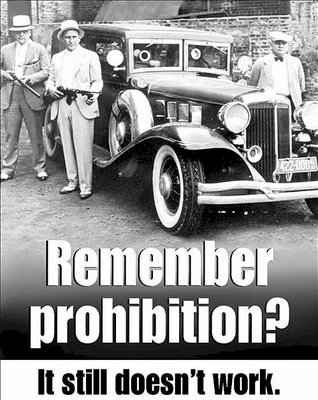
Contrast all that with, say, the sale of paracetamol, a widely-used, easily available pain relief medication.  No matter from which outlet you purchase paracetamol -- a pharmacy, supermarket, dairy or even petrol station -- you can be assured that it has been legitimately manufactured by a reputable company, and duly tried and tested before being released for sale at a price acceptable to the market.

But if we banned it, and overnight tried to limit its supply, you would then have to resort to buying your pain relief (whatever it consists of) from some crook behind a filthy public toilet in your local crappy council park.  Gee, I can’t wait.  And who knows what is in that bottle you'd be so keen to purchase.

Did you ever stop to think that neither kids nor criminals are interested in stealing Viagra or Cialis from their local pharmacy?  These are wildly popular but the kids aren't interested precisely because they are legal, which means there's no money in it for them.

Did you ever stop to think that the government is not there to tell adults what they may voluntarily put into their bodies?

That the great majority of people who use illegal drugs do not abuse them, are not addicted, are harming nobody (are just getting on with their own lives), but are nevertheless considered criminals in the eyes of the law?

That we already, rightly and properly, have laws that prosecute those who harm others or neglect children, whether “under the influence” or not?  And that every single time you call for more regulation, you have just put even more money into the gangs’ pockets?

Yes, I’m talking to you, the well-meaning person who’s actually making matters worse. You cannot save people from themselves (and God knows the state can’t) but you sure as hell can make things worse -- and you have.

Your local pharmacist is a drug-dealer. But he or she is a much nicer person with whom to do business, and you can do it in much nicer surroundings. They are fully qualified, supplying reputable products priced to meet the market. They are hardly likely to hang around school gates in order to supply children. They stand and fall upon their service as per any legitimate business.

Criminals, on the other hand, can never compete with private enterprise for the reasons provided, which means that a drug like P would simply not exist in an open market.  No pharmaceutical company would manufacture it, marketing a safer substitute instead.  But in the market made by prohibition, it's the ideal drug for dealers to push.

Look, I don’t like drugs any more than you do.  I don’t even like taking prescription drugs if I can avoid it. But the truth is that the likes of Al Capone and Pretty Boy Floyd only went out of business in Chicago after Prohibition was thankfully repealed. Their black market profits disappeared at the stroke of a government pen (virtually the only good thing Roosevelt ever did with his pen) and at that stroke the gang violence and the police corruption of alcohol prohibition ended as well.  The only difference between the Chicagoan gangsters and New Zealand’s Black Power?  Capone and his colleagues had better dress sense.  Prohibition of alcohol didn’t work then, and prohibition of drugs doesn’t work now.

One last word, please.  Do not make excuses for the vile individual who attacked Mrs X.  I’m in no mood to listen.  You see, he could have chosen an alternative drug that day, one that wasn’t so destructive.  He could have chosen not to consume anything, not to fry his brain at all. He could have done a lot of things.  But the choices he did make saw him end up brutally violating, perhaps destroying, a sweet lady old enough to be his great-great-grandmother.  For that, I damn the bastard to hell.

* * * More brave and brilliant writing from Libertarian Sus here at Sus's Soundbites * * *

UPDATE 1: Disgraced former media tycoon Conrad Black, convicted last year for his theft of company funds, and now sharing a prison with assorted Florida felons  ("It is a little like going back to boarding school," he says of his stay) has finally woken up to the effects of The War on Drugs - a war he himself once championed.  But in a letter to London's Sunday Times he says the the War has failed:

    "U.S. justice has become a command economy based on the avarice of private prison companies, a gigantic prison service industry and politically influential correctional officers' unions that agitate for an unlimited increase in the number of prosecutions and the length of sentences."
   
Fruitless attempts to wipe out the illegal drug trade are to blame for the situation, says Black, taking up a battle cry long espoused by people he's never traditionally associated with - those on the left of the political spectrum, including groups like the American Civil Liberties Union.
   
"The entire 'war on drugs,' by contrast, is a classic illustration of supply-side economics: a trillion taxpayers' dollars squandered and (one million) small fry imprisoned at a cost of $50 billion a year; as supply of and demand for illegal drugs have increased, prices have fallen and product quality has improved."

Says PM Jaworski at The Shotgun Blog,

it looks to me like Black thinks money spent on the war on drugs is money "squandered." That in spite of blowing through ridiculous sums of money, there is just about nothing to show for it.
 
Conrad Black understands what Milton Friedman said so long ago: "The war on drugs is a failure because it is a socialist enterprise." It always amazes me that there are still so-called conservatives who manage to somehow reconcile opposition to social engineering and big government, with the ultimate social engineering and big government program: the war on drugs ...

UPDATE 2: And let's not fail to mention Milton Friedman's Iron Law of Prohibition,,which explains why outlawing drugs only increases the virulence of recreational drugs: The more intense the law enforcement, the more potent the prohibited substance becomes.  Which means  'P' is precisely the sort of drug you should expect when you start a War on Drugs.

                                  image

Thursday, 29 May 2008

Another front opening on the War on Drug Users?

A chap called Mike Sabin is making the rounds of the country's impressionable parents, politicians and pedagogues, telling them that to fix the country's drug scourge we need to get even more authoritarian on the War on Drug Users than we already are.  The War on Drug Users that Annette King was open enough to admit a few weeks ago that we're losing.

A few days ago Mr Sabin was briefing parliament on the "Drug epidemic" -- a briefing the pollies were lapping up like dying men in a desert --  offering what Russell Brown calls a "miracle cure for all drug problems."  The cure includes:

  • Recognising that cannabis is a "gateway drug" that must be expunged from use;
  • Proposing a Drug Tzar who reports only to the Prime Minister (ie., with no outside  oversight or governance);
  • Compulsory drug testing in schools and workplaces;
  • A system where friends and family dob in users to the police for compulsory rehabilitation
    ... and much, much more..

Apparently the bare bones of the cure (which sounds far worse than the disease) is based on what Sabin says is the successful Montana Meth Project in the States.

If you think this all sounds either too good to be true (or too authoritarian to be taken seriously) then you'd be right, as  Russell Brown's successful fisking of the Montana Meth Project and the rest of Mr Sabin's proposals demonstrates.  This isn't a new front on the War on Drug Users -- it's the same failing War on Drugs in which the real damage is done by the War on Drugs itself.

If Russell doesn't convince you, just give some thought to what a Prime Minister like Helen Clark could do with an open-ended brief to conduct a covert War on selected New Zealanders -- a War conducted without any oversight or governance except by Heather Simpson...  and there you have the bare bones of every War on Drugs ever conducted.

Monday, 20 June 2016

Amy Adams is an idiot


Amy Adams argues that cannabis is a gateway drug for meth. Amy Adams is an idiot. It is not …

What is true however, and what the minister in charge of prohbition needs to realise, urgently, is that prohibition of cannabis is a gateway policy in encouraging production and dristribution of meth – Milton Friedman pointing out many years ago when the War on Drugs was born that prohibiting all drugs encourages drug suppliers to supply and produce the most potent and toxic drugs per kilo. (You know, if you’re going to carry risky illegal substances around as a supplier, then you’re better to carry around less in quantity but the most potent substances for that weight. He calls this an Iron Law of Prohibition.)

It is also true that beer and wine are a gateway to whiskey and rum – although RTDs themselves are probably a gateway to the sort of idiotic childlike comments made by the minister.

It is true that the Dunedin life-study for example finds that heavy use of cannabis in teenagers correlates with mental health problems, but neither this study nor any other shows that heavy use of cannabis causes problems like schizophrenia any more than heavy drinking causes depression – indeed, it is more likely that those who are depressed feel like a drink, and so on.

Moreover, synthetic cannabis, which Adams and her ilk make legal from moment to moment, is arguably among the very worst of the recreational drugs found so easily around towns and cities; and just like the incentive towards more potent drugs, virtually all the many “harms” Adams and other cite as being due to cannabis – encouraging gangs, increasing toxicity, inconcistent products – are due instead entirely to its prohibition (as Portugal for example discovered so benevolently in overturning its prohibition policies and seeing crime and drug abuse both fall.)

Adams herself cites no studies at all in making her claim, relying instead only on her own studied ignorance and the fatuous stupidity of her interviewers.

Examples of studies concluding the gateway theory to be false however include a 2002 study based on recent survey data on nearly 4,000 children and young adults which finds:
        ● No significant impact of soft drug use on the risk of later involvement with crack and heroin.
        ● Very little impact of soft drug use on the risk of later involvement in crime.
    Add to this the
peer-reviewed study published in the Journal of School Health which found that cannabis is not the gateway drug, but instead the most commonly used legalised drug in New Zealand, alcohol, is the precursor to use of much harder drugs like amphetamines.
    ‘While it may not settle the debate over how drug use begins, researchers found that alcohol, not marijuana, is the gateway drug that leads teens down the path of hard drug use, according to a new study that will be published in the August edition of the
Journal of School Health.
   
Researchers looked at data from over 14,500 students from 120 public and private schools in the United States to evaluate whether students had used any of 11 substances, including alcohol, tobacco, marijuana, cocaine, heroin, LSD, amphetamines, tranquilizers and other narcotics. They found that more often than not, alcohol was the first substance students tried before moving on to other drugs.
    
“I am confident in our findings and the clear implications they have for school-based prevention programs. By delaying and/or preventing the use of alcohol, these programs can indirectly reduce the rate of use of other substances,” Barry said in a statement.
   
Alcohol was also the most commonly used substance, according to the study. More than 70 percent of students reported using alcohol at some point during their lifetime, compared to only 45 percent who reported using tobacco and 43 percent who used marijuana.
   
Researchers also found that students who used alcohol were up to 16 times more likely to use illicit drugs.’

norml_remember_prohibition_Not that this represents any case either to prohibit responsible adults enjoying alcohol – all the evils of that most famous prohibition being obvious to all but the most abjectly ignorant.

Meanwhile, Wake Up NZ point out that

Cannabis use in New Zealand registered 14.6% of adults in 2007 compared to methamphetamine use at 2% in 2009. With this in mind, wouldn’t we expect to see a much higher corresponding figure of people using meth if according to Amy Adams, cannabis users progress on to smoking meth?
   
It is widely known that the large majority of people who smoke cannabis do not progress to using dangerous drugs such as amphetamines, just as the large majority of people who drink alcohol also do not then move on to hard illicit drugs. The current National government however won’t let facts get in the way of publicly spreading misinformation to keep the war on drugs consuming more victims in New Zealand.

Amy Adams is an idiot. In continuing to cause harm by continuing prohibition, she is a very harmful idiot – a gateway to all the harms that Richard Nixon’s War on Drugs has caused and will continue to under the ignorance of all the deluded drug warriors who maintain it.

Mind you, at least Dick Nixon’s advisors knew they were lying. I wonder what excuse Adams et al have.

.BxlcMbgIMAAabge

.

Saturday, 28 May 2005

Schapelle Corby is the collateral damage of war

“Went through my bags like McCartney in Japan
I didn't have a thing so I didn't give a damn
You can't trick me
'Cause I've been to Bali too.”
        Redgum

The trial and conviction and the public responses (many representative responses here) to the twenty-year sentence of Schapelle Corby have shone a light on some of the interesting hypocrisies of our modern world.

First off: Innocent or guilty? It seems fantastic that
Corby wouldn't have noticed someone having slipped a pillow-sized 4.1kg bag of electric puha into her slim, light boogie board bag. And if the weight of Corby's bags at either her Brisbane check-in or Sydney transfer did show a 4kg discrepancy with their weight at Denpasar her defence team would be supremely incompetent not to have raised that, wouldn't they?

Since bag and board were there in the courtroom it didn’t matter that they hadn’t been weighed when the drugs were found, they could have been weighed in court. That her defence didn't raise the weight discrepancy suggests there wasn't one. Guilty? Seems likely.

Second: Innocent or guilty of what exactly? Of smuggling some recreational hash? Should that actually be a crime? Who exactly is the victim here? If users weren’t criminalised what exactly would the ‘drug problem’ be – that some people like to get high and others object to that? So what? I like to get drunk and fall over; doesn’t hurt anyone except myself. Robert Downey Jr never had a problem at work, expect that he kept getting arrested for buying drugs.

The real ‘drug problem’ is not that some people take drugs, it is that the busybody Puritanism of The War on Drugs has made drugs criminally expensive, put drug profits and control of drug quality into the hands of criminals and corrupt policemen, and has criminalised people like Shapelle Corby. Read here for example. As H.L Mencken said of such people, "A Puritan is someone who is desperately afraid that, somewhere, someone might be having a good time."

Is that really sufficient motivation to criminalise those guilty of nothing except pleasing themselves?

Third: The twenty-year sentence: There’s been a lot of justified bitching at the length of Schapelle Corby’s sentence for smuggling marijuana. Twenty years in a Bali jail for smuggling marijuana attracts comments from like this from ‘Bart’: “Finally, justice has been served. She got what she deserved. You smuggle drugs, you pay the price, it's that simple.” Bart is an idiot. The scum responsible for killing 202 people in the Bali bombing received a sentence of just thirty months, story here. No Indonesian hypocrisy here. None at all. Indonesian justice appears to be an oxymoron.

Fourth: The ‘It’s their country’ argument: ‘Need to respect the law of the land’ screams a Daily Telegraph headline. “It really doesn't matter what you think is fair or what I think is fair. It's THEIR country and THEIR rules,” says another idiot at a Free Corby Petition site. “Indonesians do get executed for similar crimes (why aren't you crying for them?), so why should the westerners be treated any differently?” continues the idiot.

Bollocks, says me. Frankly, you’re free to criticise anything as an outrage wherever it occurs and no matter the ‘culture,’ and this is an outrage. You can say she’s stupid for smuggling drugs to a country in which the stuff is cheaper than it is back home and for which a death penalty is in operation, but your main criticism should be directed at the laws that criminalise such stupidity.

It’s not an outrage that she’s been found guilty -- she probably is – it’s an outrage that the War on Drugs has found another victim. Australians and New Zealanders who have responded to the injustice they see in the Corby trial should reflect that it is an injustice they and their governments support. It’s time people question that support, and if Corby’s plight helps people do that it might just serve a useful purpose.

The Sydney Morning Herald editorialised today,

...long before the sentence was handed down many concerned Australians had elevated Corby to martyr status. But a martyr to what cause? There are 155 Australians in foreign jails on drugs charges, two facing the death penalty. However, their stories of personal tragedy, stupidity and brazen greed fail to move us, while Corby touches strangers: "If eyes are the windows to the soul, I see a soft kindness shining through," wrote one supporter.

If you are a stranger who was touched by Corby’s plight, then why not be moved to make her a martyr to a worthy cause – not whether or not she is innocent or guilty; not the state of Indonesian justice; but the abject bloody hypocrisy of the War on Drugs that makes martyrs of such as she.

Monday, 26 March 2012

The drug lords are holding a party on the US Government

Every time a politician pledges to go hard on the War on Drugs, the drug lords hold a party.

We’ve said this for years.

And here’s one now to back me up, a Mexican Drug Lord officially thanking American lawmakers for keeping drugs illegal.

Joaquin "El Chapo" Guzman Loera reported head of the Sinaloa cartel in Mexico, ranked 701st on Forbes' yearly report of the wealthiest men alive and worth an estimated $1 billion, today officially thanked United States politicians for making sure that drugs remain illegal. According to one of his closest confidants, he said, "I couldn't have gotten so stinking rich without George Bush, George Bush Jr., Ronald Reagan, even El Presidente Obama, none of them have the cajones to stand up to all the big money that wants to keep this stuff illegal. From the bottom of my heart, I want to say, Gracias amigos, I owe my whole empire to you…
As an epidemic of murderous violence rages on the Mexican-US border, and the American government wastes boatloads of badly needed money on the illegal drug business which results from the Prohibition laws, El Chapo is laughing all the way to the bank. "Whoever came up with this whole War on Drugs," one of his lieutenants reports he said, "I would like to kiss him on the lips and shake his hand and buy him dinner with caviar and champagne. The War on Drugs is the greatest thing that ever happened to me, and the day they decide to end that war, will be a sad one for me and all of my closest friends.

You think our local gang leaders don’t feel the same way? Fortunately, Mexican president Calderon does not. He knows what prohibition has done to Mexico. He just can’t get any politician in the States to give a shit.

According to sources in the Mexican government, President Calderon is begging American officials to, in the words of reggae great Peter Tosh, legalize it. "Oh yeah," said an official close to the Mexican president, "Felipe is going crazy. He's screaming at everybody who comes in, 'Why don't they make this sh*t legal already! You're killing me here!' Look, everyone knows, when you have Prohibition, you create gangsters. And the more you prohibit, the more gangsters you make. El Chapo is hero now to all those slumdogs who want to be millionaires. Kids in the street, when they play games, they all want to be El Chapo, the baddest man in the whole damn town."
Meanwhile, many speculate that rich and prominent Mexican families are in cahoots with American businessmen in the alcohol industry, wealthy industrialists who launder the unprecedented profits from the drug business with their legitimate enterprises, and lawmakers who get gigantic kickbacks and payoffs to make sure that these drugs remain illegal, so they can remain rich, fat and happy. According to sources on both sides of the border, tens of millions of dollars in payoffs and kickbacks are stashed in Swiss banks every year, blood money from the brutal business made possible by a corrupt system supported by laws that don't, and have never, worked.

You think that has ever bothered politicians?

image

Wednesday, 2 March 2016

Don’t like gangs? Then legalise cannabis.


Ever the populist, Police Minister Judith Collins has announced what she calls “a multi pronged attack on gangs” and a plan to “tackle drugs, illegal gains and firearms.”

But you can’t talk sensibly about a War on Gangs without also talking about the government’s War on Drugs. Not properly. As the prohibition of alcohol proved so conclusively in America—coinciding as that sorry period did with the birth of big criminal gangs there – where you have prohibition, you have a ready income stream for criminal organisations. (It was prohibition, if you like, that caused the Greatness of Gatsby.)

You might have thought then that ripping away their secure income stream would have been the obvious “prong” with which a police minister might begin attacking gangs. Even the most obvious.

Challenged on this point on Morning Report this morning however, Collins airily dismissed the notion. Accepting that gangs’ "primary income is from selling drugs," she was Asked by Espiner what would happen to gangs’ finances if marijuana were legalised, Collins rather bizarelly insisted that they would then get into legalised prostitution and harder drugs like methamphetamine.

But this is nonsensical. A Justice Ministry study that Collins could easily have read in her previous post found that during the in-depth interviews of 656 sex workers “there was no mention of gang involvement or coercion.” Overseeing the research, the Ministry’s Prostitution Law Reform Committee considered “that the links between crime and prostitution are tenuous. The Committee could not find any evidence of a specific link between crime and prostitution.”

The notion is as bizarre as her claim that legalising marijuana, for example, would see an explosion of methamphetamine being sold on the street. As thousands of current and former members of law enforcement who support drug regulation rather than prohibition argue—including Scotland Yard’s former head of drug policing—prohibition doesn’t mean people stop consuming drugs, they just change the drugs they're consuming.

Here, Collins could benefit from getting to grips with what Milton Friedman called The Iron Law of Prohibition: which says that the more you actively prohibit drugs, then it is the more virulent drugs you actively encourage. 

    Friedman proved, for example, that prohibition changes the way people use drugs, making many people use stronger, more dangerous variants than they would in a legal market.
    During alcohol prohibition, moonshine eclipsed beer; during drug prohibition, crack is eclipsing coke. He called his rule explaining this curious historical fact “the Iron Law of Prohibition”: the harder the police crack down on a substance, the more concentrated the substance will become.
    Why? If you run a bootleg bar in Prohibition-era Chicago and you are going to make a gallon of alcoholic drink, you could make a gallon of beer, which one person can drink and constitutes one sale – or you can make a gallon of pucheen, which is so strong it takes thirty people to drink it and constitutes thirty sales. Prohibition encourages you produce and provide the stronger, more harmful drink.
    If you are a drug dealer in Hackney, you can use the kilo of cocaine you own to sell to casual coke users who will snort it and come back a month later – or you can microwave it into crack, which is far more addictive, and you will have your customer coming back for more in a few hours. Prohibition encourages you to produce and provide the more harmful drug.
    For Friedman, the solution was stark: take drugs back from criminals and hand them to doctors, pharmacists, and off-licenses. Legalise. Chronic drug use will be a problem whatever we do, but adding a vast layer of criminality, making the drugs more toxic, and squandering £20bn on enforcing prohibition that could be spent on prescription and rehab, only exacerbates the problem [and helps raise the profits for gangs].

Collins talks about offering “a path out of gangs.” If she’s serious, then most obvious is to make them unprofitable.

After all, it’s working exactly that way in Mexico, where legalising American weed has been off killing drug cartels.

In fact, as both Ethan Nadelmann of the N.Y.C.-based Drug Policy Alliance and Richard Branson, the chairman of Virgin Group point out: drug legalisation is pretty much the worst thing that could happen to organized crime.*

Are you listening, Judith?


RELATED POSTS:

*   Note that they say legalisation, not merely decriminalisation. Decriminalisation can mean that it’s legal to enjoy drugs but still illegal to sell them. Portugal, for example decriminalised every imaginable drug, from marijuana, to cocaine, to heroin in 2001, to discover that to discover that drug use went down rather than up, that the drugs being consumed were far safer than they were before, and most importantly Portugal now enjoys the second-lowest death rate from recreational drugs in all of Europe (after experiencing one of the worst rates with prohibition)
But because the selling of those drugs in Portugal is stil illegal, it is still largely in the hands of gangs – who are certainly being nicer than they were, but are still at heart just gangsters. “Decriminalisation’s flaw,” notes the Economist, “is that it does nothing to undermine the criminal monopoly on the multi-billion-dollar drugs industry. The decriminalised cocaine consumed without criminal consequences in Portugal is still supplied by the gangs who cut off heads in Colombia. Washington, DC’s version of legalisation is similarly flawed: although possession has been legalised, Congress has prevented the city from legalising the buying and selling of the drug. The capital’s pot business will therefore remain a criminal monopoly. The new law is good news for the people who harmlessly get high. But unless it is followed up eventually by legalisation of the supply-side of the business, it is [still] good news for the crooks who sell it.”


Capture1
Capture