There have been more modern fairy tales peddled about Sweden than even Hans Christian Andersen could dream up – and I don’t just mean whatever the American president thought he was talking about the other night.
The far-off place has become a convenient political talisman for the misinformed of both sides of the statist coin: both left and alt-right. The former insist that Sweden is that exception, a welfare state that doesn’t eat itself. The latter tell stories about “no-go zones” and “rapefugees.” Neither has much basis in fact.
The first myth is intended to tell the story that welfare-state socialism works better than markets. But, as Johan Norberg thoroughly and repeatedly demonstrates, Sweden's history in fact points to the opposite conclusion: that it was laissez-faire that delivered the riches, on which the looters are now feeding.
The second myth is supposed to tell us that immigrants and refugees are bad news, and Sweden’s crime statistics are supposed to show that. Politicians, commentators and internet trolls of the alt-right variety tell stories of crime exploding under a refugees engulf the country’s towns and cities, citing alleged crime statistics from fake think tanks showing, they say, that Sweden’s once-lovely places are now so teeming with these nasty people that rape has rocketed and violent crime has exploded.
Trouble is, that’s that not what actual Swedish criminologists citing actual Swedish crime statistics actually tell us. Is “the country's welcoming approach to refugees and its alleged effects on crime rates a warning sign”?
“Absolutely not,” said Felipe Estrada, a criminology professor at Stockholm University. His response was echoed Monday by multiple other experts who are familiar with Swedish crime statistics.
Overall, Sweden's average crime rate has fallen in recent years, Estrada said. That drop has been observed for cases of lethal violence and for assaults, two of the most serious categories of crime.
Moreover, an analysis by Swedish newspaper Dagens Nyheter, conducted between October 2015 and January 2016, came to the conclusion that refugees were responsible for only 1 percent of all incidents.

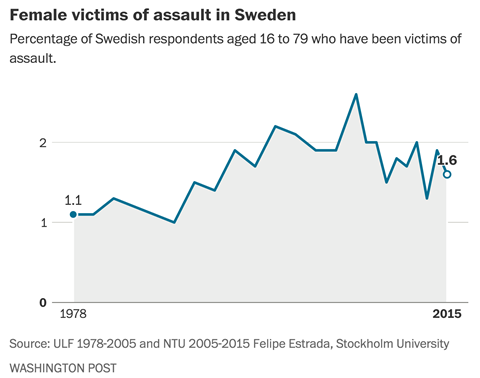
Clear enough.
Support also comes from “Germany, the other European country that took in similar numbers of refugees per capita in 2015.” Here also claims that the influx led to an increase in crime are unsupported by actual evidence.
“Immigrants are not more criminal than Germans,” an interior ministry spokesman said in June. Overall, crime levels in Germany declined over the first quarter of 2016, officials said last year.
So why, apart from the obvious reasons that rabid anti-immigration types might dream up rabid claims, does the myth persist? Say criminologists:
Reports about alleged police coverups of refugee crimes might have contributed to distrust in official statistics. Criminologists also say that a handful of cases have received disproportionate public attention, creating a distorted perception among Swedes.
“What we’re hearing is a very, very extreme exaggeration based on a few isolated events,” Jerzy Sarnecki, a criminologist at Stockholm University, told the ‘Globe and Mail’ newspaper in May, when coverage of refugee-related crimes reached a peak.
Read that line again: “Very extreme exaggeration based on a few isolated events.” Just part of the logical fallacy subsumed under the principle understood by the phrase “a picture is not an argument.”
There is however “one statistic in which Sweden does indeed lead international crime statistics, though: reported cases of rape.” So does this support the alt-right myth, then? No, say criminologists, only if you don’t understand (or don’t care to understand) how the statistics are gathered.
“The [definitions] of rape differ between countries,” Estrada said. “In Sweden, several changes in legislation have been made to include more cases of sexual crimes as rape cases.” Sweden's definition of what constitutes rape is now one of the world's most expansive. Varying figures, as well as other Swedish measures to facilitate rape complaints, might have affected statistics, as well.
This has been pointed out several times in the comments to my regular alt-rights trolls, so I have no expectation of any increase in understanding this time. But just understand when you do hear the claim that this would be just another form of the fake news the alt-right keyboard warriors claim to revile.
So what about these alleged no-go zones like Malmo? What about that then? Sorry, say criminologists, that too is another fairy tale.
Swedish crime experts also do not agree that immigrants have created so-called no-go areas in Sweden — areas that allegedly are too dangerous for native Swedes to enter and are effectively run by criminals. “This perception is fabricated,” Estrada said. But he and others pointed out that the refugee influx poses challenges to Sweden, just not in the way it is being portrayed by some.
“Even [though] there are no 'no-go zones' as alleged in the propaganda, there are problems around crimes and disturbances in several suburbs of Swedish cities, where immigrant groups tend to be over-represented,” said Henrik Selin, director of intercultural dialogue at the Swedish Institute.
Just as you’d expect. We’re not talking utopias here, we’re talking about real places with real human problems – problems made harder, not better, by gross exaggeration.
Fascinatingly, an Alt-right editor has challenges journalists to visit Sweden to discover for themselves the facts he alleges about the place. Paul Joseph Watson (he’s the alt-right Brit conspiracy theorist who isn’t an apologist for paedophilia) has offered to personally stump up the fare for them to Malmo– an offer already taken up by one enthusiastic punter, and responded to by Malmo’s deputy mayor, who promises any and all visiting journalists a warm welcome and to go with them on any jaunts to the zones to which Mr Watson alleges they can’t go.

Sure, all is not well in Malmo, but neither is it the war zone alleged by the fetid fringe. “Seeing Scandinavia’s largest country, with its reputation for high living standards, good governance, and low crime, thrust into a sort of police line-up of multicultural Europe’s failures felt,” says Irishman Feargus O’Sullivan who’s already visited and researched the place for himself, “a bit like seeing your neighbour’s lovable pet guinea pig being ducked as a witch.”
Is there any truth in the accusations? The short answer is no. Malmö is actually a likable, easy-going kind of place. Facing Denmark and Copenhagen across the Oresund Strait (a distance spanned by a bridge since 2000), it’s a historic, faintly gruff port city of 342,000 residents—think Liverpool to Copenhagen’s Paris. Or to make an American comparison, an Oakland to the Danish capital’s San Francisco. By Scandinavian standards, it’s ethnically diverse, bustling, and ever so slightly unkempt. By the standards of just about anywhere lying southwards, however, its streets come across as trim, orderly, and, peaceful.
Certainly, Malmö is a city whose urban (but not greater metropolitan) population has been substantially reshaped by immigration. A third of its population was born outside Sweden, with the largest groups coming from (in order) Iraq, Serbia, Denmark, and Poland. Rates of arrival have gone up in recent years. What hasn’t risen, however, is crime.
In fact, Malmö’s violent crime figures would make the mayor of an average American big city weep with longing. With 12 murders in 2015 among a population of 342,000, Malmö’s murder rate is two thirds that of Western Europe’s real murder capital of Glasgow, and half that of Los Angeles. By contrast, Washington, D.C., has a murder rate almost seven times higher, while the rate in St. Louis, Missouri is just under 17 times higher. In relatively safe Sweden, those 12 murders are still cause for rightful alarm, but as this piece makes clear, Malmö’s crime figures aren’t just low compared to most American cities—they’re not even the highest in Sweden.
Read that sentence again, please: “Malmö’s crime figures aren’t just low compared to most American cities—they’re not even the highest in Sweden.”
So all is not utopic in the Scandinavian paradise, and journalists and the commentariat will continue to use its occasional incidents to cherrypick, but if this really is the best place anti-immigrationists can dredge up to support their argument, then they ain’t got one. And as far as intelligent debate about immigration goes, let’s (please) look at actual evidence, not the manufactured stuff of Machiavellian commentators and think tanks.
“Sweden definitely, like other countries, [faces] challenges when it comes to integration of immigrants into Swedish society, with lower levels of employment, tendencies of exclusion and also crime-related problems,” [Henrik Selin at the Swedish Institute concluded]. There is little evidence, however, that Sweden has turned into the lawless country it is at times being described as abroad.
[Quotes and pics from Washington Post, BBC News and City Lab]
.