Despite the headline talk of cuts, Obama’s budget plan is to use the miracle of big numbers to do nothing at all (much like British Prime Minister Cameron). This short video explains the ruse:
[Hat tip to an anonymous commenter]
Despite the headline talk of cuts, Obama’s budget plan is to use the miracle of big numbers to do nothing at all (much like British Prime Minister Cameron). This short video explains the ruse:
[Hat tip to an anonymous commenter]
There will be no attractive outcome from the incipient revolution in Cairo’s streets. On one side, fighting for survival, a nationalistic sense of “nationhood” going back several millennia that has been represented in recent decades by the brutal military dictatorships of Nasser, Sadat and Mubarak; on the other, fighting for its biggest conquest since the Iranian Revolution, a brand of toxic, militant Islam from which sprang the ideology of hate that powers Al Qaeda and related Islamic murderers.
Whoever wins in the street battles, the results will not be pretty.
All that can be said in favour of the dictators is that they were and are opposed to the militant mystics—helping make Egypt one of the more secular, “westernized” Islamic nations in the Middle East. But the price at which this was bought was a militant dictatorship maintaining control by political oppression—an environment of overarching brutality in which the odious mystic hate-mongers flourished underground. Like a bacillus.
That bacillus is now out of the cellars and into the streets, and whichever particular individual takes over after the violence subsides (and note that the leading opposition candidate Mohammed ElBaradei is backed by the same Muslim Brotherhood from which Al Qaeda mentor Sayyid Qutb emerged) the eventual victor will assuredly be the bacillus.
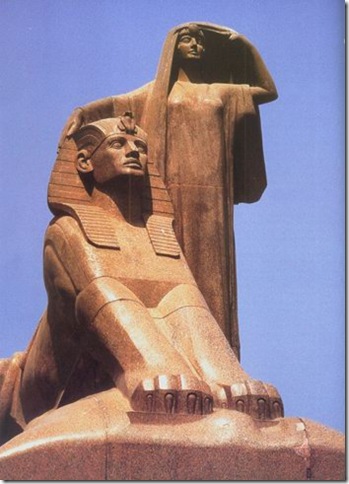 It was always inevitable. If Egypt ever had a renaissance, it was only in 1919 to 1928 in the wake of World War I when Egypt's rising tide of nationalism re-emerged in the modern form of secular socialism, building a “modern Egypt” in the likeness of a worker’s Soviet and such lifeless monuments to its dead past as this one shown here by Mahmoud Mokhtar. Egypt’s sense of nationhood certainly goes back centuries, (as historian Scott Powell explains “an implicit premise embedded in Egyptian thinking that extends back to its “glorious” pharaonic past, of which the ever present pyramids and temples [and mortuaries and funerary palaces] provide a constant reminder”), but without the philosophical base responsible for these past glories, its modern “renaissance” could never rekindle the full power of its past (as Mokhtar’s soulless sculpture adumbrates). The strident militant nationalism of Nasser/Sadat/Mubarak could never be a real substitute for the full-on pharaonic metaphysics.
Hence, since the death of Nasser, Egyptian nationalism's most vigorous standard bearer, Egypt's nationalism has withered in the face of the more explicit and integrated metaphysics and values of Islam, both of which are widely accepted by the Egyptian population. As I blogged a couple of years ago,
the values of these two ideological forces have been in open warfare ever since the formation of the Muslim Brotherhood in 1928 -- the suppression of the Brotherhood and the murder of Nasser's successor Anwar Sadat by Muslim Brotherhood killers being two ready symbols of the conflict played out between the secular but disintegrating nationalism and the vigorous, violent and persistent Islamism that the brotherhood embodies.
This can be a conflict with only one victor. Scott Powell argues at his 'Powell History Recommends' blog that because nationalism is merely a set of disintegrated implicit notions whereas Islamism is an "all-encompassing and explicit system of ideas," it is therefore "only a matter of time before it takes over."
Only a matter of time . . .
An Egyptian Islamist theocracy? Don’t bet against it.
Why does this matter to us?
Let us profoundly hope not.
Here’s The Cure:
UPDATE: Egypt and the world face a crossroads, says Liberty Scott.
For if it were to happen, do not be deluded that it will cost in lives, and could create a new age of conflict that makes Iraq and Afghanistan seem like they were easy. . .
For if it is a bad dream for Egyptians to be suppressed by the Mubarak regime, it would be one of our worst nightmares to have an Ayatollah of Cairo.
Not that Obama would know. Looks like while Cairo burns, Obama parties.
Our thought for this Sunday morning comes from the Pre-Socratic philosopher Xenophanes of Colophon (570-475BC), who first voiced this insight piece of post-prandial wisdom:
Among men he is to be praised who after drinking produces noble thoughts . . . “
John Boy's announcement today of his intentions for partial privatisation of so-called state “assets” is the weak-kneed response of a lily-livered government to the realisation that has taken three years to dawn on them that theirs is a government unable to pay its way—and that somehow, somewhere, there must be a way to get more without giving anything away what they’ve found under the mattress.
Partial privatisation of entities in which the government should never have been involved is the worst of all worlds. It’s like sex without the friction.
This is a government out of control. A government deeply in debt, yet committed to spending more than one billion more every new year. The state over which they preside is already
The assets already controlled by government have a book value around six times the value of all the shares on the local stock exchange. Instead of turning this around, this new policy asks for that shrinking private sector to instead further prop up the inexorably expanding state—with taxpayers in their position as willing investors paying again for “assets” originally paid for by the with money extracted from them in their position as unwilling tax-victims.
It is the illusion of real business activity that only a government could promote.
It is an alliance of dollar and gun for the benefit of everyone and no-one.
It retains government involvement in what are supposedly commercial organisations—leaving the referee in the position of writing rules for itself, and investors in the position of signing up to share in the rent-seeking have government favours (ands monopolies) may bestow up on them.
But at the same time, it pits commercial incentives against political incentives—the latter of which are always certain to triumph over the former, leaving any potential profits severely diminished by the conflict, and few of the new investors able to fully exercise their entrepreneurial acumen with their new assets.
Which means that any of New Zealand’s diminishing stock of investment capital that does find its way into the various entities of mixed ownership will produce far less value from that investment capital than it would if invested instead in purely private profit-making enterprises—leaving the already denuded pool of local investment capital all the poorer for the association.
And it leaves the co-owners in the position of being unable to establish the true value of the state enterprises divested so partially—which in the case some of them (KiwiRail being a glaring example) is a price that without continued taxpayer “investment” is virtually zero. Which means that any investors in these lemons will be in the position of constantly lobbying for more favours from their government partner, and more dollars from the long-suffering taxpayer—seeking as they do to privatise their profits and socialise their losses.
Which takes us back the first objections above. This is an alliance between dollar and gun in which consumers (in their position as purchasers from these aggrandised monopolies) and taxpayers (in their position as ripe sucks) will assuredly be the losers.
The mild-mannered Roger Kerr deals with many of the myths concerning past privatisations, and has more on the problems attendant on partial privatisation:
We have seen partially privatised companies remain political playthings, a prime example being the former Auckland Regional Council’s nationalisation of Ports of Auckland. Earlier experience with the partial privatisation of the Bank of New Zealand was also unhappy.
[The authors of a recent trial balloon for the policy that ran in the Herald] note that the New Zealand sharemarket would benefit from partial listings, as did the Capital Market Development Taskforce. But, other things equal, it would obviously benefit more from full privatisation. Moreover, partial privatisation of the small entities they give as examples – Quotable Value, Learning Media and Asure New Zealand – would hardly be worth the candle. Game-changing policy must involve major SOEs such as those in the electricity sector. [But note that these are essentially coercive monopolies enjoying the use of a restricted market to extract usurious rates from consumers.]
The article cites Air New Zealand as a model of partial privatisation but unaccountably fails to note that the company’s share price performance since the government resumed majority ownership has been poor.
They also commend the Singaporean Temasek holding company model. This is also dubious. The performance of the underlying businesses is not sharply reflected in such a model.
The authors mention the possibility of restricting privatised company shares to New Zealand nationals, and rightly note that this would depress the share price. The arguments for such restrictions could only be political. The idea that foreign ownership is a cost of privatisation is misplaced. The level of foreign ownership in the economy is determined by the cumulative current account deficit or surplus in the balance of payments, not by which assets are for sale. If foreign ownership of some assets is blocked, foreign stakes in other assets will be higher. If this is an issue, a better approach would arguably be to simply give SOE shares to their true owners, New Zealand taxpayers.
The value of partial privatisation should not be over-stated . . .
… and there is no serious argument against full privatisation. By which I mean privatisation that returns whatever assets still exist to those who’ve already paid for them.
All that is lacking from National’s limp-dicks is a spine.
Libertarianz leader Dr Richard McGrath ransacks the newspapers for stories and headlines affecting our freedom.
This week: Goff proposes robbing the rich to bribe the poor
“Mr Goff said 'rebalancing' the tax system would ensure
everybody paid their fair share.”
- New Zealand Herald
“I would like to electrocute everyone who uses the word ‘fair’
in connection with income tax policies.”
- William F. Buckley, Jr.
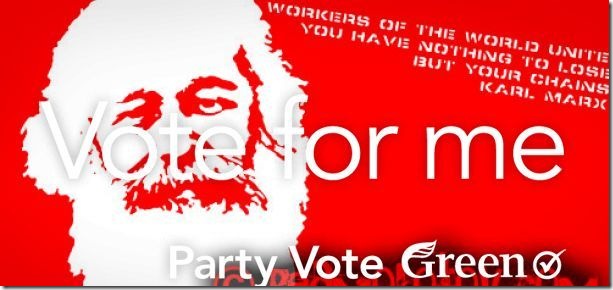
 I’m afraid I have some sad news to impart. The Greens's Keith Locke is retiring. Sorry to have to break it to you.
Keith has a wasted life to look back on. A life spent backing some of the world’s nastiest horses. His departure will however help to Greenwash a Green Party struggling to keep the veneer on.
I'll probably be remembered as the MP who most strongly resisted legislation inspired by the 'war on terror' which has eroded our civil liberties,”
says a Keith hoping to get in early and write his own history.
Good try, but that’s frankly wishful thinking. Because he will be deservedly remembered instead as the MP who went to bat for Pol Pot’s Khmer Rouge regime, about whose takeover Keith wrote a lead article for his April 1975 'Socialist Action rag with the banner heading: "Cambodia Liberated: Victory For Humanity"
Keith’s "liberators," of course, went on to kill most of the population and enslave the rest. A “victory for humanity” bought at the price of the death by government of 2,035,000 souls.
This was a regime about which there is nothing good to say, and nothing at all to cheer. A Cambodian friend told me that towards the end of the Pol Pot regime, when they began running out of bullets, Khmer Rouge troops were killing people with bamboo stakes instead. Such was the regime that 'liberated' Cambodia. [RJ Rummel has a 'Docudrama' from that fateful liberation to help give you some more context.]
Copies of that fateful April 1975 edition of Socialist Action in which Keith expressed his devotion to what would become one of the modern world’s most murderous regimes now change hands at enormous prices, as well they should. You can however find a copy in the Parliamentary Library now that is has been tabled in the House by Michael Cullen. [For the record, see Frog Blog's answer to the charge here. ]
But this love of “liberators” along similar lines is not out of character. As Trevor Loudon records,
In 1980 Keith Locke was a member of Socialist Action League National Committee. On February 23rd that year (Socialist Action March 14th) Keith Locke gave a talk in Wellington "Why workers should support Soviet Action in Afghanistan."
At the time, of course, all non-Maoist communists like Keith were required to slavishly follow the Soviet line. Keith, of course, now claims that he is older and wiser. Not so, however, as another revealing incident from 2001 demonstrates. Soon after the act of war that was September 11, Keith Locke spoke at a meeting in Rotorua on a platform with Annette Sykes, at a meeting called to protest the war against the Taleban. As Keith sat there smiling and nodding his head in agreement, Sykes told the audience (as transcribed by a member of that audience):
Keith neither challenged nor questioned Sykes’s rant; instead he sat there and smiled and nodded and then led the applause when she finished. Nice chap. Good company he keeps. [I raised this matter on the Greens’s Frog Blog a few years back, at which time some discussion ensued.]
And the love of violence has not ceased. In 2007 he could be found supporting the activities of the Urewera 16, something even Martin Bradbury found too far beyond the pale to countenance. And as recently as 2008 Keith was writing for a publication glorifying Palestinian suicide bombers.
So if anyone is going to write Keith’s history as in his words, “a human rights watchdog and peace advocate,” they might care to remember these incidents. They might also like to refer to Trevor Loudon ‘s four-part series on the “peace advocate,” Keith Locke-A Wasted Life, Part1,Part2, Part 3, and Part 4 (Final for Now). Loudon concluded this 2005 four-parter with the observation that,
Too true. I trust the many eulogies that will now be written about the man will not fail to highlight this all-too salient point.
Here’s another billboard for Keith:

Good to see Labour leader Phil Goof adopting Libertarianz’ taxation policy by announcing he would like to make the first $5000 of everyone’s income tax-free “eventually.”
Sure, it’s not as good as the Libz policy itself, which is to axe the GST tax while making the first $10,000 of income wholly tax-free (raising this limit rapidly to $50,000). It’s nowhere near as good as that, but it’s a start.
And it’s not even as good as the calculations backing the Libz policy, since as Idiot/Savant points out, there’s a HUGE hole in Phil’s figures. A $1.2 billion hole, in fact—a shortfall that will require more than magic and political spin to make up.
Might I recommend then that instead of just dipping his toe in the Libz policy water, that Phil fleece the full Libz policy as a whole and Put the State Sector Through the Woodchipper, thereby saving tax victims from the enormous tax burden the sector imposes on every one of us.
It would at least serve to distinguish his party from the do-nothing dildoes presently in power.
Despite New Zealand’s parlous economic conditions, New Zealand housing is no more affordable now than it was before the economic wheels started falling off. In fact, according to the latest annual Demographia International Housing Affordability Survey housing in New Zealand is still severely unaffordable.
Author Joel Kotkin notes that even after the bursting of the housing bubble, the ratio of incomes to housing prices in most cities (what the researchers call “the median multiple”) has shown a steady increase.
The survey gave New Zealand a median multiple of 5.3 for housing affordability, which is above the historic norm of three.
All major [cities] in Australia and New Zealand, as well as Hong Kong, were judged to be severely unaffordable. Of the 325 [cities] the survey covered, 115 were affordable, 94 were moderately unaffordable, 42 were seriously unaffordable and 74 were severely unaffordable.
All of the affordable [cities] are in the United States. The most affordable is Atlanta, with a median house price of $US129,400 ($NZ170,485). Hong Kong was the least affordable major [city], with a median multiple of 11.4, Sydney second with a median multiple of 9.6 and Vancouver was 9.5.
New Zealand's housing was [rated as] affordable in the early 1990s, with a median multiple of under three, the survey said.
Auckland now has a median multiple of 6.4, with Christchurch on six and Wellington on 5.5, which is regarded as severely unaffordable. Tauranga-Western Bay of Plenty was again the least affordable market [in the country], with a median multiple of 6.5.
The reason some cities’ houses remain severely unaffordable while others do not (median house price of just $US129,400 in Atlanta!) remain the same, and may be described very simply: cities in which town planners have been given powers to seriously restrict house-building are generally the least affordable; those in which they have the least power are generally the most affordable.
In other words, the more “sustainable” a city is and the more power its “planners” have, the less affordable its housing.
Now you might have thought that Prime Minister John Boy might have been working since his election to turn around the dire situation in which even hard-working New Zealanders are finding it increasingly difficult to buy a house. But you’d be wrong. Instead, Smile and Wave’s local government minister Rodney Hide just spent the last two years working night and day not to remove power from the smug self-anointed vermin who have made life worse for would-be home-owners, but instead (as a model for councils across the country) to give Auckland’s town planners even more power to make the city even more severely unaffordable.
What a creep. What a disgrace. What a tragedy.
NB: You can download the detailed survey and related commentary at the Demographia website, from whence graphs and tables like these two below are sourced.
RELATED POSTS:
The headline comes from the Boston Globe, commenting on the return of thug, murderer and thief ‘Baby Doc’ Duvalier to the country in which he was formerly (he had hoped) dictator-for-life, and which he and his father did much to make the poorest and most dangerous in the western hemisphere.
During Jean-Claude “Baby Doc’’ Duvalier’s reign as dictator in Haiti from 1971 to 1986, Haitians were kidnapped, tortured, and murdered by his security forces. Now that he is back in Haiti after a 25-year exile in France he must not be allowed to escape justice either for the crimes against humanity or for his flagrant theft of enormous sums of money.
I look forward to being able to blog his obituary.
Here’s itinerant NZ muso Luke Hurley with a topical track from his 1994 album Reha:
UPDATE: “Who in Haiti and Malaysia can aim and fire?” asks Liberty Scott, who reckons the opportunity should not be let slip to rid the world of two extraordinary criminals “that hide behind ‘state sovereignty’ to protect their blood-dripping hands.”
This “Summer Seconds” series gives you a second chance to read classic posts from the NOT PC archives. This time, part of a piece written back in January 2007 when John Key visited the Ratana marae for the first time, setting the tone for his premiership to come.
Are we somehow all special? How can that be?
I ask because John Boy Key was saying at Ratana marae yesterday both that Maori are "special," and at the same time that Don Brash's "message" that everyone should be equal before the law "won't be changing." Which means either we're all special (a logical impossibility), or else he's just talking nonsense and he thinks we won’t notice, or care.
In a relaxed speech that began with a short introduction in te reo, Mr Key reiterated his view that the National Party believes Maori have a special place as the Tangata Whenua.
He says the National Party wants to engage in dialog with Maori and develop a relationship that will stand the test of time...
A speech by National's previous leader, Don Brash, on race relations led to some strain between National and Maori, and Mr Key concedes there may be bridges to mend. But he says fundamentally his message won't be changing from Dr Brash's - but the tone may be different.
Those two statements -- that Maori should be regarded as "special"; and at the same time that everyone should be regarded as equal before the law regardless of colour -- are so different that either he thinks we're all stupid, or else he thinks the meaning of words is less important than the "tone" in which those words are said, or the 'emotional vibrations' with which the words are delivered.
Either way, he's disgusting.
The most sensible thing said yesterday at Ratana seems to have been said by Tariana Turia. "Maori don't need patronising politicians," Turia is reported to have said.
Maori aren't the only ones.
PS: Lindsay Mitchell puts it bluntly: "When government accords one group special status they are by necessity taking from another. There can be no privilege without some corresponding disadvantage. If one individual or group is "special" then others are not." Couldn't say it better myself.
Here’s Paul Kelly:
This “Summer Seconds” series gives you a second chance to read classic posts from the NOT PC archives. This time, part of a piece written back in October 2008, before the last election, when I was among those warning that all the remedies bandied about by all the alleged economists would not generate recovery, would delay whatever turnaround might have happened, and would instead be the cause of other, further, crises—just as those remedies did when the likes of Hoover and Roosevelt used them to extend the 1929 correction for another fifteen years.
When markets need to correct, when real savings are being consumed on malinvestments that urgently need to to closed off, then here's seven things you can do to make sure that the necessary correction will not happen [with the more rational reaction shown in square brackets]:
As Murray Rothbard points out in America's Great Depression (from which I draw the above seven points) when you list logically the various ways that government could hamper market adjustments and hobble the adjustment process, you find that you have precisely listed the favourite "anti-depression" arsenal of government policy.
[ I said in 2008 that all these variants of stimulunacy would be used, and would fail—just as they were and did in the First Great Depression. Sadly, I was right. ]
This “Summer Seconds” series gives you a second chance to read classic posts from the NOT PC archives. This time, a piece written three years ago suggesting that instead of extending economics into other fields, economist should instead begin repairing their own manifest professional failures.
Many folk have been talking excitedly about 'pop econ' books like Steven Leavitt's Freakonomics, Steven Landsburg’s Armchair Economist and Tim Harford's Undercover Economist, popular works works purporting to extract economic reasoning from the realms of arid economic analysis and apply it to everyday behaviour—offering dubious statistical insights everything from the use of toilet paper to the alleged impact of abortion on inner city crime.
Great fun. But there is a problem. For all the pleasure to be had in reading these light pieces of pseudo-scholarship (and the huge sales of these books show much fun is being derived from their reading), they appear at a time when the world’s economies are approaching ruin, and the ignorance of mainstream economists to explain their own field has never been more clearly demonstrated. I can’t help wondering then whether it wouldn't be better if instead of applying economic reasoning to other people's fields, these economists first began sorting out their own?
Sorting out the stale hand-me-down drek that is taught so unquestioningly in university economics departments and that passes so universally as mainstream economic reasoning has never been more urgent. A collapse of the world economies that surprised virtually every mainstream economic commentator make that only too clear. Instead they are revelling in what their alleged economics has to say about your nail clippings, or of the 'hidden' effect of what your mother calls you when you're born -- in other words, things of almost total irrelevance -- while being blithely unaware as the meddling of the world's great central bankers brought about the world's great credit crunch.
When most economists miss such an obvious blunder, when they struggle to understand the very basics of their own profession -- including where money comes from and what causes recessions and inflation and even how to properly define them -- it's clear that instead of offering others advice, the economists should begin mucking out their own stables.
Until that's done, (if I may mix a metaphor) perhaps they'd better stick to their own knitting instead of giving more dubious advice to others.
|
|
|
This “Summer Seconds” series gives you a second chance to read classic posts from the NOT PC archives. This time, a piece from just a few months ago looking at the issue that might now get Hone expelled from his own party for writing this column.
As usurpation is the exercise of power, which another hath a right to; so tyranny is
the exercise of power beyond right, which no body can have a right to.”
- John Locke
 The Foreshore & Seabed deal is complicated enough already without Hone Harawira muddying its far from pellucid waters. But bear in mind that when Hone complains the government has “pandered to rednecks” and he calls the agreement “bullshit” [audio] he’s just playing politics with you. He just wants mainstream New Zealanders* to think his tribalists have been shafted so they won’t look too deeply into what’s just been given away.
Hone is obviously upset that the government has (quite properly) refused to make a gift to iwi of that which they were previously required to go to court to prove. From Lew at KiwiPolitico (who, it seems, agrees with Hone):
“The two things are guaranteed public access and inalienability [clarifies Lew]; the one thing is Māori title.”
I disagree. I’d say the government got one thing right and several things wrong. But I’d go further. In opening the door for iwi to make a form of common law claim to property in specific tracts of foreshore or seabed, on that at least the government has done well. To put it in the famous terms of John Locke, this would be using power to recognise right. So too would have been recognising the right to alienate (sell) that to which title had been so proved. On that, the government has done poorly. That too would have been using power to protect right.
What Hone wants “mainstream” New Zealand to overlook however is what has been given beyond right, which nobody can have a right to—no matter what their heritage or skin colour.
The devil seems to lie in that details that have been changed to allow this deal to happen between the government’s offer last month and what was announced yesterday. There appear to be two new things handed over:
And so much for one law for all.
So the scorecard to me on yesterday’s agreement looks like one step forward, and three back. And in every direction, these are big steps.
The gravy train is still rolling.
* * * *
* Yes, Virginia, it’s now Politically Correct to talk about “mainstream New Zealanders.” You now have Aunty Tariana’s permission.
![A_260209NZHDPFITZSMONS10_220x147_thumb[2]](https://blogger.googleusercontent.com/img/b/R29vZ2xl/AVvXsEiBngxhgmqX8kj6C_x6i9MriAamjc700ZWqtsRmIo8CDMDkwR6fsYrLvSajsZEJZsB-hwkWLVN8vIwXdIwXGpb-Cgy9x-qxH7UeGfcJlYHfXb1H-LFIlVY2mv3qJFcPb91x5TfO/s1600-h/A_260209NZHDPFITZSMONS10_220x147_thumb%5B2%5D%5B4%5D.jpg "A_260209NZHDPFITZSMONS10_220x147_thumb[2]")
The former Green co-person leader thingy steps down from parliament, effective immediately, having handed the party over to a new generation of communists young leaders who show all the signs of running the Fitzsimplesimons/Donald party vehicle into the ground.
We can but hope.
At least with the departure of Jeanette, the party’s Greenwash is now gone for good: their last real environmentalist is gone, and the Greens are down to their communist rump.
Now you’re probably wondering why I’d be calling Jeanette a witch when she’s everyone’s favourite Mrs Nice. Fair question. It’s not her personality that’s evil, it’s her policies. The problem is that while she does cook a mean lentil bake, and can even be great fun when she isn’t also being Mrs Worthy, the anti-industrial policies that she and her party espouse will send us straight to hell.
Policies are more important than personalities. You wouldn’t buy an insurance policy from someone just because they smiled nicely. You’d ask to look at the details of their policies first—and if they were poison, you’d push them away. So it is, or was, with Jeanette. While she always smiled nicely, the policies she was pushing were always pure poison.*

He has a blog. Sort of. And he employs “Climate Campaign Interns” for Greenpeace. Promoting himself to his adopted party before the last election the baby-faced Gareth Hughes told his adoring audience that his “motivation for standing [for the Greens] is my new baby son.”
He deserves, when he is older, not to have to ask for the right to bring a child into this world.
Whatever the hell that means. (Perhaps he still thought he was back in Tiananmen Square. Or he forgot that China’s mistaken Malthusian “one-child”misanthropy mirrors his party’s own.) Passing over that inanity (or insanity) he concluded, to canned applause,
And obviously bigger, too, than things like basic logic. As blogger Keeping Stock said so astutely, “Send in the Clown.”
Oh, and just to show that Gareth’s own house has the full set of jokers, you might like to know that Gareth’s wife Meghan released her own informal law and order policy at the Green Party blog before the last election, announcing that for any "proud activist ... within reasonable limits a bit of trespass, a bit of property damage, a bit of general disruption is fine. Quite fun, too."
Since one searches in vain for a law and order policy at the Greens' site, one can only assume that this is at least this is indicative of the Greens' general attitude to people and their property, if not their general approach to law and order.
One wonders how much fun Meghan and Gatheth might find it if a bit of trespass, a bit of property damage, and a bit of general disruption were to be bestowed up on their house. But perhaps they really haven’t thought things through.
Leastways, they do almost makes Hone Harawira look sane.
* * * *
* The oddity here is that despite their obvious lunacy, Green Party policies are now “mainstream” with every other parliamentary party. Which just shows you how, if you run on ideas (even bad ones), you can’t but help to have a victory eventually. A lesson for every minority party.
Here’s the party flag:
“HERALD: Key plans tertiary vouchers for teen school-leavers”
Asks the blogger known as Write Ups about this Key plan:
Is John Key’s voucher plan for 16 & 17 year old school leavers nothing more than changing the nature of the handout slightly?
No matter how you try to spin it, a voucher for polytechnic training is still a handout.
What we really should be worrying about is how to wean people of the welfare cradle-to-grave expectations many New Zealanders have of the government.
Too true. Weaning young NZers off their cradle-to-grave welfare expectations is infinitely more important than the dubious details of a new handout with a designed life-span of one electoral term.
Frankly, a partial redesign of the present handout system is far less important than cracking the culture of entitlement which young NZers imbibe in Nanny's indoctrination centres, and which any new handout will do nothing to cure.
And what’s with the promise to “introduce” vouchers. We already have them. Don't forget that it's the existing tertiary education funding system, a voucher system in all but name (a system introduced by the previous National Government), that delivered such delights as Rongo Wetere's exorbitant salary and tales of profligacy, nepotism and waste at his Wananga; of first class air travel, million dollar contracts to family members, and money wasted on failed IT projects and bribes to new students who enrolled at the Wananga but never showed up.
The idea of school vouchers is certainly popular (not least with the purveyors of twilight golf and the owners of Wananga o Aoteaora). Vouchers do purchase wider choice, it’s true, but this choice is purchased at a cost: it brings any remaining independent private schools even more under the Ministry’s boot (as a once relatively free early-childhood sector now understands), and it squanders the taxpayer’s hard-earned money on bullshit.
About these outcomes Key's advisors (and supporters) neither know nor care. The “plan” will do nothing to wean anyone off NZ’s all-pervasive culture of entitlement, and will deliver the Ministry goons even more power over educationalists and young NZers.
Fact is, as long as state and school remain un-separated and youngsters consider themselves entitled to your cash, we may continue to enjoy the various educational dogs' breakfasts that we keep being served up, and continue to have inflicted upon us the smart-arse youngsters who think the taxpayer owes them a living. As long as it's assumed young people are the responsibility of the state, young people will keep thinking the whole world owes them a living—and they'll keep stamping their feet until they get it. And now!
Face it. With the existing virtual voucher schme having been in operation for more than a decade, The number of tertiary providers in this country has never been greater, and the number of young NZers enrolled in tertiary courses has never been higher. Yet the number of people who can actually think on their feet -- actually do things -- must surely be at an all-time low. The entitlement culture is growing, while basic thinking skills and the culture of kiwi ingenuity is dying one box-ticking graduate at a time.
Already, more young NZers have gone to more tertiary institutions than perhaps at any time in this country's short history, yet fewer and fewer of these young NZers show any sign of being educated. This is not an accident. Like the Soviets producing tractors, there are lots of figures showing an awful lot of production, but none of the tractors work.
Such is the way that all government incentive schemes work.
The most important lesson for a sixteen- to seventeen-year old is not entitlement, but independence. John Key's vouchers are not the lesson they need.

Feel free to leave congratulations to the father for the new son, and commiserations to the new son for the father.
 Guest post by Jeff Perren
 In general I”m not a fan of Friedrich Hayek. I think he surrenders far too much to Progressives and Pragmatists. But he had some things of value to say. In particular, this gem from The Road to Serfdom:
The cultural decay represented by the withering of those virtues is almost as true of America today as it was of Britain in the 1950s. (That latter makes it all the more remarkable that Hayek saw this in 1944.)There is one aspect of the change in moral values brought about by the advance of collectivism which at the present time provides special food for thought. It is that the virtues which are held less and less in esteem and which consequently become rarer are precisely those on which the British people justly prided themselves and in which they were generally agreed to excel.
The virtues possessed by Anglo-Saxons in a higher degree than most other people, excepting only a few of the smaller nations, like the Swiss and the Dutch, were independence and self-reliance, individual initiative and local responsibility, the successful reliance on voluntary activity, noninterference with one’s neighbor and tolerance of the different and queer, respect for custom and tradition, and a healthy suspicion of power and authority.
America itself won't come back unless those virtues again become dominant and are as celebrated as they were a hundred years ago.
Still, I'm not completely pessimistic. If anyone can restore them to popularity, it would be the American people themselves. After all, Progressives may currently dominate all but two of the major cultural transmission belts, but are in fact a small percentage of the population. So was the aristocracy of Britain (and their sycophants) in the 18th century and we managed to rid ourselves of them. Maybe we'll do so again with the current crop who believe themselves anointed to rule us.

This week: Spooner, schools and the silly season
- (CHRISTCHURCH PRESS) “Sack Auckland Grammar board” – President of the teachers union attacks ‘Education’ Minister for not sacking and throwing into leg-irons Auckland Grammar School headmaster John Morris, the board of trustees, its pupils, the parents of its pupils and anyone who lives in the Grammar zone after Morris’s “brazen attack on the NCEA.”
THE DOCTOR SAYS: This is typical. When politicians don’t act “decisively” or show “leadership” by failing to silence dissent, or by choosing not to interfere in the business affairs of New Zealanders, they are not lauded as principled but instead are criticized as “timid.” The minute a school principal takes a stand against their beloved NCEA, the teachers union shrieks that not only is NCEA the perfect tool for assessing all students, but that it should be made compulsory! After all, as Helen Clark once said, the State is sovereign. Individuals don’t matter, but The People do.
It shows just how threatened the teachers union feel by the actions of John Morris. Their frothing union leader, Kate Gainsford, describes the Cambridge exam preferred by Auckland Grammar as “colonial” and smacks the board of Auckland Grammar for marketing themselves and promoting themselves as “better than everyone else.” Gainsford calls in the cavalry, principals of two secondary schools who will march lockstep behind the union leader, baying “Cambridge bad, NCEA good!”
Well, Ms Gainsford, did it occur to you that perhaps AGS is better than other schools? Marketing yourself as better than the competition is what happens in the world of private enterprise. But then, being a left-wing trade unionist protected by extensive pro-union legislation, what would you know about open competition or free markets?- (NZ HERALD) “Lawn mower rage ends race” - Rival mower riders traded punches after a side-on shunt at the end of the ride-on lawnmower race . . .
THE DOCTOR SAYS: Who knew lawnmower racing had an ugly underbelly? You know it’s silly season when a stoush between drivers at a ride-on-lawnmower race at the Lake Hayes A&P show makes the headlines of Granny Herald.- (DOMPOST) “Take up dancing, mayor tells councillors” - Green Wellington mayor Celia Wade-Brown is promoting ballroom dancing to her councillors to improve their performance. . .
THE DOCTOR SAYS: What is it about Greens and dancing? After all, it increases people’s CO2 emissions, so therefore must be BAD BAD BAD. Well, I guess it’s marginally better than the folk dancing that took place at a Green Party conference, and of which Russel Norman was unaware as Bob Jones reported a few years back. Perhaps later we might see a TV show starring the Wellington City Councillors—titled, perhaps, Dancing With The Despots?- And finally, a tribute to our Libertarian of the day: Lysander Spooner – born this day in 1808; described as an individualist anarchist, libertarian, political philosopher, Deist, abolitionist, supporter of the labour movement and entrepreneur. Read all about his efforts to compete with the U.S. Post Office, and how the state crushed him. And enjoy his perceptive quote, which from this day forth (or even fifth) will grace this new year’s column:
A man is none the less a slave because he is allowed to
choose a new master once in a term of years.
- Lysander Spooner
This “Summer Seconds” series gives you a second chance to read classic posts from the NOT PC archives. This time, a piece from 2009 made more topical by a flatulent piece of back slapping penned over the summer break by alleged political commentator Tracy Watkins claiming “no one had an inkling” before the November 2008 election that a global financial disaster “lay in wait”—that it was a wholly “unexpected” crisis John Boy had to “stare down,” while letting his big tax cuts promises unravel.
“We didn’t see it coming” said John Boy & Billy Bob at the time.
Yeah right.
* * * *
But you think Bill and John might have noticed some of this, right? You know, like John might have wondered about things when, you know, his former employers went to the wall?
“Tax cuts!”...Yeah right.
“We didn’t see it coming.”...Yeah right.
Here’s a brief timeline of the economic collapse that John Key and Bill English now say they “never saw coming” . . .
MAY 2007:
· Housing collapse begins to hit US economy.
OCTOBER 2007:
· Dow Jones tops out at 14,164, and begins a year-long long downward slide.
· New Zealand economy officially enters recession, about twelve months before the rest of the world.
FEBRUARY 2008
· UK bank Northern Rock collapses
MARCH 2008:
· Bear Sterns collapses.
APRIL 2008:
· US Treasury and – for the first time since the Great Depression – the US Federal Reserve both quietly begin directing US$800 billion in “bailout loans” to banks and finance companies.
· US and NZ housing markets fall into a bottomless hole.
MAY 2008:
· On the back of six years of promoting tax cuts, John Key reaffirms after the delivery of Michael Cullen’s budget that “We believe in tax cuts. We believe in the power of tax cuts. And we will deliver them.”
SEPTEMBER 2008:
· As the US and local housing markets show no sign of recovery, Fannie Mae and Freddie Mac are completely nationalised, putting around 75% of the US mortage market into government hands.
· Lehman Brothers collapses.
· John Key’s former employer Merrill Lynch collapses.
· US$85 billion bailout of AIG insurance (with another $40bn to follow in November).
· Washington Mutual liquidated.
· US$700 billion Toxic Assets Relief Program (TARP) promoted.
· Will all this blood on the floor, on September 30 Bill English promises voters “a credible economic package to take account of the changing economic climate.” “Our tax cut programme will not require any additional borrowing,” he said, comparing Michael Cullen’s record with Bill’s own promise to deliver “an ongoing programme of personal tax cuts.”
OCTOBER 2008:
· On October 2nd, the US$700 billion TARP programme is passed into law in the US.
· One week later, the Dow Jones plunges around ten percent to a new low below 9000.
· Panicky governments announce a ban on short selling of stocks.
· The FDIC announces it will raise its guarantee on banks. Kevin Rudd and Helen Clark announce their own bank guarantee programmes.
· NZ’s Treasury Department releases its Pre-Election Economic Update predicting “a decade of deficits.”
· The American Treasury bails out nine large US banks, including Citibank, Goldman Sachs and Bank of America.
· Watching all this happen, John Key reconfirms to voters that “the pledge to deliver about $50 a week to workers on the average age remained on track.”
NOVEMBER 2008:
· The National Party wins an election conducted in an air of complete economic unreality on a platform of tax cuts promised and “dead rats” swallowed.
DECEMBER 16, 2008:
· New Finance Minister Bill English stands up in Parliament and says, “National will not be going back on any of these promises, as we fully costed and funded them.”
MAY 2009:
· New Finance Minister Bill English stands up in Parliament and reneges on their fully-promised and “fully costed” tax cut package (which in the first tranche in 2010 would have cost just $100 million dollars).
· At the same time he announces up to a billion dollars of extra spending on preparations for an emissions trading scheme and subsidised home insulation (which was not even a National Party policy, but a Green Party policy); and nearly six billion dollars of extra spending on the health, education and welfare sectors. . .
§ National kept their promises to the moochers.
§ National kept a promise to the Green Party.
§ National broke their promises to you, and to every other every taxpayer in the country.
Ever get the feeling you’ve been cheated?
“Summer Seconds” gives you a second chance to read classic posts from the NOT PC archives. This time, a piece from 2008 made more topical by the announcement over the summer break that the protagonist will very shortly be released from gaol, just fifteen months after having been sent there.
I must confess I'm disturbed by the many messages of support and sympathy I've seen around the place for the murderer of Pihema Cameron, a fifty-year old man who knifed the fifteen-year old for the offence of tagging his Manurewa fence.
This wasn't self-defence, for which he'd have my support. He didn't drag the young tagger from his fence and discipline him, for which he might have my sympathy. He didn't just chastise him, which he certainly deserved.
Instead he chased him three-hundred metres down the road and stabbed him through the heart. That's not self-defence—the only legal defence available to him. That looks more like murder.
For tagging his fence, he murdered him. Yet his supporters now say he should be let off.
I cannot even begin to understand how people who support law and order can also support murder.
Now I don't know the murdered youngster from a hole in the ground—which is where Pihema Cameron is now—but when I was his age I must confess to having tagged a building or two around South Auckland.
I'm not proud of it. It wasn't smart. But I grew up. Pihema Cameron never will.
I just don't understand how people can support his murder.
As we all head back from the beach and begin easing gently back into a new year, here’s some pertinent news and comment that appeared around the net while the rest of us dozed.
 Um, how interesting would it be if John Bolton ran for US President? Talk about polarising. [Hat tip (and T-shirt) Bosch Fawstin]


…. which just beat out these two entries:


Welcome to 2011,
Cheers
PC


 Freakonomics [Revised and Expanded]: A Rogue Economist Explores the Hidden Side of Everything (9780061234002): Steven D. Levitt, Stephen J. Dubner: Books
 The Undercover Economist (9780345494016): Tim Harford: Books
 Armchair Economist: Economics & Everyday Life (9780029177761): Steven E. Landsburg: Books


