Half-a-dozen of us here last night watched two films and a TV programme. That might sound like a busy evening, but it wasn't. It only took an hour-and-a-half.
It only took an hour-and-a-half because the two films didn't take long to watch. Despite stars, spectacle and really big budgets both 'The Good German' and 'Black Dahlia' were execrable. They failed the fifteen minute test, offering no good reason we should watch them any further. If you haven't already seen them, my advice is 'don't bother.'
 Not so the TV show, conveniently packaged on DVD. With no stars and a merely moderate budget, but with a script so tight it rivalled a fish's sphincter, in its one non-commercial hour the BBC's 'Spooks' showed how good drama is done, and just how good it is when done well.
As too many directors forget, It's the Story Stupid. 'The Good German' and the 'Black Dahlia' had George Clooney and Cate Blanchett and Scarlett Johansen and a host of other so called stars who couldn't act their way out of a paper bag even if they'd been given any lines worth delivering to help them out.
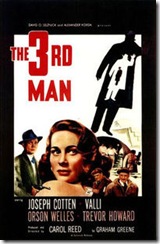
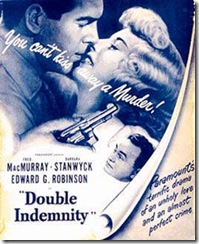 These two "modern noirs" are supposedly homages to the great film noirs of the forties and fifties, films like 'In a Lonely Place,' 'Double Indemnity,' 'The Third Man' or 'The Blue Dahlia' (the only similarity to 'The Black Dahlia is that they are both films), but unlike these classics today's tributes have no stories worth following, no characters worth caring about, and no actors able to impart the gravity that actors like Bogart and Stanwyck and Welles delivered so easily and (still) so memorably, and often with a touch of easy humour. Neither 'Good German' nor 'Black Dahlia' could even manage the humour, yet these are films that deserve to be roundly laughed at.
As with so many of today's films, the films' directors seem to have forgotten the basic elements of their craft, and their actors all-too obviously never had them. Watching 'Spooks' however was damn fine entertainment, and also a simple reminder of how important those basic elements are.
 Nearly two-and-a-half thousand years ago Aristotle identified the six basic parts of any drama. In decreasing order of importance they are Plot, Characters, Theme, Dialogue, Rhythm (or Melody), and Spectacle*. In that order. Without a plot to follow and characters to care about, neither spectacle nor melody can save a drama. Two millennia and a century of film technology hasn't changed that, no matter how much CGI you might be able to afford.
It's the first two of Aristotle's elements that truly characterise good drama -- that is, Plot and Character. With all the technology now available to film-makers however, it's now the last two in his list that dominate contemporary films, with 'Spectacle' generally and mind-numbingly considered the most important, and a sumptuous score used to bolster the empty bravado. “Superior poets rely on the inner structure of the play rather than spectacle,"observed Aristotle, however “the production of spectacular effects depends more on the art of the stage machinist than on that of the poet.” It's no accident that "stage machinists" and soundtrack simpletons are highly valued in Hollywood while the "poets" are striking for better pay and recognition of their talents, and no wonder most of what's produced there is so teeth-achingly dull. With nothing to integrate the explosions, the car chases and the lingering 'artistic' shots of most of today's films whether art-house or shit-house, there's nothing to do but either nod off or turn off. Last night we turned off, and turned on 'Spooks' instead.
By crikey, this show is good. With none of the megabudget resources available to most of today's film-makers, the show's creators rely instead on Aristotle's first two elements, and like the classic noir films they do them superbly: the Characters are sympathetic, well drawn and given enough light and depth to emerge from the thematic shadows -- they are agents in both the fully volitional and the MI5 sense; and their Plots are sharp and well-integrated and relentless -- you mustn't blink for fear of missing a crucial plot point.
 With 'Spooks,' the plot is always king, and this holds true for every episode of every season -- a remarkable achievement.
What makes a good plot wasn't news to noir's lions and isn't news to the makers of 'Spooks,' although it's clearly news that's now been lost in L.A.: in three words, it's Dramatic Conflict, and Integration. Without a decent dramatic conflict, there is no plot. Without tight integration of all elements, you can't bring the drama into focus. And once you have a well-written and well-integrated dramatic conflict, you don't need to spend a fortune on Spectacle.
You'd think budget-conscious producers would value that simple formula. The rarity of shows as sharp as 'Spooks' and the flatulence of so many films shows it's something so many have still to learn. Until they do, I'll keep ignoring most of what they produce.
_ _ _ _ _ _ _
* Here, for your future viewing pleasure, are Aristotle's six elements along with explanatory quotes from his Poetics whence they come:
- Plot (muthos): “the combination of the incidents, or things done in the story.”
- Character (êthé): “what makes us ascribe certain qualities to the agents.”
- Thought/Theme (dianoia): "all they say when proving a particular point or, it may be, enunciating a general truth...”
- Dialogue/Diction (lexis): "the externalisation of the internal order of the fable..."
“What indeed would be the good of the speaker if things appeared in the required light even apart from anything he says?” - Melody (mélopoia)
- Spectacle (opsis)
About these last two Aristotle says but little, regarding them "as having more to do with how the tragedy is performed, as opposed to its actual content."
UPDATE: I loved novelist Ed Cline's review of the Will Smith blockbuster 'I Am Legend.' With characteristic economy -- and a useful integration with my own post -- the review is titled "I am Plotless," and begins:
For a change of pace, offered here is a movie review. Warning: there are no plot-spoilers in this review; there is no plot to spoil... I suspected this movie would be talked about ... given the critical imprimatur. However, it is a B movie inflated by modern film technology (chiefly CGI, or computer generated imagery) with the intention of making it a blockbuster. But, fundamentally, it isn't any better than Ed Wood's Plan 9 from Outer Space.
The details or concretes one chooses to show or include in a story must have a purpose, that is, they must be integrated into the plot, they must have a demonstrable place or a role in the logical sequence of events. If they are included, but not explained, or are there just for "special effects" to impress or mislead a reader or viewer, or are included simply at the whim of a writer or director, then they violate Louis Sullivan's rule that form must follow function, or Ayn Rand's rule of essentialization. A plot itself, by Rand's definition, is "a purposeful progression of logically connected events leading to the resolution of a climax."
I am Legend is a cinematic jigsaw puzzle most of whose pieces do not connect. There is a "climax," but no logic to it. Among its many other faults, it is an epistemological abomination, and the horrible thing about it is that I don't believe the film's makers consciously intended that. Its illogic reflects the state of their epistemology. And since their epistemology (and metaphysics) is a subjectivist shambles, to them logic and causal-connections are elective elements not absolutely requisite to solving the problem of the moment.
Let us examine the film story of I am Legend, based on Richard Matheson's 1954 science fiction novel of the same title...
Click here to read all of Cline's masterful review, especially if you want to find why Plot and Character trump special effects and loud explosions -- and why Aristotle still matters. ;^)


 Labour's Electoral Finance Act has its first result: State


 When the student loan election bribe was uncorked last election, it was predicted by everyone from bankers to political opponents to Cactus Kate that it was going to cost a lot -- up to $1billion said
  If you've never heard of the
