Wikipedia did celebrate American Indepence Day -- they were just a little late. The Onion has the 'news.'
LINK: Wikipedia celebrates 750 years of American Independence: Founding Fathers, patriots, Mr T. honored - 'The Onion' [Hat tip Diana at Noodle Food]
RELATED: Humour
Monday, 31 July 2006


Beirut blogger
A new blog promises to be a window on Beirut in the same way the Interdictor blog was a window on New Orleans in the wake of Hurricane Katrina -- in fact it's the former Interdictor blogger who recommends it: it's called Cedarseed.
Here's a few recent excerpts:
Interdictor
RELATED: Blog, Israel, War, Politics-World
Here's a few recent excerpts:
- "HA [ie., Hezbollah] is NOT in good standing with the Arab world right now and it's pretty clear that this is more than a HA-Israel war or even a US-Iran proxy war: we're watching a large Sunni-Shia conflict of influences unfold. I'm sure what's happening in Iraq has both factions irritated enough as is, and the HA's fanaticism was the last straw."
- "My dad's phone rang, he picked up and started chuckling – then held it up to my ear so I could hear: it was a recorded message that started, in careful Arabic, 'This is the Israeli nation' and went on warning us against Hizballah and against allowing them near us or into our homes.
My mom, not taking her eyes off the tv: 'They probably know by satellite which ones of us are still home'." - "Of course the running joke now is that Google Earth needs to update its files, because southern Beirut is now a giant parking lot."
- "I have mentioned before that despite several really horrible mistakes (or not mistakes, who knows), we generally have faith in the IDF's remarkable intel. Here's a story to illustrate this. 5 days ago the news made a fuss about a car 'full of Lebanese policemen,' in the Bekaa, that an Israeli plane bombed before shooting down those that escaped from the wreck. The next day it was revealed that the 'policemen' were in fact HA in disguise. And yesterday right on the edge of the suburb, another plane took out another carful of HA fleeing in civilian disguise. How the hell they know this is absolutely mindboggling. I have a suspicion that despite the bravado, the [Hezbollah] party is mostly peeing their pants at the moment. They're being taken out one at a time like pigeons (or whatever the English equivalent is)."
Interdictor
RELATED: Blog, Israel, War, Politics-World
Six years preparation for war with Israel - Hezbollah
Hezbollah's Sheikh Naim Qassem tells the Sunday Times that Hezbollah has been preparing for war with Israel for six years.
UPDATED: Link to Herald Sun story added.
LINK: Hezbollah: We've planned this for six years - Sunday Times [Hat tip Free Market News]
Photos that damn Hezbollah [Hat tip Jihad Watch]
RELATED: Israel, War, Politics-World
Hezbollah’s stockpiling of arms and preparation of numerous bunkers and tunnels over the past six years have been key to its resistance. “If it was not for these preparations Lebanon would have been defeated within hours,” he said.In fact, if it weren't for those preparations and the use of those stockpiled arms on Israel, Lebanon would very likely not have been attacked at all.
Hezbollah is believed to be in possession of four types of advanced missile: Fajr missiles with a range of 100 kilometres; Iran 130 missiles with a range of 110km; and Shahin missiles and 355mm rockets with ranges of 150km. He said that Hezbollah will use its weapons to strike deep into Israel should the attacks in Lebanon continue.And what sort of places are are those weapons stockpiled? According to Israel's U.N. ambassador, Dan Gillerman, "Hezbollah has homes in Lebanon which house a missile in which a family sleeps. When you sleep with missiles sometimes you don't wake up in the morning." The Australian Sunday Herald Sun shows where those weapons are being fired from:
The bravery of using children and families as human shields.The images, obtained exclusively by the 'Sunday Herald Sun,' show Hezbollah using high-density residential areas as launch pads for rockets and heavy-calibre weapons.
Dressed in civilian clothing so they can quickly disappear, the militants carrying automatic assault rifles and ride in on trucks mounted with cannon.
The photographs, from the Christian area of Wadi Chahrour in the east of Beirut, were taken by a visiting journalist and smuggled out by a friend...
The images include one of a group of men and youths preparing to fire an anti-aircraft gun metres from an apartment block with sheets hanging out on a balcony to dry.
Others show a militant with AK47 rifle guarding no-go zones after Israeli blitzes.
Another depicts the remnants of a Hezbollah Katyusha rocket in the middle of a residential block blown up in an Israeli air attack.
UPDATED: Link to Herald Sun story added.
LINK: Hezbollah: We've planned this for six years - Sunday Times [Hat tip Free Market News]
Photos that damn Hezbollah [Hat tip Jihad Watch]
RELATED: Israel, War, Politics-World
More environmentalists at war with the human race
For those still considering the truth of Charlie Pedersen's point that some environmentalists are at war with the human race, the Bio-Nuclear Bunny has a short post that you might like to consider - three environmental projects that between them cost millions of human lives every year.
LINK: The truth will set you free - Bio-Nuclear Bunny
REALTED: Environment, Ethics
LINK: The truth will set you free - Bio-Nuclear Bunny
REALTED: Environment, Ethics
Prius: Look at me!
Jeremy Clarkson puts the boot into the Toyota Prius, the hippy 'hybrid car' that equates 'good for the environment' with the words slow, fat and ugly, and in the process skewers the motive for so much environmentalist hand-waving.
LINK: Jeremy Clarkson column - Times Online [hat tip Marcus Bachler]
Prius as backup generator - Ryan.Freebern.Org
RELATED: Environment, Humour
Anybody want to 'fess up to owning a Prius? Perhaps you've just bought it to use as a backup generator?Saving polar bears, of course, is not the point of a hybrid car. The point is not to save the planet but to be seen trying. I saw a Prius in California the other day with the registration plate “Hug Life” and that’s what the car does. It says to other road users, “Hey. I’ve spent a lot of money on this flimsy p.o.s. and I’m chewing a lot of fuel too. But I’m making a green statement.”
Think of it, then, as a big metal beard, a pair of open-toed sandals with wheels, David Cameron with windscreen wipers.

LINK: Jeremy Clarkson column - Times Online [hat tip Marcus Bachler]
Prius as backup generator - Ryan.Freebern.Org
RELATED: Environment, Humour
Sunday, 30 July 2006
Excusing 'the bash'
An unusually patronising article appeared in yesterday's NZ Herald purporting to explain once again why, as one do-gooder put it the other night on 'Campbell Live,' "we're killing our chooldren" ( which once again had me yelling, "What's with the 'we,' white man? You speak for yourself. I didn't kill them!")
Anyway, the article by Simon Collins entitled 'Salvation Through Racial Pride and Self-Awareness' was as thoroughly racist, collectivist and wet as it sounds from that title, and full of excuses for Maori who bash their kids, and for women (and men) trapped by the "male will for power and control."
"Why are we still where we are?" asks one "former drug dealer" who has now exchanged dependency on drugs to a dependency on racial identity and the supernatural (he is now a pastor who, he proudly says, "chose the Charisma church because its pastor was Maori"). Once again, you might ask "What's with the 'we'? " This chap's 'insights' seemed to be included as some sort of expert or specially insightful commentary on why "we Maori" are killing "our" children -- and a better example of pathetically inept group-think on such a tragic topic would be hard to find.
"The way we think and the way we see things is totally different to our European brothers and sisters," says this idiot as some sort of excuse for 'Maori alienation in a Pakeha world', echoing no doubt what he's heard from group-think academics in counselling sessions over the years.
As P.J. O'Rourke points out so pithily, the very idea that racial differences are so important is absurd.
The first is Maori culture itself -- as distinct from the race of Maori -- and the failure of that culture yet to fully embrace individualism. As more than a few Australian rugby coaches and commentators pointed out last week in relation to the haka, it is -- or at least has been -- a tribal culture that values savagery and bloody violence. About that those Australians were accurate, and if 'we' weren't so bloody precious about things we'd recognise that.
As Alan Duff points out in the Herald, in a piece that appears opposite Simon Collins's apologetics (in more ways than one), the "base line" for the Maori culture "is a Stone Age societal model which patently does not work in the modern world."
It is our ability to make choices -- moral choices -- that is part of what makes us distinctly human beings. We -- none of us -- are merely the helpless playthings of blood, of genes, of upbringing. Adult human beings have the power of choice. We have free will.
No one, has to bash their children, they either choose to, or they chose to take the actions that led to that. Commentators talk glibly of a 'cycle of violence,' but not every person bashed by their parents goes on to become parents who bash; not every "poor working class Maori" bashes their kids. People who do are not depraved because they're deprived -- they're just depraved. Not every human being who grows up in despair is trapped by that. It is fundementally a matter of choice.
Positing race or upbringing as a reason for bashing children or for avoiding the responsibility of becoming an adult human being merely provides an excuse to those who refuse to exercise any free will in their own lives, and to make any positive choices themselves. Alan Duff is right, as he has often been right before.
LINKS: "We"? - Not PC (Peter Cresswell)
Cue Card Libertarianism - Individualism - Not PC (Peter Cresswell
Nature v nurture: character is all - Not PC (Peter Cresswell
RELATED: Racism, Maoritanga, New Zealand, Ethics
Anyway, the article by Simon Collins entitled 'Salvation Through Racial Pride and Self-Awareness' was as thoroughly racist, collectivist and wet as it sounds from that title, and full of excuses for Maori who bash their kids, and for women (and men) trapped by the "male will for power and control."
"Why are we still where we are?" asks one "former drug dealer" who has now exchanged dependency on drugs to a dependency on racial identity and the supernatural (he is now a pastor who, he proudly says, "chose the Charisma church because its pastor was Maori"). Once again, you might ask "What's with the 'we'? " This chap's 'insights' seemed to be included as some sort of expert or specially insightful commentary on why "we Maori" are killing "our" children -- and a better example of pathetically inept group-think on such a tragic topic would be hard to find.
"The way we think and the way we see things is totally different to our European brothers and sisters," says this idiot as some sort of excuse for 'Maori alienation in a Pakeha world', echoing no doubt what he's heard from group-think academics in counselling sessions over the years.
It's just different values. So with a Maori, you can drop in at your [relative's] house, sleep for the night, have a big feed, because we have been brought up in the same community.As I write this I hear sounds of cleaning up coming from my kitchen, where friends are cleaning up after dropping in unannounced last night (as they so often do here) and staying over for a big feed. The proposition of this Charisma church bigot is so fatuous it hardly even serves as an argument, yet these are the sort of paper-thin 'differences' between Maori and non-Maori that are frequently cited by blowhard academics and their fellow-travellers like Collins to argue that "after years of assimilation, differences like these" need to be recognised, or "the bash" is the inevitable result. Hence the nauseating title of the patronising piece: Salvation Through Racial Pride -- about as vile a proposition as one could imagine.
With Europeans you have to ring them up, make an appointment for Sunday at 10am, and don't overstay your time. So we are different.
As P.J. O'Rourke points out so pithily, the very idea that racial differences are so important is absurd.
Finally, people are all exactly alike. There is no such thing as a race and barely such a thing as an ethnic group. If we were dogs, we'd be the same breed. George Bush and an Australian aborigine have fewer differences than a lhasa apso and a fox terrier. A Japanese raised in Riyadh would be an Arab. A Zulu raised in New Rochelle would be an orthodontist. I wish I could say I found this out by spending arctic nights on ice flows with Inuit elders and by sitting with tribal medicine men over fires made of human bones in Madagascar. But, actually, I found it out by sleeping around. People are all the same, though their circumstances differ terribly."It is those terrible circumstances all commentators are trying to explain, but the focus on race has made too many I've read in recent days ignore P.J.'s important point, and two very important things that underly his point.
The first is Maori culture itself -- as distinct from the race of Maori -- and the failure of that culture yet to fully embrace individualism. As more than a few Australian rugby coaches and commentators pointed out last week in relation to the haka, it is -- or at least has been -- a tribal culture that values savagery and bloody violence. About that those Australians were accurate, and if 'we' weren't so bloody precious about things we'd recognise that.
As Alan Duff points out in the Herald, in a piece that appears opposite Simon Collins's apologetics (in more ways than one), the "base line" for the Maori culture "is a Stone Age societal model which patently does not work in the modern world."
Most of this is due to not developing as individuals, which includes of course taking responsibility as an individual [says Duff with unerring accuracy]. If the group says no, we’re okay, we don’t have to change. Then no change occurs.To continue with the collective, whanau, hapu, iwi societal model is a fatal mistake. A fatal mistake. For in not developing individuality we continue down the declining slope of anonymity in a collective. Of no-one willing to make decisions – especially unpopular decisions – for fear of standing out from the crowd, going against the collective will. Individuality is as fundamental to a society’s development as property rights.
The quality of debate in this country on Maori issues is poor, cowardly, non-analytical, and none of it serves the Maori people well. Like social welfare, which many of us have warned about for years, every government benefit takes another breath of the recipient’s self-respect away. Until they choke on self-hatred and maim and kill themselves and others.
Which leads to the second point, one too often ignored, the very faculty that underpins individualism: the fundamental human quality of free will.
It is our ability to make choices -- moral choices -- that is part of what makes us distinctly human beings. We -- none of us -- are merely the helpless playthings of blood, of genes, of upbringing. Adult human beings have the power of choice. We have free will.
No one, has to bash their children, they either choose to, or they chose to take the actions that led to that. Commentators talk glibly of a 'cycle of violence,' but not every person bashed by their parents goes on to become parents who bash; not every "poor working class Maori" bashes their kids. People who do are not depraved because they're deprived -- they're just depraved. Not every human being who grows up in despair is trapped by that. It is fundementally a matter of choice.
Positing race or upbringing as a reason for bashing children or for avoiding the responsibility of becoming an adult human being merely provides an excuse to those who refuse to exercise any free will in their own lives, and to make any positive choices themselves. Alan Duff is right, as he has often been right before.
LINKS: "We"? - Not PC (Peter Cresswell)
Cue Card Libertarianism - Individualism - Not PC (Peter Cresswell
Nature v nurture: character is all - Not PC (Peter Cresswell
RELATED: Racism, Maoritanga, New Zealand, Ethics
Saturday, 29 July 2006
Thought for the day ...
... comes from John Lewis, assistant professor of history at Ashland University, writing in The Objective Standard.
To fail to establish [proper, that is constitutional] terms [for peace] is not pacific, but rather solidifies the conditions that make further war inescapable. It is not a kindness to accept a peace today that turns tomorrow's children into soldiers -- a point that Thomas Paine had understood: "let us," he wrote, "not leave the next generation to be cutting throats..."RELATED: War, History
Some comments on recent comments
I need to remind some commenters of the comments policy here at 'Not PC.'
When a commenter continues to post questions which have been answered ad nauseum, refuses to answer legitimate questions that have been posed in response, and instead continues to viciously misrepresent a position that has been explained and defended at some length then it's time to realise that my time is being wasted and also that of my readers. As I've explained before:
RELATED: Blog
When a commenter continues to post questions which have been answered ad nauseum, refuses to answer legitimate questions that have been posed in response, and instead continues to viciously misrepresent a position that has been explained and defended at some length then it's time to realise that my time is being wasted and also that of my readers. As I've explained before:
I welcome honest argument and discussion. I welcome free speech. But the principle of free speech doesn't require that I provide my unhinged attackers with a microphone.Honest debate is welcome. Dishonest smears are not. That is all.
RELATED: Blog
Break-up songs
For once, Rick Giles has an idea worth borrowing (who would have thunk it?). He's posted a short-list of breakup songs. I think we can do better, after all popular music has a breakup song for every mood, so here's a longer list, which still only scratches the surface:
And we haven't even touched opera! Where would we be without Pagliacci's Vesti la Giubba -- " Laugh, you clown, at your broken love. Laugh at the pain which poisons your heart" -- or the passionately optimistic denial of Madame Butterfly's Un Bel Di, Vedremo. And where would opera be without break-ups and reconciliations, and break-ups again!
But in the end, when all you can do is laugh or you'll cry, there's the truly, madly, deeply cheesy:
Breaking Up is Hard to Do, by The Partridge Family. 'Cos you really do have to laugh, don't you. Don't you?
RELATED: Music
WISTFUL: The Best of Everything - Tom Petty and the HeartbreakersThere are musicians who've carved whole careers out of break-up songs. Hank Williams for instance:
"Wherever you are tonight, I wish you the best of everything, In the World, And I hope you found, Whatever you were looking for."
JUVENILE: Song for the Dumped - Ben Folds Five
"So you wanted to take a break? Slow it down some, and have some space? Well fuck you too! Give me my money back, Give me my money back, you bitch."
SONG FOR THE DUMP-ER: I Useta Love Her - Saw Doctors
"So now you know the truth of it she’s no longer my obsession, Though the thoughts and dreams I had of her would take six months in confession. See I met this young one Thursday night and she’s inta free expression. And her mission is to rid the world of sinful repression. Then we had a session..."
HONEST: Toy Love Song - Toy Love
"'Cos when I see you by my side, I wonder if you're suicide, Affects me like I feel it ought to do. Or was our loving just a toy, A crazy girl a stupid boy, Ignoring things that could have made it true..."
SELF-FLAGELLATING: Blue Valentines - Tom Waits
"And it takes a lot of whiskey, To make these nightmares go away, And I cut my bleedin' heart out every night. And I die a little more on each St. Valentines day. Remember that I promised I would Write, you... These blue valentines..."
INDECISIVE: Should I Stay or Should I Go - The Clash
"This indecisions bugging me, If you dont want me, set me free..."
VENGEFUL: Sometimes - The Stranglers
"Somebody's gonna call your bluff, Somebody's gonna treat you rough, Sometimes there's only one way out, I gotta fight!"
DISBELIEF: No You! - Paul Kelly
"I go up and down, And every single sound says, No you! No you! No you! No you! No you, no you, no you!"
FANTASY: I'll Come Running (To Tie Your Shoe) - Brian Eno
"I sit playing solitaire by the window. Just waiting, seasons change, ah hah, you'll see, Some day these dreams will pull you through my door..."
IT'S COMPLICATED: Pale Blue Eyes - Velvet Underground
"Thought of you as my mountain top. Thought of you as my peak. I thought of you as everything I've had, but couldn't keep. I've had, but couldn't keep... Skip a life completely. Stuff it in a cup. They said, money is like us in time, It lies, but can't stand up. Down for you is up."
IT'S NOT YOU, IT'S ME: It Ain't Me, Babe - Bob Dylan
"You say you're lookin' for someone, Never weak but always strong, To protect you an' defend you, Whether you are right or wrong, Someone to open each and every door, But it ain't me, babe, No, no, no, it ain't me, babe, It ain't me you're lookin' for, babe."
LINGERING RESENTMENT: Pretty as a Picture - Hammond Gamble
"And I'll send you a card for Christmas, one at Easter time, Call and see the children in the summer time..."
"I JUST HAD TO": Ruby's Arms - Tom Waits
"So jesus christ this goddamn rain, Will someone put me on a train, I'll never kiss your lips again, Or break your heart..."
FINALITY: It's Over - Graham Brazier
"See the change, See the way... See that gleam in her eye, Telling you it's all over."
OH SHIT: Stephanie Says - Velvet Underground
"Stephanie says that she wants to know, Why she's given half her life, to people she hates now..."
OH FUCK: It's All Over Now, Baby Blue - Bob Dylan
"The lover who just walked out your door, Has taken all his blankets from the floor.
The carpet, too, is moving under you, And its all over now, baby blue."
NO HOPE: Love Will Tear Us Apart - Joy Division
"When routine bites hard, and ambitions are low, And resentment rides high, but emotions won't grow. And we're changing our ways, taking different roads, Then love, love will tear us apart, again."
"Your cheating heart will pine some day, And crave the love you threw away. The time will come when you'll be blue, Your cheating heart will tell on you."Crieky! And then there's whole albums of 'break-up madness.' Two classics are Nick Cave's 'Let Love In' -- "Love is always having to say you're sorry, And I am, from my head down to my shoes. I'm sorry that I'm always pissed, I'm sorry that I exist, And when I look into your eyes I can see you're sorry too" -- and Lou Reed's black and self-pitying 'Berlin' album, the recording of which was said to have driven everyone mad by its extremes of intensity, and from which come these gems:
"Did you ever see a robin weep, When leaves begin to die. That means he's lost the will to live, I'm so lonesome, I could cry."
UNCERTAIN: How do you think it feelsAnd then of course there's the female divorcee's karaoke favourite: I Will Survive, by Gloria Gaynor. And for the bloke with new-found freedom: Bring on the Nubiles, by The Stranglers.
"How do you think it feels, To feel like a wolf and foxy? How do you think it feels, To always make love by proxy?"
QUESTIONING: Oh Jim
"Now you said that you love us, But you only make love to one of us, Oh Jim, how could you treat me this way, You know you broke my heart, Ever since you went away, When you're looking through the eyes of hate, Oh, oh, oh, oh."
IMMATURE: Caroline Says, I
"Caroline says that I'm just a toy, She wants a man, not just a boy, Oh, Caroline says, ooh Caroline says. Caroline says she can't help but be mean, Or cruel, or oh so it seems, Oh, Caroline says. Caroline says. She say she doesn't want a man who leans, Still she is my Germanic Queen."
BRUTAL: Caroline Says, II
"Caroline says - as she gets up from the floor, You can hit me all you want to, but I don't love you anymore."
HURTFUL: The Kids
"I am the Water Boy, the real game's not over here, But my heart is overflowin' anyway. I'm just a tired man, no words to say, But since she lost her daughter It's her eyes that fill with water, And I am much happier this way."
SUICIDAL: The Bed
"This is the place where she lay her head, When she went to bed at night. And this is the place our children were conceived, Candles lit the room brightly at night. And this is the place where she cut her wrists, That odd and fateful night..."
And finally, back again to WISTFUL: Sad Song
"My castle, kids and home, I thought she was Mary, Queen of Scots. I tried so very hard. Shows just how wrong you can be."
And we haven't even touched opera! Where would we be without Pagliacci's Vesti la Giubba -- " Laugh, you clown, at your broken love. Laugh at the pain which poisons your heart" -- or the passionately optimistic denial of Madame Butterfly's Un Bel Di, Vedremo. And where would opera be without break-ups and reconciliations, and break-ups again!
But in the end, when all you can do is laugh or you'll cry, there's the truly, madly, deeply cheesy:
Breaking Up is Hard to Do, by The Partridge Family. 'Cos you really do have to laugh, don't you. Don't you?
RELATED: Music
Friday, 28 July 2006
Cease fire = peace?
 Today's thought from Thomas Sowell:
People are calling for a cease-fire in the interests of peace. But there have been more cease-fires in the Middle East than anywhere else. If cease-fires actually promoted peace, the Middle East would be the most peaceful region on the face of the earth instead of the most violent.LINKS: Pacifists versus peace - Thomas Sowell
RELATED: Israel, War, Politics-World
Beer O'Clock: Monteith's Black
Beer O'Clock this week comes from Real Beer's Stu.
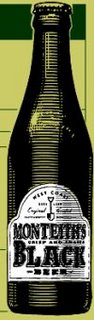 Monteith's annual Wild Food Callenge began in Wellington this week and is rolling out around he country at various times over the coming month. It had me thinking of my early forays into craft beer, and of a food match of my own.
The Mac's and Monteith's beer ranges were my own first tentative steps away from the likes of DB Bitter and Mainland Draught. (Those weren't the days.) The Monteith's beers still do come across as 'stepping-stone' beers for me, not quite hitting the high points of some of the recent releases from Mac's – their arch nemesis brand. However, for the kids out there wanting to learn something, they are certainly worth trying if you're interested in a wider variety of flavours to your usual KGB or Tui (I think Emerson's 9% Bourbon Porter for example may be a bit too great a leap for the average teenage punter, and at $9 a bottle it is more than a little on the steep side ).
While not really standing up as craft beers I'd regularly purchase, I do commend the Monteith's marketing team for adding the Wild Food challenge to their brand. It challenges chefs and us as consumers, while promoting their brand no end. Food is a nice accompaniment to beer (yes, I did mean it that way around), especially if you're not quaffing great quantities of either. In fact, I rate it more highly than wine (not that you’d have guessed).
My Monteith's match is far from wild -- though perhaps simplicity is the new wild? It is, however, undeniably simple, extremely satisfying and works well in the dining room or infront of the plasma TV: Monteith's Black with a fresh Bordeaux baguette, Kapiti's French-style Camembert and Ruth Pretty's Springfield Pear Chutney. The dry roasted notes in the beer will cut through the fruity creaminess of the cheese and chutney, while complimenting the sweet crustiness of fresh French bread. Cheap, cheerful and deliciously feminine – a little something for the Rob Moodie in all of us.
OK blokes, you can have a kransky in yours and call it a hot dog...
Cheers, Stu
RELATED: Beer & Elsewhere
 Monteith's annual Wild Food Callenge began in Wellington this week and is rolling out around he country at various times over the coming month. It had me thinking of my early forays into craft beer, and of a food match of my own.
The Mac's and Monteith's beer ranges were my own first tentative steps away from the likes of DB Bitter and Mainland Draught. (Those weren't the days.) The Monteith's beers still do come across as 'stepping-stone' beers for me, not quite hitting the high points of some of the recent releases from Mac's – their arch nemesis brand. However, for the kids out there wanting to learn something, they are certainly worth trying if you're interested in a wider variety of flavours to your usual KGB or Tui (I think Emerson's 9% Bourbon Porter for example may be a bit too great a leap for the average teenage punter, and at $9 a bottle it is more than a little on the steep side ).
While not really standing up as craft beers I'd regularly purchase, I do commend the Monteith's marketing team for adding the Wild Food challenge to their brand. It challenges chefs and us as consumers, while promoting their brand no end. Food is a nice accompaniment to beer (yes, I did mean it that way around), especially if you're not quaffing great quantities of either. In fact, I rate it more highly than wine (not that you’d have guessed).
My Monteith's match is far from wild -- though perhaps simplicity is the new wild? It is, however, undeniably simple, extremely satisfying and works well in the dining room or infront of the plasma TV: Monteith's Black with a fresh Bordeaux baguette, Kapiti's French-style Camembert and Ruth Pretty's Springfield Pear Chutney. The dry roasted notes in the beer will cut through the fruity creaminess of the cheese and chutney, while complimenting the sweet crustiness of fresh French bread. Cheap, cheerful and deliciously feminine – a little something for the Rob Moodie in all of us.
OK blokes, you can have a kransky in yours and call it a hot dog...
Cheers, Stu
RELATED: Beer & Elsewhere
List of Iconic Drinkers
I've started to get a fair number of hits from the Wikipedia page, 'List of Iconic Drinkers' -- and when you think about it, that isn't such a bad thing. And not a bad page to visit as the weekend is almost upon us.
Cheers.
LINK: List of iconic drinkers - Wikipedia
TAGS: Beer & Elsewhere
Cheers.
LINK: List of iconic drinkers - Wikipedia
TAGS: Beer & Elsewhere
Mangere Brown
 A friend sent me this map (left) of the area in which I grew up. (If you look hard, you can see Phillip Field's office.) According to the map it's all dark brown. How 'bout that.
This you see, is what use is made of all those census statistics you lot filled out so obediently last year -- they're used by sociologists to produce maps like this: 'The New Zealand Index of Deprivation.' Dark brown means "most deprived." Bright green means "least deprived." The criteria for these measures were chosen by the sociologists who produced the study, as were the colours. Perhaps some of those sociologists have a sense of humour?
Maybe they do. What they don't have however is a broad range of views within their profession -- and who would be surprised about that? In fact, a new study on sociologists themselves (those expensive exercises normally conducted by sociologists) found very little diversity of views among the 'profession.'
In fact, surprise, surprise, the study "found far more support for economic regulations, the regulation of personal choices, and a broad role for government than opposition to them." In other words, they're all slavering state-worshippers.
Daniel B. Klein and Charlotta Stern, the authors of the study ("Sociology and Classical Liberalism," THE INDEPENDENT REVIEW, Summer 2006), sent letters to 1000 members of the American Sociological Association asking their preferences about 18 public-policy topics. The 347 responses they received suggest that the sociology profession in the United States tilts heavily to the left and has few, in any, classical liberals.No suprise at all. No surprise then that all such sociological studies as 'The New Zealand Index of Deprivation' is used simply to justify even more state intervention in areas where atate intevention has already caused more than enough problems.
LINK: Sociology and classical liberalism - The Independent Review
RELATED: Politics-NZ, Auckland, Politics, Welfare, Racism
A bloodthirsty warmonger speaks out
NZ HERALD: Al Qaeda warns Israel's supporters over Mideast
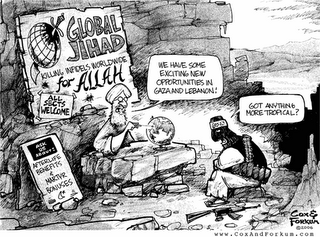 "Oh Muslims everywhere, I call on you to fight and become martyrs in the war against the Zionists and the Crusaders," [Al Qaeda's deputy leader Ayman al ]Zawahri said in the statement which was entitled 'The Zionist-crusader war on Lebanon and the Palestinians. ' "As they fight us everywhere, we will fight them everywhere... The whole world is our battlefield."
In the video, Zawahri appeared to be seated in a studio, with three photographs behind him, one showing the collapsing Twin Towers of New York, which al Qaeda targeted in September 11, 2001 attacks on the United States.
I look forward to hearing those who denounce bloodthirsty warmongers coming out against this bloodthirsty bloody warmonger, and all those who support and succour him and his accomplices. I look forward to it, but not with too much optimism.
LINKS: Cartoon and links by Cox and Forkum: Global Jihad
RELATED: Israel, War, Politics-World
"Oh Muslims everywhere, I call on you to fight and become martyrs in the war against the Zionists and the Crusaders," [Al Qaeda's deputy leader Ayman al ]Zawahri said in the statement which was entitled 'The Zionist-crusader war on Lebanon and the Palestinians. ' "As they fight us everywhere, we will fight them everywhere... The whole world is our battlefield."In the video, Zawahri appeared to be seated in a studio, with three photographs behind him, one showing the collapsing Twin Towers of New York, which al Qaeda targeted in September 11, 2001 attacks on the United States.
I look forward to hearing those who denounce bloodthirsty warmongers coming out against this bloodthirsty bloody warmonger, and all those who support and succour him and his accomplices. I look forward to it, but not with too much optimism.
LINKS: Cartoon and links by Cox and Forkum: Global Jihad
RELATED: Israel, War, Politics-World
Shell House - J.J.P. Oud
 A small portion of the Shell Oil Building in The Hague, completed just after the war by Dutch architect J.J.P. Oud.
This was the building of which Oud was most proud -- "a step forward" he called it -- and the one that had him virtually thrown out of the modernist moverment for apostasy. 'Just imagine darling, all that ornament! All that beauty! Uugh!'
Oud wrote Ayn Rand a fan letter after reading The Fountainhead, after which she requested and received an autographed photo of this building.
Of his "battle with the alleged modernists who object to ornament,' Rand told Oud, "I can see they criticized you precisely for the best things about the Shell building -- for the fact that it is beautiful."
Sadly, very few online pictures of the building exist. This comes from the cover of a book celebrating the building.
RELATED: Architecture
Thursday, 27 July 2006
Property rights victory
 The Institute for Justice is a nonprofit law firm that specializes in defending individual rights. Yes Virginia, it's an organisation full of honest lawyers -- if that doesn't sound too much like an oxymoron. You can read an interview with IJ's Scott Bullock here.
And they've just scored another victory. In Ohio. (That's right, they're an American organisation with no local parallels -- and I say that with great sadness.)
You'll remember that last year the US Supreme Court gave a decision in Kelo v New London that allowed the state government to confiscate private houses, and give them to a private developer -- and you might also remember Rand-reading Logan Darrow Clements who then put in a claim for the house and land of Justice David Souter in order to build the Lost Liberty Hotel, in which guests would find a copy of Atlas Shrugged where they might normally expect a Gideon Bible.
 Anyway, in the first challenge of property rights law since Kelo, the IJ have scored a significant victory:
 The Ohio Supreme Court ruled unanimously on Wednesday that economic development isn't a sufficient reason under the state constitution to justify taking homes, putting a halt to a $125 million project of offices, shops and restaurants in a Cincinnati suburb that officials said would create jobs and add tax revenue...Let's hope so. Let's hope we're witnessing the rejection of the idea that government confiscation of private property rights is ever justified. And well done Dana, Scott and all the good folk at the Institute of Justice.
"For the individual property owner, the appropriation is not simply the seizure of a house," Justice Maureen O'Connor wrote in a case that pitted the city of Norwood against two couples trying to save their homes. "It is the taking of a home — the place where ancestors toiled, where families were raised, where memories were made."
...“Our home is ours again!” exclaimed Joy Gamble. “The Ohio Supreme Court has stopped this piracy. Now all Ohioans are safe from the scourge of eminent domain for private profit.”
...Dana Berliner, an attorney for the Arlington, Va.-based Institute for Justice that represented property owners in the case, said Wednesday's decision will have ramifications in high courts and legislatures across the country. "This case is really part of a trend throughout the country of states responding to and rejecting the U.S. Supreme Court's Kelo decision last year," she said. "There are now 28 states that have taken legislative steps to protect owners more after that decision, and this case is the next movement in that trend, and I believe now not only legislatures but other courts are going to begin rejecting that terrible decision."
LINKS: Ohio's High Court backs property owners - Associated Press [Hat tip Bidinotto Blog] Ohio Supreme Court rules unanimously to to protect property from eminent domain abuse - Media Release from Institute for Justice
The supreme assault on private property: An interview with Scott Bullock - TNI
Institute for Justice website
Lost Liberty Hotel - Wikipedia
RELATED: Property Rights, Politics-US, Libertarianism, Objectivism
Wednesday, 26 July 2006
Ten bands, fifteen questions
I found this at Paula's place. The first step is to write down 10 bands quickly--the first ten off the top of your head. Mine are:
Velvet Undergound
Nick Cave and the Bad Seeds
The Stranglers
Manic Street Preachers
Hello Sailor
Patti Smith Group
Dr Feelgood
Pixies
Tall Dwarfs
King Crimson
Then, there's the questions...
1. What was the first song you ever heard by 6? 'Gloria'
2. What is your favourite album of 8? 'Bossanova'
3. What is your favourite lyric of 5?"Give me coffee, cigarettes, and freedom from oppression."
4. How many times have you seen 4 live? Twice. London Astoria, 1993. Two nights. Just before Richey disappeared. :-(
5. What is your favourite song by 7? 'Milk and Alcohol'
6. Is there a song of 3 that makes you sad? 'Don't Bring Harry'
7.What is your favourite lyric of 9? "Woke up this morning with those post-modern deconstructivist blues..."
8. What is your favourite song by 1? 'Sweet Jane'
9. How did you get into 8? I was introduced by a friend. They appeared just as rock music was overwhelmed with synths and bubble gum, and I was listening to more and more opera. :-)
10. What is your favourite song by 4? 'You Love Us!'
11. How many times have you seen 1 live? Twice. In London. 1993. Right place, right time. Made the most of it. Heard about the London shows the night before tickets went on sale, and began queuing almost immediately.
12. What is a good memory concerning 2? Walking back home to my flat in Brixton every day listening to 'Let Love In' on my walkman, where I used to pass by a 'Let Love In' poster on the Railton Rd that for some months remained miraculously un-vandalised. I used to smile at that every day. I used to have a rule that if 'Thirsty Dog' was playing as I passed a pub I would stop in for a drink.
13. Is there a song by 2 that makes you sad? ! Talk about being spoiled for choice! How about 'Into My Arms'? Or having the walkman play 'Thirsty Dog' just after I'd passed a pub?
14. What is your favourite song of 6? 'Because the Night.' Great song. Deservedly a hit.
15. How did you become a fan of 10? Introduced by a friend at school who had a musical older brother whose record collection we used to, ah, borrow occasionally. 'Court of the Crimson King' turned up to eleven is not something you forget in a hurry.
RELATED: Music
Velvet Undergound
Nick Cave and the Bad Seeds
The Stranglers
Manic Street Preachers
Hello Sailor
Patti Smith Group
Dr Feelgood
Pixies
Tall Dwarfs
King Crimson
Then, there's the questions...
1. What was the first song you ever heard by 6? 'Gloria'
2. What is your favourite album of 8? 'Bossanova'
3. What is your favourite lyric of 5?"Give me coffee, cigarettes, and freedom from oppression."
4. How many times have you seen 4 live? Twice. London Astoria, 1993. Two nights. Just before Richey disappeared. :-(
5. What is your favourite song by 7? 'Milk and Alcohol'
6. Is there a song of 3 that makes you sad? 'Don't Bring Harry'
7.What is your favourite lyric of 9? "Woke up this morning with those post-modern deconstructivist blues..."
8. What is your favourite song by 1? 'Sweet Jane'
9. How did you get into 8? I was introduced by a friend. They appeared just as rock music was overwhelmed with synths and bubble gum, and I was listening to more and more opera. :-)
10. What is your favourite song by 4? 'You Love Us!'
11. How many times have you seen 1 live? Twice. In London. 1993. Right place, right time. Made the most of it. Heard about the London shows the night before tickets went on sale, and began queuing almost immediately.
12. What is a good memory concerning 2? Walking back home to my flat in Brixton every day listening to 'Let Love In' on my walkman, where I used to pass by a 'Let Love In' poster on the Railton Rd that for some months remained miraculously un-vandalised. I used to smile at that every day. I used to have a rule that if 'Thirsty Dog' was playing as I passed a pub I would stop in for a drink.
13. Is there a song by 2 that makes you sad? ! Talk about being spoiled for choice! How about 'Into My Arms'? Or having the walkman play 'Thirsty Dog' just after I'd passed a pub?
14. What is your favourite song of 6? 'Because the Night.' Great song. Deservedly a hit.
15. How did you become a fan of 10? Introduced by a friend at school who had a musical older brother whose record collection we used to, ah, borrow occasionally. 'Court of the Crimson King' turned up to eleven is not something you forget in a hurry.
RELATED: Music
Climate change - open letter to MPs
The NZ Climate Science Coalition have sent an Open Letter to MPs today "urging them to support the Coalition's request to the Prime Minister for a Royal Commission on the Science and Economics of Climate Change." The full text appears here:
LINKS: MP's contact details - Parliamentary website
Climate Science Coalition website
Open Letter to members of NZ Parliament - NZ Climate Science Coalition [14-page PDF]
RELATED: Environment, Global Warming, Politics-NZ, Science
The New Zealand Climate Science Coalition has taken the unusual step of delivering (Tuesday 25 July) to every MP in Parliament an Open Letter to Members of the House of Representatives, urging them to support the Coalition's request to the Prime Minister for a Royal Commission on the Science and Economics of Climate Change.Accompanying the letter is a fourteen-page report backing up their call, which includes a summary of the nine reasons that require it:
The reasons justifying a Commission are set out in the Open Letter and its explanatory summary, and also in the attached media release.
In anticipation of untrue and entirely unjustified attacks on our members by the likes of Greenpeace claiming that we are simply tools of the fossil fuel industry, etc, we attach also for your background information, details of the qualifications and motivations of the signatories to the letter.
Recent developments make it clear that the science of climate change is far from settled. Our Coalition of qualified people believes that a deep, thorough and independent investigation by a Royal Commission is a necessary prerequisite for setting new national climate and related energy policies. Given the strength of the vested interests involved, we assert that such a Commission is the best way in which to separate fact from fiction and emotion.
We hope that the press will report, analyse and give editorial support to our call for a Royal Commission into climate change.
Terry Dunleavy
Hon Secretary
New Zealand Climate Science Coalition.
Nine Reasons why the New Zealand Climate Science Coalition believes that a Royal Commission into the science and economics of climate change is justified:If you agree that a Royal Commission is justified, you might like to write to your MP yourself to support this call.
- There is no scientific consensus about man-made global warming (page 2);
- The extent to which the globe is warming is questionable (page 3);
- New Zealand climate data shows little evidence of warming and no evidence that humans are affecting the temperature (page 4);
- Projections of changes in the climate are based on unproven computer models (page 6);
- The IPCC uses circumstantial argument, vagueness and ambiguity to hide the fact that direct evidence to support man-made global warming is lacking (page 7);
- Carbon dioxide is essential to life on earth and an increase in its atmospheric concentration may be beneficial (page 8);
- There is a poor relationship between carbon dioxide concentration in the atmosphere and global temperatures (page 9);
- The Kyoto Protocol will not prevent global warming, and is already projected to cost the nation over $1 billion more than was originally estimated (page 10);
- Advice to the government has thus far been one-sided, with little provision for contestability or open debate (page 11).
LINKS: MP's contact details - Parliamentary website
Climate Science Coalition website
Open Letter to members of NZ Parliament - NZ Climate Science Coalition [14-page PDF]
RELATED: Environment, Global Warming, Politics-NZ, Science
Penn & Teller et al
A friend sent me some news and links that you lot might enjoy:
Did you catch Penn & Teller’s show last night on Prime TV? They did an absolutely stunning demolition job on PETA (the animal rights terrorists). God it was good!
Also, exploring the Google Video site where you had pointed people from 'Not PC' to the piece by Nat Branden, there is quite a good interview with Russell Means, the Indian actor and activist who explains why the US Libertarian Party was the best vehicle for his activism. Link here.
Did you catch Penn & Teller’s show last night on Prime TV? They did an absolutely stunning demolition job on PETA (the animal rights terrorists). God it was good!
Also, exploring the Google Video site where you had pointed people from 'Not PC' to the piece by Nat Branden, there is quite a good interview with Russell Means, the Indian actor and activist who explains why the US Libertarian Party was the best vehicle for his activism. Link here.
Also, there is a new movie coming out in the States tomorrow produced by Aaron Russo, who sought the US Libertarian Party presidential nomination last year and actually beat Michael Badnarik on the first ballot. Link here.
There are some good trailers for the movie + an interview with Russo.
TAGS: Libertarianism
Cue Card Libertarianism - Pro-Liberty, not Anti-State
Libertarians are not anti-state, they are primarily pro-liberty -- we define ourselves by what we are for, not what we are against. In the current state of the world, that difference makes all the difference in the world.
Pro-liberty libertarians understand that freedom in the political context means freedom from physical coercion, and in order to protect themseves from physical coercion individuals have the right to self-defence, to the use of retaliatory force. In order to bring this use of force under objective control, and to bar the initiation of physical force, governments are a necessity -- agencies, that is, that hold a monopoly on physical force in a given area. The job then is to tie up governments to do just this job, which is the reason constitutions were invented.
In the words of Ayn Rand: "A government is the means of placing the retaliatory use of physical force under objective control." To pro-liberty libertarians, this is the underlying purpose of governments, and the means by which liberty is assured. It is only by this means that the libertarian non-agression principle can be enforced, ie., that no person should initiate force aginst any other.
There are 'anti-government' and 'no-government libertarians' about however: they are more accurately called anarchists, or even anarcho-capitalists -- or as Ayn Rand used to accurately call them, "hippies of the right." Right on. You can find such types at sites such as AntiWar.Com, and LewRockwell.Com -- sites inhabited respectively by pacifists, who renounce the right to national self-defence altogether (it is national self-defence that causes all wars they will tell you), and by antediluvians (who frequently maintain that Abraham Lincoln was a Nazi and that the southern slave states should have won the Civil War).
Anarchism in either form is not pro-liberty; it does not bring force under objective control -- it cannot ensure the universality of the non-agression principle, or of any principle. Instead, at best, it simply sets up a market for competing forms of force.
Such a market can presently be seen in the suburbs and villages of Somalia and Lebanon.
There is one main area in which the difference between pro-liberty libertarians and anti-state anarchists is tragically apparent: Defence. Pro-liberty libertarians realise that to protect their citizens, governments must run credible defence forces that can protect against foreign invasion or interdiction. This is a legitimate role for governments: to uphold as Lindsay Perigo says, "the right to life, to liberty and the pursuit of one's enemies" when those enemies have designs on your life.
Anarchists however just wave their hands around and pretend this isn't necessary. Murray Rothbard for example, the godfather of modern anarcho-capitalism recognised that an anarchist society could not provide such a credible or unified force, and rather than dismissing as absurd his devotion to anarchy, he instead embraced the absurd by arguing it wasn't even necessary.
 Rothbard's rationalistic devotion to his anti-state views led him to claim -- at the height of the Cold War -- first, that there were "no external threats to the US"; second, that what looked like a clear threat, the Soviet Union, was in fact "devoted to peace"; and third the real villain of the Cold War was in fact the United States, who was "more warlike than even Nazi Germany."
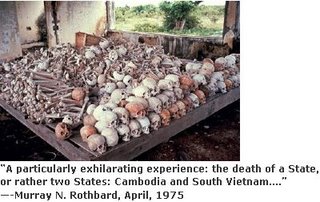
Not just bizarre, then, but disgraceful. This is the man who "rejoiced" at watching what he called “a particularly exhilarating experience: the death of a State, or rather two States: Cambodia and South Vietnam….” You might care to know, as Murray didn't, that between them the deaths of those two states led directly to the deaths of about five million human beings. As Tom Palmer says on this episode"it matters which state replaces which."
It sure does.
As I said at the outset, given the current state of the world and the many very real external threats to human beings from terrorists and Islamists, the difference between being pro-liberty and being anti-state has never held more implications for the future of liberty around the world, and for our civilisation that is based on that liberty.
The anti-state anarchist must of necessity deny the existence of any real threat, and instead simply blames The Warfare State (the repository of all evil) or America ("more warlike than even Nazi Germany") for all the evils that exist. The pro-liberty libertarian however understands that this is nonsensical; that for liberty and civilisation to exist and be maintained, it is right to hunt down the bloodsoaked enemies of liberty and freedom who say they love death and who wish to inflict it on us.
Given the current state of the world then, the difference between being pro-liberty and anti-state may just be the difference between liberty and death.
LINKS: Cue Card Libertarianism - Force - Not PC
Cue Card Libertarianism - Government - Not PC
Cue Card Libertarianism - Constitution - Not PC
Cue Card Libertarianism - Freedom - Not PC
Cue Card Libertarianism - Anarchy - Not PC
Apologetics for 'Death of a State' - Tom Palmer
RELATED: War, Cue Card Libertarianism, Libertarianism, Politics-World, Israel
Pro-liberty libertarians understand that freedom in the political context means freedom from physical coercion, and in order to protect themseves from physical coercion individuals have the right to self-defence, to the use of retaliatory force. In order to bring this use of force under objective control, and to bar the initiation of physical force, governments are a necessity -- agencies, that is, that hold a monopoly on physical force in a given area. The job then is to tie up governments to do just this job, which is the reason constitutions were invented.
In the words of Ayn Rand: "A government is the means of placing the retaliatory use of physical force under objective control." To pro-liberty libertarians, this is the underlying purpose of governments, and the means by which liberty is assured. It is only by this means that the libertarian non-agression principle can be enforced, ie., that no person should initiate force aginst any other.
There are 'anti-government' and 'no-government libertarians' about however: they are more accurately called anarchists, or even anarcho-capitalists -- or as Ayn Rand used to accurately call them, "hippies of the right." Right on. You can find such types at sites such as AntiWar.Com, and LewRockwell.Com -- sites inhabited respectively by pacifists, who renounce the right to national self-defence altogether (it is national self-defence that causes all wars they will tell you), and by antediluvians (who frequently maintain that Abraham Lincoln was a Nazi and that the southern slave states should have won the Civil War).
Anarchism in either form is not pro-liberty; it does not bring force under objective control -- it cannot ensure the universality of the non-agression principle, or of any principle. Instead, at best, it simply sets up a market for competing forms of force.
Such a market can presently be seen in the suburbs and villages of Somalia and Lebanon.
There is one main area in which the difference between pro-liberty libertarians and anti-state anarchists is tragically apparent: Defence. Pro-liberty libertarians realise that to protect their citizens, governments must run credible defence forces that can protect against foreign invasion or interdiction. This is a legitimate role for governments: to uphold as Lindsay Perigo says, "the right to life, to liberty and the pursuit of one's enemies" when those enemies have designs on your life.
Anarchists however just wave their hands around and pretend this isn't necessary. Murray Rothbard for example, the godfather of modern anarcho-capitalism recognised that an anarchist society could not provide such a credible or unified force, and rather than dismissing as absurd his devotion to anarchy, he instead embraced the absurd by arguing it wasn't even necessary.
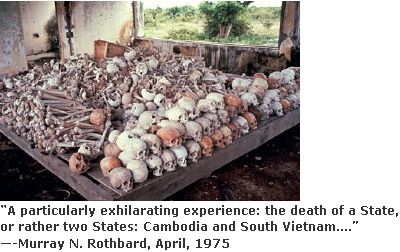 Rothbard's rationalistic devotion to his anti-state views led him to claim -- at the height of the Cold War -- first, that there were "no external threats to the US"; second, that what looked like a clear threat, the Soviet Union, was in fact "devoted to peace"; and third the real villain of the Cold War was in fact the United States, who was "more warlike than even Nazi Germany."
Not just bizarre, then, but disgraceful. This is the man who "rejoiced" at watching what he called “a particularly exhilarating experience: the death of a State, or rather two States: Cambodia and South Vietnam….” You might care to know, as Murray didn't, that between them the deaths of those two states led directly to the deaths of about five million human beings. As Tom Palmer says on this episode"it matters which state replaces which."
It sure does.
As I said at the outset, given the current state of the world and the many very real external threats to human beings from terrorists and Islamists, the difference between being pro-liberty and being anti-state has never held more implications for the future of liberty around the world, and for our civilisation that is based on that liberty.
The anti-state anarchist must of necessity deny the existence of any real threat, and instead simply blames The Warfare State (the repository of all evil) or America ("more warlike than even Nazi Germany") for all the evils that exist. The pro-liberty libertarian however understands that this is nonsensical; that for liberty and civilisation to exist and be maintained, it is right to hunt down the bloodsoaked enemies of liberty and freedom who say they love death and who wish to inflict it on us.
Given the current state of the world then, the difference between being pro-liberty and anti-state may just be the difference between liberty and death.
LINKS: Cue Card Libertarianism - Force - Not PC
Cue Card Libertarianism - Government - Not PC
Cue Card Libertarianism - Constitution - Not PC
Cue Card Libertarianism - Freedom - Not PC
Cue Card Libertarianism - Anarchy - Not PC
Apologetics for 'Death of a State' - Tom Palmer
RELATED: War, Cue Card Libertarianism, Libertarianism, Politics-World, Israel
Millau Viaduct - Michel Virlogeux & Norman Foster
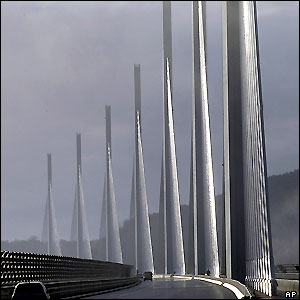
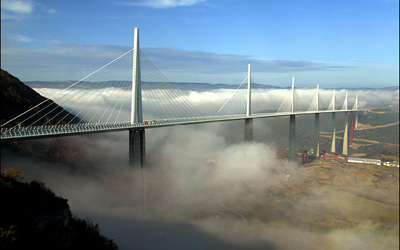 Yep, I've posted pics of this cable-stayed bridge before, but by crikey it's a marvel, and this (erroneously named) Powerpoint presentation here gives you some idea of its contruction.
What an achievement!
LINK: The longest bridge in the world - Metacafe
RELATED: Architecture
Tuesday, 25 July 2006
Return of the Llama
So I didn't notice until a flurry of stats arrived bearing the name 'Llama,' but YES, it's true, troops, the Spitting Llama has been reincarnated, and the Llama has returned with a bang -- quite literally: he's offering 3d Kama Sutra. Don't say he never does 'nuffin for ya.
"Who the **** is Alice?" - Berrymans
Oh Lord!
NZ HERALD: Male lawyer appears in court in women's clothes
UPDATE: The Dom, which I should have linked before, has the 'full story,' and concludes:
LINK: High profile lawyer protests through dress - Dominion Post
RELATED: Berrymans
NZ HERALD: Male lawyer appears in court in women's clothes
Lawyer Rob Moodie turned heads at the High Court in Wellington yesterday when he arrived dressed in a skirt and asked to be called Ms Alice...I'm sure that's just what the Berrymans needed.
Dr Moodie, who wore Kaftans when he was Police Association secretary, said his frustration at the judiciary's handling of the Berryman bridge case had prompted his decision to resume wearing women's clothing.
The case had caused him "to reflect on what it means to be a male in this country. I've decided I don't actually want to be part of that ethos."
UPDATE: The Dom, which I should have linked before, has the 'full story,' and concludes:
...his main motivation was to highlight the injustice suffered by the Berrymans and the judiciary's inability to address it, he said.Well, thank goodness for that at least. But if this is just a protest to get attention for the case, it seems somewhat countr-productive to me. Idiot/Savant disagrees: he reckons the Dom should have ignored the dressing up and "focussed on the allegation... in this day and age, I'd hardly think of it as 'news'." Well, maybe not, but if it ain't news, it ain't useful protest. And if it's news like this, it may not be useful either.
"Two people's lives have been ruined. I will not let this issue go."
LINK: High profile lawyer protests through dress - Dominion Post
RELATED: Berrymans
Israel
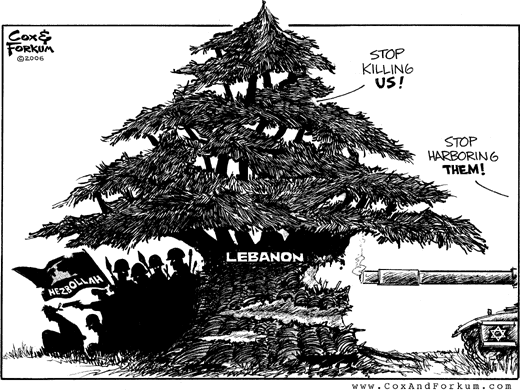 To make it easier for commenters to demonise me properly, I've added an 'Israel' section to My Categories (that's where you go if you click on those 'TAGS' below), so if you want to see and quote back to me all the outrageous and offensive stuff I've been saying or endorsing on this subject (at least all the stuff that I can find, you're welcome to keep digging), here's where you can find it.
Make the most of it.
And the cartoon? Oh, that's simply another gratuitous swip by cartoonists Cox and Forkum at misunderstood Hezbollah warriors who've bravely embedded both themselves and their rocket launchers amidst Lebanese civilians. What heroes.
TAGS: Israel, Blog, Cartoons
Key and Cullen equally mistaken on government spending
The low level of NZ's wages compared to the rest of the world became an issue at the last election, and for many of us -- inclusing especially those New Zealanders currently considering packing up and heading for greener pastures -- it still remains one. At the same time, both the Blue Team and the Red Team were found saying rather silly things about government deficits and government spending last election and since.
Unsurprisingly, the two things are linked. Goverment spending and government deficits both reduce investment and reduce real wages. Of these two, the greatest imposition is government deficits.
On the latter point, Team Red was and still is on the side of spending. Granting tax cuts, said the Red Team, would simply see people "fritter away" the hard-won Cullen Surplus, whereas retaining the loot in Government hands would see it 'invested' wisely. Indeed, As Colin James noted after this year's Budget, "The government wants you to think of [the 2006] Budget as the 'investment Budget.' That's right: spending is investment." According to this view, it is only government spending that constitutes investment -- the rest of us will presumably just use our spare cash to roll up and snort coke off glass-topped tables, while those troublesome journalists insisting on tax cuts for themselves will be using it to wallpaper their smoking rooms.
Meanwhile, Team Blue were on the side of deficits. They were and have continued to insist that tax cuts are absolutely necessary, but unlike libertarians and Alan Greenspan they failed to realise that tax cuts require concomitant spending cuts. Spending cuts are still as unpopular with the Nats as pork at a Muslim wedding, which was the reason Team Blue's John Key was found to be planning a new programme of increased government borrowing to help pay for tax cuts -- excuse me: to help invest in infrastucture. At this legerdemain of course, the ghost of Sir Robert Muldoon was seen to nod approvingly.
Both teams then view government spending as 'investment.' Key compounds the error by viewing government deficits as an investment. Both views are are mistaken. Governments do not 'invest' money, they consume it. Real investment comes from real savings, private savings -- and deficits consume those savings with no real productive return. George Reisman explains:
LINKS: How Government Budget Deficits Reduce Wages and Raise Profits - George Reisman
RELATED: Economics, Politics-NZ, Politics-National
Unsurprisingly, the two things are linked. Goverment spending and government deficits both reduce investment and reduce real wages. Of these two, the greatest imposition is government deficits.
On the latter point, Team Red was and still is on the side of spending. Granting tax cuts, said the Red Team, would simply see people "fritter away" the hard-won Cullen Surplus, whereas retaining the loot in Government hands would see it 'invested' wisely. Indeed, As Colin James noted after this year's Budget, "The government wants you to think of [the 2006] Budget as the 'investment Budget.' That's right: spending is investment." According to this view, it is only government spending that constitutes investment -- the rest of us will presumably just use our spare cash to roll up and snort coke off glass-topped tables, while those troublesome journalists insisting on tax cuts for themselves will be using it to wallpaper their smoking rooms.
Meanwhile, Team Blue were on the side of deficits. They were and have continued to insist that tax cuts are absolutely necessary, but unlike libertarians and Alan Greenspan they failed to realise that tax cuts require concomitant spending cuts. Spending cuts are still as unpopular with the Nats as pork at a Muslim wedding, which was the reason Team Blue's John Key was found to be planning a new programme of increased government borrowing to help pay for tax cuts -- excuse me: to help invest in infrastucture. At this legerdemain of course, the ghost of Sir Robert Muldoon was seen to nod approvingly.
Both teams then view government spending as 'investment.' Key compounds the error by viewing government deficits as an investment. Both views are are mistaken. Governments do not 'invest' money, they consume it. Real investment comes from real savings, private savings -- and deficits consume those savings with no real productive return. George Reisman explains:
Government budget deficits are financed partly by the creation of new and additional money. But for the rest, they are financed by selling government securities to the citizens, who pay for the securities with money that already exists and which is part of their savings. If the government had not been running at a deficit and had not needed to sell these securities, the citizens would have used most of the savings with which they buy the government securities to buy corporate securities and in other ways to make their funds available to business firms.And that's not all. Because of the large welfare-state component of government spending, most of this borrowing is not used on production, but on consumption.
Those savings, in the hands of business firms would have been used to purchase capital goods and to pay wages. These wages, however, never come into existence if the savings out of which they would have been paid are diverted to the government to finance its deficit. Thus, wage payments in the economic system are smaller because of government deficits.
Yes, it is true that the government itself pays wages to some extent. But it is unlikely to do so to the same extent as do business firms. And to whatever extent the additional wage payments it makes out of the proceeds of its securities sales are less than the wage payments that business firms cannot make because of the diversion of part of what would have been their capital funds to the government, total wage payments in the economic system are reduced.
A part of the output of the economic system that would have gone into the production of future output is instead diverted to the government’s consumption and to the consumption of those to whom the government gives money.By taking the private capital that is needed to produce future capital and future output, both deficits and high government spending reduce capital investment, making labour less productive and the country produce less than would have been produced otherwise. The result is (amongst other theings) a loss in real wages, which continues to make the country the low-wage, fifth-of-an-acre pavlova paradise it has become.
The effect of this cannot fail to be that the productivity of labor in the economic system will be less than it otherwise would have been and that real wages in the future will consequently suffer from production being less than it otherwise would have been and thus from prices being higher than they otherwise would have been.
LINKS: How Government Budget Deficits Reduce Wages and Raise Profits - George Reisman
RELATED: Economics, Politics-NZ, Politics-National
Millard House - Frank Lloyd Wright, 1923
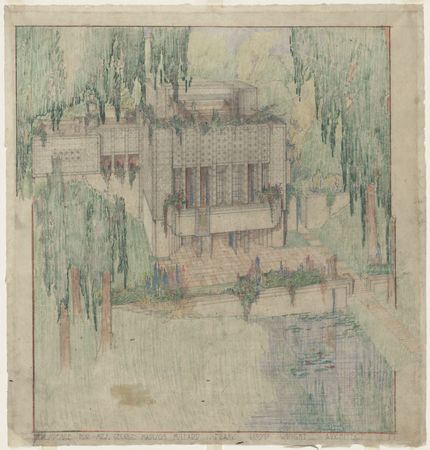
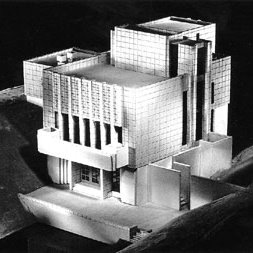 The Millard House in Pasadena, California -- dubbed 'La Miniatura.'
This was one of a clutch of textile concrete block houses designed by Wright for California.
RELATED: Architecture
Monday, 24 July 2006
McCain-Espiner deal sewn up
"TV reporter Guyon Espiner has sewn up a free trade agreement with the USA," says the 'Kiwi Herald.'
LINKS: US free trade deal is sealed - Kiwi Herald
RELATED: Humour, Politics-NZ
TV One current affairs boss Bill Ralston told the Herald that the free trade deal was a real coup. "At the moment the deal is only between Guyon and the US but its a foot in the door. We are confident that gradually the US will extend the deal to include other TV One staff and their families."Good satire. [I needed just to say that for those of you who need a pointer when a post is satirical.]
LINKS: US free trade deal is sealed - Kiwi Herald
RELATED: Humour, Politics-NZ
Objectivism & Libertarianism
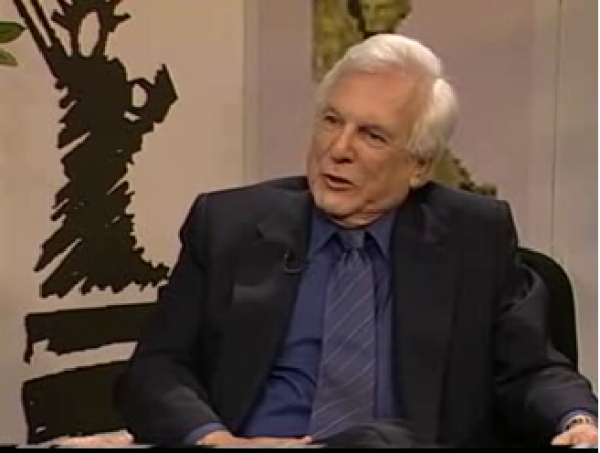 Here's the sort of thing you'll never see in the mainstream media: A twenty-five minute interview with author and psychologist Nathanial Branden, expounding (briefly) on his time with Ayn Rand, the foundations of the US Libertarian Party, which books changed more Americans' lives than any other, who is most valuable for society -- Mother Theresa for example, or Ernst Moller ("who?" I hear you ask) -- and concludes with some things libertarians often do wrong.
Whatever your estimate of Nathaniel Branden (and mine is not awfully high), it's good intelligent television, and available right here at Google Video.
LINK: The Libertarian Alternative - Ayn Rand and Objectivism - interview with Nathaniel Branden [Hat tip SOLO]
RELATED SUBJECTS: Libertarianism, Objectivism, Economics, Books
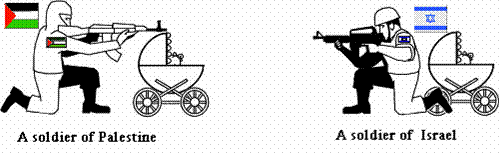
Moral equivalence inducement to war
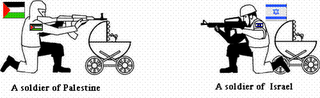
MORAL EQUIVALENCE: the position whereby those who initiate force and those who defend themselves against that initiation are considered morally equal.
A position equivalent to a parent who treats a bully the same as a child being bullied.
A position easily taken here in New Zealand at the distance of twelve-thousand benign strategic miles, with the luxury of not having Katyusha rockets raining down on us and enemies permanently at our gates who have expressed for fifty years their desire to drive us into the sea.
A position of appeasement that rewards the aggressor, punishes the defender, and refuses to see any difference between the two.
Peace cannot be achieved in the Middle East as long as individuals there continue to see themselves only as part of some tribal entity or collective. It will not be achieved as long as 'the world community' condemns Israel for defending itself, but fails to condemn those, like Hezbollah and its masters in Syria and Iran, who define themselves chiefly by their aim of exterminating Israelis. It will not be achieved as long as 'peace' is imposed without justice. It will not be achieved without a permanent cessation of Arab violence and permanent outrage at its rebirth.-- it will never last as long as entities exist that declare they intend to exterminate Israel and drive its citizens into the sea.
 There are dangers in defending oneself, that for example a war of defence will radicalise new oppononents. There are heart-breaking tragedies that result. But what else can one do when rockets are falling on your cities, fired from sites intentionally embedded in civilian areas, and when no-one else is either condemning or even lifting a finger to stop those firing and supplying those rockets? There are those who say Israel should work with 'moderates' among those who fire rockets at them and send out suicide bombers to blow themselves up in the buses and restaurants of Israel. As Tel Aviv professor Barry Rubin pointed out, however, the problem is that "a Palestinian moderate [and presumably a Hezbollah apologist] ... can usually be defined as someone who apologizes for terrorism in good English."
At the end of the day, those responsible for the present tragedies are not those defending themselves from rocket attack . They are those who have initiated force from the 'defensive positions' of teeming civilian areas. The destruction and heartbreak are the direct result of those who fired the first rockets and who continue to fire them, knowing full well what the response had and has to be.
Only those who accept the principle of moral equivalance could fail to condemn the initiators of force, while noisily condemning those defending their citizens. Failure to condemn is an act of moral blindness, and an invitation for the same thing to happen again in future.
UPDATE 1: I just heard a good, combative interview from Naftali Tamir, Israel's ambassador to NZ, on National Radio, followed by the usual flatulent pro-terror apologetics from Richard Fisk. The audio from both is up now.
UPDATE 2: If you want to challenge yourself, you could download and print off a ten-page PDF 'In Moral Defence of Israel' produced by the Ayn Rand Institute back in 2002. "We hold, it begins, "that the state of Israel has a moral right to exist and to defend itself against attack...
LINKS: Cue Card Libertarianism - War: What is it good for? - Not PC (Peter Cresswell)
Cue Card Libertarianism - Force - Not PC (Peter Cresswell)
In moral defence of Israel - Ayn Rand Institute [10-page PDF, 2002]
In moral defence of Israel - Ayn Rand Institute [collection of web-based articles]
MORE ON THESE SUBJECTS: War, Politics-World, Ethics
Cartoon hat tip Samizdata. For "a soldier of Palestine" you may also read "a soldier of Hezbollah."
A position equivalent to a parent who treats a bully the same as a child being bullied.
A position easily taken here in New Zealand at the distance of twelve-thousand benign strategic miles, with the luxury of not having Katyusha rockets raining down on us and enemies permanently at our gates who have expressed for fifty years their desire to drive us into the sea.
A position of appeasement that rewards the aggressor, punishes the defender, and refuses to see any difference between the two.
Peace cannot be achieved in the Middle East as long as individuals there continue to see themselves only as part of some tribal entity or collective. It will not be achieved as long as 'the world community' condemns Israel for defending itself, but fails to condemn those, like Hezbollah and its masters in Syria and Iran, who define themselves chiefly by their aim of exterminating Israelis. It will not be achieved as long as 'peace' is imposed without justice. It will not be achieved without a permanent cessation of Arab violence and permanent outrage at its rebirth.-- it will never last as long as entities exist that declare they intend to exterminate Israel and drive its citizens into the sea.
 There are dangers in defending oneself, that for example a war of defence will radicalise new oppononents. There are heart-breaking tragedies that result. But what else can one do when rockets are falling on your cities, fired from sites intentionally embedded in civilian areas, and when no-one else is either condemning or even lifting a finger to stop those firing and supplying those rockets? There are those who say Israel should work with 'moderates' among those who fire rockets at them and send out suicide bombers to blow themselves up in the buses and restaurants of Israel. As Tel Aviv professor Barry Rubin pointed out, however, the problem is that "a Palestinian moderate [and presumably a Hezbollah apologist] ... can usually be defined as someone who apologizes for terrorism in good English."
At the end of the day, those responsible for the present tragedies are not those defending themselves from rocket attack . They are those who have initiated force from the 'defensive positions' of teeming civilian areas. The destruction and heartbreak are the direct result of those who fired the first rockets and who continue to fire them, knowing full well what the response had and has to be.
Only those who accept the principle of moral equivalance could fail to condemn the initiators of force, while noisily condemning those defending their citizens. Failure to condemn is an act of moral blindness, and an invitation for the same thing to happen again in future.
UPDATE 1: I just heard a good, combative interview from Naftali Tamir, Israel's ambassador to NZ, on National Radio, followed by the usual flatulent pro-terror apologetics from Richard Fisk. The audio from both is up now.
UPDATE 2: If you want to challenge yourself, you could download and print off a ten-page PDF 'In Moral Defence of Israel' produced by the Ayn Rand Institute back in 2002. "We hold, it begins, "that the state of Israel has a moral right to exist and to defend itself against attack...
Israel and those who attack it are not moral equals. Israel is a free, Westernized country, which recognizes the individual rights of its citizens... It uses military force only in self-defence, in order to protect itself.Nothing substantive has changed since 2002 for this analysis except of course for Arafat's death, and the analysis becoming all the more pertinent through recent events. I highly recommend this and related articles as a good thought-provoking moral purge.
Those attacking Israel, by contrast, are terrorist organizations, theocracies, dictatorships and would-be dictators...
Fundamentally, Israel is the target of those organizations and regimes precisely because of its virtues: it is an oasis of freedom and prosperity in a desert of tyrany and stagnation...
This is not an ethnic battle between Jews and Arabs. but a moral battle between those who value the individual's right to be free and those who don't. Those Arabs who value individual freedom are enemies of the [former] Arafat regime [and also of Hezbollah and its allies] and deserve to be embraced by Israel; those Jews who do not value individual freedom deserve to be condemned by Israel.
LINKS: Cue Card Libertarianism - War: What is it good for? - Not PC (Peter Cresswell)
Cue Card Libertarianism - Force - Not PC (Peter Cresswell)
In moral defence of Israel - Ayn Rand Institute [10-page PDF, 2002]
In moral defence of Israel - Ayn Rand Institute [collection of web-based articles]
MORE ON THESE SUBJECTS: War, Politics-World, Ethics
Cartoon hat tip Samizdata. For "a soldier of Palestine" you may also read "a soldier of Hezbollah."
No 'me-tooism' from The Don
Good stuff from Don Brash at the National Party conference over the weekend:
LINKS: Leader's speech to annual conference - Kiwiblog
MORE ON THIS SUBJECT: Politics-National, Politics-NZ
There are always those who believe the only way we can win the Treasury benches is by trying to 'out-Labour Labour.' If Labour wins office by taking $25,000 in tax off a successful hardworking Kiwi and bribing five voters with $5,000 each, perhaps National has to 'up' the stakes, and take $30,000 in tax off a successful hardworking Kiwi and bribe five voters with $6,000 each or six voters with $5,000 each?That means, I hope, no more 'mee-tooism' from The Don. I trust Nick Smith and Murray McCully were listening.
But that way surely lies disaster. Not only do we erode the spirit of personal responsibility and self-reliance on which this great country was built, but ultimately those who are more and more heavily taxed to finance the political bribes decide they've paid enough, and either arrange their affairs so they can substantially avoid tax or leave for places where they can pay much less tax. And of course plenty of affluent New Zealanders have done exactly that.
LINKS: Leader's speech to annual conference - Kiwiblog
MORE ON THIS SUBJECT: Politics-National, Politics-NZ
Saturday, 22 July 2006
"Destroy the infidel - but get me out of here first!"
Perry at Samizdata has spotted a doozy:
TAGS: War, Religion, Politics-World
Omar Bakri Mohammed, the Islamic preacher thrown out of Britain for inciting Muslims to violence and calling for the Islamisation of the UK (quote: "The life of an unbeliever has no value, it has no sanctity"), wants the Royal Navy to evacuate him from the fighting in Lebanon. So he hates the UK but wants it to come to his rescue?
The Jews have a good expression expression for this: chutzpah.
Well spotted, and a comment that's right on the money: a good demonstration perhaps of how evil is always and of necessity parasitic on the good.
TAGS: War, Religion, Politics-World
Chinese rice tipping point for GE
 China is "on the verge of a decision that historians eventually may interpret as a tipping point in the global debate over genetically modified food," says Dean Kleckner of Truth about Trade and Technology.
No doubt the decision will also nettle the type of environmentalist that Charlie Pedersen was criticising.
The 'tipping point' about which he speaks and which will have deep ecologists and their fellow travellers choking on their muesli is the imminent approval by Beijing of the planting and commercial sale of genetically modified rice. The motive for the decision is clear enough:
A recent study by a team of Chinese and American scientists revealed that the use of biotech rice reduced pesticide costs by 80 percent. “We estimate that if 90 percent of the farmers plant GM rice, then the annual agricultural income of China will increase by $4 billion,” said Huang Jukun, director of the Agriculture Policy Research Center at the Chinese Academy of Sciences. .And if China gets it, that means the rest of the world won't be far behind. Read the whole article here.
Around the world, GM crops are becoming more popular. No country that has allowed access to this technology has subsequently turned its back on biotech, in what we might label an “untipping point.”
To be sure, a number of European nations continue to hold out against GMOs. Yet they are becoming increasingly isolated, and China’s forthcoming decision will highlight their detachment. You certainly don’t need to crack open a fortune cookie to predict the future of rice farming in China: Farmers want it, and they will get it.
LINK: Biotech tipping point - Dean Kleckner, Truth about Trade and Technology
MORE ON THESE SUBJECTS: GE, Environment, Politics-World
Friday, 21 July 2006
Immigration and the Statue of Bigotry
At the foot of the Statue of Liberty, a gift from nineteenth-century France to nineteenth-century America, Emma Lazarus's poem The New Colossus sums up what the statue symbolised for the immigrants who helped build America:  . . .
. . .

 Fortunately, most of the facts and arguments thereon have been summarised in a series of articles in the current Reason magazine (right) -- "Reason's guide to reality-based reform" -- and in the latest Free Radical magazine (left). The list of articles is below with the main arguments summarised above. All the articles relate to American immigration, but there is no good reason to think anything but the same or similar facts would be uncovered in NZ should someone be willing to look with more than one eye.
LINKS:
The New Colossus (1883) - US Department of State
Is the NZ Immigration review repressive - Katie Small, Scoop (May, 2006)
FOR MORE ON THESE SUBJECTS: Immigration, Politics-US, Economics, Politics-NZ
 . . .
. . . From her beacon-hand Glows world-wide welcome; her mild eyes commandThat lamp is in the process of being snuffed out by people who today can find no two words to better describe those huddled masses yearning to breathe free than "illegal immigrant." They seek to turn Lazarus's Colossus of Liberty into something else, something evocatively described by Lou Reed:
The air-bridged harbor that twin cities frame.
"Keep, ancient lands, your storied pomp!" cries she With silent lips. "Give me your tired, your poor,
Your huddled masses yearning to breathe free,
The wretched refuse of your teeming shore.
Send these, the homeless, tempest-tost to me, I lift my lamp beside the golden door!"
Give me your hungry, your tired your poorBoth here in NZ and in the US, immigration proposals now on the table look to snuff out that lamp beside the golden door, and to piss on those poor huddled masses. But as former Fox commentator (and now President Bush's press secretary) Tony Snow says,
I'll piss on 'em
That's what the Statue of Bigotry says
Your poor huddled masses, let's club 'em to death
And get it over with and just dump 'em on the boulevard...
Immigration is not the pox neo-Know Nothings make it out to be... Before someone razes Lady Liberty and decides to erect a wall to "protect" America from the world, shouldn't we at least spend a little time trying to get our facts straight?Yes. We should. I suspect however that those of you more inclined to favour the Statue of Bigotry approach will already be putting on their eye-patches and heading for that comments button. Meanwhile, the rest of us can consider some of those facts.
Fortunately, most of the facts and arguments thereon have been summarised in a series of articles in the current Reason magazine (right) -- "Reason's guide to reality-based reform" -- and in the latest Free Radical magazine (left). The list of articles is below with the main arguments summarised above. All the articles relate to American immigration, but there is no good reason to think anything but the same or similar facts would be uncovered in NZ should someone be willing to look with more than one eye. - Immigrants are not flocking to the States to mooch off the government.
- 'Illegals' are not milking the government; if anything it is the other way around. The National Research Council found for example that most immigrant families "contribute an average of $80,000 more to federal coffers than they consume over their lifetimes."
- Immigrants generally earn more than they receive.
- More than 60% of illegals -- illegals -- pay income tax, and two-thirds kick in to Social Security (even if they do often get nothing back).
- Immigrants help sustain economic growth and cultural dynamism.
- Even economists who favour restrictive immigration policies admit low-skilled immigrants are a net plus to the economy.
- "Government intervention into the economic system breeds later intervention. Here the application of his principle is, start with the Welfare State, end with the Police State. A police state is what is required effectively to stop substantial illegal immigration that has become a major burden because of the Welfare State." - George Reisman
- Immigrants "are generally less involved in crime than similarly situated groups," and crime rates in border towns "are lower than those of comparable non-border cities."
- Crime rates in the highest-immigration states have been trending significanty downward.
- There's no reason that the North American Free Trade Agreement (or NZ's own free trade agreements) shouldn't apply equally to people as to widgets.
- Unemployment is low and crime is down everywhere, especially in places teeming with immigrants.
- Google, Yahoo! and Sun Microsystems were all founded by immigrants.
- Immigrants are more likely than 'natives' to be self-employed.
- "Sometimes what looks like lousy conditions to us are the best option an employee has... But sometimes the only reason those conditions are the least bad choice is available is because the other possibilities have been cut off by legal fiat. I'm referring not just to illegal immigrants, who for obvious reasons have little recourse if defrauded or enslaved, but to guest workers, who come here under strict rules that prevent them from changing jobs, let alone striking out on their own." - Jesse Walker. [Take note Phillip Field bashers]
- Immigrants tend to create their own work -- when they're allowed to.
- The power and reach of Spanish-language media in L.A. for example shows supply of productive people creating its own demand.
- Immigrant labour makes work easier for all of us, and brings new skills to the table.
- Immigrants and low-skilled American workers fill very different roles in the economy.
- Immigrant labour makes all businesses easier to start, thus spurring 'native' creativity.
- "Some argue that we should employ a more restrictive policy that allows in only immigrants with 'needed' skills. But this assumes the government can read economic tea leaves." - Tyler Cowen and Daniel M. Rothschild
- New arrivals, by producing more goods and services, keep prices down across the economy -- the net gain to US from immigration is about $7 billion a year.
- Even in the halls of Congress, economic arguments against immigration are losing their aura of truthfulness, so pro-enforcement types are focussing on national security.
- "The only way to actually prevent terrorists from slipping in is to legalize as much 'illegal immigration' as possible. If one is looking for a needle in a haystack, as the saying goes, one has a hell of job. Finding that needle on a relatively clean floor, however, presents an achievable goal." - James Valliant
- Immigration is good for the immigrants themselves.
How about a little common sense on immigration - Tony SnowAnd of course there are the two classic Harry Binswanger articles which are 'must-reads' for the moral and practical case behind open immigration (note, open immigration, not open borders.):
Immigration plus Welfare State equals Police State - George Reisman
Immigration and the Welfare State - the real root of the problem - Brian Doherty
Who's milking who? - illegal aliens pay more in taxes than they impose in costs - Shikha Dalmia
Don't bad-mouth unskilled immigrants - Tyler Cowen & Daniel M. Rothschild
Exploitation or expulsion - illegal immigrants in a double bind - Jesse Walker
Fighting terrorism requires legalizing immigration - James Valliant
Worse than a wall - Kerry Howley
A legacy of the unforeseen - Carolyn Lochhead
Breathe free, huddled masses - Cathy Young
Open the borders - why should citizens of NAFTA countries need visas at all - Tim Cavanagh
Bush's border bravado - non-militarized solutions to a non-problem - Nick Gillespie
Open immigration, Si! Open borders, No! - Sixth Column
The solution to 'illegal immigration' - Harry BinswangerThere. That should give you plenty of weekend reading. And if you'd rather read all this in print form, then head here or to Borders to buy a single copy of Reason, and head to any good newsagent (or here for a single PDF copy) for The Free Radical.
Immigration Quotas vs. Individual Rights: The Moral and Practical Case for Open Immigration - Harry Binswanger
LINKS:
The New Colossus (1883) - US Department of State
Is the NZ Immigration review repressive - Katie Small, Scoop (May, 2006)
FOR MORE ON THESE SUBJECTS: Immigration, Politics-US, Economics, Politics-NZ
Subscribe to:
Posts (Atom)